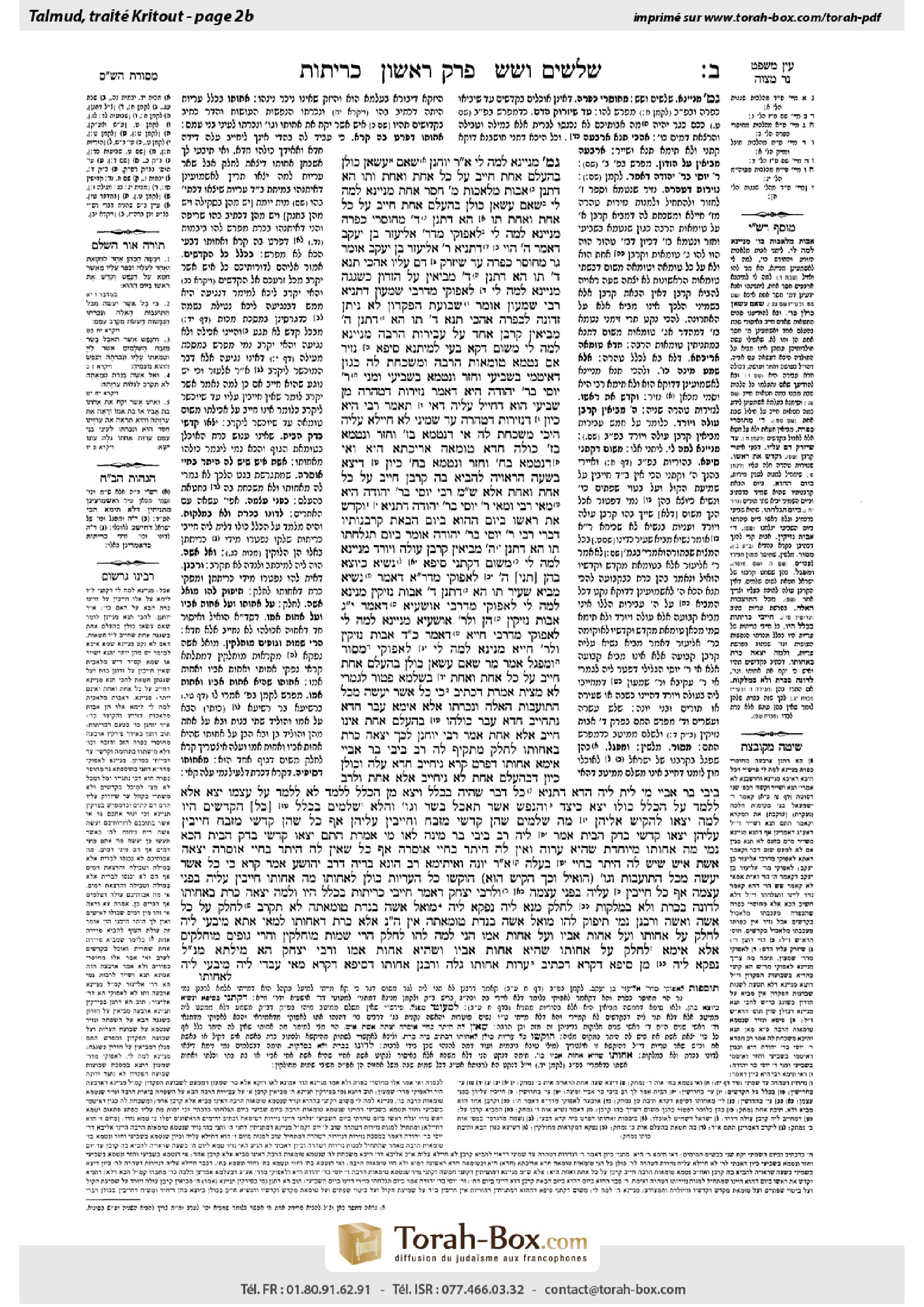
Keritot 2b: Talmud study for Daf Yomi
Daf Yomi is the daily study of one Talmud folio. Explore 37 tractates with scans, Hebrew text, Sefaria English and AI-generated French translations where annotated.
Passage selection and English or AI-generated French translation are available where the scan has annotations. Daf Study is independent of Torah-Box and Sefaria.
Browse Keritot · כריתות · All tractatesKeritot 2b text and translations
This page of Keritot includes the Aramaic text, an English translation and an AI-generated French translation, alongside the scan above.
כריתות ב׳ ב · Aramaic and Hebrew text
גְּמָ׳ מִנְיָינָא לְמָה לִי? אָמַר רַבִּי יוֹחָנָן: שֶׁאִם עֲשָׂאָן כּוּלָּן בְּהֶעְלֵם אַחַת – חַיָּיב עַל כׇּל אַחַת וְאַחַת.
וְתוּ, הָא דִּתְנַן: אֲבוֹת מְלָאכוֹת אַרְבָּעִים חָסֵר אַחַת, מִנְיָינָא לְמָה לִי? שֶׁאִם עֲשָׂאָן כּוּלָּן בְּהֶעְלֵם אַחַת – חַיָּיב עַל כׇּל אַחַת וְאַחַת.
תּוּ, הָא דִּתְנַן: אַרְבָּעָה מְחוּסְּרֵי כַּפָּרָה, מִנְיָינָא לְמָה לִי?
לְאַפּוֹקֵי מִדְּרַבִּי אֱלִיעֶזֶר בֶּן יַעֲקֹב, דְּאָמַר: חֲמִשָּׁה הָוֵי, דְּתַנְיָא, רַבִּי אֱלִיעֶזֶר בֶּן יַעֲקֹב אוֹמֵר: גֵּר מְחוּסַּר כַּפָּרָה עַד שֶׁיִּזָּרֵק דָּם עָלָיו, אַהָכִי תְּנָא אַרְבָּעָה.
תּוּ, הָא דִּתְנַן: אַרְבָּעָה מְבִיאִין עַל הַזָּדוֹן כִּשְׁגָגָה, מִנְיָינָא לְמָה לִי?
לְאַפּוֹקֵי מִדְּרַבִּי שִׁמְעוֹן, דְּתַנְיָא, רַבִּי שִׁמְעוֹן אוֹמֵר: שְׁבוּעַת הַפִּקָּדוֹן – לֹא נִיתָּן זְדוֹנָהּ לְכַפָּרָה, אַהָכִי תְּנָא אַרְבָּעָה.
תּוּ, הָא דִּתְנַן: חֲמִשָּׁה מְבִיאִין קׇרְבָּן אֶחָד עַל עֲבֵירוֹת הַרְבֵּה, מִנְיָינָא לְמָה לִי?
מִשּׁוּם דְּקָא בָּעֵי לְמִיתְנָא סֵיפָא: נָזִיר אִם נִטְמָא טוּמְאוֹת הַרְבֵּה, וּמַשְׁכַּחַתְּ לַהּ כְּגוֹן דְּאִיטַּמִּי בִּשְׁבִיעִי וְחָזַר וְנִטְמָא בַּשְּׁבִיעִי, וּמַנִּי? רַבִּי יוֹסֵי בְּרַבִּי יְהוּדָה הִיא, דְּאָמַר: נְזִירוּת דְּטָהֲרָה, מִן שְׁבִיעִי הוּא דְּחָיֵיל עֲלֵיהּ.
דְּאִי תֵּאמַר רַבִּי הִיא, כֵּיוָן דִּנְזִירוּת דְּטׇהֳרָה עַד שְׁמִינִי לָא חָיְילָא עֲלֵיהּ, הֵיכִי מַשְׁכַּחַתְּ לַהּ?
אִי דְּנִטְמָא בִּשְׁבִיעִי וְחָזַר וְנִטְמָא בִּשְׁבִיעִי – כּוּלַּהּ חֲדָא טוּמְאָה אֲרִיכְתָּא הִיא.
וְאִי דְּנִטְמָא בַּשְּׁמִינִי וְחָזַר וְנִטְמָא בַּשְּׁמִינִי, כֵּיוָן דְּיָצָא בְּשָׁעָה הָרְאוּיָה לְהָבִיא בָּהּ קׇרְבָּן, חַיָּיב עַל כׇּל אַחַת וְאַחַת! אֶלָּא שְׁמַע מִינַּהּ רַבִּי יוֹסֵי בְּרַבִּי יְהוּדָה הִיא.
מַאי רַבִּי וּמַאי רַבִּי יוֹסֵי בְּרַבִּי יְהוּדָה? דְּתַנְיָא: ״וְקִדַּשׁ אֶת רֹאשׁוֹ בַּיּוֹם הַהוּא״ – בְּיוֹם הֲבָאַת קׇרְבְּנוֹתָיו, דִּבְרֵי רַבִּי. רַבִּי יוֹסֵי בְּרַבִּי יְהוּדָה אוֹמֵר: בְּיוֹם תִּגְלַחְתּוֹ.
תּוּ, הָא דִּתְנַן: חֲמִשָּׁה מְבִיאִין קׇרְבַּן עוֹלֶה וְיוֹרֵד, מִנְיָינָא לְמָה לִי?
מִשּׁוּם דְּקָתָנֵי סֵיפָא: נָשִׂיא כַּיּוֹצֵא בָּהֶן. חֲמִשָּׁה לְאַפּוֹקֵי מִדְּרַבִּי אֱלִיעֶזֶר, דְּאָמַר: נָשִׂיא מֵבִיא שָׂעִיר.
תּוּ, הָא דִּתְנַן: אַרְבָּעָה אֲבוֹת נְזִיקִין, מִנְיָנָא לְמָה לִי?
לְאַפּוֹקֵי מִדְּרַבִּי אוֹשַׁעְיָא, דְּאָמַר: שְׁלֹשָׁה עָשָׂר אֲבוֹת נְזִיקִין הֵן. וּלְרַבִּי אוֹשַׁעְיָא, מִנְיָינָא לְמָה לִי? לְאַפּוֹקֵי מִדְּרַבִּי חִיָּיא, דְּאָמַר: עֶשְׂרִים וְאַרְבָּעָה אֲבוֹת נְזִיקִין. וּלְרַבִּי חִיָּיא מִנְיָנָא לְמָה לִי? לְאַפּוֹקֵי מָסוֹר וּמְפַגֵּל.
אָמַר מָר: שֶׁאִם עֲשָׂאָן כּוּלָּן בְּהֶעְלֵם אַחַת – חַיָּיב עַל כׇּל אַחַת וְאַחַת.
בִּשְׁלָמָא פָּטוּר לִגְמָרֵי לָא מָצֵית אָמְרַתְּ, דִּכְתִיב: ״כִּי כׇּל אֲשֶׁר יַעֲשֶׂה מִכֹּל הַתּוֹעֵבֹת הָאֵלֶּה וְנִכְרְתוּ״. אֶלָּא אֵימָא: עֲבַר חֲדָא – נִתְחַיֵּיב חֲדָא, עֲבַר כּוּלְּהוּ בְּהֶעְלֵם אַחַת – אֵינוֹ חַיָּיב אֶלָּא אַחַת!
אָמַר רַבִּי יוֹחָנָן: לְכָךְ יָצְאָה כָּרֵת בַּאֲחוֹתוֹ – לְחַלֵּק.
מַתְקֵיף לַהּ רַב בִּיבִי בַּר אַבָּיֵי, אֵימָא: אֲחוֹתוֹ דִּפְרַט קְרָא – נִיחַיַּיב חֲדָא עֲלַהּ, וְכוּלָּן כֵּיוָן דִּבְהֶעְלֵם אַחַת – לָא נִיחַיַּיב אֶלָּא אַחַת!
וּלְרַב בִּיבִי בַּר אַבָּיֵי, מִי לֵית לֵיהּ הֲדָא דְּתַנְיָא: כׇּל דָּבָר שֶׁהָיָה בַּכְּלָל וְיָצָא מִן הַכְּלָל לְלַמֵּד, לֹא לְלַמֵּד עַל עַצְמוֹ יָצָא אֶלָּא לְלַמֵּד עַל הַכְּלָל כּוּלּוֹ יָצָא.
כֵּיצַד? ״וְהַנֶּפֶשׁ אֲשֶׁר תֹּאכַל בָּשָׂר וְגוֹ׳״, וַהֲלֹא שְׁלָמִים בִּכְלָל הַקֳּדָשִׁים הָיוּ. לָמָּה יָצְאוּ?
לְהַקִּישׁ אֲלֵיהֶן: מָה שְּׁלָמִים שֶׁהֵן קׇדְשֵׁי מִזְבֵּחַ וְחַיָּיבִין עֲלֵיהֶן – אַף כׇּל שֶׁהֵן קׇדְשֵׁי מִזְבֵּחַ חַיָּיבִין עֲלֵיהֶן, יָצְאוּ קׇדְשֵׁי בֶּדֶק הַבַּיִת!
אֲמַר לֵיהּ רַב בִּיבִי: בַּר מִינַּהּ. לָאו מִי אָמְרַתְּ הָתָם יָצְאוּ קׇדְשֵׁי בֶּדֶק הַבַּיִת?
הָכָא נָמֵי: מָה אֲחוֹתוֹ מְיוּחֶדֶת שֶׁהִיא עֶרְוָה וְאֵין לָהּ הֶיתֵּר בְּחַיֵּי אוֹסְרָהּ, אַף כֹּל שֶׁאֵין לָהּ הֶיתֵּר בְּחַיֵּי אוֹסְרָהּ, יָצְאָה אֵשֶׁת אִישׁ, שֶׁיֵּשׁ לָהּ הֶיתֵּר בְּחַיֵּי בַעֲלָהּ!
אָמַר רַבִּי יוֹנָה וְאִיתֵּימָא רַב הוּנָא בְּרֵיהּ דְּרַב יְהוֹשֻׁעַ, אָמַר קְרָא: ״כִּי כׇּל אֲשֶׁר יַעֲשֶׂה מִכֹּל הַתּוֹעֵבֹת וְגוֹ׳״, הוֹאִיל וְכָךְ הִקִּישׁ הוּא, הוּקְשׁוּ כׇּל הָעֲרָיוֹת כּוּלָּן לַאֲחוֹתוֹ: מָה אֲחוֹתוֹ חַיָּיבִין עָלֶיהָ בִּפְנֵי עַצְמָהּ, אַף כֹּל חַיָּיבִין עָלֶיהָ בִּפְנֵי עַצְמָהּ.
וּלְרַבִּי יִצְחָק דְּאָמַר: חַיָּיבֵי כָרֵיתוֹת בִּכְלָל הָיוּ, וְלָמָּה יָצְאָה כָּרֵת בַּאֲחוֹתוֹ – לְדוּנָהּ בְּכָרֵת וְלֹא בְּמַלְקוֹת,
לְחַלֵּק מְנָא לֵיהּ? נָפְקָא לֵיהּ מִ״וְּאֶל אִשָּׁה בְּנִדַּת טוּמְאָתָהּ לֹא תִקְרַב״ – לְחַלֵּק עַל כׇּל אִשָּׁה וְאִשָּׁה.
וְרַבָּנַן נָמֵי, תִּיפּוֹק לְהוּ מִ״וְּאֶל אִשָּׁה בְּנִדַּת טוּמְאָתָהּ״! אִין הָכִי נָמֵי. אֶלָּא כָּרֵת דַּאֲחוֹתוֹ לְמַאי אָתָא? מִיבְּעֵי לֵיהּ לְחַלֵּק עַל אֲחוֹתוֹ וְעַל אֲחוֹת אָבִיו וְעַל אֲחוֹת אִמּוֹ.
הָנֵי לְמָה לְהוּ לְחַלֵּק? הֲרֵי שֵׁמוֹת מוּחְלָקִין וַהֲרֵי גּוּפִים מוּחְלָקִים! אֶלָּא אֵימָא: לְחַלֵּק עַל אֲחוֹתוֹ שֶׁהִיא אֲחוֹת אָבִיו וְשֶׁהִיא אֲחוֹת אִמּוֹ.
וְרַבִּי יִצְחָק, הָא מִילְּתָא מְנָא לֵיהּ? נָפְקָא לֵיהּ מִן סֵיפָא דִּקְרָא, דִּכְתִיב: ״עֶרְוַת אֲחֹתוֹ גִּלָּה״.
וְרַבָּנַן, ״אֲחֹתוֹ״ דְּסֵיפָא דִּקְרָא מַאי עָבְדִי לֵיהּ? מִיבְּעֵי לֵיהּ
Keritot 2b · English translation
GEMARA: The Gemara asks: Why do I need the mishna to state this tally of cases where one who performs the action is liable to receive karet? Why does it state a number? All thirty-six are listed in the mishna, and one could simply count them to discover how many there are. Rabbi Yoḥanan said: By listing the tally, the mishna is teaching that if one performed all of them in the course of one lapse of awareness, he is liable to receive punishment for each and every one, i.e., to bring thirty-six sin offerings.
The Gemara asks: And furthermore, with regard to that which we learned in a mishna (Shabbat 73a): The primary categories of labor are forty-less-one; why do I need this tally of forty-less-one? The Gemara answers: By listing the tally the mishna is teaching that if one performed all of the prohibited labors in one lapse of awareness during which he was unaware of the prohibition involved, he is liable to bring a sin offering for each and every one.
The Gemara asks: And furthermore, with regard to that which we learned in a mishna (8b): There are four people who have not yet brought an atonement offering to complete their purification process and may not eat sacrificial meat until they bring the requisite offerings. The mishna then teaches: And these are the people who have not yet brought an atonement offering: The zav, and the zava, and the woman after childbirth, and the leper. Why do I need this tally of four?
The Gemara answers: By listing the tally, the mishna serves to exclude the opinion of Rabbi Eliezer ben Ya’akov, who says there are five such individuals. As it is taught in a baraita that Rabbi Eliezer ben Ya’akov says: A convert is also one who has not yet brought an atonement offering and he may not partake of sacrificial meat, although he was circumcised and immersed in a ritual bath, until the priest sprinkles the blood of his offering on the altar on his behalf. It is for this reason that the mishna teaches four, to emphasize that there are not five such people.
The Gemara asks: And furthermore, with regard to that which we learned in that same mishna (8b): And there are four who bring an offering for the intentional transgression of a prohibition as they do for the unwitting transgression of a prohibition: One who engages in intercourse with a designated maidservant (see Leviticus 19:20–22), a nazirite who became ritually impure (see Numbers 6:9–12), one who takes a false oath that he does not know testimony on behalf of another (Leviticus 5:1), and one who takes a false oath on a deposit, i.e., that that an item belonging to another is not in his possession (Leviticus 5:21–26). Why do I need this tally of four?
The Gemara answers: By listing the tally, the mishna serves to exclude the opinion of Rabbi Shimon. As it is taught in a baraita that Rabbi Shimon says: The intentional transgressor who takes a false oath on a deposit is not given the opportunity for atonement by bringing an offering. It is for this reason that the mishna teaches four, to emphasize that taking a false oath on a deposit is included in this list.
The Gemara asks: And furthermore, with regard to that which we learned in a mishna (9a): There are five people who bring one offering for several transgressions, i.e., for violating the same transgression several times; and the mishna then teaches: These individuals bring one offering for several transgressions: One who engages in several acts of intercourse with an espoused maidservant; a nazirite who became ritually impure via several instances of ritual impurity; one who issues a warning to his wife with regard to entering into seclusion with several men; a leper who was afflicted with several instances of leprosy; and a woman who gave birth to several offspring. Why do I need this tally of five?
The Gemara answers: The tanna of the mishna lists the tally because he wants to teach the latter clause: This also applies to a nazirite if he became ritually impure with several instances of ritual impurity. The tally of five includes the case of a nazirite. The Gemara explains what the novelty of this case is: And you find this, that a nazirite can contract ritual impurity several times consecutively, in a case where he became ritually impure on the seventh day and, after undergoing the purification process, again became ritually impure on the seventh day. And in accordance with whose opinion is it? It is in accordance with the opinion of Rabbi Yosei, son of Rabbi Yehuda, who says that the naziriteship of purity, i.e., the naziriteship one must observe afresh after his purification, takes effect on the nazirite from the seventh day of his purification process.
The Gemara clarifies: As, if you say the mishna is in accordance with the opinion of Rabbi Yehuda HaNasi, that is difficult: Since he says that the naziriteship of purity does not take effect on the nazirite until the eighth day, how can you find a case in which these circumstances apply, i.e., that a nazirite can be considered impure with several instances of ritual impurity in the same term of naziriteship?
The Gemara explains why, according to the opinion of Rabbi Yehuda HaNasi, this is not possible: If this case involves a nazirite who became ritually impure on the seventh day, and, after undergoing the purification process, again became ritually impure on the seventh day, Rabbi Yehuda HaNasi would hold that all these impurities are in fact one instance of long ritual impurity. His reasoning is that the nazirite never reached the eighth day, which would renew his observance of naziriteship in purity. If so, the mishna would not refer to this as a case of multiple impurities.
And if the mishna is referring to a nazirite who became ritually impure on the eighth day and, after undergoing the purification process, again became ritually impure on the eighth day, the ruling of the mishna would not apply either. Since he left his state of impurity at an appropriate time to bring his offering, as he can bring his offering on the eighth day, it is not considered a continuation of the previous ritual impurity and he is liable to bring a separate offering for each and every instance of impurity. Rather, conclude from it that this mishna is in accordance with the opinion of Rabbi Yosei, son of Rabbi Yehuda. It is to emphasize this fact that the mishna lists the tally.
The Gemara asks: What is the source of this opinion of Rabbi Yehuda HaNasi and what is the source of this opinion of Rabbi Yosei, son of Rabbi Yehuda? The Gemara answers: As it is taught in a baraita with regard to a verse that discusses a nazirite who became ritually impure and brought two birds to the Temple: “And the priest shall prepare one for a sin offering, and the other for a burnt offering, and make atonement for him, for he sinned by the soul, and he shall sanctify his head that same day” (Numbers 6:11). The verse is referring to the day of the bringing of his offerings, which is the eighth day of his purification; this is the statement of Rabbi Yehuda HaNasi. And Rabbi Yosei, son of Rabbi Yehuda, says the verse is referring to the day of his shaving, i.e., the seventh day of his purification.
The Gemara returns to its series of questions concerning the mention of tallies in mishnayot. The Gemara asks: And furthermore, with regard to that which we learned in a mishna (9a): And there are five people who bring a sliding-scale offering, which is determined by the financial status of the sinner; and the mishna then teaches (10b): These bring a sliding-scale offering: One brings such an offering for hearing the voice of an oath, and for a false oath of the utterance of the lips, and for the defiling of the Temple and its sacred foods, and the woman after childbirth, and the leper. Why do I need this tally of five?
The Gemara answers: The tanna of the mishna lists the tally because of the halakha taught in the latter clause, as the latter clause teaches, in a different mishna (Horayot 8b): The court is not liable for issuing a ruling with regard to the hearing of a voice, or for a false oath of the utterance of the lips, or for the defiling of the Temple and its sacred foods. The status of the king is like that of the court and he is exempt from bringing an offering in these cases. It is for this reason the mishna teaches five, to exclude the opinion of Rabbi Eliezer, who says that a king brings a goat, i.e., a fixed sin offering, instead of a sliding-scale offering for the defiling of the Temple and its sacred foods.
The Gemara asks: And furthermore, with regard to that which we learned in a mishna (Bava Kamma 2a): There are four primary categories of damage: The category of Ox, the category of Pit, the category of Maveh, and the category of Fire. Why do I need this tally of four?
The Gemara answers: By listing the tally, the mishna serves to exclude the opinion of Rabbi Oshaya, who says (Tosefta, Bava Kamma 9:1): There are thirteen primary categories of damage. And according to Rabbi Oshaya, why do I need this tally of thirteen? By listing the tally, he serves to exclude the opinion of Rabbi Ḥiyya, who says: There are twenty-four primary categories of damage. And according to Rabbi Ḥiyya, why do I need this tally of twenty-four? By listing the tally, he serves to exclude the case of an informer who causes the authorities to confiscate the property of another, and a priest who renders another’s offering piggul, as Rabbi Ḥiyya concedes that these are not included in the primary categories of damage.
§ The Gemara returns to discuss the statement of Rabbi Yoḥanan. The Master said earlier: By listing the tally, the mishna is teaching that if he performed all of them, i.e., he unwittingly violated every prohibition, in the course of one lapse of awareness, he is liable to receive punishment for each and every one, i.e., to bring thirty-six sin offerings.
The Gemara raises a difficulty with regard to the prohibitions against engaging in forbidden intercourse: Granted, you cannot say that one who unwittingly violates every prohibition against engaging in forbidden intercourse is entirely exempt, as it is written: “For whoever shall do any of these abominations, the souls that do them shall be cut off from among their people” (Leviticus 18:29), and as they all are punishable by karet he is liable to bring a sin offering for his unwitting transgression. But why not say that if he transgressed one prohibition he becomes liable to bring one sin offering, and likewise if he transgressed all of them in one lapse of awareness he is liable to bring only one sin offering.
Rabbi Yoḥanan said: It is for this reason that karet which one incurs for engaging in intercourse with one’s sister is singled out and mentioned independently of the other acts of forbidden intercourse (Leviticus 20:17). This serves to separate the prohibitions and teach that one is liable to receive a separate punishment of karet or to bring a sin offering for each individual prohibition against forbidden intercourse.
Rav Beivai bar Abaye objects to this: Why not say: With regard to one who engages in intercourse with his sister, which the verse detailed separately, he becomes liable to bring one sin offering for it, but with regard to all the other acts of forbidden intercourse, once he transgressed all of them in one lapse of awareness he becomes liable to bring only one sin offering for all of them.
The Gemara objects: And according to Rav Beivai bar Abaye, does he not accept that hermeneutical principle which is taught in a baraita: Any matter that was included in a generalization, but was singled out to teach a halakha, was singled out to teach that halakha not only about itself but to teach that halakha about the entire generalization.
The baraita explains: How so? The verse states: “But the soul that eats of the flesh of the sacrifice of peace offerings that belong to the Lord, with his ritual impurity upon him, that soul shall be cut off from his people” (Leviticus 7:20). But weren’t peace offerings included in the general category of all sacrificial offerings; why, then, were they explicitly singled out in this verse?
The baraita answers: They were singled out to juxtapose the halakha of other offerings to them, teaching: Just as peace offerings are unique in that they are consecrated for the altar and one is liable to receive karet for partaking of them while impure, so too, with regard to all food that is consecrated for the altar, one is liable to receive karet for partaking of them while impure. This excludes from this halakha items that are consecrated for Temple maintenance. The same reasoning should apply to the singling out of the prohibition against engaging in intercourse with one’s sister, as it teaches that one is liable separately for all the categories of forbidden relations.
Rav Beivai bar Abaye said to the Sage who raised this difficulty: The discussion of Rabbi Yoḥanan’s statement should be held apart from that baraita. As, didn’t you say there that the comparison to peace offerings excludes items that are consecrated for Temple maintenance? The matter that was singled out teaches its halakha only with regard to cases that are similar to it. The same reasoning should apply with regard to the prohibition against engaging in intercourse with one’s sister.
Rav Beivai elaborates: Here too, just as the case of one’s sister is unique in that she is a forbidden relative who cannot be permitted during the entire life of the one who prohibits her, i.e., her brother, as she will always be his sister, so too, the halakha that one is liable to bring a sin offering for the transgression of each prohibition applies to any forbidden relative who cannot be permitted in the life of the one who prohibits her. This excludes a married woman, who can be permitted in the life of the one who prohibits her, i.e., her husband, as their relationship can be terminated by means of divorce. If so, one would not be liable to bring a separate sin offering for each instance of engaging in intercourse with a married woman, whereas Rabbi Yoḥanan maintains that one is liable to bring a sin offering for violating each of the prohibitions listed in the mishna, including the one concerning a married woman.
Rabbi Yona said in response, and some say this was stated by Rav Huna, son of Rav Yehoshua: The verse states: “For whoever shall do any of these abominations, the souls that do them shall be cut off from among their people” (Leviticus 18:29). Since this is a juxtaposition, it means that in this verse all of those with whom relations are forbidden are juxtaposed to the case of one’s sister, written in that passage, as follows: Just as with regard to one’s sister he is liable to bring a separate sin offering for engaging in intercourse with her alone, so too, with regard to any one of all the cases of forbidden relations, one is liable to bring a separate sin offering for engaging in intercourse with that woman alone. When a halakha is derived by juxtaposition the cases do not have to be entirely similar.
The Gemara objects: But this presents a difficulty according to the opinion of Rabbi Yitzḥak, who says: All those liable to receive karet in cases of incest were included in the principle: “For whoever shall commit any of these abominations, even the people who commit them shall be cut off from among their people” (Leviticus 18:29). And why was karet incurred by engaging in intercourse with one’s sister singled out in Leviticus 20:17? It was singled out to judge it, so that the transgressors receive the punishment of karet and not the punishment of lashes. Although they have violated a prohibition, which generally carries the punishment of lashes, they are not flogged, as they are liable to receive the more severe punishment of karet.
The Gemara explains the difficulty: From where does Rabbi Yitzḥak learn to separate the prohibitions and teach that one is liable to receive a separate punishment of karet or to bring a sin offering for each violation of the prohibition against forbidden intercourse? Unlike Rabbi Yoḥanan, he cannot derive it from the above verse, as he learns this aforementioned halakha from that verse. The Gemara answers: He derives it from the verse: “And you shall not approach a woman to uncover her nakedness as long as she is impure by her menstruation” (Leviticus 18:19). Since the verse could have stated simply: And you shall not approach a menstruating woman, the lengthy expression of: “A woman…as long as she is impure by her menstruation,” serves to separate the transgressions and render him liable to receive a punishment for each and every woman with whom he engaged in forbidden sexual intercourse.
The Gemara challenges: And with regard to the Rabbis, who disagree with Rabbi Yitzḥak, let them also derive this halakha that one is liable to receive a separate punishment of karet or to bring a sin offering for each violation of the prohibition against forbidden intercourse from the verse cited by Rabbi Yitzḥak: “And you shall not approach a woman to uncover her nakedness as long as she is impure by her menstruation.” The Gemara answers: Yes, it is indeed so. The Gemara asks: But if they derive that halakha from the same source as Rabbi Yitzḥak, for what purpose does the specific instance of karet stated with regard to one’s sister come? The Gemara answers: The Rabbis require it to separate the transgressions and render one liable to bring a separate sin offering for engaging in intercourse with his sister, and for engaging in intercourse with his father’s sister, and for engaging in intercourse with his mother’s sister, in a single lapse of awareness.
The Gemara asks: Why is it necessary for the verse to separate the transgressions and render one liable to bring a separate sin offering with regard to these forbidden relatives? Aren’t they separate categories of prohibitions, and aren’t they separate bodies, i.e., three different people? It is obvious that each act of intercourse will require a separate sin offering. Rather, say as follows: The verse serves to separate the transgressions and render one liable to bring a separate sin offering for unwittingly engaging in intercourse with his sister who is also his father’s sister and who is also his mother’s sister, i.e., one is liable to bring three sin offerings despite the fact that all three prohibitions are violated through one act of intercourse with the same person.
The Gemara turns its attention to the other opinion: And with regard to Rabbi Yitzḥak, from where does he derive this matter? The Gemara answers: He derives it from the latter clause of the verse, as it is written: “He has uncovered his sister’s nakedness” (Leviticus 20:17). This seemingly superfluous phrase teaches this halakha.
The Gemara further asks: And with regard to the Rabbis, concerning this mention of “his sister” in the latter clause of the verse, what do they do with it? The Gemara answers: They require it
Keritot 2b · Traduction française (IA)
GUEMARA : La Guemara demande : Pourquoi la Michna doit-elle donner ce décompte des cas où celui qui commet l’acte est passible de karet ? Pourquoi indique-t-elle un nombre ? Les trente-six cas sont tous énumérés dans la Michna, et il suffit de les compter pour savoir combien ils sont. Rabbi Yoḥanan dit : En donnant ce décompte, la Michna enseigne que si quelqu’un les commet tous au cours d’une seule période d’inadvertance, il est passible d’une peine pour chacun d’eux, c’est-à-dire qu’il doit apporter trente-six sacrifices expiatoires.
La Guemara demande : Et en outre, à propos de ce que nous avons appris dans une Michna (Chabbat 73a) : Les catégories principales de travaux interdits sont au nombre de trente-neuf ; pourquoi faut-il indiquer ce nombre ? La Guemara répond : En donnant ce décompte, la Michna enseigne que si quelqu’un a accompli tous les travaux interdits au cours d’une seule période d’inadvertance, pendant laquelle il ignorait l’interdiction en cause, il doit apporter un sacrifice expiatoire pour chacun d’eux.
La Guemara demande : Et en outre, à propos de ce que nous avons appris dans une Michna (8b) : Il y a quatre personnes qui n’ont pas encore apporté de sacrifice expiatoire pour achever leur processus de purification et qui ne peuvent pas manger de viande sacrificielle avant d’avoir apporté les sacrifices requis. La Michna enseigne ensuite : Voici ceux qui n’ont pas encore apporté de sacrifice expiatoire : le zav, la zava, la femme après un accouchement et le lépreux. Pourquoi faut-il indiquer ce nombre de quatre ?
La Guemara répond : En donnant ce décompte, la Michna écarte l’opinion de Rabbi Eliezer ben Ya’akov, qui dit qu’il y a cinq personnes de cette catégorie. En effet, il est enseigné dans une baraïta que Rabbi Eliezer ben Ya’akov dit : Le converti est lui aussi quelqu’un qui n’a pas encore apporté de sacrifice expiatoire et il ne peut pas consommer de viande sacrificielle, bien qu’il ait été circoncis et immergé dans un bain rituel, tant que le prêtre n’a pas aspergé l’autel du sang de son sacrifice en sa faveur. C’est pour cette raison que la Michna en indique quatre, afin de souligner qu’ils ne sont pas cinq.
La Guemara demande : Et en outre, à propos de ce que nous avons appris dans cette même Michna (8b) : Il y a quatre personnes qui apportent un sacrifice pour la transgression intentionnelle d’une interdiction, comme pour sa transgression involontaire : celui qui a des relations avec une servante désignée (voir Lévitique 19:20–22), le nazir devenu rituellement impur (voir Nombres 6:9–12), celui qui prête un faux serment en affirmant qu’il ne connaît pas de témoignage en faveur d’autrui (Lévitique 5:1), et celui qui prête un faux serment au sujet d’un dépôt, c’est-à-dire en affirmant qu’un objet appartenant à autrui ne se trouve pas en sa possession (Lévitique 5:21–26). Pourquoi faut-il indiquer ce nombre de quatre ?
La Guemara répond : En donnant ce décompte, la Michna écarte l’opinion de Rabbi Shimon. En effet, il est enseigné dans une baraïta que Rabbi Shimon dit : Celui qui transgresse intentionnellement en prêtant un faux serment au sujet d’un dépôt ne peut pas obtenir l’expiation en apportant un sacrifice. C’est pour cette raison que la Michna en indique quatre, afin de souligner que le faux serment au sujet d’un dépôt figure dans cette liste.
La Guemara demande : Et en outre, à propos de ce que nous avons appris dans une Michna (9a) : Il y a cinq personnes qui apportent un seul sacrifice pour plusieurs transgressions, c’est-à-dire pour avoir transgressé plusieurs fois la même interdiction ; puis la Michna enseigne : Voici ceux qui apportent un seul sacrifice pour plusieurs transgressions : celui qui a plusieurs fois des relations avec une servante fiancée ; le nazir devenu rituellement impur à plusieurs reprises ; celui qui adresse à sa femme plusieurs mises en garde au sujet de son isolement avec différents hommes ; le lépreux atteint de plusieurs affections de lèpre ; et la femme qui a donné naissance à plusieurs enfants. Pourquoi faut-il indiquer ce nombre de cinq ?
La Guemara répond : Le tanna de la Michna donne ce décompte parce qu’il veut enseigner la règle de la dernière partie : cela s’applique aussi au nazir devenu rituellement impur à plusieurs reprises. Le décompte de cinq inclut le cas du nazir. La Guemara explique la nouveauté de ce cas : on trouve qu’un nazir peut contracter l’impureté rituelle plusieurs fois de suite dans le cas où il est devenu rituellement impur le septième jour et, après avoir accompli le processus de purification, est de nouveau devenu rituellement impur le septième jour. Et selon l’opinion de qui est-ce ? Selon celle de Rabbi Yosei, fils de Rabbi Yehuda, qui dit que le naziréat de pureté, c’est-à-dire le naziréat que l’on doit observer à nouveau après sa purification, prend effet pour le nazir dès le septième jour de son processus de purification.
La Guemara précise : En effet, si tu dis que la Michna suit l’opinion de Rabbi Yehuda HaNassi, cela pose une difficulté : puisqu’il dit que le naziréat de pureté ne prend effet pour le nazir qu’à partir du huitième jour, comment trouver un cas répondant à ces circonstances, c’est-à-dire un cas où un nazir peut être considéré comme ayant contracté l’impureté rituelle à plusieurs reprises au cours d’une même période de naziréat ?
La Guemara explique pourquoi, selon l’opinion de Rabbi Yehuda HaNassi, cela n’est pas possible : si ce cas concerne un nazir devenu rituellement impur le septième jour et qui, après avoir accompli le processus de purification, est de nouveau devenu rituellement impur le septième jour, Rabbi Yehuda HaNassi considérerait que toutes ces impuretés constituent en fait un seul épisode prolongé d’impureté rituelle. En effet, le nazir n’a jamais atteint le huitième jour, qui aurait renouvelé son observance du naziréat en état de pureté. Dans ce cas, la Michna ne qualifierait pas cette situation de cas d’impuretés multiples.
Et si la Michna parle d’un nazir devenu rituellement impur le huitième jour et qui, après avoir accompli le processus de purification, est de nouveau devenu rituellement impur le huitième jour, la règle de la Michna ne s’appliquerait pas non plus. Puisqu’il est sorti de son état d’impureté à un moment où il pouvait apporter son sacrifice, car il peut le faire le huitième jour, il ne s’agit pas du prolongement de l’impureté rituelle précédente et il est tenu d’apporter un sacrifice distinct pour chaque épisode d’impureté. Il faut donc en conclure que cette Michna suit l’opinion de Rabbi Yosei, fils de Rabbi Yehuda. C’est pour souligner ce fait que la Michna donne le décompte.
La Guemara demande : Quelle est la source de l’opinion de Rabbi Yehuda HaNassi et quelle est celle de l’opinion de Rabbi Yosei, fils de Rabbi Yehuda ? La Guemara répond : Il est enseigné dans une baraïta, à propos d’un verset concernant un nazir devenu rituellement impur et ayant apporté deux oiseaux au Temple : « Le prêtre préparera l’un en sacrifice expiatoire et l’autre en holocauste, et fera pour lui l’expiation, car il a péché à cause du mort ; et il sanctifiera sa tête ce jour-là » (Nombres 6:11). Le verset fait référence au jour où il apporte ses sacrifices, c’est-à-dire le huitième jour de sa purification ; telle est la déclaration de Rabbi Yehuda HaNassi. Rabbi Yosei, fils de Rabbi Yehuda, dit que le verset fait référence au jour où il se rase, c’est-à-dire le septième jour de sa purification.
La Guemara reprend sa série de questions au sujet de la mention de décomptes dans les Michnayot. Elle demande : Et en outre, à propos de ce que nous avons appris dans une Michna (9a) : Il y a cinq personnes qui apportent un sacrifice à échelle variable, dont le montant dépend de la situation financière du pécheur ; puis la Michna enseigne (10b) : Voici ceux qui apportent un sacrifice à échelle variable : on apporte un tel sacrifice pour avoir entendu la voix d’un serment, pour un faux serment portant sur une parole prononcée, pour avoir rendu impurs le Temple et ses aliments sacrés, pour la femme après un accouchement et pour le lépreux. Pourquoi faut-il indiquer ce nombre de cinq ?
La Guemara répond : Le tanna de la Michna donne ce décompte en raison de la règle enseignée dans la dernière partie, car celle-ci enseigne, dans une autre Michna (Horayot 8b) : Le tribunal n’est pas passible d’un sacrifice pour avoir rendu une décision concernant le fait d’avoir entendu la voix d’un serment, un faux serment portant sur une parole prononcée, ou le fait d’avoir rendu impurs le Temple et ses aliments sacrés. Le roi a le même statut que le tribunal et il est dispensé d’apporter un sacrifice dans ces cas. C’est pour cette raison que la Michna indique qu’ils sont cinq, afin d’écarter l’opinion de Rabbi Eliezer, qui dit qu’un roi apporte un bouc, c’est-à-dire un sacrifice expiatoire déterminé, au lieu d’un sacrifice à échelle variable pour avoir rendu impurs le Temple et ses aliments sacrés.
La Guemara demande : Et en outre, à propos de ce que nous avons appris dans une Michna (Bava Kamma 2a) : Il y a quatre catégories principales de dommages : la catégorie du Bœuf, celle de la Fosse, celle du Maveh et celle du Feu. Pourquoi faut-il indiquer ce nombre de quatre ?
La Guemara répond : En donnant ce décompte, la Michna écarte l’opinion de Rabbi Oshaya, qui dit (Tosefta, Bava Kamma 9:1) qu’il y a treize catégories principales de dommages. Et selon Rabbi Oshaya, pourquoi faut-il indiquer ce nombre de treize ? En donnant ce décompte, il écarte l’opinion de Rabbi Ḥiyya, qui dit qu’il y a vingt-quatre catégories principales de dommages. Et selon Rabbi Ḥiyya, pourquoi faut-il indiquer ce nombre de vingt-quatre ? En donnant ce décompte, il écarte le cas d’un délateur qui pousse les autorités à confisquer les biens d’autrui, ainsi que celui d’un prêtre qui rend piggul le sacrifice d’autrui, car Rabbi Ḥiyya admet que ces cas ne figurent pas parmi les catégories principales de dommages.
§ La Guemara revient sur la déclaration de Rabbi Yoḥanan. Le Maître a dit précédemment : En donnant ce décompte, la Michna enseigne que si quelqu’un les commet tous, c’est-à-dire s’il transgresse involontairement chacune des interdictions, au cours d’une seule période d’inadvertance, il est passible d’une peine pour chacun d’eux, c’est-à-dire qu’il doit apporter trente-six sacrifices expiatoires.
La Guemara soulève une difficulté à propos des interdictions relatives aux relations sexuelles interdites. Certes, on ne peut pas dire que celui qui transgresse involontairement chacune de ces interdictions soit entièrement exempté, car il est écrit : « Quiconque commet l’une de ces abominations, les personnes qui les commettent seront retranchées du sein de leur peuple » (Lévitique 18:29). Puisqu’elles sont toutes passibles de karet, il doit apporter un sacrifice expiatoire pour sa transgression involontaire. Mais pourquoi ne pas dire que s’il transgresse une interdiction, il est tenu d’apporter un sacrifice expiatoire, et que, de même, s’il les transgresse toutes au cours d’une seule période d’inadvertance, il n’est tenu d’apporter qu’un seul sacrifice expiatoire ?
Rabbi Yoḥanan dit : C’est pour cette raison que le karet encouru pour avoir des relations avec sa sœur est isolé et mentionné séparément des autres relations sexuelles interdites (Lévitique 20:17). Cela sert à distinguer les interdictions et à enseigner que l’on est passible d’une peine de karet distincte ou tenu d’apporter un sacrifice expiatoire pour chaque interdiction particulière relative aux relations sexuelles interdites.
Rav Beivai bar Abaye objecte : Pourquoi ne pas dire que celui qui a des relations avec sa sœur, cas que le verset détaille séparément, est tenu d’apporter un sacrifice expiatoire pour cela, mais que, pour toutes les autres relations sexuelles interdites, s’il les transgresse toutes au cours d’une seule période d’inadvertance, il n’est tenu d’apporter qu’un seul sacrifice expiatoire pour l’ensemble ?
La Guemara objecte : Et Rav Beivai bar Abaye n’admet-il pas ce principe d’interprétation, enseigné dans une baraïta : Toute chose incluse dans une formulation générale, mais qui en a été isolée pour enseigner une halakha, l’a été afin d’enseigner cette halakha non seulement à son propre sujet, mais aussi au sujet de l’ensemble de la formulation générale.
La baraïta explique : Comment cela ? Le verset dit : « Mais la personne qui mange de la chair du sacrifice de paix qui appartient à l’Éternel alors qu’elle est rituellement impure, cette personne sera retranchée de son peuple » (Lévitique 7:20). Or, les sacrifices de paix n’étaient-ils pas inclus dans la catégorie générale de tous les sacrifices ? Pourquoi, dès lors, sont-ils explicitement isolés dans ce verset ?
La baraïta répond : Ils ont été isolés afin de rapprocher d’eux la halakha concernant les autres sacrifices et d’enseigner ceci : de même que les sacrifices de paix se distinguent en ce qu’ils sont consacrés à l’autel et que celui qui en consomme alors qu’il est impur est passible de karet, de même, pour tout aliment consacré à l’autel, celui qui en consomme alors qu’il est impur est passible de karet. Cela exclut de cette halakha les biens consacrés à l’entretien du Temple. Le même raisonnement devrait s’appliquer au fait d’isoler l’interdiction d’avoir des relations avec sa sœur : cela enseigne que l’on est passible séparément pour chacune des catégories de relations interdites.
Rav Beivai bar Abaye dit au Sage qui a soulevé cette difficulté : Il faut distinguer la discussion de la déclaration de Rabbi Yoḥanan de cette baraïta. Car n’as-tu pas dit là-bas que la comparaison avec les sacrifices de paix exclut les biens consacrés à l’entretien du Temple ? Le cas isolé n’enseigne sa halakha qu’au sujet de situations qui lui sont comparables. Le même raisonnement devrait s’appliquer à l’interdiction d’avoir des relations avec sa sœur.
Rav Beivai développe : Ici aussi, de même que le cas de la sœur se distingue en ce qu’elle est une parente interdite qui ne peut jamais être permise du vivant de celui qui la rend interdite, c’est-à-dire son frère, puisqu’elle restera toujours sa sœur, de même, la halakha imposant un sacrifice expiatoire pour la transgression de chaque interdiction s’applique à toute parente interdite qui ne peut être permise du vivant de celui qui la rend interdite. Cela exclut une femme mariée, qui peut être permise du vivant de celui qui la rend interdite, c’est-à-dire son mari, puisque leur relation peut prendre fin par un divorce. Dans ce cas, on ne serait pas tenu d’apporter un sacrifice expiatoire distinct pour chaque relation avec une femme mariée, tandis que Rabbi Yoḥanan soutient qu’on est tenu d’apporter un sacrifice expiatoire pour la transgression de chacune des interdictions énumérées dans la Michna, y compris celle qui concerne une femme mariée.
Rabbi Yona répondit — et certains disent que cette réponse a été formulée par Rav Huna, fils de Rav Yehoshua : Le verset dit : « Quiconque commet l’une de ces abominations, les personnes qui les commettent seront retranchées du sein de leur peuple » (Lévitique 18:29). Puisqu’il s’agit ici d’un rapprochement, cela signifie que, dans ce verset, tous ceux avec qui les relations sont interdites sont rapprochés du cas de la sœur, mentionné dans ce passage, comme suit : de même que, pour sa sœur, il est tenu d’apporter un sacrifice expiatoire distinct pour avoir eu des relations avec elle seule, de même, pour n’importe lequel des cas de relations interdites, il est tenu d’apporter un sacrifice expiatoire distinct pour avoir eu des relations avec cette femme seule. Lorsqu’une halakha est déduite par rapprochement, les cas n’ont pas besoin d’être entièrement comparables.
La Guemara objecte : Mais cela pose une difficulté selon l’opinion de Rabbi Yitzḥak, qui dit que tous ceux qui sont passibles de karet dans les cas d’inceste étaient inclus dans la règle générale : « Quiconque commet l’une de ces abominations, les personnes qui les commettent seront retranchées du sein de leur peuple » (Lévitique 18:29). Pourquoi, alors, le karet encouru pour avoir des relations avec sa sœur a-t-il été isolé en Lévitique 20:17 ? Il a été isolé afin d’en déterminer la sanction : les transgresseurs reçoivent la sanction du karet et non celle de la flagellation. Bien qu’ils aient enfreint une interdiction généralement punie par la flagellation, ils ne sont pas fouettés, puisqu’ils sont passibles de la sanction plus sévère du karet.
La Guemara explique la difficulté : De quelle source Rabbi Yitzḥak déduit-il qu’il faut distinguer les interdictions et enseigner que l’on est passible d’une peine de karet distincte ou tenu d’apporter un sacrifice expiatoire pour chaque transgression d’une interdiction relative aux relations sexuelles interdites ? Contrairement à Rabbi Yoḥanan, il ne peut pas le déduire du verset précédent, puisqu’il en tire la halakha mentionnée plus haut. La Guemara répond : Il le déduit du verset : « Tu ne t’approcheras pas d’une femme pour découvrir sa nudité tant qu’elle est impure de ses règles » (Lévitique 18:19). Puisque le verset aurait pu simplement dire : « Tu ne t’approcheras pas d’une femme menstruée », l’expression plus longue « une femme… tant qu’elle est impure de ses règles » sert à distinguer les transgressions et à rendre quelqu’un passible d’une peine pour chacune des femmes avec lesquelles il a eu des relations sexuelles interdites.
La Guemara objecte : Et les Sages, qui ne sont pas d’accord avec Rabbi Yitzḥak, pourraient eux aussi déduire cette halakha — selon laquelle on est passible d’une peine de karet distincte ou tenu d’apporter un sacrifice expiatoire pour chaque transgression d’une interdiction relative aux relations sexuelles interdites — du verset cité par Rabbi Yitzḥak : « Tu ne t’approcheras pas d’une femme pour découvrir sa nudité tant qu’elle est impure de ses règles. » La Guemara répond : Oui, c’est effectivement ainsi. La Guemara demande : Mais s’ils déduisent cette halakha de la même source que Rabbi Yitzḥak, dans quel but le cas particulier du karet mentionné à propos de la sœur est-il énoncé ? La Guemara répond : Les Sages en ont besoin pour distinguer les transgressions et rendre quelqu’un tenu d’apporter un sacrifice expiatoire distinct pour avoir eu des relations avec sa sœur, avec la sœur de son père et avec la sœur de sa mère au cours d’une seule période d’inadvertance.
La Guemara demande : Pourquoi le verset doit-il distinguer les transgressions et rendre quelqu’un tenu d’apporter un sacrifice expiatoire distinct pour ces parentes interdites ? Ne s’agit-il pas de catégories d’interdictions distinctes et de personnes distinctes, c’est-à-dire de trois femmes différentes ? Il est évident que chaque acte sexuel nécessite un sacrifice expiatoire distinct. Il faut plutôt dire ceci : le verset sert à distinguer les transgressions et à rendre quelqu’un tenu d’apporter un sacrifice expiatoire distinct s’il a eu involontairement des relations avec sa sœur qui est aussi la sœur de son père et la sœur de sa mère, c’est-à-dire qu’il est tenu d’apporter trois sacrifices expiatoires, bien que les trois interdictions soient transgressées par un seul acte sexuel avec la même personne.
La Guemara se tourne vers l’autre opinion : Et d’où Rabbi Yitzḥak déduit-il cette règle ? La Guemara répond : Il la déduit de la dernière partie du verset, comme il est écrit : « Il a découvert la nudité de sa sœur » (Lévitique 20:17). Cette expression, apparemment superflue, enseigne cette halakha.
La Guemara demande encore : Et les Sages, que font-ils de cette mention de « sa sœur » dans la dernière partie du verset ? La Guemara répond : Ils en ont besoin.
Traduction française générée par IA à partir de l’édition anglaise de Sefaria. Vérifie toujours un passage avec le texte source.
Text from Sefaria: William Davidson Edition - Vocalized Aramaic (CC BY NC); William Davidson Edition - English (CC BY NC).