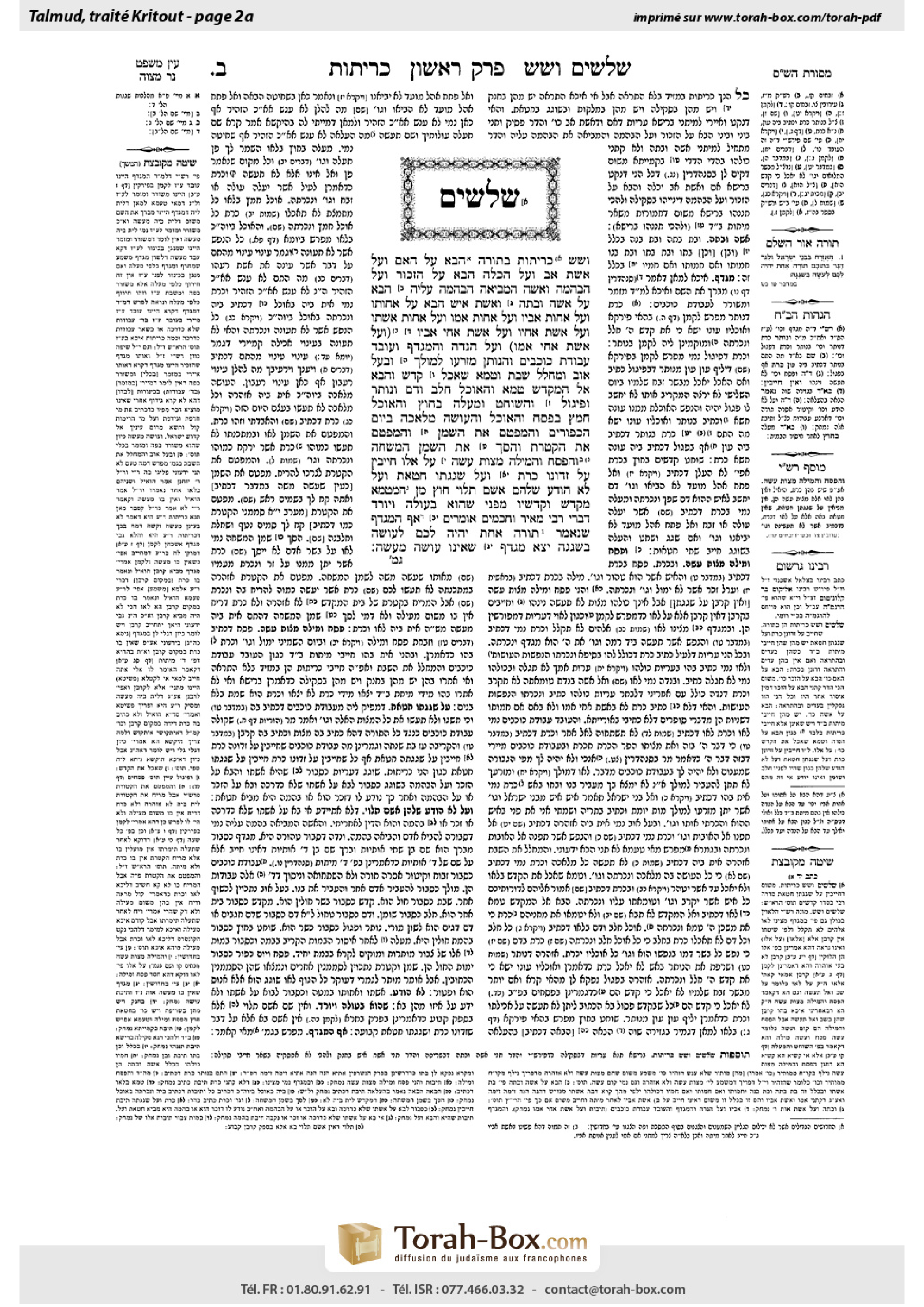
Keritot 2a: Talmud study for Daf Yomi
Daf Yomi is the daily study of one Talmud folio. Explore 37 tractates with scans, Hebrew text, Sefaria English and AI-generated French translations where annotated.
Passage selection and English or AI-generated French translation are available where the scan has annotations. Daf Study is independent of Torah-Box and Sefaria.
Browse Keritot · כריתות · All tractatesKeritot 2a text and translations
This page of Keritot includes the Aramaic text, an English translation and an AI-generated French translation, alongside the scan above.
כריתות ב׳ א · Aramaic and Hebrew text
מַתְנִי׳ שְׁלֹשִׁים וָשֵׁשׁ כָּרֵיתוֹת בְּתוֹרָה: הַבָּא עַל הָאֵם, וְעַל אֵשֶׁת אָב, וְעַל הַכַּלָּה, הַבָּא עַל הַזָּכוּר, וְעַל הַבְּהֵמָה, וְאִשָּׁה הַמְּבִיאָה הַבְּהֵמָה עָלֶיהָ, הַבָּא עַל אִשָּׁה וּבִתָּהּ, וְאֵשֶׁת אִישׁ, הַבָּא עַל אֲחוֹתוֹ, וְעַל אֲחוֹת אָבִיו, וְעַל אֲחוֹת אִמּוֹ, וְעַל אֲחוֹת אִשְׁתּוֹ, וְעַל אֵשֶׁת אָחִיו, וְעַל אֵשֶׁת אֲחִי אָבִיו, וְעַל אֵשֶׁת אֲחִי אִמּוֹ, וְעַל הַנִּדָּה.
וְהַמְגַדֵּף, וְעוֹבֵד עֲבוֹדָה זָרָה, וְהַנּוֹתֵן מִזַּרְעוֹ לַמּוֹלֶךְ, וּבַעַל אוֹב, וּמְחַלֵּל שַׁבָּת, וְטָמֵא שֶׁאָכַל קֹדֶשׁ, וְהַבָּא אֶל הַמִּקְדָּשׁ טָמֵא, וְהָאוֹכֶל חֵלֶב, וָדָם, וְנוֹתָר, וּפִיגּוּל, וְהַשּׁוֹחֵט, וּמַעֲלֶה בַּחוּץ,
וְהָאוֹכֵל חָמֵץ בַּפֶּסַח, וְהָאוֹכֵל וְהָעוֹשֶׂה מְלָאכָה בְּיוֹם הַכִּפּוּרִים, וְהַמְפַטֵּם אֶת הַשֶּׁמֶן, וְהַמְפַטֵּם אֶת הַקְּטֹרֶת, וְהַסָּךְ אֶת הַשֶּׁמֶן הַמִּשְׁחָה. וְהַפֶּסַח וְהַמִּילָה מִצְוַת עֲשֵׂה.
עַל אֵלּוּ חַיָּיבִין עַל זְדוֹנוֹ כָּרֵת, וְעַל שִׁגְגָתוֹ חַטָּאת, וְעַל לֹא הוֹדַע שֶׁלָּהֶם אָשָׁם תָּלוּי, חוּץ מִן הַמְטַמֵּא מִקְדָּשׁ וְקָדָשָׁיו, מִפְּנֵי שֶׁהוּא בְּעוֹלֶה וְיוֹרֵד, דִּבְרֵי רַבִּי מֵאִיר.
וַחֲכָמִים אוֹמְרִים: אַף הַמְגַדֵּף, שֶׁנֶּאֱמַר: ״תּוֹרָה אַחַת יִהְיֶה לָכֶם לָעֹשֶׂה בִּשְׁגָגָה״, יָצָא מְגַדֵּף שֶׁאֵינוֹ עוֹשֶׂה מַעֲשֶׂה.
Keritot 2a · English translation
MISHNA: There are thirty-six cases in the Torah with regard to which one who performs a prohibited action intentionally is liable to receive excision from the World-to-Come [karet]. They are: One who engages in sexual intercourse with his mother; or with the wife of his father, even if she is not his mother; or with his daughter-in-law. The same punishment is imposed on a man who engages in intercourse with another male [hazekhur], or who copulates with an animal; and a woman who brings an animal upon her to engage in bestiality. The same punishment is imposed on one who engages in intercourse with a woman and her daughter, or with a married woman. The same punishment is imposed on one who engages in intercourse with his sister, or with his father’s sister, or with his mother’s sister, or with his wife’s sister, or with his brother’s wife, or with the wife of his father’s brother, or with the wife of his mother’s brother, or with a menstruating woman.
And these too are liable to receive karet: One who blasphemes the name of Heaven, and one who worships an idol, and one who gives of his children to Molekh (see Leviticus 20:1–5), and a necromancer, and one who desecrates Shabbat. And the same is the punishment of one who is ritually impure who ate sacrificial food; and one who enters the Temple while ritually impure; and one who eats forbidden fat, or consumes blood, or eats meat left over from an offering after the time allotted for its consumption [notar], or eats meat of an offering that was sacrificed with the intent to consume it after its designated time [piggul]; and one who slaughters offerings and offers them up outside the Temple.
And these too are liable to receive karet: One who eats leavened bread on Passover, and one who eats or performs prohibited labor on Yom Kippur. And the same is the punishment of one who blends the anointing oil according to the specifications of the oil prepared by Moses in the wilderness (see Exodus 30:22–33); and one who blends the incense according to the specifications of the incense used in the Temple service for purposes other than use in the Temple; and one who applies the anointing oil to his skin. And one is liable to receive karet for failure to fulfill the mitzva of bringing the Paschal offering and the mitzva of circumcision, which unlike the cases of prohibitions enumerated in the mishna, are positive mitzvot.
For any of these prohibitions, one is liable to receive karet for its intentional violation and to bring a sin offering for its unwitting violation. And for their violation in a case where it is unknown to him whether or not he transgressed, he is liable to bring a provisional guilt offering, which provides provisional atonement until he discovers whether or not he transgressed. This is the halakha for all of the transgressions listed above except for one who defiles the Temple, i.e., he enters the Temple while ritually impure, or partakes of its consecrated items while ritually impure. In these cases he does not bring a provisional guilt offering because he is obligated to bring a sliding-scale offering for a definite transgression. This is the statement of Rabbi Meir.
And the Rabbis say: The halakha is the same even with regard to the one who blasphemes, as it is stated with regard to the sin offering: “You shall have one law for him who performs the action unwittingly” (Numbers 15:29), excluding one who blasphemes, as he does not perform an action but sins with speech.
Keritot 2a · Traduction française (IA)
Michna : Il existe trente-six cas dans la Torah pour lesquels celui qui commet intentionnellement une action interdite est passible de la sanction de la mort par excision [karet] de la Vie à Venir. Ils sont les suivants : celui qui a des relations sexuelles avec sa mère ; ou avec la femme de son père, même si elle n'est pas sa mère ; ou avec sa belle-fille. La même peine est infligée à un homme qui a des relations sexuelles avec un autre homme [hazekhur], ou qui a des rapports avec un animal ; et à une femme qui amène un animal sur elle pour commettre l'acte bestial. La même peine est infligée à celui qui a des relations sexuelles avec une femme et sa fille, ou avec une femme mariée. La même peine est infligée à celui qui a des relations sexuelles avec sa sœur, ou avec la sœur de son père, ou avec la sœur de sa mère, ou avec la sœur de sa femme, ou avec la femme de son frère, ou avec la femme du frère de son père, ou avec la femme du frère de sa mère, ou avec une femme en période menstruelle.
Et ceux-ci sont également passibles de la sanction de la mort par excision [karet] : celui qui blasphème le Nom du Ciel, et celui qui adore une idole, et celui qui livre ses enfants à Molekh (voir Lévitique 20:1–5), et un nécromancien, et celui qui profane le Chabbat. Et la même peine est celle de celui qui est rituellement impur et qui a mangé de la nourriture sacrificielle ; et celui qui entre dans le Temple en état d'impureté rituelle ; et celui qui mange de la graisse interdite, ou consomme du sang, ou mange de la viande restée de l'offrande après le temps imparti pour sa consommation [notar], ou mange de la viande d'une offrande qui a été sacrifiée avec l'intention de la consommer après son temps désigné [piggul] ; et celui qui immole des offrandes et les offre en dehors du Temple.
Et ceux-ci sont également passibles de la peine de karet : celui qui mange du pain levé pendant Pessah, et celui qui mange ou accomplit un travail interdit le jour de Yom Kippour. Il en va de même pour la peine de celui qui prépare l'huile d'onction selon les spécifications de l'huile préparée par Moïse dans le désert (voir Exode 30:22-33) ; et celui qui prépare l'encens selon les spécifications de l'encens utilisé dans le service du Temple à des fins autres que l'usage dans le Temple ; et celui qui applique l'huile d'onction sur sa peau. On est passible de la peine de karet pour le non-respect de la mitsva d'offrir la Pâque et de la mitsva de la circoncision, qui, contrairement aux cas d'interdits énumérés dans la Michna, sont des mitsvot positives.
Pour l'une de ces interdictions, on est passible de la peine de karet pour sa violation intentionnelle et tenu d'offrir un sacrifice expiatoire pour sa violation involontaire. Et pour leur violation dans un cas où il lui est inconnu s'il a transgressé ou non, il est tenu d'offrir un sacrifice de culpabilité provisoire, qui procure une expiation provisoire jusqu'à ce qu'il découvre s'il a transgressé ou non. C'est la halakha pour toutes les transgressions énumérées ci-dessus, à l'exception de celui qui souille le Temple, c'est-à-dire qu'il entre dans le Temple alors qu'il est rituellement impur, ou qu'il consomme ses objets sanctifiés alors qu'il est rituellement impur. Dans ces cas, il n'offre pas de sacrifice de culpabilité provisoire, car il est tenu d'offrir un sacrifice à échelle variable pour une transgression certaine. C'est l'avis de Rabbi Meïr.
Et les Sages disent : La halakha est la même même pour celui qui blasphème, car il est dit à propos du sacrifice expiatoire : « Vous aurez une seule loi pour celui qui commet l'acte involontairement » (Nombres 15:29), excluant celui qui blasphème, car il ne commet pas un acte mais pèche par la parole.
Traduction française générée par IA à partir de l’édition anglaise de Sefaria. Vérifie toujours un passage avec le texte source.
Text from Sefaria: William Davidson Edition - Vocalized Aramaic (CC BY NC); William Davidson Edition - English (CC BY NC).