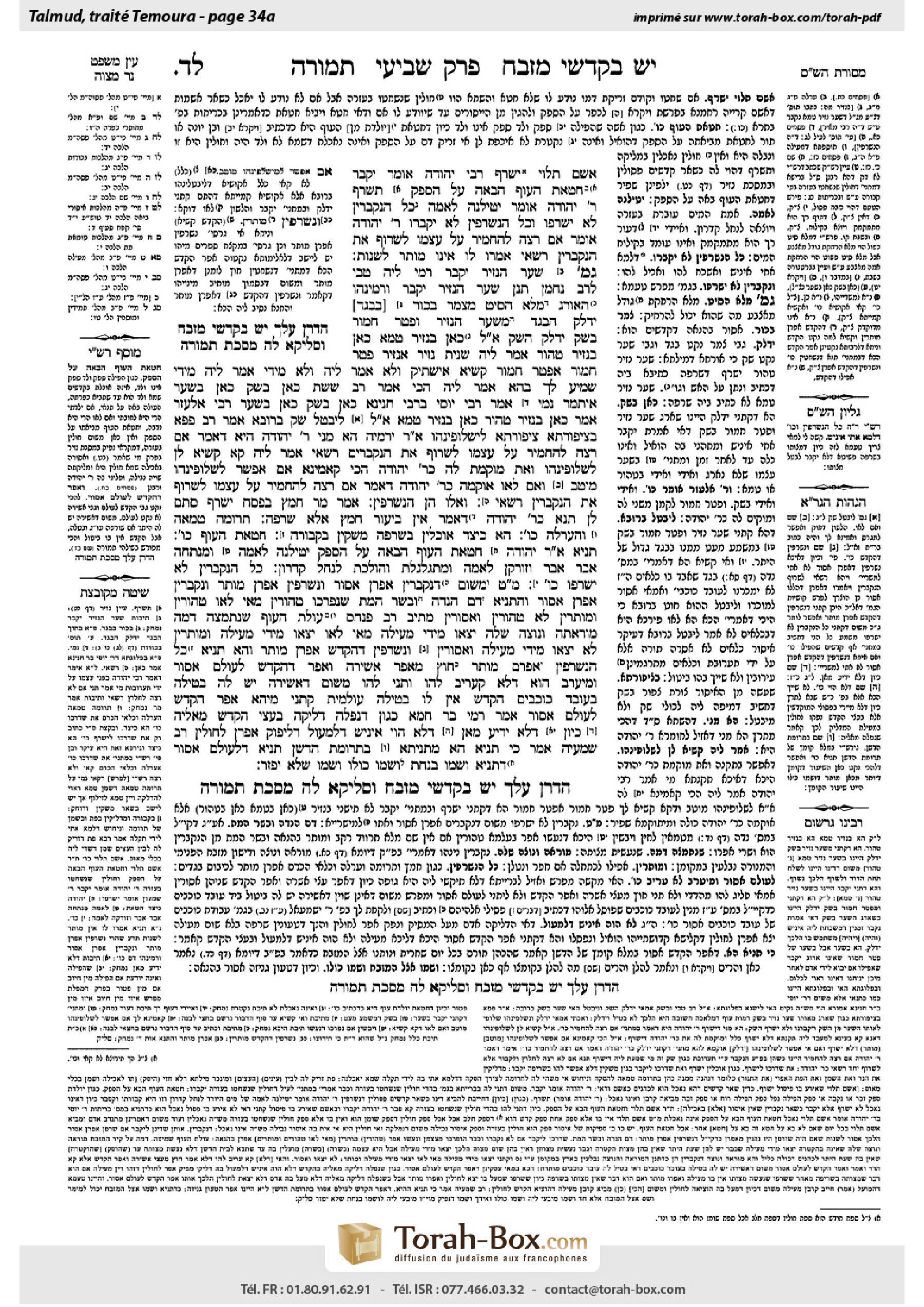
Temurah 34a: Talmud study for Daf Yomi
Daf Yomi is the daily study of one Talmud folio. Explore 37 tractates with scans, Hebrew text, Sefaria English and AI-generated French translations where annotated.
Passage selection and English or AI-generated French translation are available where the scan has annotations. Daf Study is independent of Torah-Box and Sefaria.
Browse Temurah · תמורה · All tractatesTemurah 34a text and translations
This page of Temurah includes the Aramaic text, an English translation and an AI-generated French translation, alongside the scan above.
תמורה ל״ד א · Aramaic and Hebrew text
אָשָׁם תָּלוּי — יִשָּׂרֵף, רַבִּי יְהוּדָה אוֹמֵר: יִקָּבֵר. חַטַּאת הָעוֹף הַבָּאָה עַל הַסָּפֵק — תִּשָּׂרֵף, רַבִּי יְהוּדָה אוֹמֵר: יְטִילֶנָּה לָאַמָּה.
כָּל הַנִּקְבָּרִין — לֹא יִשָּׂרֵפוּ, וְכׇל הַנִּשְׂרָפִין — לֹא יִקָּבֵרוּ. רַבִּי יְהוּדָה אוֹמֵר: אִם רָצָה לְהַחְמִיר עַל עַצְמוֹ לִשְׂרוֹף אֶת הַנִּקְבָּרִין — רַשַּׁאי. אָמְרוּ לוֹ: אֵינוֹ מוּתָּר לְשַׁנּוֹת.
גְּמָ׳ שְׂעַר הַנָּזִיר יִקָּבֵר. רָמֵי לֵיהּ טָבִי לְרַב נַחְמָן: תְּנַן שְׂעַר הַנָּזִיר יִקָּבֵר, וּרְמִינְהוּ: הָאוֹרֵג ״מְלֹא הַסִּיט״ מִצֶּמֶר בְּכוֹר בְּבֶגֶד — יִדָּלֵק הַבֶּגֶד, מִשְּׂעַר הַנָּזִיר וּפֶטֶר חֲמוֹר בְּשַׂק — יִדָּלֵק הַשַּׂק!
אֲמַר לֵיהּ: כָּאן בְּנָזִיר טָמֵא, כָּאן בְּנָזִיר טָהוֹר.
אֲמַר לֵיהּ שַׁנֵּית נָזִיר אַנָּזִיר, פֶּטֶר חֲמוֹר אַפֶּטֶר חֲמוֹר קַשְׁיָא! אִישְׁתִּיק וְלָא אֲמַר לֵיהּ וְלָא מִידֵּי. אֲמַר לֵיהּ: מִידֵּי שְׁמִיעַ לָךְ בְּהָא? אֲמַר לֵיהּ: הָכִי אָמַר רַב שֵׁשֶׁת — כָּאן בְּשַׂק, כָּאן בְּשֵׂעָר.
אִיתְּמַר נָמֵי: אָמַר רַבִּי יוֹסֵי בְּרַבִּי חֲנִינָא: כָּאן — בְּשַׂק, כָּאן — בְּשֵׂעָר. רַבִּי אֶלְעָזָר אָמַר: כָּאן — בְּנָזִיר טָהוֹר, כָּאן — בְּנָזִיר טָמֵא.
אֲמַר לֵיהּ: לִיבְטֵל שַׂק בְּרוּבָּא! אָמַר רַב פָּפָּא: בְּצִיפּוּרְתָּא. צִיפּוּרְתָּא? לִישַׁלּוֹפִינְהוּ!
אָמַר רַבִּי יִרְמְיָה: הָא מַנִּי? רַבִּי יְהוּדָה הִיא, דְּאָמַר: אִם רָצָה לְהַחְמִיר עַל עַצְמוֹ לִשְׂרוֹף אֶת הַנִּקְבָּרִים — רַשַּׁאי. אֲמַר לֵיהּ: קָא קַשְׁיָא לַן לְשַׁלּוֹפִינְהוּ, וְאַתְּ מוֹקְמַתְּ לַהּ כְּרַבִּי יְהוּדָה!
הָכִי קָאָמֵינָא: אִם אֶפְשָׁר לְשַׁלּוֹפִינְהוּ — מוּטָב, וְאִם לָאו — אוֹקְמַהּ כְּרַבִּי יְהוּדָה, דְּאָמַר: אִם רָצָה לְהַחְמִיר עַל עַצְמוֹ לִשְׂרוֹף אֶת הַנִּקְבָּרִין — רַשַּׁאי.
וְאֵלּוּ הֵן הַנִּשְׂרָפִין. אָמַר מָר: חָמֵץ בַּפֶּסַח — יִשָּׂרֵף. סְתַם לַן תַּנָּא כְּרַבִּי יְהוּדָה, דְּאָמַר: אֵין בִּיעוּר חָמֵץ אֶלָּא שְׂרֵפָה.
תְּרוּמָה טְמֵאָה וְהָעׇרְלָה כּוּ׳. הָא כֵיצַד? אֳוכָלִין בִּשְׂרֵפָה, מַשְׁקִין בִּקְבוּרָה.
חַטַּאת הָעוֹף כּוּ׳. תַּנְיָא, אָמַר רַבִּי יְהוּדָה: חַטַּאת הָעוֹף הַבָּאָה עַל הַסָּפֵק — יְטִילֶנָּה לָאַמָּה, וּמְנַתְּחָה אֵבֶר אֵבֶר, וְזוֹרְקָן לָאַמָּה, וּמִתְגַּלְגֶּלֶת וְהוֹלֶכֶת לְנַחַל קִדְרוֹן.
כׇּל הַנִּקְבָּרִין לֹא יִשָּׂרֵפוּ כּוּ׳. מַאי טַעְמָא? מִשּׁוּם דְּנִקְבָּרִין אֶפְרָן אָסוּר, וְנִשְׂרָפִין אֶפְרָן מוּתָּר.
וְנִקְבָּרִין אֶפְרָן אָסוּר? וְהָתַנְיָא: דַּם הַנִּדָּה וּבְשַׂר הַמֵּת שֶׁנִּפְרְכוּ — טְהוֹרִין, מַאי לַָאו טְהוֹרִין וּמוּתָּרִין? לָא, טְהוֹרִין וַאֲסוּרִין.
מֵתִיב רַב פִּנְחָס: עוֹלַת הָעוֹף שֶׁנִּתְמַצָּה דָּמָהּ, מוּרְאָתָהּ וְנוֹצָה שֶׁלָּהּ יָצְאוּ מִידֵי מְעִילָה. מַאי לַָאו יָצְאוּ מִידֵי מְעִילָה וּמוּתָּרִין? לָא, יָצְאוּ מִידֵי מְעִילָה וַאֲסוּרִין.
וְנִשְׂרָפִין דְּהֶקְדֵּשׁ אֶפְרָן מוּתָּר? וְהָא תַּנְיָא: כׇּל הַנִּשְׂרָפִין אֶפְרָם מוּתָּר, חוּץ מֵאֵפֶר אֲשֵׁירָה — וְאֵפֶר דְּהֶקְדֵּשׁ לְעוֹלָם אָסוּר!
וּמִיעְרָב הוּא דְּלָא קָעָרֵיב לְהוּ וְתָנֵי לְהוּ, מִשּׁוּם דַּאֲשֵׁירָה יֵשׁ לָהּ בְּטִילָה בְּגוֹי, הֶקְדֵּשׁ אֵין לוֹ בְּטִילָה עוֹלָמִית. קָתָנֵי מִיהָא: אֵפֶר הֶקְדֵּשׁ לְעוֹלָם אָסוּר.
אָמַר רָמֵי בַּר חָמָא: כְּגוֹן דְּנָפְלָה דְּלֵיקָה בַּעֲצֵי הֶקְדֵּשׁ מֵאֵלֶיהָ, כֵּיוָן דְּלָא יְדִיעַ מַאן, דְּלָא הָוֵי אִינִישׁ דְּלִמְעוֹל, דְּלִיפּוֹק אֶפְרָן לְחוּלִּין.
רַב שְׁמַעְיָה אָמַר: כִּי תַּנְיָא הָא מַתְנִיתָא בִּתְרוּמַת הַדֶּשֶׁן תַּנְיָא, דִּלְעוֹלָם אָסוּר.
דְּתַנְיָא: ״וְשָׂמוֹ״ בְּנַחַת, ״וְשָׂמוֹ״ כּוּלּוֹ, ״וְשָׂמוֹ״ שֶׁלֹּא יְפַזֵּר.
הֲדַרַן עֲלָךְ יֵשׁ בְּקׇדְשֵׁי מִזְבֵּחַ, וּסְלִיקָא לַהּ מַסֶּכֶת תְּמוּרָה.
Temurah 34a · English translation
With regard to a provisional guilt offering brought by one who is uncertain as to whether he committed a sin that renders him liable to bring a sin offering, if he discovers that he did not sin, the offering shall be burned, as its legal status is like that of an unfit offering. Rabbi Yehuda says: It shall be buried. A sin offering of the bird that comes due to an uncertainty, e.g., in the case of a woman who miscarried and she is uncertain whether it was a fetus, shall be burned, as it may not be eaten due to the uncertainty and because the nape of its neck was pinched and it was not slaughtered. Rabbi Yehuda says: One should cast it into the Temple courtyard drain, as the young bird will decompose and be drawn into the stream outside the Temple.
The principle is: All items that are buried shall not be burned, and all items that are burned shall not be buried. Rabbi Yehuda says: If one wished to impose a stringency upon himself by burning items that are to be buried, he is permitted to burn them. The Rabbis said to Rabbi Yehuda: One is not permitted to change the method of destruction, as this could lead to a leniency, since it is permitted to derive benefit from the ashes of items that require burning, whereas it is not permitted to derive benefit from the ashes of items that require burial.
GEMARA: Among the items from which benefit is prohibited, the mishna states that the hair of a nazirite shall be buried. With regard to this halakha, Tavi raised a contradiction before Rav Naḥman: We learned in the mishna that the hair of a nazirite shall be buried; but one can raise a contradiction from another mishna (Orla 3:3): One who weaves one sit, the distance between one’s index and middle fingers, of the wool of a firstborn animal, from which deriving benefit is prohibited in accordance with the halakha of all sacrificial animals, in a garment, the garment shall be ignited. Similarly, if one weaves from the hair of a nazirite, or from the hair of a firstborn donkey, in a sack, the sack shall be ignited.
Rav Naḥman said to Tavi: There is no contradiction. Here, the ruling of the mishna that teaches that the hair of a nazirite is buried, is stated with regard to a nazirite who became ritually impure, and who must therefore shave his head and begin a new naziriteship. And there, the ruling of the mishna that states that the hair is burned, is stated with regard to the hair of a ritually pure nazirite, who shaves his head upon successful completion of his naziriteship. At this stage his hair is burned, in accordance with the verses: “And this is the law of the nazirite, when the days of his consecration are fulfilled…And the nazirite shall shave his consecrated head at the door of the Tent of Meeting, and shall take the hair of his consecrated head and put it on the fire that is under the sacrifice of peace offerings” (Numbers 6:13–18).
Tavi said to Rav Naḥman: You have answered the contradiction with regard to a nazirite and a nazirite. But the contradiction with regard to a firstborn donkey and a firstborn donkey still poses a difficulty, as the mishna here states that the animal and its hair are buried, whereas the mishna in tractate Orla teaches that its hair is burned. Rav Naḥman was silent and said nothing to Tavi about the contradiction. Instead, he said to him: Have you heard anything with regard to this from others? Tavi said to him: This is what Rav Sheshet said in response to the contradiction: Here, where the mishna states that the hair of a firstborn donkey is burned, it is referring to a case where the hair was weaved in a sack, whereas there, where the mishna rules that the hair is buried, it is referring to the hair by itself.
The Gemara notes that these responses of Rav Naḥman and Rav Sheshet were also stated by other Sages. Rabbi Yosei, son of Rabbi Ḥanina, says: Here, in tractate Orla, the mishna is referring to a case where the hair of the nazirite or firstborn donkey was weaved in a sack, whereas there it is referring to the hair of the nazirite or firstborn donkey itself. And Rabbi Elazar says: Here, in tractate Orla, the mishna is referring to a ritually pure nazirite, and there the mishna is referring to the hair of a ritually impure nazirite.
Rav Naḥman said to Rav Sheshet: Even if there is a difference between the hair itself and hair weaved in a sack, let the hair that was weaved in a sack be nullified by the majority, i.e., the other materials weaved into the sack, and therefore the sack need not be burned. Rav Pappa said: That mishna is dealing with a case where one used the prohibited hair to weave an ornamental design of a bird into the sack. Such a design is considered significant in its own right, and consequently it is not nullified by the majority. The Gemara asks: Why should the entire sack be burned on account of the bird design? Let him remove any designs weaved into the sack with the prohibited hair, and the remaining materials should be permitted.
Rabbi Yirmeya said: In accordance with whose opinion is this mishna in tractate Orla? It is in accordance with the opinion of Rabbi Yehuda, who said that if one wished to impose a stringency upon himself by burning items that are to be buried, he is permitted to do so. Rav Naḥman said to him: We raised a difficulty that one should remove the bird designs, and you establish that the mishna is in accordance with the opinion of Rabbi Yehuda? Even according to Rabbi Yehuda, in a case where one can remove the prohibited portion of the sack and use the rest of it, why would he burn it, even as a stringency?
Rabbi Yirmeya responded: This is what I meant to say: If it is possible to remove it from the sack, fine; and if not, there is a third answer to the contradiction that Tavi raised before Rav Naḥman: Interpret the mishna in accordance with the opinion of Rabbi Yehuda, who said that if one wished to impose a stringency upon himself by burning items that are to be buried, he is permitted to do so.
§ The mishna teaches: And these are the items that are burned: Leavened bread. The Gemara comments: The Master said in the mishna that leavened bread on Passover shall be burned. If so, the tanna taught us an unattributed mishna in accordance with the opinion of Rabbi Yehuda, who said that the eradication of leavened bread can be performed only by means of burning. By contrast, the Rabbis rule that leavened bread may be eradicated through any manner of destruction.
The mishna further teaches that ritually impure teruma shall be burned. And with regard to orla and diverse kinds of food crops sown in a vineyard, those items whose appropriate manner of destruction is to be burned shall be burned, and those items whose appropriate manner of destruction is to be buried shall be buried. The Gemara elaborates: How so, i.e., what is an item whose appropriate manner of destruction is to be burned? Foods are items whose appropriate manner of destruction is by burning; and liquids are items whose appropriate manner of destruction is by burial.
The mishna also teaches: A sin offering of the bird that comes due to an uncertainty shall be burned; Rabbi Yehuda says that one should cast it into the Temple courtyard drain. With regard to the opinion of Rabbi Yehuda, the Gemara notes that it is taught in a baraita that Rabbi Yehuda says: With regard to a sin offering of the bird that comes due to an uncertainty, one should cast it into the Temple courtyard drain. And how is this performed? He severs the animal limb by limb and then tosses all the limbs into the drain, and each limb rolls out continuously with the liquids in the drain to the Kidron River outside Jerusalem.
§ The mishna teaches that all items that are buried shall not be burned, and all items that are burned shall not be buried. The Gemara asks: What is the reason that items that are buried may not be burned? The Gemara responds: This is because with regard to items that are buried, their ashes are prohibited, but with regard to items that are burned, their ashes are permitted. Accordingly, due to a concern that one who burns an item that should be buried might derive benefit from the ashes, the Sages prohibited the burning of any item that is buried.
The Gemara asks: And is the halakha with regard to items that are buried that their ashes are prohibited? But isn’t it taught in a baraita: With regard to the blood of a menstruating woman and the flesh of a corpse, which normally render one ritually impure whether they are dry or wet, in a case where they dried up and crumbled, they are ritually pure. What, is it not correct to infer from the baraita that they are ritually pure and one is permitted to derive benefit from them, despite the fact that a corpse is an item that is buried? The Gemara rejects this inference: No, the baraita means that they are pure only in the sense that they do not render one ritually impure, but it is nevertheless prohibited to derive benefit from them.
Rav Pineḥas raises an objection from another baraita: With regard to a burnt offering of the bird whose blood was squeezed onto the wall of the altar in the appropriate manner, its crop and its feathers, which do not ascend upon the altar, have been removed from the halakhot of misuse. What, is it not correct to infer from this that they have been removed entirely from the halakhot of misuse and are no longer consecrated? And therefore one is permitted to derive benefit from them, despite the fact that the crop and feathers are buried, as they are tossed to the eastern side of the altar and are swallowed in their place. Evidently, it is permitted to derive benefit from items that are buried. The Gemara rejects this claim: No, the baraita means that they have been removed from the halakhot of misuse, but one is nevertheless prohibited to derive benefit from them.
The Gemara asks: And is it the halakha with regard to consecrated items that are burned that their ashes are permitted? But isn’t it taught in a baraita: With regard to all prohibited items that must be burned, their ashes are permitted, except for wood from a tree used as part of idolatrous rites [ashera]. And ash of consecrated property is prohibited forever.
Before summarizing the question, the Gemara explains why the baraita teaches the halakhot with regard to an ashera and consecrated property separately: And the tanna did not combine them into one phrase and teach them together, because an ashera can become permitted, as it has the option of nullification by a gentile, whereas consecrated property never has the option of nullification. The Gemara concludes its question: In any event, the baraita teaches that the ash of consecrated property is prohibited forever.
Rami bar Ḥama said: In general, it is permitted to derive benefit from the ash of burnt consecrated property. But this is the halakha either in a case where the consecrated property has been disqualified in some manner, as in the mishna, when its sanctity is weakened, or in a case where one would be liable for misuse of consecrated property when burning it. In such a situation, it is the misuse which causes the consecrated property to become non-sacred. By contrast, the baraita is dealing with a case where the ash remains prohibited, for example, if a fire fell by itself onto consecrated wood. Since it cannot be known who burned the wood, as there is no person who misused the wood in order that its ash should change to non-sacred status, the ash is therefore prohibited.
Rav Shemaya said: When this baraita was taught, it was taught with regard to the removal of the ashes every morning, i.e., the rite in which the priest removes some of the ashes from upon the altar and places them on the ground beside the altar. In this instance, the halakha is that the ash is prohibited forever.
As it is taught in a baraita with regard to the removal of the ashes: The verse states: “And he shall take up the ashes to which the fire has consumed the burnt offering on the altar, and he shall put them beside the altar” (Leviticus 6:3). The term “and he shall put them” indicates that he shall place them down gently, rather than cast them down. Additionally, the emphasis on “them” in the term “and he shall put them” teaches that he shall put all of them. Finally, it is derived from the superfluous “and” in the term “and he shall put them” that he shall not scatter the ashes. The ruling of the baraita that all of the ashes must be placed in the ground indicates that even after the consecrated item is burned, the ashes remain sanctified and are prohibited.
Temurah 34a · Traduction française (IA)
Concernant un sacrifice de culpabilité provisoire apporté par celui qui doute d’avoir commis une faute l’obligeant à apporter un sacrifice expiatoire, s’il découvre qu’il n’a pas péché, le sacrifice doit être brûlé, car son statut est celui d’un sacrifice impropre. Rabbi Yehuda dit : Il doit être enterré. Un sacrifice expiatoire d’oiseau apporté en raison d’un doute, par exemple dans le cas d’une femme qui a fait une fausse couche et qui ignore s’il s’agissait d’un fœtus, doit être brûlé, car il ne peut être mangé en raison du doute et parce que sa nuque a été brisée, au lieu d’être égorgé. Rabbi Yehuda dit : On doit le jeter dans le conduit d’évacuation de la cour du Temple, car le jeune oiseau se décomposera et sera entraîné par le courant à l’extérieur du Temple.
Le principe est le suivant : tout ce qui doit être enterré ne doit pas être brûlé, et tout ce qui doit être brûlé ne doit pas être enterré. Rabbi Yehuda dit : Si quelqu’un souhaite s’imposer une rigueur en brûlant des objets qui doivent être enterrés, il en a le droit. Les Sages dirent à Rabbi Yehuda : Il n’est pas permis de changer la méthode de destruction, car cela pourrait entraîner une indulgence : il est permis de tirer profit des cendres des objets qui doivent être brûlés, tandis qu’il est interdit de tirer profit des cendres des objets qui doivent être enterrés.
GUEMARA : Parmi les objets dont il est interdit de tirer profit, la Michna indique que les cheveux d’un nazir doivent être enterrés. À propos de cette halakha, Tavi souleva une contradiction devant Rav Naḥman : Nous avons appris dans la Michna que les cheveux d’un nazir doivent être enterrés ; mais on peut opposer à cela une autre Michna (Orla 3:3) : Celui qui tisse dans un vêtement un sit, c’est-à-dire la distance entre l’index et le majeur, de laine provenant d’un animal premier-né, dont il est interdit de tirer profit conformément à la halakha applicable à tous les animaux consacrés, doit brûler le vêtement. De même, si quelqu’un tisse dans un sac des cheveux de nazir ou les poils d’un âne premier-né, le sac doit être brûlé.
Rav Naḥman dit à Tavi : Il n’y a pas de contradiction. Ici, la décision de la Michna selon laquelle les cheveux d’un nazir doivent être enterrés concerne un nazir devenu rituellement impur, qui doit donc se raser la tête et commencer un nouveau naziréat. Là, la décision de la Michna selon laquelle les cheveux doivent être brûlés concerne ceux d’un nazir rituellement pur, qui se rase la tête après avoir achevé son naziréat. À ce stade, ses cheveux sont brûlés, conformément aux versets : « Voici la loi du nazir, lorsque les jours de son naziréat seront accomplis… Le nazir rasera sa tête consacrée à l’entrée de la Tente d’assignation, prendra les cheveux de sa tête consacrée et les mettra sur le feu qui est sous le sacrifice de paix » (Nombres 6:13–18).
Tavi dit à Rav Naḥman : Tu as résolu la contradiction concernant un nazir et un nazir. Mais la contradiction concernant un âne premier-né et un âne premier-né reste difficile, car la Michna, ici, dit que l’animal et ses poils doivent être enterrés, tandis que la Michna du traité Orla enseigne que ses poils doivent être brûlés. Rav Naḥman garda le silence et ne répondit rien à Tavi au sujet de la contradiction. Au lieu de cela, il lui demanda : As-tu entendu d’autres personnes donner une explication à ce sujet ? Tavi lui répondit : Voici ce que Rav Sheshet a dit pour résoudre la contradiction : Ici, lorsque la Michna dit que les poils d’un âne premier-né doivent être brûlés, il s’agit du cas où ils ont été tissés dans un sac ; là, lorsque la Michna statue que les poils doivent être enterrés, il s’agit des poils eux-mêmes.
La Guemara relève que ces réponses de Rav Naḥman et de Rav Sheshet ont également été formulées par d’autres Sages. Rabbi Yosei, fils de Rabbi Ḥanina, dit : Ici, dans le traité Orla, la Michna parle du cas où les cheveux du nazir ou les poils de l’âne premier-né ont été tissés dans un sac, tandis que là, elle parle des cheveux du nazir ou des poils de l’âne premier-né eux-mêmes. Et Rabbi Elazar dit : Ici, dans le traité Orla, la Michna parle d’un nazir rituellement pur, tandis que là, elle parle des cheveux d’un nazir rituellement impur.
Rav Naḥman dit à Rav Sheshet : Même s’il existe une différence entre les poils eux-mêmes et les poils tissés dans un sac, que les poils tissés dans le sac soient annulés par la majorité, c’est-à-dire les autres matières tissées dans le sac ; il ne serait donc pas nécessaire de brûler celui-ci. Rav Pappa dit : Cette Michna traite du cas où l’on a utilisé les poils interdits pour tisser dans le sac un motif ornemental représentant un oiseau. Un tel motif est considéré comme important en soi et n’est donc pas annulé par la majorité. La Guemara demande : Pourquoi brûler tout le sac à cause du motif de l’oiseau ? Qu’il retire du sac les motifs tissés avec les poils interdits, et les matières restantes devraient être permises.
Rabbi Yirmeya dit : Selon l’opinion de qui cette Michna du traité Orla est-elle formulée ? Selon celle de Rabbi Yehuda, qui a dit que si quelqu’un souhaite s’imposer une rigueur en brûlant des objets qui doivent être enterrés, il en a le droit. Rav Naḥman lui dit : Nous avons soulevé la difficulté qu’il faudrait retirer les motifs représentant des oiseaux, et toi, tu établis que la Michna suit l’opinion de Rabbi Yehuda ? Même selon Rabbi Yehuda, lorsque l’on peut retirer la partie interdite du sac et utiliser le reste, pourquoi le brûlerait-on, même par rigueur ?
Rabbi Yirmeya répondit : Voici ce que je voulais dire : S’il est possible de le retirer du sac, tant mieux ; sinon, il existe une troisième réponse à la contradiction que Tavi a soulevée devant Rav Naḥman : interprète la Michna conformément à l’opinion de Rabbi Yehuda, qui a dit que si quelqu’un souhaite s’imposer une rigueur en brûlant des objets qui doivent être enterrés, il en a le droit.
§ La Michna enseigne : Et voici les objets qui doivent être brûlés : le pain levé. La Guemara remarque : Le Maître a dit dans la Michna que le pain levé à Pessaḥ doit être brûlé. Si tel est le cas, le tanna nous a enseigné une Michna anonyme conforme à l’opinion de Rabbi Yehuda, qui a dit que l’élimination du pain levé ne peut se faire que par le feu. Les Sages, en revanche, statuent que le pain levé peut être éliminé par toute méthode de destruction.
La Michna enseigne aussi que la terouma rituellement impure doit être brûlée. Quant à l’orla et aux espèces végétales interdites qui poussent dans une vigne, les aliments dont le mode de destruction approprié est le feu doivent être brûlés, et les liquides dont le mode de destruction approprié est l’enterrement doivent être enterrés. La Guemara précise : Que signifie cela, c’est-à-dire quels objets doivent être détruits par le feu ? Les aliments doivent être détruits par le feu, tandis que les liquides doivent être enterrés.
La Michna enseigne également : Un sacrifice expiatoire d’oiseau apporté en raison d’un doute doit être brûlé ; Rabbi Yehuda dit qu’on doit le jeter dans le conduit d’évacuation de la cour du Temple. À propos de l’opinion de Rabbi Yehuda, la Guemara relève qu’il est enseigné dans une baraïta que Rabbi Yehuda dit : Un sacrifice expiatoire d’oiseau apporté en raison d’un doute doit être jeté dans le conduit d’évacuation de la cour du Temple. Et comment procède-t-on ? On découpe l’oiseau membre par membre, puis on jette tous les membres dans le conduit ; chacun est continuellement entraîné par les liquides qui s’y écoulent jusqu’au fleuve du Cédron, à l’extérieur de Jérusalem.
§ La Michna enseigne que tout ce qui doit être enterré ne doit pas être brûlé, et que tout ce qui doit être brûlé ne doit pas être enterré. La Guemara demande : Pourquoi les objets qui doivent être enterrés ne peuvent-ils pas être brûlés ? La Guemara répond : C’est parce que les cendres des objets qui doivent être enterrés sont interdites, tandis que celles des objets qui doivent être brûlés sont permises. Ainsi, par crainte qu’une personne qui brûle un objet devant être enterré ne tire profit de ses cendres, les Sages ont interdit de brûler tout objet qui doit être enterré.
La Guemara demande : Est-il vrai que, selon la halakha, les cendres des objets qui doivent être enterrés sont interdites ? N’est-il pas enseigné dans une baraïta : Le sang d’une femme menstruée et la chair d’un cadavre, qui rendent normalement impur quiconque les touche, qu’ils soient secs ou humides, sont rituellement purs lorsqu’ils ont séché et se sont émiettés. Ne faut-il pas déduire de la baraïta qu’ils sont rituellement purs et qu’il est permis d’en tirer profit, bien qu’un cadavre soit un objet qui doit être enterré ? La Guemara rejette cette déduction : Non, la baraïta signifie qu’ils sont purs uniquement en ce sens qu’ils ne rendent pas impur ; il reste néanmoins interdit d’en tirer profit.
Rav Pineḥas soulève une objection à partir d’une autre baraïta : Pour un holocauste d’oiseau dont le sang a été appliqué de la manière appropriée contre la paroi de l’autel, le jabot et les plumes, qui ne montent pas sur l’autel, sont soustraits aux lois relatives au détournement de biens consacrés. Ne faut-il pas déduire qu’ils sont entièrement soustraits à ces lois et qu’ils ne sont plus consacrés ? Il serait donc permis d’en tirer profit, bien que le jabot et les plumes soient enterrés, puisqu’on les jette du côté est de l’autel, où ils disparaissent. Il apparaît donc qu’il est permis de tirer profit des objets qui doivent être enterrés. La Guemara rejette cette affirmation : Non, la baraïta signifie qu’ils sont soustraits aux lois relatives au détournement de biens consacrés, mais qu’il reste interdit d’en tirer profit.
La Guemara demande : Est-il vrai que, selon la halakha, les cendres des objets consacrés qui sont brûlés sont permises ? N’est-il pas enseigné dans une baraïta : Les cendres de tous les objets interdits qui doivent être brûlés sont permises, à l’exception du bois d’un arbre utilisé dans les rites idolâtres [ashera]. Quant aux cendres des biens consacrés, elles sont interdites à jamais.
Avant de résumer la question, la Guemara explique pourquoi la baraïta enseigne séparément les halakhot relatives à l’ashera et aux biens consacrés : le tanna ne les a pas réunies dans une seule formule pour les enseigner ensemble, parce qu’une ashera peut devenir permise, puisqu’un non-Juif peut l’annuler, tandis que les biens consacrés ne peuvent jamais être annulés. La Guemara conclut sa question : En tout cas, la baraïta enseigne que les cendres des biens consacrés sont interdites à jamais.
Rami bar Ḥama dit : En règle générale, il est permis de tirer profit des cendres de biens consacrés brûlés. Mais cette halakha s’applique soit dans un cas où les biens consacrés ont été disqualifiés d’une manière ou d’une autre, comme dans la Michna, ce qui affaiblit leur sainteté, soit dans un cas où celui qui les brûle serait passible pour détournement de biens consacrés. Dans une telle situation, c’est le détournement qui fait perdre aux biens consacrés leur statut sacré. En revanche, la baraïta traite d’un cas où les cendres restent interdites, par exemple si le feu a pris de lui-même à du bois consacré. Puisqu’on ne peut pas savoir qui a brûlé le bois, car personne n’a détourné celui-ci de sa destination sacrée pour que ses cendres acquièrent un statut profane, les cendres sont donc interdites.
Rav Shemaya dit : Lorsque cette baraïta a été enseignée, elle l’a été au sujet du retrait des cendres chaque matin, c’est-à-dire le rite par lequel le prêtre retire une partie des cendres de l’autel et les dépose au sol, à côté de l’autel. Dans ce cas, la halakha est que les cendres sont interdites à jamais.
Comme il est enseigné dans une baraïta au sujet du retrait des cendres : Le verset dit : « Il enlèvera les cendres consumées par le feu avec l’holocauste sur l’autel, et il les déposera à côté de l’autel » (Lévitique 6:3). L’expression « il les déposera » indique qu’il doit les déposer doucement, plutôt que de les jeter. En outre, l’insistance sur « les » dans l’expression « il les déposera » enseigne qu’il doit les déposer toutes. Enfin, on déduit du « et » superflu dans l’expression « et il les déposera » qu’il ne doit pas disperser les cendres. La règle de la baraïta selon laquelle toutes les cendres doivent être déposées au sol indique que même après la combustion de l’objet consacré, les cendres restent saintes et sont interdites.
Traduction française générée par IA à partir de l’édition anglaise de Sefaria. Vérifie toujours un passage avec le texte source.
Text from Sefaria: William Davidson Edition - Vocalized Aramaic (CC BY NC); William Davidson Edition - English (CC BY NC).