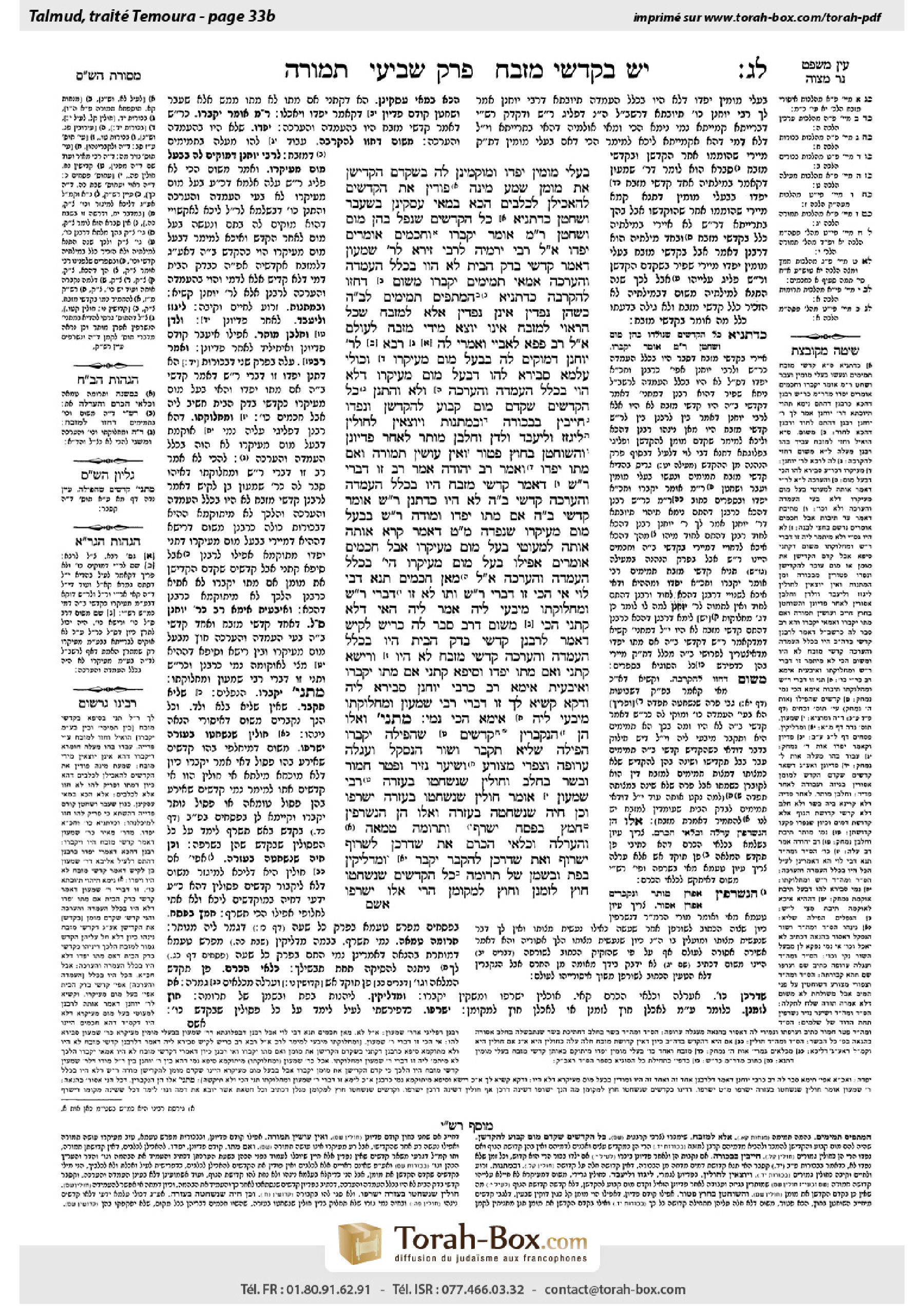
Temurah 33b: Talmud study for Daf Yomi
Daf Yomi is the daily study of one Talmud folio. Explore 37 tractates with scans, Hebrew text, Sefaria English and AI-generated French translations where annotated.
Passage selection and English or AI-generated French translation are available where the scan has annotations. Daf Study is independent of Torah-Box and Sefaria.
Browse Temurah · תמורה · All tractatesTemurah 33b text and translations
This page of Temurah includes the Aramaic text, an English translation and an AI-generated French translation, alongside the scan above.
תמורה ל״ג ב · Aramaic and Hebrew text
בַּעֲלֵי מוּמִין יִפָּדוּ״, וּמוֹקְמִינַן לָהּ בְּשֶׁקָּדַם הֶקְדֵּישָׁן אֶת מוּמָן, שְׁמַע מִינַּהּ פּוֹדִין אֶת הַקֳּדָשִׁים לְהַאֲכִילָן לִכְלָבִים!
הָכָא בְּמַאי עָסְקִינַן? בְּשֶׁעָבַר וּשְׁחָטָן.
כִּדְתַנְיָא: כׇּל הַקֳּדָשִׁים שֶׁנָּפַל בָּהֶן מוּם, וּשְׁחָטָן, רַבִּי מֵאִיר אוֹמֵר: יִקָּבֵרוּ, וַחֲכָמִים אוֹמְרִים: יִפָּדוּ.
אֲמַר לֵיהּ רַבִּי יִרְמְיָה לְרַבִּי זֵירָא: לְרַבִּי שִׁמְעוֹן, דְּאָמַר: קׇדְשֵׁי בֶּדֶק הַבַּיִת לֹא הָיוּ בִּכְלַל הַעֲמָדָה וְהַעֲרָכָה, אַמַּאי תְּמִימִים יִקָּבֵרוּ? מִשּׁוּם דַּחֲזוּ לְהַקְרָבָה.
כִּדְתַנְיָא: הַמַּתְפִּיס תְּמִימִים לְבֶדֶק הַבַּיִת, כְּשֶׁהֵן נִפְדִּין — אֵינָן נִפְדִּין אֶלָּא לַמִּזְבֵּחַ, שֶׁכׇּל הָרָאוּי לַמִּזְבֵּחַ אֵינוֹ יוֹצֵא מִידֵי מִזְבֵּחַ לְעוֹלָם.
אֲמַר לֵיהּ רַב פָּפָּא לְאַבָּיֵי, וְאָמְרִי לַהּ רָבָא: לְרַבִּי יוֹחָנָן, דְּמוֹקֵים לַהּ בְּבַעַל מוּם מֵעִיקָּרוֹ, וְכוּלֵּי עָלְמָא סְבִירָא לְהוּ דְּבַעַל מוּם מֵעִיקָּרוֹ דְּלָא הָוֵי בִּכְלַל הַעֲמָדָה וְהַעֲרָכָה. וְלָא?!
וְהָתְנַן: כׇּל הַקֳּדָשִׁים שֶׁקָּדַם מוּם קָבוּעַ לְהֶקְדֵּשָׁן וְנִפְדּוּ, חַיָּיבִין בַּבְּכוֹרָה וּבַמַּתָּנוֹת, וְיוֹצְאִין לְחוּלִּין לִיגָּזֵז וְלֵיעָבֵד.
וְלָדָן וַחֲלָבָן מוּתָּר לְאַחַר פִּדְיוֹנָן, וְהַשּׁוֹחֲטָן בַּחוּץ פָּטוּר, וְאֵין עוֹשִׂין תְּמוּרָה, וְאִם מֵתוּ יִפָּדוּ.
וְאָמַר רַב יְהוּדָה, אָמַר רַב: זוֹ דִּבְרֵי רַבִּי שִׁמְעוֹן, דְּאָמַר קׇדְשֵׁי מִזְבֵּחַ הָיוּ בִּכְלַל הַעֲמָדָה וְהַעֲרָכָה, קׇדְשֵׁי בֶּדֶק הַבַּיִת לֹא הָיוּ, כְּדִתְנַן: רַבִּי שִׁמְעוֹן אוֹמֵר קׇדְשֵׁי בֶּדֶק הַבַּיִת אִם מֵתוּ יִפָּדוּ.
וּמוֹדֶה רַבִּי שִׁמְעוֹן בְּבַעַל מוּם מֵעִיקָּרוֹ שֶׁנִּפְדֶּה, מַאי טַעְמָא? דַּאֲמַר קְרָא: ״אוֹתָהּ״, ״אוֹתָהּ״ לְמַעוֹטֵי בַּעַל מוּם מֵעִיקָּרוֹ. אֲבָל חֲכָמִים אוֹמְרִים: אֲפִילּוּ בַּעַל מוּם מֵעִיקָּרוֹ הָיָה בִּכְלַל הַעֲמָדָה וְהַעֲרָכָה!
אֲמַר לֵיהּ: מַאן חֲכָמִים? תַּנָּא דְּבֵי לֵוִי. אִי הָכִי, ״זוֹ דִּבְרֵי רַבִּי שִׁמְעוֹן״ וְתוּ לָא? ״זוֹ דִּבְרֵי רַבִּי שִׁמְעוֹן וּמַחְלוּקְתּוֹ״ מִיבְּעֵי לֵיהּ!
אֲמַר לֵיהּ: הַאי דְּלָא קָתָנֵי הָכִי, מִשּׁוּם דְּרַב סָבַר לַהּ כְּרֵישׁ לָקִישׁ, דְּאָמַר לְרַבָּנַן: קׇדְשֵׁי בֶּדֶק הַבַּיִת הָיוּ בִּכְלַל הַעֲמָדָה וְהַעֲרָכָה, קׇדְשֵׁי מִזְבֵּחַ לֹא הָיוּ.
וְרֵישָׁא קָתָנֵי: ״וְאִם מֵתוּ יִפָּדוּ״, וְסֵיפָא קָתָנֵי: ״אִם מֵתוּ יִקָּבֵרוּ״.
וְאִיבָּעֵית אֵימָא, רַב כְּרַבִּי יוֹחָנָן סְבִירָא לֵיהּ, וּדְקָא קַשְׁיָא לָךְ ״זוֹ דִּבְרֵי רַבִּי שִׁמְעוֹן וּמַחְלוּקְתּוֹ״ מִיבְּעֵי לֵיהּ, אֵימָא הָכִי נָמֵי.
מַתְנִי׳ וְאֵלּוּ הֵן הַנִּקְבָּרִין: קָדָשִׁים שֶׁהִפִּילוּ — יִקָּבֵרוּ, הִפִּילָה שִׁלְיָא — תִּקָּבֵר, וְשׁוֹר הַנִּסְקָל, וְעֶגְלָה עֲרוּפָה, וְצִפֳּרֵי מְצוֹרָע, וְשֵׂיעַר נָזִיר,
וּפֶטֶר חֲמוֹר, וּבָשָׂר בְּחָלָב, וְחוּלִּין שֶׁנִּשְׁחֲטוּ בַּעֲזָרָה. רַבִּי שִׁמְעוֹן אוֹמֵר: חוּלִּין שֶׁנִּשְׁחֲטוּ בַּעֲזָרָה יִשָּׂרֵפוּ, וְכֵן חַיָּה שֶׁנִּשְׁחֲטָה בַּעֲזָרָה.
וְאֵלּוּ הֵן הַנִּשְׂרָפִין: חָמֵץ בַּפֶּסַח — יִשָּׂרֵף, וּתְרוּמָה טְמֵאָה, וְהָעׇרְלָה, וְכִלְאֵי הַכֶּרֶם, אֶת שֶׁדַּרְכָּן לִשָּׂרֵוף — ישרף, וְאֶת שֶׁדַּרְכָּן לְהִקָּבֵר — יִקָּבֵר, וּמַדְלִיקִין בְּפַת וּבְשֶׁמֶן שֶׁל תְּרוּמָה. כׇּל הַקֳּדָשִׁים שֶׁנִּשְׁחֲטוּ חוּץ לִזְמַנָּן וְחוּץ לִמְקוֹמָן — הֲרֵי אֵלּוּ יִשָּׂרֵפוּ.
Temurah 33b · English translation
that blemished animals can be redeemed; and we established that according to Reish Lakish, the baraita is dealing with animals whose consecrations preceded their blemishes, which means that although the animal has inherent sanctity because it was consecrated when unblemished, nevertheless it can be redeemed; let us conclude from the baraita that one may redeem sacrificial animals in order to feed them to dogs.
The Gemara rejects this suggestion: One cannot arrive at this conclusion from the baraita, since when the baraita states that the animals died it is not referring to deaths due to natural causes. Rather, what are we dealing with here? With a case where one transgressed the prohibition against slaughtering the blemished animals and slaughtered them before they were redeemed, an act that nevertheless renders them permitted for human consumption after redemption.
As it is taught in a baraita: With regard to all sacrificial animals that developed a blemish and one slaughtered them, Rabbi Meir says that they shall be buried, as he holds in accordance with the opinion of Rabbi Shimon that animals consecrated for the altar were included in the halakha of standing and valuation and must be buried if they died. And the Rabbis say: Since an animal consecrated for the altar is not included in the halakha of standing and valuation, even if one slaughtered it, it can be redeemed.
Rabbi Yirmeya further said to Rabbi Zeira: According to Rabbi Shimon, who said that animals consecrated for Temple maintenance were not included in the halakha of standing and valuation and are redeemed if they died, why does he state, in the last baraita cited earlier, that unblemished animals consecrated for Temple maintenance shall be buried and not redeemed? Rabbi Zeira responds: It is because they are fit for sacrifice upon the altar.
The Gemara explains the significance of the fact that these animals, which were consecrated for Temple maintenance, are fit for the altar. As it is taught in a baraita: One who associates unblemished animals, i.e., consecrates them by means of associating their sanctity with sanctified items, for Temple maintenance, when they are redeemed by the treasurer they are redeemed only for the altar, i.e., they are sold to those who must bring an offering, and the animals are sacrificed upon the altar. They may be redeemed only for the altar, not for any non-sacred use, as any consecrated item that is fit to be sacrificed on the altar may never leave the custody of the altar.
§ The Gemara continues to analyze the opinions of Rabbi Yoḥanan and Reish Lakish. Rav Pappa said to Abaye, and some say that Rava said to Abaye: According to Rabbi Yoḥanan, who interprets the above baraita as referring to an animal blemished from the outset, and who further claims that everyone, i.e., Rabbi Shimon and the Rabbis, holds that an animal blemished from the outset was not included in the halakha of standing and valuation, one may ask: And do they both agree that an animal blemished from the outset was not included in that halakha?
But didn’t we learn in a mishna (Bekhorot 14a): All the sacrificial animals in which a permanent blemish preceded their consecration are not sanctified as offerings; rather, they are sold and the money received is used to purchase valid offerings. And once they are redeemed, they are obligated in, i.e., subject to accounting their offspring, a firstborn; and in the priestly gifts of the foreleg, jaw, and maw; and they emerge from their sacred status and assume complete non-sacred status in order to be shorn and to be utilized for labor.
And their offspring and their milk are permitted after their redemption. And one who slaughters them outside the Temple courtyard is exempt from karet, even if the animal was not yet redeemed, and those animals do not render an animal exchanged for them a substitute. And if these animals died before they were redeemed, they may be redeemed.
And Rav Yehuda says that Rav says, with regard to this mishna: This statement, that one who consecrates a blemished animal for the altar may redeem it if it dies, is in accordance with the statement of Rabbi Shimon, who says that animals consecrated for the altar were included in the halakha of standing and valuation, but animals consecrated for Temple maintenance were not included. As we learned in the mishna that Rabbi Shimon says: If animals consecrated for Temple maintenance died, they can be redeemed, since they were not included in the halakha of standing and valuation. But animals consecrated for the altar that died are buried, as they were included in this halakha.
And Rabbi Shimon concedes with regard to an animal that was blemished from the outset, which was consecrated for the altar and died, that it is redeemed. What is the reason? As the verse states: “Then he shall set the animal before the priest. And the priest shall value it” (Leviticus 27:11–12). The emphasis of “it” serves to exclude an animal that was blemished from the outset from the halakha of standing and valuation. But the Rabbis say: Every animal consecrated for the altar, even one that was blemished from the outset, was included in the halakha of standing and valuation, and must be buried if it dies. This apparently contradicts the opinion of Rabbi Yoḥanan, who says that according to the Rabbis an animal that was blemished from the outset was not included in the halakha of standing and valuation.
Abaye said to Rav Pappa, or Rava: The statement of Rav Yehuda in the name of Rav does not pose a difficulty for Rabbi Yoḥanan, as Rav was not referring to the Rabbis of the mishna, who disagree with Rabbi Shimon. Rather, who is the tanna referred to here as the Rabbis? It is a tanna of the school of Levi. The other rabbi questioned Abaye’s answer: If so, that even the Rabbis of the mishna hold that an animal that was blemished from the outset is redeemed, why did Rav Yehuda say that Rav said that this mishna in tractate Bekhorot is in accordance with the statement of Rabbi Shimon, and nothing more? This statement indicates that the mishna is in accordance with the opinion of Rabbi Shimon alone. He should have said that this mishna is in accordance with the statement of Rabbi Shimon and those who disagree with him, i.e., the Rabbis.
Abaye said to him: The reason that Rav Yehuda does not teach in this manner, i.e., he does not say that the mishna is in accordance with the opinion of the Rabbis, is because Rav holds in accordance with the opinion of Reish Lakish, who said that according to the Rabbis of the mishna, only animals consecrated for Temple maintenance were included in the halakha of standing and valuation; animals consecrated for the altar were not included, and are therefore redeemed.
And admittedly the first clause of the mishna can be explained in accordance with the opinion of the Rabbis, as it teaches that if they died they can be redeemed. This ruling is in accordance with the Rabbis, as an animal that was blemished from the outset is considered as one consecrated for the altar, since as it was consecrated in order to be sold to purchase a valid offering. But the latter clause of the mishna, which discusses a case where the consecration of the animal preceded the development of a blemish, is not in accordance with the opinion of the Rabbis, as it teaches that if they died they shall be buried. According to Reish Lakish and Rav, the Rabbis hold that in such a case the animal is redeemed. Consequently, the mishna cannot be in accordance with the opinion of the Rabbis.
And if you wish, say instead that Rav holds in accordance with the opinion of Rabbi Yoḥanan, that the Rabbis maintain that all consecrations were included in the halakha of standing and valuation and are buried if they died, and the mishna is in fact in accordance with the opinion of the Rabbis. And as for that which posed a difficulty for you, that Rav Yehuda should have said that this mishna is in accordance with the statement of Rabbi Shimon and those who disagree with him, say: Indeed he said so, that the mishna is in accordance with the opinion of Rabbi Shimon and those who disagree with him.
MISHNA: And these are the items that are buried from which deriving benefit is forbidden: In the case of a sacrificial animal that miscarried, the fetus shall be buried. If the animal miscarried a placenta, the placenta shall be buried. And the same halakha applies to an ox that is stoned for killing a person; and a heifer whose neck is broken when a corpse is found between two cities and the killer is unknown; and the birds brought by a leper for purification; and the hair of a nazirite who became ritually impure, who shaves his head before beginning a new term of naziriteship.
And the same halakha applies to the firstborn of a donkey that, if it is not redeemed with a sheep, has its neck broken; and a forbidden mixture of meat cooked in milk; and non-sacred animals that were slaughtered in the Temple courtyard. Rabbi Shimon says: Non-sacred animals that were slaughtered in the Temple courtyard shall be burned, like sacrificial animals that were disqualified in the courtyard. And likewise, an undomesticated animal that was slaughtered in the Temple courtyard, although it is not similar to the animals sacrificed in the Temple, shall be burned by rabbinic decree.
And these are the items that are burned: Leavened bread on Passover shall be burned. And the same halakha applies to ritually impure teruma. And with regard to the fruit that grows on a tree during the three years after it was planted [orla], and diverse kinds of food crops sown in a vineyard, those items whose appropriate manner of destruction is to be burned, e.g., foods, shall be burned; and those items whose appropriate manner of destruction is to be buried, e.g., liquids, shall be buried. And one may ignite a fire with bread and with oil of impure teruma, even though the priest derives benefit from that fire. And with regard to all sacrificial animals that were slaughtered with the intent to sacrifice or consume them beyond their designated time or outside their designated place, those animals shall be burned.
Temurah 33b · Traduction française (IA)
que les animaux présentant un défaut peuvent être rachetés ; et nous avons établi que, selon Reish Lakish, la baraïta traite d’animaux dont la consécration a précédé l’apparition de leurs défauts. Cela signifie que, bien que l’animal possède une sainteté intrinsèque puisqu’il a été consacré alors qu’il était sans défaut, il peut néanmoins être racheté. Concluons de la baraïta qu’il est permis de racheter des animaux consacrés afin de les donner à manger à des chiens.
La Guemara rejette cette suggestion : on ne peut pas tirer cette conclusion de la baraïta, car lorsqu’elle dit que les animaux sont morts, elle ne parle pas de morts survenues naturellement. De quoi s’agit-il donc ici ? D’un cas où quelqu’un a transgressé l’interdiction d’abattre les animaux présentant un défaut et les a abattus avant leur rachat, acte qui les rend néanmoins propres à la consommation humaine après leur rachat.
Comme il est enseigné dans une baraïta : au sujet de tous les animaux consacrés qui ont développé un défaut et que quelqu’un a abattus, Rabbi Meir dit qu’ils doivent être enterrés, car il partage l’opinion de Rabbi Shimon selon laquelle les animaux consacrés à l’autel étaient soumis à la halakha de la présentation et de l’évaluation, et doivent être enterrés s’ils meurent. Les Sages disent : puisqu’un animal consacré à l’autel n’est pas soumis à la halakha de la présentation et de l’évaluation, même si quelqu’un l’a abattu, il peut être racheté.
Rabbi Yirmeya dit encore à Rabbi Zeira : selon Rabbi Shimon, qui a dit que les animaux consacrés à l’entretien du Temple n’étaient pas soumis à la halakha de la présentation et de l’évaluation et qu’ils sont rachetés s’ils meurent, pourquoi affirme-t-il, dans la dernière baraïta citée précédemment, que les animaux sans défaut consacrés à l’entretien du Temple doivent être enterrés et non rachetés ? Rabbi Zeira répond : c’est parce qu’ils sont aptes à être sacrifiés sur l’autel.
La Guemara explique l’importance du fait que ces animaux, consacrés à l’entretien du Temple, soient aptes à être sacrifiés sur l’autel. En effet, il est enseigné dans une baraïta : celui qui consacre des animaux sans défaut à l’entretien du Temple en leur attribuant la sainteté d’objets consacrés, lorsqu’ils sont rachetés par le trésorier, ne les fait racheter que pour l’autel ; autrement dit, ils sont vendus à ceux qui doivent apporter un sacrifice, et les animaux sont sacrifiés sur l’autel. Ils ne peuvent être rachetés que pour l’autel, et non pour un usage profane, car tout objet consacré qui peut être sacrifié sur l’autel ne peut jamais quitter la juridiction de l’autel.
§ La Guemara poursuit l’analyse des opinions de Rabbi Yoḥanan et de Reish Lakish. Rav Pappa dit à Abaye — et certains disent que c’est Rava qui dit à Abaye : selon Rabbi Yoḥanan, qui interprète la baraïta ci-dessus comme parlant d’un animal qui présentait un défaut dès le départ et affirme en outre que tous, c’est-à-dire Rabbi Shimon et les Sages, tiennent qu’un animal qui présentait un défaut dès le départ n’était pas soumis à la halakha de la présentation et de l’évaluation, on peut demander : sont-ils vraiment tous deux d’accord qu’un animal qui présentait un défaut dès le départ n’était pas soumis à cette halakha ?
Mais n’avons-nous pas appris dans une Michna (Bekhorot 14a) : tous les animaux consacrés chez lesquels un défaut permanent a précédé la consécration ne sont pas sanctifiés comme offrandes ; ils sont plutôt vendus, et l’argent reçu sert à acheter des offrandes valides. Une fois rachetés, ils sont soumis aux règles relatives à leurs petits, qui sont considérés comme premiers-nés, ainsi qu’aux dons sacerdotaux de la patte antérieure, des mâchoires et de la caillette ; ils perdent leur statut sacré et acquièrent un statut entièrement profane, de sorte qu’on peut les tondre et les utiliser pour le travail.
Leurs petits et leur lait sont également permis après leur rachat. Celui qui les abat hors de la cour du Temple est exempt de karet, même si l’animal n’a pas encore été racheté, et ces animaux ne confèrent pas le statut de substitut à l’animal qui leur a été substitué. Si ces animaux meurent avant d’avoir été rachetés, ils peuvent être rachetés.
Et Rav Yehuda dit au nom de Rav, à propos de cette Michna : cette déclaration, selon laquelle celui qui consacre à l’autel un animal présentant un défaut peut le racheter s’il meurt, est conforme à l’opinion de Rabbi Shimon, qui dit que les animaux consacrés à l’autel étaient soumis à la halakha de la présentation et de l’évaluation, tandis que les animaux consacrés à l’entretien du Temple ne l’étaient pas. En effet, nous avons appris dans la Michna que Rabbi Shimon dit : si des animaux consacrés à l’entretien du Temple meurent, ils peuvent être rachetés, puisqu’ils n’étaient pas soumis à la halakha de la présentation et de l’évaluation. Mais les animaux consacrés à l’autel qui meurent doivent être enterrés, car ils étaient soumis à cette halakha.
Rabbi Shimon admet toutefois qu’un animal qui présentait un défaut dès le départ, qui a été consacré à l’autel et qui est mort, peut être racheté. Pour quelle raison ? Car le verset dit : « Alors il présentera l’animal devant le prêtre. Le prêtre en fera l’évaluation » (Lévitique 27, 11-12). L’accent mis sur « l’animal » exclut de la halakha de la présentation et de l’évaluation un animal qui présentait un défaut dès le départ. Mais les Sages disent : tout animal consacré à l’autel, même celui qui présentait un défaut dès le départ, était soumis à la halakha de la présentation et de l’évaluation et doit être enterré s’il meurt. Cela semble contredire l’opinion de Rabbi Yoḥanan, selon laquelle les Sages tiennent qu’un animal qui présentait un défaut dès le départ n’était pas soumis à cette halakha.
Abaye dit à Rav Pappa, ou à Rava : la déclaration de Rav Yehuda au nom de Rav ne pose pas de difficulté à Rabbi Yoḥanan, car Rav ne parlait pas des Sages de la Michna, qui sont en désaccord avec Rabbi Shimon. Qui est donc le tanna désigné ici par « les Sages » ? C’est un tanna de l’école de Levi. L’autre rabbin conteste la réponse d’Abaye : si c’est ainsi, si même les Sages de la Michna tiennent qu’un animal qui présentait un défaut dès le départ est racheté, pourquoi Rav Yehuda a-t-il dit au nom de Rav que cette Michna du traité Bekhorot est conforme à l’opinion de Rabbi Shimon, sans rien ajouter ? Cette formulation indique que la Michna est conforme à l’opinion de Rabbi Shimon seul. Il aurait dû dire qu’elle est conforme à l’opinion de Rabbi Shimon et de ceux qui sont en désaccord avec lui, c’est-à-dire les Sages.
Abaye lui dit : si Rav Yehuda ne formule pas la chose ainsi, c’est-à-dire s’il ne dit pas que la Michna est conforme à l’opinion des Sages, c’est parce que Rav suit l’opinion de Reish Lakish, qui a dit que, selon les Sages de la Michna, seuls les animaux consacrés à l’entretien du Temple étaient soumis à la halakha de la présentation et de l’évaluation ; les animaux consacrés à l’autel ne l’étaient pas et sont donc rachetés.
Certes, la première partie de la Michna peut être expliquée conformément à l’opinion des Sages, puisqu’elle enseigne que, s’ils meurent, ils peuvent être rachetés. Cette décision est conforme à l’opinion des Sages, car un animal qui présentait un défaut dès le départ est considéré comme consacré à l’autel, puisqu’il a été consacré afin d’être vendu pour acheter une offrande valide. Mais la dernière partie de la Michna, qui traite d’un cas où la consécration de l’animal a précédé l’apparition d’un défaut, n’est pas conforme à l’opinion des Sages, puisqu’elle enseigne que, s’ils meurent, ils doivent être enterrés. Selon Reish Lakish et Rav, les Sages tiennent que, dans un tel cas, l’animal est racheté. Par conséquent, la Michna ne peut pas être conforme à l’opinion des Sages.
Et si tu le souhaites, dis plutôt que Rav suit l’opinion de Rabbi Yoḥanan : les Sages maintiennent que toutes les consécrations étaient soumises à la halakha de la présentation et de l’évaluation et que les animaux doivent être enterrés s’ils meurent ; la Michna est donc bien conforme à l’opinion des Sages. Quant à ce qui te posait difficulté, à savoir que Rav Yehuda aurait dû dire que cette Michna est conforme à l’opinion de Rabbi Shimon et de ceux qui sont en désaccord avec lui, réponds : en effet, il l’a dit ainsi, à savoir que la Michna est conforme à l’opinion de Rabbi Shimon et de ceux qui sont en désaccord avec lui.
MICHNA : Voici les choses qui doivent être enterrées et dont il est interdit de tirer profit : si un animal consacré en vue d’un sacrifice fait une fausse couche, le fœtus doit être enterré. Si l’animal expulse le placenta, celui-ci doit être enterré. La même halakha s’applique au taureau condamné à être lapidé pour avoir tué une personne ; à la génisse dont on brise la nuque lorsqu’un cadavre est découvert entre deux villes et que le meurtrier est inconnu ; aux oiseaux apportés par un lépreux pour sa purification ; et aux cheveux d’un nazir devenu rituellement impur, qui se rase la tête avant d’entamer une nouvelle période de naziréat.
La même halakha s’applique au premier-né d’un âne qui, s’il n’est pas racheté par un agneau, doit avoir la nuque brisée ; au mélange interdit de viande cuite dans du lait ; et aux animaux profanes abattus dans la cour du Temple. Rabbi Shimon dit : les animaux profanes abattus dans la cour du Temple doivent être brûlés, comme les animaux consacrés qui ont été invalidés dans la cour. De même, un animal sauvage abattu dans la cour du Temple, bien qu’il ne ressemble pas aux animaux sacrifiés dans le Temple, doit être brûlé par décret rabbinique.
Voici les choses qui doivent être brûlées : le pain levé à Pessaḥ doit être brûlé. La même halakha s’applique à la terouma rituellement impure. Quant aux fruits qui poussent sur un arbre pendant les trois années suivant sa plantation [orla], et aux espèces végétales hétérogènes semées dans une vigne, les éléments dont le mode approprié de destruction est la combustion, par exemple les aliments, doivent être brûlés ; et ceux dont le mode approprié de destruction est l’enterrement, par exemple les liquides, doivent être enterrés. On peut allumer un feu avec du pain et de l’huile de terouma impure, même si le prêtre tire profit de ce feu. Quant à tous les animaux consacrés qui ont été abattus avec l’intention de les sacrifier ou de les consommer au-delà du délai prévu ou hors du lieu prévu, ils doivent être brûlés.
Traduction française générée par IA à partir de l’édition anglaise de Sefaria. Vérifie toujours un passage avec le texte source.
Text from Sefaria: William Davidson Edition - Vocalized Aramaic (CC BY NC); William Davidson Edition - English (CC BY NC).