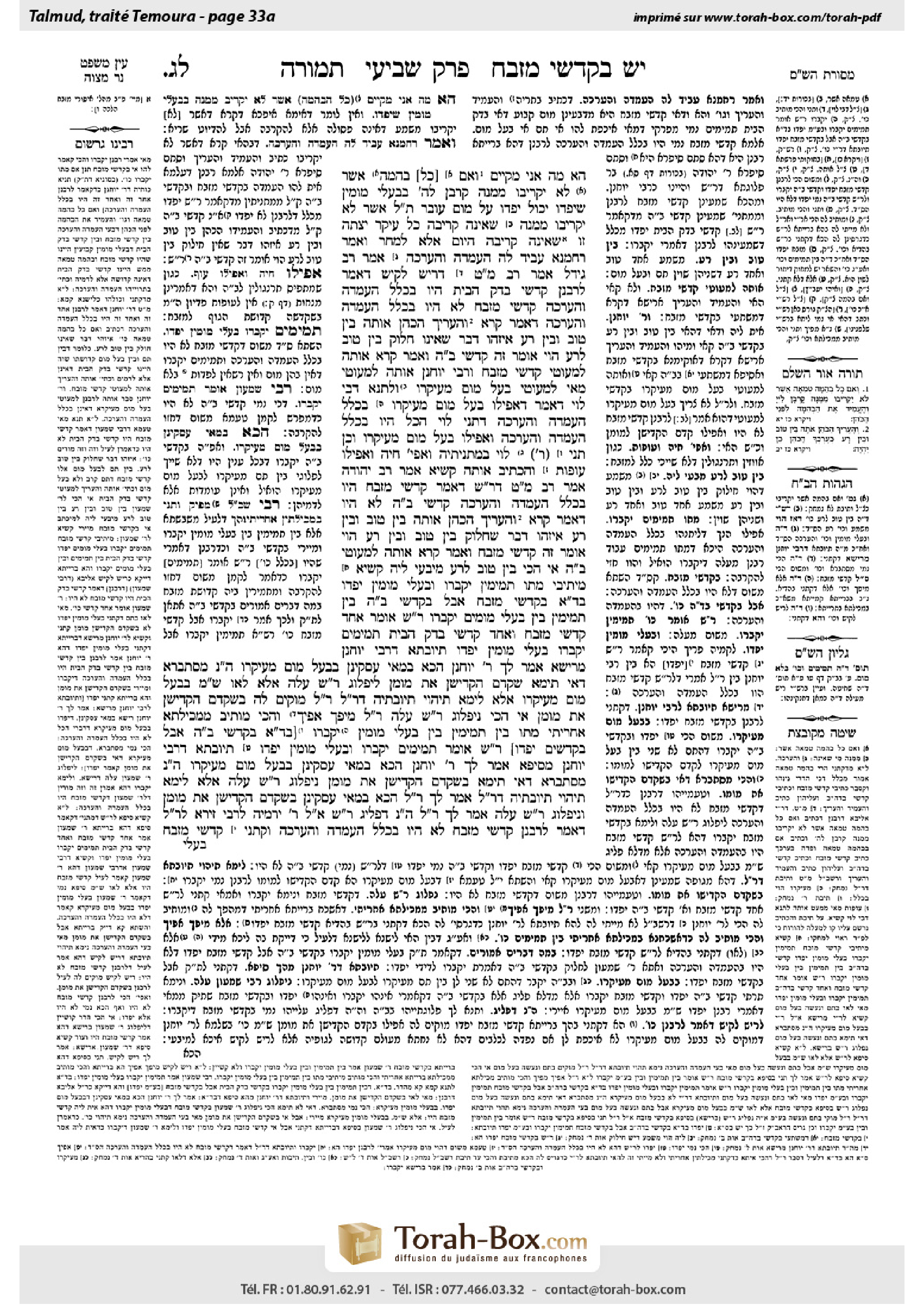
Temurah 33a: Talmud study for Daf Yomi
Daf Yomi is the daily study of one Talmud folio. Explore 37 tractates with scans, Hebrew text, Sefaria English and AI-generated French translations where annotated.
Passage selection and English or AI-generated French translation are available where the scan has annotations. Daf Study is independent of Torah-Box and Sefaria.
Browse Temurah · תמורה · All tractatesTemurah 33a text and translations
This page of Temurah includes the Aramaic text, an English translation and an AI-generated French translation, alongside the scan above.
תמורה ל״ג א · Aramaic and Hebrew text
הָא מָה אֲנִי מְקַיֵּים ״וְאִם כׇּל בְּהֵמָה אֲשֶׁר לֹא יַקְרִיבוּ מִמֶּנָּה קׇרְבָּן לַה׳״ — בְּבַעֲלֵי מוּמִין שֶׁיִּפָּדוּ.
יָכוֹל יִפָּדוּ עַל מוּם עוֹבֵר? תַּלְמוּד לוֹמַר ״אֲשֶׁר לֹא יַקְרִיבוּ מִמֶּנָּה״ — שֶׁאֵינָהּ קְרֵיבָה כׇּל עִיקָּר, יָצְתָה זוֹ שֶׁאֵינָהּ קְרֵיבָה הַיּוֹם אֶלָּא לְמָחָר.
וְאָמַר רַחֲמָנָא: עֲבֵיד לַהּ הַעֲמָדָה וְהַעֲרָכָה.
אָמַר רַב גִּידֵּל, אָמַר רַב: מַאי טַעְמָא דְּרֵישׁ לָקִישׁ, דְּאָמַר לְרַבָּנַן קׇדְשֵׁי בֶּדֶק הַבַּיִת הָיוּ בִּכְלַל הַעֲמָדָה וְהַעֲרָכָה, קׇדְשֵׁי מִזְבֵּחַ לֹא הָיוּ בִּכְלַל הַעֲמָדָה וְהַעֲרָכָה? דְּאָמַר קְרָא: ״וְהֶעֱרִיךְ הַכֹּהֵן אוֹתָהּ בֵּין טוֹב וּבֵין רָע״.
אֵיזֶהוּ דָּבָר שֶׁאֵינוֹ חָלוּק בֵּין טוֹב לְרַע? הֱוֵי אוֹמֵר: זֶה קׇדְשֵׁי בֶּדֶק הַבַּיִת, וְאָמַר קְרָא ״אוֹתָהּ״ לְמַעוֹטֵי קׇדְשֵׁי מִזְבֵּחַ.
וְרַבִּי יוֹחָנָן, ״אוֹתָהּ״ לְמַעוֹטֵי מַאי? לְמַעוֹטֵי בַּעַל מוּם מֵעִיקָּרוֹ.
וּלְתַנָּא דְּבֵי לֵוִי, דְּאָמַר דַּאֲפִילּוּ בַּעַל מוּם מֵעִיקָּרוֹ בִּכְלַל הַעֲמָדָה וְהַעֲרָכָה, דְּתָנֵי לֵוִי: הַכֹּל הָיוּ בִּכְלַל הַעֲמָדָה וְהַעֲרָכָה, וַאֲפִילּוּ בַּעַל מוּם מֵעִיקָּרוֹ, וְכֵן תָּנֵי לֵוִי בְּמַתְנִיתֵיהּ: וַאֲפִילּוּ חַיָּה, וַאֲפִילּוּ עוֹפוֹת, וְהָכְתִיב ״אוֹתָהּ״! קַשְׁיָא.
אָמַר רַב יְהוּדָה, אָמַר רַב: מַאי טַעְמָא דְּרַבִּי שִׁמְעוֹן דְּאָמַר, קׇדְשֵׁי מִזְבֵּחַ הָיוּ בִּכְלַל הַעֲמָדָה וְהַעֲרָכָה, קׇדְשֵׁי בֶּדֶק הַבַּיִת לֹא הָיוּ? דְּאָמַר קְרָא: ״וְהֶעֱרִיךְ הַכֹּהֵן אוֹתָהּ בֵּין טוֹב וּבֵין רָע״, אֵיזֶהוּ דָּבָר שֶׁחָלוּק בֵּין טוֹב וּבֵין רָע? הֱוֵי אוֹמֵר: זֶה קׇדְשֵׁי מִזְבֵּחַ, וְאָמַר קְרָא ״אוֹתָהּ״ לְמַעוֹטֵי בֶּדֶק הַבַּיִת.
אִי הָכִי, ״בֵּין טוֹב לְרָע״ מִיבְּעֵי לֵיהּ! קַשְׁיָא.
מֵיתִיבִי: מֵתוּ תְּמִימִין — יִקָּבְרוּ, וּבַעֲלֵי מוּמִין — יִפָּדוּ. בַּמֶּה דְבָרִים אֲמוּרִים? בְּקׇדְשֵׁי מִזְבֵּחַ, אֲבָל בְּקׇדְשֵׁי בֶּדֶק הַבַּיִת — בֵּין תְּמִימִין בֵּין בַּעֲלֵי מוּמִים יִקָּבֵרוּ.
רַבִּי שִׁמְעוֹן אוֹמֵר: אֶחָד קׇדְשֵׁי מִזְבֵּחַ וְאֶחָד קׇדְשֵׁי בֶּדֶק הַבַּיִת, תְּמִימִים — יִקָּבְרוּ, בַּעֲלֵי מוּמִין — יִפָּדוּ. תְּיוּבְתָּא דְּרַבִּי יוֹחָנָן מֵרֵישָׁא!
אָמַר לָךְ רַבִּי יוֹחָנָן: הָכָא בְמַאי עָסְקִינַן? בְּבַעַל מוּם מֵעִיקָּרוֹ.
הָכִי נָמֵי מִסְתַּבְּרָא, דְּאִי תֵּימָא שֶׁקָּדַם הֶקְדֵּישָׁן אֶת מוּמָן — לִיפְלוֹג רַבִּי שִׁמְעוֹן עֲלַהּ, אֶלָּא לָאו שְׁמַע מִינָּה בְּבַעַל מוּם מֵעִיקָּרוֹ.
אֶלָּא, לֵימָא תֶּיהְוֵי תְּיוּבְתֵּיהּ דְּרֵישׁ לָקִישׁ!
רֵישׁ לָקִישׁ מוֹקֵים לַהּ בְּשֶׁקָּדַם הֶקְדֵּישָׁן אֶת מוּמָן, אִי הָכִי, נִיפְלוֹג רַבִּי שִׁמְעוֹן עֲלַהּ.
רֵישׁ לָקִישׁ מֵיפָךְ אָפֵיךְ, וְהָכִי מוֹתֵיב מִמְּכִילְתָּא אַחֲרִיתִי: מֵתוּ, בֵּין תְּמִימִין בֵּין בַּעֲלֵי מוּמִין — יִקָּבֵרוּ. [בַּמֶּה דְבָרִים אֲמוּרִים? בְּקׇדְשֵׁי מִזְבֵּחַ, אֲבָל בְּקׇדְשֵׁי בֶּדֶק הַבַּיִת — יִפָּדוּ.]
רַבִּי שִׁמְעוֹן אוֹמֵר: תְּמִימִים — יִקָּבְרוּ, וּבַעֲלֵי מוּמִין — יִפָּדוּ. תְּיוּבְתָּא דְּרַבִּי יוֹחָנָן מִסֵּיפָא!
אָמַר לָךְ רַבִּי יוֹחָנָן: הָכָא בְמַאי עָסְקִינַן? בְּבַעַל מוּם מֵעִיקָּרוֹ. הָכִי נָמֵי מִסְתַּבְּרָא, דְּאִי תֵּימָא בְּשֶׁקָּדַם הֶקְדֵּישָׁן אֶת מוּמָן — נִיפְלוֹג רַבִּי שִׁמְעוֹן עֲלַהּ.
אֶלָּא לֵימָא תֶּיהְוֵי תְּיוּבְתֵּיהּ דְּרֵישׁ לָקִישׁ! אָמַר לָךְ רֵישׁ לָקִישׁ: הָכָא בְמַאי עָסְקִינַן — בְּשֶׁקָּדַם הֶקְדֵּישָׁן אֶת מוּמָן. וְנִיפְלוֹג רַבִּי שִׁמְעוֹן עֲלַהּ! אָמַר לָךְ רֵישׁ לָקִישׁ: הָכִי נָמֵי דִּפְלִיג רַבִּי שִׁמְעוֹן.
אֲמַר לֵיהּ רַבִּי יִרְמְיָה לְרַבִּי זֵירָא: לְרֵישׁ לָקִישׁ, דְּאָמַר לְרַבָּנַן: קׇדְשֵׁי מִזְבֵּחַ לֹא הָיוּ בִּכְלַל הַעֲמָדָה וְהַעֲרָכָה, וְקָתָנֵי ״קׇדְשֵׁי מִזְבֵּחַ
Temurah 33a · English translation
But if the halakha of standing and valuation is already mentioned with regard to a non-kosher animal, how do I realize the meaning of the verse: “And if it be any non-kosher animal, of which they may not bring an offering unto the Lord, then he shall set the animal before the priest. And the priest shall value it.” The verse is referring to blemished animals, which are unfit for sacrifice just like non-kosher animals, and it teaches that they can be redeemed.
The baraita continues: One might have thought that any blemished animal can be redeemed, even for a temporary blemish. Therefore, the verse states: “Non-kosher animal, of which they may not bring an offering,” which indicates that only a blemished animal that may not be sacrificed at all, i.e., one with a permanent blemish, is redeemed. This animal with a temporary blemish is thereby excluded, as it may not be sacrificed today, but it may be sacrificed tomorrow.
The Gemara concludes its reasoning: And the Merciful One states that one should perform standing and valuation for a blemished animal, in accordance with the verse “Then he shall set the animal before the priest. And the priest shall value it.” Since the verse requires that the animal have a permanent blemish to be redeemed, it must be referring to an animal consecrated for the altar, as all animals consecrated for Temple maintenance may be redeemed, even unblemished ones. Furthermore, as this is an unattributed baraita that appears in the Sifra, it is in accordance with the opinion of Rabbi Yehuda, the disputant of Rabbi Shimon, and therefore it follows the opinion of the Rabbis of the mishna. It may therefore be concluded from the baraita that the Rabbis hold that one redeems an animal consecrated for the altar with standing and valuation, as maintained by Rabbi Yoḥanan.
§ The Gemara analyzes the opinion of Reish Lakish. Rav Giddel said that Rav said: What is the reasoning of Reish Lakish, who said that according to the Rabbis, animals consecrated for Temple maintenance were included in the halakha of standing and valuation, whereas animals consecrated for the altar were not included in the halakha of standing and valuation? The reasoning is that the verse states: “Then he shall set the animal before the priest. And the priest shall value it, whether it be good or bad” (Leviticus 27:12).
Rav explained: What is an item for which the halakha is not divided between good and bad, i.e., where there is no difference between unblemished and blemished animals? You must say that this is an item consecrated for Temple maintenance, which has the same sanctity whether blemished or unblemished. And the verse states: “And the priest shall value it.” The restrictive term “it” serves to exclude animals consecrated for the altar from the halakha of standing and valuation.
The Gemara asks: And according to Rabbi Yoḥanan, who says that according to the Rabbis, animals consecrated for the altar are also included in the obligation of standing and valuation, the term “it” serves to exclude what? The Gemara responds: It serves to exclude from the halakha of standing and valuation an animal that was blemished from the outset and was consecrated for the altar.
The Gemara raises a difficulty: But this is problematic according to the tanna of the school of Levi, who said that even an animal that was blemished from the outset is included in the halakha of standing and valuation. As Levi taught: Everything was included in the halakha of standing and valuation, even an animal blemished from the outset. And Levi taught likewise in his baraita: Even an undomesticated animal, and even birds that are not brought as offerings, e.g., geese, are included in the halakha of standing and valuation. But isn’t it written “it,” which must serve to exclude some animal from the obligation of standing and valuation? If so, how can Levi teach that everything is included? The Gemara concludes: Indeed, this poses a difficulty.
The Gemara discusses the opinion of Rabbi Shimon in the mishna. Rav Yehuda said that Rav said: What is the reasoning of Rabbi Shimon, who said that animals consecrated for the altar were included in the halakha of standing and valuation, and therefore if they died without redemption they are buried, but animals consecrated for Temple maintenance were not included in this halakha? As the verse states: “Then he shall set the animal before the priest. And the priest shall value it, whether it be good or bad” (Leviticus 27:11–12). What is an item for which the halakha is divided between good and bad, i.e., between an unblemished and blemished animal? You must say that this is an animal consecrated for the altar, and the verse states: “And the priest shall value it,” which serves to exclude animals consecrated for Temple maintenance from the halakha of standing and valuation.
The Gemara asks: If so, that the verse is referring to a consecration for which there is a distinction between good and bad, then it should have stated: And the priest shall value it between good and bad, to indicate that this distinction is made. The term “whether it be good or bad” indicates that the two types have the same halakha, as claimed by the Rabbis. The Gemara concludes: This poses a difficulty for the opinion of Rabbi Shimon.
§ The Gemara raises an objection to the opinions of Rabbi Yoḥanan and Reish Lakish from a baraita: With regard to consecrated animals that died, if they were unblemished they are not redeemed and shall be buried, and if they were blemished they can be redeemed. In what case is this statement said? It is said with regard to animals consecrated for the altar. But with regard to animals consecrated for Temple maintenance, both unblemished and blemished animals shall be buried. This is the statement of the Rabbis.
Rabbi Shimon says: Both in a case where the animals that died were consecrated for the altar and in a case where they were consecrated for Temple maintenance, if they were unblemished they can be buried, and if they were blemished they can be redeemed. This is apparently a conclusive refutation of the statement of Rabbi Yoḥanan, from the first clause of the baraita, as Rabbi Yoḥanan holds that according to the Rabbis, both animals consecrated for the altar and those consecrated for Temple maintenance are included in the halakha of standing and valuation and are buried if they died.
The Gemara answers that Rabbi Yoḥanan could say to you: What are we dealing with here? We are dealing with an animal that was blemished from the outset. In such a case, the Rabbis rule that the animal was not included in the halakha of standing and valuation and is therefore redeemed if it dies. But a consecrated animal that subsequently developed a blemish and died must be buried.
The Gemara adds: So too, it is reasonable that the baraita is discussing animals blemished from the outset, as, if you say that it is referring to animals whose consecrations preceded their blemishes, then Rabbi Shimon should disagree with the Rabbis on this point and maintain that such blemished animals consecrated for the altar should be buried, not redeemed. After all, Rabbi Shimon holds that animals consecrated for the altar are included in the halakha of standing and valuation. Rather, must one not conclude from this that the baraita is dealing with an animal that is blemished from the outset?
The Gemara raises a difficulty: But if the baraita is referring to animals blemished from the outset, and for this reason the Rabbis hold that the animal is redeemed, then it may be inferred that the Rabbis maintain that if the animal developed a blemish after its consecration and died, it must be buried. If so, let us say that the baraita is a conclusive refutation of the opinion of Reish Lakish, who maintains that according to the Rabbis, animals consecrated for the altar were not included in the halakha of standing and valuation and are redeemed if they died.
The Gemara responds: Reish Lakish interprets the baraita as referring to animals whose consecrations preceded their blemishes. Consequently, the statement of the Rabbis is in accordance with his opinion that animals consecrated for the altar were not included in the halakha of standing and valuation and are therefore redeemed if they died. The Gemara asks: If so, then the earlier question recurs, as Rabbi Shimon should disagree with the statement of the Rabbis and say that such blemished animals consecrated for the altar are buried.
The Gemara answers: Reish Lakish reverses the text of that baraita, i.e., he maintains that in that baraita, Rabbi Shimon explicitly states that animals consecrated for the altar are buried, whether they are unblemished or blemished. And he raises his objection to the opinion of Rabbi Yoḥanan from another baraita, like this: With regard to consecrated animals that died, whether they were unblemished or blemished, they shall be buried. With regard to what case is this ruling stated? It is stated with regard to animals consecrated for the altar, but in the case of animals consecrated for Temple maintenance, they can be redeemed. This is the statement of the Rabbis.
The baraita continues: Rabbi Shimon says: With regard to animals consecrated for Temple maintenance that died, if they were unblemished they shall be buried, and if they were blemished they can be redeemed. This is apparently a conclusive refutation of the opinion of Rabbi Yoḥanan, from the latter clause of the statement of the Rabbis in this baraita. According to the baraita, the Rabbis rule that animals consecrated for the altar are redeemed, whereas according to Rabbi Yoḥanan, the Rabbis maintain that animals consecrated for the altar are buried.
The Gemara answers that Rabbi Yoḥanan could say to you: What are we dealing with here? We are dealing with an animal that was blemished from the outset. The Gemara notes: So, too, it is reasonable that the baraita is referring to animals blemished from the outset, as, if you say that it is dealing with animals whose consecrations preceded their blemishes, and the Rabbis hold that animals consecrated for Temple maintenance are buried whereas those consecrated for the altar are redeemed, then Rabbi Shimon should disagree with the statement of the Rabbis on both accounts, rather than disagreeing merely in the case of animals consecrated for Temple maintenance.
The Gemara asks: But if so, let us say that the baraita is a conclusive refutation of the opinion of Reish Lakish, as Rabbi Shimon does not disagree with the Rabbis in the case of animals consecrated for the altar. The Gemara answers that Reish Lakish could say to you: What are we dealing with here? We are dealing with animals whose consecrations preceded their blemishes. The Gemara reiterates: But in that case, Rabbi Shimon should disagree with the Rabbis. The Gemara responds: Reish Lakish could say to you: Indeed, Rabbi Shimon disagrees with the Rabbis even with regard to animals consecrated for the altar. The baraita mentions Rabbi Shimon’s opinion only with regard to consecrations for Temple maintenance, but he also disagrees with regard to consecrations for the altar.
§ The Gemara further discusses the dispute between Rabbi Yoḥanan and Reish Lakish. Rabbi Yirmeya said to Rabbi Zeira: According to Reish Lakish, who says that according to the Rabbis, animals consecrated for the altar were not included in the halakha of standing and valuation, and it is taught with regard to animals consecrated for the altar
Temurah 33a · Traduction française (IA)
Mais si la halakha de la présentation et de l’estimation est déjà mentionnée à propos d’un animal non casher, comment comprendre le verset : « Et s’il s’agit d’un animal non casher, dont on ne peut apporter d’offrande au Seigneur, on présentera l’animal au prêtre. Et le prêtre en fera l’estimation. » Le verset parle d’animaux atteints d’un défaut, qui sont inaptes au sacrifice au même titre que les animaux non casher, et enseigne qu’ils peuvent être rachetés.
La baraïta poursuit : On aurait pu penser que tout animal atteint d’un défaut peut être racheté, même si ce défaut est temporaire. C’est pourquoi le verset dit : « Un animal non casher, dont on ne peut apporter d’offrande », ce qui indique que seul peut être racheté un animal qui ne peut absolument pas être sacrifié, c’est-à-dire un animal atteint d’un défaut permanent. L’animal atteint d’un défaut temporaire est ainsi exclu, car il ne peut pas être sacrifié aujourd’hui, mais il pourra l’être demain.
La Guemara achève son raisonnement : Le Miséricordieux dit qu’il faut procéder à la présentation et à l’estimation d’un animal atteint d’un défaut, conformément au verset : « On présentera l’animal au prêtre. Et le prêtre en fera l’estimation. » Puisque le verset exige que l’animal soit atteint d’un défaut permanent pour pouvoir être racheté, il doit s’agir d’un animal consacré à l’autel, car tout animal consacré à l’entretien du Temple peut être racheté, même s’il est sans défaut. En outre, puisqu’il s’agit d’une baraïta anonyme qui figure dans le Sifra, elle est conforme à l’opinion de Rabbi Yehuda, qui s’oppose à Rabbi Shimon, et donc à celle des rabbins de la Michna. On peut par conséquent conclure de cette baraïta que les rabbins estiment qu’un animal consacré à l’autel est racheté après présentation et estimation, comme le soutient Rabbi Yoḥanan.
§ La Guemara examine l’opinion de Reish Lakish. Rav Giddel a dit au nom de Rav : Quelle est la raison de Reish Lakish, qui affirme que, selon les rabbins, les animaux consacrés à l’entretien du Temple sont soumis à la halakha de la présentation et de l’estimation, tandis que les animaux consacrés à l’autel ne le sont pas ? La raison en est que le verset dit : « On présentera l’animal au prêtre. Et le prêtre en fera l’estimation, qu’il soit bon ou mauvais » (Lévitique 27,12).
Rav explique : De quel bien la halakha ne distingue-t-elle pas le bon du mauvais, c’est-à-dire entre un animal sans défaut et un animal atteint d’un défaut ? Il faut dire qu’il s’agit d’un bien consacré à l’entretien du Temple, qui possède la même sainteté, qu’il soit atteint d’un défaut ou non. Et le verset dit : « Et le prêtre en fera l’estimation. » Le terme restrictif « en » sert à exclure les animaux consacrés à l’autel de la halakha de la présentation et de l’estimation.
La Guemara demande : Et selon Rabbi Yoḥanan, qui dit que, selon les rabbins, les animaux consacrés à l’autel sont eux aussi soumis à l’obligation de présentation et d’estimation, qu’est-ce que le terme « en » sert à exclure ? La Guemara répond : Il sert à exclure de la halakha de la présentation et de l’estimation un animal qui était atteint d’un défaut dès le départ et qui a été consacré à l’autel.
La Guemara soulève une difficulté : Mais cela pose problème selon le tanna de l’école de Levi, qui a dit que même un animal atteint d’un défaut dès le départ est soumis à la halakha de la présentation et de l’estimation. Car Levi a enseigné : Tout était inclus dans la halakha de la présentation et de l’estimation, même un animal atteint d’un défaut dès le départ. Levi l’a également enseigné dans sa baraïta : même les animaux sauvages, et même les oiseaux qui ne sont pas apportés comme offrandes, par exemple les oies, sont soumis à la halakha de la présentation et de l’estimation. Or, n’est-il pas écrit « en », terme qui doit servir à exclure un animal de l’obligation de présentation et d’estimation ? Si oui, comment Levi peut-il enseigner que tout est inclus ? La Guemara conclut : En effet, cela pose une difficulté.
La Guemara examine l’opinion de Rabbi Shimon dans la Michna. Rav Yehuda a dit au nom de Rav : Quelle est la raison de Rabbi Shimon, qui a dit que les animaux consacrés à l’autel sont soumis à la halakha de la présentation et de l’estimation et que, par conséquent, s’ils meurent sans avoir été rachetés, ils doivent être enterrés, tandis que les animaux consacrés à l’entretien du Temple ne sont pas soumis à cette halakha ? Le verset dit : « On présentera l’animal au prêtre. Et le prêtre en fera l’estimation, qu’il soit bon ou mauvais » (Lévitique 27,11-12). De quel bien la halakha distingue-t-elle le bon du mauvais, c’est-à-dire entre un animal sans défaut et un animal atteint d’un défaut ? Il faut dire qu’il s’agit d’un animal consacré à l’autel. Or, le verset dit : « Et le prêtre en fera l’estimation », ce qui sert à exclure les animaux consacrés à l’entretien du Temple de la halakha de la présentation et de l’estimation.
La Guemara demande : Si c’est ainsi, si le verset parle d’une consécration pour laquelle il existe une distinction entre le bon et le mauvais, il aurait dû dire : « Et le prêtre en fera l’estimation entre le bon et le mauvais », afin d’indiquer que cette distinction est faite. Les termes « qu’il soit bon ou mauvais » indiquent que les deux catégories relèvent de la même halakha, comme le soutiennent les rabbins. La Guemara conclut : Cela pose une difficulté à l’opinion de Rabbi Shimon.
§ La Guemara soulève une objection aux opinions de Rabbi Yoḥanan et de Reish Lakish à partir d’une baraïta : Quant aux animaux consacrés qui sont morts, s’ils étaient sans défaut, ils ne sont pas rachetés et doivent être enterrés ; s’ils étaient atteints d’un défaut, ils peuvent être rachetés. Dans quel cas cette déclaration s’applique-t-elle ? Elle concerne des animaux consacrés à l’autel. Mais les animaux consacrés à l’entretien du Temple, qu’ils soient sans défaut ou atteints d’un défaut, doivent être enterrés. Telle est la déclaration des rabbins.
Rabbi Shimon dit : Que les animaux morts aient été consacrés à l’autel ou à l’entretien du Temple, s’ils étaient sans défaut, ils doivent être enterrés ; s’ils étaient atteints d’un défaut, ils peuvent être rachetés. Cela semble réfuter définitivement la déclaration de Rabbi Yoḥanan, d’après la première partie de la baraïta, car Rabbi Yoḥanan estime que, selon les rabbins, les animaux consacrés à l’autel comme ceux consacrés à l’entretien du Temple sont soumis à la halakha de la présentation et de l’estimation et doivent être enterrés s’ils meurent.
La Guemara répond que Rabbi Yoḥanan pourrait te dire : De quoi parlons-nous ici ? D’un animal qui était atteint d’un défaut dès le départ. Dans ce cas, les rabbins statuent que l’animal n’était pas soumis à la halakha de la présentation et de l’estimation et qu’il est donc racheté s’il meurt. Mais un animal consacré qui a ensuite développé un défaut et qui est mort doit être enterré.
La Guemara ajoute : Il est également raisonnable que la baraïta parle d’animaux atteints d’un défaut dès le départ, car, si l’on dit qu’elle parle d’animaux consacrés avant d’avoir été atteints d’un défaut, Rabbi Shimon devrait être en désaccord avec les rabbins sur ce point et soutenir que ces animaux atteints d’un défaut, consacrés à l’autel, doivent être enterrés et non rachetés. Après tout, Rabbi Shimon estime que les animaux consacrés à l’autel sont soumis à la halakha de la présentation et de l’estimation. Ne faut-il donc pas conclure que la baraïta parle d’un animal atteint d’un défaut dès le départ ?
La Guemara soulève une difficulté : Mais si la baraïta parle d’animaux atteints d’un défaut dès le départ, et que c’est pour cette raison que les rabbins estiment que l’animal est racheté, on peut en déduire que les rabbins soutiennent que, si l’animal a développé un défaut après sa consécration et qu’il est mort, il doit être enterré. Si c’est ainsi, disons que la baraïta réfute définitivement l’opinion de Reish Lakish, qui soutient que, selon les rabbins, les animaux consacrés à l’autel ne sont pas soumis à la halakha de la présentation et de l’estimation et sont rachetés s’ils meurent.
La Guemara répond : Reish Lakish interprète la baraïta comme parlant d’animaux consacrés avant d’avoir été atteints d’un défaut. Par conséquent, la déclaration des rabbins est conforme à son opinion : les animaux consacrés à l’autel ne sont pas soumis à la halakha de la présentation et de l’estimation et sont donc rachetés s’ils meurent. La Guemara demande : Si c’est ainsi, la question précédente se pose à nouveau, car Rabbi Shimon devrait être en désaccord avec les rabbins et dire que de tels animaux atteints d’un défaut, consacrés à l’autel, doivent être enterrés.
La Guemara répond : Reish Lakish inverse le texte de cette baraïta, c’est-à-dire qu’il estime que, dans cette baraïta, Rabbi Shimon dit explicitement que les animaux consacrés à l’autel doivent être enterrés, qu’ils soient sans défaut ou atteints d’un défaut. Il soulève son objection à l’opinion de Rabbi Yoḥanan à partir d’une autre baraïta, comme suit : Quant aux animaux consacrés qui sont morts, qu’ils soient sans défaut ou atteints d’un défaut, ils doivent être enterrés. À quel cas cette règle s’applique-t-elle ? Aux animaux consacrés à l’autel ; mais les animaux consacrés à l’entretien du Temple peuvent être rachetés. Telle est la déclaration des rabbins.
La baraïta poursuit : Rabbi Shimon dit : Quant aux animaux consacrés à l’entretien du Temple qui sont morts, s’ils étaient sans défaut, ils doivent être enterrés ; s’ils étaient atteints d’un défaut, ils peuvent être rachetés. Cela semble réfuter définitivement l’opinion de Rabbi Yoḥanan, d’après la dernière partie de la déclaration des rabbins dans cette baraïta. Selon la baraïta, les rabbins statuent que les animaux consacrés à l’autel sont rachetés, alors que, selon Rabbi Yoḥanan, les rabbins estiment que les animaux consacrés à l’autel doivent être enterrés.
La Guemara répond que Rabbi Yoḥanan pourrait te dire : De quoi parlons-nous ici ? D’un animal qui était atteint d’un défaut dès le départ. La Guemara fait également remarquer qu’il est raisonnable que la baraïta parle d’animaux atteints d’un défaut dès le départ, car, si l’on dit qu’elle concerne des animaux consacrés avant d’avoir été atteints d’un défaut et que les rabbins estiment que les animaux consacrés à l’entretien du Temple doivent être enterrés, tandis que ceux consacrés à l’autel sont rachetés, alors Rabbi Shimon devrait être en désaccord avec les rabbins sur les deux points, au lieu de ne s’opposer qu’au sujet des animaux consacrés à l’entretien du Temple.
La Guemara demande : Mais si c’est ainsi, disons que la baraïta réfute définitivement l’opinion de Reish Lakish, puisque Rabbi Shimon n’est pas en désaccord avec les rabbins au sujet des animaux consacrés à l’autel. La Guemara répond que Reish Lakish pourrait te dire : De quoi parlons-nous ici ? D’animaux consacrés avant d’avoir été atteints d’un défaut. La Guemara reprend : Mais dans ce cas, Rabbi Shimon devrait être en désaccord avec les rabbins. La Guemara répond : Reish Lakish pourrait te dire : En effet, Rabbi Shimon est également en désaccord avec les rabbins au sujet des animaux consacrés à l’autel. La baraïta mentionne l’opinion de Rabbi Shimon uniquement à propos des animaux consacrés à l’entretien du Temple, mais il est également en désaccord au sujet des animaux consacrés à l’autel.
§ La Guemara poursuit l’examen du désaccord entre Rabbi Yoḥanan et Reish Lakish. Rabbi Yirmeya dit à Rabbi Zeira : Selon Reish Lakish, qui affirme que, selon les rabbins, les animaux consacrés à l’autel ne sont pas soumis à la halakha de la présentation et de l’estimation, et qu’il est enseigné au sujet des animaux consacrés à l’autel
Traduction française générée par IA à partir de l’édition anglaise de Sefaria. Vérifie toujours un passage avec le texte source.
Text from Sefaria: William Davidson Edition - Vocalized Aramaic (CC BY NC); William Davidson Edition - English (CC BY NC).