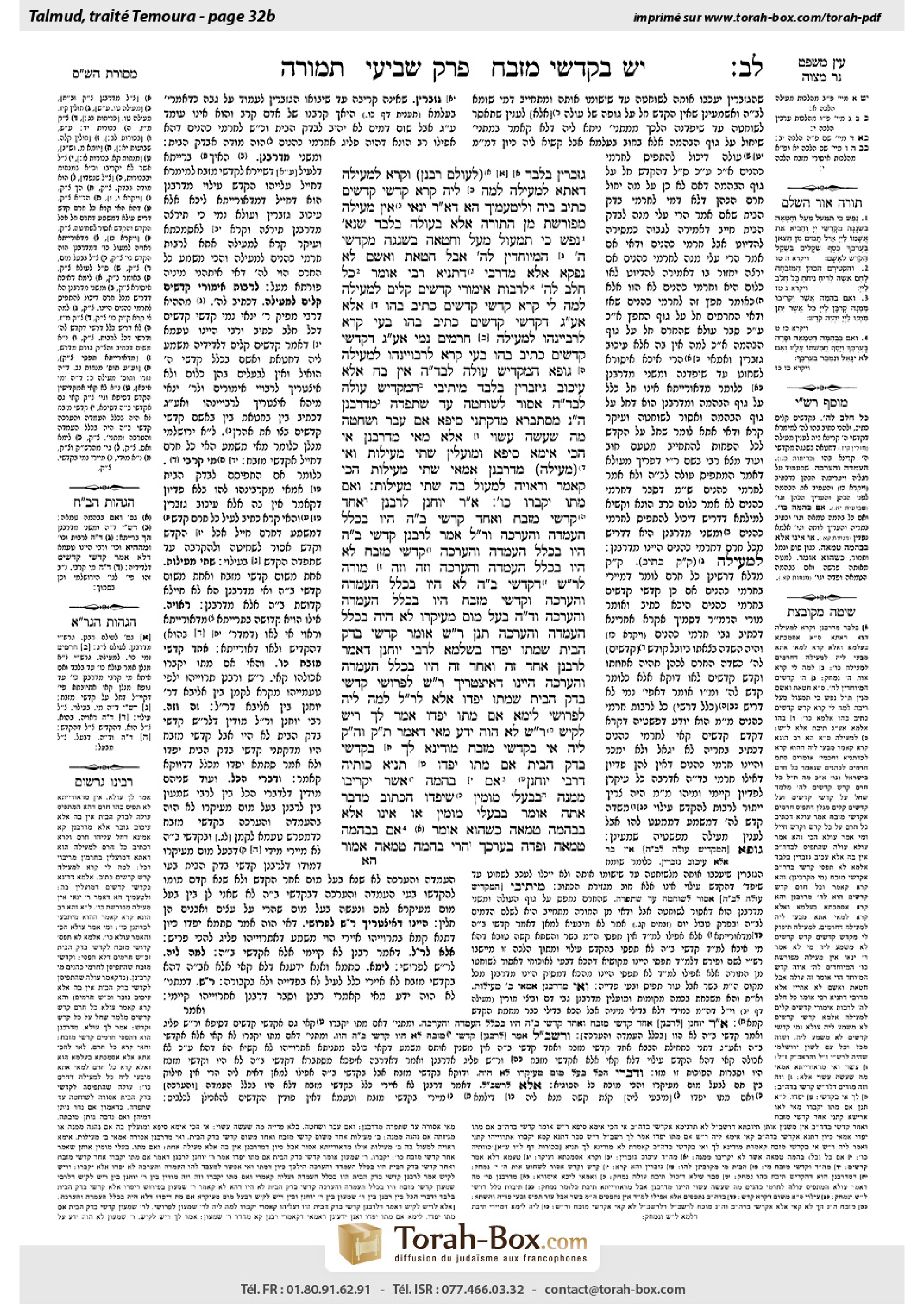
Temurah 32b: Talmud study for Daf Yomi
Daf Yomi is the daily study of one Talmud folio. Explore 37 tractates with scans, Hebrew text, Sefaria English and AI-generated French translations where annotated.
Passage selection and English or AI-generated French translation are available where the scan has annotations. Daf Study is independent of Torah-Box and Sefaria.
Browse Temurah · תמורה · All tractatesTemurah 32b text and translations
This page of Temurah includes the Aramaic text, an English translation and an AI-generated French translation, alongside the scan above.
תמורה ל״ב ב · Aramaic and Hebrew text
גִּזְבָּרִין בִּלְבַד!
לְעוֹלָם רַבָּנַן, וְקָרָא לִמְעִילָה [הוּא] דַּאֲתָא.
לִמְעִילָה לְמָה לֵיהּ קְרָא? קׇדְשֵׁי קָדָשִׁים כְּתִיב בֵּיהּ!
וְלִיטַעְמָיךְ, הָא דְּאָמַר רַבִּי יַנַּאי: אֵין מְעִילָה מְפוֹרֶשֶׁת מִן הַתּוֹרָה אֶלָּא בְּעוֹלָה בִּלְבָד, שֶׁנֶּאֱמַר: ״נֶפֶשׁ כִּי תִמְעוֹל מַעַל וְחָטְאָה בִּשְׁגָגָה מִקׇּדְשֵׁי ה׳״, הַמְיוּחָדִין לַה׳. אֲבָל חַטָּאת וְאָשָׁם לָא נָפְקָא אֶלָּא מִדְּרַבִּי.
דְּתַנְיָא, רַבִּי אוֹמֵר: ״כׇּל חֵלֶב לַה׳״ — לְרַבּוֹת אֵימוּרֵי קָדָשִׁים קַלִּים לִמְעִילָה.
לְמָה לִי קְרָא? ״קׇדְשֵׁי קָדָשִׁים״ כְּתִיב בְּהוּ! אֶלָּא, אַף עַל גַּב דְּ״קׇדְשֵׁי קָדָשִׁים״ כְּתִיב בְּהוּ, בָּעֵי קְרָא לְרַבּוֹיִינְהוּ לִמְעִילָה. חֲרָמִים נָמֵי, אַף עַל גַּב דְּ״קׇדְשֵׁי קָדָשִׁים״ כְּתִיב בְּהוּ, בָּעֵי קְרָא לְרַבּוֹיִינְהוּ לִמְעִילָה.
גּוּפָא: הַמַּקְדִּישׁ עוֹלָה לְבֶדֶק הַבַּיִת — אֵין בָּהּ אֶלָּא עִיכּוּב גִּיזְבָּרִין בִּלְבַד. מֵיתִיבִי: הַמַּקְדִּישׁ עוֹלָה לְבֶדֶק הַבַּיִת — אָסוּר לְשׁוֹחֳטָהּ עַד שֶׁתִּפָּדֶה!
מִדְּרַבָּנַן, הָכִי נָמֵי מִסְתַּבְּרָא, מִדְּקָתָנֵי סֵיפָא: אִם עָבַר וּשְׁחָטָהּ — מַה שֶּׁעָשָׂה עָשׂוּי.
אֶלָּא מַאי מִדְּרַבָּנַן? אִי הָכִי, אֵימָא סֵיפָא: וּמוֹעֲלִין שְׁתֵּי מְעִילוֹת, וְאִי מִדְּרַבָּנַן — אַמַּאי שְׁתֵּי מְעִילוֹת? הָכִי קָאָמַר: וּרְאוּיָה לִמְעוֹל בָּהּ שְׁתֵּי מְעִילוֹת.
וְאִם מֵתוּ יִקָּבֵרוּ כּוּ׳.
אָמַר רַבִּי יוֹחָנָן לְרַבָּנַן: אֶחָד קׇדְשֵׁי מִזְבֵּחַ וְאֶחָד קׇדְשֵׁי בֶּדֶק הַבַּיִת — הָיוּ בִּכְלַל הַעֲמָדָה וְהַעֲרָכָה.
וְרֵישׁ לָקִישׁ אָמַר: לְרַבָּנַן, קׇדְשֵׁי בֶּדֶק הַבַּיִת הָיוּ בִּכְלַל הַעֲמָדָה וְהַעֲרָכָה, קׇדְשֵׁי מִזְבֵּחַ לֹא הָיוּ בִּכְלַל הַעֲמָדָה וְהַעֲרָכָה.
וְזֶה וָזֶה, מוֹדֶה לְרַבִּי שִׁמְעוֹן, דְּקׇדְשֵׁי בֶּדֶק הַבַּיִת לֹא הָיוּ בִּכְלַל הַעֲמָדָה וְהַעֲרָכָה, וְקׇדְשֵׁי מִזְבֵּחַ הָיוּ בִּכְלַל הַעֲמָדָה וְהַעֲרָכָה, וְדִבְרֵי הַכֹּל, בַּעַל מוּם מֵעִיקָּרוֹ לֹא הָיָה בִּכְלַל הַעֲמָדָה וְהַעֲרָכָה.
תְּנַן: רַבִּי שִׁמְעוֹן אוֹמֵר: ״קׇדְשֵׁי בֶּדֶק הַבַּיִת שֶׁמֵּתוּ יִפָּדוּ״. בִּשְׁלָמָא לְרַבִּי יוֹחָנָן, דְּאָמַר לְרַבָּנַן אֶחָד זֶה וְאֶחָד זֶה הָיוּ בִּכְלַל הַעֲמָדָה וְהַעֲרָכָה, הַיְינוּ דְּאִיצְטְרִיךְ רַבִּי שִׁמְעוֹן לְפָרוֹשֵׁי ״קׇדְשֵׁי בֶּדֶק הַבַּיִת שֶׁמֵּתוּ יִפָּדוּ״.
אֶלָּא לְרֵישׁ לָקִישׁ, לְמָה לֵיהּ לְפָרוֹשֵׁי? לֵימָא ״אִם מֵתוּ יִפָּדוּ״!
אָמַר לָךְ רֵישׁ לָקִישׁ: רַבִּי שִׁמְעוֹן לָא הֲוָה יָדַע מַאי דְּאָמַר תַּנָּא קַמָּא, וְהָכִי קָאָמַר לֵיהּ: אִי בְּקׇדְשֵׁי מִזְבֵּחַ — מוֹדֵינָא לָךְ, בְּקׇדְשֵׁי בֶּדֶק הַבַּיִת — אִם מֵתוּ יִפָּדוּ.
תַּנְיָא כְּוָתֵיהּ דְּרַבִּי יוֹחָנָן: ״אִם בְּהֵמָה אֲשֶׁר יַקְרִיבוּ מִמֶּנָּה״ — בְּבַעֲלֵי מוּמִין שֶׁיִּפָּדוּ הַכָּתוּב מְדַבֵּר.
אַתָּה אוֹמֵר בְּבַעֲלֵי מוּמִין, אוֹ אֵינוֹ אֶלָּא בִּבְהֵמָה טְמֵאָה? כְּשֶׁהוּא אוֹמֵר ״אִם בִּבְהֵמָה טְמֵאָה וּפָדָה בְעֶרְכֶּךָ״ — הֲרֵי בְּהֵמָה טְמֵאָה אָמוּר,
Temurah 32b · English translation
the treasurers alone preventing the offering from being sacrificed. In other words, the owner of an offering must stand over the animal when it is sacrificed, and in the case of a burnt offering that was associated with a consecration for Temple maintenance, the Temple treasurer is the owner. Evidently, Ulla maintains that the offering does not require an appraisal for a consecration of its value before it may be sacrificed, despite the fact that it was associated with a consecration for Temple maintenance.
The Gemara responds: Actually, this halakha, that one who associates an animal consecrated for the altar with a consecration for Temple maintenance must give the value of the animal for Temple maintenance, was instituted by the Sages; by Torah law, there is only the delay attributed to the treasurers. This is also the opinion of Ulla. And as for the verse that Ulla cites as a source for the halakha that an animal consecrated for the altar can be associated with dedications to priests (Leviticus 27:28), it is mere support for this rabbinic law. The verse actually comes to teach that one is subject to the halakhot of misuse in the case of dedications to priests.
The Gemara asks: If the term in the verse “every dedicated item” serves to teach only that one is subject to the halakhot of misuse in the case of dedications to priests, why does one need this verse at all? After all, an expression of most holy is written in the verse, as it states: “Is most holy unto the Lord,” and the halakhot of misuse apply to all sanctified items.
The Gemara rejects this claim: And according to your reasoning, that liability for misuse in the case of dedications to priests is derived from the term “is most holy,” then consider that which Rabbi Yannai said: The halakhot of misuse are written explicitly in the Torah only in the case of one who misuses a burnt offering, as it is stated with regard to the guilt offering brought for misuse: “If anyone commit a trespass, and sin through error, in the holy items of the Lord” (Leviticus 5:15). The verse indicates only that one is liable for misuse of burnt offerings, which are exclusively for the Lord. But the fact that the halakhot of misuse apply to a sin offering or a guilt offering, from which the priests or owners partake, is derived only from that which Rabbi Yehuda HaNasi taught.
This is as it is taught in a baraita, that Rabbi Yehuda HaNasi says: The verse states at the conclusion of the passage discussing the sacrifice of a peace offering: “And the priest shall make them smoke upon the altar…all the fat is the Lord’s” (Leviticus 3:16). The word “all” serves to include the portions of offerings of lesser sanctity in the halakhot of misuse; all the more so is it the case that offerings of the most sacred order, e.g., a sin offering or guilt offering, are included.
The Gemara concludes its reasoning: Why, then, do I need a verse to include these offerings? After all, an expression of “most holy,” is written with regard to a sin offering and guilt offering. Rather, it must be that even though “most holy” is written with regard to them, nevertheless, a verse is required to include them in the halakhot of misuse. With regard to dedications as well, even though “most holy” is written with regard to them, a verse is required to include them in the halakhot of misuse.
§ The Gemara earlier cited a statement of Ulla with regard to one who associates a burnt offering with a consecration for Temple maintenance. The Gemara discusses the matter itself: One who consecrates a burnt offering for Temple maintenance has only the delay attributed to the treasurers alone preventing the offering from being sacrificed. The Gemara raises an objection to this opinion from a baraita: In the case of one who consecrates a burnt offering for Temple maintenance, it is prohibited to slaughter it until it is redeemed.
The Gemara explains that this baraita is referring to the halakha by rabbinic law; by Torah law, a burnt offering cannot be consecrated by means of a consecration of value, and only the presence of the treasurers is required for it to be sacrificed. The Gemara adds: This too stands to reason, from the fact that the latter clause of the baraita teaches: If he transgressed and slaughtered it before redeeming it what he did is done and he is not required to redeem it. But if the burnt offering must be redeemed by Torah law, how can the baraita state that what he did is done? Evidently, the burnt offering is redeemed by rabbinic law.
The Gemara asks: Rather, what will you say? Will you say that the baraita is referring to the halakha by rabbinic law? If so, say the last clause of the baraita: And anyone who derives benefit from this burnt offering misuses consecrated property on two counts of misuse, one for deriving benefit from an animal consecrated for the altar and one for deriving benefit from an item consecrated for Temple maintenance. But if the burnt offering is consecrated with a consecration of value by rabbinic law, why does one who derives benefit from this burnt offering misuse consecrated property on two counts of misuse? The Gemara explains that this is what the baraita is saying: And if the consecration of value of this burnt offering was by Torah law, it is fit to be liable for misuse on two counts of misuse.
§ The mishna cites a dispute between Rabbi Shimon and the Rabbis with regard to animals consecrated for the altar and animals consecrated for Temple maintenance. The Rabbis hold that if they died and were not redeemed, they cannot be redeemed and they must be buried, whereas Rabbi Shimon maintains that this is the halakha only with regard to animals consecrated for the altar; animals consecrated for Temple maintenance can be redeemed.
With regard to this dispute, Rabbi Yoḥanan says: According to the Rabbis, both animals consecrated for the altar and animals consecrated for Temple maintenance were included in the halakha of standing and valuation, as it states in the Torah with regard to the redemption of consecrated animals: “And if it be any unclean animal, of which they may not bring an offering unto the Lord, then he shall set the animal before the priest. And the priest shall value it, whether it be good or bad; as you the priest values it, so shall it be” (Leviticus 27:11–12). Any consecrated animal that cannot be stood before the priest, e.g., one that died, is not included in the halakha of standing and valuation and must be buried.
And Reish Lakish says: According to the Rabbis, animals consecrated for Temple maintenance were included in the halakha of standing and valuation, as that verse is discussing animals consecrated for Temple maintenance. Accordingly, if an animal consecrated for Temple maintenance died and was not redeemed, it must be buried without redemption. But animals consecrated for the altar were not included in the halakha of standing and valuation, as the verse is not referring to such animals. Accordingly, if they died they are redeemed.
The Gemara adds: And both this one and that one, Rabbi Yoḥanan and Reish Lakish, agree that according to Rabbi Shimon, animals consecrated for Temple maintenance were not included in the halakha of standing and valuation, and therefore if they died they are redeemed; and animals consecrated for the altar were included in the halakha of standing and valuation, and if they died they are not redeemed. And according to both Rabbi Yoḥanan and Reish Lakish, everyone agrees, both the Rabbis and Rabbi Shimon, that if one consecrated for the altar an animal that was blemished from the outset, the animal was not included in the halakha of standing and valuation and it may be redeemed if it died.
The Gemara raises an objection to the explanation of Reish Lakish: We learned in the mishna: Rabbi Shimon says that animals consecrated for Temple maintenance that died can be redeemed. The Gemara analyzes this statement of Rabbi Shimon: Granted, according to the explanation of Rabbi Yoḥanan, who said that according to the Rabbis, both this and that, i.e., animals consecrated for the altar and for Temple maintenance, were included in the halakha of standing and valuation and if they died they are not redeemed; this is why it was necessary for Rabbi Shimon to explain that specifically in the case of animals consecrated for Temple maintenance that died, they can be redeemed. This serves to emphasize that Rabbi Shimon disagrees with the Rabbis only with regard to animals consecrated for Temple maintenance, not those consecrated for the altar.
But according to the explanation of Reish Lakish, that the Rabbis hold that only animals consecrated for Temple maintenance may not be redeemed if they died, why must Rabbi Shimon explain that he is referring to animals consecrated for Temple maintenance? Let him say simply: If they died they can be redeemed, and it would be obvious that he is speaking of animals consecrated for Temple maintenance, for if he were referring to animals consecrated for the altar, even the Rabbis agree that they may be redeemed.
The Gemara answers: Reish Lakish could have said to you that Rabbi Shimon did not know what the first tanna said, i.e., he was unsure whether the statement of the first tanna, the Rabbis, that the animal must be buried without redemption, is referring to animals consecrated for Temple maintenance or to animals consecrated for the altar. And therefore, this is what Rabbi Shimon is saying to the first tanna: If your statement is referring to animals consecrated for the altar, that they are included in the halakha of standing and valuation and must be buried if they died without redemption, then I concede to you. By contrast, if your statement is referring to animals consecrated for Temple maintenance, then I disagree with you and rule that if they died they can be redeemed.
The Gemara notes that it is taught in a baraita in accordance with the opinion of Rabbi Yoḥanan: The verse states: “And if it be any non-kosher animal, of which they may not bring an offering unto the Lord, then he shall set the animal before the priest. And the priest shall value it” (Leviticus 27:11–12). The Sages teach that the verse is speaking of blemished animals, that they can be redeemed. The verse indicates that one redeems a blemished animal by means of standing and valuation.
The baraita continues: Do you say that the verse is speaking of blemished animals; or perhaps it is referring only to a non-kosher animal, and it is teaching that a non-kosher animal that was consecrated for Temple maintenance is redeemed through standing and valuation. The baraita answers: When it says later in that passage: “And if it be of a non-kosher animal, then he shall redeem it according to your valuation” (Leviticus 27:27), a non-kosher animal is thereby stated as subject to redemption.
Temurah 32b · Traduction française (IA)
les trésoriers seuls empêchant que l’offrande soit sacrifiée. Autrement dit, le propriétaire d’une offrande doit se tenir auprès de l’animal lorsqu’il est sacrifié ; dans le cas d’un holocauste associé à une consécration destinée à l’entretien du Temple, le trésorier du Temple en est le propriétaire. Il apparaît donc qu’Oulla estime que l’offrande n’a pas besoin d’être évaluée en vue de la consécration de sa valeur avant de pouvoir être sacrifiée, bien qu’elle ait été associée à une consécration destinée à l’entretien du Temple.
La Guemara répond : En réalité, cette halakha, selon laquelle celui qui associe un animal consacré à l’autel à une consécration destinée à l’entretien du Temple doit verser au Temple la valeur de l’animal, a été instituée par les Sages ; selon la Torah, seuls les trésoriers retardent le sacrifice. C’est également l’opinion d’Oulla. Quant au verset qu’Oulla cite comme source de la halakha selon laquelle un animal consacré à l’autel peut être associé à des dons aux prêtres (Lévitique 27,28), il ne fait qu’étayer cette loi rabbinique. En réalité, le verset vient enseigner que les lois relatives à l’usage illicite de biens consacrés s’appliquent aux dons aux prêtres.
La Guemara demande : Si l’expression « tout objet voué » dans le verset sert uniquement à enseigner que les lois relatives à l’usage illicite de biens consacrés s’appliquent aux dons aux prêtres, pourquoi ce verset est-il nécessaire ? Après tout, le verset emploie l’expression « est très saint », puisqu’il est dit : « Il est très saint pour le Seigneur », et les lois relatives à l’usage illicite de biens consacrés s’appliquent à tous les objets consacrés.
La Guemara rejette cette affirmation : Selon ton raisonnement, si la responsabilité pour usage illicite de biens consacrés dans le cas des dons aux prêtres se déduit de l’expression « est très saint », considère ce que Rabbi Yannai a dit : Dans la Torah, les lois relatives à l’usage illicite de biens consacrés ne sont explicitement énoncées que dans le cas de celui qui fait un usage illicite d’un holocauste, comme il est dit à propos du sacrifice de culpabilité apporté pour un usage illicite : « Si quelqu’un commet une infidélité et pèche par inadvertance à l’égard des choses saintes du Seigneur » (Lévitique 5,15). Le verset indique uniquement qu’on est passible pour l’usage illicite d’holocaustes, qui sont exclusivement destinés au Seigneur. En revanche, le fait que les lois relatives à l’usage illicite de biens consacrés s’appliquent à un sacrifice expiatoire ou à un sacrifice de culpabilité, dont les prêtres ou les propriétaires consomment une part, se déduit uniquement de ce que Rabbi Yehouda HaNassi a enseigné.
Comme l’enseigne une baraïta, Rabbi Yehouda HaNassi dit : À la fin du passage consacré au sacrifice de paix, le verset dit : « Le prêtre les fera fumer sur l’autel… toute la graisse appartient au Seigneur » (Lévitique 3,16). Le mot « toute » inclut les parts des offrandes de moindre sainteté dans les lois relatives à l’usage illicite de biens consacrés ; à plus forte raison en va-t-il ainsi des offrandes du plus haut degré de sainteté, par exemple un sacrifice expiatoire ou un sacrifice de culpabilité.
La Guemara conclut son raisonnement : Pourquoi, alors, faut-il un verset pour inclure ces offrandes ? Après tout, l’expression « très saint » figure à propos d’un sacrifice expiatoire et d’un sacrifice de culpabilité. Il faut donc en déduire que, même si l’expression « très saint » figure à leur propos, un verset reste nécessaire pour les inclure dans les lois relatives à l’usage illicite de biens consacrés. De même, en ce qui concerne les dons, bien que l’expression « très saint » figure à leur propos, un verset est nécessaire pour les inclure dans ces lois.
§ La Guemara avait cité plus tôt une déclaration d’Oulla concernant celui qui associe un holocauste à une consécration destinée à l’entretien du Temple. La Guemara examine la question elle-même : Celui qui consacre un holocauste à l’entretien du Temple ne voit le sacrifice empêché que par les trésoriers. La Guemara soulève une objection à cette opinion à partir d’une baraïta : Dans le cas de celui qui consacre un holocauste à l’entretien du Temple, il est interdit de l’égorger tant qu’il n’a pas été racheté.
La Guemara explique que cette baraïta se rapporte à la halakha rabbinique ; selon la Torah, un holocauste ne peut pas être consacré par une consécration de sa valeur, et seule la présence des trésoriers est nécessaire pour qu’il soit sacrifié. La Guemara ajoute : Cela est également logique, puisque la dernière clause de la baraïta enseigne : S’il a transgressé et l’a égorgé avant de le racheter, son acte est valable et il n’est pas tenu de le racheter. Mais si, selon la Torah, l’holocauste doit être racheté, comment la baraïta peut-elle dire que son acte est valable ? Il apparaît donc que le rachat de l’holocauste relève de la loi rabbinique.
La Guemara demande : Que diras-tu alors ? Que la baraïta se rapporte à la halakha rabbinique ? Dans ce cas, examinons la dernière clause de la baraïta : Quiconque tire profit de cet holocauste commet deux infractions d’usage illicite de biens consacrés, l’une en tirant profit d’un animal consacré à l’autel et l’autre en tirant profit d’un bien consacré à l’entretien du Temple. Mais si l’holocauste est consacré par une consécration de sa valeur selon la loi rabbinique, pourquoi celui qui en tire profit commet-il deux infractions d’usage illicite de biens consacrés ? La Guemara explique que voici ce que dit la baraïta : si la consécration de la valeur de cet holocauste relevait de la loi de la Torah, il serait passible de deux infractions d’usage illicite de biens consacrés.
§ La Michna rapporte un désaccord entre Rabbi Shimon et les Sages au sujet des animaux consacrés à l’autel et de ceux consacrés à l’entretien du Temple. Les Sages estiment que s’ils meurent sans avoir été rachetés, ils ne peuvent plus être rachetés et doivent être enterrés, tandis que Rabbi Shimon soutient que cette halakha ne concerne que les animaux consacrés à l’autel ; les animaux consacrés à l’entretien du Temple peuvent être rachetés.
À propos de ce désaccord, Rabbi Yoḥanan dit : Selon les Sages, les animaux consacrés à l’autel comme ceux consacrés à l’entretien du Temple sont soumis à la halakha de la présentation et de l’évaluation, comme l’énonce la Torah au sujet du rachat des animaux consacrés : « Si c’est un animal impur, dont on ne peut apporter une offrande au Seigneur, on présentera l’animal au prêtre. Le prêtre l’évaluera, qu’il soit bon ou mauvais ; selon l’évaluation du prêtre, il en sera ainsi » (Lévitique 27,11-12). Tout animal consacré qui ne peut pas être présenté au prêtre, par exemple un animal mort, n’est pas soumis à la halakha de la présentation et de l’évaluation et doit être enterré.
Et Reish Lakish dit : Selon les Sages, les animaux consacrés à l’entretien du Temple sont soumis à la halakha de la présentation et de l’évaluation, car ce verset parle d’animaux consacrés à l’entretien du Temple. Par conséquent, si un animal consacré à l’entretien du Temple meurt sans avoir été racheté, il doit être enterré sans rachat. En revanche, les animaux consacrés à l’autel ne sont pas soumis à la halakha de la présentation et de l’évaluation, car le verset ne les concerne pas. Par conséquent, s’ils meurent, ils sont rachetés.
La Guemara ajoute : Rabbi Yoḥanan et Reish Lakish sont tous deux d’accord pour dire que, selon Rabbi Shimon, les animaux consacrés à l’entretien du Temple ne sont pas soumis à la halakha de la présentation et de l’évaluation et que, par conséquent, s’ils meurent, ils sont rachetés ; les animaux consacrés à l’autel, eux, y sont soumis et ne sont pas rachetés s’ils meurent. Rabbi Yoḥanan et Reish Lakish sont également tous deux d’accord pour dire que tous, les Sages comme Rabbi Shimon, reconnaissent que si quelqu’un consacre à l’autel un animal qui était déjà atteint d’un défaut dès l’origine, cet animal n’est pas soumis à la halakha de la présentation et de l’évaluation et peut être racheté s’il meurt.
La Guemara soulève une objection à l’explication de Reish Lakish : Nous avons appris dans la Michna que Rabbi Shimon dit que les animaux consacrés à l’entretien du Temple qui sont morts peuvent être rachetés. La Guemara analyse cette déclaration de Rabbi Shimon : Certes, selon l’explication de Rabbi Yoḥanan, qui dit que, selon les Sages, les animaux consacrés à l’autel comme ceux consacrés à l’entretien du Temple sont soumis à la halakha de la présentation et de l’évaluation et ne sont pas rachetés s’ils meurent, il était nécessaire que Rabbi Shimon précise que les animaux consacrés à l’entretien du Temple qui sont morts peuvent être rachetés. Cela souligne que Rabbi Shimon ne diverge des Sages qu’au sujet des animaux consacrés à l’entretien du Temple, et non de ceux consacrés à l’autel.
Mais selon l’explication de Reish Lakish, à savoir que les Sages estiment que seuls les animaux consacrés à l’entretien du Temple ne peuvent pas être rachetés s’ils meurent, pourquoi Rabbi Shimon doit-il préciser qu’il parle des animaux consacrés à l’entretien du Temple ? Qu’il dise simplement : S’ils meurent, ils peuvent être rachetés ; il serait évident qu’il parle d’animaux consacrés à l’entretien du Temple, car s’il parlait d’animaux consacrés à l’autel, même les Sages conviendraient qu’ils peuvent être rachetés.
La Guemara répond : Reish Lakish aurait pu te dire que Rabbi Shimon ne savait pas ce que le premier tanna avait dit, c’est-à-dire qu’il ne savait pas si la déclaration du premier tanna, les Sages, selon laquelle l’animal doit être enterré sans être racheté, concernait les animaux consacrés à l’entretien du Temple ou ceux consacrés à l’autel. Rabbi Shimon dit donc au premier tanna : Si ta déclaration concerne les animaux consacrés à l’autel, qui sont soumis à la halakha de la présentation et de l’évaluation et doivent être enterrés s’ils meurent sans avoir été rachetés, je suis d’accord avec toi. En revanche, si ta déclaration concerne les animaux consacrés à l’entretien du Temple, alors je ne suis pas d’accord avec toi et je statue que, s’ils meurent, ils peuvent être rachetés.
La Guemara note qu’une baraïta enseigne conformément à l’opinion de Rabbi Yoḥanan : Le verset dit : « Si c’est un animal impur, dont on ne peut apporter une offrande au Seigneur, on présentera l’animal au prêtre. Le prêtre l’évaluera » (Lévitique 27,11-12). Les Sages enseignent que le verset parle d’animaux atteints d’un défaut et indique qu’ils peuvent être rachetés. Le verset montre qu’un animal atteint d’un défaut se rachète au moyen de la présentation et de l’évaluation.
La baraïta poursuit : Dis-tu que le verset parle d’animaux atteints d’un défaut, ou bien ne parle-t-il que d’un animal impur et enseigne-t-il qu’un animal impur consacré à l’entretien du Temple se rachète au moyen de la présentation et de l’évaluation ? La baraïta répond : Lorsque le passage dit plus loin : « S’il s’agit d’un animal impur, il le rachètera selon ton évaluation » (Lévitique 27,27), il est ainsi établi qu’un animal impur est soumis au rachat.
Traduction française générée par IA à partir de l’édition anglaise de Sefaria. Vérifie toujours un passage avec le texte source.
Text from Sefaria: William Davidson Edition - Vocalized Aramaic (CC BY NC); William Davidson Edition - English (CC BY NC).