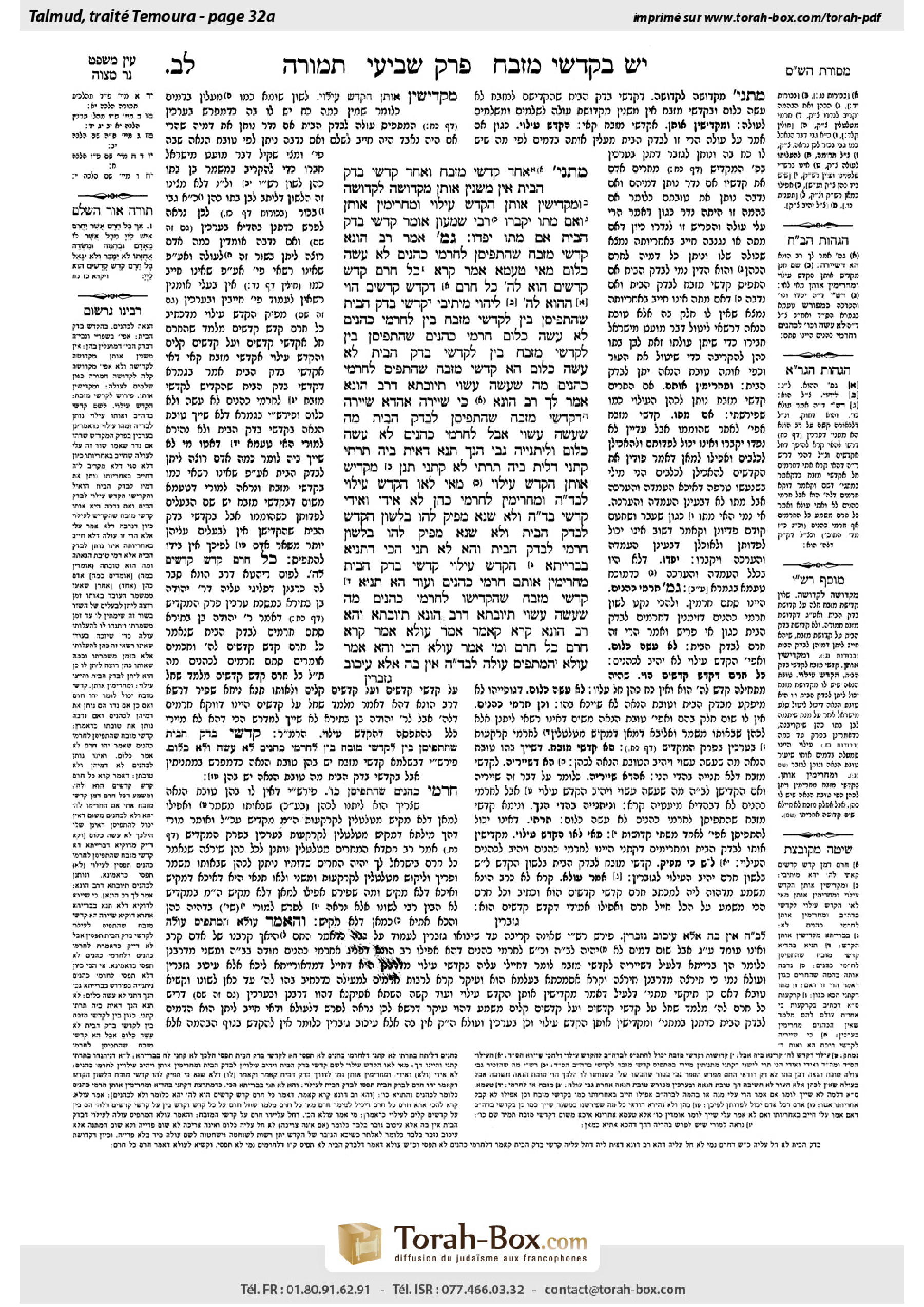
Temurah 32a: Talmud study for Daf Yomi
Daf Yomi is the daily study of one Talmud folio. Explore 37 tractates with scans, Hebrew text, Sefaria English and AI-generated French translations where annotated.
Passage selection and English or AI-generated French translation are available where the scan has annotations. Daf Study is independent of Torah-Box and Sefaria.
Browse Temurah · תמורה · All tractatesTemurah 32a text and translations
This page of Temurah includes the Aramaic text, an English translation and an AI-generated French translation, alongside the scan above.
תמורה ל״ב א · Aramaic and Hebrew text
מַתְנִי׳ אֶחָד קׇדְשֵׁי מִזְבֵּחַ וְאֶחָד קׇדְשֵׁי בֶּדֶק הַבַּיִת אֵין מְשַׁנִּין אוֹתָן מִקְּדוּשָּׁה לִקְדוּשָּׁה, וּמַקְדִּישִׁין אוֹתָן הֶקְדֵּשׁ עִילּוּי, וּמַחְרִימִין אוֹתָן, וְאִם מֵתוּ — יִקָּבֵרוּ. רַבִּי שִׁמְעוֹן אוֹמֵר: קׇדְשֵׁי בֶּדֶק הַבַּיִת אִם מֵתוּ — יִפָּדוּ.
גְּמָ׳ אָמַר רַב הוּנָא: קׇדְשֵׁי מִזְבֵּחַ שֶׁהִתְפִּיסָן לְחֶרְמֵי כֹהֲנִים — לֹא עָשָׂה כְּלוּם. מַאי טַעְמָא? אָמַר קְרָא: ״כׇּל חֵרֶם קֹדֶשׁ קָדָשִׁים הוּא לַה׳״ — כׇּל חֵרֶם דְּקֹדֶשׁ קָדָשִׁים הָוֵי, הָהוּא לַה׳ לֶיהֱוֵי.
מֵיתִיבִי: קׇדְשֵׁי בֶּדֶק הַבַּיִת שֶׁהִתְפִּיסָן, בֵּין לְקׇדְשֵׁי מִזְבֵּחַ בֵּין לְחֶרְמֵי כֹהֲנִים — לֹא עָשָׂה כְּלוּם.
חֶרְמֵי כֹהֲנִים שֶׁהִתְפִּיסָן, בֵּין לְקׇדְשֵׁי מִזְבֵּחַ, בֵּין לְקׇדְשֵׁי בֶּדֶק הַבַּיִת — לֹא עָשָׂה כְּלוּם.
הָא קׇדְשֵׁי מִזְבֵּחַ שֶׁהִתְפִּיס לְחֶרְמֵי כֹהֲנִים — מַה שֶּׁעָשָׂה עָשׂוּי, תְּיוּבְתָּא דְּרַב הוּנָא!
אָמַר לְךָ רַב הוּנָא: כִּי שַׁיְּירַהּ — אַהָדָא שַׁיְּירַהּ, דְּקָדְשֵׁי מִזְבֵּחַ שֶׁהִתְפִּיסָן לְבֶדֶק הַבַּיִת — מַה שֶּׁעָשָׂה עָשׂוּי, אֲבָל לְחֶרְמֵי כֹהֲנִים — לֹא עָשָׂה כְּלוּם.
וְלִיתְנְיַיהּ גַּבֵּי הָנָךְ! תַּנָּא דְּאִית בֵּיהּ תַּרְתֵּי — קָתָנֵי, דְּלֵית בֵּיהּ תַּרְתֵּי — לָא קָתָנֵי.
תְּנַן: ״מַקְדִּישׁ אוֹתָן הֶקְדֵּשׁ עִילּוּי״, מַאי לַָאו ״הֶקְדֵּשׁ עִילּוּי״ — לְבֶדֶק הַבַּיִת, וּ״מַחְרִימִין״ — לְחֶרְמֵי כֹהֵן?
לָא, אִידִי וְאִידִי קׇדְשֵׁי בֶּדֶק הַבַּיִת, וְלָא שְׁנָא מַפֵּיק לְהוּ בִּלְשׁוֹן ״הַקֹּדֶשׁ״ לְבֶדֶק הַבַּיִת, וְלָא שְׁנָא מַפֵּיק לְהוּ בִּלְשׁוֹן ״(חֶרְמֵי) [חֵרֶם]״ לְבֶדֶק הַבַּיִת.
וְהָא לָא תָּנֵי הָכִי, דְּתַנְיָא בְּבָרַיְיתָא: הֶקְדֵּשׁ עִילּוּי — קׇדְשֵׁי בֶּדֶק הַבַּיִת, מַחְרִימִין אוֹתָם — חֶרְמֵי כֹהֲנִים! וְעוֹד, הָא תַּנְיָא: קׇדְשֵׁי מִזְבֵּחַ שֶׁהִקְדִּישָׁן לְחֶרְמֵי כֹהֲנִים — מַה שֶּׁעָשָׂה עָשׂוּי! תְּיוּבְתָּא דְּרַב הוּנָא, תְּיוּבְתָּא.
וְהָא רַב הוּנָא קְרָא קָאָמַר! אָמַר עוּלָּא: אָמַר קְרָא ״חֵרֶם כׇּל חֵרֶם״.
וּמִי אָמַר עוּלָּא הָכִי? וְהָא אָמַר עוּלָּא: הַמַּתְפִּיס עוֹלָה לְבֶדֶק הַבַּיִת — אֵין בָּהּ אֶלָּא עִיכּוּב
Temurah 32a · English translation
MISHNA: While the previous mishna enumerated differences between consecration for the altar and consecration for Temple maintenance, this mishna enumerates halakhot that apply to both. With regard to both animals consecrated for the altar and items consecrated for Temple maintenance, one may not alter their designation from one form of sanctity to another form of sanctity. But one may consecrate animals already consecrated for the altar by a consecration of their value, and that value is donated to the Temple treasury for maintenance. And one may dedicate them for the purpose of giving their value to the priests. And if animals consecrated either for the altar or for Temple maintenance died, they must be buried. Rabbi Shimon says: Although that is the halakha with regard to animals consecrated for the altar, if animals consecrated for Temple maintenance died, they can be redeemed.
GEMARA: Rav Huna says: With regard to animals consecrated for the altar, if one associated such objects of his vow with dedications for the priests, i.e., he vowed to give their value as a dedication to the priests, he has done nothing. What is the reason? The verse states: “Notwithstanding, no devoted item that a man may devote unto the Lord of all that he has, whether of man or animal, or of his ancestral field, shall be sold or redeemed; every dedicated item is most holy unto the Lord” (Leviticus 27:28). The verse is interpreted to mean that any dedicated item that is most holy, i.e., that was consecrated for the altar and then dedicated to the priests, that item should be for the Lord, and the priests are not entitled to it.
The Gemara raises an objection to the statement of Rav Huna from a baraita: With regard to items consecrated for Temple maintenance that one associated with another sanctity, whether with a consecration for the altar, whose sanctity is more stringent than consecration for Temple maintenance, or with a dedication to the priests, he has done nothing. The reason is that one cannot remove the sanctity of an item consecrated for Temple maintenance, and he has no ownership of value in it. As for the benefit of discretion, i.e., the right to choose the priest that will receive the offering, this is not relevant to items consecrated for Temple maintenance, and therefore it cannot be suggested that his act of consecration was with regard to the benefit of discretion.
Similarly, in the case of a dedication to priests that one associated with another sanctity, whether with a consecration for the altar or with a consecration for Temple maintenance, he has done nothing. One does not have any rights to an item dedicated to the priests, not even the benefit of discretion, as the dedicated item must be given to the members of the priestly watch serving in the Temple at the time of its dedication.
The Gemara explains the objection: Since the baraita teaches only that one may not associate with another sanctity items consecrated for Temple maintenance or dedications to priests, it may be inferred with regard to animals consecrated for the altar that one associated with dedications to priests, that what he did is done, i.e., it takes effect. If so, this baraita is apparently a conclusive refutation of the statement of Rav Huna.
The Gemara responds: Rav Huna could have said to you that one cannot draw such an inference from the baraita, as it is possible that the tanna chose to discuss only those two instances while omitting the case of an animal consecrated for the altar. And as for the fact that the tanna omitted this latter case, he omitted it due to this reason, that the halakha differs depending on the case: With regard to animals consecrated for the altar that one associated with a consecration for Temple maintenance, what he did is done, and he must pay the Temple treasury a consecration of value, but if he associated it with a dedication to priests, he has done nothing.
The Gemara objects: But if so, let the tanna teach explicitly that one who associates an animal consecrated for the altar with a dedication to the priests has done nothing, alongside these other cases of items consecrated for Temple maintenance and dedications to priests. The Gemara explains: The tanna teaches instances where there are two types of consecration with which the item cannot be associated, e.g., an item consecrated for Temple maintenance, which cannot be associated with either a consecration for the altar or a dedication to the priests. By contrast, the tanna does not teach a case where there are not two instances with which the item cannot be associated, i.e., an animal consecrated for the altar. Although an animal consecrated for the altar cannot be associated with a dedication to the priests, it can be associated with a consecration for Temple maintenance.
The Gemara raises another objection to the statement of Rav Huna from that which we learned in the mishna: One may consecrate animals already consecrated for the altar by a consecration of their value, and one can dedicate them. The Gemara asks: What, is it not correct to say that when the mishna is referring to a consecration of their value, this is a consecration for Temple maintenance, and when it states that one dedicates them, this is referring to dedications to a priest? Evidently, one can associate an animal consecrated for the altar with a dedication to priests.
The Gemara responds: No, this is not the meaning of the mishna. Rather, both this and that are referring to consecrations for Temple maintenance. And the mishna is teaching that there is no difference whether he expresses a term of consecration, i.e., if he states: This animal is consecrated for Temple maintenance, in which case the animal is consecrated for Temple maintenance, and there is no difference if he expresses a term of dedication, i.e., he states: This animal is dedicated for Temple maintenance, as in this case too, the animal is consecrated for Temple maintenance.
The Gemara raises a difficulty: But this is not how it is taught in a baraita. As it is taught in a baraita: One can consecrate animals consecrated for the altar by a consecration of its value, that is, a consecration for Temple maintenance, and one can dedicate them by a dedication to priests. And furthermore, isn’t it taught in another baraita with regard to animals consecrated for the altar that one subsequently consecrated their value as dedications to the priests, that what he did is done? The Gemara concludes: The refutation of the opinion of Rav Huna is a conclusive refutation.
The Gemara raises a difficulty: But Rav Huna says a verse as the source for his opinion. Since his opinion is refuted, how should the verse be interpreted? Ulla said: That verse is not interpreted in the manner of Rav Huna. The verse states: “Notwithstanding, no dedicated item that a man may devote unto the Lord of all that he has, whether of man or animal, or of his ancestral field, shall be sold or redeemed; every dedicated item is most holy unto the Lord” (Leviticus 27:28). The emphasis that “every dedicated item” is most holy indicates that a dedication to the priests takes effect on every item, even with regard to animals consecrated for the altar.
Since Ulla holds that animals consecrated for the altar may be associated with a dedication to priests, evidently he also holds that they may be associated with a consecration for Temple maintenance, as even Rav Huna agrees they may be associated with such a consecration. The Gemara therefore asks: And did Ulla actually say this? But didn’t Ulla say that one who associates a burnt offering with a consecration for Temple maintenance has only the delay of
Temurah 32a · Traduction française (IA)
MICHNA : Alors que la Michna précédente énumérait les différences entre la consécration à l’autel et celle destinée à l’entretien du Temple, cette Michna énumère les halakhot qui s’appliquent aux deux. Pour les animaux consacrés à l’autel comme pour les biens consacrés à l’entretien du Temple, on ne peut pas modifier leur affectation en les faisant passer d’une forme de sainteté à une autre. Toutefois, on peut consacrer la valeur d’animaux déjà consacrés à l’autel, et cette valeur est donnée au trésor du Temple pour son entretien. On peut également les vouer afin que leur valeur soit donnée aux prêtres. Si des animaux consacrés à l’autel ou à l’entretien du Temple meurent, ils doivent être enterrés. Rabbi Shimon dit : bien que telle soit la halakha concernant les animaux consacrés à l’autel, si des animaux consacrés à l’entretien du Temple meurent, ils peuvent être rachetés.
GUEMARA : Rav Houna dit : concernant les animaux consacrés à l’autel, si quelqu’un les voue aux prêtres, c’est-à-dire s’il fait vœu de donner leur valeur aux prêtres, son acte est sans effet. Pour quelle raison ? Le verset dit : « Toutefois, aucun bien voué qu’un homme vouera à l’Éternel parmi tout ce qui lui appartient, qu’il s’agisse d’un homme, d’un animal ou d’un champ de son patrimoine, ne pourra être vendu ni racheté ; tout bien voué est très saint pour l’Éternel » (Lévitique 27, 28). Le verset s’interprète ainsi : tout bien voué qui est très saint, c’est-à-dire qui a été consacré à l’autel puis voué aux prêtres, doit être pour l’Éternel ; les prêtres n’y ont donc pas droit.
La Guemara soulève une objection à l’opinion de Rav Houna à partir d’une baraïta : concernant les biens consacrés à l’entretien du Temple qu’on associe à une autre forme de sainteté, qu’il s’agisse d’une consécration à l’autel, dont la sainteté est plus stricte que celle des biens consacrés à l’entretien du Temple, ou d’un vœu destiné aux prêtres, l’acte est sans effet. En effet, on ne peut pas retirer sa sainteté à un bien consacré à l’entretien du Temple, et celui qui l’a consacré n’en possède pas la valeur. Quant au bénéfice du choix, c’est-à-dire le droit de choisir le prêtre qui recevra l’offrande, il ne s’applique pas aux biens consacrés à l’entretien du Temple ; on ne peut donc pas dire que l’acte de consécration ait porté sur ce bénéfice.
De même, si l’on associe un bien voué aux prêtres à une autre forme de sainteté, qu’il s’agisse d’une consécration à l’autel ou d’une consécration à l’entretien du Temple, l’acte est sans effet. On ne détient aucun droit sur un bien voué aux prêtres, pas même le bénéfice du choix, car ce bien doit être donné aux membres de la garde sacerdotale qui assurent le service au Temple au moment où il est voué.
La Guemara explique l’objection : puisque la baraïta enseigne seulement qu’on ne peut pas associer à une autre forme de sainteté les biens consacrés à l’entretien du Temple ou ceux qui sont voués aux prêtres, on peut en déduire que, lorsqu’une personne voue aux prêtres un animal consacré à l’autel, son acte prend effet. Dès lors, cette baraïta semble réfuter de manière décisive l’opinion de Rav Houna.
La Guemara répond : Rav Houna aurait pu te dire qu’on ne peut pas tirer une telle déduction de la baraïta, car il est possible que le tanna ait choisi de traiter seulement ces deux cas, en omettant celui d’un animal consacré à l’autel. Quant à l’omission de ce dernier cas, elle s’explique par le fait que la halakha diffère selon les cas : si l’on associe une consécration à l’entretien du Temple à un animal consacré à l’autel, l’acte prend effet et l’on doit verser au trésor du Temple la valeur de sa consécration ; mais si l’on voue l’animal aux prêtres, l’acte est sans effet.
La Guemara objecte : dans ce cas, que le tanna enseigne explicitement que celui qui voue aux prêtres un animal consacré à l’autel n’a rien fait, en plus des autres cas, ceux des biens consacrés à l’entretien du Temple et des biens voués aux prêtres. La Guemara explique : le tanna enseigne les cas où le bien ne peut être associé à deux types de consécration, par exemple un bien consacré à l’entretien du Temple, qui ne peut être associé ni à une consécration à l’autel ni à un vœu destiné aux prêtres. En revanche, le tanna n’enseigne pas un cas où le bien ne peut être associé qu’à un seul type de consécration, à savoir celui d’un animal consacré à l’autel. Bien qu’un animal consacré à l’autel ne puisse pas être associé à un vœu destiné aux prêtres, il peut être associé à une consécration à l’entretien du Temple.
La Guemara soulève une autre objection à l’opinion de Rav Houna à partir de ce que nous avons appris dans la Michna : on peut consacrer la valeur d’animaux déjà consacrés à l’autel, et on peut les vouer. La Guemara demande : n’est-il pas correct de dire que, lorsque la Michna parle de consacrer leur valeur, elle fait référence à une consécration à l’entretien du Temple, et que, lorsqu’elle dit qu’on peut les vouer, elle fait référence à un vœu destiné à un prêtre ? Il apparaît donc qu’on peut vouer aux prêtres un animal consacré à l’autel.
La Guemara répond : non, telle n’est pas la signification de la Michna. Les deux expressions font plutôt référence à des consécrations à l’entretien du Temple. La Michna enseigne qu’il n’y a pas de différence entre employer une formule de consécration, c’est-à-dire dire : « Cet animal est consacré à l’entretien du Temple », auquel cas l’animal est consacré à l’entretien du Temple, et employer une formule de vœu, c’est-à-dire dire : « Cet animal est voué à l’entretien du Temple » ; dans ce cas également, l’animal est consacré à l’entretien du Temple.
La Guemara soulève une difficulté : mais ce n’est pas ainsi que l’enseigne une baraïta. En effet, une baraïta enseigne : on peut consacrer la valeur d’un animal consacré à l’autel, c’est-à-dire le consacrer à l’entretien du Temple, et on peut le vouer aux prêtres. De plus, une autre baraïta n’enseigne-t-elle pas que, lorsqu’on consacre ensuite aux prêtres la valeur d’animaux consacrés à l’autel, l’acte prend effet ? La Guemara conclut : la réfutation de l’opinion de Rav Houna est décisive.
La Guemara soulève une difficulté : mais Rav Houna cite un verset à l’appui de son opinion. Puisque son opinion est réfutée, comment faut-il interpréter le verset ? Oulla dit : ce verset ne s’interprète pas comme le fait Rav Houna. Le verset dit : « Toutefois, aucun bien voué qu’un homme vouera à l’Éternel parmi tout ce qui lui appartient, qu’il s’agisse d’un homme, d’un animal ou d’un champ de son patrimoine, ne pourra être vendu ni racheté ; tout bien voué est très saint pour l’Éternel » (Lévitique 27, 28). L’insistance sur « tout bien voué » indique qu’un vœu destiné aux prêtres prend effet sur tout bien, même sur les animaux consacrés à l’autel.
Puisqu’Oulla estime que les animaux consacrés à l’autel peuvent être voués aux prêtres, il estime manifestement aussi qu’ils peuvent être associés à une consécration à l’entretien du Temple, puisque même Rav Houna reconnaît qu’ils peuvent être associés à une telle consécration. La Guemara demande donc : Oulla a-t-il vraiment dit cela ? Oulla n’a-t-il pas dit que celui qui associe un holocauste à une consécration à l’entretien du Temple n’a que le retard de
Traduction française générée par IA à partir de l’édition anglaise de Sefaria. Vérifie toujours un passage avec le texte source.
Text from Sefaria: William Davidson Edition - Vocalized Aramaic (CC BY NC); William Davidson Edition - English (CC BY NC).