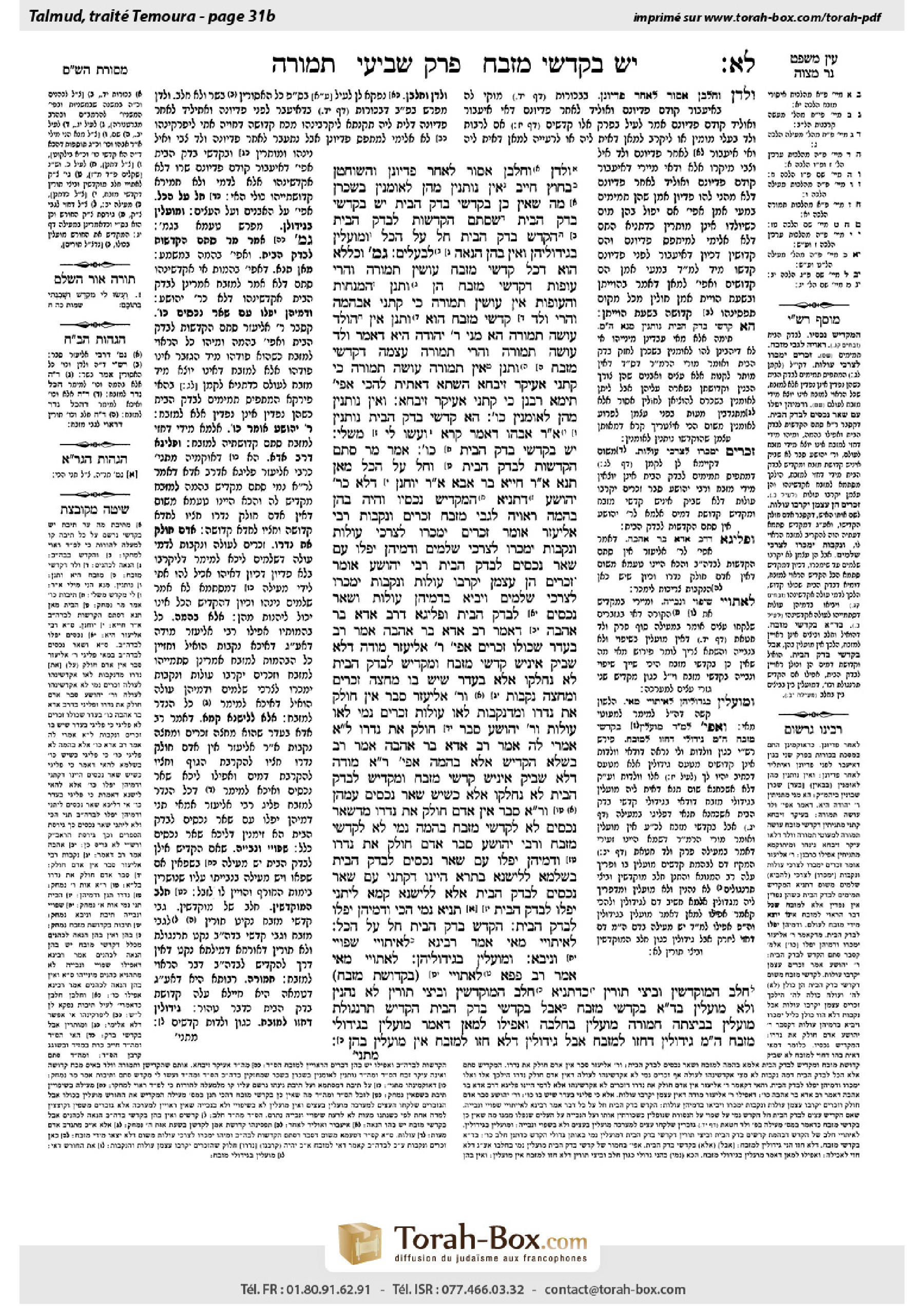
Temurah 31b: Talmud study for Daf Yomi
Daf Yomi is the daily study of one Talmud folio. Explore 37 tractates with scans, Hebrew text, Sefaria English and AI-generated French translations where annotated.
Passage selection and English or AI-generated French translation are available where the scan has annotations. Daf Study is independent of Torah-Box and Sefaria.
Browse Temurah · תמורה · All tractatesTemurah 31b text and translations
This page of Temurah includes the Aramaic text, an English translation and an AI-generated French translation, alongside the scan above.
תמורה ל״א ב · Aramaic and Hebrew text
וְלָדָן וַחֲלָבָן אָסוּר לְאַחַר פִּדְיוֹנָן, וְהַשּׁוֹחֲטָן בַּחוּץ חַיָּיב. אֵין נוֹתְנִין מֵהֶן לָאוּמָּנִין בִּשְׂכָרָן — מָה שֶׁאֵין כֵּן בְּקׇדְשֵׁי בֶּדֶק הַבַּיִת.
יֵשׁ בְּקׇדְשֵׁי בֶּדֶק הַבַּיִת, שֶׁסְּתַם הֶקְדֵּשׁוֹת לְבֶדֶק הַבַּיִת, הֶקְדֵּשׁ בֶּדֶק הַבַּיִת חָל עַל הַכֹּל, וּמוֹעֲלִין בְּגִידּוּלֵיהֶן, וְאֵין בָּהֶן הֲנָאָה לַבְּעָלִים.
גְּמָ׳ וּכְלָלָא הוּא דְּכׇל קׇדְשֵׁי מִזְבֵּחַ עוֹשִׂין תְּמוּרָה? וַהֲרֵי עוֹפוֹת דְּקׇדְשֵׁי מִזְבֵּחַ הֵן, וּתְנַן: הַמְּנָחוֹת וְהָעוֹפוֹת אֵין עוֹשִׂין תְּמוּרָה! כִּי קָתָנֵי — אַבְּהֵמָה.
וַהֲרֵי וָלָד קׇדְשֵׁי מִזְבֵּחַ הוּא, וּתְנַן: אֵין הַוָּלָד עוֹשֶׂה תְּמוּרָה. הָא מַנִּי? רַבִּי יְהוּדָה הִיא, דְּאָמַר: וָלָד עוֹשֶׂה תְּמוּרָה.
וַהֲרֵי תְּמוּרָה עַצְמָהּ, דְּקׇדְשֵׁי מִזְבֵּחַ, וּתְנַן: אֵין תְּמוּרָה עוֹשָׂה תְּמוּרָה! כִּי קָתָנֵי — אַעִיקַּר זִיבְחָא.
הַשְׁתָּא דַאֲתֵית לְהָכִי, אֲפִילּוּ תֵּימָא רַבָּנַן, כִּי קָתָנֵי — אַעִיקַּר זִיבְחָא.
וְאֵין נוֹתְנִין מֵהֶן לָאוּמָּנִין כּוּ׳. הָא קׇדְשֵׁי בֶּדֶק הַבַּיִת נוֹתְנִין? אָמַר רַבִּי אֲבָהוּ: דְּאָמַר קְרָא ״וְעָשׂוּ לִי״ — מִשֶּׁלִּי.
יֵשׁ בְּקׇדְשֵׁי בֶּדֶק הַבַּיִת כּוּ׳. אָמַר מָר: סְתָם הֶקְדֵּשׁוֹת לְבֶדֶק הַבַּיִת, וְחָל עַל הַכֹּל. מַאן תַּנָּא? אָמַר רַבִּי חִיָּיא בַּר אַבָּא אָמַר רַבִּי יוֹחָנָן: דְּלָא כְּרַבִּי יְהוֹשֻׁעַ.
דְּתַנְיָא: הַמַּקְדִּישׁ נְכָסָיו, וְהָיָה בָּהֶן בְּהֵמָה רְאוּיָה לְגַבֵּי מִזְבֵּחַ, זְכָרִים וּנְקֵבוֹת — רַבִּי אֱלִיעֶזֶר אוֹמֵר: זְכָרִים יִמָּכְרוּ לְצׇרְכֵי עוֹלוֹת, וּנְקֵבוֹת יִמָּכְרוּ לְצׇרְכֵי שְׁלָמִים, וּדְמֵיהֶן יִפְּלוּ עִם שְׁאָר נְכָסִים לְבֶדֶק הַבַּיִת.
רַבִּי יְהוֹשֻׁעַ אוֹמֵר: זְכָרִים הֵן עַצְמָן יִקְרְבוּ עוֹלוֹת, וּנְקֵבוֹת יִמָּכְרוּ לְצׇרְכֵי שְׁלָמִים וְיָבִיא בִּדְמֵיהֶן עוֹלוֹת, וּשְׁאָר נְכָסִים לְבֶדֶק הַבַּיִת.
וּפְלִיגָא דְּרַב אַדָּא בַּר אַהֲבָה, דְּאָמַר רַב אַדָּא בַּר אַהֲבָה אָמַר רַב: בְּעֵדֶר שֶׁכּוּלּוֹ זְכָרִים, אֲפִילּוּ רַבִּי אֱלִיעֶזֶר מוֹדֶה, דְּלָא שָׁבֵיק אִינִישׁ קׇדְשֵׁי מִזְבֵּחַ וּמַקְדִּישׁ לְבֶדֶק הַבַּיִת.
לֹא נֶחְלְקוּ אֶלָּא בְּעֵדֶר שֶׁיֵּשׁ בּוֹ מֶחֱצָה זְכָרִים וּמֶחֱצָה נְקֵבוֹת, וְרַבִּי אֱלִיעֶזֶר סָבַר: אֵין חוֹלֵק אֶת נִדְרוֹ, וּמִדִּנְקֵבוֹת לָאו עוֹלוֹת — זְכָרִים נָמֵי לָאו עוֹלוֹת.
וְרַבִּי יְהוֹשֻׁעַ סָבַר: חוֹלֵק אֶת נִדְרוֹ.
לִישָּׁנָא אַחְרִינָא אָמְרִי לַהּ, אָמַר רַב אַדָּא בַּר אַהֲבָה אָמַר רַב: בְּשֶׁלֹּא הִקְדִּישׁ אֶלָּא בְּהֵמָה, אֲפִילּוּ רַבִּי אֱלִיעֶזֶר מוֹדֶה, דְּלָא שָׁבֵיק אִינִישׁ קׇדְשֵׁי מִזְבֵּחַ וּמַקְדֵּישׁ לְבֶדֶק הַבַּיִת.
לֹא נֶחְלְקוּ אֶלָּא כְּשֶׁיֵּשׁ שְׁאָר נְכָסִים עִמָּהֶן, וְרַבִּי אֱלִיעֶזֶר סָבַר: אֵין אָדָם חוֹלֵק אֶת נִדְרוֹ, מִדִּשְׁאָר נְכָסִים לָא לְקׇדְשֵׁי מִזְבַּח, בְּהֵמָה נָמֵי לָא לְקׇדְשֵׁי מִזְבֵּחַ, וְרַבִּי יְהוֹשֻׁעַ סָבַר: אָדָם חוֹלֵק אֶת נִדְרוֹ.
וּדְמֵיהֶן יִפְּלוּ עִם שְׁאָר נְכָסִים לְבֶדֶק הַבַּיִת — בִּשְׁלָמָא לְלִישָּׁנָא בָּתְרָא, הַיְינוּ דְּקָתָנֵי: ״עִם שְׁאָר נְכָסִים לְבֶדֶק הַבַּיִת״.
אֶלָּא לְלִישָּׁנָא קַמָּא, לִיתְנֵי ״יִפְּלוּ לְבֶדֶק הַבַּיִת״! תַּנְיָא נָמֵי הָכִי: ״וּדְמֵיהֶן יִפְּלוּ לְבֶדֶק הַבַּיִת״.
הֶקְדֵּשׁ בֶּדֶק הַבַּיִת חָל עַל הַכֹּל. לְאֵיתוֹיֵי מַאי? אָמַר רָבִינָא: לְאֵיתוֹיֵי שִׁפּוּיֵי וְנִיבָא.
וּמוֹעֲלִין בְּגִידּוּלֵיהֶן. לְאֵתוֹיֵי מַאי? אָמַר רַב פָּפָּא: לְאֵתוֹיֵי בִּקְדוּשַּׁת מִזְבֵּחַ, חֲלֵב הַמּוּקְדָּשִׁין וּבֵיצֵי תוֹרִין.
כִּדְתַנְיָא: חֲלֵב הַמּוּקְדָּשִׁין וּבֵיצֵי תוֹרִין — לֹא נֶהֱנִין וְלֹא מוֹעֲלִין. בַּמֶּה דְבָרִים אֲמוּרִים? בְּקׇדְשֵׁי מִזְבֵּחַ, אֲבָל בְּקׇדְשֵׁי בֶּדֶק הַבַּיִת — הִקְדִּישׁ תַּרְנְגוֹלֶת מוֹעֲלִין בְּבֵיצָתָהּ, חֲמוֹרָהּ מוֹעֲלִין בַּחֲלָבָהּ.
וַאֲפִילּוּ לְמַאן דְּאָמַר מוֹעֲלִין בְּגִידּוּלֵי מִזְבֵּחַ, הָנֵי מִילֵּי גִּידּוּלִין דַּחֲזוּ לַמִּזְבֵּחַ, אֲבָל גִּידּוּלִין דְּלָא חֲזוּ לַמִּזְבֵּחַ — אֵין מוֹעֲלִין בָּהֶן.
Temurah 31b · English translation
If animals consecrated for the altar became pregnant and then became blemished and gave birth after redemption, their offspring and their milk are forbidden after their redemption. And one who slaughters them outside the Temple courtyard is liable to receive karet. And the Temple treasurer does not give compensation to craftsmen from money designated for purchasing animals consecrated for the altar. And in all these instances, that is not so with regard to money consecrated for Temple maintenance.
There are elements that apply to items consecrated for Temple maintenance that do not apply to animals consecrated for the altar, in that unspecified consecrations are designated for Temple maintenance; consecration for Temple maintenance takes effect on all items; and one is liable to bring a guilt offering and pay an additional payment of one-fifth for misuse of consecrated property, not only for the items themselves, but for their by-products, e.g., milk of a consecrated animal or eggs of a consecrated chicken; and there is no benefit for the owner from items consecrated for Temple maintenance, in contrast to some animals consecrated for the altar, e.g., a peace offering, from which there is benefit for the owner.
GEMARA: The Gemara questions the statement of the mishna that an item consecrated for the altar renders an animal exchanged for it a substitute: And is it an established principle that anything consecrated for the altar renders an animal exchanged for it a substitute? But there are offerings brought from birds, i.e., doves and pigeons, which are consecrated for the altar, and yet they do not render an animal exchanged for them a substitute, as we learned in a mishna (Temura 13a): Meal offerings and bird offerings do not render an animal exchanged for them a substitute. The Gemara responds: When this halakha of the mishna was taught, it was taught only with regard to animal offerings.
The Gemara raises a difficulty: But there is the offspring of an animal consecrated for the altar, which is consecrated for the altar, and yet we learned in a mishna (Temura 12a): The offspring of an animal consecrated for the altar does not render an animal exchanged for it a substitute. The Gemara responds: In accordance with whose opinion is this mishna here (31a)? It is in accordance with the opinion of Rabbi Yehuda, who says: The offspring of an animal consecrated for the altar renders an animal exchanged for it a substitute.
The Gemara objects: But there is the case of a substitute itself, which is consecrated for the altar, and yet we learned in that mishna (12a): A substitute does not render an animal exchanged for it a substitute. The Gemara responds: When this principle, that all animals consecrated for the altar render an animal exchanged for them a substitute, was taught in the mishna, it was taught only with regard to the principal offering, i.e., an animal initially consecrated as an offering, not an animal consecrated by extension, e.g., a substitute.
The Gemara comments: Now that you have arrived at this qualification of the established principle, one does not need to resolve the difficulty from the case of offspring of consecrated animals by saying that the mishna is in accordance with the opinion of Rabbi Yehuda. Rather, you may even say that the mishna is in accordance with the opinion of the Rabbis, who maintain that the offspring of an animal does not render an animal exchanged for it a substitute, since when this principle was taught in the mishna it was taught only with regard to the principal offering.
§ The mishna teaches that the Temple treasurer does not give craftsmen compensation from money designated for purchasing animals consecrated for the altar. The Gemara asks: It may be inferred from the mishna that consecrations for Temple maintenance are given to craftsmen. From where is this halakha derived? Rabbi Abbahu said: It is derived from a verse, as the verse states, with regard to the mitzva to build the Tabernacle: “And let them make Me a sanctuary, that I may dwell among them” (Exodus 25:8). The verse indicates that the Tabernacle can be constructed from that which is Mine, i.e., consecrated property. Consequently, consecrated property may be used to pay the wages of a craftsman for work performed in the service of the Tabernacle.
§ The mishna teaches that there are elements that apply to items consecrated for Temple maintenance that do not apply to animals consecrated for the altar, as unspecified consecrations are designated for Temple maintenance rather than for the altar. Additionally, consecration for Temple maintenance takes effect on all items, but not all items may be consecrated for the altar. The Gemara discusses these halakhot: The Master said in the mishna that unspecified consecrations are designated for Temple maintenance, and consecration for Temple maintenance takes effect on all items. Who is the tanna whose ruling is stated in this mishna? Rabbi Ḥiyya bar Abba said that Rabbi Yoḥanan said: The mishna is not in accordance with the opinion of Rabbi Yehoshua.
This is as it is taught in a mishna (Shekalim 4:7): In the case of one who consecrates his possessions without specification, and among the consecrated property there was an animal suitable for sacrifice upon the altar, male or female, what should be done with it? Rabbi Eliezer says: Males that are suitable to be brought as a burnt offerings should be sold for the needs of burnt offerings, i.e., to individuals obligated to bring a burnt offering. And females should be sold for the purpose of being used for peace offerings. And the money received from their sale is allocated with the rest of his property for Temple maintenance.
Rabbi Yehoshua says: The males are not sold; rather, they themselves should be sacrificed as burnt offerings, and the females should be sold for the purpose of being used for peace offerings and they will be offered as such, and one should purchase and bring burnt offerings with the money received from their sale. And the rest of the property, which is unsuitable for sacrificial use, is allocated for Temple maintenance. Evidently, Rabbi Yehoshua maintains that unspecified consecrations are not necessarily designated for Temple maintenance.
The Gemara notes: And this explanation of the dispute between Rabbi Eliezer and Rabbi Yehoshua, stated by Rabbi Ḥiyya bar Abba in the name of Rabbi Yoḥanan, disagrees with the explanation of Rav Adda bar Ahava. As Rav Adda bar Ahava says that Rav says: With regard to a herd that is entirely male, even Rabbi Eliezer concedes that suitable animals are brought as burnt offerings, as a person does not set aside his ability to consecrate to the altar an animal fit to be consecrated for the altar and instead consecrate it for Temple maintenance. Even if the owner consecrated these animals without specification, it is presumed that he consecrated them for sacrifice upon the altar.
Rabbi Eliezer and Rabbi Yehoshua disagree only with regard to a case where one consecrates a herd that has one-half males and one-half females. And their dispute is as follows: Rabbi Eliezer holds that one does not divide his vow, i.e., state a single vow that must be fulfilled in different ways, and therefore, from the fact that the females are not consecrated as burnt offerings, as burnt offerings must be male, it must be that the males are also not consecrated as burnt offerings.
And Rabbi Yehoshua holds that a person does divide his vow. Accordingly, the males, which are fit to be brought as burnt offerings, are consecrated for the altar, whereas the females are sold to those who must bring peace offerings, and the money from their sale is used to purchase burnt offerings. According to this interpretation, Rabbi Eliezer concedes that one does not consecrate for Temple maintenance an animal fit for the altar. Consequently, the mishna is not in accordance with the opinion of Rabbi Eliezer either.
The Gemara adds: Some say another version of the explanation of the dispute between Rabbi Eliezer and Rabbi Yehoshua. Rav Adda bar Ahava says that Rav says: In a case where one consecrated without specification only the type of animal that is suitable as an offering, even Rabbi Eliezer concedes that all the animals are consecrated for the altar. Accordingly, the males are brought as burnt offerings, and the females are sold to those who require peace offerings, and the money from their sale is used to purchase burnt offerings. The reason is that a person does not set aside his ability to consecrate for the altar an animal fit to be consecrated for the altar and instead consecrate it for Temple maintenance.
They disagree only with regard to a case where there is other property that was consecrated with the animals. And their dispute is as follows: Rabbi Eliezer holds that a person does not divide his vow. Consequently, from the fact that the other property is not consecrated for the altar, as it is not fit for sacrifice, it must be that the animals are also not consecrated for the altar. And Rabbi Yehoshua holds that a person divides his vow. Accordingly, the animals are consecrated for the altar, while the other property is consecrated for Temple maintenance. According to this explanation as well, the mishna is not in accordance with the opinions of either Rabbi Yehoshua or Rabbi Eliezer.
The Gemara discusses the two versions of the explanation of Rav Adda bar Ahava, in light of the statement of Rabbi Eliezer in the mishna cited above in Shekalim (4:7): And the money from their sale is allocated with the rest of his property for Temple maintenance. The Gemara asks: Granted, according to the latter version, that Rabbi Eliezer maintains that when one consecrates animals and other property he does not divide his vow, and as some of his property is unfit for the altar, all of his property is consecrated for Temple maintenance, this explanation is consistent with that which Rabbi Eliezer teaches: The money from their sale is allocated with the rest of his property for Temple maintenance, i.e., the money from their sale is consecrated for Temple maintenance due to the consecration of his other property.
But according to the first version, that Rabbi Eliezer maintains that one does not divide his vow even when he consecrates only animals, i.e., he does not consecrate some as burnt offerings and others as peace offerings, let the mishna teach: The money from their sale is allocated for Temple maintenance, without mentioning the rest of his property. The Gemara responds: Indeed, the mishna should be taught in such a manner, and this is also taught in a baraita: And the money from their sale is allocated for Temple maintenance.
§ The mishna teaches that consecration for Temple maintenance takes effect on all items. This emphasis indicates that it takes effect even on items that one might otherwise have thought are not consecrated. The Gemara asks: What does the mishna mean to add by this emphasis? Ravina said: It means to add shavings and fallen leaves of a tree that was consecrated for Temple maintenance.
The mishna further teaches that one is liable for misuse of items consecrated for Temple maintenance and for their by-products, but one is not liable for misuse of by-products of animals consecrated for the altar. The Gemara elaborates: When the mishna states that one is not liable for misuse of by-products of animals consecrated for the altar, this serves to add what? Rav Pappa said: It serves to add that one is not liable for misuse of by-products of animals consecrated for the altar, such as milk from sacrificial animals and eggs of pigeons.
This is as it is taught in a baraita: With regard to milk of sacrificial animals and eggs of pigeons, one may not derive benefit from them ab initio, but if one derived benefit from them, he is not liable for misuse. In what case is this statement said? It is said with regard to milk and eggs of animals consecrated for the altar. But with regard to animals consecrated for Temple maintenance, e.g., if one consecrated a chicken for Temple maintenance, one is liable for misusing its eggs, or if one consecrated a female donkey for Temple maintenance, one is liable for misusing its milk.
And even according to the one who said that one is liable for misusing by-products of animals consecrated for the altar, this statement applies only to by-products that are fit for the altar, but with regard to by-products that are not fit for the altar, e.g., eggs and milk, one is not liable for misusing them.
Temurah 31b · Traduction française (IA)
Si des animaux consacrés à l’autel deviennent gravides, puis présentent un défaut et mettent bas après leur rachat, leurs petits et leur lait restent interdits après leur rachat. Celui qui les abat hors de la cour du Temple est passible de karet. Le trésorier du Temple ne rémunère pas les artisans avec l’argent destiné à l’achat d’animaux consacrés à l’autel. Dans tous ces cas, il en va autrement de l’argent consacré à l’entretien du Temple.
Certains aspects s’appliquent aux biens consacrés à l’entretien du Temple, mais pas aux animaux consacrés à l’autel : les consécrations non spécifiées sont affectées à l’entretien du Temple ; la consécration à l’entretien du Temple prend effet sur tous les biens ; et l’on est tenu d’apporter un sacrifice de culpabilité et de payer un supplément d’un cinquième en cas d’usage illicite de biens consacrés, non seulement pour les biens eux-mêmes, mais aussi pour leurs produits dérivés, par exemple le lait d’un animal consacré ou les œufs d’une poule consacrée. De plus, le propriétaire ne tire aucun bénéfice des biens consacrés à l’entretien du Temple, contrairement à certains animaux consacrés à l’autel, comme une offrande de paix, dont le propriétaire tire un bénéfice.
GUEMARA : La Guemara met en question l’affirmation de la Michna selon laquelle un bien consacré à l’autel rend substitut l’animal échangé contre lui : est-il donc établi que tout ce qui est consacré à l’autel rend substitut l’animal échangé contre lui ? Or, il existe des offrandes d’oiseaux, c’est-à-dire des colombes et des pigeons, qui sont consacrées à l’autel, et pourtant elles ne rendent pas substitut l’animal échangé contre elles, comme nous l’avons appris dans une Michna (Temoura 13a) : les offrandes de farine et les offrandes d’oiseaux ne rendent pas substitut l’animal échangé contre elles. La Guemara répond : cette halakha de la Michna ne concerne que les offrandes animales.
La Guemara soulève une difficulté : il y a aussi le petit d’un animal consacré à l’autel, qui est lui-même consacré à l’autel, et pourtant nous avons appris dans une Michna (Temoura 12a) que le petit d’un animal consacré à l’autel ne rend pas substitut l’animal échangé contre lui. La Guemara répond : selon l’opinion de qui cette Michna-ci (31a) est-elle formulée ? Selon Rabbi Yehouda, qui dit : le petit d’un animal consacré à l’autel rend substitut l’animal échangé contre lui.
La Guemara objecte : il y a aussi le cas d’un substitut lui-même, qui est consacré à l’autel, et pourtant nous avons appris dans cette Michna (12a) qu’un substitut ne rend pas substitut l’animal échangé contre lui. La Guemara répond : lorsque ce principe — selon lequel tous les animaux consacrés à l’autel rendent substitut l’animal échangé contre eux — a été enseigné dans la Michna, il ne concernait que l’offrande principale, c’est-à-dire un animal initialement consacré comme offrande, et non un animal consacré par extension, tel qu’un substitut.
La Guemara fait remarquer : maintenant que cette précision a été apportée au principe établi, il n’est pas nécessaire de résoudre la difficulté relative aux petits d’animaux consacrés en disant que la Michna suit l’opinion de Rabbi Yehouda. On peut même dire que la Michna suit l’opinion des Sages, qui soutiennent que le petit d’un animal ne rend pas substitut l’animal échangé contre lui, puisque ce principe, dans la Michna, ne concerne que l’offrande principale.
§ La Michna enseigne que le trésorier du Temple ne rémunère pas les artisans avec l’argent destiné à l’achat d’animaux consacrés à l’autel. La Guemara demande : on peut déduire de la Michna que les biens consacrés à l’entretien du Temple sont remis aux artisans. D’où tire-t-on cette halakha ? Rabbi Abbahou dit : elle est tirée d’un verset, car il est écrit, au sujet de la mitsva de construire le Tabernacle : « Qu’ils me fassent un sanctuaire, et je résiderai parmi eux » (Exode 25:8). Le verset indique que le Tabernacle peut être construit avec ce qui m’appartient, c’est-à-dire des biens consacrés. Par conséquent, des biens consacrés peuvent servir à payer le salaire d’un artisan pour un travail effectué au service du Tabernacle.
§ La Michna enseigne que certains aspects s’appliquent aux biens consacrés à l’entretien du Temple, mais pas aux animaux consacrés à l’autel, car les consécrations non spécifiées sont affectées à l’entretien du Temple plutôt qu’à l’autel. En outre, la consécration à l’entretien du Temple prend effet sur tous les biens, tandis que tous les biens ne peuvent pas être consacrés à l’autel. La Guemara examine ces halakhot : le Maître a dit dans la Michna que les consécrations non spécifiées sont affectées à l’entretien du Temple et que la consécration à l’entretien du Temple prend effet sur tous les biens. Quel est le tanna dont l’opinion est énoncée dans cette Michna ? Rabbi Ḥiyya bar Abba dit au nom de Rabbi Yoḥanan : la Michna ne suit pas l’opinion de Rabbi Yehoshua.
C’est ce qui est enseigné dans une Michna (Shekalim 4:7) : si quelqu’un consacre ses biens sans préciser leur destination et que, parmi les biens consacrés, se trouve un animal, mâle ou femelle, apte à être offert sur l’autel, que faut-il en faire ? Rabbi Eliezer dit : les mâles aptes à être offerts comme holocaustes doivent être vendus pour financer des holocaustes, c’est-à-dire à des personnes tenues d’apporter un holocauste. Les femelles doivent être vendues pour être utilisées comme offrandes de paix. L’argent obtenu de leur vente est affecté à l’entretien du Temple avec le reste de ses biens.
Rabbi Yehoshua dit : les mâles ne sont pas vendus ; ils doivent plutôt être sacrifiés eux-mêmes comme holocaustes. Les femelles doivent être vendues pour être utilisées comme offrandes de paix et offertes en tant que telles, et l’argent obtenu de leur vente doit servir à acheter et à apporter des holocaustes. Le reste des biens, qui ne convient pas à un usage sacrificiel, est affecté à l’entretien du Temple. De toute évidence, Rabbi Yehoshua soutient que les consécrations non spécifiées ne sont pas nécessairement affectées à l’entretien du Temple.
La Guemara fait remarquer que cette explication du différend entre Rabbi Eliezer et Rabbi Yehoshua, rapportée par Rabbi Ḥiyya bar Abba au nom de Rabbi Yoḥanan, contredit l’explication de Rav Adda bar Ahava. En effet, Rav Adda bar Ahava dit au nom de Rav : dans le cas d’un troupeau composé entièrement de mâles, même Rabbi Eliezer reconnaît que les animaux aptes sont offerts comme holocaustes, car une personne ne renonce pas à la possibilité de consacrer à l’autel un animal apte à y être consacré pour le consacrer plutôt à l’entretien du Temple. Même si le propriétaire a consacré ces animaux sans préciser leur destination, on présume qu’il les a consacrés pour être sacrifiés sur l’autel.
Rabbi Eliezer et Rabbi Yehoshua ne sont en désaccord que dans le cas où quelqu’un consacre un troupeau composé pour moitié de mâles et pour moitié de femelles. Leur différend est le suivant : Rabbi Eliezer estime qu’on ne divise pas son vœu, c’est-à-dire qu’on ne formule pas un seul vœu qui doit être accompli de différentes façons. Par conséquent, du fait que les femelles ne sont pas consacrées comme holocaustes — car les holocaustes doivent être des mâles —, il faut conclure que les mâles ne sont pas non plus consacrés comme holocaustes.
Rabbi Yehoshua estime, lui, qu’une personne divise son vœu. Ainsi, les mâles, qui sont aptes à être offerts comme holocaustes, sont consacrés à l’autel, tandis que les femelles sont vendues à ceux qui doivent apporter des offrandes de paix, et l’argent de leur vente sert à acheter des holocaustes. Selon cette interprétation, Rabbi Eliezer reconnaît qu’on ne consacre pas à l’entretien du Temple un animal apte à être offert sur l’autel. Par conséquent, la Michna ne suit pas non plus l’opinion de Rabbi Eliezer.
La Guemara ajoute : certains rapportent une autre version de l’explication du différend entre Rabbi Eliezer et Rabbi Yehoshua. Rav Adda bar Ahava dit au nom de Rav : lorsqu’on consacre sans préciser leur destination uniquement des animaux du type qui convient comme offrande, même Rabbi Eliezer reconnaît que tous ces animaux sont consacrés à l’autel. Ainsi, les mâles sont offerts comme holocaustes et les femelles sont vendues à ceux qui ont besoin d’offrandes de paix ; l’argent de leur vente sert à acheter des holocaustes. La raison en est qu’une personne ne renonce pas à la possibilité de consacrer à l’autel un animal apte à y être consacré pour le consacrer plutôt à l’entretien du Temple.
Ils ne sont en désaccord que dans le cas où d’autres biens ont été consacrés en même temps que les animaux. Leur différend est le suivant : Rabbi Eliezer estime qu’une personne ne divise pas son vœu. Par conséquent, du fait que les autres biens ne sont pas consacrés à l’autel, puisqu’ils ne sont pas aptes à être offerts, il faut conclure que les animaux ne sont pas non plus consacrés à l’autel. Rabbi Yehoshua estime, lui, qu’une personne divise son vœu. Ainsi, les animaux sont consacrés à l’autel, tandis que les autres biens sont consacrés à l’entretien du Temple. Selon cette explication également, la Michna ne suit l’opinion ni de Rabbi Yehoshua ni de Rabbi Eliezer.
La Guemara examine les deux versions de l’explication de Rav Adda bar Ahava à la lumière de la déclaration de Rabbi Eliezer dans la Michna citée plus haut, dans Shekalim (4:7) : « L’argent de leur vente est affecté à l’entretien du Temple avec le reste de ses biens. » La Guemara demande : certes, selon la dernière version, Rabbi Eliezer soutient que lorsqu’on consacre des animaux et d’autres biens, on ne divise pas son vœu ; comme une partie de ses biens ne convient pas à l’autel, tous ses biens sont consacrés à l’entretien du Temple. Cette explication concorde avec ce que Rabbi Eliezer enseigne : « L’argent de leur vente est affecté à l’entretien du Temple avec le reste de ses biens », c’est-à-dire que l’argent de leur vente est consacré à l’entretien du Temple en raison de la consécration de ses autres biens.
Mais selon la première version, Rabbi Eliezer soutient qu’on ne divise pas son vœu même lorsqu’on ne consacre que des animaux, c’est-à-dire qu’on n’en consacre pas certains comme holocaustes et d’autres comme offrandes de paix. La Michna aurait alors dû enseigner : « L’argent de leur vente est affecté à l’entretien du Temple », sans mentionner le reste de ses biens. La Guemara répond : en effet, la Michna devrait être enseignée ainsi, et c’est aussi ce qui est enseigné dans une baraïta : « L’argent de leur vente est affecté à l’entretien du Temple. »
§ La Michna enseigne que la consécration à l’entretien du Temple prend effet sur tous les biens. Cette précision indique qu’elle prend effet même sur des biens dont on aurait pu penser qu’ils ne sont pas consacrés. La Guemara demande : qu’ajoute la Michna par cette précision ? Ravina dit : elle inclut les copeaux et les feuilles tombées d’un arbre consacré à l’entretien du Temple.
La Michna enseigne en outre qu’on est passible pour l’usage illicite de biens consacrés à l’entretien du Temple et de leurs produits dérivés, mais qu’on n’est pas passible pour l’usage illicite des produits dérivés d’animaux consacrés à l’autel. La Guemara précise : lorsque la Michna enseigne qu’on n’est pas passible pour l’usage illicite des produits dérivés d’animaux consacrés à l’autel, quel cas vise-t-elle à ajouter ? Rav Pappa dit : elle ajoute qu’on n’est pas passible pour l’usage illicite de produits dérivés d’animaux consacrés à l’autel, tels que le lait d’animaux sacrificiels et les œufs de pigeons.
C’est ce qui est enseigné dans une baraïta : concernant le lait d’animaux sacrificiels et les œufs de pigeons, il est interdit d’en tirer profit a priori, mais si quelqu’un en a tiré profit, il n’est pas passible pour usage illicite de biens consacrés. Dans quel cas cette déclaration s’applique-t-elle ? Elle concerne le lait et les œufs d’animaux consacrés à l’autel. Mais pour les animaux consacrés à l’entretien du Temple, par exemple si quelqu’un a consacré une poule à l’entretien du Temple, il est passible pour l’usage illicite de ses œufs ; de même, s’il a consacré une ânesse à l’entretien du Temple, il est passible pour l’usage illicite de son lait.
Et même selon celui qui dit qu’on est passible pour l’usage illicite des produits dérivés d’animaux consacrés à l’autel, cela ne s’applique qu’aux produits dérivés qui conviennent à l’autel. Mais pour les produits dérivés qui ne conviennent pas à l’autel, tels que les œufs et le lait, on n’est pas passible pour leur usage illicite.
Traduction française générée par IA à partir de l’édition anglaise de Sefaria. Vérifie toujours un passage avec le texte source.
Text from Sefaria: William Davidson Edition - Vocalized Aramaic (CC BY NC); William Davidson Edition - English (CC BY NC).