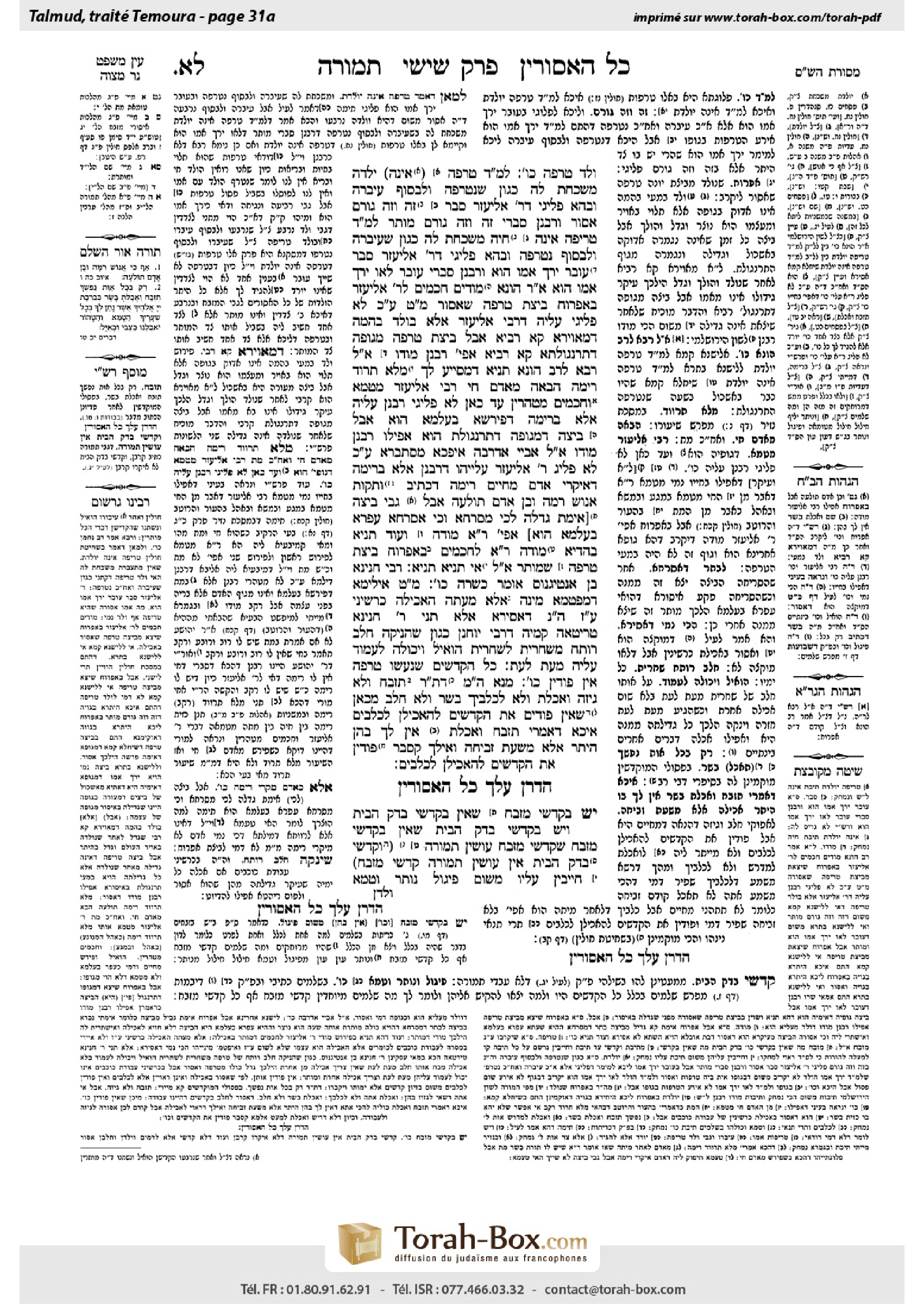
Temurah 31a: Talmud study for Daf Yomi
Daf Yomi is the daily study of one Talmud folio. Explore 37 tractates with scans, Hebrew text, Sefaria English and AI-generated French translations where annotated.
Passage selection and English or AI-generated French translation are available where the scan has annotations. Daf Study is independent of Torah-Box and Sefaria.
Browse Temurah · תמורה · All tractatesTemurah 31a text and translations
This page of Temurah includes the Aramaic text, an English translation and an AI-generated French translation, alongside the scan above.
תמורה ל״א א · Aramaic and Hebrew text
וְלַד טְרֵפָה כּוּ׳. לְמַאן דְּאָמַר טְרֵפָה (אינה) יָלְדָה — מַשְׁכַּחַתְּ לַהּ כְּגוֹן שֶׁנִּטְרְפָה וּלְבַסּוֹף עִיבְּרָה.
וּבְהָא פְּלִיגִי, דְּרַבִּי אֱלִיעֶזֶר סָבַר: זֶה וָזֶה גּוֹרֵם אָסוּר, וְרַבָּנַן סָבְרִי: זֶה וָזֶה גּוֹרֵם מוּתָּר.
לְמַאן דְּאָמַר טְרֵיפָה אֵינָהּ חַיָּה, מַשְׁכַּחַתְּ לַהּ כְּגוֹן שֶׁעִיבְּרָה וּלְבַסּוֹף נִטְרְפָה, וּבְהָא פְּלִיגִי: דְּרַבִּי אֱלִיעֶזֶר סָבַר עוּבָּר יֶרֶךְ אִמּוֹ הוּא, וְרַבָּנַן סָבְרִי עוּבָּר לָאו יֶרֶךְ אִמּוֹ הוּא.
אָמַר רַב הוּנָא: מוֹדִים חֲכָמִים לְרַבִּי אֱלִיעֶזֶר בְּאֶפְרוֹחַ בֵּיצַת טְרֵפָה שֶׁאָסוּר. מַאי טַעְמָא? עַד כָּאן לָא פְּלִיגִי עֲלֵיהּ דְּרַבִּי אֱלִיעֶזֶר אֶלָּא בִּוְלַד בְּהֵמָה, דְּמֵאַוֵּירָא קָא רָבְיָא, אֲבָל בֵּיצַת טְרֵפָה דְּמִגּוּפַהּ דְּתַרְנְגוֹלְתָּא קָא רָבְיָא — אֲפִילּוּ רַבָּנַן מוֹדוּ.
אֲמַר לֵיהּ רָבָא לְרַב הוּנָא: תַּנְיָא דִּמְסַיַּיע לָךְ, מְלֹא תַּרְוָד רִימָּה הַבָּאָה מֵאָדָם חַי — רַבִּי אֱלִיעֶזֶר מְטַמֵּא, וַחֲכָמִים מְטַהֲרִין. עַד כָּאן לָא פְּלִיגִי רַבָּנַן עֲלֵיהּ אֶלָּא בְּרִימָּה, דְּפִירְשָׁא בְּעָלְמָא הוּא, אֲבָל בֵּיצָה דְּמִגּוּפַהּ דְּתַרְנְגוֹלֶת הוּא — אֲפִילּוּ רַבָּנַן מוֹדוּ.
אֲמַר לֵיהּ אַבָּיֵי: אַדְּרַבָּה, אִיפְּכָא מִסְתַּבְּרָא — עַד כָּאן לָא פְּלִיג רַבִּי אֱלִיעֶזֶר עֲלַיְיהוּ דְּרַבָּנַן אֶלָּא בְּרִימָּה, דְּאִיקְּרִי אָדָם מֵחַיִּים ״רִימָּה״, דִּכְתִיב: ״וְתִקְוַת אֱנוֹשׁ רִמָּה וּבֶן אָדָם תּוֹלֵעָה״.
אֲבָל גַּבֵּי בֵּיצָה, אֵימַת גָּדְלָה? לְכִי מַסְרְחָא, וְכִי אַסְרַחָא — עַפְרָא בְּעָלְמָא הוּא, אֲפִילּוּ רַבִּי אֱלִיעֶזֶר מוֹדֶה! וְעוֹד, תַּנְיָא בְּהֶדְיָא: מוֹדֶה רַבִּי אֱלִיעֶזֶר לַחֲכָמִים בְּאֶפְרוֹחַ בֵּיצַת טְרֵפָה שֶׁמּוּתָּר! אֲמַר לֵיהּ: אִי תַּנְיָא — תַּנְיָא.
רַבִּי חֲנִינָא בֶּן אַנְטִיגְנוֹס אוֹמֵר: כְּשֵׁרָה כּוּ׳. מַאי טַעְמָא? אִילֵּימָא דְּמִפַּטְמָא מִינַּהּ, אֶלָּא מֵעַתָּה הֶאֱכִילָהּ כַּרְשִׁינֵי עֲבוֹדָה זָרָה, הָכִי נָמֵי דַּאֲסִירָא?
אֶלָּא, תָּנֵי רַבִּי חֲנִינָא טְרִיטָאָה קַמֵּיהּ דְּרַבִּי יוֹחָנָן: כְּגוֹן שֶׁהֱנִיקָהּ חָלָב רוֹתֵחַ מִשַּׁחֲרִית לְשַׁחֲרִית, הוֹאִיל וִיכוֹלָה לַעֲמוֹד עָלֶיהָ מֵעֵת לְעֵת.
כָּל הַקֳּדָשִׁים שֶׁנַּעֲשׂוּ טְרֵפָה אֵין פּוֹדִין כּוּ׳. מְנָא הָנֵי מִילֵּי? דְּתָנוּ רַבָּנַן: ״תִּזְבַּח״ — וְלֹא גִּיזָּה, ״וְאָכַלְתָּ״ — וְלֹא לִכְלָבֶיךָ, ״בָּשָׂר״ — וְלֹא חָלָב. מִכָּאן שֶׁאֵין פּוֹדִים אֶת הַקֳּדָשִׁים לְהַאֲכִילָן לִכְלָבִים.
אִיכָּא דְאָמְרִי: ״תִּזְבַּח וְאָכַלְתָּ״ — אֵין לְךָ בָּהֶן הֶיתֵּר אֶלָּא מִשְּׁעַת זְבִיחָה וְאֵילָךְ, קָסָבַר: פּוֹדִין אֶת הַקֳּדָשִׁים לְהַאֲכִילָן לִכְלָבִים.
הֲדַרַן עֲלָךְ כָּל הָאֲסוּרִין.
מַתְנִי׳ יֵשׁ בְּקׇדְשֵׁי מִזְבֵּחַ שֶׁאֵין בְּקׇדְשֵׁי בֶּדֶק הַבַּיִת, וְיֵשׁ בְּקׇדְשֵׁי בֶּדֶק הַבַּיִת שֶׁאֵין בְּקׇדְשֵׁי מִזְבֵּחַ.
שֶׁקׇּדְשֵׁי מִזְבֵּחַ עוֹשִׂין תְּמוּרָה, וְקׇדְשֵׁי בֶּדֶק הַבַּיִת אֵין עוֹשִׂין תְּמוּרָה. קׇדְשֵׁי מִזְבֵּחַ חַיָּיבִין (עָלָיו) [עֲלֵיהֶן] מִשּׁוּם פִּיגּוּל, נוֹתָר, וְטָמֵא,
Temurah 31a · English translation
§ The mishna teaches that with regard to the offspring of a tereifa, Rabbi Eliezer prohibits it to be sacrificed on the altar, whereas the Rabbis permit it. The Gemara explains: There is a dispute as to whether a tereifa is capable of giving birth. According to the one who says that a tereifa can give birth, you find this dispute between Rabbi Eliezer and the Rabbis in a case where the animal first became a tereifa and then became pregnant.
The Gemara elaborates: And this is the matter over which they disagree, as Rabbi Eliezer holds that when both this permitted factor and that prohibited factor cause a certain situation, the resulting item is prohibited. Here too, as the mother of this offspring is prohibited, the offspring is likewise prohibited, despite the fact that its father is permitted. And the Rabbis hold that when both this permitted factor and that prohibited factor cause a situation, the resulting item is permitted. Therefore, the offspring in this case is permitted like its father.
By contrast, according to the one who says that a tereifa cannot survive, i.e., cannot give birth, you find this dispute in a case where the animal first became pregnant and then became a tereifa. And this is the point over which they disagree, as Rabbi Eliezer holds that a fetus is considered the thigh of its mother, and therefore just as its mother is prohibited to be sacrificed on the altar as a tereifa, the same applies to its offspring. And the Rabbis hold that a fetus is not considered the thigh of its mother, and consequently there is no reason to prohibit it to be sacrificed on the altar.
§ The Gemara continues to discuss the dispute between Rabbi Eliezer and the Rabbis. Rav Huna says: The Rabbis concede to Rabbi Eliezer in the case of a chick that emerges from the egg of a tereifa dove that it is prohibited to be sacrificed on the altar. What is the reason that the Rabbis rule stringently here? The Rabbis disagree with Rabbi Eliezer and claim that the offspring of a tereifa is permitted only with regard to the offspring of an animal, which grows from its own space, i.e., even when it is in its mother’s womb it develops as an independent entity. But with regard to an egg of a tereifa hen, which grows from the body of the hen, even the Rabbis concede that the chick which emerges from this egg may not be sacrificed on the altar.
Rava said to Rav Huna: That which is taught in a baraita supports your opinion: With regard to a full ladle [tarvad] of worms that come from a living person who subsequently died, Rabbi Eliezer holds that it transmits ritual impurity in the same manner as a corpse, as a full ladle is the minimum amount of dust from the dead that imparts impurity; and the Rabbis deem it pure. Rava analyzes this baraita: The Rabbis disagree with Rabbi Eliezer only with regard to worms, which are merely a secretion. But with regard to an egg, which is part of the hen’s body, even the Rabbis concede that in the case of a tereifa, the chick that emerges from the egg is prohibited to the altar.
Abaye said to Rava: No proof can be brought from here for the opinion of Rav Huna, as on the contrary, the opposite is reasonable: Rabbi Eliezer disagrees with the Rabbis only with regard to worms, as he maintains that worms are considered part of a person even if they emerged from him while he was still alive, as a person is called a worm while he is still alive, as it is written: And the hope of man is a worm, and the son of man, that is a maggot (see Job 25:6).
But with regard to a chick that emerges from an egg, one can say: When does the chick grow out of and emerge from the egg? It does so when the egg rots, and when it rots it is considered merely dust and is no longer attributed to the hen that laid it. Therefore, despite the fact that the hen is a tereifa, even Rabbi Eliezer should concede that the chick that emerges from its egg is permitted to be sacrificed. And furthermore, it is explicitly taught in a baraita that Rabbi Eliezer concedes to the Rabbis with regard to the chick that emerged from the egg of a tereifa animal that it is permitted to be sacrificed on the altar, which is not in accordance with the opinion of Rav Huna. Rava said to Abaye: If this baraita is taught, it is taught, and I cannot take issue with it.
§ The mishna teaches that Rabbi Ḥanina ben Antigonus says: A kosher animal that suckled from a tereifa is disqualified from being sacrificed on the altar. The Gemara asks: What is the reason? If we say that it is because the kosher animal was fattened from the tereifa animal, if that is so, then in a case where its owner fed it vetches of idolatry, so too, should one say that it is prohibited? Feeding an animal vetches of idolatry renders it prohibited only if the animal has been set aside for idolatry; a regular animal is not prohibited by this action.
Rather, Rabbi Ḥanina Terita taught the meaning of the mishna before Rabbi Yoḥanan: This is referring to a case where one gave the kosher animal to suckle from the tereifa warm, i.e., fresh, milk every morning. Since the kosher animal can maintain its existence based upon this suckling for a twenty-four-hour period, until the next suckling, it survives only due to the tereifa animal. Consequently, the kosher animal is prohibited to be sacrificed on the altar.
§ The mishna further teaches: With regard to all sacrificial animals that became tereifa, one may not redeem them and render them non-sacred, as their consumption is prohibited, and one does not redeem sacrificial animals to feed them to dogs. The Gemara asks: From where are these matters derived? As the Sages taught with regard to the verse: “Notwithstanding you may slaughter and eat flesh within all your gates” (Deuteronomy 12:15). This verse, which is referring to disqualified consecrated animals that have been redeemed, is expounded as follows: “You may slaughter,” but you may not shear their wool; “and eat,” but you may not give to your dogs to eat; “and eat flesh,” but not their milk. From here it is derived that one does not redeem sacrificial animals to feed them to dogs.
There are those who state a different version: “You may slaughter and eat,” this teaches that you have permission to derive benefit from them only from the time of slaughter and onward, i.e., those benefits that come after slaughter, such as the consumption of its flesh, are permitted. But one may not derive benefit from their shearing or their milk, as these occur even when the animal is alive. It can be inferred from here that the tanna of this baraita maintains that one may redeem sacrificial animals to feed them to dogs, as this occurs after the slaughter.
MISHNA: There are elements that apply to animals consecrated for the altar that do not apply to items consecrated for Temple maintenance, and there are elements that apply to items consecrated for Temple maintenance that do not apply to animals consecrated for the altar.
One element exclusive to animals consecrated for the altar is that animals consecrated for the altar render an animal exchanged for them a substitute, and items consecrated for Temple maintenance do not render an animal exchanged for them a substitute. In addition, if one slaughters an animal consecrated for the altar with the intention to eat it beyond its designated time, or if he ate the offering after its designated time, or if he ate the offering while ritually impure, he is liable to receive karet for eating it due to violation of the prohibitions of piggul, notar, and eating while ritually impure, respectively.
Temurah 31a · Traduction française (IA)
§ La Michna enseigne qu’au sujet du petit d’une tereifa, Rabbi Eliezer interdit de le sacrifier sur l’autel, tandis que les Rabbins le permettent. La Guemara explique qu’il existe une controverse quant à savoir si une tereifa peut donner naissance. Selon celui qui affirme qu’une tereifa peut donner naissance, la controverse entre Rabbi Eliezer et les Rabbins porte sur le cas où l’animal est d’abord devenu une tereifa, puis est devenu gestant.
La Guemara précise : c’est sur ce point qu’ils sont en désaccord. Rabbi Eliezer estime que lorsque ce facteur permis et ce facteur interdit contribuent ensemble à produire une situation donnée, le résultat est interdit. Ici aussi, puisque la mère de ce petit est interdite, le petit l’est également, bien que son père soit permis. Les Rabbins, eux, estiment que lorsque ce facteur permis et ce facteur interdit contribuent ensemble à produire une situation, le résultat est permis. Par conséquent, dans ce cas, le petit est permis comme son père.
En revanche, selon celui qui affirme qu’une tereifa ne peut pas survivre, c’est-à-dire qu’elle ne peut pas donner naissance, la controverse porte sur le cas où l’animal est d’abord devenu gestant, puis est devenu une tereifa. C’est sur ce point qu’ils sont en désaccord : Rabbi Eliezer estime qu’un fœtus est considéré comme la cuisse de sa mère. Par conséquent, de même que sa mère, étant une tereifa, ne peut pas être sacrifiée sur l’autel, il en va de même de son petit. Les Rabbins, eux, estiment qu’un fœtus n’est pas considéré comme la cuisse de sa mère ; rien ne justifie donc d’interdire de le sacrifier sur l’autel.
§ La Guemara poursuit la discussion de la controverse entre Rabbi Eliezer et les Rabbins. Rav Houna dit : Les Rabbins concèdent à Rabbi Eliezer que, dans le cas d’un poussin qui sort de l’œuf d’une colombe tereifa, il est interdit de le sacrifier sur l’autel. Pour quelle raison les Rabbins adoptent-ils ici une position stricte ? Les Rabbins contestent l’avis de Rabbi Eliezer et soutiennent que le petit d’une tereifa n’est permis que lorsqu’il s’agit du petit d’un animal, qui se développe dans son propre espace, c’est-à-dire que, même dans le ventre de sa mère, il se développe comme une entité indépendante. Mais s’agissant de l’œuf d’une poule tereifa, qui se développe à partir du corps de la poule, même les Rabbins concèdent que le poussin qui en sort ne peut pas être sacrifié sur l’autel.
Rava dit à Rav Houna : Ce qui est enseigné dans une baraïta appuie ton avis : au sujet d’une pleine louche [tarvad] de vers provenant d’un homme vivant qui est ensuite mort, Rabbi Eliezer estime qu’elle transmet l’impureté rituelle comme un cadavre, car une pleine louche est la quantité minimale de poussière provenant d’un mort qui transmet l’impureté ; les Rabbins, eux, la considèrent comme pure. Rava analyse cette baraïta : les Rabbins ne contestent l’avis de Rabbi Eliezer qu’au sujet des vers, qui ne sont qu’une sécrétion. Mais s’agissant d’un œuf, qui fait partie du corps de la poule, même les Rabbins concèdent que, dans le cas d’une tereifa, le poussin qui sort de l’œuf est interdit sur l’autel.
Abayé dit à Rava : On ne peut pas tirer de preuve de là en faveur de l’avis de Rav Houna ; au contraire, c’est l’inverse qui semble raisonnable : Rabbi Eliezer ne s’oppose aux Rabbins qu’au sujet des vers, car il estime que les vers sont considérés comme faisant partie d’un homme, même s’ils sont sortis de lui alors qu’il était encore vivant. En effet, l’homme est appelé « ver » de son vivant, comme il est écrit : « L’espoir de l’homme est un ver, et le fils de l’homme, un asticot » (voir Job 25,6).
Mais au sujet d’un poussin qui sort d’un œuf, on peut dire : quand le poussin se développe-t-il à partir de l’œuf et en sort-il ? Cela se produit lorsque l’œuf pourrit ; alors, il est considéré comme de la simple poussière et n’est plus attribué à la poule qui l’a pondu. Par conséquent, bien que la poule soit une tereifa, même Rabbi Eliezer devrait concéder que le poussin qui sort de son œuf peut être sacrifié. De plus, une baraïta enseigne explicitement que Rabbi Eliezer concède aux Rabbins, au sujet du poussin qui sort de l’œuf d’un animal tereifa, qu’il peut être sacrifié sur l’autel, ce qui n’est pas conforme à l’avis de Rav Houna. Rava dit à Abayé : Si cette baraïta est enseignée, elle l’est, et je ne peux pas la contester.
§ La Michna enseigne que Rabbi Ḥanina ben Antigonus dit : Un animal cachère qui a été allaité par une tereifa ne peut pas être sacrifié sur l’autel. La Guemara demande : Pour quelle raison ? Si l’on dit que c’est parce que l’animal cachère a été engraissé par l’animal tereifa, alors, si son propriétaire lui a donné des vesces provenant d’une idole, devrait-on également dire qu’il est interdit ? Donner à un animal des vesces provenant d’une idole ne le rend interdit que si l’animal a été mis à part pour l’idolâtrie ; un animal ordinaire n’est pas interdit par cette action.
Rabbi Ḥanina Terita enseigna plutôt l’interprétation de la Michna devant Rabbi Yoḥanan : cela fait référence au cas où l’on a fait téter chaque matin à l’animal cachère le lait chaud, c’est-à-dire frais, d’une tereifa. Puisque l’animal cachère peut subsister grâce à cette tétée pendant vingt-quatre heures, jusqu’à la tétée suivante, il ne survit que grâce à l’animal tereifa. Par conséquent, l’animal cachère ne peut pas être sacrifié sur l’autel.
§ La Michna enseigne encore : Pour tous les animaux consacrés à l’autel qui sont devenus des tereifot, on ne peut pas les racheter et les rendre profanes, car il est interdit de les consommer et l’on ne rachète pas des animaux consacrés pour les donner à manger aux chiens. La Guemara demande : D’où tire-t-on ces règles ? Les Sages ont enseigné à propos du verset : « Toutefois, tu pourras abattre et manger de la viande dans toutes tes villes » (Deutéronome 12,15). Ce verset, qui fait référence aux animaux consacrés devenus impropres et qui ont été rachetés, est interprété ainsi : « Tu pourras abattre », mais tu ne peux pas tondre leur laine ; « et manger », mais tu ne peux pas en donner à manger à tes chiens ; « et manger de la viande », mais pas leur lait. On en déduit qu’on ne rachète pas des animaux consacrés pour les donner à manger aux chiens.
Certains transmettent une autre version : « Tu pourras abattre et manger » enseigne qu’il est permis de tirer profit de ces animaux uniquement à partir de l’abattage, c’est-à-dire que les bénéfices qui en découlent après l’abattage, comme la consommation de leur viande, sont permis. Mais il est interdit de tirer profit de leur tonte ou de leur lait, puisque cela survient alors que l’animal est encore vivant. On peut en déduire que le tanna de cette baraïta estime qu’on peut racheter des animaux consacrés pour les donner à manger aux chiens, puisque cela survient après l’abattage.
MICHNA : Il existe des règles qui s’appliquent aux animaux consacrés à l’autel mais pas aux biens consacrés à l’entretien du Temple, et des règles qui s’appliquent aux biens consacrés à l’entretien du Temple mais pas aux animaux consacrés à l’autel.
Une règle propre aux animaux consacrés à l’autel est que ceux-ci confèrent le statut de substitut à un animal échangé contre eux, tandis que les biens consacrés à l’entretien du Temple ne confèrent pas ce statut à un animal échangé contre eux. En outre, si quelqu’un abat un animal consacré à l’autel avec l’intention de le manger au-delà du délai fixé, s’il mange l’offrande après le délai fixé, ou s’il la mange alors qu’il est rituellement impur, il est passible de karet pour l’avoir consommée, en raison de la violation, respectivement, des interdictions de piggoul, de notar et de consommation en état d’impureté rituelle.
Traduction française générée par IA à partir de l’édition anglaise de Sefaria. Vérifie toujours un passage avec le texte source.
Text from Sefaria: William Davidson Edition - Vocalized Aramaic (CC BY NC); William Davidson Edition - English (CC BY NC).