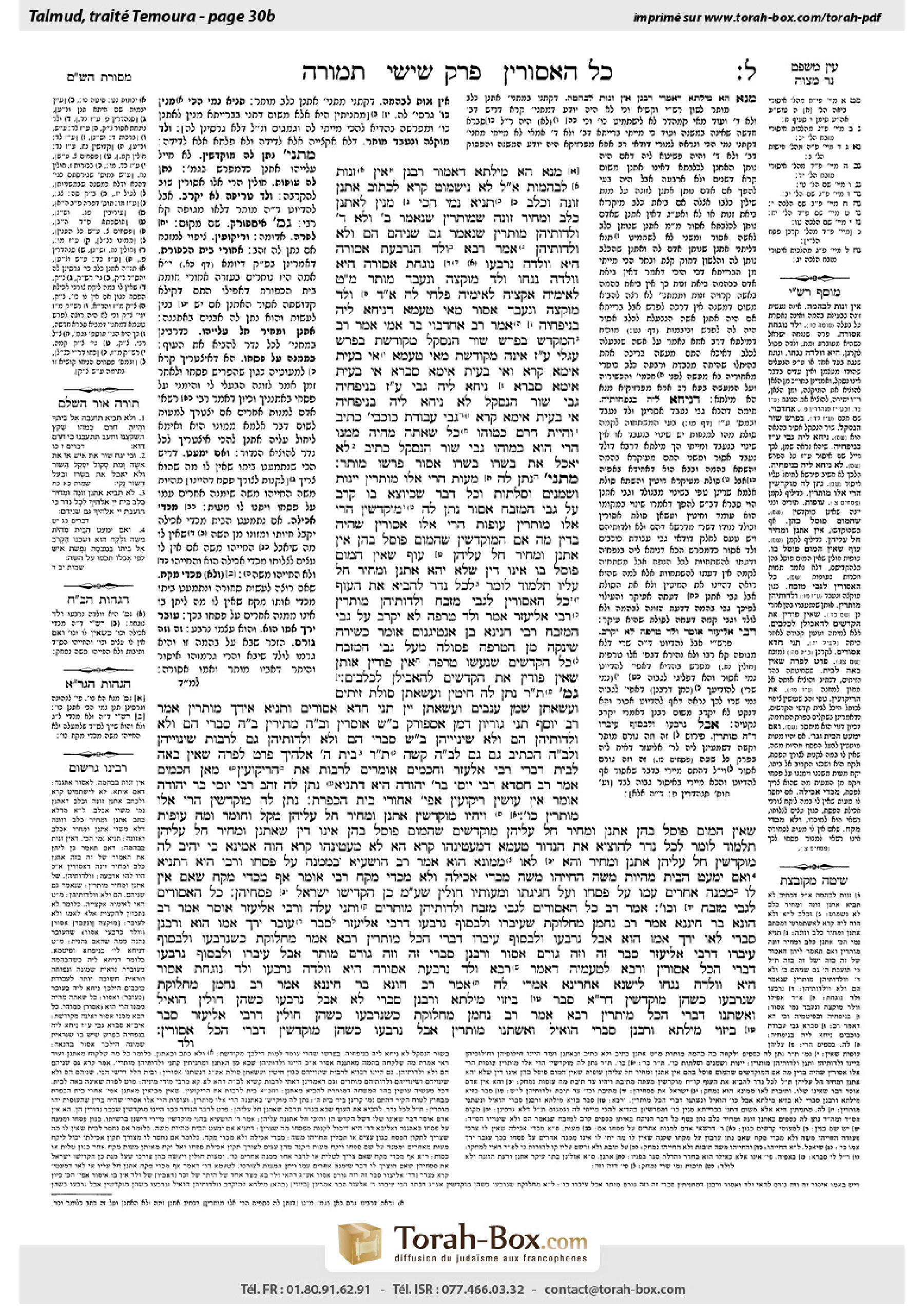
Temurah 30b: Talmud study for Daf Yomi
Daf Yomi is the daily study of one Talmud folio. Explore 37 tractates with scans, Hebrew text, Sefaria English and AI-generated French translations where annotated.
Passage selection and English or AI-generated French translation are available where the scan has annotations. Daf Study is independent of Torah-Box and Sefaria.
Browse Temurah · תמורה · All tractatesTemurah 30b text and translations
This page of Temurah includes the Aramaic text, an English translation and an AI-generated French translation, alongside the scan above.
תמורה ל׳ ב · Aramaic and Hebrew text
מְנַָא הָא מִילְּתָא דַאֲמוּר רַבָּנַן אֵין זְנוּת לִבְהֵמוֹת? אֲמַר לֵיהּ: לָא (נִישְׁמוֹט) [לִישְׁתְּמִיט] קְרָא לִכְתּוֹב ״אֶתְנַן זוֹנָה וָכֶלֶב״.
תַּנְיָא נָמֵי הָכִי: מִנַּיִן לְאֶתְנַן כֶּלֶב וּמְחִיר זוֹנָה שֶׁמּוּתָּרִין? שֶׁנֶּאֱמַר ״שְׁנַיִם״ וְלֹא אַרְבָּעָה. וַלְדוֹתֵיהֶן מוּתָּרִין, שֶׁנֶּאֱמַר ״גַּם שְׁנֵיהֶם״ — ״הֵם״ וְלֹא וַלְדוֹתֵיהֶן.
אָמַר רָבָא: וְלַד הַנִּרְבַּעַת אֲסוּרָה, הִיא וּוְלָדָהּ נִרְבְּעוּ. נוֹגַחַת אֲסוּרָה, הִיא וּוְלָדָהּ נָגְחוּ.
וְלַד מוּקְצֶה וְנֶעֱבָד — מוּתָּר. מַאי טַעְמָא? לְאִימֵּיהּ אַקְצְיַהּ, לְאִימֵּיהּ פָּלְחִי לַהּ. אִיכָּא דְאָמְרִי: וְלַד מוּקְצֶה וְנֶעֱבָד — אָסוּר. מַאי טַעְמָא? דְּנִיחָא לֵיהּ בְּנִיפְחֵיהּ.
אָמַר רַב אַחָדְבוּי בַּר אַמֵּי, אָמַר רַב: הַמְקַדֵּשׁ בְּפֶרֶשׁ שׁוֹר הַנִּסְקָל, מְקוּדֶּשֶׁת. בְּפֶרֶשׁ עֶגְלֵי עֲבוֹדָה זָרָה, אֵינָהּ מְקוּדֶּשֶׁת. מַאי טַעְמָא? אִי בָּעֵית אֵימָא קְרָא, וְאִי בָּעֵית אֵימָא סְבָרָא.
אִי בָּעֵית אֵימָא סְבָרָא: נִיחָא לֵיהּ גַּבֵּי עֲבוֹדָה זָרָה בְּנִיפְחֵיהּ, גַּבֵּי שׁוֹר הַנִּסְקָל — לָא נִיחָא לֵיהּ בְּנִיפְחֵיהּ.
אִי בָּעֵית אֵימָא קְרָא, גַּבֵּי עֲבוֹדָה זָרָה כְּתִיב: ״וְהָיִיתָ חֵרֶם כָּמוֹהוּ״, כֹּל שֶׁאַתָּה מְהַיֶּה מִמֶּנּוּ הֲרֵי הוּא כָּמוֹהוּ. גַּבֵּי שׁוֹר הַנִּסְקָל כְּתִיב: ״לֹא יֵאָכֵל אֶת בְּשָׂרוֹ״ — בְּשָׂרוֹ אָסוּר, פִּרְשׁוֹ מוּתָּר.
מַתְנִי׳ נָתַן לָהּ מָעוֹת — הֲרֵי אֵלּוּ מוּתָּרִין. יֵינוֹת וּשְׁמָנִים וּסְלָתוֹת, וְכׇל דָּבָר שֶׁכַּיּוֹצֵא בּוֹ קָרֵב עַל גַּבֵּי הַמִּזְבֵּחַ — אָסוּר. נָתַן לָהּ מוּקְדָּשִׁין — הֲרֵי אֵלּוּ מוּתָּרִין.
עוֹפוֹת — הֲרֵי אֵלּוּ אֲסוּרִין, שֶׁהָיָה בַּדִּין: מָה אִם הַמּוּקְדָּשִׁין, שֶׁהַמּוּם פּוֹסֵל בָּהֶן — אֵין אֶתְנַן וּמְחִיר חָל עֲלֵיהֶן; עוֹף, שֶׁאֵין הַמּוּם פּוֹסֵל בּוֹ — אֵינוֹ דִּין שֶׁלֹּא יְהֵא אֶתְנַן וּמְחִיר חָל עָלָיו? תַּלְמוּד לוֹמַר ״לְכׇל נֶדֶר״ — לְהָבִיא אֶת הָעוֹף.
כׇּל הָאֲסוּרִין לְגַבֵּי מִזְבֵּחַ — וַלְדוֹתֵיהֶן מוּתָּרִין. רַבִּי אֱלִיעֶזֶר אוֹמֵר: וְלַד טְרֵפָה לֹא יִקְרַב עַל גַּבֵּי הַמִּזְבֵּחַ. רַבִּי חֲנִינָא בֶּן אַנְטִיגְנוֹס אוֹמֵר: כְּשֵׁירָה שֶׁיָּנְקָה מִן הַטְּרֵפָה — פְּסוּלָה מֵעַל גַּבֵּי הַמִּזְבֵּחַ. כׇּל הַקֳּדָשִׁים שֶׁנַּעֲשׂוּ טְרֵפָה — אֵין פּוֹדִין אוֹתָן, שֶׁאֵין פּוֹדִין אֶת הַקֳּדָשִׁים לְהַאֲכִילָן לִכְלָבִים.
גְּמָ׳ תָּנוּ רַבָּנַן: נָתַן לָהּ חִיטִּין וַעֲשָׂאָתַן סוֹלֶת, זֵיתִים וַעֲשָׂאָתַן שֶׁמֶן, עֲנָבִים וַעֲשָׂאָתַן יַיִן. תָּנֵי חֲדָא: אֲסוּרִים, וְתַנְיָא אִידַּךְ: מוּתָּרִין. אָמַר רַב יוֹסֵף: תָּנֵי גּוּרְיוֹן דְּמִן אַסְפּוֹרַק — בֵּית שַׁמַּאי אוֹסְרִין וּבֵית הִלֵּל מַתִּירִין.
בֵּית הִלֵּל סָבְרִי: ״הֵם״ — וְלֹא וַלְדוֹתֵיהֶן, ״הֵם״ — וְלֹא שִׁינּוּיֵיהֶן.
בֵּית שַׁמַּאי סָבְרִי: ״הֵם״ — וְלֹא וַלְדוֹתֵיהֶן, ״גַּם״ — לְרַבּוֹת שִׁינּוּיֵיהֶן, וּלְבֵית הִלֵּל, הָכְתִיב ״גַּם״! ״גַּם״ לְבֵית הִלֵּל קַשְׁיָא.
תָּנוּ רַבָּנַן: ״בֵּית ה׳ אֱלֹהֶיךָ״ — פְּרָט לְפָרָה, שֶׁאֵין בָּאָה לַבַּיִת, דִּבְרֵי רַבִּי אֶלְעָזָר. וַחֲכָמִים אוֹמְרִים: לְרַבּוֹת אֶת הָרִיקּוּעִין.
מַאן חֲכָמִים? אָמַר רַב חִסְדָּא: רַבִּי יוֹסֵי בְּרַבִּי יְהוּדָה הִיא, דְּתַנְיָא: נָתַן לָהּ זָהָב, רַבִּי יוֹסֵי בַּר יְהוּדָה אוֹמֵר: אֵין עוֹשִׂין רִיקּוּעִין, אֲפִילּוּ אֲחוֹרֵי בֵּית הַכַּפּוֹרֶת.
נָתַן לָהּ מוּקְדָּשִׁין — הֲרֵי אֵלּוּ מוּתָּרִין כּוּ׳.
וְיִהְיוּ מוּקְדָּשִׁין אֶתְנַן וּמְחִיר חָל עֲלֵיהֶן, מִקַּל וָחוֹמֶר: וּמָה עוֹפוֹת שֶׁאֵין הַמּוּם פּוֹסֵל בָּהֶן — אֶתְנַן וּמְחִיר חָל עֲלֵיהֶן, מוּקְדָּשִׁים שֶׁהַמּוּם פּוֹסֵל בָּהֶן — אֵינוֹ דִּין שֶׁאֶתְנַן וּמְחִיר חָל עֲלֵיהֶן? תַּלְמוּד לוֹמַר ״לְכׇל נֶדֶר״ — לְהוֹצִיא אֶת הַנָּדוּר.
טַעְמָא דְּמַעֲטִינְהוּ קְרָא, הָא לָא מַעֲטִינְהוּ קְרָא הֲוָה אֲמִינָא: כִּי יָהֵיב לַהּ מוּקְדָּשִׁין — חָל עֲלֵיהֶן אֶתְנַן וּמְחִיר? וְהָא לָאו מָמוֹנָא הוּא!
אָמַר רַב הוֹשַׁעְיָא: בְּמַמְנֶה עַל פִּסְחוֹ, וְרַבִּי הִיא, דְּתַנְיָא: ״וְאִם יִמְעַט הַבַּיִת מִהְיוֹת מִשֶּׂה״.
הַחֲיֵיהוּ מִשֶּׂה, מִכְּדֵי אֲכִילָה וְלֹא מִכְּדֵי מִקָּח.
רַבִּי אוֹמֵר: אַף מִכְּדֵי מִקָּח, שֶׁאִם אֵין לוֹ מַמְנֶה אֲחֵרִים עִמּוֹ עַל פִּסְחוֹ וְעַל חֲגִיגָתוֹ, וּמְעוֹתָיו חוּלִּין, שֶׁעַל מְנָת כֵּן הִקְדִּישׁוּ יִשְׂרָאֵל פִּסְחֵיהֶן.
כָּל הָאֲסוּרִים לְגַבֵּי מִזְבֵּחַ וְכוּ׳. אָמַר רַב: כָּל הָאֲסוּרִים לְגַבֵּי מִזְבֵּחַ וַלְדוֹתֵיהֶן מוּתָּרִים, וְתָנֵי עֲלַהּ: וְרַבִּי אֱלִיעֶזֶר אוֹסֵר.
אָמַר רַב הוּנָא בַּר חִינָּנָא, אָמַר רַב נַחְמָן: מַחְלוֹקֶת שֶׁעִיבְּרוּ וּלְבַסּוֹף נִרְבְּעוּ, דְּרַבִּי אֱלִיעֶזֶר סָבַר ״עוּבָּר יֶרֶךְ אִמּוֹ הוּא״, וְרַבָּנַן סָבְרִי ״לָאו יֶרֶךְ אִמּוֹ הוּא״, אֲבָל נִרְבְּעוּ וּלְבַסּוֹף עִיבְּרוּ — דִּבְרֵי הַכֹּל מוּתָּרִין.
רָבָא אָמַר: מַחְלוֹקֶת שֶׁנִּרְבְּעוּ וּלְבַסּוֹף עִיבְּרוּ, דְּרַבִּי אֱלִיעֶזֶר סָבַר: זֶה וָזֶה גּוֹרֵם אָסוּר, וְרַבָּנַן סָבְרִי: זֶה וָזֶה גּוֹרֵם מוּתָּר.
אֲבָל עִיבְּרוּ וּלְבַסּוֹף נִרְבְּעוּ — דִּבְרֵי הַכֹּל אֲסוּרִין. וְרָבָא לְטַעְמֵיהּ, דְּאָמַר רָבָא: וְלַד נִרְבַּעַת אָסוּר, הִיא וּוְלָדָהּ נִרְבְּעוּ, וְלַד נוֹגַחַת אָסוּר, הִיא וּוְלָדָהּ נָגְחוּ.
לִישָּׁנָא אַחֲרִינָא אָמְרִי לַהּ. אָמַר רַב הוּנָא בַּר חִינָּנָא, אָמַר רַב נַחְמָן: מַחְלוֹקֶת שֶׁנִּרְבְּעוּ כְּשֶׁהֵן מוּקְדָּשִׁין, דְּרַבִּי אֱלִיעֶזֶר סָבַר בִּיזּוּי מִילְּתָא, וְרַבָּנַן סָבְרִי לָא. אֲבָל נִרְבְּעוּ כְּשֶׁהֵן חוּלִּין, הוֹאִיל וְהִשְׁתַּנּוּ — דִּבְרֵי הַכֹּל מוּתָּרִין.
רָבָא אָמַר רַב נַחְמָן: מַחְלוֹקֶת כְּשֶׁנִּרְבְּעוּ כְּשֶׁהֵן חוּלִּין, דְּרַבִּי אֱלִיעֶזֶר סָבַר: בִּיזּוּי מִילְּתָא, וְרַבָּנַן סָבְרִי: הוֹאִיל וְהִשְׁתַּנּוּ — מוּתָּרִין, אֲבָל נִרְבְּעוּ כְּשֶׁהֵן מוּקְדָּשִׁין — דִּבְרֵי הַכֹּל אֲסוּרִין.
Temurah 30b · English translation
From where is this matter that the Sages stated, that there is no prostitution with regard to an animal derived? I.e., from where is it derived that a woman who copulates with an animal is not considered a prostitute, in accordance with the ruling of the mishna that payment for intercourse with an animal is permitted? Rav Ashi said to Rava from Parzakya: There was nothing preventing the verse from writing: You shall not bring the payment of a prostitute or a dog into the House of the Lord your God. Since the verse states: “You shall not bring the payment of a prostitute or the price of a dog,” this indicates that these are two different cases, and there is no prostitution with regard to an animal.
The Gemara adds that this is also taught in a baraita: From where is it derived with regard to the payment of a lamb to another for engaging in intercourse with a dog, or as the price of a prostitute to purchase her as his maidservant, that their sacrifice is permitted? As it is stated: “For even both of them are an abomination to the Lord your God” (Deuteronomy 23:19), from which it is inferred: Two are prohibited, payment to a prostitute and the price of a dog, and not four, i.e., payment for intercourse with a dog and the price of a prostitute, which are permitted. Furthermore, sacrifice of their offspring is permitted, as it is stated: “Even both of them,” which indicates that it is “them” that are forbidden, and not their offspring.
The Gemara discusses other cases of offspring of animals with regard to sacrifice on the altar. Rava says: The offspring of a female animal that was the object of bestiality when it was pregnant is prohibited to be sacrificed on the altar, like its mother. The reason is that it is considered as though it, the mother, and its offspring both were the object of bestiality. Likewise, if a pregnant cow gores and kills a Jew, its offspring is prohibited to be sacrificed, like its mother, as it is as though it, the mother, and its offspring both gored.
But the offspring of a set-aside animal and an animal worshipped as an idol are permitted to be sacrificed on the altar. What is the reason? It is that only the mother was set aside, and not the offspring. Likewise, they worshipped only its mother, not the offspring. There are those who say a different version of Rava’s statement: The offspring of a set-aside animal and the offspring of an animal worshipped as an idol are prohibited. What is the reason? It is that it is beneficial to the owner if its girth is large, as a pregnant animal is more impressive than an ordinary one. Consequently, its offspring is also considered set-aside and worshipped, and it is therefore prohibited.
Rav Aḥadevoi bar Ami says that Rav says: With regard to one who betroths a woman with the excrement of an ox that is sentenced to be stoned, if the excrement is worth at least one peruta, the woman is betrothed. Although it is not permitted to derive benefit from the ox itself, one may derive benefit from its excrement. But if one betroths her with the excrement of calves that were used for idol worship, she is not betrothed, as even their excrement is prohibited. The Gemara explains: What is the reason for the difference between the excrement of an ox that is stoned and the excrement of calves used for idolatry? If you wish, say that this is learned from a verse; if you wish, say instead that it is derived by means of a logical argument.
The Gemara elaborates: If you wish, say it is derived by means of a logical argument: With regard to calves used for idol worship, a calf’s additional girth due to the excrement stored in its body is beneficial to the owner, as fatter animals are more impressive. Therefore, the excrement is considered part of the offering and is prohibited. By contrast, with regard to an ox that is stoned, its additional girth is not beneficial to him, as he gains nothing from it, and consequently it is not considered part of the animal.
If you wish, say that this is learned from a verse: It is written with regard to an animal used for idol worship: “And you shall not bring an abomination into your house, and be [vehayita] accursed like it” (Deuteronomy 7:26). This teaches that anything that you create [mehayye] from the idol is prohibited like the idol itself. But with regard to an ox that is stoned, it is written: “The ox shall surely be stoned, and its flesh shall not be eaten” (Exodus 21:28). This teaches that only its flesh is forbidden, but its excrement is permitted.
MISHNA: If one gave money to a prostitute as her payment, it is permitted to purchase an offering with that money, as the money itself is not sacrificed. If he paid her with wine, or oil, or flour, or any other item the like of which is sacrificed on the altar, sacrifice of those items is prohibited. If he gave her consecrated items for her services, their sacrifice is permitted. Since they were already consecrated, they do not belong to him, and one cannot prohibit an item that is not his.
If he paid her with non-sacred birds, their sacrifice is prohibited. The mishna elaborates: As, by right, it should be inferred a fortiori: If in the case of consecrated items, which a blemish disqualifies, the prohibition of payment to a prostitute and the price of a dog do not take effect with regard to them; with regard to a bird, which a blemish does not disqualify, is it not right that the prohibition of payment to a prostitute and the price of a dog should not take effect with regard to them? Therefore, the verse states: “You shall not bring the payment of a prostitute, or the price of a dog, into the House of the Lord your God for any vow” (Deuteronomy 23:19). This serves to include the bird in the prohibition.
The mishna adds a principle: With regard to all animals whose sacrifice on the altar is prohibited, sacrifice of their offspring is permitted. Rabbi Eliezer says: The offspring of an animal with a wound that will cause it to die within twelve months [tereifa]shall not be sacrificed on the altar. Rabbi Ḥanina ben Antigonus says: A kosher animal that suckled from a tereifa is disqualified from sacrifice on the altar. With regard to all sacrificial animals that became tereifot, one may not redeem them and render them non-sacred, as their consumption is forbidden and one does not redeem sacrificial animals to feed them to dogs, as this is considered a degradation of sacrificial animals.
GEMARA: The Sages taught: If one gave wheat to a prostitute and she made the wheat into flour, or if he gave her olives and she made them into oil, or if he gave her grapes and she made them into wine, it is taught in one baraita that these products are prohibited to be used as an offering in the Temple, and it is taught in another baraita that they are permitted, as the physical change transforms them into new objects. Rav Yosef said that Guryon of Aspork teaches in a baraita: Beit Shammai prohibit these products and Beit Hillel permit them. If so, the two baraitot cited above reflect a dispute between Beit Shammai and Beit Hillel.
The Gemara explains that Beit Shammai and Beit Hillel both derive their ruling from the verse: “You shall not bring the hire of a harlot, or the price of a dog, into the House of the Lord your God for any vow; for even both of them are an abomination to the Lord your God” (Deuteronomy 23:19). Beit Hillel, who permit these items after they have undergone a physical change, maintain that the word “them” teaches that this prohibition applies only to the original items, but not to their offspring. Likewise, it applies only to them, i.e., the items in their original form, but not to their changed status.
Beit Shammai maintain that one indeed derives: “Them,” but not their offspring. But they maintain that the word “even” serves to include in the prohibition items in their changed status. The Gemara asks: And according to the opinion of Beit Hillel, isn’t it written “even”? How do they interpret that word? The Gemara responds: The word “even” is in fact difficult according to Beit Hillel.
The Sages taught in a baraita, with regard to the verse: “You shall not bring the hire of a harlot, or the price of a dog, into the House of the Lord your God,” that this excludes a red heifer, which is not brought to the House of the Lord, i.e., the Temple, but is slaughtered outside Jerusalem on the Mount of Olives. This is the statement of Rabbi Elazar. And the Rabbis say: This verse serves to include in the prohibition beaten plates of gold in the Temple, if the gold was used as payment to a prostitute or as the price of a dog.
The Gemara asks: Who are the Rabbis cited here? Rav Ḥisda says: It is the opinion of Rabbi Yosei, son of Rabbi Yehuda, as it is taught in a baraita: If one gave a prostitute gold as her payment, Rabbi Yosei bar Yehuda says: One may not fashion hanging beaten plates of gold for the Temple from it, even for the area behind the Hall of the Ark Cover, i.e., the eleven cubits of space behind the Holy of Holies up to the wall of the Temple courtyard, which was at the western end of the Sanctuary. Athough this area is of lesser sanctity than the rest of the Temple, one may not place there any gold given as payment to a prostitute.
§ The mishna teaches: If he gave her consecrated items for her services, their sacrifice is permitted, whereas if he paid her with non-sacred birds, their sacrifice is prohibited. The prohibited status of birds is derived from the verse: “You shall not bring the hire of a harlot, or the price of a dog, into the House of the Lord your God for any vow,” despite an a fortiori inference from consecrated animals that indicates they should be permitted.
The Gemara objects: But if these birds are disqualified as sacrifices, let the prohibitions of payment to a prostitute and the price of a dog apply to consecrated animals, by the following a fortiori inference: If in the case of birds, which a blemish does not disqualify, the status of a prostitute’s payment and a dog’s price applies to them, then with regard to consecrated items, which a blemish does disqualify, is it not logical that the status of a prostitute’s payment and a dog’s price should apply to them? Therefore, the verse states: “For any vow.” This serves to exclude those animals that have already been vowed to be sacrificed.
The Gemara objects: The only reason consecrated animals are disqualified is that the verse excludes them, through the word “vow.” But had the verse not excluded them, I would say that if one gives a prostitute sacrificial animals, or gives these animals in exchange for a dog, the prohibition of payment to a prostitute or a dog’s price applies to them. But this conclusion is problematic, as a consecrated animal is not his property, and there is an established principle that one cannot render an item prohibited if it does not belong to him. How then could one render it prohibited by giving it to a prostitute?
Rav Hoshaya says: This is referring to one who registers the prostitute for his Paschal offering (see Pesaḥim 61a), giving her a portion in it as payment for her services, and it is in accordance with the opinion of Rabbi Yehuda HaNasi, who maintains that a Paschal offering is considered one’s personal property for the purposes of allowing additional people to register for it. As it is taught in a baraita: The verse states, with regard to the Paschal offering: “And if the household be too little for a lamb, then he and his neighbor next to his house shall take one” (Exodus 12:4). The phrase “if the household be too little” is interpreted to mean that the household cannot afford the basic necessities of the Festival.
Based on this interpretation, the phrase “for a lamb [mihyot miseh]” is interpreted to mean: Sustain him from the lamb [haḥyeihu miseh], i.e., he may use the Paschal offering as a means of supporting himself. He takes money from his neighbor in return for registering that neighbor for a portion of his Paschal offering and uses the money to purchase his needs. This halakha applies only if one lacks sufficient means to purchase food to eat, but not if he lacks merely sufficient means to purchase other items.
Rabbi Yehuda HaNasi says: This lenient halakha applies even if one lacks sufficient means to purchase other necessary items, as, if he does not have sufficient funds he may register others with him for his Paschal offering and for his Festival peace offering. And his money that he receives for registering that person is non-sacred, as it is on this condition of registering others in exchange for the money which he receives from them that the Jewish people consecrate their Paschal offerings.
§ The mishna teaches: With regard to all animals whose sacrifice on the altar is prohibited, sacrifice of their offspring is permitted. Rav says: This ruling that with regard to all animals whose sacrifice on the altar is prohibited, sacrifice of their offspring is permitted, is not unanimous but is the opinion of the Rabbis. And indeed it is taught with regard to this case: And Rabbi Eliezer prohibits their offspring to be sacrificed on the altar.
Rav Huna bar Ḥinnana says that Rav Naḥman says: This dispute applies in a case where the animals became pregnant and then were the objects of bestiality, thereby becoming prohibited to sacrifice on the altar. As Rabbi Eliezer holds that a fetus is considered the thigh of its mother and regarded as part of the animal, and is consequently prohibited like its mother. And the Rabbis hold that a fetus is not considered the thigh of its mother. But if the animals were the objects of bestiality and then became pregnant, everyone agrees that they are permitted.
Rava says: This dispute applies in a case where the animals were the objects of bestiality and then became pregnant, as Rabbi Eliezer holds that when both this permitted factor and that prohibited factor cause a certain situation, the resulting item is prohibited. Since the mother of this offspring is prohibited, the offspring is likewise prohibited, despite the fact that its father is permitted. And the Rabbis hold that when this permitted factor and that prohibited factor cause a result, it, i.e., the offspring, is permitted like its father.
But in a case where the animals became pregnant and then were the object of bestiality, everyone agrees that they are prohibited. And the Gemara adds that Rava conforms to his standard line of reasoning in this regard, as Rava said: The offspring of a female animal that was the object of bestiality when it was pregnant is prohibited to be sacrificed on the altar, as it is considered as though it, the mother, and its offspring were both the object of bestiality. Likewise, the offspring of a pregnant cow that gores and kills a person is prohibited, because it is as though it, the mother, and its offspring both gored.
Some state another version of the previous discussion: Rav Huna bar Ḥinnana says that Rav Naḥman says: This dispute applies in a case where the animals were the object of bestiality when they already had the status of sacrificial animals. As Rabbi Eliezer holds that the offspring are also prohibited to be sacrificed on the altar, as their sacrifice is considered a degradation of consecrated items, and degradation of consecrated items is significant. And the Rabbis hold that the offspring may be sacrificed, as they maintain that this is not considered a degradation of consecrated items. But in a case where the animals were the object of bestiality when they were non-sacred, and were subsequently consecrated, since their status was changed by their consecration, everyone agrees that they are permitted.
In contrast, Rava says that Rav Naḥman says: This dispute applies in a case where the animals were the object of bestiality when they were non-sacred, as Rabbi Eliezer holds that even the sacrifice of this offspring is considered degrading to sacrificial animals, and degradation of sacrificial animals is significant, and therefore they are prohibited. And the Rabbis hold that since their status was changed by their consecration, they are permitted. But in a case where the animals were the object of bestiality when they already had the status of sacrificial animals, everyone agrees that they are prohibited.
Temurah 30b · Traduction française (IA)
D'où est tirée cette règle établie par les Sages, selon laquelle il n'existe pas de prostitution au sens propre concernant un animal ? Autrement dit, d'où déduit-on qu'une femme qui a des rapports sexuels avec un animal n'est pas considérée comme une prostituée, conformément à la décision de la Michna selon laquelle le paiement pour des rapports avec un animal est permis ? Rav Ashi dit à Rava de Parzakya : Rien n'empêchait le verset d'écrire : « Tu ne porteras pas le salaire d'une prostituée ni le prix d'un chien dans la Maison de l'Éternel, ton Dieu ». Puisque le verset énonce : « Tu ne porteras pas le salaire d'une prostituée ni le prix d'un chien », cela indique qu'il s'agit de deux cas distincts, et qu'il n'y a pas de prostitution au sens propre concernant un animal.
La Guemara ajoute que cela est également enseigné dans une baraïta : D'où déduit-on, concernant le paiement d'un agneau à une autre personne pour des rapports sexuels avec un chien, ou le prix d'une prostituée pour l'acheter comme servante, que leur sacrifice est permis ? Comme il est écrit : « Car toutes deux sont une abomination pour l'Éternel, ton Dieu » (Deutéronome 23:19), d'où l'on infère : Deux choses sont interdites, le salaire d'une prostituée et le prix d'un chien, et non quatre, c'est-à-dire le paiement pour des rapports avec un chien et le prix d'une prostituée, qui sont permis. De plus, le sacrifice de leur descendance est permis, comme l'indique l'expression : « Toutes deux », ce qui signifie que ce sont « elles » qui sont interdites, et non leur descendance.
La Guemara examine d'autres cas concernant la descendance d'animaux et leur sacrifice sur l'autel. Rava déclare : La descendance d'une femelle qui a été l'objet d'un acte de bestialité alors qu'elle était enceinte est interdite au sacrifice sur l'autel, tout comme sa mère. La raison en est qu'elle est considérée comme si elle, la mère, et sa descendance avaient toutes deux été l'objet de bestialité. De même, si une vache enceinte bouscule et tue un Juif, sa descendance est interdite au sacrifice, tout comme sa mère, car c'est comme si elle, la mère, et sa descendance avaient toutes deux bousculé.
Mais la descendance d'un animal consacré et d'un animal adoré comme une idole est permise au sacrifice sur l'autel. Quelle est la raison ? C'est que seule la mère a été consacrée, et non la descendance. De même, on n'a adoré que sa mère, et non la descendance. Certains rapportent une autre version de la déclaration de Rava : La descendance d'un animal consacré et la descendance d'un animal adoré comme une idole sont interdites. Quelle est la raison ? C'est que c'est avantageux pour le propriétaire si sa taille est grande, car un animal enceinte est plus impressionnant qu'un animal ordinaire. Par conséquent, sa descendance est également considérée comme consacrée et adorée, et elle est donc interdite.
Rav Aḥadevoi bar Ami dit que Rav dit : Concernant celui qui marie une femme avec les excréments d'un bœuf condamné à être lapidé, si les excréments valent au moins une peruta, la femme est mariée. Bien qu'il ne soit pas permis de tirer profit du bœuf lui-même, on peut tirer profit de ses excréments. Mais si on la marie avec les excréments de veaux utilisés pour le culte des idoles, elle n'est pas mariée, car même leurs excréments sont interdits. La Guemara explique : Quelle est la raison de la différence entre les excréments d'un bœuf lapidé et les excréments de veaux utilisés pour l'idolâtrie ? Si tu le souhaites, dis que cela est appris d'un verset ; si tu le souhaites, dis plutôt que cela est déduit par un raisonnement logique.
La Guemara développe : Si tu le souhaites, dis que cela est déduit par un raisonnement logique : Concernant les veaux utilisés pour le culte des idoles, l'augmentation de la taille d'un veau due aux excréments stockés dans son corps est avantageuse pour le propriétaire, car les animaux plus gras sont plus impressionnants. Par conséquent, les excréments sont considérés comme faisant partie de l'offrande et sont interdits. En revanche, concernant un bœuf lapidé, son augmentation de taille n'est pas avantageuse pour lui, car il n'en tire aucun profit, et par conséquent cela n'est pas considéré comme faisant partie de l'animal.
Si tu le souhaites, dis que cela est appris d'un verset : Il est écrit concernant un animal utilisé pour le culte des idoles : « Et tu ne feras pas entrer une abomination dans ta maison, et tu seras [vehayita] maudit comme elle » (Deutéronome 7:26). Cela enseigne que tout ce que tu crées [mehayye] de l'idole est interdit comme l'idole elle-même. Mais concernant un bœuf lapidé, il est écrit : « Le bœuf sera certainement lapidé, et sa chair ne sera pas mangée » (Exode 21:28). Cela enseigne que seule sa chair est interdite, mais ses excréments sont permis.
Michna : Si un homme a donné de l'argent à une prostituée en guise de rémunération, il est permis d'acheter une offrande avec cet argent, car l'argent lui-même n'est pas sacrifié. S'il l'a payée avec du vin, de l'huile, de la farine, ou tout autre objet dont le genre est sacrifié sur l'autel, le sacrifice de ces objets est interdit. S'il lui a donné des objets consacrés pour ses services, leur sacrifice est permis. Puisqu'ils étaient déjà consacrés, ils ne lui appartiennent pas, et on ne peut pas interdire un objet qui ne lui appartient pas.
S'il l'a payée avec des oiseaux non sacrés, leur sacrifice est interdit. La Michna développe : Car, de droit, on devrait en inférer a fortiori : Si dans le cas d'objets consacrés, qu'un défaut disqualifie, l'interdiction du salaire d'une prostituée et du prix d'un chien ne s'applique pas à eux ; concernant un oiseau, qu'un défaut ne disqualifie pas, n'est-il pas juste que l'interdiction du salaire d'une prostituée et du prix d'un chien ne s'applique pas à eux ? Par conséquent, le verset énonce : « Tu ne porteras pas le salaire d'une prostituée, ni le prix d'un chien, dans la Maison de l'Éternel, ton Dieu, pour quelque vœu que ce soit » (Deutéronome 23:19). Cela sert à inclure l'oiseau dans l'interdiction.
La Michna ajoute un principe : En ce qui concerne tous les animaux dont le sacrifice sur l'autel est interdit, le sacrifice de leur descendance est permis. Rabbi Eliezer dit : La descendance d'un animal ayant une blessure qui causera sa mort dans les douze mois [tereifa] ne doit pas être sacrifiée sur l'autel. Rabbi Ḥanina ben Antigonus dit : Un animal casher qui a tété d'une tereifa est disqualifié du sacrifice sur l'autel. En ce qui concerne tous les animaux sacrés devenus tereifot, on ne peut pas les racheter et les rendre non sacrés, car leur consommation est interdite et on ne rachète pas des animaux sacrés pour les donner à manger aux chiens, car cela est considéré comme une dégradation des animaux sacrés.
Guemara : Les Sages ont enseigné : Si un homme a donné du blé à une prostituée et qu'elle a transformé le blé en farine, ou s'il lui a donné des olives et qu'elle les a transformées en huile, ou s'il lui a donné des raisins et qu'elle les a transformés en vin, il est enseigné dans une baraïta que ces produits sont interdits d'être utilisés comme offrande dans le Temple, et il est enseigné dans une autre baraïta qu'ils sont permis, car le changement physique les transforme en nouveaux objets. Rav Yosef a dit que Guryon d'Aspork enseigne dans une baraïta : Beit Chammaï interdisent ces produits et Beit Hillel les permettent. Si c'est le cas, les deux baraïot citées ci-dessus reflètent un différend entre Beit Chammaï et Beit Hillel.
La Guemara explique que Beit Chammaï et Beit Hillel déduisent tous deux leur décision du verset : « Tu ne porteras pas le salaire d'une prostituée, ni le prix d'un chien, dans la Maison de l'Éternel ton Dieu, pour quelque vœu que ce soit ; car l'un et l'autre sont une abomination pour l'Éternel ton Dieu » (Deutéronome 23:19). Beit Hillel, qui permettent ces articles après qu'ils ont subi un changement physique, soutiennent que le mot « eux » enseigne que cette interdiction ne s'applique qu'aux articles d'origine, mais pas à leur descendance. De même, elle ne s'applique qu'à eux, c'est-à-dire aux articles dans leur forme d'origine, mais pas à leur statut modifié.
Beit Chammaï soutiennent qu'on déduit bien : « Eux », mais pas leur descendance. Mais ils soutiennent que le mot « même » sert à inclure dans l'interdiction les articles dans leur statut modifié. La Guemara demande : Et selon l'opinion de Beit Hillel, n'est-il pas écrit « même » ? Comment interprètent-ils ce mot ? La Guemara répond : Le mot « même » est en fait difficile à comprendre selon Beit Hillel.
Les Sages ont enseigné dans une baraïta, au sujet du verset : « Tu ne porteras pas le salaire d'une prostituée, ni le prix d'un chien, dans la Maison de l'Éternel ton Dieu », que cela exclut la vache rousse, qui n'est pas apportée dans la Maison de l'Éternel, c'est-à-dire le Temple, mais est immolée en dehors de Jérusalem, sur la Montagne des Oliviers. C'est l'opinion de Rabbi Elazar. Et les Rabbins disent : Ce verset sert à inclure dans l'interdiction les plaques d'or frappées destinées au Temple, si l'or a été utilisé comme paiement à une prostituée ou comme prix d'un chien.
La Guemara demande : Qui sont les Rabbins cités ici ? Rav Ḥisda dit : C'est l'opinion de Rabbi Yosei, fils de Rabbi Yehuda, car il est enseigné dans une baraïta : Si un homme a donné de l'or à une prostituée en paiement, Rabbi Yosei bar Yehuda dit : On ne peut pas en faire des plaques d'or frappées suspendues pour le Temple, même pour la zone derrière la Salle de l'Arche, c'est-à-dire les onze coudées d'espace derrière le Saint des Saints jusqu'au mur de la cour du Temple, qui était à l'extrémité occidentale du Sanctuaire. Bien que cette zone ait une sainteté moindre que le reste du Temple, on ne peut pas y placer d'or donné comme paiement à une prostituée.
§ La Michna enseigne : S'il lui a donné des objets consacrés pour ses services, leur sacrifice est permis, alors que s'il l'a payée avec des oiseaux non sacrés, leur sacrifice est interdit. Le statut interdit des oiseaux est déduit du verset : « Tu ne porteras pas le salaire d'une prostituée, ni le prix d'un chien, dans la Maison de l'Éternel ton Dieu, pour quelque vœu que ce soit », malgré une déduction a fortiori à partir des animaux consacrés qui indique qu'ils devraient être permis.
La Guemara objecte : Mais si ces oiseaux sont disqualifiés comme sacrifices, que les interdictions du salaire de la prostituée et du prix du chien s'appliquent aux animaux consacrés, par le raisonnement a fortiori suivant : Si, dans le cas des oiseaux, qu'un défaut ne disqualifie pas, le statut de salaire de la prostituée et de prix du chien s'applique à eux, alors, en ce qui concerne les objets consacrés, qu'un défaut disqualifie, n'est-il pas logique que le statut de salaire de la prostituée et de prix du chien s'applique à eux ? Par conséquent, le verset énonce : « Pour tout vœu ». Cela sert à exclure les animaux qui ont déjà été voués au sacrifice.
La Guemara objecte : La seule raison pour laquelle les animaux consacrés sont disqualifiés est que le verset les exclut, par le mot « vœu ». Mais si le verset ne les avait pas exclus, j'aurais dit que si l'on donne des animaux sacrés à une prostituée, ou si l'on échange ces animaux contre un chien, l'interdiction du salaire de la prostituée ou du prix du chien s'applique à eux. Mais cette conclusion est problématique, car un animal consacré n'est pas sa propriété, et il existe un principe établi selon lequel on ne peut rendre interdit un objet qui ne lui appartient pas. Comment alors pourrait-on le rendre interdit en le donnant à une prostituée ?
Rav Hoshaya dit : Cela fait référence à un homme qui inscrit une prostituée pour son agneau pascal (voir Pesaḥim 61a), lui attribuant une part dans celui-ci en paiement de ses services, et cela est conforme à l'opinion de Rabbi Yehuda HaNasi, qui soutient qu'un agneau pascal est considéré comme la propriété personnelle d'un homme aux fins de permettre à d'autres personnes de s'y inscrire. Car il est enseigné dans une baraïta : Le verset dit, en ce qui concerne l'agneau pascal : « Et si la maison est trop petite pour un agneau, alors lui et son voisin le plus proche de sa maison en prendront un » (Exode 12:4). La phrase « si la maison est trop petite » est interprétée comme signifiant que la maison ne peut pas se permettre les besoins de base de la fête.
Selon cette interprétation, l'expression « pour un agneau [mihyot miseh] » est comprise comme signifiant : Soutiens-toi par l'agneau [haḥyeihu miseh], c'est-à-dire qu'il peut utiliser l'agneau pascal comme moyen de subvenir à ses besoins. Il reçoit de l'argent de son voisin en échange de l'inscription de ce dernier pour une part de son agneau pascal et utilise cet argent pour acheter ses nécessités. Cette halakha ne s'applique que si une personne ne dispose pas de moyens suffisants pour acheter de la nourriture à manger, mais pas si elle ne dispose simplement pas de moyens suffisants pour acheter d'autres articles.
Rabbi Yehuda HaNasi dit : Cette halakha indulgente s'applique même si une personne ne dispose pas de moyens suffisants pour acheter d'autres articles nécessaires, car, s'il ne dispose pas de fonds suffisants, il peut inscrire d'autres personnes avec lui pour son agneau pascal et pour son offrande de paix de fête. Et l'argent qu'il reçoit pour l'inscription de cette personne est non sacré, car c'est à la condition d'inscrire d'autres personnes en échange de l'argent qu'il reçoit d'eux que le peuple juif consacre ses agneaux pascals.
§ La Michna enseigne : En ce qui concerne tous les animaux dont le sacrifice sur l'autel est interdit, le sacrifice de leur descendance est permis. Rav dit : Ce jugement, selon lequel, en ce qui concerne tous les animaux dont le sacrifice sur l'autel est interdit, le sacrifice de leur descendance est permis, n'est pas unanime, mais est l'opinion des Sages. Et en effet, il est enseigné à propos de ce cas : Et Rabbi Eliezer interdit que leur descendance soit sacrifiée sur l'autel.
Rav Huna bar Ḥinnana dit que Rav Naḥman dit : Ce différend s'applique dans un cas où les animaux sont devenus enceintes et ont ensuite été l'objet d'un acte de bestialité, devenant ainsi interdits au sacrifice sur l'autel. Car Rabbi Eliezer soutient qu'un fœtus est considéré comme la cuisse de sa mère et regardé comme faisant partie de l'animal, et est par conséquent interdit comme sa mère. Et les Sages soutiennent qu'un fœtus n'est pas considéré comme la cuisse de sa mère. Mais si les animaux ont été l'objet d'un acte de bestialité et sont devenus enceintes ensuite, tout le monde est d'accord pour dire qu'ils sont permis.
Rava dit : Ce différend s'applique dans un cas où les animaux ont été l'objet d'un acte de bestialité et sont devenus enceintes ensuite, car Rabbi Eliezer soutient que lorsque ce facteur permis et ce facteur interdit provoquent une certaine situation, l'élément résultant est interdit. Puisque la mère de cette descendance est interdite, la descendance est également interdite, malgré le fait que son père soit permis. Et les Sages soutiennent que lorsque ce facteur permis et ce facteur interdit provoquent un résultat, celui-ci, c'est-à-dire la descendance, est permis comme son père.
Mais dans un cas où les animaux sont devenus gestants et ont ensuite été l'objet d'un acte de bestialité, tout le monde est d'accord pour dire qu'ils sont interdits. Et la Guemara ajoute que Rava se conforme à sa ligne de raisonnement habituelle à cet égard, car Rava a dit : La descendance d'un animal femelle qui a été l'objet d'un acte de bestialité alors qu'elle était gestante est interdite au sacrifice sur l'autel, car elle est considérée comme si elle, la mère, et sa descendance avaient toutes deux été l'objet d'un acte de bestialité. De même, la descendance d'une vache gestante qui bouscule et tue une personne est interdite, car c'est comme si elle, la mère, et sa descendance avaient toutes deux bousculé.
Certains rapportent une autre version de la discussion précédente : Rav Huna bar Ḥinnana dit que Rav Naḥman dit : Ce différend s'applique dans un cas où les animaux ont été l'objet d'un acte de bestialité alors qu'ils avaient déjà le statut d'animaux sacrifiés. Car Rabbi Eliezer soutient que la descendance est également interdite au sacrifice sur l'autel, car leur sacrifice est considéré comme une dégradation d'objets consacrés, et la dégradation d'objets consacrés est significative. Et les Sages soutiennent que la descendance peut être sacrifiée, car ils maintiennent que cela n'est pas considéré comme une dégradation d'objets consacrés. Mais dans un cas où les animaux ont été l'objet d'un acte de bestialité alors qu'ils étaient non sacrés, et ont été consacrés par la suite, puisque leur statut a été modifié par leur consécration, tout le monde est d'accord pour dire qu'ils sont permis.
En revanche, Rava dit que Rav Naḥman enseigne : Ce différend s'applique dans le cas où les animaux ont été l'objet d'un acte de bestialité alors qu'ils n'étaient pas encore sacrés, car Rabbi Eliezer soutient que même le sacrifice de cette descendance est considéré comme une dégradation pour les animaux sacrés, et la dégradation des animaux sacrés est significative, et par conséquent ils sont interdits. Et les Sages soutiennent que puisque leur statut a été modifié par leur consécration, ils sont permis. Mais dans le cas où les animaux ont été l'objet d'un acte de bestialité alors qu'ils avaient déjà le statut d'animaux sacrés, tout le monde est d'accord pour dire qu'ils sont interdits.
Traduction française générée par IA à partir de l’édition anglaise de Sefaria. Vérifie toujours un passage avec le texte source.
Text from Sefaria: William Davidson Edition - Vocalized Aramaic (CC BY NC); William Davidson Edition - English (CC BY NC).