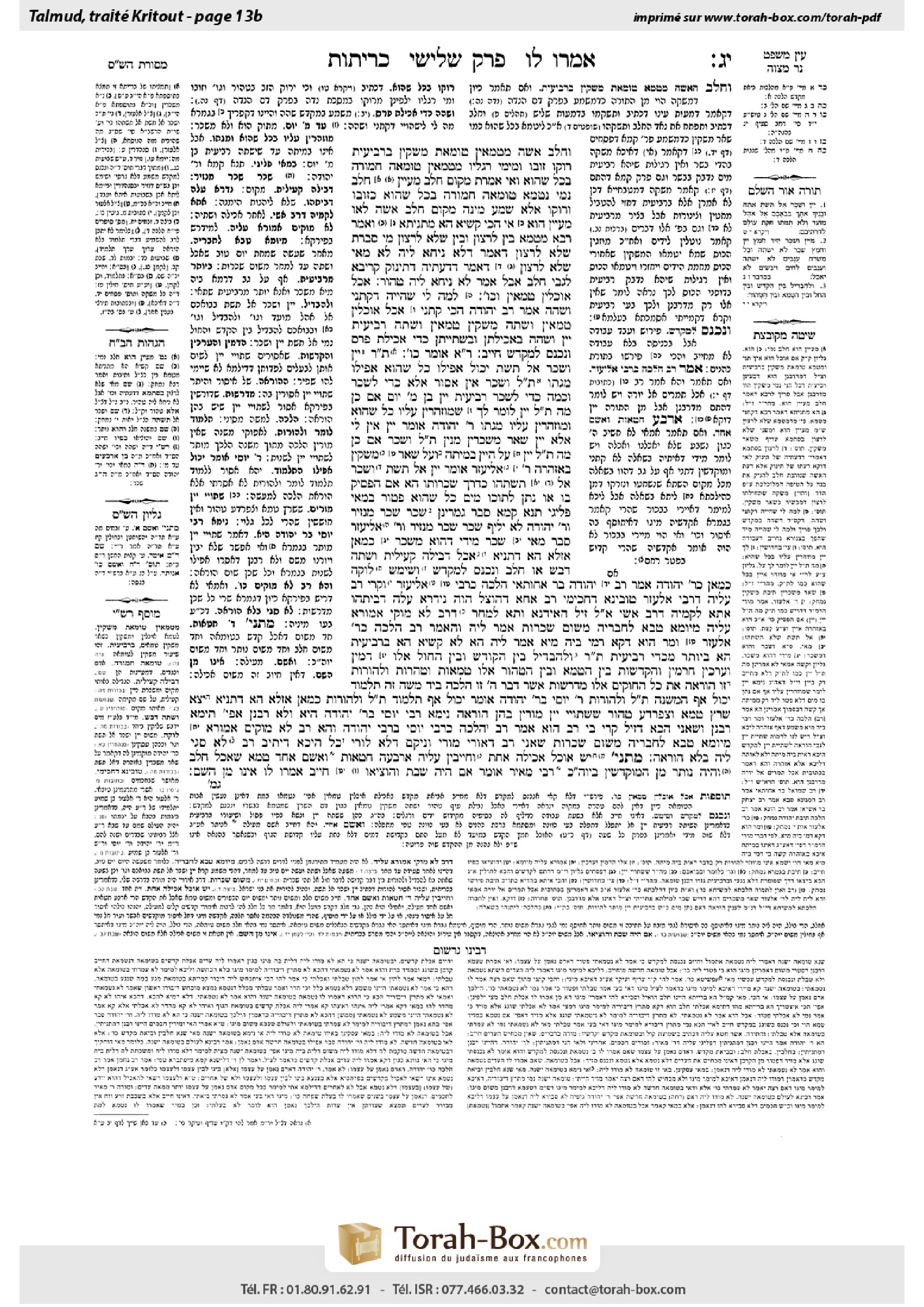
Keritot 13b: Talmud study for Daf Yomi
Daf Yomi is the daily study of one Talmud folio. Explore 37 tractates with scans, Hebrew text, Sefaria English and AI-generated French translations where annotated.
Passage selection and English or AI-generated French translation are available where the scan has annotations. Daf Study is independent of Torah-Box and Sefaria.
Browse Keritot · כריתות · All tractatesKeritot 13b text and translations
This page of Keritot includes the Aramaic text, an English translation and an AI-generated French translation, alongside the scan above.
כריתות י״ג ב · Aramaic and Hebrew text
וַחֲלֵב אִשָּׁה – מְטַמְּאִין טוּמְאַת מַשְׁקִין בִּרְבִיעִית. רוּקּוֹ, זוֹבוֹ, וּמֵימֵי רַגְלָיו – מְטַמְּאִין טוּמְאָה חֲמוּרָה, בְּכֹל שֶׁהוּא.
וְאִי אָמְרַתְּ מְקוֹם חָלָב מְעַיֵּין [הוּא], חָלָב נָמֵי נְטַמֵּא טוּמְאָה חֲמוּרָה בְּכֹל שֶׁהוּא, כְּזוֹבוֹ וְרוּקּוֹ! אֶלָּא שְׁמַע מִינַּהּ: מְקוֹם חֲלֵב אִשָּׁה לָאו מַעְיָין הוּא.
אִי הָכִי, קַשְׁיָא הָא מַתְנִיתָא וְאָמַר רָבָא: ״מְטַמֵּא בֵּין לְרָצוֹן וּבֵין שֶׁלֹּא לְרָצוֹן״!
מִי סָבְרַתְּ ״שֶׁלֹּא לְרָצוֹן״ דְּאָמַר – דְּלָא נִיחָא לֵיהּ? לָא, מַאי ״שֶׁלֹּא לְרָצוֹן״ דְּאָמַר, דְּדַעְתֵּיהּ דְּתִינוֹק קָרִיבָא לְגַבֵּי חָלָב, אֲבָל אָמַר לָא נִיחָא לֵיהּ – טָהוֹר.
אָכַל אוֹכָלִין טְמֵאִין וְכוּ׳. לְמָה לִי שְׁהִיָּיה, דְּקָתָנֵי: וְשָׁהָה? אָמַר רַב יְהוּדָה, הָכִי קָתָנֵי: אָכַל אוֹכָלִין טְמֵאִין, וְשָׁתָה מַשְׁקִין טְמֵאִין, וְשָׁתָה רְבִיעִית יַיִן, וְשָׁהָה בַּאֲכִילָתָן וּבִשְׁתִיָּיתָן כְּדֵי אֲכִילַת פְּרָס, וְנִכְנַס לַמִּקְדָּשׁ – חַיָּיב.
רַבִּי אֶלְעָזָר אוֹמֵר כּוּ׳. תָּנוּ רַבָּנַן: ״יַיִן וְשֵׁכָר אַל תֵּשְׁתְּ״ – יָכוֹל אֲפִילּוּ כֹּל שֶׁהוּא, אֲפִילּוּ מִגִּתּוֹ?
תַּלְמוּד לוֹמַר: ״וְשֵׁכָר״ – אֵין אָסוּר אֶלָּא כְּדֵי לְשַׁכֵּר, וְכַמָּה כְּדֵי לְשַׁכֵּר? רְבִיעִית יַיִן בֶּן אַרְבָּעִים יוֹם.
אִם כֵּן, מָה תַּלְמוּד לוֹמַר ״יַיִן״? לוֹמַר לְךָ שֶׁמּוּזְהָרִין עָלָיו כֹּל שֶׁהוּא, וּמוּזְהָרִין עָלָיו מִגִּתּוֹ.
רַבִּי יְהוּדָה אוֹמֵר: ״יַיִן״ – אֵין לִי אֶלָּא יַיִן, שְׁאָר מְשַׁכְּרִין מִנַּיִן? תַּלְמוּד לוֹמַר: ״וְשֵׁכָר״. אִם כֵּן, מָה תַּלְמוּד לוֹמַר: ״יַיִן״? עַל הַיַּיִן – בְּמִיתָה, וְעַל שְׁאָר מַשְׁקִין – בְּאַזְהָרָה.
רַבִּי אֶלְעָזָר אוֹמֵר: ״יַיִן אַל תֵּשְׁתְּ וְשֵׁכָר״ – אַל תִּשְׁתֵּהוּ כְּדֶרֶךְ שִׁכְרוּתוֹ, הָא אִם הִפְסִיק בּוֹ, אוֹ נָתַן לְתוֹכוֹ מַיִם כֹּל שֶׁהוּא – פָּטוּר.
בְּמַאי פְלִיגִי? תַּנָּא קַמָּא סָבַר: גָּמְרִינַן ״שֵׁכָר״ ״שֵׁכָר״ מִנָּזִיר.
וְרַבִּי יְהוּדָה לָא יָלֵיף ״שֵׁכָר״ ״שֵׁכָר״ מִנָּזִיר. וְרַבִּי אֶלְעָזָר סָבַר: מַאי ״שֵׁכָר״? מִידֵּי דְּהוּא מְשַׁכֵּר.
כְּמַאן אָזְלָא הָא דְּתַנְיָא: אָכַל דְּבֵילָה קְעִילִית, וְשָׁתָה דְּבַשׁ אוֹ חָלָב, וְנִכְנַס לַמִּקְדָּשׁ וְשִׁימֵּשׁ – לוֹקֶה, כְּמַאן? כְּרַבִּי יְהוּדָה. אָמַר רַב יְהוּדָה בַּר אֲחוֹתַאי: הֲלָכָה כְּרַבִּי אֶלְעָזָר. וְקָרֵי רַב עֲלֵיהּ דְּרַבִּי אֶלְעָזָר: ״טוּבְיָנָא דְּחַכִּימֵי״.
רַב אַחָא דְּהוּצָל הֲוָה נִידְרָא עֲלַהּ דְּבֵיתְהוּ, אֲתָא לְקַמֵּיהּ דְּרַב אָשֵׁי, אֲמַר לֵיהּ: זִיל הָאִידָּנָא וְתָא לִמְחַר, דְּרַב לָא מוֹקֵי אָמוֹרָא עֲלֵיהּ מִיּוֹמָא טָבָא לְחַבְרֵיהּ מִשּׁוּם שִׁכְרוּת.
אֲמַר לֵיהּ, וְהָאָמַר רַב: הֲלָכָה כְּרַבִּי אֶלְעָזָר, וּמָר הוּא דְּקָא רָמֵי בֵּיהּ מַיָּא! אֲמַר לֵיהּ, הָא לָא קַשְׁיָא: הָא בִּרְבִיעִית, הָא בְּיוֹתֵר מִכְּדֵי רְבִיעִית.
תָּנוּ רַבָּנַן: ״וּלְהַבְדִּיל בֵּין הַקֹּדֶשׁ וּבֵין הַחוֹל״ – אֵלּוּ דָּמִין וַעֲרָכִין, חֲרָמִין וְהֶקְדֵּשׁוֹת.
״בֵּין הַטָּמֵא וּבֵין הַטָּהוֹר״ – אֵלּוּ טְמָאוֹת וּטְהָרוֹת. ״וּלְהוֹרוֹת״ – זוֹ הוֹרָאָה. ״אֵת כׇּל הַחוּקִּים״ – אֵלּוּ מִדְרָשׁוֹת. ״אֲשֶׁר דְּבַר ה׳״ – זוֹ הֲלָכָה. ״בְּיַד מֹשֶׁה״ – זֶה תַּלְמוּד.
יָכוֹל אַף הַמִּשְׁנָה? תַּלְמוּד לוֹמַר: ״וּלְהוֹרוֹת״. רַבִּי יוֹסֵי בְּרַבִּי יְהוּדָה אוֹמֵר: יָכוֹל אַף תַּלְמוּד? תַּלְמוּד לוֹמַר: ״וּלְהוֹרוֹת״.
כְּמַאן אָזְלָא הָא דְּתַנְיָא: יָצָא שֶׁרֶץ טָמֵא, וּצְפַרְדֵּעַ טָהוֹר, שֶׁשְּׁתוּיֵי יַיִן מוֹרִין בָּהֶן הוֹרָאָה. נֵימָא רַבִּי יוֹסֵי בְּרַבִּי יְהוּדָה הִיא, וְלָא רַבָּנַן? – אֲפִילּוּ תֵּימָא רַבָּנַן, וְשָׁאנֵי הָכָא, דְּזִיל קְרִי בֵּי רַב הוּא.
אָמַר רַב: הֲלָכָה כְּרַבִּי יוֹסֵי בְּרַבִּי יְהוּדָה. וְהָא רַב לָא מוֹקֵים אָמוֹרָא מִיּוֹמָא טָבָא לְחַבְרֵיהּ מִשּׁוּם שִׁכְרוּת! שָׁאנֵי רַב, דְּאוֹרִי מוֹרֵי. וְנֹיקֵם (דְּלָא) [וְלָא] לוֹרֵי! – כֹּל הֵיכָא דְּיָתֵיב רַב לָא סַגִּי לֵיהּ בְּלָא הוֹרָאָה.
מַתְנִי׳ יֵשׁ אוֹכֵל אֲכִילָה אַחַת וְחַיָּיבִין עָלֶיהָ אַרְבָּעָה חַטָּאוֹת וְאָשָׁם אֶחָד: טָמֵא שֶׁאָכַל חֵלֶב, וְהָיָה נוֹתָר מִן הַמּוּקְדָּשִׁין, בְּיוֹם הַכִּפּוּרִים.
רַבִּי מֵאִיר אוֹמֵר: אִם הָיָה שַׁבָּת וְהוֹצִיאוֹ – חַיָּיב. אָמְרוּ לוֹ: אֵינוֹ מִן הַשֵּׁם.
Keritot 13b · English translation
and the milk of a woman who is a zava transmit impurity of liquids where there is a quarter-log. The saliva, gonorrhea-like discharge of a zav, and urine transmit severe impurity in any amount.
And if you say in accordance with the opinion of Rava that the location from which the milk emerges is considered a spring, then milk also should transmit severe impurity in any amount, like the gonorrhea-like discharge of a zav and his saliva. Rather, conclude from it that the location from which the milk of a woman emerges is not considered to be a spring, and the milk must be rendered susceptible to impurity in order to become impure or transmit impurity.
The Gemara objects: If so, this mishna in Makhshirin cited earlier (13a), which Rava said supports his opinion, is difficult, as it states that a woman’s milk renders food susceptible to impurity whether it emerged to the satisfaction of the infant or not to his satisfaction. The mishna is difficult, as food is generally rendered susceptible to impurity only when the liquid comes into contact with it to the owner’s satisfaction.
The Gemara explains: Do you maintain that the term: Not to their satisfaction, that the mishna states, means that the emergence of the milk is not amenable to him? No; rather, what is the meaning of the expression: Not to his satisfaction, that the mishna states? It means that the child did not indicate whether he desires the milk or not, but as a child’s mind is close to milk, i.e., he generally enjoys the milk, an explicit indication of interest or satisfaction is unnecessary in order for the milk to be susceptible to ritual impurity or to render other food items impure. But if he says, i.e., indicates, explictly that the milk is not amenable to him, then the milk is not susceptible to ritual impurity, and it remains pure.
The mishna teaches that if one ate one quarter-loaf of ritually impure foods or drank a quarter-log of ritually impure liquids, or if one drank a quarter-log of wine, and he entered the Temple and remained there for the time it takes to eat a half-loaf of bread, he is liable. The Gemara objects: Why do I need him to remain in the Temple in order to be liable, such that it teaches: And remained there? Rav Yehuda said that this is what the mishna is teaching: In the case of one who ate a quarter-loaf of ritually impure foods or drank a quarter-log of impure liquids, or drank a quarter-log of wine, and remained involved in eating them or drinking them for no more than the time it takes to eat a half-loaf of bread, and then entered the Temple, he is liable.
§ The mishna teaches that Rabbi Elazar says: If one interrupted his drinking of the quarter-log of wine, or if he placed any amount of water into the wine, he is exempt. The Sages taught in a baraita: When the Torah instructs Aaron the High Priest: “Drink no wine nor intoxicating drink, you, nor your sons with you, when you go into the Tent of Meeting, that you shall not die” (Leviticus 10:9), one might have thought that this applies even if he drank any amount, and even if he drank wine from its press, i.e., wine that has not finished fermenting.
Therefore, the verse states: “Nor intoxicating drink,” indicating that only the consumption of a quantity of wine sufficient to intoxicate is prohibited. And how much wine is sufficient to intoxicate? It is a minimum of a quarter-log of wine that is forty days old, which has already fermented.
If so, why must the verse state “wine,” when the term “intoxicating drink” would have sufficed? It is to tell you that although one is not liable to receive death at the hand of Heaven for it, it is prohibited to drink any amount of it, even less than a quarter-log, and then enter the Temple; and similarly, it is prohibited to drink it from its press and then enter the Temple, and one who does so is liable to be flogged, as is the case with any other prohibition by Torah law.
Rabbi Yehuda says: From the word “wine” I have derived only that wine is forbidden; from where is it derived that other intoxicating beverages are forbidden as well? The verse states: “Nor intoxicating drink.” If so, why must the verse state “wine”? This comes to teach that for entering the Temple after drinking wine one is liable to receive the punishment of death at the hand of Heaven, but for entering after drinking other intoxicating drinks, one violates only a regular prohibition.
Rabbi Elazar says that the verse is interpreted to mean: Wine you shall not drink, and intoxicating drink, meaning that you shall not drink it in the manner of its being intoxicating. But if one interrupted his drinking, or placed any amount of water into it and drank it, he is exempt.
The Gemara explains: With regard to what do they disagree? The first tanna holds: We learn by verbal analogy that the term “intoxicating drink” is referring to wine, from the term “intoxicating drink” mentioned with regard to a nazirite in the verse: “He shall abstain from wine and intoxicating drink” (Numbers 6:3). There it is referring only to wine (see Nazir 4a).
But Rabbi Yehuda does not derive that the term “intoxicating drink” refers only to wine by the verbal analogy from the term “intoxicating drink” stated with regard to a nazirite. Consequently, he interprets the word as referring to an intoxicating drink that is not wine. And Rabbi Elazar holds: What is the meaning of the phrase: “Wine and intoxicating drink”? It is not referring to two separate items, but rather to wine in the manner that it intoxicates.
The Gemara comments: In accordance with whose opinion is that which is taught in the following baraita: In the case of one who ate a sweet dried fig from Ke’ila, or drank honey or milk, all of which can have an intoxicating effect, and he entered the Temple and performed the Temple service, he is flogged. In accordance with whose opinion is this? It is in accordance with the opinion of Rabbi Yehuda, who maintains that any item which intoxicates is included in the prohibition. Rav Yehuda bar Aḥotai says: The halakha is in accordance with the opinion of Rabbi Elazar, and Rav referred to Rabbi Elazar as the most gratified of the Sages, as the halakha is in accordance with his opinion.
The Gemara relates that Rav Aḥa of the city of Huzal had taken a vow not to derive benefit from his wife. He came before Rav Ashi to request that he dissolve the vow. Rav Ashi said to him: Go now and come back tomorrow, as I have just drunk wine, and it is prohibited for me to issue a halakhic ruling, as Rav would not place a disseminator before him to communicate his lectures to the masses from the meal of one Festival day until the other, i.e., the next morning, due to drunkenness. Since it was customary to drink wine during Festival meals, Rav would not deliver public lectures on Festival days, as one who has consumed wine may not issue halakhic rulings.
Rav Aḥa said to him: But doesn’t Rav say: The halakha is in accordance with the opinion of Rabbi Elazar that if one diluted the wine he drank with water and entered the Temple he is exempt; and the Master is one who puts water into his wine? Rav Ashi said to him: That is not difficult; that ruling of Rabbi Elazar applies in a case where one drank precisely a quarter-log of wine, whereas in this case I drank more than a quarter-log of wine. In such a case one does not maintain a clear mind even if he mixed in a small amount of water.
§ In the continuation of the passage in which the Torah prohibits a priest from entering the Temple after drinking wine, the verse states: “And that you may differentiate between the sacred and the common, and between the impure and the pure; and that you may instruct the children of Israel in all the statutes which the Lord has spoken to them by the hand of Moses” (Leviticus 10:10–11). The Sages taught in a baraita: The verse states: “And that you may differentiate between the sacred and the common.” These terms are referring to the halakhot of values and valuations, dedications and consecrations, and the verse is teaching that it is prohibited to issue a ruling concerning these matters after drinking wine.
“Between the impure and the pure”; these terms indicate that it is prohibited for one who drank wine to render decisions with regard to ritually impure items and ritually pure items. “And that you may instruct”; this is referring to issuing a ruling about what is permitted or prohibited. “All the statutes”; this is referring to the halakhic expositions of the Torah. “Which the Lord has spoken”; this is referring to halakha transmitted orally to Moses from Sinai. “By the hand of Moses”; this is referring to the Talmud, the deliberations on the Oral Law, from which halakhic conclusions are derived. It is prohibited to teach any of these subjects after drinking wine.
One might have thought that it is prohibited to teach even Mishna after drinking wine. Therefore, the verse states: “And that you may instruct,” indicating that the prohibition is limited to material that provides practical halakhic instruction, whereas one does not derive practical rulings from the Mishna. Rabbi Yosei, son of Rabbi Yehuda, says: One might have thought that even teaching Talmud is prohibited. Therefore, the verse states: “And that you may instruct,” indicating that the prohibition is limited to issuing halakhic rulings, but it does not include teaching material such as Talmud, although halakhic conclusions may be derived from it.
The Gemara asks: In accordance with whose opinion is that which is taught in a baraita: The rulings that a carcass of a creeping animal is ritually impure and that a carcass of a frog is pure are excluded from this principle, as those who have drunk wine may issue a halakhic ruling about these matters. Let us say that this is in accordance with the opinion of Rabbi Yosei, son of Rabbi Yehuda, who says it is permitted to teach Talmud, and these conclusions are obvious from the Talmud, and that it is not in accordance with the opinion of the Rabbis. The Gemara responds: You may even say that it is in accordance with the opinion of the Rabbis, and that this case is different, as it is a topic that one could go learn in a children’s school, and teaching is not considered issuing a halakhic ruling.
Rav says: The halakha is in accordance with the opinion of Rabbi Yosei, son of Rabbi Yehuda, that it is permitted to teach material from which halakha may be derived, but it is prohibited to issue halakhic rulings. The Gemara objects: But Rav himself would not place a disseminator before him to communicate his lectures to the masses from the meal of one Festival day until the other, i.e., the next morning, due to drunkenness. The Gemara explains: Rav is different, as he would issue halakhic rulings during his lectures. The Gemara further objects: And let him place a disseminator and deliver a lecture but not issue halakhic rulings. The Gemara explains: Wherever Rav sits and delivers a lecture, it is not possible for him to do so without issuing a halakhic ruling.
MISHNA: There is a case where one can perform a single act of eating an olive-bulk of food and be liable to bring four sin offerings and one guilt offering for it. How so? This halakha applies to one who is ritually impure who ate forbidden fat, and it was left over from a consecrated offering after the time allotted for its consumption [notar], on Yom Kippur. He is liable to bring sin offerings for eating forbidden fat and notar, for eating the meat of an offering while impure, and for eating on Yom Kippur. He is also liable to bring a guilt offering for misuse of consecrated property.
Rabbi Meir says: If it was Shabbat and he carried it out from a private domain to a public domain while eating it, he would be liable to bring an additional sin offering for performing prohibited labor on Shabbat. The Rabbis said to him: That liability is not from the same type of prohibition, as it is not due to the act of eating, and therefore, it should not be counted.
Keritot 13b · Traduction française (IA)
et le lait d’une femme zava transmettent l’impureté des liquides à partir d’un quart de log. La salive, l’écoulement gonorrhéique d’un zav et son urine transmettent une impureté grave quelle qu’en soit la quantité.
Et si tu dis, conformément à l’avis de Rava, que l’endroit d’où sort le lait est considéré comme une source, alors le lait devrait lui aussi transmettre une impureté grave quelle qu’en soit la quantité, comme l’écoulement gonorrhéique d’un zav et sa salive. Il faut plutôt en conclure que l’endroit d’où sort le lait d’une femme n’est pas considéré comme une source, et que le lait doit être rendu apte à contracter l’impureté pour devenir impur ou transmettre l’impureté.
La Guemara objecte : Si tel est le cas, la Michna de Makhshirin citée plus haut (13a), que Rava a invoquée à l’appui de son avis, pose problème, car elle enseigne que le lait d’une femme rend un aliment apte à contracter l’impureté, qu’il soit sorti à la satisfaction du nourrisson ou non. Or la Michna pose problème, car en règle générale, un aliment ne devient apte à contracter l’impureté que si le liquide entre en contact avec lui à la satisfaction de son propriétaire.
La Guemara explique : Penses-tu que l’expression « non à leur satisfaction » employée par la Michna signifie que la sortie du lait ne lui convient pas ? Non. Que signifie donc l’expression « non à sa satisfaction » employée par la Michna ? Elle signifie que l’enfant n’a pas indiqué s’il désirait ou non le lait. Mais comme l’esprit d’un enfant est proche du lait, c’est-à-dire qu’il l’apprécie généralement, il n’est pas nécessaire qu’il manifeste explicitement son intérêt ou sa satisfaction pour que le lait soit apte à contracter l’impureté rituelle ou à rendre impurs d’autres aliments. En revanche, s’il dit, c’est-à-dire indique explicitement, que le lait ne lui convient pas, alors celui-ci n’est pas apte à contracter l’impureté rituelle et demeure pur.
La Michna enseigne que si quelqu’un a mangé un quart de pain d’aliments rituellement impurs, ou bu un quart de log de liquides rituellement impurs, ou encore bu un quart de log de vin, puis est entré dans le Temple et y est resté le temps nécessaire pour manger un demi-pain, il est passible. La Guemara objecte : Pourquoi faut-il qu’il reste dans le Temple pour être passible, au point que la Michna enseigne : « et y est resté » ? Rav Yehouda dit que voici ce qu’enseigne la Michna : dans le cas de celui qui a mangé un quart de pain d’aliments rituellement impurs, ou bu un quart de log de liquides impurs, ou bu un quart de log de vin, et qui a continué à manger ou à boire pendant une durée n’excédant pas le temps nécessaire pour manger un demi-pain, puis est entré dans le Temple, il est passible.
§ La Michna enseigne que Rabbi Elazar dit : Si quelqu’un a interrompu sa consommation du quart de log de vin, ou s’il a ajouté une quantité quelconque d’eau au vin, il est exempt. Les Sages ont enseigné dans une baraïta : Lorsque la Torah ordonne à Aaron, le grand prêtre : « Ne bois ni vin ni boisson enivrante, ni toi ni tes fils avec toi, lorsque vous entrez dans la Tente d’assignation, de peur que vous ne mouriez » (Lévitique 10:9), on aurait pu penser que cela s’applique même s’il en a bu une quantité quelconque, et même s’il a bu du vin sorti du pressoir, c’est-à-dire du vin qui n’a pas achevé de fermenter.
C’est pourquoi le verset dit : « ni boisson enivrante », ce qui indique que seule est interdite la consommation d’une quantité de vin suffisante pour enivrer. Et quelle quantité de vin suffit à enivrer ? Un minimum de quart de log de vin âgé de quarante jours, qui a déjà fermenté.
Si tel est le cas, pourquoi le verset doit-il mentionner le « vin », alors que l’expression « boisson enivrante » aurait suffi ? C’est pour t’enseigner que, bien qu’on ne soit pas passible de mort par la main du Ciel pour cela, il est interdit d’en boire une quantité quelconque, même inférieure à un quart de log, puis d’entrer dans le Temple. De même, il est interdit d’en boire alors qu’il sort du pressoir, puis d’entrer dans le Temple ; celui qui agit ainsi est passible de flagellation, comme pour toute autre interdiction de la Torah.
Rabbi Yehouda dit : Du mot « vin », je n’ai déduit que l’interdiction du vin. D’où déduit-on que les autres boissons enivrantes sont également interdites ? Le verset dit : « ni boisson enivrante ». Si tel est le cas, pourquoi le verset doit-il mentionner le « vin » ? Cela vient enseigner que celui qui entre dans le Temple après avoir bu du vin est passible de mort par la main du Ciel, tandis que celui qui y entre après avoir bu d’autres boissons enivrantes ne transgresse qu’une interdiction ordinaire.
Rabbi Elazar dit que le verset s’interprète ainsi : « Du vin, tu ne boiras pas, ni de boisson enivrante », c’est-à-dire que tu ne boiras pas de boisson enivrante de manière à être enivré. Mais si quelqu’un a interrompu sa consommation, ou y a ajouté une quantité quelconque d’eau avant de la boire, il est exempt.
La Guemara explique : Sur quoi portent leurs divergences ? Le premier tanna estime que nous apprenons, par analogie verbale, que l’expression « boisson enivrante » désigne le vin, à partir de la même expression employée à propos du nazir dans le verset : « Il s’abstiendra de vin et de boisson enivrante » (Nombres 6:3). Là, elle désigne uniquement le vin (voir Nazir 4a).
Mais Rabbi Yehouda ne déduit pas, par analogie verbale avec l’expression « boisson enivrante » employée à propos du nazir, que cette expression désigne uniquement le vin. Il interprète donc le terme comme désignant une boisson enivrante autre que le vin. Rabbi Elazar estime, quant à lui : que signifie l’expression « vin et boisson enivrante » ? Elle ne désigne pas deux éléments distincts, mais le vin lorsqu’il enivre.
La Guemara remarque : De l’avis de qui relève l’enseignement de la baraïta suivante ? Dans le cas de celui qui a mangé une figue sèche sucrée de Keïla, ou bu du miel ou du lait, autant de substances pouvant avoir un effet enivrant, puis est entré dans le Temple et y a accompli le service, il est passible de flagellation. De l’avis de qui est-ce ? De l’avis de Rabbi Yehouda, qui estime que toute substance enivrante est comprise dans l’interdiction. Rav Yehouda bar Aḥotai dit : La halakha est conforme à l’avis de Rabbi Elazar, et Rav qualifiait Rabbi Elazar de « plus satisfait parmi les Sages », car la halakha est conforme à son avis.
La Guemara rapporte que Rav Aḥa, de la ville de Houzal, avait fait vœu de ne tirer aucun profit de sa femme. Il se présenta devant Rav Ashi pour lui demander de délier son vœu. Rav Ashi lui dit : Reviens demain, car je viens de boire du vin et il m’est interdit de rendre une décision halakhique. En effet, Rav ne faisait pas placer devant lui un orateur chargé de transmettre ses cours aux foules entre le repas d’un jour de fête et celui du jour suivant, c’est-à-dire jusqu’au lendemain matin, à cause de l’ivresse. Comme il était d’usage de boire du vin aux repas de fête, Rav ne donnait pas de cours publics les jours de fête, car celui qui a consommé du vin ne peut pas rendre de décision halakhique.
Rav Aḥa lui dit : Mais Rav ne dit-il pas que la halakha est conforme à l’avis de Rabbi Elazar, selon lequel celui qui a dilué avec de l’eau le vin qu’il a bu et est entré dans le Temple est exempt ? Et vous-même, Maître, vous ajoutez de l’eau à votre vin ! Rav Ashi lui répondit : Il n’y a pas de difficulté. La décision de Rabbi Elazar s’applique au cas où quelqu’un a bu exactement un quart de log de vin, tandis que, dans mon cas, j’ai bu plus d’un quart de log de vin. Dans un tel cas, on ne garde pas l’esprit clair, même si l’on y a ajouté une petite quantité d’eau.
§ Dans la suite du passage où la Torah interdit au prêtre d’entrer dans le Temple après avoir bu du vin, le verset dit : « Afin que vous puissiez distinguer entre le sacré et le profane, entre l’impur et le pur, et que vous enseigniez aux enfants d’Israël tous les statuts que l’Éternel leur a énoncés par l’intermédiaire de Moïse » (Lévitique 10:10–11). Les Sages ont enseigné dans une baraïta : Le verset dit : « Afin que vous puissiez distinguer entre le sacré et le profane. » Ces termes désignent les halakhot des valeurs et des évaluations, des consécrations et des sanctifications ; le verset enseigne qu’il est interdit de rendre une décision concernant ces sujets après avoir bu du vin.
« Entre l’impur et le pur » : ces termes indiquent qu’il est interdit à celui qui a bu du vin de rendre des décisions concernant les objets rituellement impurs et les objets rituellement purs. « Et que vous enseigniez » désigne le fait de rendre une décision sur ce qui est permis ou interdit. « Tous les statuts » désigne les interprétations halakhiques de la Torah. « Que l’Éternel a énoncés » désigne la halakha transmise oralement à Moïse au Sinaï. « Par l’intermédiaire de Moïse » désigne le Talmud, les délibérations sur la Torah orale dont on tire les conclusions halakhiques. Il est interdit d’enseigner l’un quelconque de ces sujets après avoir bu du vin.
On aurait pu penser qu’il est interdit d’enseigner même la Michna après avoir bu du vin. C’est pourquoi le verset dit : « Et que vous enseigniez », ce qui indique que l’interdiction se limite aux matières donnant lieu à des instructions halakhiques pratiques, alors qu’on ne tire pas de décisions pratiques de la Michna. Rabbi Yossi, fils de Rabbi Yehouda, dit : On aurait pu penser qu’il est interdit même d’enseigner le Talmud. C’est pourquoi le verset dit : « Et que vous enseigniez », ce qui indique que l’interdiction se limite au fait de rendre des décisions halakhiques, mais ne comprend pas l’enseignement de matières telles que le Talmud, même si l’on peut en tirer des conclusions halakhiques.
La Guemara demande : De l’avis de qui relève l’enseignement de la baraïta suivante ? Les règles selon lesquelles la carcasse d’un animal rampant est rituellement impure et celle d’une grenouille est pure échappent à ce principe, car ceux qui ont bu du vin peuvent rendre une décision halakhique à leur sujet. Doit-on dire que cela correspond à l’avis de Rabbi Yossi, fils de Rabbi Yehouda, qui dit qu’il est permis d’enseigner le Talmud, et que ces conclusions ressortent clairement du Talmud, mais non à l’avis des Rabbins ? La Guemara répond : On peut même dire que cela correspond à l’avis des Rabbins ; ce cas est différent, car il s’agit d’un sujet que l’on peut aller étudier dans une école pour enfants, et l’enseignement n’est pas considéré comme le fait de rendre une décision halakhique.
Rav dit : La halakha est conforme à l’avis de Rabbi Yossi, fils de Rabbi Yehouda : il est permis d’enseigner une matière dont on peut tirer une halakha, mais il est interdit de rendre des décisions halakhiques. La Guemara objecte : Pourtant, Rav lui-même ne faisait pas placer devant lui un orateur chargé de transmettre ses cours aux foules entre le repas d’un jour de fête et celui du jour suivant, c’est-à-dire jusqu’au lendemain matin, à cause de l’ivresse. La Guemara explique : Le cas de Rav est différent, car pendant ses cours, il rendait des décisions halakhiques. La Guemara objecte encore : Qu’il fasse donc placer un orateur et donne son cours sans rendre de décisions halakhiques. La Guemara explique : Chaque fois que Rav s’asseyait pour donner un cours, il lui était impossible de le faire sans rendre une décision halakhique.
MICHNA : Il existe un cas où un acte unique consistant à manger l’équivalent d’une olive d’un aliment peut rendre quelqu’un passible de quatre sacrifices expiatoires et d’un sacrifice de culpabilité. Dans quel cas ? Cette halakha s’applique à une personne rituellement impure qui a mangé de la graisse interdite, laquelle était le reste d’une offrande consacrée après le délai fixé pour sa consommation [notar], à Yom Kippour. Elle est passible d’apporter des sacrifices expiatoires pour avoir mangé de la graisse interdite et du notar, pour avoir mangé la viande d’une offrande alors qu’elle était impure, et pour avoir mangé à Yom Kippour. Elle est également passible d’apporter un sacrifice de culpabilité pour l’usage illicite d’un bien consacré.
Rabbi Meïr dit : Si c’était Chabbat et qu’il l’avait transporté d’un domaine privé à un domaine public tout en le mangeant, il serait passible d’apporter un sacrifice expiatoire supplémentaire pour avoir accompli un travail interdit le Chabbat. Les Rabbins lui dirent : Cette responsabilité ne relève pas du même type d’interdiction, car elle ne découle pas de l’acte de manger ; elle ne doit donc pas être comptée.
Traduction française générée par IA à partir de l’édition anglaise de Sefaria. Vérifie toujours un passage avec le texte source.
Text from Sefaria: William Davidson Edition - Vocalized Aramaic (CC BY NC); William Davidson Edition - English (CC BY NC).