Keritot 14a: Talmud study for Daf Yomi
Daf Yomi is the daily study of one Talmud folio. Explore 37 tractates with scans, Hebrew text, Sefaria English and AI-generated French translations where annotated.
Passage selection and English or AI-generated French translation are available where the scan has annotations. Daf Study is independent of Torah-Box and Sefaria.
Browse Keritot · כריתות · All tractatesKeritot 14a text and translations
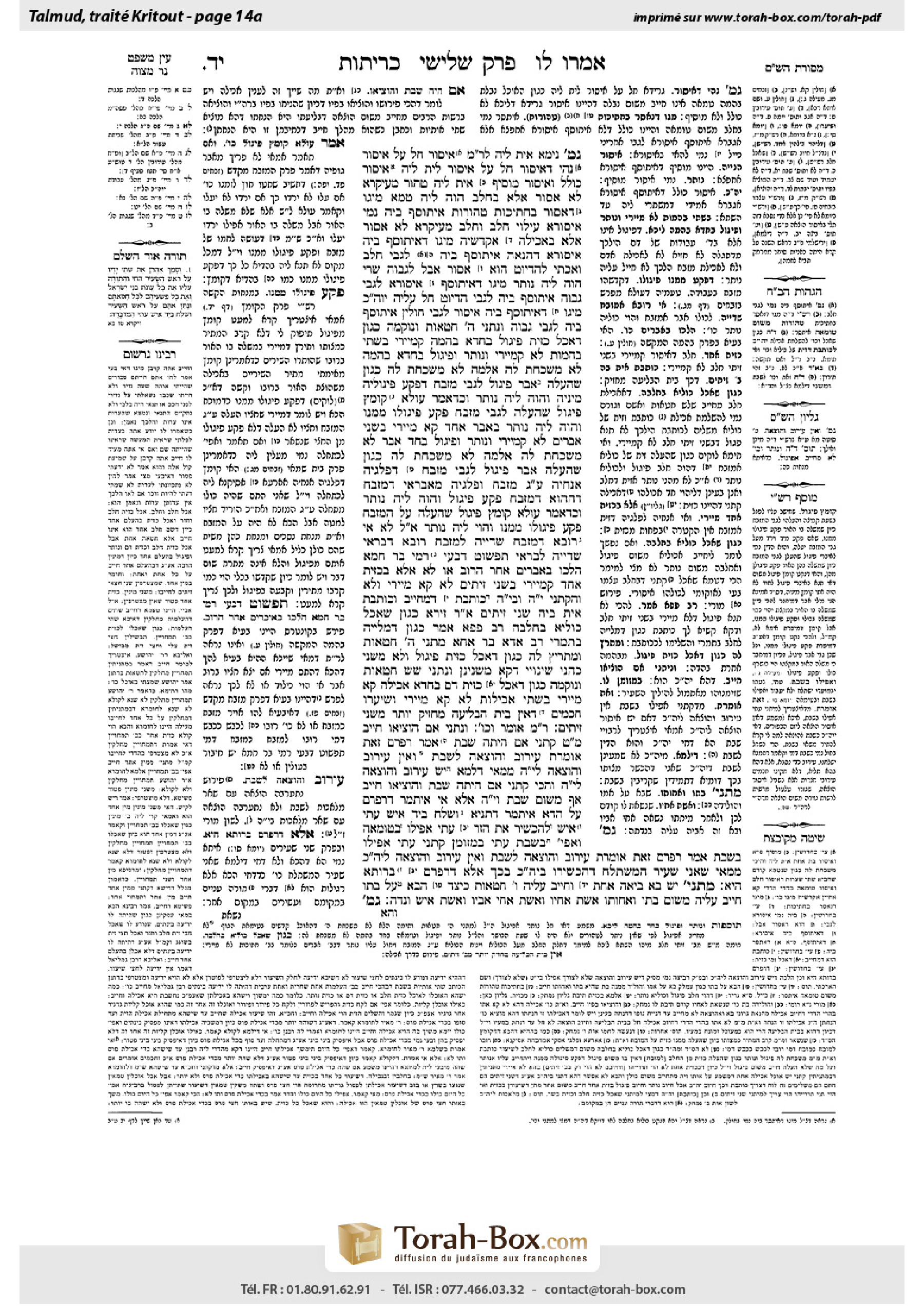
This page of Keritot includes the Aramaic text, an English translation and an AI-generated French translation, alongside the scan above.
כריתות י״ד א · Aramaic and Hebrew text
גְּמָ׳ נֵימָא אִית לֵיהּ לְרַבִּי מֵאִיר אִיסּוּר חָל עַל אִיסּוּר? נְהִי דְּאִיסּוּר חָל עַל אִיסּוּר לֵית לֵיהּ, אִיסּוּר כּוֹלֵל וְאִיסּוּר מוֹסִיף אִית לֵיהּ.
טָהוֹר, מֵעִיקָּרָא לָא אֲסִיר אֶלָּא בְּחֵלֶב, הֲוָה לֵיהּ טָמֵא, מִיגּוֹ דַּאֲסִיר בַּחֲתִיכוֹת טְהוֹרוֹת – אִיתּוֹסַף בֵּיהּ נָמֵי אִיסּוּרָא עִילָּוֵי חֵלֶב.
וְחֵלֶב מֵעִיקָּרָא לָא אֲסִיר אֶלָּא בַּאֲכִילָה, אַקְדְּשֵׁיהּ, מִיגּוֹ דְּאִיתּוֹסַף בֵּיהּ אִיסּוּרָא דַּהֲנָאָה – אִיתּוֹסַף בֵּיהּ לְגַבֵּי חֵלֶב.
וְאַכַּתִּי לְהֶדְיוֹט הוּא דַּאֲסִיר אֲבָל לְגָבוֹהַּ שְׁרֵי, הֲוָה לֵיהּ נוֹתָר, מִיגּוֹ דְּאִיתּוֹסַף אִיסּוּרָא לְגַבֵּי גָּבוֹהַּ – אִיתּוֹסַף בֵּיהּ לְגַבֵּי הֶדְיוֹט. חָל עֲלֵיהּ יוֹם הַכִּפּוּרִים, מִיגּוֹ דְּאִיתּוֹסַף בֵּיהּ אִיסּוּר לְגַבֵּי חוּלִּין – אִיתּוֹסַף בֵּיהּ לְגַבֵּי גָבוֹהַּ.
וְנִתְנֵי: חָמֵשׁ חַטָּאוֹת, וְנוֹקְמַהּ כְּגוֹן דַּאֲכַל כְּזַיִת פִּיגּוּל! בַּחֲדָא בְּהֵמָה קָמַיְירֵי, בִּשְׁתֵּי בְּהֵמוֹת לָא קָמַיְירֵי, וְנוֹתָר וּפִיגּוּל בַּחֲדָא בְּהֵמָה לָא מַשְׁכַּחַתְּ לַהּ.
אַלְּמָה לָא? מַשְׁכַּחַתְּ לַהּ כְּגוֹן שֶׁהֶעֱלָה אֵבֶר פִּיגּוּל לְגַבֵּי מִזְבֵּחַ, דְּפָקַע פִּיגּוּלֵיהּ מִינֵּיהּ וְהָוֵה לֵיהּ נוֹתָר,
וְכִדְאָמַר עוּלָּא: קוֹמֶץ פִּיגּוּל שֶׁהֶעֱלָה לְגַבֵּי מִזְבֵּחַ – פָּקַע פִּיגּוּלוֹ מִמֶּנּוּ וְהָוֵה לֵיהּ נוֹתָר. בְּאֵבֶר אֶחָד קָא מַיְירֵי, בִּשְׁנֵי אֵבָרִים לָא קָמַיְירֵי, וְנוֹתָר וּפִיגּוּל בְּחַד אֵבֶר לָא מַשְׁכַּחַתְּ לַהּ.
אַלְּמָה לָא? מַשְׁכַּחַתְּ לַהּ כְּגוֹן שֶׁהֶעֱלָה אֵבֶר פִּיגּוּל לְגַבֵּי מִזְבֵּחַ, דְּפַלְגֵיהּ אַנְּחֵיהּ עַל גַּבֵּי מִזְבֵּחַ, וּפַלְגֵיהּ מֵאַבָּרַאי דְּמִזְבֵּחַ, דְּהָהוּא דְּמִזְבֵּחַ פָּקַע פִּיגּוּל וַהֲוָה לֵיהּ נוֹתָר, וְכִדְאָמַר עוּלָּא: קוֹמֶץ פִּיגּוּל שֶׁהֶעֱלָה עַל הַמִּזְבֵּחַ – פָּקַע פִּיגּוּלוֹ מִמֶּנּוּ וְהָוֵי לֵיהּ נוֹתָר!
אֲמַר לֵיהּ: לָא, אִי רוּבָּא דְּמִזְבֵּחַ – שִׁדְיֵיהּ לַמִּזְבֵּחַ, רוּבָּא דְּבָרַאי – שִׁדְיֵיהּ לְבָרַאי.
תִּפְשׁוֹט דְּבָעֵי רָמֵי בַּר חָמָא: הָלְכוּ בְּאֵבָרִים אַחַר הָרוֹב אוֹ לֹא! אֶלָּא, בִּכְזַיִת אֶחָד קָמַיְירֵי, בִּשְׁנֵי זֵיתִים לָא קָא מַיְירֵי.
וְלָא? וְהָקָתָנֵי ״יוֹם הַכִּפּוּרִים״, וּבְיוֹם הַכִּפּוּרִים כּוֹתֶבֶת [הוּא] דְּמִחַיַּיב, וְכוֹתֶבֶת אִית בַּיהּ שְׁנֵי זֵיתִים!
אָמַר רַבִּי זֵירָא: כְּגוֹן שֶׁאָכַל כּוּלְיָא בְּחֶלְבָּהּ. רַב פָּפָּא אָמַר: כְּגוֹן דְּמַלְּיֵיהּ בְּתַמְרֵי.
רַב אַדָּא בַּר אַחָא מַתְנֵי ״חָמֵשׁ חַטָּאוֹת״, וּמְתָרֵיץ לַהּ: כְּגוֹן דַּאֲכַל כְּזַיִת פִּיגּוּל, וְלָא מְשַׁנֵּי כְּהָנֵי שִׁינּוּיֵי דְּקָא מְשַׁנֵּינַן.
וְנִתְנֵי: ״שֵׁשׁ חַטָּאוֹת״, וְנוֹקְמַהּ כְּגוֹן דַּאֲכַל כְּזַיִת דָּם! בַּחֲדָא אֲכִילָה קָא מַיְירֵי, בִּשְׁתֵּי אֲכִילוֹת לֹא קָא מַיְירֵי, וְשִׁיעֲרוּ חֲכָמִים דְּאֵין בֵּית הַבְּלִיעָה מַחֲזִיק יוֹתֵר מִשְּׁנֵי זֵיתִים.
רַבִּי מֵאִיר אוֹמֵר וְכוּ׳. וְנִתְנֵי: ״אִם הוֹצִיאוֹ – חַיָּיב״, מַאי טַעְמָא קָתָנֵי ״אִם הָיְתָה שַׁבָּת״? אָמַר רַפְרָם: זֹאת אוֹמֶרֶת: עֵירוּב וְהוֹצָאָה לְשַׁבָּת, וְאֵין עֵירוּב וְהוֹצָאָה לְיוֹם הַכִּפּוּרִים.
מִמַּאי? דִּלְמָא יֵשׁ עֵירוּב וְהוֹצָאָה לְיוֹם הַכִּפּוּרִים, וְהָכִי קָתָנֵי: אִם הָיְתָה שַׁבָּת וְהוֹצִיאוֹ – חַיָּיב אַף מִשּׁוּם שַׁבָּת וְיוֹם הַכִּפּוּרִים!
אֶלָּא אִי אִיתְּמַר דְּרַפְרָם עַל הָדָא אִיתְּמַר, דְּתַנְיָא: ״וְשִׁלַּח בְּיַד אִישׁ עִתִּי״, ״אִישׁ״ – לְהַכְשִׁיר אֶת הַזָּר. ״עִתִּי״ – אֲפִילּוּ בְּטוּמְאָה וַאֲפִילּוּ בְּשַׁבָּת, ״עִתִּי״ – בִּמְזוּמָּן.
קָתָנֵי: ״עִתִּי״ – אֲפִילּוּ בְּשַׁבָּת, אָמַר רַפְרָם: זֹאת אוֹמֶרֶת עֵירוּב וְהוֹצָאָה לְשַׁבָּת, וְאֵין עֵירוּב וְהוֹצָאָה לְיוֹם הַכִּפּוּרִים.
מִמַּאי? שָׁאנֵי שָׂעִיר הַמִּשְׁתַּלֵּחַ, דְּהֶכְשֵׁירוֹ בְּיוֹם הַכִּפּוּרִים בְּכָךְ! אֶלָּא דְּרַפְרָם בְּרוּתָא הִיא.
מַתְנִי׳ יֵשׁ בָּא בִּיאָה אַחַת וְחַיָּיב עָלֶיהָ שֵׁשׁ חַטָּאוֹת, כֵּיצַד? הַבָּא עַל בִּתּוֹ חַיָּיב עָלֶיהָ מִשּׁוּם בִּתּוֹ, וַאֲחוֹתוֹ, אֵשֶׁת אָחִיו, וְאֵשֶׁת אֲחִי אָבִיו, וְאֵשֶׁת אִישׁ, וְנִדָּה.
Keritot 14a · English translation
GEMARA: The Gemara suggests: Let us say that it is evident from the mishna that Rabbi Meir holds that a prohibition takes effect where another prohibition already exists. The Gemara counters: Although he does not generally hold that a prohibition takes effect where another prohibition already exists, with regard to a more inclusive prohibition and an expanded prohibition, he holds that the second prohibition does take effect where a prohibition already exists. Under certain circumstances a second prohibition takes effect, and under other circumstances it does not. When the second prohibition is an expanded or inclusive prohibition, it takes effect.
Therefore, in the case in the mishna of a ritually impure person who ate leftover forbidden fat from an offering, one who was initially pure was prohibited from eating the food only due to the prohibition of forbidden fat. Once the person became impure, since he became prohibited from eating even pure pieces of sacrificial meat, an additional prohibition is also added to the forbidden fat. The prohibition against an impure person eating sacrificial meat is considered an inclusive prohibition, and therefore it takes effect even though the prohibition against eating forbidden fat already applied.
And likewise, the forbidden fat was initially forbidden only in consumption. When he consecrated the animal, it became prohibited to derive benefit from it in any manner. Therefore, since the prohibition against deriving any form of benefit was added to it, it was also added with regard to eating the forbidden fat. Consequently, the prohibition against misusing consecrated property, which is an expanded prohibition, applies even to one who eats the forbidden fat.
And still, the consecrated forbidden fat is prohibited only to an ordinary person, but it is permitted to the Most High, i.e., the altar. When it becomes leftover, since a prohibition was added with regard to the Most High, as it is now prohibited to sacrifice it upon the altar, the expanded prohibition of leftover sacrificial meat is added with regard to an ordinary person as well. If Yom Kippur, during which the person is prohibited from eating anything, takes effect with regard to it, since a prohibition was added with regard to eating non-sacred food, a prohibition is also added with regard to food that had been consecrated to the Most High. The prohibition against eating on Yom Kippur is an inclusive prohibition, and therefore it takes effect even with regard to eating leftover sacrificial meat.
The Gemara objects: And let the mishna teach: There is a case where one can perform a single act of eating an olive-bulk of food and be liable to bring five sin offerings, rather than four, and interpret it as a case where he ate an olive-bulk from an offering that was sacrificed with the intent to consume it after its appointed time [piggul]. The Gemara explains: The mishna is referring to a case of one animal, but is not referring to a case of two animals, and you do not find a case where the prohibitions of leftover sacrificial meat [notar] and piggul apply to one animal. From the moment an offering is rendered piggul it may not be sacrificed or eaten, and therefore it is not subject to the prohibition of notar.
The Gemara asks: Why is it not possible for the prohibitions of notar and piggul to apply to the same animal? You find it in a case where one brought upon the altar a limb from an offering that was piggul, as from that time its piggul status has been abrogated, and it becomes notar once the time that it may be sacrificed has passed.
And this is as Ulla says: In the case of a handful of a meal offering that is piggul that one brought upon the altar, its piggul status has been abrogated and it becomes leftover. Consequently, he is liable with regard to the limb that was offered for violating the prohibition of notar, and is liable with regard to the rest of the animal for violating the prohibition of piggul. The Gemara answers: The mishna is referring to one limb, but it is not referring to two limbs, and you do not find notar and piggul with regard to one limb.
The Gemara asks: Why is there no such case? You find it in a situation where one brought a limb from a piggul offering upon the altar, and he placed half of it upon the altar and half of it outside of the altar. In such a case, with regard to that portion of the limb which he placed upon the altar, its piggul status has been abrogated and it becomes notar. And this is as Ulla says: In the case of a handful of a meal offering that is piggul that one brought upon the altar, its piggul status has been abrogated and it becomes notar. By contrast, the part of the limb that was not placed upon the altar retains its status as piggul.
The Sage answering the question said to the questioner: No, the status of piggul cannot be abrogated from part of a limb. Rather, if the majority of the limb is on the altar, then throw it on the altar, i.e., the entire limb has the status of being on the altar. If the majority of the limb is outside the altar, throw it outside, i.e., it is considered as though the limb was not placed on the altar at all.
The Gemara objects: If so, one can resolve the dilemma that Rami bar Ḥama raised: Does one follow the majority with regard to limbs or not? According to the previous interpretation of the mishna, one does follow the majority with regard to limbs. The Gemara explains: Rather, the reason that the mishna did not mention the prohibition of piggul is that it is referring to the consumption of one olive-bulk of forbidden fat, and is not referring to two olive-bulks. Even if parts of one limb can have the status of piggul and other parts can be leftover sacrificial meat, one single olive-bulk cannot have both statuses.
The Gemara asks: And is the mishna not referring to a case of more than one olive-bulk? But isn’t it taught that one is liable to bring a sin offering for eating on Yom Kippur, and on Yom Kippur it is only eating the volume of a large date that obligates one to bring a sin offering, and the volume of a large date contains the volume of two olives?
Rabbi Zeira said: It is referring to a case where he eats a kidney with the fat attached to it. He is liable to bring three of the sin offerings enumerated in the mishna for eating the olive-bulk of fat, and the additional amount of kidney he eats brings his total consumption to the volume of a large date, so that he is liable for eating on Yom Kippur. Rav Pappa said: It is referring to a case where he ate an olive-bulk of the fat and completed the volume of a large date with dates.
Rav Adda bar Aḥa teaches that the mishna is stating that one can be liable to bring five sin offerings for one act of eating, not just four, and he interprets it to be referring to a case where one ate an olive-bulk of piggul from another animal together with the olive-bulk of forbidden fat, and he does not answer in accordance with these answers that we answered in the name of Rav Pappa and Rabbi Zeira.
The Gemara objects: And let the mishna teach that one can be liable to bring six sin offerings, and interpret it as referring to a case where he consumed an olive-bulk of blood in addition to the other two olive-bulks. The Gemara explains: The mishna is referring to one act of eating, but is not referring to two acts of eating, and the Sages calculated that one’s throat does not hold more than two olive-bulks at once.
§ The mishna teaches that Rabbi Meir says: If it was Shabbat and he carried it out from the private domain into the public domain while eating it, he would be liable to bring a sin offering for performing a prohibited labor on Shabbat. The Gemara objects: And let the mishna teach: If he carried it out he is liable, as the mishna is referring to one who ate on Yom Kippur, which is also a day when labor is prohibited. What is the reason that it teaches: If it was Shabbat and he carried it out he is liable? Why mention Shabbat at all? Rafram said: That is to say that the joining of courtyards in order to permit carrying, and the general prohibition against carrying from one domain to another, apply with regard to Shabbat, but the joining of courtyards and the prohibition against carrying do not apply with regard to Yom Kippur.
The Gemara asks: From where is this conclusion derived? Perhaps the joining of courtyards and the prohibition against carrying do apply to Yom Kippur, and this is what the mishna is teaching: If it was Shabbat and he carried it out from one domain to another he is liable due to the prohibition against carrying on Shabbat and also due to the prohibition against carrying on Yom Kippur.
Rather, if the statement of Rafram was stated, it was stated with regard to this case, as it is taught in a baraita: The verse states with regard to the scapegoat of Yom Kippur: “And he shall send it away with an appointed man into the wilderness” (Leviticus 16:21). The word “man” is mentioned in order to render a non-priest fit for this task. The term “appointed” indicates that the scapegoat is always sent away at the appropriate time, even when the appointed man is in a state of ritual impurity, and even when Yom Kippur occurs on Shabbat. In addition, the word “appointed” is referring to one who was designated for the task the day before.
The baraita taught that the word “appointed” indicates that the scapegoat is sent away even on Shabbat, and in this context Rafram says: That is to say that the joining of courtyards and the prohibition against carrying apply with regard to Shabbat, but the joining of courtyards and the prohibition against carrying do not apply with regard to Yom Kippur.
The Gemara objects to Rafram’s inference: From where does he cite proof for this inference? The case of the scapegoat is different, as its validity on Yom Kippur is in this manner. Even if the prohibition against carrying does apply on Yom Kippur, the Torah explicitly commanded that the scapegoat be sent away on that day, and therefore it is permitted. Rather, the statement cited in the name of Rafram is an error [beruta], and it was not actually stated in the study hall.
MISHNA: There is a case where one can engage in a single act of intercourse and be liable to bring six sin offerings for it. How so? It is possible for one who engages in intercourse with his daughter to be liable due to having violated the prohibitions of engaging in intercourse with his daughter, his sister, the wife of his brother, the wife of his father’s brother, a married woman, and a menstruating woman.
Keritot 14a · Traduction française (IA)
GUEMARA : La Guemara propose : Concluons de la Michna que Rabbi Meir soutient qu’une interdiction prend effet alors qu’une autre interdiction s’applique déjà. La Guemara objecte : Bien qu’en général il ne soutienne pas qu’une interdiction prenne effet alors qu’une autre s’applique déjà, il considère que tel est le cas lorsqu’il s’agit d’une interdiction plus inclusive ou d’une interdiction élargie. Dans certaines circonstances, une seconde interdiction prend effet, et dans d’autres, elle ne prend pas effet. Lorsqu’elle est élargie ou inclusive, elle prend effet.
Par conséquent, dans le cas de la Michna, où une personne rituellement impure a mangé du suif interdit provenant d’une offrande et devenu un reste sacrificiel, celui qui était auparavant pur n’était interdit de consommer cet aliment qu’en raison de l’interdiction du suif. Une fois devenu impur, puisqu’il lui est désormais interdit de manger même des morceaux purs de viande sacrificielle, une interdiction supplémentaire s’ajoute à celle du suif interdit. L’interdiction faite à une personne impure de manger de la viande sacrificielle est considérée comme inclusive ; elle prend donc effet même si l’interdiction de manger du suif était déjà en vigueur.
De même, le suif interdit n’était initialement interdit qu’à la consommation. Lorsque l’animal a été consacré, il est devenu interdit d’en tirer profit de quelque manière que ce soit. Par conséquent, puisque l’interdiction d’en tirer profit sous quelque forme que ce soit s’y est ajoutée, elle s’est également ajoutée en ce qui concerne la consommation du suif interdit. Ainsi, l’interdiction de faire un usage indu d’un bien consacré, qui est une interdiction élargie, s’applique même à celui qui mange le suif interdit.
Pourtant, le suif interdit consacré n’est interdit qu’à une personne ordinaire ; il reste permis au Très-Haut, c’est-à-dire à l’autel. Lorsqu’il devient un reste sacrificiel, une interdiction s’ajoute à l’égard du Très-Haut, car il est désormais interdit de l’offrir sur l’autel ; l’interdiction élargie relative aux restes de viande sacrificielle s’ajoute donc également à l’égard d’une personne ordinaire. Si l’interdiction de Yom Kippour, durant lequel il est interdit à la personne de manger quoi que ce soit, prend effet à son égard, alors, puisqu’une interdiction s’ajoute concernant la consommation d’aliments non consacrés, une interdiction s’ajoute également concernant les aliments consacrés au Très-Haut. L’interdiction de manger à Yom Kippour est inclusive ; elle prend donc effet même en ce qui concerne la consommation de restes sacrificiels.
La Guemara objecte : Que la Michna enseigne donc qu’il existe un cas où un seul acte de consommation d’un volume d’une olive rend passible de cinq sacrifices expiatoires, plutôt que de quatre, et qu’on l’interprète comme le cas où il a mangé un volume d’une olive provenant d’une offrande sacrifiée avec l’intention de la consommer après le délai fixé [piggul]. La Guemara explique : La Michna parle du cas d’un seul animal, et non de deux animaux ; or, on ne trouve pas de cas où les interdictions de reste sacrificiel [notar] et de piggul s’appliquent à un même animal. Dès qu’une offrande devient piggul, elle ne peut plus être sacrifiée ni consommée ; elle n’est donc pas soumise à l’interdiction de notar.
La Guemara demande : Pourquoi les interdictions de notar et de piggul ne pourraient-elles pas s’appliquer à un même animal ? On trouve un tel cas lorsqu’on a placé sur l’autel un membre provenant d’une offrande qui était piggul, car, à partir de ce moment, son statut de piggul est annulé et il devient notar une fois passé le délai pendant lequel il pouvait être sacrifié.
C’est ce qu’a dit Oula : dans le cas d’une poignée d’offrande végétale qui est piggul et qu’on a placée sur l’autel, son statut de piggul est annulé et elle devient notar. Par conséquent, il est passible pour avoir enfreint l’interdiction de notar en ce qui concerne le membre offert, et passible pour avoir enfreint l’interdiction de piggul en ce qui concerne le reste de l’animal. La Guemara répond : La Michna parle d’un seul membre, et non de deux membres ; or, on ne trouve pas de cas où notar et piggul s’appliquent à un seul membre.
La Guemara demande : Pourquoi n’existe-t-il pas de tel cas ? On le trouve lorsqu’on a placé sur l’autel un membre provenant d’une offrande piggul, en mettant la moitié sur l’autel et l’autre moitié hors de l’autel. Dans ce cas, pour la partie du membre placée sur l’autel, son statut de piggul est annulé et elle devient notar. C’est ce qu’a dit Oula : dans le cas d’une poignée d’offrande végétale qui est piggul et qu’on a placée sur l’autel, son statut de piggul est annulé et elle devient notar. En revanche, la partie du membre qui n’a pas été placée sur l’autel conserve son statut de piggul.
Le Sage qui répondait à la question dit à celui qui la posait : Non, le statut de piggul ne peut pas être annulé pour une partie d’un membre. En revanche, si la majeure partie du membre se trouve sur l’autel, jette-le sur l’autel, c’est-à-dire que le membre entier est considéré comme se trouvant sur l’autel. Si la majeure partie du membre se trouve hors de l’autel, jette-le à l’extérieur, c’est-à-dire que l’on considère que le membre n’a pas du tout été placé sur l’autel.
La Guemara objecte : Dans ce cas, on peut résoudre la question soulevée par Rami bar Ḥama : suit-on la majorité pour les membres ou non ? Selon l’interprétation précédente de la Michna, on suit la majorité pour les membres. La Guemara explique : En réalité, si la Michna ne mentionne pas l’interdiction de piggul, c’est parce qu’elle parle de la consommation d’un volume d’une olive de suif interdit, et non de deux volumes d’une olive. Même si différentes parties d’un même membre peuvent avoir le statut de piggul ou de reste sacrificiel, un seul volume d’une olive ne peut pas avoir les deux statuts.
La Guemara demande : La Michna ne parle-t-elle pas d’une quantité supérieure à un volume d’une olive ? N’est-il pas enseigné qu’on est passible d’un sacrifice expiatoire pour avoir mangé à Yom Kippour, et qu’à Yom Kippour seul le volume d’une grosse datte rend passible d’un sacrifice expiatoire, tandis que le volume d’une grosse datte équivaut à deux volumes d’une olive ?
Rabbi Zeira a dit : Il s’agit du cas où il mange un rein auquel le suif est attaché. Il est passible de trois des sacrifices expiatoires énumérés dans la Michna pour avoir mangé un volume d’une olive de suif, et la quantité supplémentaire de rein qu’il mange porte sa consommation totale au volume d’une grosse datte, de sorte qu’il est passible pour avoir mangé à Yom Kippour. Rav Pappa a dit : Il s’agit du cas où il a mangé un volume d’une olive de suif et complété le volume d’une grosse datte avec des dattes.
Rav Adda bar Aḥa enseigne que la Michna affirme qu’on peut être passible de cinq sacrifices expiatoires pour un seul acte de consommation, et pas seulement de quatre. Il interprète la Michna comme parlant du cas où l’on a mangé un volume d’une olive de piggul provenant d’un autre animal en même temps qu’un volume d’une olive de suif interdit ; il ne répond pas selon les réponses données au nom de Rav Pappa et de Rabbi Zeira.
La Guemara objecte : Que la Michna enseigne donc qu’on peut être passible de six sacrifices expiatoires, et qu’on l’interprète comme le cas où il a consommé un volume d’une olive de sang en plus des deux autres volumes d’une olive. La Guemara explique : La Michna parle d’un seul acte de consommation, et non de deux, car les Sages ont estimé que la gorge ne peut contenir plus de deux volumes d’une olive à la fois.
§ La Michna enseigne que Rabbi Meir dit : Si c’était Chabbat et qu’il l’a transporté du domaine privé au domaine public pendant qu’il le mangeait, il serait passible d’un sacrifice expiatoire pour avoir accompli un travail interdit à Chabbat. La Guemara objecte : Que la Michna enseigne donc : « S’il l’a transporté, il est passible », puisque la Michna parle de quelqu’un qui a mangé à Yom Kippour, jour où le travail est également interdit. Pourquoi enseigne-t-elle : « Si c’était Chabbat et qu’il l’a transporté, il est passible » ? Pourquoi mentionner Chabbat ? Rafram a dit : Cela signifie que l’érouv des cours permettant le transport, ainsi que l’interdiction générale de transporter d’un domaine à un autre, s’appliquent à Chabbat, mais que l’érouv des cours et l’interdiction de transporter ne s’appliquent pas à Yom Kippour.
La Guemara demande : D’où tire-t-on cette conclusion ? Peut-être l’érouv des cours et l’interdiction de transporter s’appliquent-ils aussi à Yom Kippour, et voici ce que la Michna enseigne : si c’était Chabbat et qu’il l’a transporté d’un domaine à un autre, il est passible en raison de l’interdiction de transporter à Chabbat, et également en raison de l’interdiction de transporter à Yom Kippour.
En réalité, si la déclaration de Rafram a été rapportée, c’est à propos de ce cas qu’elle l’a été, comme l’enseigne une baraïta : au sujet du bouc émissaire de Yom Kippour, le verset dit : « Et il l’enverra au désert par l’intermédiaire d’un homme désigné » (Lévitique 16, 21). Le terme « homme » est mentionné afin de rendre apte à cette tâche quelqu’un qui n’est pas prêtre. Le terme « désigné » indique que le bouc émissaire est toujours envoyé au moment approprié, même lorsque l’homme désigné est en état d’impureté rituelle, et même lorsque Yom Kippour tombe à Chabbat. De plus, le terme « désigné » désigne quelqu’un qui avait été choisi pour cette tâche la veille.
La baraïta a enseigné que le terme « désigné » indique que le bouc émissaire est envoyé même à Chabbat ; c’est dans ce contexte que Rafram dit : Cela signifie que l’érouv des cours et l’interdiction de transporter s’appliquent à Chabbat, mais que l’érouv des cours et l’interdiction de transporter ne s’appliquent pas à Yom Kippour.
La Guemara objecte à l’inférence de Rafram : Sur quoi fonde-t-il cette déduction ? Le cas du bouc émissaire est différent, car il doit être envoyé à Yom Kippour de cette manière. Même si l’interdiction de transporter s’applique à Yom Kippour, la Torah a explicitement ordonné que le bouc émissaire soit envoyé ce jour-là ; cela est donc permis. En réalité, la déclaration attribuée à Rafram est une erreur [beruta] et n’a pas été faite dans la salle d’étude.
MICHNA : Il existe un cas où un seul acte de rapport sexuel peut rendre passible de six sacrifices expiatoires. Comment cela est-il possible ? Celui qui a des rapports avec sa fille peut être passible pour avoir enfreint les interdictions d’avoir des rapports avec sa fille, sa sœur, la femme de son frère, la femme du frère de son père, une femme mariée et une femme nida.
Traduction française générée par IA à partir de l’édition anglaise de Sefaria. Vérifie toujours un passage avec le texte source.
Text from Sefaria: William Davidson Edition - Vocalized Aramaic (CC BY NC); William Davidson Edition - English (CC BY NC).