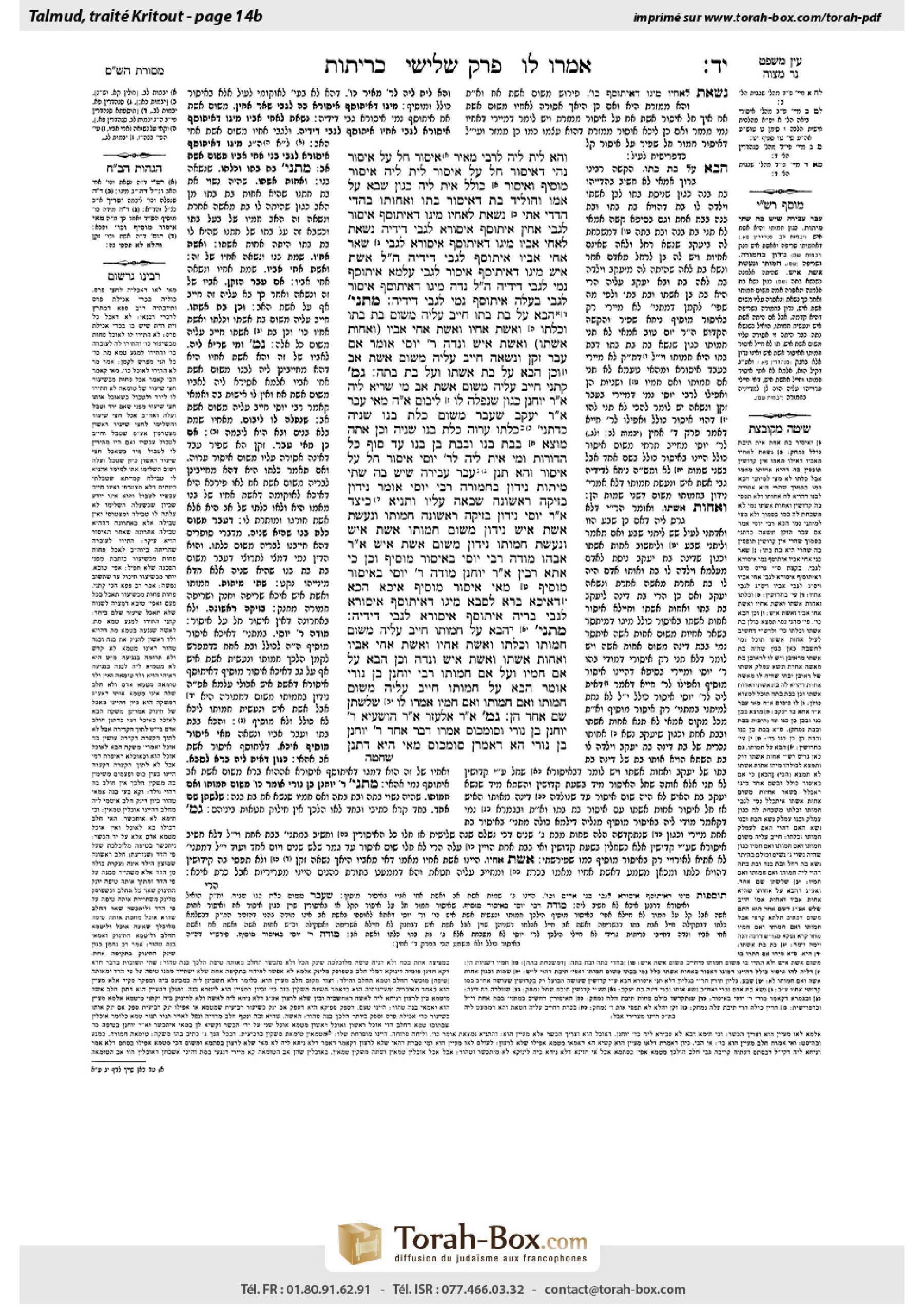
Keritot 14b: Talmud study for Daf Yomi
Daf Yomi is the daily study of one Talmud folio. Explore 37 tractates with scans, Hebrew text, Sefaria English and AI-generated French translations where annotated.
Passage selection and English or AI-generated French translation are available where the scan has annotations. Daf Study is independent of Torah-Box and Sefaria.
Browse Keritot · כריתות · All tractatesKeritot 14b text and translations
This page of Keritot includes the Aramaic text, an English translation and an AI-generated French translation, alongside the scan above.
כריתות י״ד ב · Aramaic and Hebrew text
גְּמָ׳ וְהָא לֵית לֵיהּ לְרַבִּי מֵאִיר אִיסּוּר חָל עַל אִיסּוּר! נְהִי דְּאִיסּוּר חָל עַל אִיסּוּר לֵית לֵיהּ, אִיסּוּר מוֹסִיף וְאִיסּוּר כּוֹלֵל אִית לֵיהּ.
כְּגוֹן שֶׁבָּא עַל אִמּוֹ וְהוֹלִיד בַּת, דְּאִיסּוּר בִּתּוֹ וַאֲחוֹתוֹ בַּהֲדֵי הֲדָדֵי אָתֵי. נִשֵּׂאת לְאָחִיו, מִיגּוֹ דְּאִיתּוֹסַף אִיסּוּר לְגַבֵּי אַחִין – אִיתּוֹסַף אִיסּוּרָא לְגַבֵּי דִּידֵיהּ.
נִשֵּׂאת לַאֲחִי אָבִיו, מִיגּוֹ דְּאִיתּוֹסַף אִיסּוּרָא לְגַבֵּי שְׁאָר אֲחֵי אָבִיו – אִיתּוֹסַף לְגַבֵּי דִּידֵיהּ. הָוְיָא לַהּ אֵשֶׁת אִישׁ, מִיגּוֹ דְּאִיתּוֹסַף אִיסּוּר לְגַבֵּי עָלְמָא – אִיתּוֹסַף נָמֵי לְגַבֵּי דִּידֵיהּ. הָוְיָא לַהּ נִדָּה, מִיגּוֹ דְּאִיתּוֹסַף אִיסּוּר לְגַבֵּי בַּעֲלַהּ – אִיתּוֹסַף נָמֵי לְגַבֵּי דִּידֵיהּ.
מַתְנִי׳ הַבָּא עַל בַּת בִּתּוֹ – חַיָּיב עָלֶיהָ מִשּׁוּם בַּת בִּתּוֹ, וְכַלָּתוֹ, וְאֵשֶׁת אָחִיו, וְאֵשֶׁת אֲחִי אָבִיו, וַאֲחוֹת אִשְׁתּוֹ, וְאֵשֶׁת אִישׁ, וְנִדָּה. רַבִּי יוֹסֵי אוֹמֵר: אִם עָבַר זָקֵן וּנְשָׂאָהּ – חַיָּיב עָלֶיהָ מִשּׁוּם אֵשֶׁת אָב.
וְכֵן הַבָּא עַל בַּת אִשְׁתּוֹ, וְעַל בַּת בִּתָּהּ.
גְּמָ׳ קָתָנֵי: חַיָּיב עָלֶיהָ מִשּׁוּם אֵשֶׁת אָב. מִי שַׁרְיָא לֵיהּ? אָמַר רַבִּי יוֹחָנָן: כְּגוֹן שֶׁנָּפְלָה לוֹ לְיִבּוּם.
אִי הָכִי, מַאי ״עָבַר״? אָמַר רַבִּי יַעֲקֹב: שֶׁעָבַר מִשּׁוּם כַּלַּת בְּנוֹ, שְׁנִיָּה.
כִּדְתַנְיָא: כַּלָּתוֹ עֶרְוָה, כַּלַּת בְּנוֹ שְׁנִיָּה. וְכֵן אַתָּה מוֹצֵא בְּבַת בְּנוֹ, וּבְבַת בֶּן בְּנוֹ. עַד סוֹף כׇּל הַדּוֹרוֹת.
וּמִי אִית לֵיהּ לְרַבִּי יוֹסֵי אִיסּוּר חָל עַל אִיסּוּר? וְהָא תְנַן: עָבַר עֲבֵירָה שֶׁיֵּשׁ בָּהּ שְׁתֵּי מִיתוֹת – נִידּוֹן בַּחֲמוּרָה. רַבִּי יוֹסֵי אוֹמֵר: נִידּוֹן בְּזִיקָּה רִאשׁוֹנָה שֶׁבָּאָה עָלָיו.
וְתַנְיָא: כֵּיצַד אָמַר רַבִּי יוֹסֵי נִידּוֹן בְּזִיקָּה רִאשׁוֹנָה? חֲמוֹתוֹ וְנַעֲשֵׂת אֵשֶׁת אִישׁ – נִידּוֹן מִשּׁוּם חֲמוֹתוֹ.
אֵשֶׁת אִישׁ וְנַעֲשֵׂת חֲמוֹתוֹ – נִידּוֹן מִשּׁוּם אֵשֶׁת אִישׁ!
אָמַר רַבִּי אֲבָהוּ: מוֹדֶה רַבִּי יוֹסֵי בְּאִיסּוּר מוֹסִיף. וְכֵן כִּי אֲתָא רָבִין אָמַר רַבִּי יוֹחָנָן: מוֹדֶה רַבִּי יוֹסֵי בְּאִיסּוּר מוֹסִיף.
מַאי אִיסּוּר מוֹסִיף אִיכָּא הָכָא? דְּאִיכָּא בְּרָא לְסָבָא, מִיגּוֹ דְּאִיתּוֹסַף אִיסּוּרָא לְגַבֵּי בְּרֵיהּ – אִיתּוֹסַף אִיסּוּרָא לְגַבֵּי דִּידֵיהּ.
מַתְנִי׳ הַבָּא עַל חֲמוֹתוֹ חַיָּיב עָלֶיהָ מִשּׁוּם חֲמוֹתוֹ, וְכַלָּתוֹ, וְאֵשֶׁת אָחִיו, וְאֵשֶׁת אֲחִי אָבִיו, וַאֲחוֹת אִשְׁתּוֹ, וְאֵשֶׁת אִישׁ, וְנִדָּה. וְכֵן הַבָּא עַל אֵם חָמִיו, וְעַל אֵם חֲמוֹתוֹ.
רַבִּי יוֹחָנָן בֶּן נוּרִי אוֹמֵר: הַבָּא עַל חֲמוֹתוֹ חַיָּיב עָלֶיהָ מִשּׁוּם חֲמוֹתוֹ, וְאֵם חֲמוֹתוֹ, וְאֵם חָמִיו. אָמְרוּ לוֹ: שְׁלׇשְׁתָּן שֵׁם אֶחָד הֵן.
גְּמָ׳ אָמַר רַבִּי אֶלְעָזָר אָמַר רַבִּי הוֹשַׁעְיָא: רַבִּי יוֹחָנָן בֶּן נוּרִי וְסוֹמְכוֹס אָמְרוּ דָּבָר אֶחָד. רַבִּי יוֹחָנָן בֶּן נוּרִי – הָא דַּאֲמַרַן. סוֹמְכוֹס מַאי הִיא? דִּתְנַן:
Keritot 14b · English translation
GEMARA: The Gemara asks: How could one become liable to bring multiple sin offerings? But Rabbi Meir does not hold that a prohibition takes effect where another prohibition already exists. The Gemara answers: Although he generally does not hold that a prohibition takes effect where another prohibition already exists, with regard to an expanded prohibition and a more inclusive prohibition, he does hold that it takes effect where another prohibition already exists.
Consequently, the ruling stated in the mishna applies in a case where one engaged in intercourse with his mother and thereby fathered a daughter, so that the prohibitions against engaging in intercourse with his daughter and with his sister come into effect simultaneously. If that daughter married his brother, then since a prohibition was added with regard to his other brothers, to whom she has now become forbidden, it is an expanded prohibition, and therefore a further prohibition is added with regard to him as well.
If she later married his father’s brother, then since a prohibition is added with regard to the sons of his father’s other brothers, a prohibition is also added with regard to him. If she becomes, or remains, a married woman, since a prohibition is added with regard to every man in the world other than her husband, a prohibition is added with regard to him as well. If she then becomes a menstruating woman, since a prohibition is added with regard to her husband, a prohibition is added with regard to him as well.
MISHNA: It is possible for one who engages in intercourse with his daughter’s daughter to be liable to bring sin offerings due to the unwitting violation of the prohibitions of engaging in intercourse with his daughter’s daughter, and his daughter-in-law, and the wife of his brother, and the wife of his father’s brother, and his wife’s sister, and a married woman, and a menstruating woman. Rabbi Yosei says: If the elder, i.e., the man’s father, who is the woman’s great-grandfather, transgressed and married her, the man would also be liable for engaging in intercourse with her due to the prohibition of intercourse with the wife of his father.
And likewise, it is possible for one who engages in intercourse with the daughter of his wife to be liable to bring six sin offerings, similar to one who engages in intercourse with his own daughter, for violating the prohibitions against engaging in intercourse with his wife’s daughter, his sister, the wife of his brother, the wife of his father’s brother, a married woman, and a menstruating woman. And it is possible for one who engages in intercourse with his wife’s daughter’s daughter to be liable to bring seven sin offerings, similar to one who engages in intercourse with his own daughter’s daughter, for violating the following prohibitions: Engaging in intercourse with his wife’s daughter’s daughter, his daughter-in-law, the wife of his brother, the wife of his father’s brother, his wife’s sister, a married woman, and a menstruating woman.
GEMARA: It is taught in the mishna that Rabbi Yosei says: If the elder, i.e., the man’s father, who is the woman’s great-grandfather, transgressed and married her, the man would also be liable for engaging in intercourse with her due to the prohibition against engaging in intercourse with the wife of his father. The Gemara asks: Is she permitted to marry the man’s father? She had already been married to the man’s father’s brother, and therefore even if she was widowed or divorced from him, marriage would not even take effect with the man’s father, to whom she is forbidden as the wife of his brother. Rabbi Yoḥanan said: The marriage can take effect in a case where she happened to become designated to him for levirate marriage, when his brother died without children.
The Gemara raises an objection: If so, that they were married legitimately through levirate marriage, what is the reason for Rabbi Yosei’s statement that he transgressed and married her? Rabbi Ya’akov said: It means that he transgressed by marrying her due to her status as his son’s daughter-in-law, which renders her a secondary relative, forbidden to him by rabbinic law, albeit not by Torah law. Consequently, it was prohibited for him to enter into the levirate marriage.
This is as it is taught in a baraita: One’s daughter-in-law is a forbidden relative by Torah law, and his son’s daughter-in-law is a secondary relative, prohibited to him by rabbinic law, and similarly, you find with regard to the daughter of his son, who is prohibited to him by Torah law, and with regard to the daughter of his son’s son, until the end of all generations; the daughter of his son’s son, or of his son’s grandson, etc. They are all secondary relatives, prohibited to him by rabbinic law.
The Gemara asks: And is Rabbi Yosei of the opinion that a prohibition takes effect where another prohibition already exists? But didn’t we learn in a mishna (Sanhedrin 81a): If one violated a transgression that renders him liable to two death penalties, he is sentenced to the harsher one. Rabbi Yosei says: He is sentenced according to the first prohibition that applied to him.
And it is taught in a baraita: In what case did Rabbi Yosei say that he is sentenced according to the first prohibition that applied to him? If his mother-in-law was widowed or divorced, and therefore forbidden to him only due to her status as his mother-in-law, and later she married and became forbidden as a married woman, and he engaged in intercourse with her, then he is sentenced to death by burning due to his violation of the prohibition proscribing intercourse with his mother-in-law, as this was the first prohibition to take effect.
By contrast, if she was a married woman, and then he married her daughter and she thereby became his mother-in-law, and he subsequently engaged in intercourse with her, he is sentenced to death by strangulation due to his violation of the prohibition against engaging in intercourse with a married woman, despite the fact that burning is considered the more severe death penalty. This proves that Rabbi Yosei maintains that a prohibition does not take effect where another prohibition already exists.
Rabbi Abbahu said: Rabbi Yosei concedes that in the case of an expanded prohibition it takes effect even when another prohibition already exists. Consequently, he maintains in the mishna that the prohibition against intercourse with the wife of his father applies in addition to the previously existing prohibitions. And similarly, when Ravin came from Eretz Yisrael he said that Rabbi Yoḥanan says: Rabbi Yosei concedes with regard to an expanded prohibition.
The Gemara asks: What expanded prohibition is there here? The Gemara answers: The expanded prohibition applies when there is another son of the grandfather, i.e., another son of the father of the subject of the mishna. Consequently, since a prohibition against intercourse with the woman is added with regard to his father’s other son, when his father marries this woman, another prohibition against intercourse with her is added with regard to him as well.
MISHNA: It is possible for one who engages in intercourse with his mother-in-law to be liable to bring seven sin offerings for doing so, due to the unwitting violation of the prohibitions of engaging in intercourse with his mother-in-law, and his daughter-in-law, and the wife of his brother, and the wife of his father’s brother, and his wife’s sister, and a married woman, and a menstruating woman. And likewise, the same applies with regard to one who engages in intercourse with the mother of his father-in-law or with the mother of his mother-in-law.
Rabbi Yoḥanan ben Nuri says: It is possible for one who engages in intercourse with his mother-in-law to be liable due to the unwitting violation of the prohibitions of engaging in intercourse with his mother-in-law, and the mother of his mother-in-law, and the mother of his father-in-law. The Rabbis said to him: Those three prohibitions are all one category of prohibition, derived from the same verse: “You shall not uncover the nakedness of a woman and her daughter; you shall not take her son’s daughter, or her daughter’s daughter” (Leviticus 18:17). Consequently, one is not liable to bring separate sin offerings for violating these prohibitions.
GEMARA: Rabbi Elazar says that Rabbi Hoshaya says: Rabbi Yoḥanan ben Nuri and Sumakhos said the same thing. With regard to Rabbi Yoḥanan ben Nuri, this is referring to that which we stated in the mishna. With regard to Sumakhos, what is the equivalent ruling that he stated? It is the following ruling, as we learned in a mishna (Ḥullin 82a):
Keritot 14b · Traduction française (IA)
GUEMARA : La Guemara demande : Comment peut-on être tenu d’apporter plusieurs sacrifices expiatoires ? Rabbi Meïr ne considère-t-il pas qu’une interdiction ne prend pas effet lorsqu’une autre interdiction est déjà en vigueur ? La Guemara répond : Bien que, de manière générale, Rabbi Meïr considère qu’une interdiction ne prend pas effet lorsqu’une autre interdiction est déjà en vigueur, il estime qu’une interdiction plus étendue et une interdiction plus inclusive prennent effet malgré une interdiction déjà en vigueur.
Par conséquent, la règle énoncée dans la Michna s’applique au cas où un homme a eu des rapports avec sa mère et a ainsi engendré une fille, de sorte que les interdictions d’avoir des rapports avec sa fille et avec sa sœur prennent effet simultanément. Si cette fille a épousé son frère, alors, puisqu’une interdiction s’ajoute à l’égard de ses autres frères, auxquels elle est désormais interdite, il s’agit d’une interdiction plus étendue ; une interdiction supplémentaire s’ajoute donc également à son égard.
Si elle a ensuite épousé le frère de son père, alors, puisqu’une interdiction s’ajoute à l’égard des fils des autres frères de son père, une interdiction s’ajoute également à son égard. Si elle devient, ou reste, une femme mariée, alors, puisqu’une interdiction s’ajoute à l’égard de tous les hommes du monde, à l’exception de son mari, une interdiction s’ajoute également à son égard. Si elle devient ensuite une femme menstruée, alors, puisqu’une interdiction s’ajoute à l’égard de son mari, une interdiction s’ajoute également à son égard.
MICHNA : Il est possible qu’un homme qui a des rapports avec la fille de sa fille soit tenu d’apporter des sacrifices expiatoires pour avoir transgressé involontairement les interdictions d’avoir des rapports avec la fille de sa fille, sa belle-fille, la femme de son frère, la femme du frère de son père, la sœur de sa femme, une femme mariée et une femme menstruée. Rabbi Yossei dit : Si l’aîné, c’est-à-dire le père de l’homme, qui est l’arrière-grand-père de cette femme, transgressait en l’épousant, l’homme serait également passible pour avoir eu des rapports avec elle, en raison de l’interdiction d’avoir des rapports avec la femme de son père.
De même, il est possible qu’un homme qui a des rapports avec la fille de sa femme soit tenu d’apporter six sacrifices expiatoires, comme celui qui a des rapports avec sa propre fille, pour avoir transgressé les interdictions d’avoir des rapports avec la fille de sa femme, sa sœur, la femme de son frère, la femme du frère de son père, une femme mariée et une femme menstruée. Il est également possible qu’un homme qui a des rapports avec la petite-fille de sa femme soit tenu d’apporter sept sacrifices expiatoires, comme celui qui a des rapports avec la petite-fille de sa propre fille, pour avoir transgressé les interdictions suivantes : avoir des rapports avec la petite-fille de sa femme, sa belle-fille, la femme de son frère, la femme du frère de son père, la sœur de sa femme, une femme mariée et une femme menstruée.
GUEMARA : La Michna enseigne que Rabbi Yossei dit : Si l’aîné, c’est-à-dire le père de l’homme, qui est l’arrière-grand-père de cette femme, transgressait en l’épousant, l’homme serait également passible pour avoir eu des rapports avec elle, en raison de l’interdiction d’avoir des rapports avec la femme de son père. La Guemara demande : Lui est-il permis d’épouser le père de l’homme ? Elle avait déjà été mariée au frère du père de l’homme ; par conséquent, même si elle était devenue veuve ou avait divorcé, le mariage avec le père de l’homme n’aurait pas pris effet, car elle lui était interdite en tant que femme de son frère. Rabbi Yoḥanan dit : Le mariage peut prendre effet dans le cas où elle lui était échue pour un mariage léviratique, après que son frère était mort sans enfant.
La Guemara soulève une objection : Si tel est le cas, et qu’ils étaient légitimement mariés à la suite d’un mariage léviratique, pourquoi Rabbi Yossei dit-il qu’il a transgressé en l’épousant ? Rabbi Yaakov dit : Cela signifie qu’il a transgressé en l’épousant parce qu’elle était la belle-fille de son fils, ce qui fait d’elle une parente secondaire, interdite à cet homme par décret rabbinique, mais non par la Torah. Par conséquent, il lui était interdit de contracter avec elle un mariage léviratique.
C’est ce qu’enseigne une baraïta : La belle-fille d’un homme est une parente interdite par la Torah, tandis que la belle-fille de son fils est une parente secondaire, interdite à cet homme par décret rabbinique. De même, la fille de son fils lui est interdite par la Torah, tandis que la fille du fils de son fils, et les descendantes de celui-ci jusqu’à la fin des générations, lui sont des parentes secondaires, interdites par décret rabbinique.
La Guemara demande : Rabbi Yossei considère-t-il qu’une interdiction prend effet lorsqu’une autre interdiction est déjà en vigueur ? N’avons-nous pas appris dans une Michna (Sanhédrin 81a) : Si quelqu’un commet une transgression qui le rend passible de deux peines de mort, il est condamné à la peine la plus sévère. Rabbi Yossei dit : Il est condamné selon la première interdiction qui a pris effet à son égard.
Et une baraïta enseigne : Dans quel cas Rabbi Yossei a-t-il dit qu’il est condamné selon la première interdiction qui a pris effet à son égard ? Si sa belle-mère est devenue veuve ou a divorcé, de sorte qu’elle lui était interdite uniquement en tant que belle-mère, puis qu’elle s’est remariée et est ainsi devenue interdite en tant que femme mariée, et qu’il a eu des rapports avec elle, il est alors condamné à la mort par le feu pour avoir transgressé l’interdiction d’avoir des rapports avec sa belle-mère, car c’était la première interdiction à avoir pris effet.
En revanche, si elle était une femme mariée, puis qu’il a épousé sa fille et qu’elle est ainsi devenue sa belle-mère, et qu’il a ensuite eu des rapports avec elle, il est condamné à la mort par strangulation pour avoir transgressé l’interdiction d’avoir des rapports avec une femme mariée, bien que le feu soit considéré comme une peine de mort plus sévère. Cela prouve que, selon Rabbi Yossei, une interdiction ne prend pas effet lorsqu’une autre interdiction est déjà en vigueur.
Rabbi Abbahou dit : Rabbi Yossei reconnaît que, dans le cas d’une interdiction plus étendue, celle-ci prend effet même lorsqu’une autre interdiction est déjà en vigueur. Par conséquent, dans la Michna, il considère que l’interdiction d’avoir des rapports avec la femme de son père s’ajoute aux interdictions déjà en vigueur. De même, lorsque Ravin est venu de la Terre d’Israël, il a rapporté que Rabbi Yoḥanan disait : Rabbi Yossei reconnaît le principe de l’interdiction plus étendue.
La Guemara demande : Quelle interdiction plus étendue y a-t-il ici ? La Guemara répond : L’interdiction est plus étendue lorsqu’il y a un autre fils du grand-père, c’est-à-dire un autre fils du père de l’homme dont parle la Michna. Par conséquent, puisqu’une interdiction d’avoir des rapports avec cette femme s’ajoute à l’égard de l’autre fils de son père, lorsque son père épouse cette femme, une autre interdiction d’avoir des rapports avec elle s’ajoute également à son égard.
MICHNA : Il est possible qu’un homme qui a des rapports avec sa belle-mère soit tenu d’apporter sept sacrifices expiatoires pour avoir ainsi transgressé involontairement les interdictions d’avoir des rapports avec sa belle-mère, sa belle-fille, la femme de son frère, la femme du frère de son père, la sœur de sa femme, une femme mariée et une femme menstruée. Il en va de même pour celui qui a des rapports avec la mère de son beau-père ou avec la mère de sa belle-mère.
Rabbi Yoḥanan ben Nouri dit : Il est possible qu’un homme qui a des rapports avec sa belle-mère soit passible pour avoir transgressé involontairement les interdictions d’avoir des rapports avec sa belle-mère, la mère de sa belle-mère et la mère de son beau-père. Les Sages lui dirent : Ces trois interdictions relèvent toutes d’une seule et même catégorie, dérivée du même verset : « Tu ne découvriras pas la nudité d’une femme et de sa fille ; tu ne prendras pas la fille de son fils ni la fille de sa fille » (Lévitique 18,17). Par conséquent, on n’est pas tenu d’apporter des sacrifices expiatoires distincts pour avoir transgressé ces interdictions.
GUEMARA : Rabbi Elazar rapporte au nom de Rabbi Hoshaya : Rabbi Yoḥanan ben Nouri et Sumakhos ont énoncé la même règle. En ce qui concerne Rabbi Yoḥanan ben Nouri, il s’agit de ce qui a été énoncé dans la Michna. Et pour Sumakhos, quelle règle équivalente a-t-il énoncée ? C’est la règle suivante, comme nous l’avons appris dans une Michna (Ḥoullin 82a) :
Traduction française générée par IA à partir de l’édition anglaise de Sefaria. Vérifie toujours un passage avec le texte source.
Text from Sefaria: William Davidson Edition - Vocalized Aramaic (CC BY NC); William Davidson Edition - English (CC BY NC).