Keritot 15a: Talmud study for Daf Yomi
Daf Yomi is the daily study of one Talmud folio. Explore 37 tractates with scans, Hebrew text, Sefaria English and AI-generated French translations where annotated.
Passage selection and English or AI-generated French translation are available where the scan has annotations. Daf Study is independent of Torah-Box and Sefaria.
Browse Keritot · כריתות · All tractatesKeritot 15a text and translations
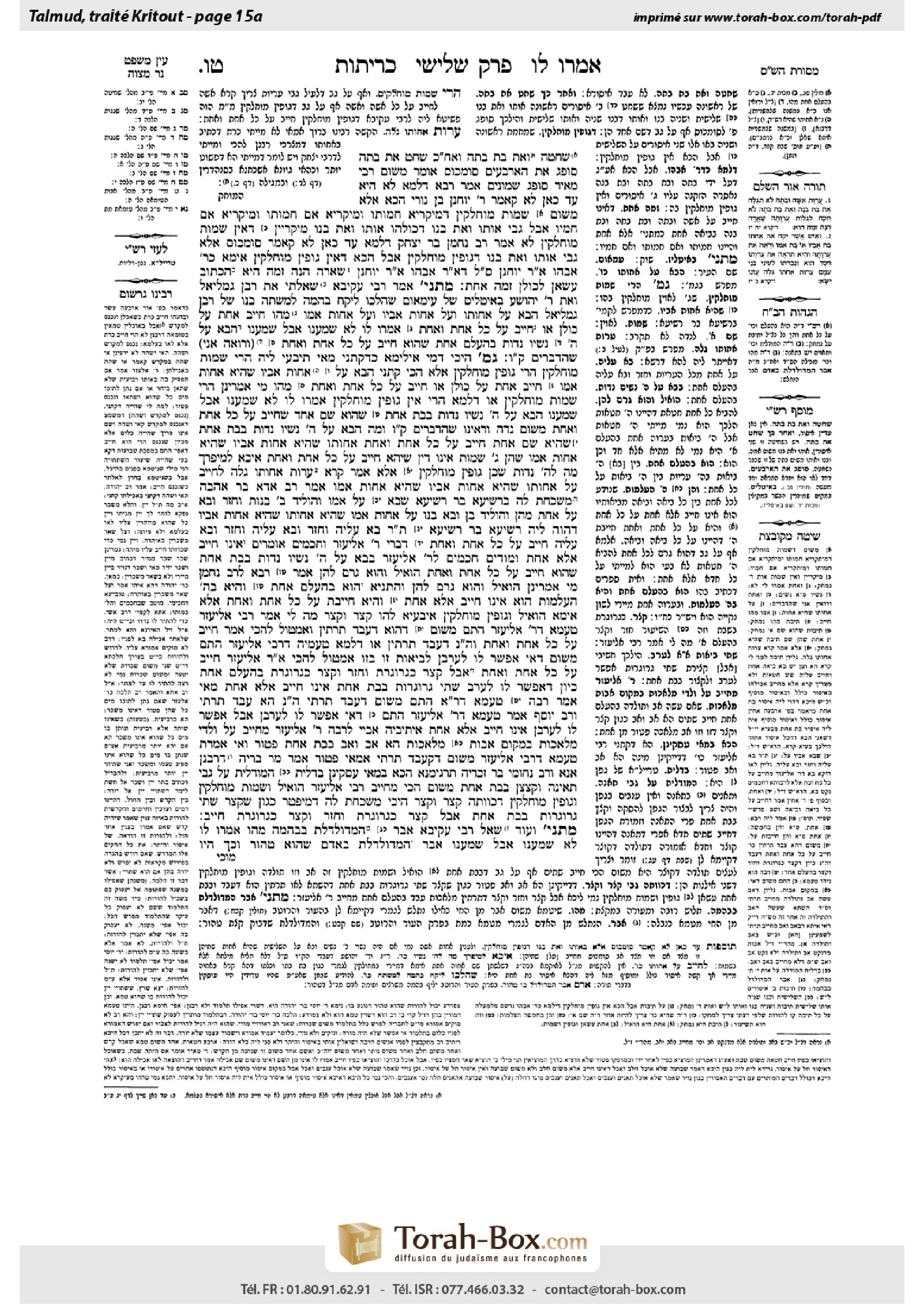
This page of Keritot includes the Aramaic text, an English translation and an AI-generated French translation, alongside the scan above.
כריתות י״ה א · Aramaic and Hebrew text
שְׁחָטָהּ וְאֶת בַּת בִּתָּהּ, וְאַחַר כָּךְ שָׁחַט אֶת בִּתָּהּ – סוֹפֵג אֶת הָאַרְבָּעִים. סוֹמְכוֹס אוֹמֵר מִשּׁוּם רַבִּי מֵאִיר: סוֹפֵג שְׁמוֹנִים.
אָמַר רָבָא: דִּלְמָא לָא הִיא, עַד כָּאן לָא קָאָמַר רַבִּי יוֹחָנָן בֶּן נוּרִי הָכָא אֶלָּא מִשּׁוּם שֵׁמוֹת מוּחְלָקִין, דְּמִיקַּרְיָא חֲמוֹתוֹ, וּמִיקַּרְיָא אֵם חֲמוֹתוֹ, וּמִיקַּרְיָא אֵם חָמִיו.
אֲבָל גַּבֵּי אוֹתוֹ וְאֶת בְּנוֹ, דְּכוּלְּהוּ ״אוֹתוֹ וְאֶת בְּנוֹ״ מִיקַּרְיָין, דְּאֵין שֵׁמוֹת מוּחְלָקִין – לָא.
אָמַר רַב נַחְמָן בַּר יִצְחָק: דִּלְמָא עַד כָּאן לָא קָאָמַר סוֹמְכוֹס אֶלָּא גַּבֵּי אוֹתוֹ וְאֶת בְּנוֹ, דְּגוּפִין מוּחְלָקִין.
אֲבָל הָכָא, דְּאֵין גּוּפִין מוּחְלָקִין, אֵימָא כְּרַבִּי אֲבָהוּ אָמַר רַבִּי יוֹחָנָן סְבִירָא לֵיהּ, דְּאָמַר רַבִּי אֲבָהוּ אָמַר רַבִּי יוֹחָנָן: ״שַׁאֲרָה הֵנָּה זִמָּה הִיא״, הַכָּתוּב עֲשָׂאָן לְכוּלָּן זִמָּה אַחַת.
מַתְנִי׳ אָמַר רַבִּי עֲקִיבָא: שָׁאַלְתִּי אֶת רַבָּן גַּמְלִיאֵל וְאֶת רַבִּי יְהוֹשֻׁעַ בָּאִיטְלֵיס שֶׁל עֵימָאוּם, שֶׁהָלְכוּ לִיקַּח בְּהֵמָה לְמִשְׁתֵּה בְנוֹ שֶׁל רַבָּן גַּמְלִיאֵל, הַבָּא עַל אֲחוֹתוֹ וְעַל אֲחוֹת אָבִיו וְעַל אֲחוֹת אִמּוֹ, מַהוּ? חַיָּיב אַחַת עַל כּוּלָּן, אוֹ חַיָּיב עַל כָּל אַחַת וְאֶחָת?
אָמְרוּ לוֹ: לֹא שָׁמַעְנוּ, אֲבָל שָׁמַעְנוּ: הַבָּא עַל חָמֵשׁ נָשָׁיו נִדּוֹת בְּהֶעְלֵם (אַחַת) [אֶחָד], שֶׁהוּא חַיָּיב עַל כׇּל אַחַת וְאֶחָת, (וְרוֹאֶה אֲנִי) [וְרוֹאִין אָנוּ] שֶׁהַדְּבָרִים קַל וָחֹמֶר.
גְּמָ׳ הֵיכִי דָמֵי? אִילֵּימָא כִּדְקָתָנֵי, מַאי תִּיבְּעֵי לֵיהּ? הֲרֵי שֵׁמוֹת מוּחְלָקִין, הֲרֵי גּוּפִין מוּחְלָקִין!
אֶלָּא הָכִי קָתָנֵי: הַבָּא עַל אֲחוֹת אָבִיו שֶׁהִיא אֲחוֹת אִמּוֹ, חַיָּיב אַחַת עַל כּוּלָּן, אוֹ חַיָּיב עַל כׇּל אַחַת וְאֶחָת, מַהוּ? מִי אָמְרִינַן: הֲרֵי שֵׁמוֹת מוּחְלָקִין, אוֹ דִלְמָא הֲרֵי אֵין גּוּפִין מוּחְלָקִין?
אָמְרוּ לוֹ: לֹא שָׁמַעְנוּ, אֲבָל שָׁמַעְנוּ: הַבָּא עַל חָמֵשׁ נָשָׁיו נִדּוֹת בְּבַת אַחַת, שֶׁהוּא שֵׁם אֶחָד, שֶׁחַיָּיב עַל כׇּל אַחַת וְאַחַת מִשּׁוּם נִדָּה,
וְרָאִינוּ שֶׁהַדְּבָרִים קַל וָחוֹמֶר: וּמָה הַבָּא עַל חָמֵשׁ נָשָׁיו נִדּוֹת בְּבַת אַחַת, שֶׁהִיא שֵׁם אַחַת – חַיָּיב עַל כׇּל אַחַת וְאַחַת, אֲחוֹתוֹ שֶׁהִיא אֲחוֹת אָבִיו שֶׁהִיא אֲחוֹת אִמּוֹ, שֶׁהֵן שְׁלֹשָׁה שֵׁמוֹת – אֵינוֹ דִּין שֶׁיְּהֵא חַיָּיב עַל כׇּל אַחַת וְאַחַת?
אִיכָּא לְמִיפְרַךְ: מָה לְחָמֵשׁ נִדּוֹת – שֶׁכֵּן גּוּפִין מוּחְלָקִין!
אֶלָּא אָמַר קְרָא: ״עֶרְוַת אֲחוֹתוֹ גִלָּה״, לְחַיֵּיב עַל אֲחוֹתוֹ שֶׁהִיא אֲחוֹת אָבִיו שֶׁהִיא אֲחוֹת אִמּוֹ.
אָמַר רַב אַדָּא בַּר אַהֲבָה: מַשְׁכַּחַתְּ לַהּ בְּרַשִּׁיעָא בַּר רַשִּׁיעָא, שֶׁבָּא עַל אִמּוֹ וְהוֹלִיד שְׁתֵּי בָּנוֹת, וְחָזַר וּבָא עַל אַחַת מֵהֶן וְהוֹלִיד בֵּן, וּבָא בְּנוֹ עַל אֲחוֹת אִמּוֹ, שֶׁהִיא אֲחוֹתוֹ, שֶׁהִיא אֲחוֹת אָבִיו, דְּהָוֵה לֵיהּ רַשִּׁיעָא בַּר רַשִּׁיעָא.
תָּנוּ רַבָּנַן: בָּא עָלֶיהָ, וְחָזַר וּבָא עָלֶיהָ, וְחָזַר וּבָא עָלֶיהָ – חַיָּיב עַל כׇּל אַחַת וְאֶחָת, דִּבְרֵי רַבִּי אֱלִיעֶזֶר. וַחֲכָמִים אוֹמְרִים: אֵינוֹ חַיָּיב אֶלָּא אֶחָת.
וּמוֹדִים חֲכָמִים לְרַבִּי אֱלִיעֶזֶר בְּבָא עַל חָמֵשׁ נָשָׁיו נִדּוֹת בְּבַת אַחַת, שֶׁהוּא חַיָּיב עַל כׇּל אַחַת וְאַחַת, הוֹאִיל וְהוּא גָּרַם לָהֶן.
אָמַר רָבָא לְרַב נַחְמָן: מִי אָמְרִינַן ״הוֹאִיל וְהוּא גָּרַם לָהֶן״? וְהָתַנְיָא: הוּא בְּהֶעְלֵם (אַחַת) [אֶחָד] וְהִיא בַּחֲמִשָּׁה הֶעְלֵמוֹת – הוּא אֵינוֹ חַיָּיב אֶלָּא אַחַת וְהִיא חַיֶּיבֶת עַל כׇּל אַחַת וְאֶחָת.
אֶלָּא אֵימָא: הוֹאִיל וְגוּפִין מוּחְלָקִין.
אִיבַּעְיָא לְהוּ, קָצַר וְקָצַר – מָה לִי אָמַר רַבִּי אֱלִיעֶזֶר?
טַעְמָא דְּרַבִּי אֱלִיעֶזֶר הָתָם מִשּׁוּם דְּהוּא דַּעֲבַד תַּרְתֵּין, וְאַמְּטוּל (ל)הָכִי אָמַר: חַיָּיב עַל כׇּל אַחַת וְאַחַת, וְהָכָא נָמֵי דַּעֲבַד תַּרְתֵּין,
אוֹ דִּלְמָא טַעְמֵיהּ דְּרַבִּי אֱלִיעֶזֶר הָתָם מִשּׁוּם דְּאִי אֶפְשָׁר לוֹ לְעָרְבָן לְבִיאוֹת זוֹ בָּזוֹ, אַמְּטוּל (לְ)הָכִי אָמַר רַבִּי אֱלִיעֶזֶר: חַיָּיב עַל כׇּל אַחַת וְאַחַת, אֲבָל קָצַר כִּגְרוֹגֶרֶת וְחָזַר וְקָצַר כִּגְרוֹגֶרֶת בְּהֶעְלֵם (אַחַת) [אֶחָד], כֵּיוָן דְּאֶפְשָׁר לוֹ לְעָרֵב שְׁתֵּי גְּרוֹגְרוֹת בְּבַת אַחַת אֵינוֹ חַיָּיב אֶלָּא אֶחָת, מַאי?
אָמַר רַבָּה: טַעְמָא דְּרַבִּי אֱלִיעֶזֶר הָתָם – מִשּׁוּם דַּעֲבַד תַּרְתֵּי, הָכָא נָמֵי הָא עֲבַד תַּרְתֵּי. וְרַב יוֹסֵף אָמַר: טַעְמָא דְּרַבִּי אֱלִיעֶזֶר הָתָם – דְּאִי אֶפְשָׁר לוֹ לְעָרְבָן, אֲבָל אֶפְשָׁר לוֹ לְעָרְבָן – אֵינוֹ חַיָּיב אֶלָּא אֶחָת.
אֵיתִיבֵיהּ אַבָּיֵי לְרַבָּה: רַבִּי אֱלִיעֶזֶר מְחַיֵּיב עַל וַלְדֵי מְלָאכוֹת בִּמְקוֹם אֲבוֹת מְלָאכוֹת.
הָא אָב וְאָב, בְּבַת אַחַת – פָּטוּר. וְאִי אָמְרַתְּ טַעְמָא דְּרַבִּי אֱלִיעֶזֶר מִשּׁוּם דְּקָעָבֵד תַּרְתֵּי, אַמַּאי פָּטוּר?
אָמַר מָר בְּרֵיהּ דְּרַבָּנַן: אֲנָא וְרַב נְחוּמִי בַּר זְכַרְיָה תַּרְגֵּימְנָא: הָכָא בְמַאי עָסְקִינַן –
בְּדָלִית הַמּוּדְלֵית עַל גַּבֵּי תְּאֵינָה וּקְצָצָן בְּבַת אַחַת, מִשּׁוּם הָכִי מְחַיֵּיב רַבִּי אֱלִיעֶזֶר, הוֹאִיל וְשֵׁמוֹת מוּחְלָקִין וְגוּפִין מוּחְלָקִין.
דִּכְווֹתַהּ קָצַר וְקָצַר, הֵיכִי מַשְׁכַּחַתְּ לַהּ דְּמִיפְּטַר? כְּגוֹן שֶׁקָּצַר שְׁתֵּי גְּרוֹגְרוֹת בְּבַת אַחַת, אֲבָל קָצַר כִּגְרוֹגֶרֶת וְחָזַר וְקָצַר כִּגְרוֹגֶרֶת – חַיָּיב.
מַתְנִי׳ וְעוֹד שָׁאַל רַבִּי עֲקִיבָא: אֵבֶר הַמְדֻולְדָּל בַּבְּהֵמָה, מַהוּ? אָמְרוּ לוֹ: לֹא שָׁמַעְנוּ, אֲבָל שָׁמַעְנוּ אֵבֶר הַמְדֻולְדָּל בָּאָדָם שֶׁהוּא טָהוֹר, וְכָךְ הָיוּ
Keritot 15a · English translation
If one slaughtered an animal and its daughter’s daughter and afterward slaughtered the original animal’s daughter, he incurs the forty lashes for transgressing the prohibition against slaughtering an animal and its offspring on a single day (see Leviticus 22:28). Sumakhos says in the name of Rabbi Meir: He incurs eighty lashes for slaughtering the third animal, as its mother and its daughter had already been slaughtered on that day. This indicates that Sumakhos also maintains that when a person commits a single act and thereby commits two transgressions that are derived from a single verse, he is liable to receive punishment for both violations.
Rava said: Perhaps it is not so, as Rabbi Yoḥanan ben Nuri would not agree with the ruling of Sumakhos. It is possible that Rabbi Yoḥanan ben Nuri says that one is liable to bring multiple sin offerings only here, in the case of one who engaged in intercourse with his mother-in-law, only due to the differentiated names of the prohibitions, as she is called his mother-in-law, and she is called his mother-in-law’s mother, and she is called his father-in-law’s mother, and the Torah prohibits each of these relationships separately.
But with regard to the case of slaughtering a mother and its offspring in a single day, where all of the permutations are called: A mother and its offspring, as there are no differentiated names given in the Torah for slaughtering a mother animal and then its offspring or for slaughtering the offspring and subsequently its mother, Rabbi Yoḥanan ben Nuri might maintain that one is not liable to receive multiple sets of lashes.
By contrast, Rav Naḥman bar Yitzḥak said: Perhaps Sumakhos says that one is liable to receive two sets of lashes only with regard to the case of slaughtering a mother and its offspring on the same day, as there are differentiated bodies. Although he violated the same prohibition twice, he did so by slaughtering three different animals.
But here, with regard to a mother-in-law, where there are not several differentiated bodies, as the man engaged in intercourse with only one woman, one might say that Sumakhos holds in accordance with the statement that Rabbi Abbahu says in the name of Rabbi Yoḥanan, as Rabbi Abbahu says that Rabbi Yoḥanan says: The verse that introduces the prohibitions against engaging in intercourse with one’s mother-in-law, one’s mother-in-law’s mother, and one’s father-in-law’s mother concludes with the phrase: “They are near kinswomen; it is lewdness” (Leviticus 18:17). This teaches that although these are different relationships, the verse rendered them all one single prohibition of lewdness, for which only a single sin offering is brought.
MISHNA: Rabbi Akiva said: I asked Rabban Gamliel and Rabbi Yehoshua in the meat market [itlis] in Emmaus, where they went to purchase an animal for the wedding feast of the son of Rabban Gamliel: In the case of one who unwittingly engages in intercourse with his sister, and the sister of his father, and the sister of his mother, during one lapse of awareness, what is the halakha? Is he liable to bring one sin offering for all three prohibitions, or is he liable to bring a separate sin offering for each and every one of the prohibitions?
They said to Rabbi Akiva: We did not hear a ruling from our teachers about that case, but we heard the following ruling: One who engages in intercourse with each of his five wives while they are menstruating, during one lapse of awareness, we heard that he is liable to bring a separate sin offering for having engaged in intercourse with each and every one of them. And it appears to me that these matters can be derived from an a fortiori inference: If he is liable to bring separate sin offerings for having engaged in intercourse with five menstruating women, who are forbidden by one prohibition, he should certainly be liable to bring separate sin offerings for having engaged in intercourse with his sister, the sister of his father, and the sister of his mother, who are forbidden by three separate prohibitions.
GEMARA: The Gemara raises a difficulty with regard to Rabbi Akiva’s question: What are the circumstances about which Rabbi Akiva inquired? If we say that the circumstances are precisely as the mishna teaches them, that one unwittingly engaged in intercourse with his sister, and the sister of his father, and the sister of his mother, then for what purpose did Rabbi Akiva raise this dilemma before Rabban Gamliel and Rabbi Yehoshua? Aren’t they differentiated names of prohibitions and aren’t they also differentiated bodies? Since the man engaged in intercourse with three women, who are forbidden by three distinct prohibitions, it is obvious that he is obligated to bring three separate sin offerings.
Rather, it must be that this is what the mishna is teaching: Rabbi Akiva asked: In the case of one who unwittingly engages in intercourse with his sister who is also the sister of his father and who is also the sister of his mother, is he liable to bring only one sin offering for violating all of those prohibitions, or is he liable to bring a separate sin offering for each and every one? What is the halakha? Do we say that they are differentiated names of prohibitions, and since he violated distinct prohibitions, he is liable to bring separate sin offerings? Or perhaps we say: It is not a case of differentiated bodies; since he engaged in intercourse with only one woman, he is liable to bring only a single sin offering.
And in response, they said to him: We did not hear a ruling from our teachers about that case, but we heard the following ruling: With regard to one who engages in intercourse with each of his five wives while they are menstruating, at the same time, i.e., during one lapse of awareness, which is five instances of violating one category of prohibition, we heard that he is liable to bring a separate sin offering for having engaged in intercourse with each and every one of them, due to the prohibition against engaging in intercourse with a menstruating woman.
And it appears to us that these matters can be derived from an a fortiori inference: If one who engages in intercourse with his five wives while they are menstruating, at the same time, which is only one name of a prohibition, is nevertheless liable to bring a sin offering for each and every one of them, then in the case of one who engages in intercourse with his sister who is also the sister of his father and the sister of his mother, which are three separate prohibition names, is it not logical that he should be liable for each and every one of them?
The Gemara raises an objection: This line of reasoning can be refuted, as follows: What is notable about the case of five menstruating women that would render one liable to bring a separate sin offering for having intercourse with each one of them? It is notable in that they are differentiated bodies, which is not the case with regard to one’s sister who is also the sister of his father and the sister of his mother, as she is a single person.
Rather, the reason one is liable to bring three separate sin offerings for engaging in intercourse with his sister who is also the sister of his mother and the sister of his father is that the verse states: “And if a man takes his sister…and they shall be cut off [venikhretu] in the sight of the children of their people; he has uncovered his sister’s nakedness” (Leviticus 20:17). The final clause in this verse serves to render him liable to receive three separate penalties of karet for intentional intercourse, or to bring three separate sin offerings for unwitting intercourse, with his sister who is also the sister of his father and who is the sister of his mother.
The Gemara explains how there could be a case where one’s sister is also the sister of his father and the sister of his mother: Rav Adda bar Ahava says: You find it in the case of a wicked man, the son of a wicked man. The case applies if a man engaged in intercourse with his mother and fathered two daughters, and then engaged in intercourse with one of those daughters and fathered a son, and his son engaged in intercourse with his mother’s sister who is also his own sister, because they share a father, and who is also his father’s sister. This individual is a wicked man, the son of a wicked man, as both he and his father engaged in incestuous relationships.
§ The Sages taught in a baraita: If one unwittingly engages in intercourse with a woman who is forbidden to him under the penalty of excision from the World-to-Come [karet], and then again engages in intercourse with her, and then yet again engages in intercourse with her, all during one lapse of awareness, he is liable to bring a separate sin offering for each and every one of the acts of intercourse with her. This is the statement of Rabbi Eliezer. But the Rabbis say: He is liable to bring only one sin offering.
And the Rabbis concede to Rabbi Eliezer with regard to one who engages in intercourse with his five wives while they are menstruating, where the prohibition was violated unwittingly by both the man and the woman, at the same time, i.e., during one lapse of awareness, that he is liable for each and every one of them, since he caused each of them to be liable to bring a sin offering.
Rava said to Rav Naḥman: Do we really say that since he caused each of them to be liable to bring a sin offering, he himself is liable to bring five separate sin offerings? But isn’t it taught in a baraita: If one unwittingly engages in intercourse five times with a woman who is forbidden to him, and he does so during one lapse of awareness, without realizing over the course of that time period that the act is forbidden, but she does so during five lapses of awareness, as she repeatedly became aware of the prohibition and then forgot it before the next transgression, he is liable to bring only one sin offering, but she is liable to bring a separate sin offering for each and every one of the five transgressions? In this case, although he caused her to bring several sin offerings, he himself brings only one sin offering.
Rather, one must say that this is the reason he brings five sin offerings for engaging in intercourse with his five wives while they were each menstruating, during one lapse of awareness: It is because they are differentiated bodies.
The Gemara discusses the opinion of Rabbi Eliezer that one who repeatedly engages in intercourse with a woman who is forbidden to him is liable to bring a separate sin offering for each act of intercourse, even if this all occurred in a single lapse of awareness. A dilemma was raised before the Sages: If one reaped a fig-bulk of grain on Shabbat, which is the measure for which one is liable to bring a sin offering, and then reaped another fig-bulk, in a single lapse of awareness, what would Rabbi Eliezer say?
The Gemara explains the sides of the dilemma: Is the reason for the ruling of Rabbi Eliezer there, with regard to forbidden relations, that the sinner performed two separate prohibited acts, and therefore Rabbi Eliezer says he is liable to bring a separate sin offering for each and every one of the acts? If so, here too, where he performed two separate acts of reaping, he is liable to bring a separate sin offering for each act.
Or, perhaps the reason for the ruling of Rabbi Eliezer there, in the case of forbidden relations, is that it is impossible for the sinner to combine the acts of intercourse with one another, and therefore Rabbi Eliezer says that he is liable to bring a separate sin offering for each and every one of the acts of intercourse. But if one reaped a fig-bulk of grain, and then reaped another fig-bulk, in a single lapse of awareness, since it is possible for him to combine the two fig-bulks of grain together and reap them at the same time, he would be liable to bring only one sin offering. What is the correct explanation for Rabbi Eliezer’s ruling?
Rabba said: The reason for the ruling of Rabbi Eliezer there, in the case of forbidden relations, is that the sinner performed two separate prohibited acts; and here too, he has performed two separate acts of reaping and is liable to bring two sin offerings. And Rav Yosef said: The reason for the ruling of Rabbi Eliezer there, in the case of forbidden relations, is that it is impossible for him to combine the two transgressions into a single act; but if it is possible for him to combine them, e.g., by reaping two fig-bulks of grain, he is liable to bring only one sin offering.
Abaye raised an objection to the opinion of Rabba from a baraita: Each type of labor prohibited on Shabbat comprises acts that are primary categories of that labor and acts that are subcategories of that labor, both prohibited by Torah law. Rabbi Eliezer deems one liable to bring separate sin offerings for the performance of subcategories of prohibited labor on Shabbat in a situation where he also performed the corresponding primary categories of prohibited labor during the same lapse of awareness. For example, if one planted grain on Shabbat and then watered the field, which is a subcategory of the prohibited labor of planting, he is liable to bring two sin offerings.
It may be inferred from this statement that: But if one performed a primary category of labor and then performed the same primary category at the same time, i.e., during the same lapse of awareness, he is exempt from bringing a second sin offering. But if you say that the reason for the ruling of Rabbi Eliezer in the case of one who engages in repeated acts of intercourse with a woman forbidden to him is because the sinner performed two separate prohibited acts, then why is one exempt from bringing a second sin offering for repeatedly performing a primary category of prohibited labor on Shabbat, when he too has performed distinct prohibited acts?
Mar, son of the Sages, said: Rav Naḥumi bar Zekharya and I interpreted the baraita as follows: What are we dealing with here, in the case where one is liable to bring two sin offerings for performing a primary category of prohibited labor and its subcategory?
It is a case of a climbing grapevine that is trellised over a fig tree, and he cut them both, the grapevine and the figs, at the same time, during one lapse of awareness. Detaching the figs is one of the primary categories of the prohibited labor of harvesting, while pruning the vine in order to use it as fuel for a fire is a subcategory of harvesting. Due to that reason Rabbi Eliezer deems him liable to bring two sin offerings, since it is a case of differentiated names of prohibitions, as he violated both the primary category of the labor and a subcategory, and it is also a case of differentiated physical entities, as he detached figs and part of a grapevine.
In the corresponding situation, where one reaped a fig-bulk of grain on Shabbat and then reaped another fig-bulk in a single lapse of awareness, how can you find circumstances in which he is exempt from bringing a second sin offering? You find this in a situation where he reaped two fig-bulks simultaneously, in which case he performed only a single prohibited act. But if one reaped a fig-bulk of grain and then reaped another fig-bulk, he is liable to bring two sin offerings, as he performed two separate acts.
MISHNA: And furthermore, Rabbi Akiva asked Rabban Gamliel and Rabbi Yehoshua in the meat market of Emmaus: What is the status of a dangling limb of an animal? Does it impart ritual impurity like a severed limb? They said to Rabbi Akiva: We have not heard a ruling from our teachers in that specific case, but we have heard with regard to a dangling limb of a person that it is ritually pure. And in this manner would
Keritot 15a · Traduction française (IA)
Si un homme abatte un animal et la fille de sa fille, puis abatte la fille de l'animal d'origine, il encourt les quarante coups de fouet pour avoir transgressé l'interdit d'abattre un animal et sa descendance en un seul jour (voir Lévitique 22:28). Sumakhos dit au nom de Rabbi Meïr : Il encourt quatre-vingts coups de fouet pour l'abattage du troisième animal, car sa mère et sa fille avaient déjà été abattues ce jour-là. Cela indique que Sumakhos soutient également qu'une personne qui commet un acte unique et par là même deux transgressions dérivées d'un seul verset est passible de punition pour les deux violations.
Rava a dit : Peut-être n'en est-il pas ainsi, car Rabbi Yoḥanan ben Nouri ne serait pas d'accord avec le jugement de Sumakhos. Il est possible que Rabbi Yoḥanan ben Nouri dise qu'une personne n'est passible d'apporter plusieurs sacrifices expiatoires que dans le cas de celui qui a eu des rapports avec sa belle-mère, et ce uniquement en raison des noms différenciés des interdictions, car elle est appelée sa belle-mère, et elle est appelée la mère de sa belle-mère, et elle est appelée la mère de son beau-père, et la Torah interdit chacune de ces relations séparément.
Mais en ce qui concerne le cas de l'abattage d'une mère et de sa descendance en un seul jour, où toutes les permutations sont appelées : Une mère et sa descendance, car la Torah ne donne pas de noms différenciés pour l'abattage d'un animal mère puis de sa descendance ou pour l'abattage de la descendance puis de sa mère, Rabbi Yoḥanan ben Nouri pourrait maintenir qu'une personne n'est pas passible de recevoir plusieurs séries de coups de fouet.
En revanche, Rav Naḥman bar Yitzḥak a dit : Peut-être Sumakhos enseigne-t-il qu'une personne n'est passible de recevoir deux séries de coups de fouet que dans le cas de l'abattage d'une mère et de sa descendance le même jour, car il y a des corps distincts. Bien qu'il ait violé la même interdiction deux fois, il l'a fait en abattant trois animaux différents.
Mais ici, en ce qui concerne le cas d'une belle-mère, où il n'y a pas plusieurs corps distincts, car l'homme a eu des rapports avec une seule femme, on pourrait dire que Sumakhos est d'accord avec l'énoncé que Rabbi Abbahu dit au nom de Rabbi Yoḥanan, car Rabbi Abbahu dit que Rabbi Yoḥanan dit : Le verset qui introduit les interdictions d'avoir des rapports avec sa belle-mère, la mère de sa belle-mère et la mère de son beau-père se conclut par la phrase : « Ce sont des parentes proches ; c'est une impureté » (Lévitique 18:17). Cela enseigne que bien qu'il s'agisse de différentes relations, le verset les a rendues toutes une seule interdiction d'impureté, pour laquelle un seul sacrifice expiatoire est apporté.
MICHNA : Rabbi Akiva a dit : J'ai demandé à Rabban Gamliel et à Rabbi Yehoshua au marché de la viande [itlis] à Emmaüs, où ils allaient acheter un animal pour le festin de mariage du fils de Rabban Gamliel : Dans le cas d'un homme qui, sans le savoir, a des rapports avec sa sœur, et la sœur de son père, et la sœur de sa mère, pendant une seule perte de conscience, quelle est la halakha ? Est-il passible d'apporter un seul sacrifice expiatoire pour les trois interdictions, ou est-il passible d'apporter un sacrifice expiatoire distinct pour chacune des interdictions ?
Ils dirent à Rabbi Akiva : Nous n'avons pas entendu de décision de nos maîtres concernant ce cas, mais nous avons entendu la décision suivante : Celui qui a des rapports avec chacune de ses cinq femmes alors qu'elles sont en période de menstruation, lors d'un seul moment d'insouciance, nous avons entendu qu'il est tenu d'apporter un sacrifice expiatoire distinct pour avoir eu des rapports avec chacune d'entre elles. Et il me semble que ces questions peuvent être déduites par un raisonnement a fortiori : S'il est tenu d'apporter des sacrifices expiatoires distincts pour avoir eu des rapports avec cinq femmes en période de menstruation, qui sont interdites par une seule interdiction, il devrait certainement être tenu d'apporter des sacrifices expiatoires distincts pour avoir eu des rapports avec sa sœur, la sœur de son père et la sœur de sa mère, qui sont interdites par trois interdictions distinctes.
GUEMARA : La Guemara soulève une difficulté concernant la question de Rabbi Akiva : Quelles sont les circonstances à propos desquelles Rabbi Akiva a posé sa question ? Si nous disons que les circonstances sont précisément celles que la Michna enseigne, à savoir qu'un homme a eu des rapports sans le savoir avec sa sœur, la sœur de son père et la sœur de sa mère, à quel but Rabbi Akiva a-t-il soulevé ce dilemme devant Rabban Gamliel et Rabbi Yehoshua ? Ne s'agit-il pas de noms d'interdictions distincts et ne s'agit-il pas aussi de corps distincts ? Puisque l'homme a eu des rapports avec trois femmes, qui sont interdites par trois interdictions distinctes, il est évident qu'il est obligé d'apporter trois sacrifices expiatoires distincts.
Plutôt, il faut comprendre que c'est ce que la Michna enseigne : Rabbi Akiva a demandé : Dans le cas d'un homme qui, sans le savoir, a des rapports avec sa sœur, qui est aussi la sœur de son père et la sœur de sa mère, est-il tenu d'apporter un seul sacrifice expiatoire pour avoir violé toutes ces interdictions, ou est-il tenu d'apporter un sacrifice expiatoire distinct pour chacune d'entre elles ? Quelle est la halakha ? Disons-nous qu'il s'agit de noms distincts d'interdictions, et comme il a violé des interdictions distinctes, il est tenu d'apporter des sacrifices expiatoires distincts ? Ou peut-être disons-nous : Ce n'est pas un cas de corps distincts ; comme il a eu des rapports avec une seule femme, il est tenu d'apporter un seul sacrifice expiatoire.
Et en réponse, ils lui ont dit : Nous n'avons pas entendu de décision de nos maîtres à ce sujet, mais nous avons entendu la décision suivante : En ce qui concerne celui qui a des rapports avec chacune de ses cinq épouses alors qu'elles sont en période menstruelle, en même temps, c'est-à-dire pendant une seule perte de conscience, ce qui constitue cinq instances de violation d'une même catégorie d'interdiction, nous avons entendu qu'il est tenu d'apporter un sacrifice expiatoire distinct pour avoir eu des rapports avec chacune d'entre elles, en raison de l'interdiction d'avoir des rapports avec une femme en période menstruelle.
Et il nous apparaît que ces questions peuvent être déduites par un raisonnement a fortiori : si celui qui a des rapports avec ses cinq épouses alors qu'elles sont en période menstruelle, en même temps, ce qui ne constitue qu'un seul nom d'interdiction, est néanmoins tenu d'apporter un sacrifice expiatoire pour chacune d'entre elles, alors dans le cas de celui qui a des rapports avec sa sœur, qui est aussi la sœur de son père et la sœur de sa mère, ce qui constitue trois noms d'interdictions distincts, n'est-il pas logique qu'il soit tenu d'apporter un sacrifice expiatoire pour chacune d'entre elles ?
La Guemara soulève une objection : Ce raisonnement peut être réfuté, comme suit : Qu'est-ce qui est remarquable dans le cas des cinq femmes en période de menstruation qui rendrait celui qui a des rapports avec chacune d'elles tenu d'offrir un sacrifice expiatoire distinct ? C'est remarquable en ce qu'il s'agit de corps distincts, ce qui n'est pas le cas concernant sa sœur qui est aussi la sœur de son père et la sœur de sa mère, car il s'agit d'une seule personne.
Plutôt, la raison pour laquelle on est tenu d'offrir trois sacrifices expiatoires distincts pour avoir eu des rapports avec sa sœur qui est aussi la sœur de sa mère et la sœur de son père est que le verset dit : « Et si un homme prend sa sœur… et ils seront retranchés [venikhretu] aux yeux des enfants de leur peuple ; il a découvert la nudité de sa sœur » (Lévitique 20:17). La dernière clause de ce verset sert à le rendre tenu de recevoir trois peines distinctes de karet pour des rapports intentionnels, ou d'offrir trois sacrifices expiatoires distincts pour des rapports non intentionnels, avec sa sœur qui est aussi la sœur de son père et qui est la sœur de sa mère.
La Guemara explique comment il pourrait y avoir un cas où la sœur d'un homme est aussi la sœur de son père et la sœur de sa mère : Rav Adda bar Ahava dit : Vous le trouvez dans le cas d'un homme méchant, fils d'un homme méchant. Le cas s'applique si un homme a eu des rapports avec sa mère et a engendré deux filles, puis a eu des rapports avec l'une de ces filles et a engendré un fils, et que son fils a eu des rapports avec la sœur de sa mère qui est aussi sa propre sœur, car ils partagent un père, et qui est aussi la sœur de son père. Cet individu est un homme méchant, fils d'un homme méchant, car lui et son père ont eu des relations incestueuses.
§ Les Sages ont enseigné dans une baraïta : Si un homme a des rapports sexuels avec une femme qui lui est interdite sous la peine de retranchement du Monde à Venir [karet], sans le savoir, puis a de nouveau des rapports avec elle, puis encore des rapports avec elle, le tout durant une seule période d'insouciance, il est tenu d'offrir un sacrifice expiatoire distinct pour chacun des actes de rapports avec elle. C'est l'opinion de Rabbi Eliezer. Mais les Rabbanins disent : Il n'est tenu d'offrir qu'un seul sacrifice expiatoire.
Et les Rabbanins concèdent à Rabbi Eliezer dans le cas de celui qui a des rapports avec ses cinq épouses alors qu'elles sont en période de menstruation, où l'interdit a été violé sans intention par l'homme et par la femme, en même temps, c'est-à-dire durant une seule période d'insouciance, qu'il est tenu pour chacune d'entre elles, puisqu'il a fait en sorte que chacune d'elles soit tenue d'offrir un sacrifice expiatoire.
Rava dit à Rav Naḥman : Disons-nous vraiment que, puisqu'il a fait en sorte que chacune d'elles soit tenue d'offrir un sacrifice expiatoire, lui-même est tenu d'offrir cinq sacrifices expiatoires distincts ? Mais n'est-il pas enseigné dans une baraïta : Si un homme a des rapports sexuels sans le savoir cinq fois avec une femme qui lui est interdite, et qu'il le fait durant une seule période d'insouciance, sans réaliser au cours de cette période que l'acte est interdit, mais qu'elle le fait durant cinq périodes d'insouciance, car elle a pris conscience de l'interdit à plusieurs reprises puis l'a oublié avant la transgression suivante, il n'est tenu d'offrir qu'un seul sacrifice expiatoire, mais elle est tenue d'offrir un sacrifice expiatoire distinct pour chacune des cinq transgressions ? Dans ce cas, bien qu'il l'ait amenée à offrir plusieurs sacrifices expiatoires, lui-même n'offre qu'un seul sacrifice expiatoire.
Il faut plutôt dire que c'est la raison pour laquelle il apporte cinq sacrifices expiatoires pour avoir eu des rapports avec ses cinq épouses alors qu'elles étaient chacune en période de menstruation, durant une seule période d'insouciance : c'est parce qu'il s'agit de corps distincts.
La Guemara discute de l'opinion de Rabbi Eliezer selon laquelle celui qui a à plusieurs reprises des rapports avec une femme qui lui est interdite est tenu d'offrir un sacrifice expiatoire distinct pour chaque acte de rapports, même si tout cela s'est produit durant une seule période d'insouciance. Un dilemme a été soulevé devant les Sages : Si un homme a moissonné un volume de grain de la taille d'une figue le jour du Chabbat, qui est la mesure pour laquelle on est tenu d'offrir un sacrifice expiatoire, puis a moissonné un autre volume de la taille d'une figue, durant une seule période d'insouciance, que dirait Rabbi Eliezer ?
La Guemara explique les aspects du dilemme : La raison de la décision de Rabbi Eliezer là-bas, concernant les relations interdites, est-elle que le pécheur a commis deux actes interdits distincts, et par conséquent Rabbi Eliezer dit qu'il est tenu d'offrir un sacrifice expiatoire distinct pour chacun des actes ? Si c'est le cas, ici aussi, où il a commis deux actes de moisson distincts, il est tenu d'offrir un sacrifice expiatoire distinct pour chaque acte.
Ou peut-être la raison de la décision de Rabbi Eliezer là-bas, dans le cas des relations interdites, est-elle qu'il est impossible pour le pécheur de combiner les actes de rapports entre eux, et par conséquent Rabbi Eliezer dit qu'il est tenu d'offrir un sacrifice expiatoire distinct pour chacun des actes de rapports. Mais si un homme a moissonné un volume de grain de la taille d'une figue, puis a moissonné un autre volume de la taille d'une figue, durant une seule période d'insouciance, puisqu'il lui est possible de combiner les deux volumes de grain de la taille d'une figue et de les moissonner en même temps, il ne serait tenu d'offrir qu'un seul sacrifice expiatoire. Quelle est l'explication correcte de la décision de Rabbi Eliezer ?
Rabba a dit : La raison de la décision de Rabbi Eliezer là-bas, dans le cas des relations interdites, est que le pécheur a commis deux actes interdits distincts ; et ici aussi, il a commis deux actes de moisson distincts et est tenu d'apporter deux sacrifices expiatoires. Et Rav Yosef a dit : La raison de la décision de Rabbi Eliezer là-bas, dans le cas des relations interdites, est qu'il lui est impossible de combiner les deux transgressions en un seul acte ; mais s'il lui est possible de les combiner, par exemple en moissonnant deux volumes de grain de la taille d'une figue, il n'est tenu d'apporter qu'un seul sacrifice expiatoire.
Abaye a soulevé une objection à l'opinion de Rabba à partir d'une baraïta : Chaque type de travail interdit le Chabbat comprend des actes qui sont des catégories primaires de ce travail et des actes qui sont des sous-catégories de ce travail, tous deux interdits par la loi de la Torah. Rabbi Eliezer estime qu'une personne est tenue d'apporter des sacrifices expiatoires distincts pour l'exécution de sous-catégories de travail interdit le Chabbat dans une situation où elle a également exécuté les catégories primaires correspondantes de travail interdit pendant la même période d'insouciance. Par exemple, si une personne a planté du grain le Chabbat et a ensuite arrosé le champ, ce qui est une sous-catégorie du travail interdit de plantation, elle est tenue d'apporter deux sacrifices expiatoires.
On peut en déduire de cette déclaration que : si une personne a exécuté une catégorie primaire de travail, puis a exécuté la même catégorie primaire en même temps, c'est-à-dire pendant la même période d'insouciance, elle est exempte d'apporter un second sacrifice expiatoire. Mais si vous dites que la raison de la décision de Rabbi Eliezer dans le cas d'une personne qui engage des actes répétés de rapports sexuels avec une femme lui étant interdite est que le pécheur a commis deux actes interdits distincts, pourquoi une personne est-elle exempte d'apporter un second sacrifice expiatoire pour exécuter à plusieurs reprises une catégorie primaire de travail interdit le Chabbat, alors qu'elle a également commis des actes interdits distincts ?
Mar, fils des Sages, a dit : Rav Naḥumi bar Zekharya et moi avons interprété la baraïta comme suit : De quoi s'agit-il ici, dans le cas où une personne est tenue d'apporter deux sacrifices expiatoires pour avoir exécuté une catégorie primaire de travail interdit et sa sous-catégorie ?
Il s'agit d'un cas de vigne grimpante qui est palissée sur un figuier, et il les a coupées toutes deux, la vigne et les figues, en même temps, pendant une seule période d'insouciance. Détacher les figues est l'une des catégories primaires du travail interdit de récolte, tandis que tailler la vigne afin de l'utiliser comme combustible pour un feu est une sous-catégorie de la récolte. En raison de cette raison, Rabbi Eliezer l'estime tenu d'apporter deux sacrifices expiatoires, car il s'agit d'un cas de noms de prohibitions différenciés, puisqu'il a violé à la fois la catégorie primaire du travail et une sous-catégorie, et c'est aussi un cas d'entités physiques différenciées, puisqu'il a détaché des figues et une partie d'une vigne.
Dans la situation correspondante, où une personne a moissonné une quantité de blé de la taille d'une figue le Chabbat, puis a moissonné une autre quantité de la même taille dans un seul intervalle de conscience, comment pouvez-vous trouver des circonstances dans lesquelles elle est exempte d'apporter un second sacrifice expiatoire ? Vous trouvez cela dans une situation où il a moissonné deux quantités simultanément, auquel cas il n'a commis qu'un seul acte interdit. Mais si une personne a moissonné une quantité de blé de la taille d'une figue et a ensuite moissonné une autre quantité, il est tenu d'apporter deux sacrifices expiatoires, car il a commis deux actes distincts.
MICHNA : De plus, Rabbi Akiva a demandé à Rabban Gamliel et à Rabbi Yehoshua sur le marché de la viande d'Emmaüs : Quel est le statut d'un membre pendouillant d'un animal ? Transmet-il l'impureté rituelle comme un membre coupé ? Ils ont dit à Rabbi Akiva : Nous n'avons pas entendu de décision de nos maîtres dans ce cas précis, mais nous avons entendu à propos d'un membre pendouillant d'une personne qu'il est rituellement pur. Et de cette manière serait
Traduction française générée par IA à partir de l’édition anglaise de Sefaria. Vérifie toujours un passage avec le texte source.
Text from Sefaria: William Davidson Edition - Vocalized Aramaic (CC BY NC); William Davidson Edition - English (CC BY NC).