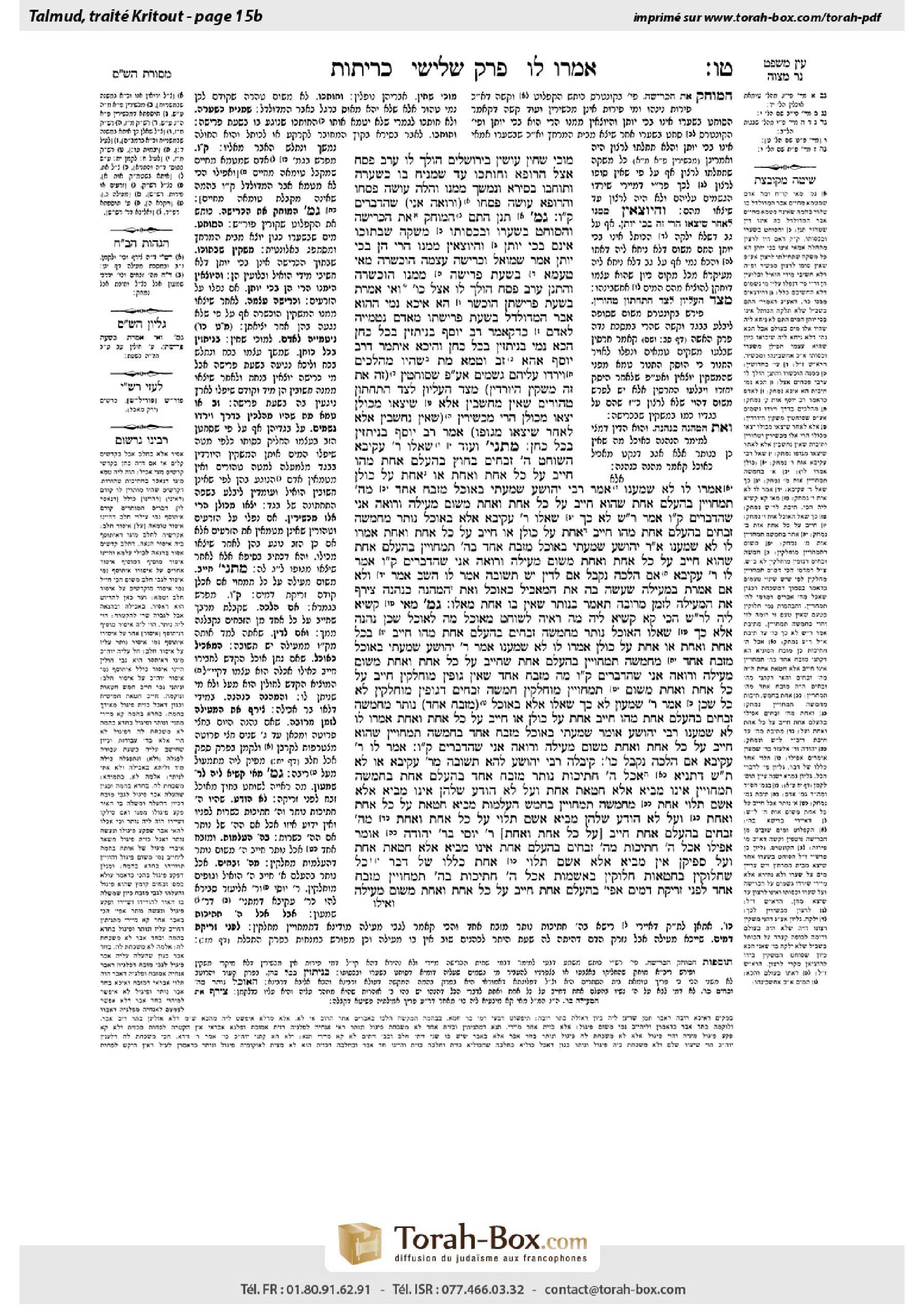
Keritot 15b: Talmud study for Daf Yomi
Daf Yomi is the daily study of one Talmud folio. Explore 37 tractates with scans, Hebrew text, Sefaria English and AI-generated French translations where annotated.
Passage selection and English or AI-generated French translation are available where the scan has annotations. Daf Study is independent of Torah-Box and Sefaria.
Browse Keritot · כריתות · All tractatesKeritot 15b text and translations
This page of Keritot includes the Aramaic text, an English translation and an AI-generated French translation, alongside the scan above.
כריתות י״ה ב · Aramaic and Hebrew text
מוּכֵּי שְׁחִין עוֹשִׂין בִּירוּשָׁלַיִם, הוֹלֵךְ לוֹ עֶרֶב פֶּסַח אֵצֶל הָרוֹפֵא, וְחוֹתְכוֹ עַד שֶׁמַּנִּיחַ בּוֹ כְּשַׂעֲרָה, וְתוֹחֲבוֹ בְּסִירָא, וְנִמְשָׁךְ מִמֶּנּוּ,
וְהַלָּה, עוֹשֶׂה פִּסְחוֹ וְהָרוֹפֵא עוֹשֶׂה פִּסְחוֹ, וְרוֹאֶה אֲנִי שֶׁהַדְּבָרִים קַל וָחוֹמֶר.
גְּמָ׳ תְּנַן הָתָם: הַמּוֹחֵק אֶת הַכְּרֵישָׁה, וְהַסּוֹחֵט בִּשְׂעָרוֹ וּבִכְסוּתוֹ – מַשְׁקִין שֶׁבְּתוֹכוֹ אֵינָם בְּ״כִי יוּתַּן״, וְהַיּוֹצְאִין מִמֶּנּוּ הֲרֵי הֵן בְּ״כִי יוּתַּן״.
אָמַר שְׁמוּאֵל: וּכְרֵישָׁה עַצְמָהּ הוּכְשְׁרָה, מַאי טַעְמָא? בִּשְׁעַת פְּרִישָׁה מִמֶּנּוּ הוּכְשְׁרָה.
וְהָתְנַן: עֶרֶב פֶּסַח הוֹלֵךְ לוֹ אֵצֶל כּוּ׳. וְאִי אָמְרַתְּ בִּשְׁעַת פְּרִישָׁתָן הוּכְשַׁר, הָא אִיכָּא נָמֵי הָהוּא אֵבֶר הַמְדוּלְדָּל, בִּשְׁעַת פְּרִישָׁתוֹ מֵאָדָם – נְטַמְּיֵיהּ לְאָדָם!
כִּדְקָאָמַר רַב יוֹסֵף: בְּנִיתָּזִין בְּכׇל כֹּחָן, הָכָא נָמֵי, בְּנִיתָּזִין בְּכׇל כֹּחָן.
וְהֵיכָא אִיתְּמַר דְּרַב יוֹסֵף? אַהָא: זָב וּטְמֵא מֵת שֶׁהָיוּ מְהַלְּכִים וְיָרְדוּ עֲלֵיהֶם גְּשָׁמִים, אַף עַל פִּי שֶׁסּוֹחֲטִין זֶה אֶת זֶה, מַשְׁקִין הַיּוֹרְדִין מִצַּד הָעֶלְיוֹן לְצַד הַתַּחְתּוֹן – טְהוֹרִים, שֶׁאֵין מְחַשְּׁבִין אֶלָּא שֶׁיָּצְאוּ מִכּוּלָּן.
יָצְאוּ מִכּוּלָּן – הֲרֵי מַכְשִׁירִין, שֶׁאֵין נֶחְשָׁבִין אֶלָּא לְאַחַר שֶׁיָּצְאוּ מִגּוּפוֹ. אָמַר רַב יוֹסֵף: בְּנִיתָּזִין בְּכׇל כֹּחָן.
מַתְנִי׳ וְעוֹד (שָׁאֲלוּ) [שְׁאֵלָן] רַבִּי עֲקִיבָא: הַשּׁוֹחֵט חֲמִשָּׁה זְבָחִים בַּחוּץ בְּהֶעְלֵם (אַחַת) [אֶחָד] מַהוּ? חַיָּיב עַל כׇּל אַחַת וְאַחַת, אוֹ אַחַת עַל כּוּלָּן? אָמְרוּ לוֹ: לֹא שָׁמַעְנוּ.
אָמַר רַבִּי יְהוֹשֻׁעַ: שָׁמַעְתִּי בְּאוֹכֵל מִזֶּבַח אֶחָד מֵחֲמִשָּׁה תַּמְחוּיִין בְּהֶעְלֵם אַחַת שֶׁהוּא חַיָּיב עַל כׇּל אַחַת וְאַחַת מִשּׁוּם מְעִילָה, וְרוֹאֶה אֲנִי שֶׁהַדְּבָרִים קַל וָחוֹמֶר.
אָמַר רַבִּי שִׁמְעוֹן: לֹא כָּךְ שָׁאַל(ו) רַבִּי עֲקִיבָא, אֶלָּא בְּאוֹכֵל נוֹתָר מֵחֲמִשָּׁה זְבָחִים בְּהֶעְלֵם (אַחַת) [אֶחָד] מַהוּ? חַיָּיב אַחַת עַל כּוּלָּן, אוֹ חַיָּיב עַל כׇּל אַחַת וְאֶחָת? אָמְרוּ לוֹ: לֹא שָׁמַעְנוּ.
אָמַר רַבִּי יְהוֹשֻׁעַ: שָׁמַעְתִּי בְּאוֹכֵל מִזֶּבַח אֶחָד בַּחֲמִשָּׁה תַּמְחוּיִין בְּהֶעְלֵם (אַחַת) [אֶחָד] שֶׁהוּא חַיָּיב עַל כׇּל אַחַת וְאַחַת מִשּׁוּם מְעִילָה, וְרוֹאֶה אֲנִי שֶׁהַדְּבָרִים קַל וָחוֹמֶר.
אָמַר לוֹ רַבִּי עֲקִיבָא: אִם הֲלָכָה – נְקַבֵּל, אִם לָדִין – יֵשׁ תְּשׁוּבָה. אָמַר לוֹ: הָשֵׁב.
אָמַר: וְלֹא אִם אָמַרְתָּ בִּמְעִילָה, שֶׁעָשָׂה בָּהּ אֶת הַמַּאֲכִיל כָּאוֹכֵל וְאֶת הַמְהַנֶּה כַּנֶּהֱנֶה,
צֵירֵף אֶת הַמְּעִילָה לִזְמַן מְרוּבֶּה, תֹּאמַר בְּנוֹתָר, שֶׁאֵין בּוֹ אַחַת מֵאֵלּוּ.
גְּמָ׳ מַאי קַשְׁיָא לֵיהּ לְרַבִּי שִׁמְעוֹן? הָכִי קָא קַשְׁיָא לֵיהּ: מָה רְאָיָה לְשׁוֹחֵט מֵאוֹכֵל? מָה לְאוֹכֵל שֶׁכֵּן נֶהֱנֶה!
אֶלָּא כָּךְ (שָׁאֲלוּ) [שְׁאֵלָן]: הָאוֹכֵל נוֹתָר מֵחֲמִשָּׁה זְבָחִים בְּהֶעְלֵם (אַחַת) [אֶחָד], מַהוּ? חַיָּיב בְּכׇל אַחַת וְאַחַת, אוֹ אַחַת עַל כּוּלָּן? אָמְרוּ לוֹ: לֹא שָׁמַעְנוּ.
אָמַר רַבִּי יְהוֹשֻׁעַ: שָׁמַעְתִּי בְּאוֹכֵל מִזֶּבַח אֶחָד מֵחֲמִשָּׁה תַּמְחוּיִין בְּהֶעְלֵם (אַחַת) [אֶחָד] שֶׁחַיָּיב עַל כׇּל אַחַת וְאַחַת מִשּׁוּם מְעִילָה, וְרוֹאֶה אֲנִי שֶׁהַדְּבָרִים קַל וָחוֹמֶר – מָה מִזֶּבַח אֶחָד שֶׁאֵין גּוּפִין מוּחְלָקִין חַיָּיב עַל כׇּל אַחַת וְאַחַת מִשּׁוּם תַּמְחוּיִין מוּחְלָקִין, חֲמִשָּׁה זְבָחִים דְּגוּפִין מוּחְלָקִין לֹא כׇּל שֶׁכֵּן?
אָמַר רַבִּי שִׁמְעוֹן: לֹא כָּךְ שָׁאַל(ו), אֶלָּא בְּאוֹכֵל (מזבח אחד) נוֹתָר מֵחֲמִשָּׁה זְבָחִים בְּהֶעְלֵם (אַחַת) [אֶחָד], מַהוּ? חַיָּיב אַחַת עַל כּוּלָּן, אוֹ חַיָּיב עַל כׇּל אַחַת וְאֶחָת? אָמְרוּ לוֹ: לֹא שָׁמַעְנוּ.
רַבִּי יְהוֹשֻׁעַ אוֹמֵר: שָׁמַעְתִּי בְּאוֹכֵל מִזֶּבַח אֶחָד בַּחֲמִשָּׁה תַּמְחוּיִין, שֶׁהוּא חַיָּיב עַל כׇּל אַחַת וְאַחַת מִשּׁוּם מְעִילָה, וְרוֹאֶה אֲנִי שֶׁהַדְּבָרִים קַל וָחוֹמֶר. אָמַר לוֹ רַבִּי עֲקִיבָא: אִם הֲלָכָה נְקַבֵּל כּוּ׳
קַיבְּלַהּ רַבִּי יְהוֹשֻׁעַ לְהָא תְּשׁוּבָה מֵרַבִּי עֲקִיבָא אוֹ לָא? תָּא שְׁמַע, דְּתַנְיָא: אָכַל חָמֵשׁ חֲתִיכוֹת נוֹתָר מִזֶּבַח אֶחָד בְּהֶעְלֵם (אַחַת) [אֶחָד] בַּחֲמִשָּׁה תַּמְחוּיִין – אֵינוֹ מֵבִיא אֶלָּא חַטָּאת אַחַת, וְעַל לֹא הוֹדַע שֶׁלָּהֶן אֵינוֹ מֵבִיא אֶלָּא אָשָׁם תָּלוּי.
מֵחֲמִשָּׁה תַּמְחוּיִין בַּחֲמִשָּׁ[ה] הֶעְלֵמוֹת – מֵבִיא חַטָּאת עַל כׇּל אַחַת וְאֶחָת, וְעַל לֹא הוֹדַע שֶׁלָּהֶן מֵבִיא אָשָׁם תָּלוּי עַל כׇּל אַחַת וְאַחַת. מֵחֲמִשָּׁה זְבָחִים בְּהֶעְלֵם (אַחַת) [אֶחָד] – חַיָּיב.
רַבִּי יוֹסֵי בְּרַבִּי יְהוּדָה אוֹמֵר: אֲפִילּוּ אָכַל חָמֵשׁ חֲתִיכוֹת מֵחֲמִשָּׁה זְבָחִים בְּהֶעְלֵם (אַחַת) [אֶחָד] – אֵינוֹ מֵבִיא אֶלָּא חַטָּאת אֶחָת, וְעַל סְפֵיקָן אֵין מֵבִיא אֶלָּא אָשָׁם תָּלוּי אֶחָד. כְּלָלוֹ שֶׁל דָּבָר: כֹּל שֶׁחֲלוּקִין בְּחַטָּאוֹת – חֲלוּקִין בַּאֲשָׁמוֹת.
אָכַל חָמֵשׁ חֲתִיכוֹת בַּחֲמִשָּׁה תַּמְחוּיִין מִזֶּבַח אֶחָד לִפְנֵי זְרִיקַת דָּמִים, אֲפִילּוּ בְּהֶעְלֵם (אַחַת) [אֶחָד] – חַיָּיב עַל כׇּל אַחַת וְאַחַת מִשּׁוּם מְעִילָה.
Keritot 15b · English translation
the people afflicted with boils, whose limbs were dangling due to their affliction, act in Jerusalem: Each of them would go on Passover eve to the doctor, who would cut the affected limb almost completely until he would leave it connected by a hairbreadth of flesh, so that neither the doctor nor the afflicted would be rendered ritually impure by a severed limb. Then, the doctor would impale the limb on a thorn attached to the floor or the wall, and the afflicted would pull away from the thorn, thereby completely severing the limb.
And that person afflicted with boils would perform the rite of his Paschal offering, and the doctor would perform the rite of his Paschal offering, as neither had come into contact with the limb once it was severed. In any case, as long as it was dangling, the limb did not impart impurity. And I consider that these matters can be derived from an a fortiori inference. If a person’s limb, the impurity of which when amputated is severe, does not impart impurity when it is dangling, it is all the more so logical that an animal’s limb, the impurity of which when amputated is lenient, does not impart impurity when it is dangling.
GEMARA: We learned in a mishna elsewhere (Makhshirin 1:5): With regard to one who forcefully wipes rainwater from the surface of a leek or squeezes out water absorbed in his hair or in his clothing, the liquid that remains within it is not included under the rubric of the verse: “If water be put upon the seed, and some of their carcass fall on it, it is impure for you” (Leviticus 11:38). Therefore, it cannot render food susceptible to contracting ritual impurity. But the liquid that is released from it, in this process of wiping or squeezing, is included under the rubric of the verse: “If water be put,” and therefore it renders any food it touches susceptible to ritual impurity, as the person has accorded it significance.
Shmuel says: And the leek itself is rendered susceptible to ritual impurity. What is the reason for this? The reason is that at the moment of the water’s separation from the leek, the leek is rendered susceptible to ritual impurity by the very water which is released from it.
The Gemara raises an objection: But we learned in the mishna: A person afflicted with boils would go on Passover eve to the doctor to sever his dangling limb, and the doctor and the afflicted individual would remain pure. And if you say that at the moment of the water’s separation from the leek, the leek is rendered susceptible to ritual impurity, there is also a parallel situation in that case of the dangling limb; at the moment of its separation from the person with boils it should render that person ritually impure.
The Gemara answers: The explanation is as Rav Yosef says in a different context, that it is referring to a situation where the liquids are removed with great force. Here too, in the case of the dangling limb, it can be explained as referring to a situation where the limbs are removed with great force. Since the limb is pulled off in one powerful motion it is not considered to have touched the person after it was detached. By contrast, the water wiped off the leek is not discharged all at once, and therefore as the drops of water separate from the leek they render it susceptible to ritual impurity.
And where, i.e., in connection to which case, was this explanation of Rav Yosef stated? It was stated with regard to this baraita: If a man who experiences a gonorrhea-like discharge [zav] and one who is ritually impure through contact with a corpse were walking along and rain fell on them, although they squeeze the garments of one another in order to remove the water, those liquids that flow down from the upper section of a garment to the lower section remain pure. They do not become impure from contact with the impure person or his garments, as these liquids are not considered liquids that can become ritually impure unless they have emerged from those garments entirely.
Once the liquids have emerged from those garments entirely they render food susceptible to ritual impurity, as the people have accorded it significance by squeezing it out of their garments. But the water itself is still not impure, as it is considered liquid that is susceptible to ritual impurity only after it has completely emerged from the body of those garments. Rav Yosef said: The reason the water does not become impure when it separates from the garment is that the baraita is referring to a case where it is removed with great force.
MISHNA: And furthermore, Rabbi Akiva asked Rabban Gamliel and Rabbi Yehoshua: With regard to one who unwittingly slaughters five offerings outside the Temple during one lapse of awareness, what is the halakha? Is he liable to bring five sin offerings, one for each and every act of slaughter, or is he liable to bring one sin offering for all the acts of slaughter? They said to Rabbi Akiva: We have not heard a ruling from our teachers in that specific case.
Rabbi Yehoshua said: I have heard with regard to one who eats meat from one offering from five different pots in which they were prepared, during one lapse of awareness, that he is liable to bring five guilt offerings, which are for the meat prepared in each and every pot, due to misuse of consecrated property. And I consider that these matters can be derived from an a fortiori inference: If one is liable to bring five guilt offerings for one offering prepared in five pots, all the more so is he liable to bring five sin offerings for slaughtering five offerings outside the Temple.
Rabbi Shimon said: It was not that question that Rabbi Akiva asked them. Rather, it was with regard to one who eats notar from five offerings during one lapse of awareness. What is the halakha? Is he liable to bring one sin offering for all the offerings from which he ate notar, or is he liable to bring five sin offerings, one for each and every one of the offerings from which he ate notar? They said to Rabbi Akiva: We have not heard a ruling from our teachers in that specific case.
Rabbi Yehoshua said: I have heard with regard to one who eats meat from one offering that was prepared in five different pots, during one lapse of awareness, that he is liable to bring separate guilt offerings for the meat prepared in each and every pot, due to misuse of consecrated property. And I consider that these matters can be derived from an a fortiori inference: If one is liable to bring five guilt offerings for one offering prepared in five pots, all the more so is he liable to bring five sin offerings for eating the notar of five separate offerings.
Rabbi Akiva said to Rabbi Yehoshua: If you are reporting a halakha that you received from your teachers with regard to one who eats notar from five offerings, we will accept it, but if it is based merely on the a fortiori inference from misuse of consecrated property, there is a response that refutes the inference. Rabbi Yehoshua said to Rabbi Akiva: Respond.
Rabbi Akiva said: And no; one cannot derive the halakha of notar through an a fortiori inference from misuse of consecrated property: If you said with regard to misuse of consecrated property that one is liable to bring five guilt offerings, perhaps that is because there are additional stringent elements unique to misuse. As, with regard to misuse, the Torah established that the status of one who feeds another person sacrificial meat is like that of one who eats sacrificial meat, and the status of one who gives benefit to another from consecrated property that is not food is like that of one who derives benefit himself, in that each is liable to bring a guilt offering for misuse.
In addition, the Torah joined the misuse of consecrated property that was performed over an extended period, i.e., if one derived benefit worth half a peruta one day and half a peruta the next, he is liable to bring a guilt offering for misuse. Would you say the same with regard to notar, which has none of these halakhot?
GEMARA: The Gemara asks: What is difficult for Rabbi Shimon with the first version of Rabbi Akiva’s question, that he insists that Rabbi Akiva had asked about one who eats notar from five offerings? The Gemara answers that this is what is difficult for him: If Rabbi Akiva asked about one who unwittingly sins by slaughtering, why is the answer derived from an unwitting sin involving eating? After all, what proof can be cited for a case of one who slaughters from a case of one who eats? What is notable about one who eats? It is notable in that he derives benefit from the act of eating, whereas one who slaughters does not derive physical benefit.
Rather, he must have asked him this: In the case of one who eats notar from five offerings during one lapse of awareness, what is the halakha? Is he liable to bring a separate sin offering for each and every one of the offerings, or only one sin offering for all of them? They said to Rabbi Akiva: We have not heard a ruling from our teachers in that specific case.
Rabbi Yehoshua said: I have heard with regard to one who eats meat from one offering from five different pots, during one lapse of awareness, that he is liable to bring a separate guilt offering for the meat prepared in each and every pot, due to misuse of consecrated property. And I consider that these matters may be derived from an a fortiori inference: Just as one who eats from one offering prepared in five pots, in which case the different parts of the offering do not come from differentiated physical entities, is liable to bring a separate guilt offering for the food prepared in each and every pot because he ate from differentiated pots, with regard to one who eats notar from five separate offerings, which are differentiated physical entities, is it not all the more so logical that he is liable to bring a separate sin offering for each and every offering?
§ The mishna teaches that Rabbi Shimon said: It was not that question that Rabbi Akiva asked them. Rather, it was with regard to one who eats notar from five offerings during one lapse of awareness. What is the halakha? Is he liable to bring one sin offering for all the offerings from which he ate notar, or is he liable to bring five sin offerings, one for each and every one of the offerings from which he ate notar? They said to Rabbi Akiva: We have not heard a ruling from our teachers in that specific case.
Rabbi Yehoshua said: I have heard with regard to one who eats meat from one offering from five different pots in which it was prepared, that he is liable to bring a separate guilt offering for the meat prepared in each and every pot, due to misuse of consecrated property. And I consider that these matters may be derived from an a fortiori inference. Rabbi Akiva said to Rabbi Yehoshua: If you are reporting a halakha that you received from your teachers with regard to one who eats notar from five offerings we will accept it, but if it is based on the a fortiori logical inference from misuse of consecrated property there is a response that refutes the inference.
The Gemara asks: Did Rabbi Yehoshua accept that refutation from Rabbi Akiva or not? The Gemara answers: Come and hear a proof in this regard, as it is taught in a baraita: If one ate five pieces of notar from one offering during one lapse of awareness, and the pieces were cooked in five different pots, he brings only one sin offering. And in a situation where it is not known to him with certainty whether he unwittingly ate from them, he brings only one provisional guilt offering, which is sacrificed by one who is uncertain whether he committed a sin that renders him liable to bring a sin offering.
By contrast, if one ate notar from a single offering from five different pots during five separate lapses of awareness he brings a sin offering for each and every one, and in a situation where it is not known to him with certainty whether he unwittingly ate from them he brings a provisional guilt offering for each and every one. If he ate notar from five separate offerings during one lapse of awareness he is liable to bring a separate sin offering for each one, as he ate from differentiated physical entities.
Rabbi Yosei, son of Rabbi Yehuda, says: Even if he ate five pieces of notar from five separate offerings during one lapse of awareness he brings only one sin offering, as he transgressed one prohibition repeatedly during a single lapse of awareness. And if he is uncertain whether he unwittingly ate from them he brings only a single provisional guilt offering. The principle of the matter is that in any situation where one’s transgressions are differentiated with regard to sin offerings, i.e., when he is liable to bring multiple sin offerings if he knows that he unwittingly transgressed, they are differentiated with regard to provisional guilt offerings if he is unsure whether he unwittingly transgressed.
If one ate five pieces of meat prepared in five separate pots from a single offering before the meat became permitted for consumption through the sprinkling of the blood on the altar, even if this occurred during a single lapse of awareness, he is liable to bring a separate guilt offering for the meat from each and every pot, due to misuse of consecrated property.
Keritot 15b · Traduction française (IA)
Les personnes atteintes de furoncles, dont les membres pendaient à cause de leur affection, agissaient ainsi à Jérusalem : chacune se rendait, la veille de Pessa'h, chez le médecin, qui coupait le membre atteint presque entièrement, jusqu'à ne le laisser attaché que par un filament de chair, afin que ni le médecin ni la personne atteinte ne deviennent rituellement impurs à cause d'un membre sectionné. Ensuite, le médecin empalait le membre sur une épine fixée au sol ou au mur, et la personne atteinte s'écartait de l'épine, sectionnant ainsi complètement le membre.
Cette personne atteinte de furoncles accomplissait alors le rite de son offrande pascale, et le médecin accomplissait celui de son offrande pascale, car aucun des deux n'avait touché le membre une fois celui-ci sectionné. En tout état de cause, tant qu'il pendait, le membre ne transmettait pas l'impureté. Et j'estime que ces choses peuvent être déduites par raisonnement a fortiori : si le membre d'une personne, dont l'impureté après amputation est grave, ne transmet pas l'impureté lorsqu'il pend, à plus forte raison le membre d'un animal, dont l'impureté après amputation est moindre, ne transmet-il pas l'impureté lorsqu'il pend.
GUEMARA : Nous avons appris dans une Michna ailleurs (Makhshirin 1:5) : Celui qui essuie avec force l'eau de pluie à la surface d'un poireau, ou exprime l'eau absorbée par ses cheveux ou ses vêtements, ne considère pas le liquide qui reste à l'intérieur comme relevant du verset : « Si de l'eau est mise sur la semence et qu'une partie de leur carcasse tombe dessus, elle sera impure pour vous » (Lévitique 11:38). Ce liquide ne peut donc pas rendre un aliment susceptible de contracter l'impureté rituelle. En revanche, le liquide qui en est extrait lors de cet essuyage ou de cette pression relève du verset : « Si de l'eau est mise », et rend donc tout aliment qu'il touche susceptible de contracter l'impureté rituelle, car la personne lui a conféré de l'importance.
Chemouel dit : le poireau lui-même devient susceptible de contracter l'impureté rituelle. Pour quelle raison ? Parce qu'au moment où l'eau se sépare du poireau, celui-ci devient susceptible de contracter l'impureté rituelle par cette même eau qui en est extraite.
La Guemara soulève une objection : mais nous avons appris dans la Michna qu'une personne atteinte de furoncles se rendait, la veille de Pessa'h, chez le médecin pour qu'il sectionne son membre pendant, et que le médecin ainsi que la personne atteinte restaient purs. Or, si tu dis qu'au moment où l'eau se sépare du poireau, celui-ci devient susceptible de contracter l'impureté rituelle, il en va de même dans le cas du membre pendant : au moment où il se sépare de la personne atteinte de furoncles, il devrait rendre cette personne rituellement impure.
La Guemara répond : l'explication est celle que Rav Yossef donne dans un autre contexte : il s'agit d'une situation où les liquides sont retirés avec une grande force. Ici aussi, dans le cas du membre pendant, on peut expliquer qu'il s'agit d'une situation où le membre est retiré avec une grande force. Puisque le membre est arraché d'un seul mouvement puissant, on considère qu'il n'a pas touché la personne après avoir été détaché. En revanche, l'eau essuyée du poireau ne s'écoule pas d'un seul coup ; ainsi, au fur et à mesure que les gouttes d'eau se séparent du poireau, elles le rendent susceptible de contracter l'impureté rituelle.
Et dans quel contexte, c'est-à-dire à propos de quel cas, cette explication de Rav Yossef a-t-elle été donnée ? Elle a été donnée au sujet de cette baraïta : si un homme atteint d'un écoulement semblable à la gonorrhée [zav] et un homme rituellement impur par contact avec un cadavre marchaient ensemble et que la pluie tombait sur eux, bien qu'ils essorent les vêtements l'un de l'autre pour en retirer l'eau, les liquides qui s'écoulent de la partie supérieure d'un vêtement vers sa partie inférieure restent purs. Ils ne deviennent pas impurs au contact de la personne impure ou de ses vêtements, car ces liquides ne sont pas considérés comme des liquides susceptibles de devenir rituellement impurs tant qu'ils ne sont pas entièrement sortis de ces vêtements.
Une fois que les liquides sont entièrement sortis de ces vêtements, ils rendent un aliment susceptible de contracter l'impureté rituelle, car les personnes leur ont conféré de l'importance en les exprimant de leurs vêtements. Mais l'eau elle-même n'est toujours pas impure, car elle n'est considérée comme un liquide susceptible de contracter l'impureté rituelle qu'après être entièrement sortie du corps de ces vêtements. Rav Yossef dit : si l'eau ne devient pas impure lorsqu'elle se sépare du vêtement, c'est parce que la baraïta parle d'un cas où elle en est retirée avec une grande force.
MICHNA : Et de plus, Rabbi Akiva demanda à Rabban Gamliel et à Rabbi Yehoshoua : quel est le statut de celui qui, par inadvertance, égorge cinq sacrifices hors du Temple au cours d'une seule période d'inattention ? Doit-il apporter cinq sacrifices expiatoires, un pour chaque acte d'égorgement, ou un seul sacrifice expiatoire pour l'ensemble des égorgements ? Ils répondirent à Rabbi Akiva : nous n'avons pas entendu de décision de nos maîtres concernant précisément ce cas.
Rabbi Yehoshoua dit : j'ai entendu, au sujet de celui qui mange, au cours d'une seule période d'inattention, de la viande provenant d'un sacrifice répartie dans cinq marmites où elle a été préparée, qu'il doit apporter cinq sacrifices de culpabilité, un pour la viande préparée dans chacune des marmites, pour détournement d'un bien consacré. Et j'estime que ces choses peuvent être déduites par raisonnement a fortiori : si l'on doit apporter cinq sacrifices de culpabilité pour un seul sacrifice préparé dans cinq marmites, à plus forte raison doit-on apporter cinq sacrifices expiatoires pour avoir égorgé cinq sacrifices hors du Temple.
Rabbi Chim'on dit : ce n'est pas cette question que Rabbi Akiva leur a posée. Il s'agissait plutôt de celui qui mange du notar provenant de cinq sacrifices au cours d'une seule période d'inattention. Quel est son statut ? Doit-il apporter un seul sacrifice expiatoire pour tous les sacrifices dont il a mangé le notar, ou cinq sacrifices expiatoires, un pour chacun des sacrifices dont il a mangé le notar ? Ils répondirent à Rabbi Akiva : nous n'avons pas entendu de décision de nos maîtres concernant précisément ce cas.
Rabbi Yehoshoua dit : j'ai entendu, au sujet de celui qui mange, au cours d'une seule période d'inattention, de la viande provenant d'un seul sacrifice préparée dans cinq marmites différentes, qu'il doit apporter des sacrifices de culpabilité distincts pour la viande préparée dans chacune des marmites, pour détournement d'un bien consacré. Et j'estime que ces choses peuvent être déduites par raisonnement a fortiori : si l'on doit apporter cinq sacrifices de culpabilité pour un seul sacrifice préparé dans cinq marmites, à plus forte raison doit-on apporter cinq sacrifices expiatoires pour avoir mangé le notar de cinq sacrifices distincts.
Rabbi Akiva dit à Rabbi Yehoshoua : si tu rapportes une halakha que tu as reçue de tes maîtres au sujet de celui qui mange du notar provenant de cinq sacrifices, nous l'accepterons ; mais si cela repose seulement sur un raisonnement a fortiori tiré du détournement d'un bien consacré, il existe une objection qui réfute cette déduction. Rabbi Yehoshoua dit à Rabbi Akiva : Réponds.
Rabbi Akiva dit : Non, on ne peut pas déduire la halakha du notar par raisonnement a fortiori à partir du détournement d'un bien consacré. Si tu dis qu'en matière de détournement d'un bien consacré, on doit apporter cinq sacrifices de culpabilité, peut-être est-ce parce que le détournement comporte des aspects supplémentaires particulièrement rigoureux. En effet, concernant le détournement, la Torah a établi que celui qui nourrit autrui de viande sacrificielle est considéré comme celui qui mange lui-même de la viande sacrificielle, et que celui qui procure à autrui un avantage tiré d'un bien consacré non alimentaire est considéré comme celui qui en tire lui-même avantage ; dans chacun de ces cas, il doit apporter un sacrifice de culpabilité pour détournement.
De plus, la Torah a regroupé les actes de détournement d'un bien consacré accomplis sur une période prolongée : si quelqu'un tire un avantage d'une valeur d'une demi-prouta un jour, puis d'une demi-prouta le lendemain, il doit apporter un sacrifice de culpabilité pour détournement. En dirais-tu autant du notar, auquel aucune de ces halakhot ne s'applique ?
GUEMARA : La Guemara demande : qu'est-ce qui gêne Rabbi Chim'on dans la première version de la question de Rabbi Akiva, au point qu'il insiste sur le fait que Rabbi Akiva avait interrogé au sujet de celui qui mange du notar provenant de cinq sacrifices ? La Guemara répond que voici ce qui le gêne : si Rabbi Akiva a posé une question sur celui qui commet involontairement une faute en égorgeant, pourquoi la réponse est-elle tirée d'une faute involontaire impliquant le fait de manger ? Après tout, quelle preuve peut-on tirer du cas de celui qui égorge à partir de celui qui mange ? Qu'y a-t-il de particulier dans le cas de celui qui mange ? C'est qu'il tire avantage de l'acte de manger, tandis que celui qui égorge n'en tire aucun avantage physique.
Il faut donc qu'il lui ait demandé ceci : dans le cas de celui qui mange du notar provenant de cinq sacrifices au cours d'une seule période d'inattention, quel est le statut ? Doit-il apporter un sacrifice expiatoire distinct pour chacun des sacrifices, ou un seul sacrifice expiatoire pour l'ensemble ? Ils répondirent à Rabbi Akiva : nous n'avons pas entendu de décision de nos maîtres concernant précisément ce cas.
Rabbi Yehoshoua dit : j'ai entendu, au sujet de celui qui mange, au cours d'une seule période d'inattention, de la viande provenant d'un seul sacrifice répartie dans cinq marmites différentes, qu'il doit apporter un sacrifice de culpabilité distinct pour la viande préparée dans chacune des marmites, pour détournement d'un bien consacré. Et j'estime que ces choses peuvent être déduites par raisonnement a fortiori : de même que celui qui mange d'un seul sacrifice préparé dans cinq marmites — dont les différentes parts ne proviennent pas d'entités physiques distinctes — doit apporter un sacrifice de culpabilité distinct pour la nourriture préparée dans chacune des marmites, parce qu'il a mangé dans des marmites distinctes, celui qui mange du notar provenant de cinq sacrifices distincts, qui sont des entités physiques distinctes, ne doit-il pas, à plus forte raison, apporter un sacrifice expiatoire distinct pour chacun des sacrifices ?
§ La Michna enseigne que Rabbi Chim'on a dit : ce n'est pas cette question que Rabbi Akiva leur a posée. Il s'agissait plutôt de celui qui mange du notar provenant de cinq sacrifices au cours d'une seule période d'inattention. Quel est son statut ? Doit-il apporter un seul sacrifice expiatoire pour tous les sacrifices dont il a mangé le notar, ou cinq sacrifices expiatoires, un pour chacun des sacrifices dont il a mangé le notar ? Ils répondirent à Rabbi Akiva : nous n'avons pas entendu de décision de nos maîtres concernant précisément ce cas.
Rabbi Yehoshoua dit : j'ai entendu, au sujet de celui qui mange de la viande provenant d'un seul sacrifice répartie dans cinq marmites différentes où elle a été préparée, qu'il doit apporter un sacrifice de culpabilité distinct pour la viande préparée dans chacune des marmites, pour détournement d'un bien consacré. Et j'estime que ces choses peuvent être déduites par raisonnement a fortiori. Rabbi Akiva dit à Rabbi Yehoshoua : si tu rapportes une halakha que tu as reçue de tes maîtres au sujet de celui qui mange du notar provenant de cinq sacrifices, nous l'accepterons ; mais si cela repose sur un raisonnement logique a fortiori tiré du détournement d'un bien consacré, il existe une objection qui réfute cette déduction.
La Guemara demande : Rabbi Yehoshoua a-t-il accepté ou non cette réfutation de Rabbi Akiva ? La Guemara répond : viens entendre une preuve à cet égard, car il est enseigné dans une baraïta : si quelqu'un a mangé cinq morceaux de notar provenant d'un seul sacrifice au cours d'une seule période d'inattention, et que ces morceaux ont été cuits dans cinq marmites différentes, il n'apporte qu'un seul sacrifice expiatoire. Et si la personne n'est pas certaine de les avoir mangés par inadvertance, elle n'apporte qu'un seul sacrifice de culpabilité provisoire, offert par celui qui doute d'avoir commis une faute l'obligeant à apporter un sacrifice expiatoire.
En revanche, si quelqu'un a mangé du notar provenant d'un seul sacrifice, préparé dans cinq marmites différentes, au cours de cinq périodes distinctes d'inattention, il apporte un sacrifice expiatoire pour chacun des cas ; et si la personne n'est pas certaine de l'avoir mangé par inadvertance, elle apporte un sacrifice de culpabilité provisoire pour chacun des cas. S'il a mangé du notar provenant de cinq sacrifices distincts au cours d'une seule période d'inattention, il doit apporter un sacrifice expiatoire distinct pour chacun, car il a mangé de produits provenant d'entités physiques distinctes.
Rabbi Yossi, fils de Rabbi Yehouda, dit : même s'il a mangé cinq morceaux de notar provenant de cinq sacrifices distincts au cours d'une seule période d'inattention, il n'apporte qu'un seul sacrifice expiatoire, car il a transgressé une même interdiction à plusieurs reprises pendant une seule période d'inattention. Et s'il doute de les avoir mangés par inadvertance, il n'apporte qu'un seul sacrifice de culpabilité provisoire. Le principe est le suivant : dans toute situation où les transgressions sont distinctes quant aux sacrifices expiatoires — c'est-à-dire lorsqu'il doit apporter plusieurs sacrifices expiatoires s'il sait qu'il a transgressé par inadvertance —, elles sont distinctes également quant aux sacrifices de culpabilité provisoires s'il doute d'avoir transgressé par inadvertance.
Si quelqu'un a mangé cinq morceaux de viande préparés dans cinq marmites distinctes, provenant d'un seul sacrifice, avant que la viande soit autorisée à la consommation par l'aspersion du sang sur l'autel, même si cela s'est produit au cours d'une seule période d'inattention, il doit apporter un sacrifice de culpabilité distinct pour la viande de chacune des marmites, pour détournement d'un bien consacré.
Traduction française générée par IA à partir de l’édition anglaise de Sefaria. Vérifie toujours un passage avec le texte source.
Text from Sefaria: William Davidson Edition - Vocalized Aramaic (CC BY NC); William Davidson Edition - English (CC BY NC).