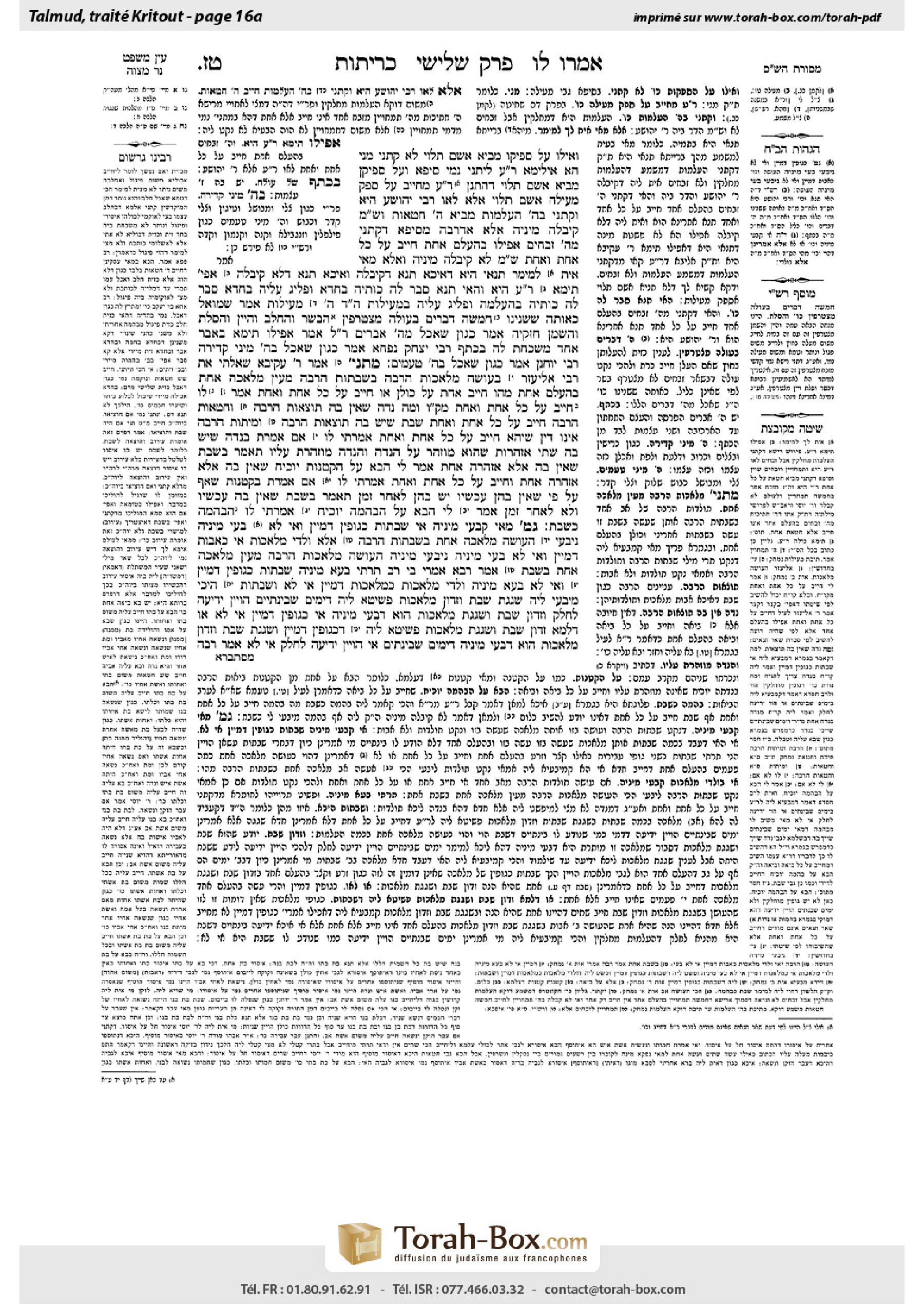
Keritot 16a: Talmud study for Daf Yomi
Daf Yomi is the daily study of one Talmud folio. Explore 37 tractates with scans, Hebrew text, Sefaria English and AI-generated French translations where annotated.
Passage selection and English or AI-generated French translation are available where the scan has annotations. Daf Study is independent of Torah-Box and Sefaria.
Browse Keritot · כריתות · All tractatesKeritot 16a text and translations
This page of Keritot includes the Aramaic text, an English translation and an AI-generated French translation, alongside the scan above.
כריתות י״ו א · Aramaic and Hebrew text
וְאִילּוּ עַל סְפֵיקוֹ, מֵבִיא אָשָׁם תָּלוּי לָא קָתָנֵי. מַנִּי הָא? אִילֵימָא רַבִּי עֲקִיבָא, לִיתְנֵי נָמֵי סֵיפָא: ״וְעַל סְפֵיקָן מֵבִיא אָשָׁם תָּלוּי״, דְּהָתְנַן: רַבִּי עֲקִיבָא מְחַיֵּיב עַל סְפֵק מְעִילָה אָשָׁם תָּלוּי!
אֶלָּא לָאו רַבִּי יְהוֹשֻׁעַ הִיא, וְקָתָנֵי: ״בַּחֲמִשָּׁה הֶעְלֵמוֹת – מֵבִיא חָמֵשׁ חַטָּאוֹת״, וּשְׁמַע מִינַּהּ: קַיבְּלַהּ מִינֵּיהּ!
אֶלָּא אַדְּרַבָּה, מִסֵּיפָא, דְּקָתָנֵי: מֵחֲמִשָּׁה זְבָחִים אֲפִילּוּ בְּהֶעְלֵם (אַחַת) [אֶחָד] – חַיָּיב עַל כׇּל אַחַת וְאֶחָת, שְׁמַע מִינַּהּ: לָא קַיבְּלַהּ מִינֵּיהּ!
וְאֶלָּא מַאי אִית [לָךְ] לְמֵימַר, תַּנָּאֵי הִיא, דְּאִיכָּא תַּנָּא דְּקַיבְּלַהּ וְאִיכָּא תַּנָּא דְּלָא קַיבְּלַהּ?
אֲפִילּוּ תֵּימָא רַבִּי עֲקִיבָא הִיא, וְהַאי תַּנָּא סָבַר לַהּ כְּוָתֵיהּ בַּחֲדָא וּפְלִיג עֲלֵיהּ בַּחֲדָא, סָבַר לַהּ כְּוָתֵיהּ בְּהַעֲלָמָה, וּפְלִיג עֲלֵיהּ בִּמְעִילוֹת.
הֵיכִי דָמֵי חָמֵשׁ מְעִילוֹת? אָמַר שְׁמוּאֵל: כְּאוֹתָהּ שֶׁשָּׁנִינוּ: חֲמִשָּׁה דְּבָרִים בָּעוֹלָה מִצְטָרְפִין: הַבָּשָׂר, וְהֶחָלָב, וְהַיַּיִן, וְהַסֹּלֶת, וְהַשֶּׁמֶן.
חִזְקִיָּה אָמַר: כְּגוֹן שֶׁאָכַל מֵחֲמִשָּׁה אֵבָרִים. רֵישׁ לָקִישׁ אָמַר: אֲפִילּוּ תֵּימָא בְּאֵבֶר אֶחָד, מַשְׁכַּחַתְּ לַהּ בְּכָתֵף. רַבִּי יִצְחָק נַפָּחָא אָמַר: כְּגוֹן שֶׁאָכַל בַּחֲמִשָּׁה מִינֵי קְדֵירָה. רַבִּי יוֹחָנָן אָמַר: כְּגוֹן שֶׁאָכַל בַּחֲמִשָּׁה טְעָמִים.
מַתְנִי׳ אָמַר רַבִּי עֲקִיבָא: שָׁאַלְתִּי אֶת רַבִּי אֱלִיעֶזֶר בְּעוֹשֶׂה מְלָאכוֹת הַרְבֵּה בְּשַׁבָּתוֹת הַרְבֵּה מֵעֵין מְלָאכָה אַחַת בְּהֶעְלֵם (אַחַת) [אֶחָד], מַהוּ? חַיָּיב אַחַת עַל כּוּלָּן, אוֹ חַיָּיב עַל כׇּל אַחַת וְאֶחָת?
אָמַר לוֹ: חַיָּיב עַל כׇּל אַחַת וְאַחַת, מִקַּל וָחוֹמֶר, וּמָה נִדָּה שֶׁאֵין בָּהּ תּוֹצָאוֹת הַרְבֵּה וְחַטָּאוֹת הַרְבֵּה – חַיָּיב עַל כׇּל אַחַת וְאֶחָת, שַׁבָּת שֶׁיֵּשׁ בָּהּ תּוֹצָאוֹת הַרְבֵּה וּמִיתוֹת הַרְבֵּה – אֵינוֹ דִּין שֶׁיְּהֵא חַיָּיב עַל כׇּל אַחַת וְאֶחָת?
אָמַרְתִּי לוֹ: אִם אָמַרְתָּ בַּנִּדָּה שֶׁיֵּשׁ בָּהּ שְׁתֵּי אַזְהָרוֹת, שֶׁהוּא מוּזְהָר עַל הַנִּדָּה וְהַנִּדָּה מוּזְהֶרֶת עָלָיו, תֹּאמַר בַּשַּׁבָּת, שֶׁאֵין בָּהּ אֶלָּא אַזְהָרָה אֶחָת!
אָמַר לִי: הַבָּא עַל הַקְּטַנּוֹת יוֹכִיחַ, שֶׁאֵין בָּהּ אֶלָּא אַזְהָרָה אַחַת, וְחַיָּיב עַל כׇּל אַחַת וְאֶחָת!
אָמַרְתִּי לוֹ: אִם אָמַרְתָּ בַּקְּטַנּוֹת, שֶׁאַף עַל פִּי שֶׁאֵין בָּהֶן עַכְשָׁיו – יֵשׁ בָּהֶן לְאַחַר זְמַן, תֹּאמַר בַּשַּׁבָּת, שֶׁאֵין בָּהּ עַכְשָׁיו וְלֹא לְאַחַר זְמַן?
אָמַר לִי: הַבָּא עַל הַבְּהֵמָה יוֹכִיחַ! אָמַרְתִּי לוֹ: הַבְּהֵמָה כַּשַּׁבָּת.
גְּמָ׳ מַאי קָבָעֵי מִינֵּיהּ? אִי שַׁבָּתוֹת כְּגוּפִין דָּמְיָין וְאִי לָא בָּעֵי מִינֵּיהּ, נִיבְעֵי: הָעוֹשֶׂה מְלָאכָה אַחַת בְּשַׁבָּתוֹת הַרְבֵּה!
אֶלָּא: וַלְדֵי מְלָאכוֹת אִי כְּאָבוֹת דָּמְיָין וְאִי לָא בָּעֵי מִינֵּיהּ, נִיבְעֵי מִינֵּיהּ: הָעוֹשֶׂה מְלָאכוֹת הַרְבֵּה מֵעֵין מְלָאכָה אַחַת בַּשַּׁבָּת!
אָמַר רָבָא: אָמְרִי בֵּי רַב, תַּרְתֵּי בְּעָא מִינֵּיהּ: שַׁבָּתוֹת כְּגוּפִין דָּמְיָין וְאִי לָא בְּעָא מִינֵּיהּ, וַלְדֵי מְלָאכוֹת כִּמְלָאכוֹת דָּמְיָין אִי לָא.
וְשַׁבָּתוֹת, הֵיכִי מִיבְּעֵי לֵיהּ? שִׁגְגַת שַׁבָּת וּזְדוֹן מְלָאכוֹת – פְּשִׁיטָא לֵיהּ דְּיָמִים שֶׁבֵּינְתַיִים הָוְיָין יְדִיעָה לְחַלֵּק,
וּזְדוֹן שַׁבָּת וְשִׁגְגַת מְלָאכוֹת הוּא דְּבָעֵי מִינֵּיהּ, אִי כְּגוּפִין דָּמְיָין אִי לָא,
אוֹ דִלְמָא, זְדוֹן שַׁבָּת וְשִׁגְגַת מְלָאכוֹת – פְּשִׁיטָא לֵיהּ דִּכְגוּפִין דָּמְיָין, וְשִׁגְגַת שַׁבָּת וּזְדוֹן מְלָאכוֹת הוּא דְּבָעֵי מִינֵּיהּ, דְּיָמִים שֶׁבֵּינָתַיִם אִי הָוְיָין יְדִיעָה לְחַלֵּק אִי לָא?
אָמַר רַבָּה:
Keritot 16a · English translation
The Gemara notes: And yet in the final case in the baraita, it does not teach that in a situation where he is uncertain whether he ate from it he brings a provisional guilt offering. Whose opinion is this? If we say it is the opinion of Rabbi Akiva, let him also teach in the last clause: For a case where he is uncertain whether he ate from them he brings a provisional guilt offering, as we learned in the mishna (22b) that Rabbi Akiva deems one liable to bring a provisional guilt offering for uncertainty about misuse of consecrated property.
Rather, isn’t the baraita in accordance with the opinion of Rabbi Yehoshua, who disagrees with the opinion of Rabbi Akiva and holds that one is not liable to bring a provisional guilt offering for uncertainty about misuse of consecrated property? And it teaches that one who eats notar from one offering cooked in five pots during five separate lapses of awareness brings five sin offerings, which indicates that if he did so during a single lapse of awareness he would be liable to bring only one sin offering, in accordance with the opinion stated by Rabbi Akiva in the mishna. And one can conclude from here that Rabbi Yehoshua accepted the refutation from Rabbi Akiva.
The Gemara responds: But on the contrary, one can infer otherwise from the latter clause of the baraita, which teaches: If he ate from five separate offerings, even during one lapse of awareness, he is liable to bring a separate sin offering for each and every one. One can conclude from this statement that Rabbi Yehoshua did not accept the refutation from Rabbi Akiva.
Rather, what is there to say about this baraita? It must be said that it is a dispute between tanna’im, that there is a tanna who maintains that Rabbi Yehoshua accepted Rabbi Akiva’s refutation, and there is a tanna who maintains that Rabbi Yehoshua did not accept it.
But once the baraita is interpreted in accordance with two different tanna’im, you may even say that the earlier clause of the baraita is in accordance with the opinion of Rabbi Akiva and not Rabbi Yehoshua. And this tanna of the baraita holds in accordance with the opinion of Rabbi Akiva in one matter and disagrees with his opinion in one matter: He holds in accordance with the opinion of Rabbi Akiva with regard to a lapse of awareness, that if one eats from five offerings during a single lapse of awareness he is liable to bring only one sin offering. But he disagrees with his opinion with regard to misuse of consecrated property, as he does not deem one liable to bring a provisional guilt offering for uncertainty about whether he misused consecrated property.
§ The mishna teaches that if one eats five pieces from a single offering, each of which was cooked in a separate pot, he is liable to bring five guilt offerings for misuse of consecrated property. The Gemara asks: What are the circumstances which require five guilt offerings for misuse of consecrated property? Shmuel says: The five pieces must be from separate parts of the offering, like that which we learned in a mishna (Me’ila 15b) with regard to a different topic: Five items from a burnt offering combine to form an olive-bulk that renders one liable for sacrificing an offering outside the Temple: The meat, and the forbidden fat, and the wine from the libations of the burnt offering, and the fine flour from the meal offering brought with the libations, and the oil for mixing with the meal offering.
Ḥizkiyya says: The obligation to bring five guilt offerings applies in a case where he ate from five different limbs of one offering. Reish Lakish says: You may even say that he ate from one limb, and you find this in a case where he ate from the shoulder of an offering, which has several different sections. Rabbi Yitzḥak Nappaḥa says: It applies in a case where he ate pieces of meat prepared as five different types of cooked dishes. Rabbi Yoḥanan says: It applies in a case where he ate five pieces of meat that had five different flavors, as they were prepared with different types of seasonings.
MISHNA: Rabbi Akiva said: I asked Rabbi Eliezer with regard to one who performs multiple prohibited labors on several Shabbatot, and all those labors were subsumed as subcategories of one primary category of prohibited labor, and he performed them during one lapse of awareness. What is the halakha? Is he liable to bring one sin offering for unwitting performance of all these labors or is he liable to bring a sin offering for violation of each and every one of the labors?
Rabbi Eliezer said to Rabbi Akiva: He is liable to bring a sin offering for violation of each and every one of the labors, and this is derived from an a fortiori inference: Just as in the case of a menstruating woman, with regard to whom there are not multiple actions that result in transgression and that result in multiple sin offerings, but rather only the prohibition against engaging in intercourse with her, and nevertheless one is liable to bring a separate sin offering for each and every one of his acts of unwitting intercourse; in the case of Shabbat, with regard to which there are multiple primary categories and subcategories of labor that result in transgression and that result in multiple death penalties or sin offerings, is it not right that he will be liable to bring a sin offering for performance of each and every one of the prohibited labors?
Rabbi Akiva continues: I said to Rabbi Eliezer that the inference is not valid: If you said one is liable to bring multiple sin offerings in the case of a menstruating woman, with regard to whom there are two prohibitions, as the man is prohibited from engaging in intercourse with the menstruating woman and the menstruating woman is prohibited from engaging in intercourse with him, would you say the same in the case of Shabbat, with regard to which there is only one prohibition?
Rabbi Eliezer said to me: The halakha of one who engages in intercourse with minor menstruating girls will prove this refutation is not valid, as in that case there is only one prohibition, because the minor is exempt from the mitzvot, and nevertheless the man is liable to bring a separate sin offering for intercourse for each and every one of the acts of intercourse.
Rabbi Akiva said: I said to Rabbi Eliezer that the cases of Shabbat and minor menstruating girls are not comparable. If you said in the case of minor girls that although it is not prohibited for them at present it is prohibited for them after the passage of time, when they reach majority, would you say the same in the case of Shabbat, with regard to which there are neither two prohibitions at present, nor will there be after the passage of time?
Rabbi Eliezer said to me: The halakha of one who copulates with an animal will prove this refutation is not valid, as there are never two prohibitions in that case, and nevertheless the person is liable to bring a sin offering for each and every act. Rabbi Akiva said: I said to Rabbi Eliezer that no proof can be cited from the case of an animal, as in my opinion the case of the animal is like that of Shabbat; there is uncertainty with regard to both cases.
GEMARA: The Gemara asks: What precise dilemma did Rabbi Akiva raise before Rabbi Eliezer? If he raised a dilemma about whether different Shabbatot are comparable to separate entities or not, i.e., if performing one labor on several Shabbatot during one lapse of awareness is similar to engaging in intercourse with multiple menstruating women during one lapse of awareness, let him raise the dilemma as follows: If one performs one prohibited labor on each of several Shabbatot during a single lapse of awareness, what is the halakha?
Rather, perhaps he raised a dilemma about whether different subcategories of a single prohibited labor are comparable to different primary categories, which would mean one is liable separately for each, or not. But if so, let him ask raise the dilemma in the following manner: In the case of one who performs multiple prohibited labors, all subsumed as subcategories of one primary category of labor, on a single Shabbat, during a single lapse of awareness, what is the halakha? Why did Rabbi Akiva specify a case of one who performed multiple prohibited labors on multiple Shabbatot?
Rava said: They say in the school of Rav [bei Rav] that Rabbi Akiva raised two dilemmas before him: He raised a dilemma about whether Shabbatot are comparable to separate entities or whether they are not comparable to separate entities, and he also raised a dilemma about whether different subcategories of a single prohibited labor are comparable to different primary categories of labor, or whether they are not. Rabbi Eliezer answered that multiple Shabbatot are comparable to separate entities, and that one who performs different subcategories of a single category of prohibited labor is like one who performs multiple primary categories of labor.
The Gemara raises another question with regard to the mishna: And in connection to the performance of the same category of prohibited labor on each of several Shabbatot during a single lapse of awareness, what is the precise case about which Rabbi Akiva raises his dilemma? If the individual was unwitting in that he was unaware that it was Shabbat but acted intentionally with regard to the prohibited labors, i.e., he knew that these labors are prohibited on Shabbat, perhaps it is obvious to Rabbi Akiva that the intervening days constitute an awareness of his sin, which serves to differentiate between the Shabbatot and render the individual liable to bring separate sin offerings for each Shabbat.
And if so, it is in reference to a case where the individual acts intentionally with regard to Shabbat, i.e., he knows that it is Shabbat, but he acts unwittingly in that he does not know that the prohibited labors he is performing are prohibited on Shabbat, that Rabbi Akiva raises his dilemma. His dilemma is whether the Shabbatot are comparable to separate entities, which would mean that he is liable to bring a separate sin offering for each Shabbat, or whether they are not comparable to separate entities and therefore he is liable to bring only one sin offering.
Or perhaps in the case where he acts intentionally with regard to Shabbat and unwittingly with regard to prohibited labors, it is obvious to Rabbi Akiva that the Shabbatot are comparable to separate entities and he is liable to bring a separate sin offering for each Shabbat. And it is in reference to a case where he acts unwittingly in that he does not know it is Shabbat, but he acts intentionally in that he knows that the labors he is performing are prohibited on Shabbat, that Rabbi Akiva raises his dilemma. His dilemma is whether the intervening days between the Shabbatot are considered awareness of his sin, which would serve to differentiate between one sin and the next, or not.
Rabba said:
Keritot 16a · Traduction française (IA)
La Guemara fait remarquer : Pourtant, dans le dernier cas de la baraïta, elle n’enseigne pas que celui qui doute d’avoir mangé de cette offrande apporte un sacrifice de culpabilité provisoire. De qui est-ce l’avis ? Si l’on dit que c’est celui de Rabbi Akiva, qu’elle enseigne aussi dans la dernière partie : Celui qui doute d’avoir mangé de ces offrandes apporte un sacrifice de culpabilité provisoire, comme nous l’avons appris dans la Michna (22b) : Rabbi Akiva estime que celui qui doute d’avoir détourné un bien consacré est tenu d’apporter un sacrifice de culpabilité provisoire.
Mais n’est-ce pas plutôt que la baraïta suit l’avis de Rabbi Yehoshua, qui s’oppose à celui de Rabbi Akiva et estime qu’on n’est pas tenu d’apporter un sacrifice de culpabilité provisoire lorsqu’on doute d’avoir détourné un bien consacré ? Elle enseigne que celui qui mange du notar provenant d’une seule offrande, cuite dans cinq marmites, au cours de cinq défaillances de conscience distinctes, apporte cinq sacrifices expiatoires. Cela indique que s’il l’avait fait au cours d’une seule défaillance de conscience, il n’aurait été tenu d’apporter qu’un seul sacrifice expiatoire, conformément à l’avis exprimé par Rabbi Akiva dans la Michna. On peut donc conclure que Rabbi Yehoshua a accepté la réfutation de Rabbi Akiva.
La Guemara répond : Mais, au contraire, on peut déduire le contraire de la dernière partie de la baraïta, qui enseigne : S’il a mangé de cinq offrandes distinctes, même au cours d’une seule défaillance de conscience, il est tenu d’apporter un sacrifice expiatoire distinct pour chacune d’elles. On peut conclure de cette déclaration que Rabbi Yehoshua n’a pas accepté la réfutation de Rabbi Akiva.
Mais que faut-il donc dire de cette baraïta ? Il faut dire qu’il s’agit d’une controverse entre des tannaïm : l’un soutient que Rabbi Yehoshua a accepté la réfutation de Rabbi Akiva, et l’autre soutient qu’il ne l’a pas acceptée.
Mais dès lors que la baraïta est interprétée comme reflétant l’avis de deux tannaïm différents, on peut même dire que sa première partie suit l’avis de Rabbi Akiva, et non celui de Rabbi Yehoshua. Ce tanna de la baraïta suit l’avis de Rabbi Akiva sur un point et s’en écarte sur un autre : il suit son avis concernant la défaillance de conscience, à savoir que si quelqu’un mange de cinq offrandes au cours d’une seule défaillance de conscience, il n’est tenu d’apporter qu’un seul sacrifice expiatoire. Mais il s’écarte de son avis concernant le détournement d’un bien consacré, car il estime qu’on n’est pas tenu d’apporter un sacrifice de culpabilité provisoire lorsqu’on doute d’avoir détourné un bien consacré.
§ La Michna enseigne que si quelqu’un mange cinq morceaux provenant d’une seule offrande, chacun cuit dans une marmite distincte, il est tenu d’apporter cinq sacrifices de culpabilité pour détournement d’un bien consacré. La Guemara demande : Dans quelles circonstances faut-il apporter cinq sacrifices de culpabilité pour détournement d’un bien consacré ? Shmuel dit : Les cinq morceaux doivent provenir de parties distinctes de l’offrande, comme nous l’avons appris dans une Michna (Meïla 15b), à propos d’un autre sujet : cinq éléments provenant d’un holocauste s’associent pour former un volume équivalant à une olive, dont la consommation rend passible d’avoir offert un sacrifice hors du Temple : la viande, la graisse interdite, le vin des libations de l’holocauste, la fleur de farine de l’offrande de farine apportée avec les libations, et l’huile servant à mélanger l’offrande de farine.
Ḥizkiyya dit : L’obligation d’apporter cinq sacrifices de culpabilité s’applique dans le cas où il a mangé de cinq membres différents d’une même offrande. Reish Lakish dit : On peut même dire qu’il a mangé d’un seul membre ; c’est le cas lorsqu’il a mangé de l’épaule d’une offrande, qui comporte plusieurs parties distinctes. Rabbi Yitzḥak Nappaḥa dit : Cela s’applique dans le cas où il a mangé des morceaux de viande préparés selon cinq modes de cuisson différents. Rabbi Yoḥanan dit : Cela s’applique dans le cas où il a mangé cinq morceaux de viande ayant des saveurs différentes, parce qu’ils avaient été préparés avec différentes sortes d’assaisonnements.
MICHNA : Rabbi Akiva dit : J’ai interrogé Rabbi Eliezer au sujet de quelqu’un qui accomplit plusieurs travaux interdits pendant plusieurs Shabbatot, tous relevant de sous-catégories d’une même catégorie principale de travaux interdits, au cours d’une seule défaillance de conscience. Quelle est la halakha ? Est-il tenu d’apporter un seul sacrifice expiatoire pour l’accomplissement involontaire de tous ces travaux, ou doit-il apporter un sacrifice expiatoire pour chacun de ces travaux ?
Rabbi Eliezer dit à Rabbi Akiva : Il est tenu d’apporter un sacrifice expiatoire pour chacun de ces travaux, et cela se déduit par un raisonnement a fortiori : dans le cas d’une femme nidda, où il n’existe pas plusieurs actes entraînant une transgression et, par conséquent, plusieurs sacrifices expiatoires, mais seulement l’interdiction d’avoir des rapports avec elle, on est néanmoins tenu d’apporter un sacrifice expiatoire distinct pour chacun des rapports involontaires. À plus forte raison, dans le cas du Shabbat, où plusieurs catégories principales et sous-catégories de travaux entraînent une transgression et, par conséquent, plusieurs peines de mort ou sacrifices expiatoires, n’est-il pas juste d’être tenu d’apporter un sacrifice expiatoire pour chacun des travaux interdits accomplis ?
Rabbi Akiva poursuit : J’ai dit à Rabbi Eliezer que le raisonnement n’était pas valable : si tu dis qu’on est tenu d’apporter plusieurs sacrifices expiatoires dans le cas d’une femme nidda, où il existe deux interdictions, puisque l’homme ne peut avoir de rapports avec la femme nidda et que celle-ci ne peut en avoir avec lui, dirais-tu la même chose dans le cas du Shabbat, où il n’existe qu’une seule interdiction ?
Rabbi Eliezer m’a dit : Le cas de celui qui a des rapports avec des filles mineures nidda prouvera que cette réfutation n’est pas valable : dans ce cas, il n’existe qu’une seule interdiction, puisque la mineure est dispensée des mitsvot ; néanmoins, l’homme est tenu d’apporter un sacrifice expiatoire distinct pour chacun des rapports.
Rabbi Akiva dit : J’ai dit à Rabbi Eliezer que les cas du Shabbat et des filles mineures nidda ne sont pas comparables. Si tu dis, à propos des filles mineures, que même si cela ne leur est pas interdit à présent, cela le leur sera après un certain temps, lorsqu’elles atteindront la majorité, dirais-tu la même chose du Shabbat, où il n’existe actuellement aucune seconde interdiction et où il n’y en aura pas non plus après un certain temps ?
Rabbi Eliezer m’a dit : Le cas de celui qui a des rapports avec un animal prouvera que cette réfutation n’est pas valable, car dans ce cas, il n’existe jamais deux interdictions ; néanmoins, la personne est tenue d’apporter un sacrifice expiatoire pour chaque acte. Rabbi Akiva dit : J’ai dit à Rabbi Eliezer qu’on ne peut pas tirer de preuve du cas d’un animal, car, à mon avis, ce cas est semblable à celui du Shabbat : il y a une incertitude dans les deux cas.
GUEMARA : La Guemara demande : Quel était précisément le dilemme que Rabbi Akiva a soumis à Rabbi Eliezer ? S’il s’interrogeait sur le fait que plusieurs Shabbatot soient ou non considérés comme des entités distinctes — c’est-à-dire si accomplir un même travail pendant plusieurs Shabbatot au cours d’une seule défaillance de conscience est comparable au fait d’avoir des rapports avec plusieurs femmes nidda au cours d’une seule défaillance de conscience —, qu’il formule son dilemme ainsi : Quelle est la halakha si quelqu’un accomplit un travail interdit pendant chacun de plusieurs Shabbatot, au cours d’une seule défaillance de conscience ?
Ou bien, peut-être s’interrogeait-il sur le fait que les différentes sous-catégories d’un même travail interdit soient ou non comparables à différentes catégories principales, ce qui signifierait qu’on est passible séparément pour chacune d’elles. Mais dans ce cas, qu’il formule son dilemme ainsi : Quelle est la halakha dans le cas de quelqu’un qui accomplit plusieurs travaux interdits, tous relevant de sous-catégories d’une même catégorie principale, pendant un seul Shabbat et au cours d’une seule défaillance de conscience ? Pourquoi Rabbi Akiva a-t-il précisé le cas de quelqu’un qui avait accompli plusieurs travaux interdits pendant plusieurs Shabbatot ?
Rava dit : À l’école de Rav [bei Rav], on enseigne que Rabbi Akiva lui a soumis deux dilemmes : il s’est demandé si plusieurs Shabbatot sont considérés comme des entités distinctes ou non, et aussi si les différentes sous-catégories d’un même travail interdit sont comparables à différentes catégories principales de travaux ou non. Rabbi Eliezer a répondu que plusieurs Shabbatot sont considérés comme des entités distinctes, et que celui qui accomplit différentes sous-catégories d’une même catégorie de travaux interdits est comparable à celui qui accomplit plusieurs catégories principales de travaux.
La Guemara soulève une autre question à propos de la Michna : concernant l’accomplissement d’un même type de travail interdit pendant chacun de plusieurs Shabbatot au cours d’une seule défaillance de conscience, quel est précisément le cas sur lequel Rabbi Akiva pose son dilemme ? Si la personne ignorait que c’était Shabbat, mais agissait intentionnellement quant aux travaux interdits, c’est-à-dire qu’elle savait que ces travaux sont interdits le Shabbat, il est peut-être évident pour Rabbi Akiva que les jours intermédiaires constituent une prise de conscience de son péché, ce qui distingue les Shabbatot et rend la personne tenue d’apporter des sacrifices expiatoires distincts pour chaque Shabbat.
Dans ce cas, Rabbi Akiva pose son dilemme au sujet d’une situation où la personne agit intentionnellement quant au Shabbat, c’est-à-dire qu’elle sait que c’est Shabbat, mais involontairement quant aux travaux interdits, car elle ignore que les travaux qu’elle accomplit sont interdits le Shabbat. Il se demande si les Shabbatot sont considérés comme des entités distinctes, auquel cas elle est tenue d’apporter un sacrifice expiatoire distinct pour chaque Shabbat, ou s’ils ne le sont pas, auquel cas elle n’est tenue d’apporter qu’un seul sacrifice expiatoire.
Ou peut-être que, dans le cas où la personne agit intentionnellement quant au Shabbat et involontairement quant aux travaux interdits, il est évident pour Rabbi Akiva que les Shabbatot sont considérés comme des entités distinctes et qu’elle est tenue d’apporter un sacrifice expiatoire distinct pour chaque Shabbat. C’est alors au sujet d’une situation où elle ignore que c’est Shabbat, mais sait que les travaux qu’elle accomplit sont interdits le Shabbat, que Rabbi Akiva pose son dilemme. Il se demande si les jours séparant les Shabbatot sont considérés comme une prise de conscience de son péché, ce qui distinguerait une transgression de la suivante, ou non.
Rabba dit :
Traduction française générée par IA à partir de l’édition anglaise de Sefaria. Vérifie toujours un passage avec le texte source.
Text from Sefaria: William Davidson Edition - Vocalized Aramaic (CC BY NC); William Davidson Edition - English (CC BY NC).