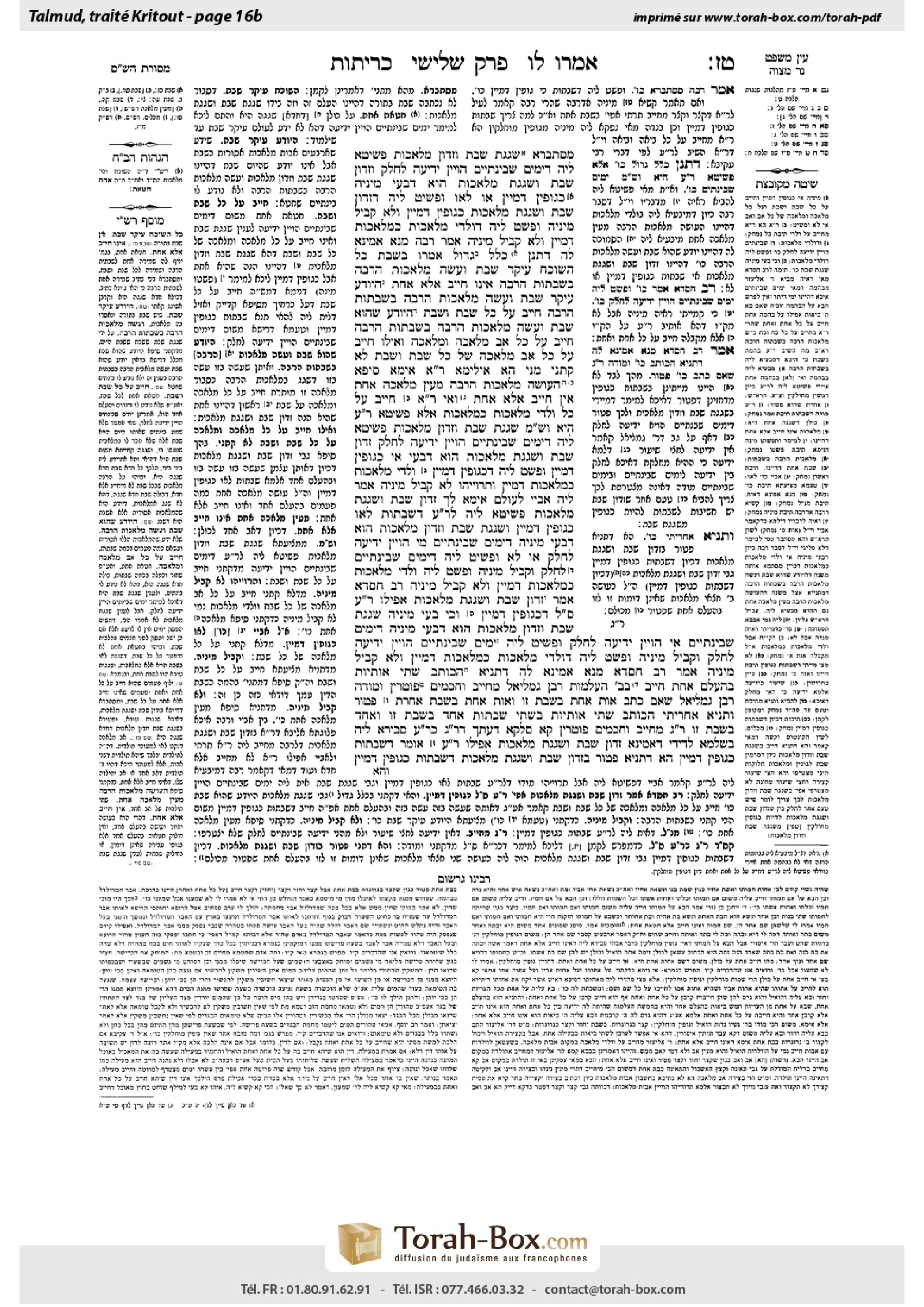
Keritot 16b: Talmud study for Daf Yomi
Daf Yomi is the daily study of one Talmud folio. Explore 37 tractates with scans, Hebrew text, Sefaria English and AI-generated French translations where annotated.
Passage selection and English or AI-generated French translation are available where the scan has annotations. Daf Study is independent of Torah-Box and Sefaria.
Browse Keritot · כריתות · All tractatesKeritot 16b text and translations
This page of Keritot includes the Aramaic text, an English translation and an AI-generated French translation, alongside the scan above.
כריתות י״ו ב · Aramaic and Hebrew text
מִסְתַּבְּרָא שִׁגְגַת שַׁבָּת וּזְדוֹן מְלָאכוֹת פְּשִׁיטָא לֵיהּ דְּיָמִים שֶׁבֵּינְתַיִים הָוַיִין יְדִיעָה לְחַלֵּק, וּזְדוֹן שַׁבָּת וְשִׁגְגַת מְלָאכוֹת הוּא דְּבָעֵי מִינֵּיהּ – כְּגוּפִין דָּמְיָין, אוֹ לָאו.
וּפְשַׁיט לֵיהּ דִּזְדוֹן שַׁבָּת וְשִׁגְגַת מְלָאכוֹת כְּגוּפִין דָּמְיָין, וְלָא קַבֵּיל מִינֵּיהּ. וּפְשַׁט לֵיהּ, דְּוַלְדֵי מְלָאכוֹת כִּמְלָאכוֹת דָּמְיָין, וְלָא קַבֵּיל מִינֵּיהּ.
אָמַר רַבָּה: מְנָא אָמֵינָא לַהּ? דִּתְנַן, כְּלָל גָּדוֹל אָמְרוּ בַּשַּׁבָּת: כׇּל הַשּׁוֹכֵחַ עִיקַּר שַׁבָּת, וְעָשָׂה מְלָאכוֹת הַרְבֵּה בְּשַׁבָּתוֹת הַרְבֵּה – אֵינוֹ חַיָּיב אֶלָּא אַחַת.
הַיּוֹדֵעַ עִיקַּר שַׁבָּת, וְעָשָׂה מְלָאכוֹת הַרְבֵּה בְּשַׁבָּתוֹת הַרְבֵּה – חַיָּיב עַל כׇּל שַׁבָּת וְשַׁבָּת. הַיּוֹדֵעַ שֶׁהוּא שַׁבָּת וְעָשָׂה מְלָאכוֹת הַרְבֵּה בְּשַׁבָּתוֹת הַרְבֵּה – חַיָּיב עַל כׇּל אַב מְלָאכָה וּמְלָאכָה.
וְאִילּוּ ״חַיָּיב עַל כׇּל אַב מְלָאכָה שֶׁל כׇּל שַׁבָּת וְשַׁבָּת״ לָא קָתָנֵי.
מַנִּי הָא? אִילֵימָא רַבִּי אֱלִיעֶזֶר, אֵימָא סֵיפָא: הָעוֹשֶׂה מְלָאכוֹת הַרְבֵּה מֵעֵין מְלָאכָה אַחַת – אֵין חַיָּיב אֶלָּא אֶחָת, וְאִי רַבִּי אֱלִיעֶזֶר – חַיָּיב עַל כׇּל וַלְדֵי מְלָאכוֹת כִּמְלָאכוֹת!
אֶלָּא פְּשִׁיטָא רַבִּי עֲקִיבָא הִיא, וּשְׁמַע מִינַּהּ שִׁגְגַת שַׁבָּת וּזְדוֹן מְלָאכוֹת פְּשִׁיטָא לֵיהּ דְּיָמִים שֶׁבֵּינְתַיִים הָוַיִין יְדִיעָה לְחַלֵּק,
זְדוֹן שַׁבָּת וְשִׁגְגַת מְלָאכוֹת הוּא דְּבָעֵי אִי כְּגוּפִין דָּמְיָין, וּפְשַׁט לֵיהּ דִּכְגוּפִין דָּמְיָין, וַלְדֵי מְלָאכוֹת כִּמְלָאכוֹת דָּמְיָין, וְתַרְוַיְיהוּ לָא קַבֵּיל מִינֵּיהּ.
אֲמַר לֵיהּ אַבָּיֵי: לְעוֹלָם אֵימָא לָךְ זְדוֹן שַׁבָּת וְשִׁגְגַת מְלָאכוֹת פְּשִׁיטָא לֵיהּ לְרַבִּי עֲקִיבָא דְּשַׁבָּתוֹת לָאו כְּגוּפִין דָּמְיָין, וְשִׁגְגַת שַׁבָּת וּזְדוֹן מְלָאכוֹת הוּא דְּבָעֵי מִינֵּיהּ, דְּיָמִים שֶׁבֵּינְתַיִים מִי הָוַיִין יְדִיעָה לְחַלֵּק אוֹ לָא.
וּפְשַׁיט לֵיהּ דְּיָמִים שֶׁבֵּינְתַיִים [הָוַיִין יְדִיעָה] לְחַלֵּק וְקַבֵּיל מִינֵּיהּ, וּפְשַׁט לֵיהּ וַלְדֵי מְלָאכוֹת כִּמְלָאכוֹת דָּמַיִין וְלָא קַבֵּיל מִינֵּיהּ.
רַב חִסְדָּא אָמַר: זְדוֹן שַׁבָּת וְשִׁגְגַת מְלָאכוֹת – אֲפִילּוּ רַבִּי עֲקִיבָא סְבִירָא לֵיהּ דִּכְגוּפִין דָּמְיָין, וְכִי בָּעֵי מִינֵּיהּ, שִׁגְגַת שַׁבָּת וּזְדוֹן מְלָאכוֹת הוּא דְּבָעֵי מִינֵּיהּ, דְּיָמִים שֶׁבֵּינְתַיִים אִי הָוְיָין יְדִיעָה לְחַלֵּק.
וּפְשַׁיט לֵיהּ יָמִים שֶׁבֵּינְתַיִים הָוַיִין יְדִיעָה לְחַלֵּק, וְקַבֵּיל מִינֵּיהּ.
וּפְשַׁט לֵיהּ דְּוַלְדֵי מְלָאכוֹת כִּמְלָאכוֹת דָּמַיִין, וְלָא קַבֵּיל מִינֵּיהּ.
אָמַר רַב חִסְדָּא: מְנָא אָמֵינָא לַהּ? דְּתַנְיָא: הַכּוֹתֵב שְׁתֵּי אוֹתִיּוֹת בְּהֶעְלֵם אֶחָד – חַיָּיב. בִּשְׁתֵּי הֶעְלֵמוֹת – רַבָּן גַּמְלִיאֵל מְחַיֵּיב, וַחֲכָמִים פּוֹטְרִין. וּמוֹדֶה רַבָּן גַּמְלִיאֵל, שֶׁאִם כָּתַב אוֹת אַחַת בְּשַׁבָּת זוֹ וְאוֹת אַחַת בְּשַׁבָּת אַחֶרֶת – פָּטוּר.
וְתַנְיָא אַחֲרִיתִי: הַכּוֹתֵב שְׁתֵּי אוֹתִיּוֹת בִּשְׁתֵּי שַׁבָּתוֹת, אֶחָד בְּשַׁבָּת זוֹ וְאֶחָד בְּשַׁבָּת זוֹ – רַבָּן גַּמְלִיאֵל מְחַיֵּיב, וַחֲכָמִים פּוֹטְרִין. קָא סָלְקָא דַעְתָּךְ, דְּרַבָּן גַּמְלִיאֵל כְּרַבִּי עֲקִיבָא סְבִירָא לֵיהּ.
בִּשְׁלָמָא לְדִידִי, דְּאָמֵינָא זְדוֹן שַׁבָּת וְשִׁגְגַת מְלָאכוֹת אֲפִילּוּ רַבִּי עֲקִיבָא אוֹמֵר דְּשַׁבָּתוֹת כְּגוּפִין דָּמְיָין, הָא דְּתַנְיָא פָּטוּר – בִּזְדוֹן שַׁבָּת וְשִׁגְגַת מְלָאכוֹת, דְּשַׁבָּתוֹת כְּגוּפִין דָּמְיָין.
Keritot 16b · English translation
It stands to reason, based on a proof from a mishna, to say that in a case where he acts unwittingly in that he does not know that it is Shabbat, and intentionally in that he knows that the labors he is performing are prohibited on Shabbat, it is obvious to Rabbi Akiva that the intervening days between the Shabbatot are considered awareness of his sin, which would serve to differentiate between one sin and the next. And it is in reference to a case where he acts intentionally with regard to Shabbat and unwittingly with regard to prohibited labors that Rabbi Akiva raises his dilemma, which is about whether the Shabbatot are comparable to separate entities or not.
And Rabbi Eliezer resolved his dilemma for him by stating that in a case where he acts intentionally with regard to Shabbat and unwittingly with regard to prohibited labors, the Shabbatot are comparable to separate entities. But Rabbi Akiva did not accept this resolution from him. And with regard to Rabbi Akiva’s other dilemma, Rabbi Eliezer resolved it for him by stating that subcategories of labors are comparable to primary categories of labor, and one is liable to bring a separate sin offering for each act. But Rabbi Akiva did not accept this resolution from him either.
Rabba said: From where do I say this? As we learned in a mishna (Shabbat 67b): The Sages stated a significant principle with regard to the halakhot of Shabbat: With regard to anyone who forgets the essence of Shabbat, i.e., one who is entirely ignorant that labor is prohibited on Shabbat, and he performed multiple prohibited labors on multiple Shabbatot, he is liable to bring only one sin offering, as there is only a single, comprehensive lapse of awareness.
With regard to one who knows the essence of the prohibition against labor on Shabbat, and he performed multiple prohibited labors on multiple Shabbatot because he was unaware that those days were Shabbat, he is liable to bring a sin offering for each and every Shabbat, as the intervening days are considered awareness which differentiates between the Shabbatot. One who is aware that the day is Shabbat and performed multiple prohibited labors, which he did not know were prohibited, on multiple Shabbatot, is liable to bring a sin offering for each and every primary category of labor that he performed.
Rabba comments: But in the latter case, the mishna does not teach that he is liable to bring a sin offering for each act of a primary category of labor that he performed on each and every Shabbat. He is liable to bring one sin offering for each primary category of labor, despite the fact that he performed the act on multiple Shabbatot. This indicates that the different Shabbatot are not considered separate entities.
Whose opinion is this? If we say it is the opinion of Rabbi Eliezer, say the last clause of that mishna: One who performs multiple prohibited labors subsumed, as subcategories, under one primary category of prohibited labor is liable to bring only one sin offering. And if this were the opinion of Rabbi Eliezer it should state: He is liable to bring a separate sin offering for each of the different subcategories of labors as though they were separate primary categories of labor.
Rather, it is obvious that this mishna is in accordance with the opinion of Rabbi Akiva. And you can learn from the mishna that when one acts unwittingly in that he did not know it was Shabbat and he acts intentionally in that he knows that these labors are prohibited on Shabbat, it is obvious to Rabbi Akiva that the intervening days are considered awareness of his sin, which serves to differentiate between the Shabbatot and render the individual liable to bring separate sin offerings for each Shabbat. It is for this reason that the mishna states that if one performs multiple labors on multiple Shabbatot because he was unaware that it was Shabbat, he is liable to bring a sin offering for each Shabbat.
Consequently, it is clear that it is in a case where one acted intentionally in that he knew it was Shabbat and unwittingly in that he did not know that the acts he was performing were prohibited labor, that Rabbi Akiva raises his dilemma, as he is uncertain about whether the Shabbatot are comparable to separate entities. And Rabbi Eliezer resolved the dilemma for him by stating that the different Shabbatot are comparable to separate entities, and different subcategories of labors are comparable to primary categories of labor, and therefore one is liable for each act. And Rabbi Akiva did not accept either of these resolutions from Rabbi Eliezer.
Abaye said to Rabba: You cannot prove your claim from the mishna. Actually, I could say to you that in a case where one acts intentionally in that he knows it is Shabbat and unwittingly in that he does not know that his actions are prohibited labors, it is obvious to Rabbi Akiva that Shabbatot are not comparable to separate entities, as it can be inferred from the latter clause of this mishna that one is not liable to bring a separate sin offering for each primary category of labor performed on each individual Shabbat. And it is in reference to a case where one acted unwittingly in that he did not know it was Shabbat and intentionally in that he knew his actions are prohibited labors, that Rabbi Akiva raises his dilemma to Rabbi Eliezer. The dilemma is whether the intervening days are considered awareness to differentiate between the Shabbatot or not.
And Rabbi Eliezer resolved the dilemma for him by stating that the intervening days are considered awareness to differentiate between the Shabbatot. And Rabbi Akiva accepted this resolution from him, due the ruling of the mishna that one who knows the essence of the prohibition against labor on Shabbat and performs multiple prohibited labors on multiple Shabbatot is liable to bring a sin offering for each and every Shabbat. And Rabbi Eliezer also resolved his other dilemma for him by stating that subcategories of labors are comparable to primary categories of labor and one is liable for each act, but Rabbi Akiva did not accept this resolution from him.
Rav Ḥisda says: In a case where one acts intentionally in that he knows it is Shabbat and unwittingly in that he does not know that his actions are prohibited labors, even Rabbi Akiva holds that the Shabbatot are comparable to separate entities; and when he raises the dilemma to Rabbi Eliezer, it is in reference to a case where one acted unwittingly with regard to Shabbat and intentionally with regard to prohibited labor. And he raises the dilemma in order to clarify whether or not the intervening days are considered awareness to differentiate.
And Rabbi Eliezer resolved the dilemma for him by stating that the intervening days are considered awareness to differentiate the transgressions, and Rabbi Akiva accepted this resolution from him. This is in accordance with the mishna in tractate Shabbat (67b) cited earlier, that one who knows the essence of the prohibition against labor on Shabbat and performed multiple prohibited labors on multiple Shabbatot is liable to bring a sin offering for each and every Shabbat.
And Rabbi Eliezer also resolved Rabbi Akiva’s other dilemma for him by stating that different subcategories of prohibited labors are comparable to primary categories of labor and one is liable for each one separately. But Rabbi Akiva did not accept this resolution from him, due to the final clause of that mishna, which states that one who performs multiple prohibited labors that are subsumed as subcategories under one primary category of prohibited labor is liable to bring only one sin offering.
Rav Ḥisda said: From where do I say that according to Rabbi Akiva each Shabbat is considered a separate entity? This is as it is taught in a baraita: One who writes two letters on Shabbat during one lapse of awareness is liable, as writing two letters renders one liable for performing the prohibited labor of writing. If he does so in two separate lapses of awareness, e.g., he wrote one letter without realizing it was Shabbat, then became aware that it was Shabbat, and then again became unaware it was Shabbat and wrote a second letter, Rabban Gamliel deems him liable to bring a sin offering and the Rabbis deem him exempt. And Rabban Gamliel concedes that if he wrote one letter on this Shabbat and one letter on another Shabbat he is exempt.
And it is taught in a different baraita: In the case of one who writes two letters on two Shabbatot, one on this Shabbat and one on that Shabbat, Rabban Gamliel deems him liable and the Rabbis deem him exempt. Rav Ḥisda explains: It enters your mind that Rabban Gamliel holds in accordance with the opinion of Rabbi Akiva.
Granted, according to my opinion, as I say that in a case where one acts intentionally in that he knows it is Shabbat and unwittingly in that he does not know his actions constitute prohibited labors, even Rabbi Akiva says that the Shabbatot are comparable to separate entities. Consequently, that which is taught in the first baraita, that Rabban Gamliel concedes that if one wrote one letter on Shabbat and another letter the following Shabbat he is exempt, can be interpreted as referring to a case where one acts intentionally in that he knows it is Shabbat but unwittingly in that he does not know his actions constitute prohibited labors. Since separate Shabbatot are comparable to separate entities, the two acts do not combine to form the minimal act of writing that would render one liable to bring a sin offering.
Keritot 16b · Traduction française (IA)
Il est logique, d’après une preuve tirée d’une Michna, de dire que, lorsqu’il agit involontairement parce qu’il ignore que c’est Chabbat, mais intentionnellement parce qu’il sait que les travaux qu’il accomplit sont interdits le Chabbat, il est évident pour Rabbi Akiva que les jours intermédiaires entre les Chabbatot sont considérés comme une prise de conscience de sa faute, ce qui permet de distinguer une transgression de la suivante. Rabbi Akiva soulève son doute au sujet d’un cas où il agit intentionnellement à l’égard du Chabbat et involontairement à l’égard des travaux interdits : les Chabbatot sont-ils comparables à des entités distinctes ou non ?
Rabbi Eliezer résolut son doute en déclarant que, lorsqu’il agit intentionnellement à l’égard du Chabbat et involontairement à l’égard des travaux interdits, les Chabbatot sont comparables à des entités distinctes. Mais Rabbi Akiva n’accepta pas cette résolution. Quant à l’autre doute de Rabbi Akiva, Rabbi Eliezer le résolut en déclarant que les sous-catégories de travaux sont comparables aux catégories principales de travaux et qu’il est redevable d’apporter un sacrifice expiatoire distinct pour chaque acte. Mais Rabbi Akiva n’accepta pas non plus cette résolution.
Rabba dit : Sur quoi me fondé-je ? Sur ce que nous avons appris dans une Michna (Chabbat 67b) : les Sages ont énoncé un principe important concernant les halakhot du Chabbat : quiconque oublie l’essentiel du Chabbat, c’est-à-dire ignore totalement que les travaux sont interdits le Chabbat, et accomplit plusieurs travaux interdits pendant plusieurs Chabbatot, n’est redevable que d’un seul sacrifice expiatoire, car il n’y a eu qu’une seule méconnaissance globale.
Celui qui connaît l’essentiel de l’interdiction des travaux le Chabbat, mais accomplit plusieurs travaux interdits pendant plusieurs Chabbatot parce qu’il ne savait pas que ces jours étaient des Chabbatot, est redevable d’un sacrifice expiatoire pour chacun des Chabbatot, car les jours intermédiaires sont considérés comme une prise de conscience qui distingue les Chabbatot. Celui qui sait que le jour est Chabbat et accomplit, pendant plusieurs Chabbatot, plusieurs travaux interdits sans savoir qu’ils sont interdits, est redevable d’un sacrifice expiatoire pour chacune des catégories principales de travaux qu’il a accomplies.
Rabba fait remarquer : Pourtant, dans le dernier cas, la Michna n’enseigne pas qu’il est redevable d’un sacrifice expiatoire pour chaque acte relevant d’une catégorie principale de travaux, accompli pendant chacun des Chabbatot. Il est redevable d’un seul sacrifice expiatoire pour chaque catégorie principale de travaux, bien qu’il ait accompli l’acte pendant plusieurs Chabbatot. Cela indique que les différents Chabbatot ne sont pas considérés comme des entités distinctes.
De qui est-ce l’opinion ? Si l’on dit qu’il s’agit de celle de Rabbi Eliezer, considérons la dernière clause de cette Michna : celui qui accomplit plusieurs travaux interdits relevant, en tant que sous-catégories, d’une même catégorie principale de travaux interdits n’est redevable que d’un seul sacrifice expiatoire. Or, si telle était l’opinion de Rabbi Eliezer, la Michna aurait dû enseigner qu’il est redevable d’un sacrifice expiatoire distinct pour chacune des différentes sous-catégories de travaux, comme s’il s’agissait de catégories principales de travaux distinctes.
Il est donc évident que cette Michna est conforme à l’opinion de Rabbi Akiva. On peut en déduire que, lorsqu’on agit involontairement parce qu’on ignore que c’est Chabbat, mais intentionnellement parce qu’on sait que ces travaux sont interdits le Chabbat, il est évident pour Rabbi Akiva que les jours intermédiaires sont considérés comme une prise de conscience de sa faute. Celle-ci distingue les Chabbatot et rend la personne redevable d’apporter un sacrifice expiatoire distinct pour chacun d’eux. C’est pourquoi la Michna enseigne que celui qui accomplit plusieurs travaux pendant plusieurs Chabbatot parce qu’il ignorait que c’était Chabbat est redevable d’un sacrifice expiatoire pour chaque Chabbat.
Par conséquent, il est clair que Rabbi Akiva soulève son doute au sujet d’un cas où l’on a agi intentionnellement parce qu’on savait que c’était Chabbat, et involontairement parce qu’on ignorait que les actes accomplis constituaient des travaux interdits : il se demande si les Chabbatot sont comparables à des entités distinctes. Rabbi Eliezer résolut son doute en déclarant que les différents Chabbatot sont comparables à des entités distinctes, et que les différentes sous-catégories de travaux sont comparables aux catégories principales de travaux, de sorte que l’on est redevable pour chaque acte. Rabbi Akiva n’accepta aucune de ces résolutions de Rabbi Eliezer.
Abayé dit à Rabba : Tu ne peux pas prouver ta thèse à partir de la Michna. En réalité, je pourrais te dire que, lorsqu’on agit intentionnellement parce qu’on sait que c’est Chabbat, et involontairement parce qu’on ignore que ses actes constituent des travaux interdits, il est évident pour Rabbi Akiva que les Chabbatot ne sont pas comparables à des entités distinctes. On peut le déduire de la dernière clause de cette Michna : on n’est pas redevable d’apporter un sacrifice expiatoire distinct pour chaque catégorie principale de travaux accomplie lors de chaque Chabbat. Rabbi Akiva soulève son doute auprès de Rabbi Eliezer au sujet d’un cas où l’on a agi involontairement parce qu’on ignorait que c’était Chabbat, mais intentionnellement parce qu’on savait que ses actes constituaient des travaux interdits. Le doute porte sur la question de savoir si les jours intermédiaires sont considérés comme une prise de conscience qui distingue les Chabbatot ou non.
Rabbi Eliezer résolut son doute en déclarant que les jours intermédiaires sont considérés comme une prise de conscience qui distingue les Chabbatot. Rabbi Akiva accepta cette résolution, en raison de la règle de la Michna selon laquelle celui qui connaît l’essentiel de l’interdiction des travaux le Chabbat et accomplit plusieurs travaux interdits pendant plusieurs Chabbatot est redevable d’un sacrifice expiatoire pour chacun des Chabbatot. Rabbi Eliezer résolut également son autre doute en déclarant que les sous-catégories de travaux sont comparables aux catégories principales de travaux et que l’on est redevable pour chaque acte, mais Rabbi Akiva n’accepta pas cette résolution.
Rav Ḥisda dit : Lorsqu’on agit intentionnellement parce qu’on sait que c’est Chabbat, et involontairement parce qu’on ignore que ses actes constituent des travaux interdits, même Rabbi Akiva considère que les Chabbatot sont comparables à des entités distinctes. Lorsqu’il soulève son doute auprès de Rabbi Eliezer, c’est au sujet d’un cas où l’on a agi involontairement à l’égard du Chabbat et intentionnellement à l’égard des travaux interdits. Il soulève ce doute afin de déterminer si les jours intermédiaires sont considérés comme une prise de conscience qui distingue les transgressions ou non.
Rabbi Eliezer résolut son doute en déclarant que les jours intermédiaires sont considérés comme une prise de conscience qui distingue les transgressions, et Rabbi Akiva accepta cette résolution. Cela est conforme à la Michna du traité Chabbat (67b), citée précédemment, selon laquelle celui qui connaît l’essentiel de l’interdiction des travaux le Chabbat et accomplit plusieurs travaux interdits pendant plusieurs Chabbatot est redevable d’un sacrifice expiatoire pour chacun des Chabbatot.
Rabbi Eliezer résolut également l’autre doute de Rabbi Akiva en déclarant que les différentes sous-catégories de travaux interdits sont comparables aux catégories principales de travaux et que l’on est redevable séparément pour chacune d’elles. Mais Rabbi Akiva n’accepta pas cette résolution, en raison de la dernière clause de cette Michna, qui enseigne que celui qui accomplit plusieurs travaux interdits relevant, en tant que sous-catégories, d’une même catégorie principale de travaux interdits n’est redevable que d’un seul sacrifice expiatoire.
Rav Ḥisda dit : Sur quoi me fondé-je pour affirmer que, selon Rabbi Akiva, chaque Chabbat est considéré comme une entité distincte ? Sur ce qui est enseigné dans une baraïta : celui qui écrit deux lettres le Chabbat au cours d’une seule période de méconnaissance est redevable, car l’écriture de deux lettres le rend redevable du travail interdit d’écrire. S’il le fait au cours de deux périodes de méconnaissance distinctes — par exemple, il a écrit une lettre sans se rendre compte que c’était Chabbat, puis a pris conscience que c’était Chabbat, avant de ne plus se rendre compte que c’était Chabbat et d’écrire une deuxième lettre —, Rabban Gamliel le déclare redevable d’apporter un sacrifice expiatoire, tandis que les Sages le déclarent exempt. Rabban Gamliel reconnaît que, s’il a écrit une lettre pendant ce Chabbat et une lettre pendant un autre Chabbat, il est exempt.
Une autre baraïta enseigne : celui qui écrit deux lettres pendant deux Chabbatot, une pendant ce Chabbat et une pendant cet autre Chabbat, est déclaré redevable par Rabban Gamliel et exempt par les Sages. Rav Ḥisda explique : On pourrait penser que Rabban Gamliel est conforme à l’opinion de Rabbi Akiva.
Certes, selon mon opinion — puisque j’affirme que, lorsqu’on agit intentionnellement parce qu’on sait que c’est Chabbat, et involontairement parce qu’on ignore que ses actes constituent des travaux interdits, même Rabbi Akiva considère que les Chabbatot sont comparables à des entités distinctes —, l’enseignement de la première baraïta selon lequel Rabban Gamliel reconnaît que celui qui a écrit une lettre un Chabbat et une autre lettre le Chabbat suivant est exempt peut s’interpréter comme visant un cas où l’on agit intentionnellement parce qu’on sait que c’est Chabbat, mais involontairement parce qu’on ignore que ses actes constituent des travaux interdits. Puisque des Chabbatot distincts sont comparables à des entités distinctes, les deux actes ne s’additionnent pas pour constituer l’acte minimal d’écriture qui rendrait la personne redevable d’apporter un sacrifice expiatoire.
Traduction française générée par IA à partir de l’édition anglaise de Sefaria. Vérifie toujours un passage avec le texte source.
Text from Sefaria: William Davidson Edition - Vocalized Aramaic (CC BY NC); William Davidson Edition - English (CC BY NC).