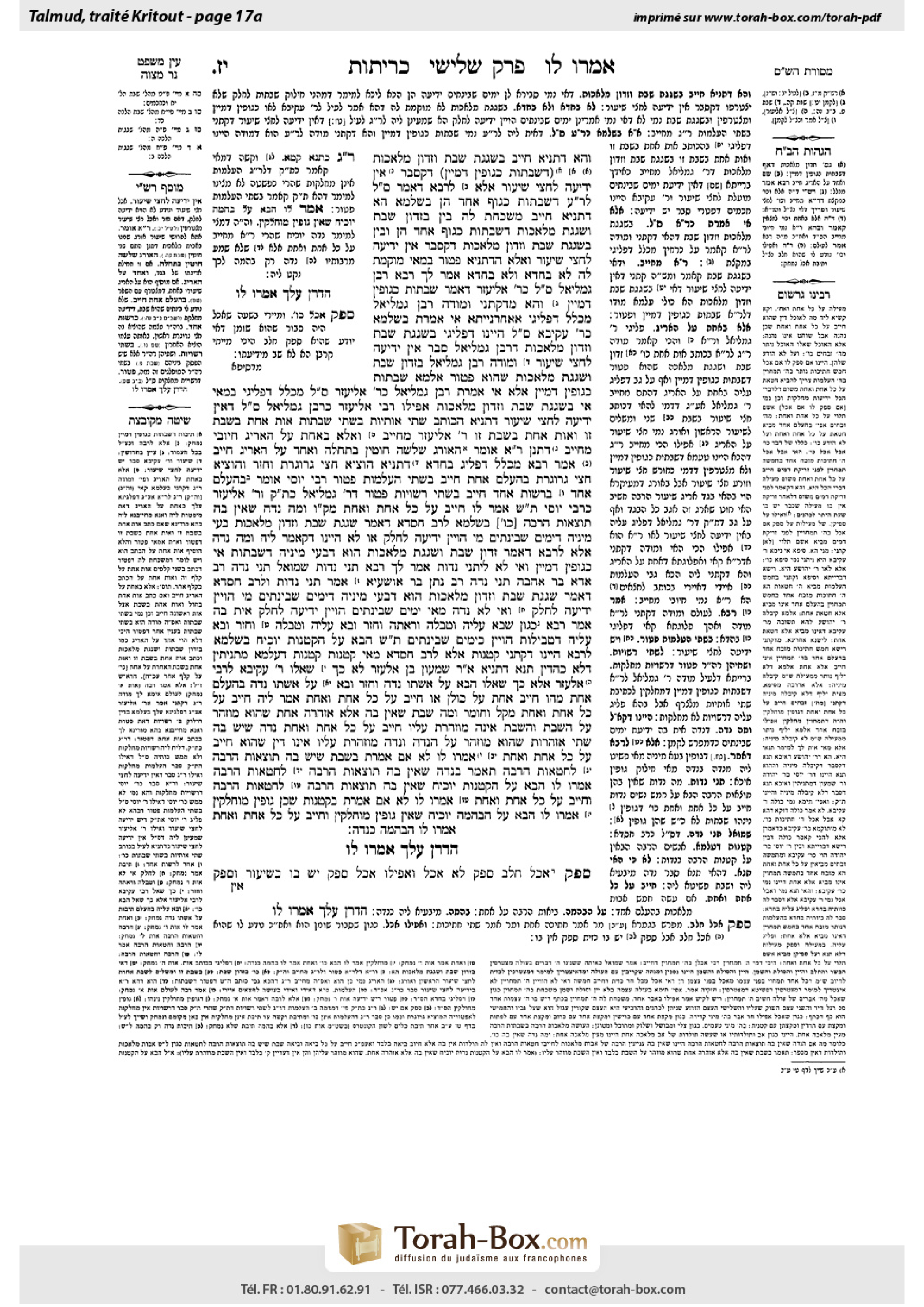
Keritot 17a: Talmud study for Daf Yomi
Daf Yomi is the daily study of one Talmud folio. Explore 37 tractates with scans, Hebrew text, Sefaria English and AI-generated French translations where annotated.
Passage selection and English or AI-generated French translation are available where the scan has annotations. Daf Study is independent of Torah-Box and Sefaria.
Browse Keritot · כריתות · All tractatesKeritot 17a text and translations
This page of Keritot includes the Aramaic text, an English translation and an AI-generated French translation, alongside the scan above.
כריתות י״ז א · Aramaic and Hebrew text
וְהָא דְּתַנְיָא חַיָּיב – בְּשִׁגְגַת שַׁבָּת וּזְדוֹן מְלָאכוֹת (דְּשַׁבָּתוֹת כְּגוּפִין דָּמְיָין), דְּקָסָבַר: אֵין יְדִיעָה לַחֲצִי שִׁיעוּר.
אֶלָּא לְרָבָא, דְּאָמַר: סְבִירָא לֵיהּ לְרַבִּי עֲקִיבָא דְּשַׁבָּתוֹת כְּגוּף אֶחָד הֵן,
בִּשְׁלָמָא הָא דְּתַנְיָא חַיָּיב, מַשְׁכַּחַתְּ לַהּ בֵּין בִּזְדוֹן שַׁבָּת וְשִׁגְגַת מְלָאכוֹת, דְּשַׁבָּתוֹת כְּגוּף אֶחָד הֵן, וּבֵין בְּשִׁגְגַת שַׁבָּת וּזְדוֹן מְלָאכוֹת, דְּקָסָבַר: אֵין יְדִיעָה לַחֲצִי שִׁיעוּר.
וְאֶלָּא הָדְתַנְיָא פָּטוּר, בְּמַאי מוֹקְמַתְּ לַהּ? לָא בַּחֲדָא וְלָא בַּחֲדָא!
אָמַר לָךְ רָבָא: רַבָּן גַּמְלִיאֵל סְבִירָא לֵיהּ כְּרַבִּי אֱלִיעֶזֶר, דְּאָמַר: שַׁבָּתוֹת כְּגוּפִין דָּמְיָין.
וְהָא מִדְּקָתָנֵי: וּמוֹדֶה רַבָּן גַּמְלִיאֵל, מִכְּלָל דִּפְלִיגִי אַאַחְרָנְיָיתָא. אִי אָמְרַתְּ בִּשְׁלָמָא כְּרַבִּי עֲקִיבָא סְבִירָא לֵיהּ – הַיְינוּ דִּפְלִיגִי בְּשִׁגְגַת שַׁבָּת וּזְדוֹן מְלָאכוֹת, דְּרַבָּן גַּמְלִיאֵל סָבַר: אֵין יְדִיעָה לַחֲצִי שִׁיעוּר.
וּמוֹדֶה רַבָּן גַּמְלִיאֵל בִּזְדוֹן שַׁבָּת וְשִׁגְגַת מְלָאכוֹת שֶׁהוּא פָּטוּר, אַלְמָא שַׁבָּתוֹת כְּגוּפִין דָּמְיָין. אֶלָּא אִי אָמְרַתְּ רַבָּן גַּמְלִיאֵל כְּרַבִּי אֱלִיעֶזֶר סְבִירָא לֵיהּ, מִכְּלָל דִּפְלִיגִי. בְּמַאי?
אִי בְּשִׁגְגַת שַׁבָּת וּזְדוֹן מְלָאכוֹת – אֲפִילּוּ רַבִּי אֱלִיעֶזֶר כְּרַבָּן גַּמְלִיאֵל סְבִירָא לֵיהּ דְּאֵין יְדִיעָה לַחֲצִי שִׁיעוּר, דְּתַנְיָא: הַכּוֹתֵב שְׁתֵּי אוֹתִיּוֹת בִּשְׁתֵּי שַׁבָּתוֹת, אוֹת אַחַת בְּשַׁבָּת זוֹ וְאוֹת אַחַת בְּשַׁבָּת זוֹ – רַבִּי אֱלִיעֶזֶר מְחַיֵּיב!
וְאֶלָּא, בְּאַחַת עַל הָאָרִיג – חַיּוֹבֵי מְחַיֵּיב, דִּתְנַן: רַבִּי אֱלִיעֶזֶר אוֹמֵר: הָאוֹרֵג שְׁלֹשָׁה חוּטִין בַּתְּחִלָּה, וְאֶחָד עַל הָאָרִיג – חַיָּיב!
אָמַר רָבָא: מִכְּלָל דִּפְלִיג בַּחֲדָא, דְּתַנְיָא: הוֹצִיא חֲצִי גְרוֹגֶרֶת וְחָזַר וְהוֹצִיא חֲצִי גְרוֹגֶרֶת בְּהֶעְלֵם (אַחַת) [אֶחָד] – חַיָּיב. בִּשְׁתֵּי הֶעְלֵמוֹת – פָּטוּר. רַבִּי יוֹסֵי אוֹמֵר: בְּהֶעְלֵם אֶחָד בִּרְשׁוּת (אֶחָד) [אַחַת] – חַיָּיב, בִּשְׁתֵּי רְשׁוּיוֹת – פָּטוּר.
דְּרַבָּן גַּמְלִיאֵל כְּתַנָּא קַמָּא, וְרַבִּי אֱלִיעֶזֶר כְּרַבִּי יוֹסֵי.
תָּא שְׁמַע, אָמַר לוֹ: חַיָּיב עַל כׇּל אַחַת וְאַחַת מִקַּל וָחוֹמֶר, וּמָה נִדָּה שֶׁאֵין בָּהּ תּוֹצָאוֹת הַרְבֵּה.
בִּשְׁלָמָא לְרַב חִסְדָּא דְּאָמַר: שִׁגְגַת שַׁבָּת וּזְדוֹן מְלָאכוֹת בָּעֵי מִינֵּיהּ, דְּיָמִים שֶׁבֵּינְתַיִם מִי הָוְיָין יְדִיעָה לְחַלֵּק אוֹ לָא – הַיְינוּ דְּקָאָמַר לֵיהּ: ״וּמָה נִדָּה״.
אֶלָּא לְרָבָא, דְּאָמַר: זְדוֹן שַׁבָּת וְשִׁגְגַת מְלָאכוֹת הוּא דְּבָעֵי מִינֵּיהּ, דְּשַׁבָּתוֹת אִי כְּגוּפִין דָּמְיָין וְאִי לָא – לִיתְנֵי ״נִדּוֹת״!
אָמַר לָךְ רָבָא: תְּנִי ״נִדּוֹת״. שְׁמוּאֵל תָּנֵי ״נִדָּה״, רַב אַדָּא בַּר אַהֲבָה תָּנֵי ״נִדָּה״. רַב נָתָן בַּר אוֹשַׁעְיָא אָמַר: תָּנֵי ״נִדּוֹת״.
וּלְרַב חִסְדָּא דְּאָמַר: שִׁגְגַת שַׁבָּת וּזְדוֹן מְלָאכוֹת הוּא דְּבָעֵי מִינֵּיהּ, דְּיָמִים שֶׁבֵּינְתַיִם מִי הָוַיִין יְדִיעָה לְחַלֵּק וְאִי לָא, נִדָּה – מַאי יָמִים שֶׁבֵּינְתַיִם הָוַיִין יְדִיעָה לְחַלֵּק אִית בַּהּ?
אָמַר רָבָא: כְּגוֹן שֶׁבָּא עָלֶיהָ וְטָבְלָה, וְרָאֲתָה וְחָזַר וּבָא עָלֶיהָ, וְטָבְלָה, וְחָזַר וּבָא עָלֶיהָ, דִּטְבִילוֹת הָוְיָין כְּיָמִים שֶׁבֵּינְתַיִם.
תָּא שְׁמַע: הַבָּא עַל הַקְּטַנּוֹת יוֹכִיחַ. בִּשְׁלָמָא לְרָבָא, הַיְינוּ דְקָתָנֵי ״קְטַנּוֹת״.
אֶלָּא לְרַב חִסְדָּא, מַאי ״קְטַנּוֹת״? קְטַנּוֹת דְּעָלְמָא.
דְּלָא כְּהָדֵין תַּנָּא, דְּתַנְיָא: אָמַר רַבִּי שִׁמְעוֹן בֶּן אֶלְעָזָר לֹא כָּךְ שְׁאֵלוֹ רַבִּי עֲקִיבָא לְרַבִּי אֶלְעָזָר, אֶלָּא כָּךְ שְׁאֵלוֹ: הַבָּא עַל אִשְׁתּוֹ נִדָּה וְחָזַר וּבָא עַל אִשְׁתּוֹ נִדָּה בְּהֶעְלֵם אֶחָד, מַהוּ? חַיָּיב אַחַת עַל כּוּלָּן, אוֹ חַיָּיב עַל כׇּל אַחַת וְאַחַת?
אָמַר לֹיה: חַיָּיב עַל כׇּל אַחַת וְאַחַת, מִקַּל וָחוֹמֶר, וּמָה שַׁבָּת שֶׁאֵין בָּהּ אֶלָּא אַזְהָרָה אַחַת, שֶׁהוּא מוּזְהָר עַל הַשַּׁבָּת וְהַשַּׁבָּת אֵינָהּ מוּזְהֶרֶת עָלָיו – חַיָּיב עַל כׇּל אַחַת וְאֶחָת, נִדָּה שֶׁיֵּשׁ בָּהּ שְׁתֵּי אַזְהָרוֹת, שֶׁהוּא מוּזְהָר עַל הַנִּדָּה וְנִדָּה מוּזְהֶרֶת עָלָיו – אֵינוֹ דִּין שֶׁהוּא חַיָּיב עַל כׇּל אַחַת וְאֶחָת?
אָמְרוּ לוֹ: לֹא, אִם אָמַרְתָּ בַּשַּׁבָּת, שֶׁיֵּשׁ בָּהּ תּוֹצָאוֹת הַרְבֵּה לְחַטָּאוֹת הַרְבֵּה, תֹּאמַר בַּנִּדָּה, שֶׁאֵין בָּהּ תּוֹצָאוֹת הַרְבֵּה לְחַטָּאוֹת הַרְבֵּה!
אָמְרוּ לוֹ: הַבָּא עַל הַקְּטַנּוֹת יוֹכִיחַ, שֶׁאֵין בָּהּ תּוֹצָאוֹת הַרְבֵּה לְחַטָּאוֹת הַרְבֵּה, וְחַיָּיב עַל כׇּל אַחַת וְאֶחָת!
אָמְרוּ לוֹ: לֹא, אִם אָמַרְתָּ בַּקְּטַנּוֹת שֶׁכֵּן גּוּפִין מוּחְלָקִין? אָמְרוּ לוֹ: הַבָּא עַל הַבְּהֵמָה יוֹכִיחַ, שֶׁאֵין גּוּפִין מוּחְלָקִין וְחַיָּיב עַל כׇּל אַחַת וְאֶחָת! אָמְרוּ לוֹ: הַבְּהֵמָה כַּנִּדָּה.
הֲדַרַן עֲלָךְ אָמְרוּ לוֹ
מַתְנִי׳ סָפֵק אָכַל חֵלֶב, סָפֵק לֹא אָכַל, וַאֲפִילּוּ אָכַל, סָפֵק יֵשׁ בּוֹ כַּשִּׁיעוּר וְסָפֵק
Keritot 17a · English translation
And that which is taught in the second baraita, that Rabban Gamliel deems a person liable if he wrote two letters over two Shabbatot, can also be explained: It is referring to a case where he acts unwittingly in that he does not know it is Shabbat, and intentionally in that he knows his actions constitute prohibited labors. In such a situation he deems an individual liable despite the fact that different Shabbatot are comparable to separate entities, as he holds that although the intervening days are generally considered awareness of his transgression, there is no awareness for a half-measure. Since he performed only half the prohibited labor on the first Shabbat, he is not considered to have become aware of his transgression on the intervening days.
But according to Rava, who says that Rabbi Akiva, and presumably also Rabban Gamliel, holds that separate Shabbatot are considered as one single entity, how can both baraitot be explained?
The Gemara elaborates: Granted, that which is taught in the second baraita, that Rabban Gamliel deems one who writes a letter on each of two Shabbatot to be liable, is understandable. You can find both a case where one acted intentionally in that he knew it was Shabbat and unwittingly in that he did not know his actions constituted prohibited labors, as he holds that Shabbatot are considered as one single entity, and a case where he acted unwittingly in that he does not know it is Shabbat and intentionally in that he knows his actions constitute prohibited labors. The reason in the second case is that he holds there is no awareness for a half-measure, and therefore the actions on the two Shabbatot are considered to have taken place during one lapse of awareness.
But with regard to that which is taught in the first baraita, that one who writes a letter on each of two Shabbatot is exempt, in what case can you interpret it, i.e., in what circumstances would this ever apply? This ruling does not apply in this case, where he is aware that it is Shabbat but unaware that his action constitutes a prohibited labor, because Rabbi Akiva, and presumably Rabban Gamliel, maintains that each Shabbat is considered a single entity and therefore it is considered as though he wrote two letters on one Shabbat, and he is liable. And this ruling also does not apply in that case, where one is unaware that it is Shabbat and aware that his action constitutes a prohibited labor, because Rabban Gamliel maintains there is no awareness for a half-measure. Consequently, the two letters are considered to have been written in one lapse of awareness.
The Gemara explains that Rava could say to you that Rabban Gamliel holds in accordance with the opinion of Rabbi Eliezer, who says: Shabbatot are comparable to separate entities, and therefore an individual who wrote one letter on one Shabbat and another letter on a different Shabbat is exempt.
The Gemara raises an objection: But from the fact that the baraita teaches: And Rabban Gamliel concedes to the Rabbis that if he wrote one letter on one Shabbat and one more letter on a different Shabbat he is exempt, it can be derived by inference that they disagree about another halakha. Granted, if you say Rabban Gamliel holds in accordance with the opinion of Rabbi Akiva, and the opinion of the Rabbis is that of Rabbi Akiva, this is referring to the fact that they disagree in the other baraita with regard to the case where one acts unwittingly in that he does not know it is Shabbat and intentionally in that he knows his actions constitute prohibited labors, as Rabban Gamliel holds that although the intervening days are considered awareness to differentiate between the Shabbatot, there is no awareness for a half-measure, and therefore he is liable.
And Rabban Gamliel concedes to Rabbi Akiva in a case where one acts intentionally in that he knows it is Shabbat and unwittingly in that he does not know his actions constitute prohibited labors, that he is exempt. Evidently, Rabbi Akiva holds that Shabbatot are comparable to separate entities, and therefore the letters written on different Shabbatot do not combine, which is why he is exempt. But if you say Rabban Gamliel holds in accordance with the opinion of Rabbi Eliezer, and from the fact that one baraita states that Rabban Gamliel concedes that he is exempt it can be derived by inference that they disagree about another similar halakha, this raises the question: About what case do they disagree?
If you suggest that they disagree with regard to a case where one acts unwittingly in that he does not know it is Shabbat and intentionally in that he knows his actions constitute prohibited labors, then that cannot be correct. After all, even Rabbi Eliezer holds in accordance with the opinion of Rabban Gamliel that there is no awareness for a half-measure, as it is taught in a baraita: With regard to one who writes two letters on two separate Shabbatot, one letter on this Shabbat and one letter on that Shabbat, Rabbi Eliezer deems him liable.
But rather, you might suggest that Rabban Gamliel’s concession that he is exempt is referring to a disagreement with regard to adding one thread to a preexisting woven fabric. If one weaves three threads together he has violated the prohibited labor of weaving on Shabbat. It might be suggested that if one adds a single thread to a preexisting woven fabric, Rabban Gamliel would deem him liable whereas Rabbi Eliezer would deem him exempt. And yet Rabban Gamliel concedes that if one writes one letter next to a letter written on the previous Shabbat he is exempt. This suggestion is also difficult, as Rabbi Eliezer deems one liable in the case of adding a single thread, as we learned in a mishna (Shabbat 105a) that Rabbi Eliezer says: One who weaves three threads at the beginning of a new fabric, or adds one thread to a preexisting woven fabric, is liable.
Rava said: When it was derived by inference that Rabban Gamliel disagrees about one other halakha, that disagreement is referring to the following case, as it is taught in a baraita: One who carried out half of a dried fig into the public domain on Shabbat and then carried out another half of a dried fig, in one lapse of awareness, is liable; if he carried them out in two lapses of awareness he is exempt. Rabbi Yosei says: Even in a case where this occurred in one lapse of awareness, if they were both carried to one public domain he is liable; but if they were carried to two public domains that are separated from each other he is exempt.
As in such a case, Rabban Gamliel holds in accordance with the opinion of the first tanna, who says that the separate domains do not cause the two acts to be considered separate; therefore, as he carried out a full dried fig, which is the minimum measure for the prohibited labor of carrying from one domain to another, he is liable. And Rabbi Eliezer holds in accordance with the opinion of Rabbi Yosei, who says the separate domains cause the acts to be considered separate, and he is exempt. Another baraita then states that although Rabban Gamliel maintains that the separate domains do not cause the two acts to be considered separate, he concedes that individual Shabbatot are considered separate entities, and therefore writing two letters on two different Shabbatot is considered two separate acts and the individual is exempt.
The Gemara suggests: Come and hear a proof for Rav Ḥisda’s opinion from the mishna: Rabbi Eliezer said to Rabbi Akiva: He is liable to bring a sin offering for violation of each and every one of the labors, and this is derived from an a fortiori inference. Just as in the case of a menstruating woman, with regard to whom there are not multiple actions that result in multiple sin offerings, one is liable to bring a separate sin offering for each act of unwitting intercourse; in the case of Shabbat, with regard to which there are multiple primary categories and subcategories of labor, is it not right that one will be liable to bring a sin offering for each prohibited labor?
Granted, according to Rav Ḥisda, who says that Rabbi Akiva raises his dilemma in reference to a case where one acted unwittingly in that he did not know it was Shabbat and intentionally in that he knew his actions constitute prohibited labors, and the basis of the dilemma was whether the intervening days are considered awareness to differentiate between the Shabbatot or not, that is the reason that Rabbi Eliezer said to him: Just as in the case of a menstruating woman, in the singular; in order to indicate that just as in the case of a menstruating woman one is liable for each act of intercourse due to the intervening days, so too with regard to Shabbat.
But according to Rava, who says it was in reference to a case where one acted intentionally in that he knew it was Shabbat and unwittingly in that he did not know his actions constituted prohibited labors that Rabbi Akiva raises his dilemma, and the basis of the dilemma was whether Shabbatot are comparable to separate entities or not, let Rabbi Eliezer teach this halakha with the plural phrase: Menstruating women. This would indicate that just as a man who engages in intercourse with five different menstruating women is liable to bring a sin offering for his transgression with each woman, as they are separate entities, the same applies to Shabbatot, which are also separate entities.
The Gemara responds that Rava could say to you: Indeed, teach the mishna with the plural term menstruating women. The Gemara notes that Shmuel teaches the mishna with the singular term menstruating woman, and Rav Adda bar Ahava teaches the mishna with the term menstruating woman; but Rav Natan bar Oshaya says: Teach the mishna with the plural term menstruating women.
The Gemara asks: And according to Rav Ḥisda, who says: It was in reference to a case where he was unwitting with regard to Shabbat and intentional with regard to prohibited labors that Rabbi Akiva raises his dilemma, and the question was whether the intervening days are considered awareness to differentiate between the Shabbatot or not, how could Rabbi Eliezer attempt to resolve the dilemma by a comparison to a menstruating woman? In the case of a menstruating woman, what intervening days apply to her that can be considered awareness of his sin, which serves to differentiate the acts of intercourse into distinct transgressions?
Rava said: This is possible in a case where he unwittingly engaged in intercourse with her while she was menstruating, and then she immersed in a ritual bath and became pure, and then she saw menstrual blood and he engaged in intercourse with her again, and then she immersed and then saw menstrual blood and he engaged in intercourse with her again. As here the immersions which purify her are considered like intervening days.
The Gemara suggests: Come and hear a proof for the opinion of Rava from the continuation of the mishna: Rabbi Eliezer said to Rabbi Akiva: The case of one who engages in intercourse with minor menstruating girls will prove this refutation is not valid. Granted, according to Rava, who says that Rabbi Akiva’s dilemma was about whether Shabbatot are considered separate entities, this is the reason that Rabbi Eliezer teaches his resolution by using the plural term minor girls, to indicate that just as one is liable to bring a separate sin offering for each girl, as she is a separate entity, the same applies to prohibited labor performed on different Shabbatot.
But according to Rav Ḥisda, who said Rabbi Akiva’s dilemma referred to whether the intervening days are considered awareness to differentiate between the Shabbatot, what is the reason Rabbi Eliezer employed the plural term minor girls? The Gemara answers that the plural term is referring to minor girls in general, i.e., to men who engage in intercourse with minor girls, but it should not be taken to mean that one man engages in intercourse with multiple minor women.
§ The Gemara notes that the mishna, which states that Rabbi Akiva raised a dilemma with regard to the halakhot of Shabbat and Rabbi Eliezer offered a resolution based on the halakhot of a menstruating woman, is not in accordance with the opinion of this following tanna, as it is taught in a baraita that Rabbi Shimon ben Elazar says: That is not what Rabbi Akiva asked Rabbi Eliezer. Rather, this is what he asked him: In the case of one who unwittingly engaged in intercourse with his wife while she was menstruating, and then again engaged in intercourse with his wife while she was menstruating, during a single lapse of awareness, what is the halakha? Is he liable to bring only one sin offering for all of the acts of intercourse, or is he liable to bring a separate sin offering for each and every one?
Rabbi Eliezer said to him: He is liable for each and every one, and this is derived from an a fortiori inference: And just as in the case of Shabbat, with regard to which there is only one prohibition because he is prohibited to perform labor on Shabbat but Shabbat is not prohibited with regard to him, he is liable to bring a separate sin offering for each and every prohibited labor; in the case of a menstruating woman, with regard to whom there are two prohibitions, as the man is prohibited to engage in intercourse with the menstruating woman and the menstruating woman is prohibited to engage in intercourse with him, is it not right that he should be liable to bring a separate sin offering for each and every act of intercourse?
Rabbi Akiva said to him: No, if you said that one is liable to bring multiple sin offerings in the case of Shabbat, with regard to which there are multiple categories of labor that result in liability to bring multiple sin offerings, shall you also say the same in the case of a menstruating woman, with regard to whom there are not multiple actions that result in multiple transgressions and multiple sin offerings, as there is only the prohibition against engaging in intercourse with her?
Rabbi Eliezer said to him: The case of one who engages in intercourse with five minor menstruating girls will prove it, as with regard to it there are not multiple actions that result in multiple sin offerings, and yet one is liable to bring a separate sin offering for having engaged in intercourse with each and every one of the girls.
Rabbi Akiva said to him: No, if you said that one is liable for each one with regard to minors, who are separate entities, shall you also say that he should be liable for each act with regard to one who engages in intercourse five times with his wife while she is menstruating? Rabbi Eliezer said to him: The case of one who copulates with an animal multiple times during a single lapse of awareness will prove that one should be held separately liable for each act, as there are no separate entities, and yet one is liable for each and every act. Rabbi Akiva said to him: The case of the animal is like the case of the menstruating woman, and one is liable to bring only one sin offering.
MISHNA: If there is uncertainty whether one ate forbidden fat and uncertainty whether one did not eat forbidden fat, or even if one ate forbidden fat and there is uncertainty whether there is the measure that determines liability in the piece he ate and uncertainty
Keritot 17a · Traduction française (IA)
Et ce qui est enseigné dans la seconde baraïta, à savoir que Rabban Gamliel considère une personne comme coupable si elle a écrit deux lettres sur deux Chabbats, peut également être expliqué : il s'agit d'un cas où l'individu agit sans intention, car il ne sait pas que c'est Chabbat, mais avec intention, car il sait que ses actes constituent des travaux interdits. Dans une telle situation, il considère l'individu comme coupable, bien que les différents Chabbats soient comparables à des entités séparées, car il soutient que, bien que les jours intermédiaires soient généralement considérés comme une prise de conscience de sa transgression, il n'y a pas de prise de conscience pour une demi-mesure. Puisqu'il n'a effectué que la moitié du travail interdit le premier Chabbat, il n'est pas considéré comme ayant pris conscience de sa transgression pendant les jours intermédiaires.
Mais selon Rava, qui dit que Rabbi Akiva, et vraisemblablement aussi Rabban Gamliel, soutient que des Chabbats séparés sont considérés comme une seule et même entité, comment les deux baraïtot peuvent-elles être expliquées ?
La Guemara développe : Certes, ce qui est enseigné dans la seconde baraïta, à savoir que Rabban Gamliel considère comme coupable celui qui écrit une lettre sur chacun de deux Chabbats, est compréhensible. On peut y trouver un cas où l'on a agi avec intention, car on savait que c'était Chabbat, mais sans intention, car on ne savait pas que ses actes constituaient des travaux interdits, car il soutient que les Chabbats sont considérés comme une seule et même entité ; et un cas où l'on a agi sans intention, car on ne savait pas que c'était Chabbat, mais avec intention, car on savait que ses actes constituaient des travaux interdits. La raison dans le second cas est qu'il soutient qu'il n'y a pas de prise de conscience pour une demi-mesure, et par conséquent, les actes sur les deux Chabbats sont considérés comme ayant eu lieu pendant une seule période d'insouciance.
Mais quant à ce qui est enseigné dans la première baraïta, à savoir que celui qui écrit une lettre sur chacun de deux Chabbats est exempt, dans quel cas peut-on l'interpréter, c'est-à-dire dans quelles circonstances cela s'appliquerait-il jamais ? Cette décision ne s'applique pas dans le cas où il sait que c'est Chabbat mais ne sait pas que son acte constitue un travail interdit, car Rabbi Akiva, et vraisemblablement Rabban Gamliel, soutient que chaque Chabbat est considéré comme une entité unique et qu'il est donc considéré comme s'il avait écrit deux lettres sur un seul Chabbat, et il est coupable. Et cette décision ne s'applique pas non plus dans le cas où l'on ne sait pas que c'est Chabbat mais sait que son acte constitue un travail interdit, car Rabban Gamliel soutient qu'il n'y a pas de prise de conscience pour une demi-mesure. Par conséquent, les deux lettres sont considérées comme ayant été écrites pendant une seule période d'insouciance.
La Guemara explique que Rava pourrait vous dire que Rabban Gamliel est d'accord avec l'opinion de Rabbi Eliezer, qui dit : les Chabbats sont comparables à des entités séparées, et par conséquent, un individu qui a écrit une lettre sur un Chabbat et une autre lettre sur un Chabbat différent est exempt.
La Guemara soulève une objection : Or, du fait que la baraïta enseigne : « Et Rabban Gamliel concède aux Sages que si une personne a écrit une lettre un Chabbat et une autre lettre un Chabbat différent, elle est exemptée », on peut en déduire par inférence qu'ils sont en désaccord sur une autre halakha. Certes, si vous dites que Rabban Gamliel est d'accord avec l'opinion de Rabbi Akiva, et que l'opinion des Sages est celle de Rabbi Akiva, cela fait référence au fait qu'ils sont en désaccord dans l'autre baraïta concernant le cas où l'on agit sans intention, car on ne sait pas que c'est Chabbat, mais avec intention, car on sait que ses actes constituent des travaux interdits, car Rabban Gamliel soutient que, bien que les jours intermédiaires soient considérés comme une prise de conscience pour distinguer les Chabbats, il n'y a pas de prise de conscience pour une demi-mesure, et par conséquent il est coupable.
Et Rabban Gamliel concède à Rabbi Akiva, dans un cas où l'on agit avec intention, car on sait que c'est Chabbat, mais sans intention, car on ne sait pas que ses actes constituent des travaux interdits, que l'on est exempté. Évidemment, Rabbi Akiva soutient que les Chabbats sont comparables à des entités séparées, et par conséquent les lettres écrites sur des Chabbats différents ne se combinent pas, c'est pourquoi il est exempté. Mais si vous dites que Rabban Gamliel est d'accord avec l'opinion de Rabbi Eliezer, et du fait qu'une baraïta énonce que Rabban Gamliel concède qu'il est exempté, on peut en déduire par inférence qu'ils sont en désaccord sur une autre halakha similaire, cela soulève la question : Sur quel cas sont-ils en désaccord ?
Si vous suggérez qu'ils sont en désaccord concernant un cas où l'on agit sans intention, car on ignore qu'il s'agit du Chabbat, mais avec intention, car on sait que ses actes constituent des travaux interdits, alors cela ne peut pas être correct. Après tout, même Rabbi Eliezer est d'accord avec l'opinion de Rabban Gamliel selon laquelle il n'y a pas de prise de conscience pour une demi-mesure, comme l'enseigne une baraïta : Concernant celui qui écrit deux lettres sur deux Chabbats séparés, une lettre sur ce Chabbat et une lettre sur l'autre Chabbat, Rabbi Eliezer le déclare coupable.
Mais plutôt, vous pourriez suggérer que la concession de Rabban Gamliel, selon laquelle il est exempt, fait référence à un désaccord concernant l'ajout d'un fil à un tissu tissé préexistant. Si l'on tisse trois fils ensemble, on a violé le travail interdit de tissage sur le Chabbat. Il pourrait être suggéré que si l'on ajoute un seul fil à un tissu tissé préexistant, Rabban Gamliel le considérerait comme coupable tandis que Rabbi Eliezer le considérerait comme exempt. Et pourtant, Rabban Gamliel concède que si l'on écrit une lettre à côté d'une lettre écrite le Chabbat précédent, il est exempt. Cette suggestion est également difficile, car Rabbi Eliezer considère comme coupable celui qui ajoute un seul fil, comme nous l'avons appris dans une Michna (Chabbat 105a) : Rabbi Eliezer dit : Celui qui tisse trois fils au début d'un nouveau tissu, ou ajoute un fil à un tissu tissé préexistant, est coupable.
Rava a dit : Lorsque l'on a déduit par raisonnement que Rabban Gamliel est en désaccord sur une autre halakha, ce désaccord fait référence au cas suivant, tel qu'il est enseigné dans une baraïta : Celui qui a sorti dans le domaine public le Shabbat la moitié d'une figue sèche, puis a sorti une autre moitié de figue sèche, dans un même lapsus de conscience, est passible de peine ; s'il les a sorties dans deux lapsus de conscience, il est exempt. Rabbi Yosse dit : Même dans un cas où cela s'est produit dans un seul lapsus de conscience, s'ils ont été portés vers un même domaine public, il est passible de peine ; mais s'ils ont été portés vers deux domaines publics séparés l'un de l'autre, il est exempt.
Dans un tel cas, Rabban Gamliel est d'accord avec l'opinion du premier tanna, qui dit que les domaines distincts ne font pas considérer les deux actes comme séparés ; par conséquent, comme il a sorti une figue sèche entière, qui est la mesure minimale pour le travail interdit de transport d'un domaine à un autre, il est passible de peine. Et Rabbi Eliezer est d'accord avec l'opinion de Rabbi Yosse, qui dit que les domaines distincts font considérer les actes comme séparés, et il est exempt. Une autre baraïta énonce ensuite que, bien que Rabban Gamliel soutienne que les domaines distincts ne font pas considérer les deux actes comme séparés, il concède que les Shabbats individuels sont considérés comme des entités distinctes, et par conséquent, écrire deux lettres sur deux Shabbats différents est considéré comme deux actes séparés et l'individu est exempt.
La Guemara propose : Venez entendre une preuve en faveur de l'opinion de Rav Ḥisda à partir de la Michna : Rabbi Eliezer a dit à Rabbi Akiva : Il est passible d'offrir un sacrifice expiatoire pour la violation de chacun des travaux, et cela est déduit par une inférence a fortiori. Tout comme dans le cas d'une femme en période menstruelle, à l'égard de laquelle il n'y a pas d'actions multiples entraînant des sacrifices expiatoires multiples, on est passible d'offrir un sacrifice expiatoire distinct pour chaque acte de rapport sexuel accompli par inadvertance ; dans le cas du Shabbat, à l'égard duquel il y a plusieurs catégories principales et sous-catégories de travail, n'est-il pas juste que l'on soit passible d'offrir un sacrifice expiatoire pour chaque travail interdit ?
Accordé, selon Rav Ḥisda, qui dit que Rabbi Akiva soulève son dilemme en référence à un cas où l'on a agi par inadvertance en ce qu'il ne savait pas que c'était le Shabbat et intentionnellement en ce qu'il savait que ses actions constituaient des travaux interdits, et que la base du dilemme était de savoir si les jours intercalaires sont considérés comme une prise de conscience permettant de différencier les Shabbats ou non, c'est la raison pour laquelle Rabbi Eliezer lui a dit : Tout comme dans le cas d'une femme en période menstruelle, au singulier ; afin d'indiquer que, tout comme dans le cas d'une femme en période menstruelle, on est passible pour chaque acte de rapport sexuel en raison des jours intercalaires, de même en ce qui concerne le Shabbat.
Mais selon Rava, qui affirme que cela concernait un cas où l'on a agi intentionnellement en ce qu'on savait qu'il s'agissait du Shabbat, et involontairement en ce qu'on ignorait que ses actes constituaient des travaux interdits, et que c'est dans ce contexte que Rabbi Akiva soulève son dilemme, dont la base était de savoir si les Shabbats sont comparables à des entités distinctes ou non, que Rabbi Eliezer enseigne cette halakha avec la formulation au pluriel : « Femmes en période menstruelle ». Cela indiquerait que, tout comme un homme qui a des rapports sexuels avec cinq femmes différentes en période menstruelle est tenu d'offrir un sacrifice expiatoire pour sa transgression avec chacune d'elles, car elles sont des entités distinctes, de même cela s'applique aux Shabbats, qui sont également des entités distinctes.
La Guemara répond que Rava pourrait vous dire : En effet, enseignez la Michna avec le terme au pluriel « femmes en période menstruelle ». La Guemara note que Shmuel enseigne la Michna avec le terme au singulier « femme en période menstruelle », et Rav Adda bar Ahava enseigne la Michna avec le terme « femme en période menstruelle » ; mais Rav Natan bar Oshaya dit : Enseignez la Michna avec le terme au pluriel « femmes en période menstruelle ».
La Guemara demande : Et selon Rav Ḥisda, qui affirme que cela concernait un cas où l'on était involontaire quant au Shabbat et intentionnel quant aux travaux interdits, et que c'est dans ce contexte que Rabbi Akiva soulève son dilemme, dont la question était de savoir si les jours intercalaires sont considérés comme une prise de conscience permettant de distinguer les Shabbats ou non, comment Rabbi Eliezer a-t-il pu tenter de résoudre le dilemme par une comparaison avec une femme en période menstruelle ? Dans le cas d'une femme en période menstruelle, quels jours intercalaires s'appliquent à elle et peuvent être considérés comme une prise de conscience de sa faute, servant à distinguer les actes de rapport sexuel en transgressions distinctes ?
Rava a dit : Cela est possible dans le cas où il a eu des rapports sexuels avec elle sans le savoir alors qu'elle était en période menstruelle, puis elle s'est immergée dans un bain rituel et est devenue pure, puis elle a vu du sang menstruel et il a eu des rapports sexuels avec elle à nouveau, puis elle s'est immergée et a ensuite vu du sang menstruel et il a eu des rapports sexuels avec elle à nouveau. Car ici, les immersions qui la purifient sont considérées comme des jours intercalaires.
La Guemara suggère : Venez entendre une preuve pour l'opinion de Rava à partir de la suite de la Michna : Rabbi Eliezer a dit à Rabbi Akiva : Le cas de celui qui a des rapports sexuels avec des jeunes filles mineures en période menstruelle prouvera que cette réfutation n'est pas valide. Accordé, selon Rava, qui dit que le dilemme de Rabbi Akiva portait sur le fait de savoir si les Shabbats sont considérés comme des entités distinctes, c'est la raison pour laquelle Rabbi Eliezer enseigne sa résolution en utilisant le terme au pluriel « jeunes filles », afin d'indiquer que, tout comme on est passible d'offrir un sacrifice expiatoire distinct pour chaque fille, car elle est une entité distincte, de même cela s'applique au travail interdit effectué sur des Shabbats différents.
Mais selon Rav Ḥisda, qui a dit que le dilemme de Rabbi Akiva se référait au fait de savoir si les jours intercalaires sont considérés comme une conscience pour différencier les Shabbats, quelle est la raison pour laquelle Rabbi Eliezer a employé le terme au pluriel « jeunes filles » ? La Guemara répond que le terme au pluriel se réfère aux jeunes filles en général, c'est-à-dire aux hommes qui ont des rapports sexuels avec des jeunes filles, mais cela ne doit pas être interprété comme signifiant qu'un seul homme a des rapports sexuels avec plusieurs jeunes femmes.
§ La Guemara note que la Michna, qui indique que Rabbi Akiva a posé un dilemme concernant les halakhot du Chabbat et que Rabbi Eliezer a proposé une résolution basée sur les halakhot d'une femme en période menstruelle, ne concorde pas avec l'opinion de ce tanna suivant, car il est enseigné dans une baraïta que Rabbi Shimon ben Elazar dit : Ce n'est pas ce que Rabbi Akiva a demandé à Rabbi Eliezer. Plutôt, voici ce qu'il lui a demandé : Dans le cas d'un homme qui a eu des rapports avec sa femme alors qu'elle était en période menstruelle sans le savoir, puis a eu de nouveau des rapports avec sa femme alors qu'elle était en période menstruelle, au cours d'une seule période d'insouciance, quelle est la halakha ? Est-il tenu d'apporter un seul sacrifice expiatoire pour tous les actes de rapports, ou est-il tenu d'apporter un sacrifice expiatoire distinct pour chacun d'eux ?
Rabbi Eliezer lui a dit : Il est tenu pour chacun d'eux, et cela est déduit par un raisonnement a fortiori : De même qu'en ce qui concerne le Chabbat, pour lequel il n'y a qu'une seule interdiction, car il lui est interdit d'accomplir un travail le Chabbat, mais le Chabbat n'est pas interdit à son égard, il est tenu d'apporter un sacrifice expiatoire distinct pour chaque travail interdit ; dans le cas d'une femme en période menstruelle, pour laquelle il y a deux interdictions, car l'homme est interdit d'avoir des rapports avec la femme en période menstruelle et la femme en période menstruelle est interdite d'avoir des rapports avec lui, n'est-il pas juste qu'il soit tenu d'apporter un sacrifice expiatoire distinct pour chaque acte de rapports ?
Rabbi Akiva lui dit : Non, si tu as dit qu'on est tenu d'apporter plusieurs sacrifices expiatoires dans le cas du Chabbat, pour lequel il existe plusieurs catégories de travaux qui entraînent la responsabilité d'apporter plusieurs sacrifices expiatoires, diras-tu la même chose dans le cas d'une femme en période menstruelle, pour laquelle il n'existe pas plusieurs actions qui entraînent plusieurs transgressions et plusieurs sacrifices expiatoires, car il n'y a que l'interdiction d'avoir des rapports avec elle ?
Rabbi Eliezer lui dit : Le cas d'un homme qui a des rapports avec cinq jeunes filles mineures en période menstruelle le prouvera, car à son égard il n'existe pas plusieurs actions qui entraînent plusieurs sacrifices expiatoires, et pourtant on est tenu d'apporter un sacrifice expiatoire distinct pour avoir eu des rapports avec chacune d'entre elles.
Rabbi Akiva lui dit : Non, si tu as dit qu'on est tenu pour chacune d'elles dans le cas des mineures, qui sont des entités distinctes, diras-tu qu'il doit être tenu pour chaque acte dans le cas d'un homme qui a des rapports cinq fois avec sa femme alors qu'elle est en période menstruelle ? Rabbi Eliezer lui dit : Le cas d'un homme qui a des rapports avec un animal plusieurs fois au cours d'une seule période d'insouciance prouvera qu'on doit être tenu responsable séparément pour chaque acte, car il n'y a pas d'entités distinctes, et pourtant on est tenu pour chaque acte. Rabbi Akiva lui dit : Le cas de l'animal est comme le cas de la femme en période menstruelle, et on est tenu d'apporter un seul sacrifice expiatoire.
MICHNA : S'il y a un doute sur le fait qu'une personne a mangé de la graisse interdite et un doute sur le fait qu'elle n'a pas mangé de graisse interdite, ou même si elle a mangé de la graisse interdite et qu'il y a un doute sur le fait que la quantité déterminant la responsabilité est présente dans la pièce qu'elle a mangée, et un doute
Traduction française générée par IA à partir de l’édition anglaise de Sefaria. Vérifie toujours un passage avec le texte source.
Text from Sefaria: William Davidson Edition - Vocalized Aramaic (CC BY NC); William Davidson Edition - English (CC BY NC).