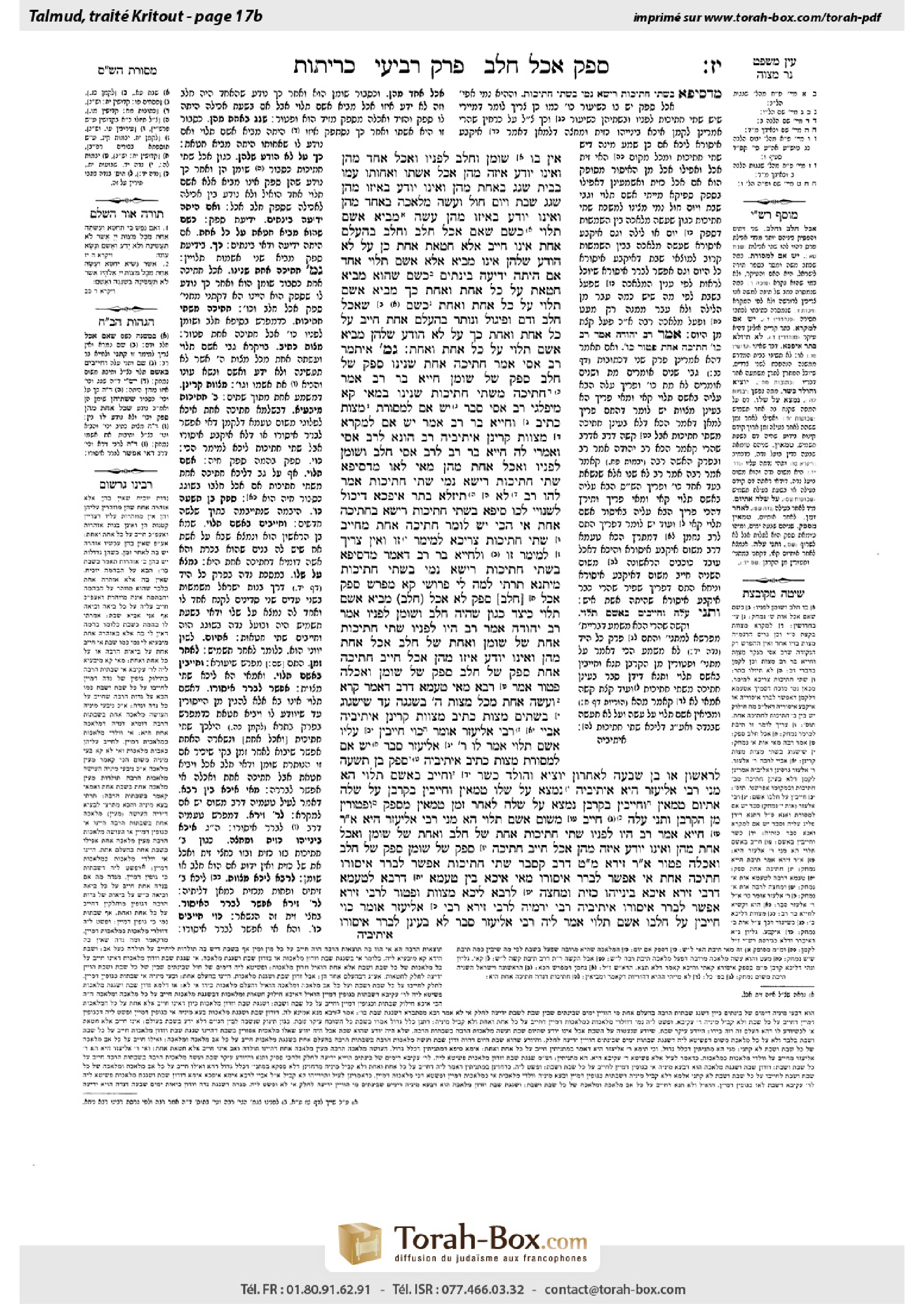
Keritot 17b: Talmud study for Daf Yomi
Daf Yomi is the daily study of one Talmud folio. Explore 37 tractates with scans, Hebrew text, Sefaria English and AI-generated French translations where annotated.
Passage selection and English or AI-generated French translation are available where the scan has annotations. Daf Study is independent of Torah-Box and Sefaria.
Browse Keritot · כריתות · All tractatesKeritot 17b text and translations
This page of Keritot includes the Aramaic text, an English translation and an AI-generated French translation, alongside the scan above.
כריתות י״ז ב · Aramaic and Hebrew text
אֵין בּוֹ,
שׁוּמָּן וָחֵלֶב לְפָנָיו, וְאָכַל אֶחָד מֵהֶן וְאֵינוֹ יוֹדֵעַ אֵיזֶה מֵהֶן אָכַל, אִשְׁתּוֹ וַאֲחוֹתוֹ עִמּוֹ בַּבַּיִת, שָׁגַג בְּאַחַת מֵהֶן וְאֵינוֹ יוֹדֵעַ בְּאֵיזוֹ מֵהֶן שָׁגַג, שַׁבָּת וְיוֹם חוֹל, וְעָשָׂה מְלָאכָה בְּאֶחָד מֵהֶן וְאֵינוֹ יוֹדֵעַ בְּאֵיזֶה מֵהֶן עָשָׂה – מֵבִיא אָשָׁם תָּלוּי.
כְּשֵׁם שֶׁאִם אָכַל חֵלֶב וָחֵלֶב בְּהֶעְלֵם (אַחַת) [אֶחָד] אֵינוֹ חַיָּיב אֶלָּא חַטָּאת אַחַת, כֵּן עַל לֹא הוֹדַע שֶׁלָּהֶן אֵינוֹ מֵבִיא אֶלָּא אָשָׁם תָּלוּי אֶחָד.
אִם הָיְתָה יְדִיעָה בֵּינָתַיִם, כְּשֵׁם שֶׁהוּא מֵבִיא חַטָּאת עַל כׇּל אַחַת וְאֶחָת, כָּךְ מֵבִיא אָשָׁם תָּלוּי עַל כׇּל אַחַת וְאֶחָת.
כְּשֵׁם שֶׁאָכַל חֵלֶב וָדָם וּפִיגּוּל וְנוֹתָר בְּהֶעְלֵם אַחַת חַיָּיב עַל כׇּל אַחַת וְאֶחָת, כָּךְ עַל לֹא הוֹדַע שֶׁלָּהֶן מֵבִיא אָשָׁם תָּלוּי עַל כׇּל אַחַת וְאֶחָת.
גְּמָ׳ אִיתְּמַר, רַב אַסִּי אָמַר: חֲתִיכָה אַחַת שָׁנִינוּ, סָפֵק שֶׁל חֵלֶב סָפֵק שֶׁל שׁוּמָּן. חִיָּיא בַּר רַב אָמַר: חֲתִיכָה מִשְׁתֵּי חֲתִיכוֹת שָׁנִינוּ.
בְּמַאי קָא מִיפַּלְגִי? רַב אַסִּי סָבַר: יֵשׁ אֵם לַמָּסוֹרֶת, ״מִצְוַת״ כְּתִיב.
וְחִיָּיא בַּר רַב אָמַר: יֵשׁ אֵם לַמִּקְרָא, ״מִצְווֹת״ קָרֵינַן.
אֵיתִיבֵיהּ רַב הוּנָא לְרַב אַסִּי, וְאָמְרִי לַהּ חִיָּיא בַּר רַב לְרַב אַסִּי: חֵלֶב וְשׁוּמָּן לְפָנָיו וְאָכַל אַחַת מֵהֶן מַאי לַָאו מִדְּסֵיפָא שְׁתֵּי חֲתִיכוֹת, רֵישָׁא נָמֵי שְׁתֵּי חֲתִיכוֹת?
אֲמַר לְהוּ רַב: לָא תֵּיזְלוּ בָּתַר אִיפְּכָא, דְּיָכוֹל לְשַׁנּוֹיֵי לְכוּ: סֵיפָא בִּשְׁתֵּי חֲתִיכוֹת רֵישָׁא בַּחֲתִיכָה אַחַת. אִי הָכִי, יֵשׁ לוֹמַר: חֲתִיכָה אַחַת מִחַיַּיב, שְׁתֵּי חֲתִיכוֹת צְרִיכָא לְמֵימַר? זוֹ וְאֵין צָרִיךְ (לְמֵימַר) [לוֹמַר] זוֹ.
וּלְחִיָּיא בַּר רַב דְּאָמַר: מִדְּסֵיפָא בִּשְׁתֵּי חֲתִיכוֹת, רֵישָׁא נָמֵי בִּשְׁתֵּי חֲתִיכוֹת, מִיתְנָא תַּרְתֵּי לְמָה לִי? פָּרוֹשֵׁי קָא מְפָרֵשׁ: סָפֵק אָכַל סָפֵק לֹא אָכַל חֵלֶב – מֵבִיא אָשָׁם תָּלוּי, כֵּיצַד? כְּגוֹן שֶׁהָיָה חֵלֶב וְשׁוּמָּן לְפָנָיו.
אָמַר רַב יְהוּדָה אָמַר רַב: הָיוּ לְפָנָיו שְׁתֵּי חֲתִיכוֹת, אַחַת שֶׁל שׁוּמָּן וְאַחַת שֶׁל חֵלֶב, אָכַל אַחַת מֵהֶן וְאֵינוֹ יוֹדֵעַ אֵיזוֹ מֵהֶן אָכַל – חַיָּיב. חֲתִיכָה אַחַת, סָפֵק שֶׁל חֵלֶב סָפֵק שֶׁל שׁוּמָּן וַאֲכָלָהּ – פָּטוּר.
אָמַר רָבָא: מַאי טַעְמָא דְּרַב? דְּאָמַר קְרָא: ״וְעָשָׂה אַחַת מִכׇּל מִצְוֹת ה׳ בִּשְׁגָגָה״ – עַד שֶׁיִּשְׁגּוֹג בִּשְׁתַּיִם, ״מִצְוַת״ כְּתִיב, ״מִצְווֹת״ קָרֵינַן.
אֵיתִיבֵיהּ אַבָּיֵי, רַבִּי אֱלִיעֶזֶר אוֹמֵר: כּוֹי – חַיָּיבִין עָלָיו אָשָׁם תָּלוּי!
אָמַר לוֹ: רַבִּי אֱלִיעֶזֶר סָבַר: יֵשׁ אֵם לַמָּסוֹרֶת, ״מִצְוַת״ כְּתִיב.
אֵיתִיבֵיהּ: סָפֵק בֶּן תִּשְׁעָה לָרִאשׁוֹן אוֹ בֶּן שִׁבְעָה לָאַחֲרוֹן – יוֹצִיא, וְהַוָּלָד כָּשֵׁר,
וְחַיָּיב בְּאָשָׁם תָּלוּי. הָא מַנִּי? רַבִּי אֱלִיעֶזֶר הִיא.
אֵיתִיבֵיהּ: נִמְצָא עַל שֶׁלּוֹ – טְמֵאִין, וְחַיָּיבִין בַּקׇּרְבָּן.
עַל שֶׁלָּהּ אֹתְיוֹם – טְמֵאִין וְחַיָּיבִין בַּקׇּרְבָּן. נִמְצָא עַל שֶׁלָּהּ לְאַחַר זְמַן – טְמֵאִין מִסָּפֵק וּפְטוּרִין מִן הַקׇּרְבָּן, וְתָנֵי עֲלַהּ: חַיָּיב מִשּׁוּם אָשָׁם תָּלוּי! הָא מַנִּי? רַבִּי אֱלִיעֶזֶר הִיא.
אָמַר רַבִּי חִיָּיא אָמַר רַב: הָיוּ לְפָנָיו שְׁתֵּי חֲתִיכוֹת, אַחַת שֶׁל חֵלֶב וְאַחַת שֶׁל שׁוּמָּן, וְאָכַל אַחַת מֵהֶן וְאֵינוֹ יוֹדֵעַ אֵיזֶה מֵהֶן אָכַל – חַיָּיב. חֲתִיכָה, סָפֵק שֶׁל שׁוּמָּן סָפֵק שֶׁל חֵלֶב וַאֲכָלָהּ – פָּטוּר.
אָמַר רַבִּי זֵירָא: מַאי טַעְמָא דְּרַב? קָסָבַר: שְׁתֵּי חֲתִיכוֹת אֶפְשָׁר לְבָרֵר אִיסּוּרָן, חֲתִיכָה אַחַת אִי אֶפְשָׁר לְבָרֵר אִיסּוּרָהּ.
מַאי אִיכָּא בֵּין טַעְמָא דְּרָבָא לְטַעְמָא דְּרַבִּי זֵירָא? אִיכָּא בֵינַיְיהוּ כְּזַיִת וּמֶחֱצָה.
לְרָבָא – לֵיכָּא ״מִצְווֹת״ וּפָטוּר, לְרַבִּי זֵירָא – אֶפְשָׁר לְבָרֵר אִיסּוּרוֹ.
אֵיתִיבֵיהּ רַבִּי יִרְמְיָה לְרַבִּי זֵירָא, רַבִּי אֱלִיעֶזֶר אוֹמֵר: כּוֹי, חַיָּיבִין עַל חֶלְבּוֹ אָשָׁם תָּלוּי! אֲמַר לֵיהּ: רַבִּי אֱלִיעֶזֶר סָבַר: לָא בָּעֵינַן לְבָרֵר אִיסּוּרוֹ.
Keritot 17b · English translation
whether there is not the measure that determines liability in the piece he ate, he must bring a provisional guilt offering.
If one has a piece of permitted fat and a piece of forbidden fat before him and he ate one of them and he does not know which of them he ate; or if his wife and his sister were with him in the house and he unwittingly engaged in intercourse with one of them and he does not know with which of them he unwittingly engaged in intercourse; or if he confused Shabbat and a weekday and he performed labor prohibited on Shabbat on one of the days and he does not know on which of them he performed the labor, in all of those cases he is liable to bring a provisional guilt offering.
Just as in a case where one unknowingly ate a piece of forbidden fat and then another piece of forbidden fat in a single lapse of awareness he is liable to bring only one sin offering, so too, in a case where their status is unknown to him and he ate them both unwittingly during a single lapse in awareness, he is liable to bring only one provisional guilt offering.
But if he had gained knowledge between the first and second instance of eating that there is a possibility the fat might be prohibited, then the halakha is different: Just as he would be liable to bring a sin offering for each and every piece when he gained knowledge of their prohibited status in between each act of consumption, so too, he must bring a provisional guilt offering for each and every instance in which he consumed food that might be forbidden after learning of their uncertain status in between each unwitting act of consumption.
Just as in a case where one ate forbidden fat, and blood, and piggul, and notar in one lapse of awareness he is liable to bring a sin offering for each and every one, so too, with regard to a case where their status is unknown to him and he ate them unwittingly during one lapse of awareness, he must bring a provisional guilt offering for each and every item.
GEMARA: With regard to the mishna’s mention of one who ate a piece of fat whose status was uncertain, it was stated that Rav Asi says: We learned that one is liable to bring a provisional guilt offering in the case of one single piece that is uncertain if it is of forbidden fat and uncertain if it is of permitted fat. Ḥiyya bar Rav disagreed and said: We learned this halakha in the case of an uncertainty involving one piece out of two pieces, one of which is forbidden fat and the other permitted fat, but in the case of a single piece, one who consumes it is not liable to bring an offering.
The Gemara inquires: With regard to what matter do Rav Asi and Ḥiyya bar Rav disagree? The Gemara answers: It is stated in a verse discussing the obligation to bring a provisional guilt offering: “And if anyone sin, and do any of the commandments [mitzvot] of the Lord that are not to be done, though does not know it; yet is he guilty, and shall bear his iniquity” (Leviticus 5:17). Rav Asi holds: The tradition of the manner in which the verses in the Torah are written is authoritative, and one derives halakhot based on the spelling of the words. Therefore, the obligation to bring a provisional guilt offering applies only when there is uncertainty with regard to a single piece, because the word is written as “mitzvat,” in the singular form.
And Ḥiyya bar Rav says: The vocalization of the Torah is authoritative, meaning that one derives halakhot based on the pronunciation of the words, even if it diverges from the spelling. Therefore, since we read the word in the plural, as mitzvot, the obligation to bring a provisional guilt offering applies only when two pieces are present.
Rav Huna raised an objection to Rav Asi, and some say it was Ḥiyya bar Rav who raised the objection to Rav Asi: The latter clause in the mishna states: If one has a piece of permitted fat and a piece of forbidden fat before him and he ate one of them. What, is it not correct to infer from the fact that the latter clause of the mishna is referring to two pieces that the first clause, which introduces the topic, is also referring to two pieces?
Rav said to them: Do not go after the opposite, i.e., do not cite a proof from a source that could be understood in the reverse manner, as Rav Asi can answer you by claiming that whereas the latter clause is referring to two pieces, the first clause is referring to one piece. The Gemara questions this claim: If so, one can say that once the mishna has taught that the consumption of one piece of fat that might be forbidden renders him obligated to bring a provisional guilt offering, does it need to be said that the same applies in a case involving two pieces, where one of them is definitely forbidden? The Gemara answers that the mishna is employing the style: This, and it is unnecessary to say that, i.e., it first teaches the more difficult and novel case, then teaches the easier, more straightforward one.
The Gemara asks: And according to the opinion of Ḥiyya bar Rav, who says that from the fact that the latter clause of the mishna is referring to two pieces, the first clause is also is referring two pieces, why do I need two clauses to teach the same halakha? The Gemara answers that the mishna is explaining itself, as follows: If there is uncertainty whether one ate forbidden fat and uncertainty whether one did not eat forbidden fat, he must bring a provisional guilt offering. How so? For example, in a case where there was forbidden fat and permitted fat before him, and he ate one of them.
§ The Gemara cites a series of virtually identical statements attributed to Rav, followed by different rationales for his opinion, after each of which it raises several objections from a baraita or a mishna. Rav Yehuda says that Rav says: In a case where one had two pieces of fat before him, one of permitted fat and one of forbidden fat, if he ate one of them and he does not know which of them he ate, he is obligated to bring a provisional guilt offering. But if there was only one piece before him and there was uncertainty whether it was of forbidden fat and uncertainty whether it was of permitted fat, and he ate it, he is exempt.
Rava said: What is the reason for the opinion of Rav? He derives it from that which the verse states: “And if anyone sin, and do any of the commandments [mitzvot] of the Lord that are not to be done, though he does not know it; yet is he guilty, and shall bear his iniquity” (Leviticus 4:22). Rav derives from the plural mitzvot that one is not liable to bring a provisional guilt offering until he is unwitting with regard to one of two items, which in this case is two pieces of fat. The Gemara asks: But isn’t it written “mitzvat,” in the singular form? The Gemara answers: We read it as mitzvot, in the plural. In other words, according to Rava, Rav maintains that the vocalization of the Torah is authoritative.
Abaye raised an objection to Rava from a baraita. Rabbi Eliezer says: With regard to a koy, a kosher animal with characteristics of both a domesticated animal and a non-domesticated animal, one is obligated to bring a provisional guilt offering for eating its fat. The prohibition of forbidden fats applies only to those of a domesticated animal; the corresponding fats are permitted in the case of a non-domesticated animal. Since a koy is of uncertain status, one must bring a provisional guilt offering for eating its fat. Evidently, one is liable to bring a provisional guilt offering even in a case where there was uncertainty involving a single item.
Rava said to Abaye: Rabbi Eliezer holds that the tradition of the manner in which the verses in the Torah are written is authoritative. Consequently, as the singular form “mitzvat” is written, he maintains that a provisional guilt offering must be brought in a case of uncertainty involving a single item, such as the fat of a koy.
The Gemara raised an objection to Rav from a baraita: If one consummates levirate marriage with his yevama and seven months later she gives birth, there is uncertainty whether the child is nine months old, i.e., counting from conception, and is the offspring of the first husband, which would mean the levirate bond did not take effect, or whether the child is only seven months old and is the offspring of the latter husband, i.e., the yavam, not the deceased, in which case the levirate bond did take effect. In such a situation, due to the possibility that she is forbidden to him as his brother’s wife, he must divorce her. But the offspring is of unflawed lineage, as whether it was born from the first or the second husband, its conception involved no transgression.
The baraita concludes: And to atone for the possibility that they engaged in forbidden intercourse they are each obligated to bring a provisional guilt offering. This indicates that one is obligated to bring a provisional guilt offering even when the uncertainty involves a single item. The Gemara answers: In accordance with whose opinion is this baraita? It is in accordance with the opinion of Rabbi Eliezer, who, as stated above, maintains that one is obligated to bring a provisional guilt offering for uncertainty involving a single item.
The Gemara raised another objection to Rav from a mishna (Nidda 14a): It is the custom of Jewish women to engage in intercourse with their husbands with two cloths, one for her husband to wipe himself with to see if any of her blood is on him after intercourse, and one for her to check herself to ascertain after intercourse whether her menstrual flow has begun. If after intercourse blood was found on his cloth, the woman and her husband are both ritually impure for seven days, in accordance with the halakha of a menstruating woman and a man who engages in intercourse with her, and they are each liable to bring a sin offering for unwittingly performing an action punishable by karet.
The mishna continues: If blood was found on her cloth immediately [otyom] after intercourse, the woman and her husband are likewise ritually impure for seven days and are each liable to bring a sin offering. If blood was found on her cloth after time passed, they are both impure due to uncertainty, as it is possible the blood appeared only after intercourse, and they are exempt from bringing the sin offering. And it is taught with regard to this last case in the mishna: They are each nevertheless liable to bring a provisional guilt offering. The Gemara again answers: In accordance with whose opinion is this mishna? It is in accordance with the opinion of Rabbi Eliezer.
§ Rabbi Ḥiyya says that Rav says: In a case where one had two pieces of fat before him, one of permitted fat and one of forbidden fat, and he ate one of them and he does not know which of them he ate, he is obligated to bring a provisional guilt offering. But if there was only one piece before him and there was uncertainty whether it was of permitted fat and uncertainty whether it was of forbidden fat, and he ate it, he is exempt.
Rabbi Zeira said: What is the reason for the ruling of Rav? He holds one is liable to bring a provisional guilt offering only in a case involving two pieces, as it is possible to identify its prohibition. As, an expert might later examine the remaining piece and determine whether or not one ate the prohibited piece. By contrast, in a case of uncertainty involving only one piece, it is impossible to identify its prohibition and ascertain whether one ate a forbidden or permitted piece of fat.
The Gemara asks: What difference is there between the reason given earlier by Rava for Rav’s ruling and the reason stated here by Rabbi Zeira? The Gemara answers: The difference between them is a case where there were two pieces before a person, one measuring an olive-bulk and the other measuring one-half of an olive-bulk. Since according to halakha a measure of less than an olive-bulk is of no relevance in such a case, it is considered as though only one piece is present before him.
The Gemara elaborates: According to Rava, who contends that Rav maintains that the plural vocalization of the Torah is authoritative, this is not a case of uncertainty involving two items, as required by the plural form mitzvot, and therefore he is exempt. By contrast, according to Rabbi Zeira, this is a case where it is possible to identify its prohibition by examining the remaining piece, and he is therefore obligated to bring a provisional guilt offering.
Rabbi Yirmeya raised an objection to Rabbi Zeira from a baraita. Rabbi Eliezer says: With regard to a koy, one is obligated to bring a provisional guilt offering for eating its fat. Evidently, one must bring a provisional guilt offering even in a case where the uncertainty involves only a single item. Rabbi Zeira said to Rabbi Yirmeya: Rabbi Eliezer holds we do not require a case where it is possible to identify its prohibition in order for one to be obligated to bring a provisional guilt offering.
Keritot 17b · Traduction française (IA)
même s’il n’y a pas, dans le morceau qu’il a mangé, la quantité qui entraîne l’obligation, il doit apporter un sacrifice de culpabilité provisoire.
Si quelqu’un a devant lui un morceau de graisse permise et un morceau de graisse interdite, qu’il en mange un sans savoir lequel ; ou si sa femme et sa sœur se trouvent avec lui dans la maison et qu’il a involontairement des rapports avec l’une d’elles sans savoir avec laquelle ; ou s’il confond le Chabbat avec un jour de semaine, accomplit un travail interdit le Chabbat l’un de ces jours et ne sait pas lequel, dans tous ces cas, il est tenu d’apporter un sacrifice de culpabilité provisoire.
De même que, dans le cas où quelqu’un mange involontairement un morceau de graisse interdite, puis un autre morceau de graisse interdite, au cours d’une seule période d’inadvertance, il n’est tenu d’apporter qu’un seul sacrifice expiatoire, de même, si le statut des morceaux lui est inconnu et qu’il les mange tous deux involontairement au cours d’une seule période d’inadvertance, il n’est tenu d’apporter qu’un seul sacrifice de culpabilité provisoire.
Mais s’il apprend, entre la première et la deuxième consommation, que la graisse est peut-être interdite, la halakha est différente : de même qu’il serait tenu d’apporter un sacrifice expiatoire pour chaque morceau s’il avait appris entre chaque acte de consommation que les morceaux étaient interdits, de même, il doit apporter un sacrifice de culpabilité provisoire pour chaque fois qu’il consomme un aliment susceptible d’être interdit, après avoir appris entre chaque acte de consommation involontaire que son statut est incertain.
De même que, dans le cas où quelqu’un mange de la graisse interdite, du sang, du piggoul et du notar au cours d’une seule période d’inadvertance, il est tenu d’apporter un sacrifice expiatoire pour chacun de ces aliments, de même, si leur statut lui est inconnu et qu’il les mange involontairement au cours d’une seule période d’inadvertance, il doit apporter un sacrifice de culpabilité provisoire pour chacun d’eux.
GUEMARA : À propos de la mention, dans la Michna, de celui qui a mangé un morceau de graisse dont le statut était incertain, Rav Assi dit : Nous avons appris qu’on est tenu d’apporter un sacrifice de culpabilité provisoire dans le cas d’un morceau unique dont on ne sait pas s’il s’agit de graisse interdite ou de graisse permise. Ḥiyya bar Rav conteste cette interprétation et dit : Nous avons appris cette halakha dans le cas d’une incertitude portant sur l’un de deux morceaux, dont l’un est de la graisse interdite et l’autre de la graisse permise ; mais, dans le cas d’un morceau unique, celui qui le consomme n’est pas tenu d’apporter de sacrifice.
La Guemara demande : Sur quel point Rav Assi et Ḥiyya bar Rav sont-ils en désaccord ? La Guemara répond : Un verset traite de l’obligation d’apporter un sacrifice de culpabilité provisoire : « Si quelqu’un pèche et accomplit l’un des commandements [mitsvot] de l’Éternel qu’il ne faut pas accomplir, sans le savoir, il est néanmoins coupable et portera sa faute » (Lévitique 5,17). Rav Assi estime que la tradition concernant la manière dont les versets de la Torah sont écrits fait autorité et que l’on déduit les halakhot de l’orthographe des mots. Par conséquent, l’obligation d’apporter un sacrifice de culpabilité provisoire ne s’applique que lorsque le doute porte sur un seul morceau, car le mot est écrit « mitzvat », au singulier.
Et Ḥiyya bar Rav dit que la vocalisation de la Torah fait autorité, c’est-à-dire que l’on déduit les halakhot de la prononciation des mots, même si elle diffère de leur graphie. Par conséquent, puisque nous lisons le mot au pluriel, « mitsvot », l’obligation d’apporter un sacrifice de culpabilité provisoire ne s’applique que lorsqu’il y a deux morceaux.
Rav Houna soulève une objection contre Rav Assi, et certains disent que c’est Ḥiyya bar Rav qui la soulève contre Rav Assi : la dernière partie de la Michna enseigne : « Si quelqu’un a devant lui un morceau de graisse permise et un morceau de graisse interdite, et qu’il en mange un. » N’est-il pas juste de déduire du fait que la dernière partie de la Michna porte sur deux morceaux que la première partie, qui introduit le sujet, porte elle aussi sur deux morceaux ?
Rav leur dit : Ne tirez pas de conclusion à partir de l’inverse, c’est-à-dire ne vous appuyez pas sur une source qui pourrait être comprise dans le sens opposé, car Rav Assi peut vous répondre que, si la dernière partie porte sur deux morceaux, la première partie porte sur un seul morceau. La Guemara conteste cette affirmation : si tel est le cas, une fois que la Michna a enseigné que la consommation d’un seul morceau de graisse dont le statut est incertain rend la personne redevable d’un sacrifice de culpabilité provisoire, faut-il encore préciser que la même règle s’applique dans le cas de deux morceaux, dont l’un est certainement interdit ? La Guemara répond que la Michna emploie la formule : « Ceci, et il n’est pas nécessaire de dire cela » ; elle enseigne d’abord le cas le plus difficile et le plus novateur, puis le cas plus facile et plus évident.
La Guemara demande : Et selon l’opinion de Ḥiyya bar Rav, qui dit que, puisque la dernière partie de la Michna porte sur deux morceaux, la première partie porte elle aussi sur deux morceaux, pourquoi faut-il deux parties pour enseigner la même halakha ? La Guemara répond que la Michna s’explique elle-même ainsi : s’il y a incertitude quant au fait d’avoir mangé de la graisse interdite et quant au fait de ne pas en avoir mangé, il doit apporter un sacrifice de culpabilité provisoire. Comment cela ? Par exemple, s’il avait devant lui de la graisse interdite et de la graisse permise, et qu’il en a mangé une des deux.
§ La Guemara cite une série de déclarations presque identiques attribuées à Rav, chacune suivie d’une justification différente de son opinion, puis soulève plusieurs objections tirées d’une baraïta ou d’une Michna. Rav Yehouda dit au nom de Rav : si quelqu’un avait devant lui deux morceaux de graisse, l’un de graisse permise et l’autre de graisse interdite, et qu’il en a mangé un sans savoir lequel, il est tenu d’apporter un sacrifice de culpabilité provisoire. Mais s’il n’y avait devant lui qu’un seul morceau, dont il ne savait pas s’il s’agissait de graisse interdite ou de graisse permise, et qu’il l’a mangé, il est exempt.
Rava dit : Quelle est la raison de l’opinion de Rav ? Rav la déduit de ce que le verset énonce : « Si quelqu’un pèche et accomplit l’un des commandements [mitsvot] de l’Éternel qu’il ne faut pas accomplir, sans le savoir, il est coupable et portera sa faute » (Lévitique 4,22). Rav déduit du pluriel « mitsvot » qu’on n’est tenu d’apporter un sacrifice de culpabilité provisoire que si l’on agit par inadvertance au sujet de l’un de deux éléments, ici deux morceaux de graisse. La Guemara demande : Mais n’est-il pas écrit « mitzvat », au singulier ? La Guemara répond : Nous le lisons « mitsvot », au pluriel. Autrement dit, selon Rava, Rav considère que la vocalisation de la Torah fait autorité.
Abayé soulève une objection à Rava à partir d’une baraïta. Rabbi Eliezer dit : au sujet d’un koy, animal casher présentant à la fois les caractéristiques d’un animal domestique et celles d’un animal sauvage, on est tenu d’apporter un sacrifice de culpabilité provisoire si l’on mange sa graisse. L’interdiction des graisses prohibées ne s’applique qu’à celles d’un animal domestique ; les graisses correspondantes sont permises dans le cas d’un animal sauvage. Le statut du koy étant incertain, il faut apporter un sacrifice de culpabilité provisoire si l’on mange sa graisse. Il apparaît donc qu’on est tenu d’apporter un sacrifice de culpabilité provisoire même lorsque l’incertitude porte sur un seul élément.
Rava dit à Abayé : Rabbi Eliezer considère que la tradition concernant la manière dont les versets de la Torah sont écrits fait autorité. Par conséquent, puisque la forme singulière « mitzvat » est écrite, il estime qu’il faut apporter un sacrifice de culpabilité provisoire lorsque l’incertitude porte sur un seul élément, comme la graisse d’un koy.
La Guemara soulève une objection contre Rav à partir d’une baraïta : si un homme épouse sa yevama par lévirat et que, sept mois plus tard, elle accouche, on ne sait pas si l’enfant a neuf mois, c’est-à-dire si l’on compte à partir de la conception, et s’il est l’enfant du premier mari — auquel cas le lien léviratique n’a pas pris effet — ou s’il n’a que sept mois et est l’enfant du second mari, c’est-à-dire du yavam et non du défunt, auquel cas le lien léviratique a pris effet. Dans une telle situation, en raison de la possibilité qu’elle lui soit interdite en tant qu’épouse de son frère, il doit divorcer d’elle. Mais l’enfant est de filiation irréprochable, car, qu’il soit né du premier ou du second mari, sa conception n’a impliqué aucune transgression.
La baraïta conclut : pour expier la possibilité qu’ils aient eu des rapports interdits, chacun d’eux est tenu d’apporter un sacrifice de culpabilité provisoire. Cela indique qu’on est tenu d’apporter un sacrifice de culpabilité provisoire même lorsque l’incertitude porte sur un seul élément. La Guemara répond : De l’opinion de qui relève cette baraïta ? Elle suit l’opinion de Rabbi Eliezer, qui, comme indiqué précédemment, maintient qu’on est tenu d’apporter un sacrifice de culpabilité provisoire lorsque l’incertitude porte sur un seul élément.
La Guemara soulève une autre objection contre Rav à partir d’une Michna (Nidda 14a) : les femmes juives ont pour coutume d’avoir des rapports avec leur mari en utilisant deux linges : l’un, pour que leur mari s’essuie afin de vérifier si du sang de la femme s’y trouve après le rapport ; l’autre, pour qu’elle se vérifie afin de déterminer si ses règles ont commencé après le rapport. Si, après le rapport, du sang est trouvé sur le linge de l’homme, la femme et son mari sont tous deux rituellement impurs pendant sept jours, conformément à la halakha concernant une femme menstruée et l’homme qui a des rapports avec elle, et chacun d’eux est tenu d’apporter un sacrifice expiatoire pour avoir accompli involontairement un acte passible de karet.
La Michna poursuit : si du sang est trouvé sur son linge immédiatement [otyom] après le rapport sexuel, la femme et son mari sont également rituellement impurs pendant sept jours et chacun est tenu d’apporter un sacrifice expiatoire. Si du sang est trouvé sur son linge après un certain délai, ils sont tous deux impurs en raison de l’incertitude, car il est possible que le sang ne soit apparu qu’après le rapport sexuel, et ils sont dispensés d’apporter le sacrifice expiatoire. Or, la Michna enseigne à propos de ce dernier cas qu’ils sont néanmoins chacun tenus d’apporter un sacrifice de culpabilité provisoire. La Guemara répond de nouveau : Selon l’opinion de qui cette Michna a-t-elle été formulée ? Selon l’opinion de Rabbi Eliezer.
§ Rabbi Ḥiyya dit au nom de Rav : dans le cas où quelqu’un avait devant lui deux morceaux de graisse, l’un de graisse permise et l’autre de graisse interdite, et qu’il en a mangé un sans savoir lequel, il est tenu d’apporter un sacrifice de culpabilité provisoire. Mais s’il n’y avait devant lui qu’un seul morceau, dont il ne savait pas s’il s’agissait de graisse permise ou de graisse interdite, et qu’il l’a mangé, il est exempt.
Rabbi Zeira dit : Quelle est la raison de la décision de Rav ? Rav considère qu’on n’est tenu d’apporter un sacrifice de culpabilité provisoire que dans un cas impliquant deux morceaux, car il est alors possible d’identifier celui qui est interdit. En effet, un expert pourrait examiner par la suite le morceau restant et déterminer si la personne a mangé ou non le morceau interdit. En revanche, dans un cas d’incertitude impliquant un seul morceau, il est impossible d’identifier celui qui est interdit et de déterminer si la personne a mangé un morceau de graisse interdit ou permis.
La Guemara demande : Quelle différence y a-t-il entre la raison que Rava a donnée précédemment pour expliquer la décision de Rav et celle qu’a énoncée ici Rabbi Zeira ? La Guemara répond : La différence porte sur le cas où une personne avait devant elle deux morceaux, l’un du volume d’une olive et l’autre du volume d’une demi-olive. Puisque, selon la halakha, une quantité inférieure au volume d’une olive n’a aucune pertinence dans un tel cas, c’est comme s’il n’y avait devant elle qu’un seul morceau.
La Guemara précise : selon Rava, qui soutient que Rav considère que la vocalisation au pluriel de la Torah fait autorité, ce cas n’implique pas une incertitude portant sur deux éléments, comme l’exige la forme plurielle « mitsvot » ; la personne est donc exemptée. En revanche, selon Rabbi Zeira, il s’agit d’un cas où il est possible d’identifier l’élément interdit en examinant le morceau restant ; la personne est donc tenue d’apporter un sacrifice de culpabilité provisoire.
Rabbi Yirmeya soulève une objection à Rabbi Zeira à partir d’une baraïta. Rabbi Eliezer dit : au sujet d’un koy, on est tenu d’apporter un sacrifice de culpabilité provisoire si l’on mange sa graisse. Il ressort de là qu’on doit apporter un sacrifice de culpabilité provisoire même lorsque l’incertitude porte sur un seul élément. Rabbi Zeira dit à Rabbi Yirmeya : Rabbi Eliezer considère qu’il n’est pas nécessaire que le cas permette d’identifier l’élément interdit pour qu’on soit tenu d’apporter un sacrifice de culpabilité provisoire.
Traduction française générée par IA à partir de l’édition anglaise de Sefaria. Vérifie toujours un passage avec le texte source.
Text from Sefaria: William Davidson Edition - Vocalized Aramaic (CC BY NC); William Davidson Edition - English (CC BY NC).