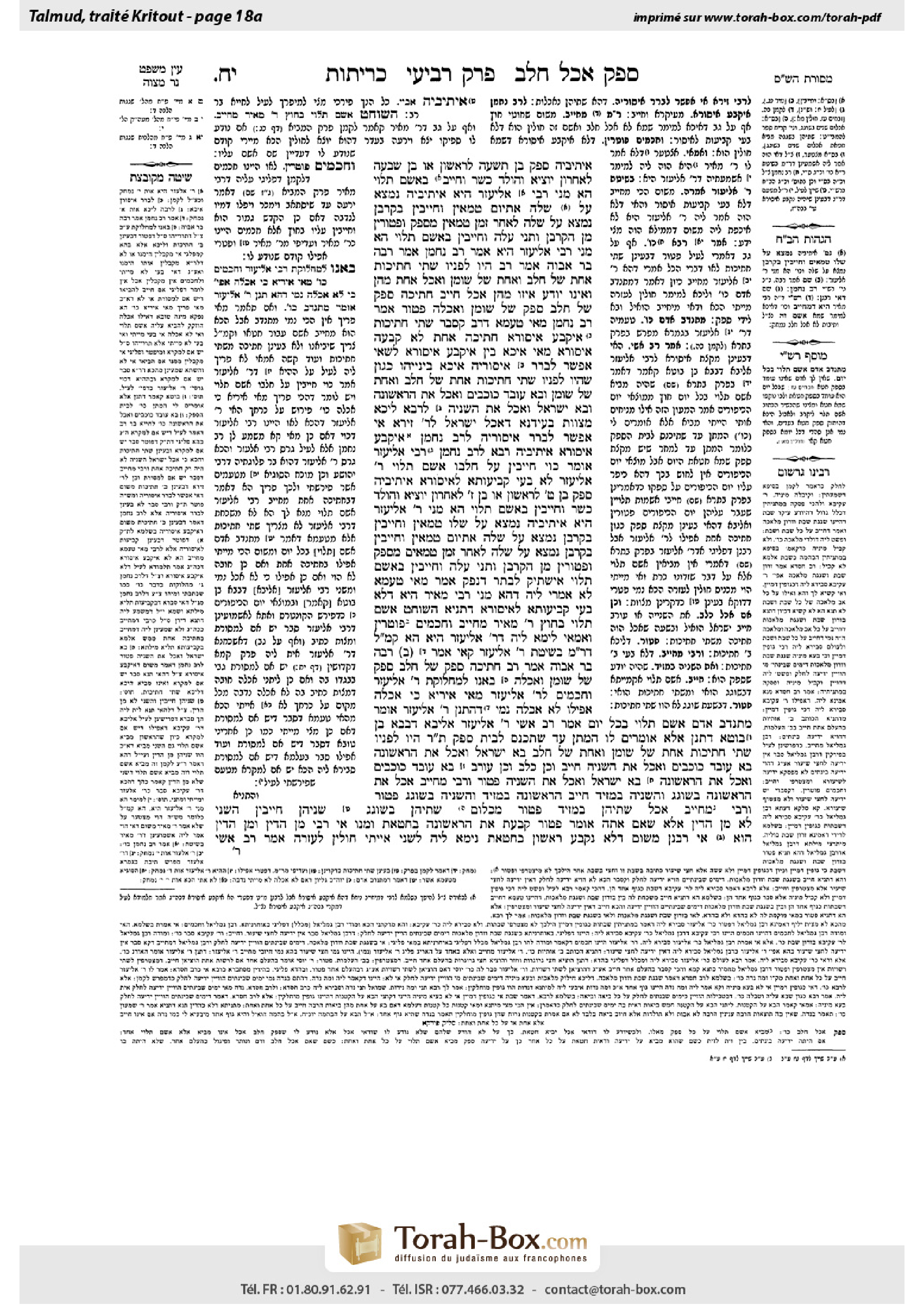
Keritot 18a: Talmud study for Daf Yomi
Daf Yomi is the daily study of one Talmud folio. Explore 37 tractates with scans, Hebrew text, Sefaria English and AI-generated French translations where annotated.
Passage selection and English or AI-generated French translation are available where the scan has annotations. Daf Study is independent of Torah-Box and Sefaria.
Browse Keritot · כריתות · All tractatesKeritot 18a text and translations
This page of Keritot includes the Aramaic text, an English translation and an AI-generated French translation, alongside the scan above.
כריתות י״ח א · Aramaic and Hebrew text
אֵיתִיבֵיהּ: סָפֵק בֶּן תִּשְׁעָה לָרִאשׁוֹן אוֹ בֶּן שִׁבְעָה לָאַחֲרוֹן – יוֹצִיא, וְהַוָּלָד כָּשֵׁר, וְחַיָּיב בְּאָשָׁם תָּלוּי. הָא מַנִּי? רַבִּי אֱלִיעֶזֶר הִיא.
אֵיתִיבֵיהּ: נִמְצָא עַל שֶׁלָּהּ אֹתְיוֹם – טְמֵאִין וְחַיָּיבִין בַּקׇּרְבָּן. נִמְצָא עַל שֶׁלָּהּ לְאַחַר זְמַן – טְמֵאִין מִסָּפֵק וּפְטוּרִין מִן הַקׇּרְבָּן. וְתָנֵי עֲלַהּ: וְחַיָּיבִין בְּאָשָׁם תָּלוּי! הָא מַנִּי? רַבִּי אֱלִיעֶזֶר הִיא.
אָמַר רַב נַחְמָן אָמַר רַבָּה בַּר אֲבוּהּ אָמַר רַב: הָיוּ לְפָנָיו שְׁתֵּי חֲתִיכוֹת, אַחַת שֶׁל חֵלֶב וְאַחַת שֶׁל שׁוּמָּן, וְאָכַל אַחַת מֵהֶן וְאֵינוֹ יוֹדֵעַ אֵיזוֹ מֵהֶן אָכַל – חַיָּיב. חֲתִיכָה, סָפֵק שֶׁל חֵלֶב סָפֵק שֶׁל שׁוּמָּן וַאֲכָלָהּ – פָּטוּר.
אָמַר רַב נַחְמָן: מַאי טַעְמָא דְּרַב? קָסָבַר: שְׁתֵּי חֲתִיכוֹת – אִיקְּבַע אִיסּוּרָא, חֲתִיכָה אַחַת – לָא (קָבְעָה) [אִיקְּבַע] אִיסּוּרָא.
מַאי אִיכָּא בֵּין אִיקְּבַע אִיסּוּרָא לְשֶׁאִי אֶפְשָׁר לְבָרֵר אִיסּוּרֵיהּ?
אִיכָּא בֵּינַיְיהוּ כְּגוֹן שֶׁהָיוּ לְפָנָיו שְׁתֵּי חֲתִיכוֹת, אַחַת שֶׁל חֵלֶב וְאַחַת שֶׁל שׁוּמָּן, וּבָא גּוֹי וְאָכַל אֶת הָרִאשׁוֹנָה, וּבָא יִשְׂרָאֵל וְאָכַל אֶת הַשְּׁנִיָּה, לְרָבָא – לֵיכָּא ״מִצְווֹת״ בְּעִידָּנָא דַּאֲכַל יִשְׂרָאֵל. לְרַבִּי זֵירָא – אִי אֶפְשָׁר לְבָרֵר אִיסּוּרֵיהּ. לְרַב נַחְמָן – אִיקְּבַע אִיסּוּרָא.
אֵיתִיבֵיהּ רָבָא לְרַב נַחְמָן: רַבִּי אֱלִיעֶזֶר אוֹמֵר: כּוֹי – חַיָּיבִין עַל חֶלְבּוֹ אָשָׁם תָּלוּי! רַבִּי אֱלִיעֶזֶר לָא בָּעֵי קְבִיעוּתָא לְאִיסּוּרָא.
אֵיתִיבֵיהּ: סָפֵק בֶּן תִּשְׁעָה לָרִאשׁוֹן, אוֹ בֶּן שִׁבְעָה לָאַחֲרוֹן – יוֹצִיא וְהַוָּלָד כָּשֵׁר, וְחַיָּיבִין בְּאָשָׁם תָּלוּי! הָא מַנִּי? רַבִּי אֱלִיעֶזֶר הִיא.
אֵיתִיבֵיהּ: נִמְצָא עַל שֶׁלּוֹ – טְמֵאִין וְחַיָּיבִין בַּקׇּרְבָּן, נִמְצָא עַל שֶׁלָּהּ אֹתְיוֹם – טְמֵאִין וְחַיָּיבִין בַּקׇּרְבָּן, נִמְצָא עַל שֶׁלָּהּ לְאַחַר זְמַן – טְמֵאִים מִסָּפֵק וּפְטוּרִין מִן הַקׇּרְבָּן, וְתָנֵי עֲלַהּ: וְחַיָּיבִין בְּאָשָׁם תָּלוּי!
אִישְׁתִּיק. לְבָתַר דִּנְפַק אֲמַר: מַאי טַעְמָא לָא אֲמַרִי לֵיהּ דְּהָא מַנִּי רַבִּי מֵאִיר הִיא, דְּלָא בָּעֵי קְבִיעוּתָא לְאִיסּוּרָא?
דְּתַנְיָא: הַשּׁוֹחֵט אָשָׁם תָּלוּי בַּחוּץ – רַבִּי מֵאִיר מְחַיֵּיב, וַחֲכָמִים פּוֹטְרִין.
וְאַמַּאי? לֵימָא לֵיהּ דְּרַבִּי אֱלִיעֶזֶר הִיא! הָא קָא מַשְׁמַע לַן, דְּרַבִּי מֵאִיר בְּשִׁיטַת רַבִּי אֱלִיעֶזֶר קָאֵי.
אָמַר רַבָּה בַּר אֲבוּהּ אָמַר רַב: חֲתִיכָה, סָפֵק שֶׁל חֵלֶב סָפֵק שֶׁל שׁוּמָּן, וַאֲכָלָהּ – בָּאנוּ לְמַחֲלוֹקֶת רַבִּי אֱלִיעֶזֶר וַחֲכָמִים.
לְרַבִּי אֱלִיעֶזֶר, מַאי אִירְיָא כִּי אַכְלַהּ? אֲפִילּוּ לָא אַכְלַהּ נָמֵי! דְּהָתְנַן: רַבִּי אֱלִיעֶזֶר אוֹמֵר: מִתְנַדֵּב אָדָם אָשָׁם תָּלוּי בְּכׇל יוֹם!
אָמַר רַב אָשֵׁי: רַבִּי אֱלִיעֶזֶר אַלִּיבָּא דְּבָבָא בֶּן בּוּטָא, דִּתְנַן: אֶלָּא אוֹמְרִים לוֹ: הַמְתֵּן עַד שֶׁתִּכָּנֵס לְבֵית סָפֵק.
תָּנוּ רַבָּנַן: הָיוּ לְפָנָיו שְׁתֵּי חֲתִיכוֹת, אַחַת שֶׁל שׁוּמָּן וְאַחַת שֶׁל חֵלֶב, בָּא יִשְׂרָאֵל וְאָכַל אֶת הָרִאשׁוֹנָה, בָּא גּוֹי וְאָכַל אֶת הַשְּׁנִיָּה – חַיָּיב, וְכֵן כֶּלֶב, וְכֵן עוֹרֵב. בָּא גּוֹי וְאָכַל אֶת הָרִאשׁוֹנָה, בָּא יִשְׂרָאֵל וְאָכַל אֶת הַשְּׁנִיָּה – פָּטוּר. וְרַבִּי מְחַיֵּיב.
אָכַל אֶת הָרִאשׁוֹנָה בְּשׁוֹגֵג, וְהַשְּׁנִיָּה בְּמֵזִיד – חַיָּיב. הָרִאשׁוֹנָה בְּמֵזִיד, וְהַשְּׁנִיָּה בְּשׁוֹגֵג – פָּטוּר, וְרַבִּי מְחַיֵּיב. אָכַל שְׁתֵּיהֶן בְּמֵזִיד – פָּטוּר מִכְּלוּם.
שְׁתֵּיהֶן בְּשׁוֹגֵג – שְׁנֵיהֶן חַיָּיבִין. הַשֵּׁנִי לֹא מִן הַדִּין, אֶלָּא שֶׁאִם אַתָּה אוֹמֵר פָּטוּר – קָבַעְתָּ אֶת הָרִאשׁוֹנָה בְּחַטָּאת.
וּמַנּוּ? אִי רַבִּי – מִן הַדִּין וּמִן הַדִּין הוּא! אִי רַבָּנַן – מִשּׁוּם דְּלֹא נִקְבַּע רִאשׁוֹן בְּחַטָּאת, נֵימָא לֵיהּ לְשֵׁנִי: אַיְיתִי חוּלִּין לָעֲזָרָה?! אָמַר רַב אָשֵׁי:
Keritot 18a · English translation
The Gemara raised an objection to Rabbi Zeira from a baraita: If one consummates a levirate marriage with his yevama and seven months later she gives birth, there is uncertainty whether the child is nine months old and is the offspring of the first husband, or whether the child is only seven months old and is the offspring of the latter husband, i.e., the yavam. In such a case he must divorce her, but the offspring is of unflawed lineage. And to atone for the possibility that they engaged in forbidden intercourse, they are each obligated to bring a provisional guilt offering. The Gemara answers: In accordance with whose opinion is this baraita? It is in accordance with the opinion of Rabbi Eliezer.
The Gemara raised another objection to Rabbi Zeira from a mishna (Nidda 14a): If blood was found on her cloth immediately after intercourse, the woman and her husband are impure for seven days and are each liable to bring a sin offering. If blood was found on her cloth after time passed, they are both impure due to uncertainty and they are exempt from bringing the sin offering. And it is taught with regard to this last case that they are each liable to bring a provisional guilt offering. The Gemara again answers: In accordance with whose opinion is this mishna? It is in accordance with the opinion of Rabbi Eliezer.
§ Rav Naḥman says that Rabba bar Avuh says that Rav says: In a case where one had two pieces of fat before him, one of permitted fat and one of forbidden fat, and he ate one of them and he does not know which of them he ate, he is obligated to bring a provisional guilt offering. But if there was only one piece before him and it was uncertain if it is of forbidden fat and uncertain if it is of permitted fat, and he ate it, he is exempt.
Rav Naḥman said: What is the reason for the opinion of Rav? He holds that one is liable in the case of two pieces because the prohibition was established, i.e., there was definitely a prohibited piece before him, and nevertheless he proceeded to eat one of them. By contrast, he is exempt in the case of one uncertain piece, as the prohibition was not established.
The Gemara asks: What difference is there between the reasoning for Rav’s opinion given by Rav Naḥman, that one is liable in the case of two pieces because the prohibition was established, and the reasoning given by Rabbi Zeira, that if there is one piece it is impossible to identify its prohibition?
The Gemara answers: The difference between them is in a case where someone had two pieces of fat before him, one of forbidden fat and one of permitted fat. And a gentile came and ate the first piece, and then a Jew came and ate the second piece. According to Rava he is exempt, because at the time when the Jew ate the uncertain piece there was only one piece present, which does not fulfill the requirement of two items, as derived from the word mitzvot in the verse. According to Rabbi Zeira he is exempt because it is impossible to identify its prohibition, as both pieces are gone. But according to Rav Naḥman he is liable to bring a provisional guilt offering, as the presence of a prohibition was established, i.e., there was definitely a forbidden piece there at one point.
Rava raised an objection to Rav Naḥman from a baraita. Rabbi Eliezer says: With regard to a koy, one is obligated to bring a provisional guilt offering for eating its fat. Rav Naḥman answered: Rabbi Eliezer does not require the prohibition to be established in order for one to be obligated to bring a provisional guilt offering.
Rava raised another objection to Rav Naḥman from a baraita: If one consummates a levirate marriage with his yevama and seven months later she gives birth, there is uncertainty whether the child is nine months old and is the offspring of the first husband, or whether the child is only seven months old and is the offspring of the latter husband, and therefore he must divorce her; but the offspring is of unflawed lineage. And they are each obligated to bring a provisional guilt offering. Once again, the Gemara responds: In accordance with whose opinion is this baraita? It is in accordance with the opinion of Rabbi Eliezer.
Rava raised a final objection to Rav Naḥman from a mishna: If blood was found on his cloth, the woman and her husband are both ritually impure for seven days and they are each liable to bring a sin offering. If blood was found on her cloth immediately after intercourse, they are impure for seven days and are each liable to bring a sin offering. If it was found on her cloth after time passed, they are both impure due to uncertainty and they are exempt from bringing the sin offering. And it is taught with regard to this last case that they each is liable to bring a provisional guilt offering.
When presented with this last objection, Rav Naḥman was silent and did not reply. After Rava left he said: What is the reason I did not say to him, i.e., I should have said to him, that in accordance with whose opinion is this mishna? It is in accordance with the opinion of Rabbi Meir, who does not require the prohibition to be established in order for one to be obligated to bring a provisional guilt offering.
As it is taught in a baraita: If one slaughters an animal designated as a provisional guilt offering outside the Temple, Rabbi Meir deems him obligated to bring a provisional guilt offering and the Rabbis deem him exempt. Rabbi Meir deems him obligated to bring a provisional guilt offering despite the fact that it is possible the owner of the first provisional guilt offering never violated any transgression and therefore was never obligated to bring his provisional guilt offering. This demonstrates that according to Rabbi Meir it is not necessary for the prohibition to be established for one to be obligated to bring a provisional guilt offering.
The Gemara asks: But why did Rav Naḥman say that he could have responded to Rava’s contradiction by claiming the mishna is in accordance with the opinion of Rabbi Meir? Let him say to him that the mishna is in accordance with the opinion of Rabbi Eliezer, as was the response to the previous objections. The Gemara explains that this is what Rav Naḥman is teaching us: That the reason for the ruling of Rabbi Meir is that he holds in accordance with the opinion of Rabbi Eliezer, who says an established prohibition is not required for one to be obligated in a provisional guilt offering.
§ Rabba bar Avuh says that Rav says: If there was a piece of fat before someone and it was uncertain if it is of forbidden fat and uncertain if it is of permitted fat, and he ate it, we have arrived at the dispute between Rabbi Eliezer and the Rabbis. In a mishna on 25a, Rabbi Eliezer states that one may bring a voluntary provisional guilt offering whenever he pleases. The Rabbis disagree and maintain that a provisional guilt offering may be brought only in a case of actual uncertainty whether one performed a sin for which he would be liable to bring a sin offering.
The Gemara asks: Why did Rav specifically choose a case where one ate the item of uncertain status in order to exemplify the opinion of Rabbi Eliezer? Even if he had not eaten anything, Rabbi Eliezer would also permit him to bring a provisional guilt offering, as we learned in the mishna that Rabbi Eliezer says: A person may volunteer to bring a provisional guilt offering every day.
Rav Ashi said: Rav mentioned a case involving the consumption of an item whose status is uncertain in order to teach the ruling of Rabbi Eliezer in accordance with the opinion of Bava ben Buta, as we learned in the mishna: They said about Bava ben Buta that he would volunteer to bring a provisional guilt offering every day except for the day after Yom Kippur, as Yom Kippur atones for all uncertain sins. He said: If they would have allowed me to do so I would have brought a provisional guilt offering even on that day. But they say to him: Wait until you enter into a situation of potential uncertainty. For this reason Rav presents a scenario where an item whose status is uncertain was consumed, in order to allow for the potential uncertainty that would justify bringing a provisional guilt offering.
§ The Sages taught in a baraita: In a case where one had before him two pieces of fat, one of permitted fat and one of forbidden fat, if a Jew came and ate the first piece and then a gentile came and ate the second, the Jew is liable to bring a provisional guilt offering. And the same applies if a dog ate the second piece and the same is true if a raven ate it. But if a gentile came and ate the first piece and then a Jew came and ate the second piece, the Jew is exempt, because at the time that he ate the uncertain piece there was only one item of uncertainty. And Rabbi Yehuda HaNasi deems him obligated to bring a provisional guilt offering, as he does not maintain that two items are required for one to be obligated to bring a provisional guilt offering.
The baraita continues: If the Jew ate the first piece unwittingly and the second intentionally, he is liable to bring a provisional guilt offering for the first piece. But if he ate the first piece intentionally and the second piece unwittingly, he is exempt, because at the time that he ate the second piece, only one piece was present. Rabbi Yehuda HaNasi deems him obligated to bring an offering. If he ate both of them intentionally, he is exempt from bringing anything.
The baraita concludes: If two Jews each ate one of two items, each of them unwittingly, each of them is liable to bring a provisional guilt offering, albeit for different reasons. The first is liable to bring a provisional guilt offering in case he ate the forbidden piece. By contrast, the second one is not strictly obligated by law, as he unwittingly ate the uncertain piece when there was no other piece present. Rather, the reason he is obligated is that if you say he is exempt, you have in effect established that the first individual is obligated to bring a sin offering. One might think that the second individual is exempt because he definitely ate the permitted piece, which would mean the first one ate the forbidden piece and he must therefore bring a sin offering.
The Gemara asks: And in accordance with whose opinion is this ruling? If it is in accordance with the opinion of Rabbi Yehuda HaNasi, why does the baraita say the second individual is obligated to bring a provisional guilt offering merely as a precaution and not by law? It is certainly by law that the second is obligated to bring a provisional guilt offering, as Rabbi Yehuda HaNasi maintains that one is obligated even for an uncertainty involving a single item. If it is in accordance with the Rabbis, can it be correct that merely in order to prevent a misunderstanding and ensure that we do not establish the first one as obligated to bring a sin offering, that we would say to the second individual: Bring and slaughter a non-sacred animal in the Temple courtyard? After all, he is not obligated to bring a provisional guilt offering. Rav Ashi said in response:
Keritot 18a · Traduction française (IA)
La Guemara soulève contre Rabbi Zeira une objection tirée d’une baraïta : si un homme contracte un mariage léviratique avec sa yevama et que celle-ci accouche sept mois plus tard, on ne sait pas si l’enfant a neuf mois et est issu du premier mari, ou s’il n’a que sept mois et est issu du second mari, c’est-à-dire du yavam. Dans ce cas, l’homme doit la répudier, mais l’enfant est de filiation irréprochable. Pour expier l’éventualité où ils auraient eu des rapports interdits, chacun d’eux est tenu d’apporter un sacrifice de culpabilité provisoire. La Guemara répond : Selon l’opinion de qui cette baraïta est-elle ? Elle est conforme à l’opinion de Rabbi Eliezer.
La Guemara soulève contre Rabbi Zeira une autre objection tirée d’une Michna (Nidda 14a) : si du sang est trouvé sur le linge de la femme immédiatement après un rapport, la femme et son mari sont impurs pendant sept jours et chacun est passible d’un sacrifice expiatoire. Si du sang est trouvé sur son linge après un certain délai, tous deux sont impurs en raison du doute et sont dispensés d’apporter le sacrifice expiatoire. Or, à propos de ce dernier cas, il est enseigné que chacun d’eux est tenu d’apporter un sacrifice de culpabilité provisoire. La Guemara répond de nouveau : Selon l’opinion de qui cette Michna est-elle ? Elle est conforme à l’opinion de Rabbi Eliezer.
§ Rav Naḥman dit que Rabba bar Avuh dit que Rav dit : si quelqu’un avait devant lui deux morceaux de graisse, l’un de graisse permise et l’autre de graisse interdite, et qu’il en a mangé un sans savoir lequel, il est tenu d’apporter un sacrifice de culpabilité provisoire. Mais s’il n’y avait devant lui qu’un seul morceau, dont on ne savait pas s’il s’agissait de graisse interdite ou de graisse permise, et qu’il l’a mangé, il est dispensé.
Rav Naḥman dit : Quelle est la raison de l’opinion de Rav ? Il estime que l’on est passible d’un sacrifice dans le cas des deux morceaux parce que l’interdiction était établie, c’est-à-dire qu’il y avait certainement devant lui un morceau interdit, et qu’il a néanmoins mangé l’un des deux. En revanche, il est dispensé dans le cas d’un seul morceau au statut incertain, car l’interdiction n’était pas établie.
La Guemara demande : Quelle différence y a-t-il entre la raison avancée par Rav Naḥman pour expliquer l’opinion de Rav — à savoir que l’on est passible dans le cas des deux morceaux parce que l’interdiction était établie — et celle avancée par Rabbi Zeira, selon laquelle, s’il n’y a qu’un seul morceau, il est impossible d’identifier l’interdiction qui le concerne ?
La Guemara répond : La différence entre eux apparaît dans le cas où quelqu’un avait devant lui deux morceaux de graisse, l’un de graisse interdite et l’autre de graisse permise. Un non-Juif vient et mange le premier morceau, puis un Juif vient et mange le second. Selon Rava, le Juif est dispensé, car, au moment où il a mangé le morceau au statut incertain, il ne restait qu’un seul morceau, ce qui ne satisfait pas à l’exigence de deux éléments, déduite du mot « mitsvot » dans le verset. Selon Rabbi Zeira, il est dispensé parce qu’il est impossible d’identifier l’interdiction qui le concerne, puisque les deux morceaux ont disparu. Mais selon Rav Naḥman, il est tenu d’apporter un sacrifice de culpabilité provisoire, car l’existence d’une interdiction était établie, c’est-à-dire qu’il y avait certainement eu là un morceau interdit.
Rava soulève contre Rav Naḥman une objection tirée d’une baraïta. Rabbi Eliezer dit : à propos d’un koy, on est tenu d’apporter un sacrifice de culpabilité provisoire si l’on mange sa graisse. Rav Naḥman répond : Rabbi Eliezer n’exige pas que l’interdiction soit établie pour que l’on soit tenu d’apporter un sacrifice de culpabilité provisoire.
Rava soulève contre Rav Naḥman une autre objection tirée d’une baraïta : si un homme contracte un mariage léviratique avec sa yevama et que celle-ci accouche sept mois plus tard, on ne sait pas si l’enfant a neuf mois et est issu du premier mari, ou s’il n’a que sept mois et est issu du second mari ; l’homme doit donc la répudier, mais l’enfant est de filiation irréprochable. Chacun d’eux est tenu d’apporter un sacrifice de culpabilité provisoire. Une fois encore, la Guemara répond : Selon l’opinion de qui cette baraïta est-elle ? Elle est conforme à l’opinion de Rabbi Eliezer.
Rava soulève contre Rav Naḥman une dernière objection tirée d’une Michna : si du sang est trouvé sur son linge, la femme et son mari sont tous deux rituellement impurs pendant sept jours et chacun est passible d’un sacrifice expiatoire. Si du sang est trouvé sur le linge de la femme immédiatement après un rapport, ils sont impurs pendant sept jours et chacun est passible d’un sacrifice expiatoire. Si du sang est trouvé sur son linge après un certain délai, tous deux sont impurs en raison du doute et sont dispensés d’apporter le sacrifice expiatoire. Or, à propos de ce dernier cas, il est enseigné que chacun d’eux est tenu d’apporter un sacrifice de culpabilité provisoire.
Face à cette dernière objection, Rav Naḥman garda le silence et ne répondit pas. Après le départ de Rava, il dit : Pourquoi ne lui ai-je pas répondu — j’aurais dû lui dire — : « Selon l’opinion de qui cette Michna est-elle ? Elle est conforme à l’opinion de Rabbi Meïr, qui n’exige pas que l’interdiction soit établie pour que l’on soit tenu d’apporter un sacrifice de culpabilité provisoire. »
Car il est enseigné dans une baraïta : si quelqu’un abat hors du Temple un animal désigné comme sacrifice de culpabilité provisoire, Rabbi Meïr estime qu’il est tenu d’apporter un sacrifice de culpabilité provisoire, tandis que les Sages l’en dispensent. Rabbi Meïr estime qu’il est tenu d’apporter un sacrifice de culpabilité provisoire bien qu’il soit possible que le propriétaire du premier sacrifice de culpabilité provisoire n’ait commis aucune transgression et n’ait donc jamais été tenu d’apporter ce sacrifice. Cela démontre que, selon Rabbi Meïr, il n’est pas nécessaire que l’interdiction soit établie pour être tenu d’apporter un sacrifice de culpabilité provisoire.
La Guemara demande : Mais pourquoi Rav Naḥman a-t-il dit qu’il aurait pu répondre à la contradiction soulevée par Rava en affirmant que la Michna est conforme à l’opinion de Rabbi Meïr ? Qu’il lui dise que la Michna est conforme à l’opinion de Rabbi Eliezer, comme il l’avait fait pour les objections précédentes. La Guemara explique que Rav Naḥman nous enseigne ceci : la raison de la décision de Rabbi Meïr est qu’il partage l’opinion de Rabbi Eliezer, qui affirme qu’il n’est pas nécessaire que l’interdiction soit établie pour être tenu d’apporter un sacrifice de culpabilité provisoire.
§ Rabba bar Avuh dit que Rav dit : si quelqu’un avait devant lui un morceau de graisse dont on ne savait pas s’il s’agissait de graisse interdite ou de graisse permise et qu’il l’a mangé, nous en arrivons à la controverse entre Rabbi Eliezer et les Sages. Dans une Michna en 25a, Rabbi Eliezer affirme que l’on peut apporter volontairement un sacrifice de culpabilité provisoire quand on le souhaite. Les Sages ne sont pas d’accord et soutiennent qu’un sacrifice de culpabilité provisoire ne peut être apporté que lorsqu’il existe un doute réel quant à la commission d’une faute passible d’un sacrifice expiatoire.
La Guemara demande : Pourquoi Rav a-t-il choisi un cas où quelqu’un a mangé un aliment au statut incertain pour illustrer l’opinion de Rabbi Eliezer ? Même s’il n’avait rien mangé, Rabbi Eliezer lui aurait également permis d’apporter un sacrifice de culpabilité provisoire, car nous avons appris dans la Michna que Rabbi Eliezer dit : « Une personne peut apporter volontairement un sacrifice de culpabilité provisoire chaque jour. »
Rav Ashi dit : Rav a mentionné un cas où l’on consomme un aliment au statut incertain afin d’enseigner la règle de Rabbi Eliezer conformément à l’opinion de Bava ben Buta, comme nous l’avons appris dans la Michna : on disait de Bava ben Buta qu’il apportait volontairement un sacrifice de culpabilité provisoire chaque jour, sauf le lendemain de Yom Kippour, car Yom Kippour expie toutes les fautes incertaines. Il disait : « Si l’on m’en avait donné l’autorisation, j’aurais apporté un sacrifice de culpabilité provisoire même ce jour-là. » Mais on lui disait : « Attends de te trouver dans une situation de doute potentiel. » C’est pourquoi Rav présente un cas où un aliment au statut incertain a été consommé, afin qu’existe le doute potentiel qui justifierait l’apport d’un sacrifice de culpabilité provisoire.
§ Les Sages ont enseigné dans une baraïta : si quelqu’un avait devant lui deux morceaux de graisse, l’un de graisse permise et l’autre de graisse interdite, et qu’un Juif vient manger le premier morceau, puis un non-Juif vient manger le second, le Juif est tenu d’apporter un sacrifice de culpabilité provisoire. Il en va de même si un chien mange le second morceau, ou si c’est un corbeau qui le mange. Mais si un non-Juif vient manger le premier morceau, puis un Juif vient manger le second, le Juif est dispensé, car, au moment où il a mangé le morceau au statut incertain, il ne restait qu’un seul élément de doute. Rabbi Yehuda HaNassi estime qu’il est tenu d’apporter un sacrifice de culpabilité provisoire, car il ne considère pas que deux éléments soient nécessaires pour être tenu d’en apporter un.
La baraïta poursuit : si le Juif a mangé le premier morceau par inadvertance et le second intentionnellement, il est tenu d’apporter un sacrifice de culpabilité provisoire pour le premier morceau. Mais s’il a mangé le premier morceau intentionnellement et le second par inadvertance, il est dispensé, car, au moment où il a mangé le second morceau, il n’y avait plus qu’un seul morceau. Rabbi Yehuda HaNassi estime qu’il est tenu d’apporter un sacrifice. S’il a mangé les deux morceaux intentionnellement, il est dispensé de toute offrande.
La baraïta conclut : si deux Juifs ont chacun mangé l’un des deux morceaux par inadvertance, chacun est tenu d’apporter un sacrifice de culpabilité provisoire, quoique pour des raisons différentes. Le premier est tenu d’en apporter un au cas où il aurait mangé le morceau interdit. En revanche, le second n’y est pas strictement tenu par la loi, puisqu’il a mangé par inadvertance le morceau au statut incertain alors qu’il ne restait aucun autre morceau. La raison pour laquelle il est néanmoins tenu d’en apporter un est que, si l’on disait qu’il en est dispensé, on aurait en fait établi que le premier individu est tenu d’apporter un sacrifice expiatoire. On pourrait penser que le second individu est dispensé parce qu’il a certainement mangé le morceau permis, ce qui signifierait que le premier a mangé le morceau interdit et doit donc apporter un sacrifice expiatoire.
La Guemara demande : Et selon l’opinion de qui cette décision est-elle ? Si elle est conforme à l’opinion de Rabbi Yehuda HaNassi, pourquoi la baraïta dit-elle que le second individu est tenu d’apporter un sacrifice de culpabilité provisoire par précaution, et non en vertu de la loi ? Le second est certainement tenu par la loi d’apporter un sacrifice de culpabilité provisoire, puisque Rabbi Yehuda HaNassi estime que l’on est tenu d’en apporter un même en cas de doute concernant un seul élément. Si elle est conforme à l’opinion des Sages, peut-on vraiment dire que, simplement pour éviter un malentendu et ne pas établir que le premier est tenu d’apporter un sacrifice expiatoire, nous dirions au second individu : « Apporte et égorge un animal non consacré dans la cour du Temple » ? Après tout, il n’est pas tenu d’apporter un sacrifice de culpabilité provisoire. Rav Ashi répondit :
Traduction française générée par IA à partir de l’édition anglaise de Sefaria. Vérifie toujours un passage avec le texte source.
Text from Sefaria: William Davidson Edition - Vocalized Aramaic (CC BY NC); William Davidson Edition - English (CC BY NC).