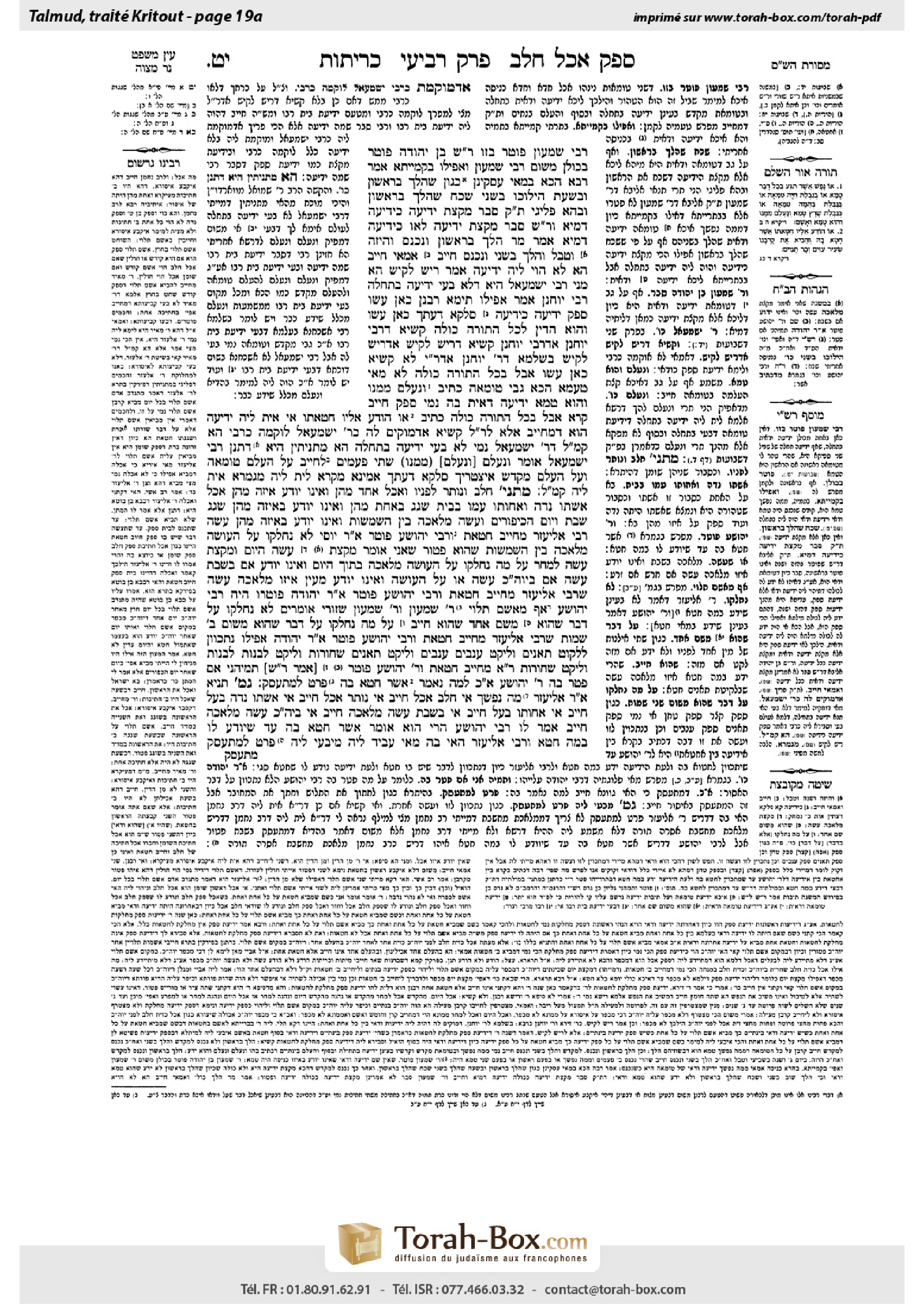
Keritot 19a: Talmud study for Daf Yomi
Daf Yomi is the daily study of one Talmud folio. Explore 37 tractates with scans, Hebrew text, Sefaria English and AI-generated French translations where annotated.
Passage selection and English or AI-generated French translation are available where the scan has annotations. Daf Study is independent of Torah-Box and Sefaria.
Browse Keritot · כריתות · All tractatesKeritot 19a text and translations
This page of Keritot includes the Aramaic text, an English translation and an AI-generated French translation, alongside the scan above.
כריתות י״ט א · Aramaic and Hebrew text
רַבִּי שִׁמְעוֹן פּוֹטֵר בָּזוֹ. רַבִּי שִׁמְעוֹן בֶּן יְהוּדָה פּוֹטֵר בְּכוּלָּן מִשּׁוּם רַבִּי שִׁמְעוֹן.
וַאֲפִילּוּ בְּקַמַּיְיתָא? אָמַר רָבָא: הָכָא בְמַאי עָסְקִינַן? כְּגוֹן שֶׁהָלַךְ בָּרִאשׁוֹן וּבִשְׁעַת הִילּוּכוֹ בַּשֵּׁנִי שָׁכַח שֶׁהָלַךְ בָּרִאשׁוֹן, וּבְהָא פְּלִיגִי, תַּנָּא קַמָּא סָבַר: מִקְצָת יְדִיעָה כִּידִיעָה דָּמְיָא, וְרַבִּי שִׁמְעוֹן סָבַר: מִקְצָת יְדִיעָה לָאו כִּידִיעָה דָּמְיָא.
אָמַר מָר: הָלַךְ בָּרִאשׁוֹן וְנִכְנַס, וְהִיזָּה וְטָבַל, וְהָלַךְ בַּשֵּׁנִי וְנִכְנַס – חַיָּיב. אַמַּאי חַיָּיב? הָא לָא הֲוַי לֵיהּ יְדִיעָה!
אָמַר רֵישׁ לָקִישׁ: הָא מַנִּי – רַבִּי יִשְׁמָעֵאל הִיא, דְּלָא בָּעֵי יְדִיעָה בַּתְּחִלָּה. רַבִּי יוֹחָנָן אָמַר: אֲפִילּוּ תֵּימָא רַבָּנַן, כָּאן עָשׂוּ סְפֵק יְדִיעָה כִּידִיעָה.
סָלְקָא דַעְתָּךְ: כָּאן עָשׂוּ, וְהוּא הַדִּין לְכׇל הַתּוֹרָה כּוּלָּהּ, קַשְׁיָא דְּרַבִּי יוֹחָנָן אַדְּרַבִּי יוֹחָנָן.
קַשְׁיָא דְּרֵישׁ לָקִישׁ אַדְּרֵישׁ לָקִישׁ.
בִּשְׁלָמָא דְּרַבִּי יוֹחָנָן אַדְּרַבִּי יוֹחָנָן לָא קַשְׁיָא: כָּאן עָשׂוּ, אֲבָל בְּכׇל הַתּוֹרָה כּוּלָּהּ – לָא,
מַאי טַעְמָא? הָכָא, גַּבֵּי טוּמְאָה כְּתִיב: ״וְנֶעְלַם מִמֶּנּוּ וְהוּא טָמֵא״ – יְדִיעָה דְּאִית בַּהּ נָמֵי סָפֵק חַיָּיב קְרָא, אֲבָל בְּכׇל הַתּוֹרָה כּוּלָּהּ כְּתִיב: ״אוֹ הוֹדַע אֵלָיו חַטָּאתוֹ״ – אִי אִית לֵיהּ יְדִיעָה הוּא דְּמִחַיַּיב.
אֶלָּא לְרֵישׁ לָקִישׁ קַשְׁיָא, אַדְּמוֹקֵים לַהּ כְּרַבִּי יִשְׁמָעֵאל, לוֹקְמַהּ כְּרַבִּי! הָא קָא מַשְׁמַע לַן דְּרַבִּי יִשְׁמָעֵאל נָמֵי לָא בָּעֵי יְדִיעָה בַּתְּחִלָּה.
הָא מַתְנִיתִין הִיא! דִּתְנַן, רַבִּי יִשְׁמָעֵאל אוֹמֵר: ״וְנֶעְלַם מִמֶּנּוּ״ שְׁתֵּי פְּעָמִים – לְחַיֵּיב עַל הֶעְלֵם טוּמְאָה וְעַל הֶעְלֵם מִקְדָּשׁ!
אִיצְטְרִיךְ, סָלְקָא דַעְתָּךְ אֲמִינָא: מִקְרָא לֵית לֵיהּ, מִגְּמָרָא אִית לֵיהּ, קָא מַשְׁמַע לַן.
מַתְנִי׳ חֵלֶב וְנוֹתָר לְפָנָיו, וְאָכַל אֶחָד מֵהֶן וְאֵינוֹ יוֹדֵעַ אֵיזֶה מֵהֶן אָכַל, אִשְׁתּוֹ נִדָּה וַאֲחוֹתוֹ עִמּוֹ בַּבַּיִת, שָׁגַג בְּאַחַת מֵהֶן וְאֵינוֹ יוֹדֵעַ בְּאֵיזֶה מֵהֶן שָׁגַג, שַׁבָּת וְיוֹם הַכִּיפּוּרִים, וְעָשָׂה מְלָאכָה בֵּין הַשְּׁמָשׁוֹת וְאֵינוֹ יוֹדֵעַ בְּאֵיזֶה מֵהֶן עָשָׂה – רַבִּי אֱלִיעֶזֶר מְחַיֵּיב חַטָּאת, וְרַבִּי יְהוֹשֻׁעַ פּוֹטֵר.
אָמַר רַבִּי יוֹסֵי: לֹא נֶחְלְקוּ עַל הָעוֹשֶׂה מְלָאכָה בֵּין הַשְּׁמָשׁוֹת שֶׁהוּא פָּטוּר, שֶׁאֲנִי אוֹמֵר: מִקְצָת עָשָׂה הַיּוֹם וּמִקְצָת עָשָׂה לְמָחָר.
עַל מָה נֶחְלְקוּ? עַל הָעוֹשֶׂה מְלָאכָה בְּתוֹךְ הַיּוֹם וְאֵינוֹ יוֹדֵעַ אִם בְּשַׁבָּת עָשָׂה אִם בְּיוֹם הַכִּפּוּרִים עָשָׂה, אוֹ עַל הָעוֹשֶׂה וְאֵינוֹ יוֹדֵעַ מֵעֵין אֵיזוֹ מְלָאכָה עָשָׂה. שֶׁרַבִּי אֱלִיעֶזֶר מְחַיֵּיב חַטָּאת, וְרַבִּי יְהוֹשֻׁעַ פּוֹטֵר. אָמַר רַבִּי יְהוּדָה: פּוֹטְרוֹ הָיָה רַבִּי יְהוֹשֻׁעַ אַף מֵאָשָׁם תָּלוּי.
רַבִּי שִׁמְעוֹן וְרַבִּי שִׁמְעוֹן שֵׁזוּרִי אוֹמְרִים: לֹא נֶחְלְקוּ עַל דָּבָר שֶׁהוּא מִשֵּׁם אֶחָד שֶׁהוּא חַיָּיב, עַל מָה נֶחְלְקוּ – עַל דָּבָר שֶׁהוּא מִשּׁוּם שְׁנֵי שֵׁמוֹת, שֶׁרַבִּי אֱלִיעֶזֶר מְחַיֵּיב חַטָּאת, וְרַבִּי יְהוֹשֻׁעַ פּוֹטֵר.
אָמַר רַבִּי יְהוּדָה: אֲפִילּוּ נִתְכַּוֵּון לִלְקוֹט תְּאֵנִים וְלִיקֵּט עֲנָבִים, עֲנָבִים וְלִיקֵּט תְּאֵנִים, שְׁחוֹרוֹת וְלִיקֵּט לְבָנוֹת, לְבָנוֹת וְלִיקֵּט שְׁחוֹרוֹת – רַבִּי אֱלִיעֶזֶר מְחַיֵּיב חַטָּאת, וְרַבִּי יְהוֹשֻׁעַ פּוֹטֵר. תְּמֵיהַנִי אִם פָּטַר בָּהּ רַבִּי יְהוֹשֻׁעַ. אִם כֵּן, לָמָּה נֶאֱמַר ״אֲשֶׁר חָטָא בָּהּ״? פְּרָט לַמִּתְעַסֵּק.
גְּמָ׳ תַּנְיָא, אָמַר רַבִּי אֱלִיעֶזֶר: מָה נַפְשָׁךְ? אִי חֵלֶב אָכַל – חַיָּיב, אִי נוֹתָר אָכַל – חַיָּיב! אִי אִשְׁתּוֹ נִדָּה בָּעַל – חַיָּיב, אִי אֲחוֹתוֹ בָּעַל – חַיָּיב! אִי בְּשַׁבָּת עָשָׂה מְלָאכָה – חַיָּיב, אִי בְּיוֹם הַכִּפּוּרִים עָשָׂה מְלָאכָה – חַיָּיב!
אָמַר לוֹ רַבִּי יְהוֹשֻׁעַ: הֲרֵי הוּא אוֹמֵר ״אֲשֶׁר חָטָא בָּהּ״ – עַד שֶׁיִּוָּדַע לוֹ בַּמֶּה חָטָא. וְרַבִּי אֱלִיעֶזֶר, הַאי ״בָּהּ״ מַאי עָבֵיד לֵיהּ? מִיבְּעֵי לֵיהּ: פְּרָט לַמִּתְעַסֵּק.
Keritot 19a · English translation
The baraita continues by citing a dispute concerning Rabbi Shimon’s opinion. Rabbi Shimon exempts him from the obligation to bring an offering in this particular case. Since he became pure in between, at no point did he have definite knowledge that he was impure. For one to be liable to bring an offering for entering the Temple in a state of ritual impurity he must have knowledge of the impurity at the beginning and the end, and a lack of knowledge in the middle. Rabbi Shimon ben Yehuda deems him exempt from the obligation to bring an offering in all of those cases, and he reports this opinion in the name of Rabbi Shimon.
Before explaining the contradictions between the opinions of Rabbi Yoḥanan and Reish Lakish, the Gemara asks a question about Rabbi Shimon ben Yehuda’s statement: Can it be that Rabbi Shimon holds that one is exempt even in the first case? Since he walked down both paths prior to entering the Temple, he had definite knowledge of his impure status. Rava said: What are we dealing with here? We are dealing with a case where he walked on the first path, and at the time of his walking on the second path he forgot that he had previously walked on the first path. Consequently, the knowledge that would render him liable to bring a sin offering is incomplete. And it is with regard to this point that they disagree: The first tanna holds that partial knowledge is considered like full knowledge, and Rabbi Shimon holds that partial knowledge is not considered like full knowledge.
The Gemara returns to discuss the contradictions for which it cited this baraita. The Master said: If he walked on the first path and entered the Temple, and then he received the sprinkling of the ashes of the red heifer on the third and seventh days, and immersed, and subsequently walked on the second path and entered the Temple, he is liable to bring a sin offering. The Gemara asks: Why is he liable? After all, he did not have definite knowledge of his ritual impurity each time he entered the Temple. Although it is certain that after walking on the second path he had contracted ritual impurity at some point, as he had been purified in between, there was no specific point at which he had knowledge of definite impurity.
Reish Lakish said: In accordance with whose opinion is this baraita? It is in accordance with the opinion of Rabbi Yishmael, who does not require knowledge at the outset, before an unwitting transgression, in order to render one liable to bring a sin offering. Rabbi Yoḥanan said: You may even say that it is in accordance with the opinion of the Rabbis, who maintain that definite knowledge is necessary to render one liable to bring a sin offering, as here they rendered uncertain knowledge like full knowledge.
The Gemara explains the contradiction: It enters your mind to say that Rabbi Yoḥanan meant that here they rendered uncertain knowledge like full knowledge, and the same is true for the entire Torah. Therefore, it is difficult, as there is an apparent contradiction between the statement of Rabbi Yoḥanan above and this statement of Rabbi Yoḥanan. Here, Rabbi Yoḥanan says that uncertain knowledge is considered like full knowledge, whereas earlier he stated that uncertain knowledge, unlike full knowledge, does not divide separate unwitting transgressions to render one obligated to bring multiple sin offerings.
And likewise it is difficult with regard to the apparent contradiction between the statement of Reish Lakish earlier and the statement of Reish Lakish here. Reish Lakish previously stated that Rabbi Yehuda HaNasi maintains that uncertain knowledge divides unwitting transgressions to render one obligated to bring separate sin offerings, whereas here he explains that the baraita is in accordance with the opinion of Rabbi Yishmael, not Rabbi Yehuda HaNasi.
The Gemara comments: Granted, the apparent contradiction between one statement of Rabbi Yoḥanan and the other statement of Rabbi Yoḥanan is not difficult. One can answer that when he said: Here they rendered uncertain knowledge like full knowledge, he meant specifically here, but with regard to the entire Torah it is not considered like full knowledge.
The Gemara asks: What is the reason that this particular case is an exception? Here, with regard to ritual impurity, it is written: “Or if anyone touch any impure thing…and it was concealed from him that he is impure” (Leviticus 5:2). This indicates that even when one has knowledge that has an uncertainty to it, the verse renders him obligated to bring an offering. But with regard to the rest of the entire Torah it is written: “If his sin, which he has sinned, be known to him” (Leviticus 4:28). This teaches that it is only if he has full knowledge that he is obligated to bring an offering.
But the contradiction between one statement of Reish Lakish and the other statement of Reish Lakish is difficult: Instead of interpreting the baraita in accordance with the opinion of Rabbi Yishmael, he should interpret it in accordance with the opinion of Rabbi Yehuda HaNasi. The Gemara answers: This is what Reish Lakish is teaching us by establishing the baraita in accordance with Rabbi Yishmael: That Rabbi Yishmael also does not require knowledge at the outset, before an unwitting transgression, in order to render one liable to bring a sin offering.
The Gemara objects: But that is already taught explicitly in a mishna, as we learned (Shevuot 14b) that Rabbi Yishmael says: The verse states: “It was concealed from him” (Leviticus 5:2–3), twice. One mention of the phrase serves to render one obligated to bring a sin offering for a lapse of awareness of his state of ritual impurity when he entered the Temple, and the other mention of the phrase teaches that he is obligated to bring a sin offering for a lapse of awareness during which he forgot that the building he was entering while impure was the Temple. Since this is the same verse that is the source for the requirement of knowledge at the outset, evidently Rabbi Yishmael disagrees with this opinion, as he derives a different halakha from the verse.
The Gemara explains: It was necessary for Reish Lakish to state that Rabbi Yishmael does not require knowledge at the outset, as it might enter your mind to say: Although Rabbi Yishmael has no verse from which he could derive this requirement, perhaps he has a tradition with regard to the requirement of prior knowledge. By establishing that the baraita is in accordance with the opinion of Rabbi Yishmael, Reish Lakish teaches us conclusively that Rabbi Yishmael does not require knowledge at the outset.
MISHNA: If one has pieces of forbidden fat and notar before him and he ate one of them and he does not know which of them he ate; or if his menstruating wife and his sister were with him in the house and he unwittingly engaged in intercourse with one of them and he does not know with which of them he unwittingly engaged in intercourse; or if Shabbat and Yom Kippur occurred adjacent to one another and he performed prohibited labor during the intervening twilight period and he does not know on which of the days he performed the labor, in all of these cases, Rabbi Eliezer deems the transgressor liable to bring a sin offering, as he certainly sinned, and Rabbi Yehoshua deems the transgressor exempt, as he does not know the nature of his sin.
Rabbi Yosei said: Rabbi Eliezer and Rabbi Yehoshua did not disagree with regard to one who performs prohibited labor during the intervening twilight period because they concur that he is exempt, as I say: He performed part of the labor today, and he performed part of the labor the following day.
With regard to what case did they disagree? With regard to the case of one who performs prohibited labor in the midst of the day, and he does not know whether it was on Shabbat that he performed the labor or whether it was on Yom Kippur that he performed the labor; or with regard to one who performs a prohibited labor and he does not know which labor he performed. As, in those cases Rabbi Eliezer deems him liable to bring a sin offering and Rabbi Yehoshua deems him exempt. Rabbi Yehuda said: Rabbi Yehoshua would deem him exempt even from bringing a provisional guilt offering.
Rabbi Shimon and Rabbi Shimon Shezuri say: Rabbi Eliezer and Rabbi Yehoshua did not disagree with regard to a case involving a matter where his lack of knowledge involves items from one category, e.g., he picked a grape from a vine on Shabbat and does not know which vine it was, as in that case they both agree that he is liable, since he knows the nature of his sin. With regard to what case did they disagree? With regard to a case involving a matter where his lack of knowledge involves items from two categories, e.g., he picked fruit from a tree on Shabbat and does not know whether it was from a vine or from a fig tree. As, in that case Rabbi Eliezer deems him liable to bring a sin offering, since he certainly sinned, and Rabbi Yehoshua deems him exempt, as he does not know the nature of his sin.
Rabbi Yehuda said: Even if one intended to pick figs and he picked grapes, or to pick grapes and he picked figs, or to pick black figs and he picked white figs, or to pick white figs and he picked black figs, Rabbi Eliezer deems him liable to bring a sin offering and Rabbi Yehoshua deems him exempt. Rabbi Yehuda added: I wonder if Rabbi Yehoshua deemed him exempt in that case, as even in his opinion the person intended to perform a prohibited labor. The mishna asks: If it is so, that he is not exempt according to Rabbi Yehuda, why is it stated: “If his sin, wherein he has sinned” (Leviticus 4:23), from which it is derived that one is liable only if the object of the sin was the one that he intended? The mishna answers: This serves to exclude one who acts unawares and does not intend to perform a prohibited action at all.
GEMARA: With regard to the first clause of the mishna and the dispute between Rabbi Eliezer and Rabbi Yehoshua, it is taught in a baraita that Rabbi Eliezer says: Whichever way you look at it he is liable to bring a sin offering. If it was forbidden fat that he ate, he is liable; and if it was notar that he ate, he is also liable. If it was with his menstruating wife that he engaged in intercourse, he is liable; and if it was with his sister that he engaged in intercourse, he is also liable. If it was on Shabbat that he performed the forbidden labor, he is liable; and if it was on Yom Kippur that he performed the labor, he is also liable. The result of any one of these scenarios is that he is liable to bring a sin offering.
Rabbi Yehoshua said to him in response: The verse states: “If his sin, which he has sinned, be known to him, he shall bring for his offering a goat, a male without blemish” (Leviticus 4:23). It is derived from the phrase: “Wherein he has sinned,” that he is not liable until it becomes known to him specifically with which item he sinned. The Gemara asks: And as for Rabbi Eliezer, what does he do with this phrase: “Which he has sinned”? The Gemara answers: He requires it for the halakha that only one who is aware of his action is liable, as this phrase excludes one who acts unawares and inadvertently commits a transgression.
Keritot 19a · Traduction française (IA)
La baraïta poursuit en citant une controverse au sujet de l’opinion de Rabbi Shimon. Rabbi Shimon l’exempte de l’obligation d’apporter un sacrifice dans ce cas précis. Puisqu’il est redevenu pur entre-temps, il n’a jamais eu la certitude d’être impur. Pour être passible d’un sacrifice expiatoire pour être entré dans le Temple en état d’impureté rituelle, il faut avoir eu connaissance de son impureté au début et à la fin, mais ne pas en avoir eu connaissance au milieu. Rabbi Shimon ben Yehuda l’exempte de l’obligation d’apporter un sacrifice dans tous ces cas, et rapporte cette opinion au nom de Rabbi Shimon.
Avant d’expliquer les contradictions entre les opinions de Rabbi Yoḥanan et de Reish Lakish, la Guemara interroge au sujet de la déclaration de Rabbi Shimon ben Yehuda : Est-il possible que Rabbi Shimon considère qu’il est exempt même dans le premier cas ? Puisqu’il a emprunté les deux chemins avant d’entrer dans le Temple, il savait avec certitude qu’il était impur. Rava dit : De quel cas s’agit-il ici ? D’un cas où il a emprunté le premier chemin et où, au moment d’emprunter le second, il avait oublié qu’il avait auparavant emprunté le premier. Par conséquent, la connaissance qui le rendrait passible d’apporter un sacrifice expiatoire est incomplète. C’est sur ce point qu’ils sont en désaccord : le premier tanna considère qu’une connaissance partielle équivaut à une connaissance complète, tandis que Rabbi Shimon considère qu’une connaissance partielle n’équivaut pas à une connaissance complète.
La Guemara revient sur les contradictions à propos desquelles elle a cité cette baraïta. Le Maître a dit : S’il a emprunté le premier chemin et est entré dans le Temple, puis a reçu l’aspersion des cendres de la vache rousse les troisième et septième jours, s’est immergé, puis a emprunté le second chemin et est entré dans le Temple, il est passible d’apporter un sacrifice expiatoire. La Guemara demande : Pourquoi en est-il passible ? Après tout, il n’avait pas la certitude d’être impur lors de chacune de ses entrées dans le Temple. Bien qu’il soit certain qu’après avoir emprunté le second chemin, il a contracté l’impureté rituelle à un moment donné, puisqu’il avait été purifié entre-temps, il n’y a eu aucun moment précis où il savait avec certitude qu’il était impur.
Reish Lakish dit : Selon l’opinion de qui cette baraïta a-t-elle été enseignée ? Selon celle de Rabbi Yishmael, qui n’exige pas de connaissance préalable, avant une transgression involontaire, pour rendre quelqu’un passible d’apporter un sacrifice expiatoire. Rabbi Yoḥanan dit : On peut même dire qu’elle est conforme à l’opinion des Sages, qui soutiennent qu’une connaissance certaine est nécessaire pour rendre quelqu’un passible d’apporter un sacrifice expiatoire, car ici, ils ont considéré une connaissance incertaine comme une connaissance complète.
La Guemara explique la contradiction : On pourrait penser que Rabbi Yoḥanan voulait dire qu’ici, ils ont considéré une connaissance incertaine comme une connaissance complète, et qu’il en va de même dans toute la Torah. La difficulté est donc qu’il semble y avoir une contradiction entre cette déclaration de Rabbi Yoḥanan et celle qu’il a faite précédemment. Ici, Rabbi Yoḥanan dit qu’une connaissance incertaine est considérée comme une connaissance complète, tandis que précédemment, il a déclaré qu’une connaissance incertaine, contrairement à une connaissance complète, ne sépare pas les transgressions involontaires successives de manière à rendre quelqu’un passible de plusieurs sacrifices expiatoires.
De même, il est difficile de résoudre la contradiction apparente entre la déclaration antérieure de Reish Lakish et celle-ci. Reish Lakish avait précédemment déclaré que Rabbi Yehuda HaNasi soutient qu’une connaissance incertaine sépare les transgressions involontaires, de sorte qu’on est passible de sacrifices expiatoires distincts ; ici, en revanche, il explique que la baraïta est conforme à l’opinion de Rabbi Yishmael, et non à celle de Rabbi Yehuda HaNasi.
La Guemara fait remarquer : Certes, la contradiction apparente entre les deux déclarations de Rabbi Yoḥanan n’est pas difficile. On peut répondre que lorsqu’il a dit : « Ici, ils ont considéré une connaissance incertaine comme une connaissance complète », il voulait dire que cela vaut précisément dans ce cas, mais que, dans le reste de la Torah, une connaissance incertaine n’est pas considérée comme une connaissance complète.
La Guemara demande : Pourquoi ce cas particulier fait-il exception ? Ici, au sujet de l’impureté rituelle, il est écrit : « Ou si quelqu’un touche une chose impure… et qu’il lui était caché qu’il était impur » (Lévitique 5:2). Cela indique que même lorsqu’on a une connaissance incertaine, le verset le rend passible d’apporter un sacrifice. En revanche, pour le reste de la Torah, il est écrit : « Si le péché qu’il a commis lui est connu » (Lévitique 4:28). Cela enseigne qu’il n’est passible d’apporter un sacrifice que s’il en a une connaissance complète.
Mais la contradiction entre les deux déclarations de Reish Lakish est difficile à résoudre : au lieu d’interpréter la baraïta selon l’opinion de Rabbi Yishmael, il aurait dû l’interpréter selon celle de Rabbi Yehuda HaNasi. La Guemara répond : En établissant que la baraïta est conforme à l’opinion de Rabbi Yishmael, Reish Lakish nous enseigne ceci : Rabbi Yishmael lui non plus n’exige pas de connaissance préalable, avant une transgression involontaire, pour rendre quelqu’un passible d’apporter un sacrifice expiatoire.
La Guemara objecte : Mais cela est déjà enseigné explicitement dans une Michna, car nous avons appris (Shevuot 14b) que Rabbi Yishmael dit : Le verset mentionne deux fois : « Il lui était caché » (Lévitique 5:2–3). L’une de ces mentions rend quelqu’un passible d’apporter un sacrifice expiatoire pour ne pas avoir eu connaissance de son état d’impureté rituelle lorsqu’il est entré dans le Temple ; l’autre lui enseigne qu’il est passible d’apporter un sacrifice expiatoire pour avoir oublié que le bâtiment où il entrait en état d’impureté était le Temple. Puisque c’est ce même verset qui fonde l’exigence d’une connaissance préalable, il est manifeste que Rabbi Yishmael est en désaccord avec cette opinion, car il déduit du verset une autre halakha.
La Guemara explique : Il était nécessaire que Reish Lakish précise que Rabbi Yishmael n’exige pas de connaissance préalable, car on aurait pu penser : bien que Rabbi Yishmael ne dispose d’aucun verset dont il puisse déduire cette exigence, peut-être a-t-il reçu une tradition concernant l’exigence d’une connaissance préalable. En établissant que la baraïta est conforme à l’opinion de Rabbi Yishmael, Reish Lakish nous enseigne de façon concluante que Rabbi Yishmael n’exige pas de connaissance préalable.
MICHNA : Si quelqu’un a devant lui des morceaux de graisse interdite et de notar et qu’il en mange un sans savoir lequel ; ou si sa femme en période de menstruation et sa sœur se trouvent avec lui dans la maison et qu’il a involontairement des relations avec l’une d’elles sans savoir laquelle ; ou si Chabbat et Yom Kippour se succèdent et qu’il accomplit un travail interdit pendant le crépuscule qui les sépare sans savoir quel jour il l’a accompli, dans tous ces cas, Rabbi Eliezer le déclare passible d’apporter un sacrifice expiatoire, puisqu’il a certainement transgressé, tandis que Rabbi Yehoshua l’en exempte, puisqu’il ne connaît pas la nature de sa faute.
Rabbi Yosei dit : Rabbi Eliezer et Rabbi Yehoshua ne sont pas en désaccord au sujet de celui qui accomplit un travail interdit pendant le crépuscule qui sépare les deux jours, car ils conviennent qu’il est exempt ; en effet, je considère qu’il a accompli une partie du travail aujourd’hui et une partie le lendemain.
Sur quel cas sont-ils en désaccord ? Sur celui qui accomplit un travail interdit au milieu de la journée sans savoir s’il l’a accompli le Chabbat ou à Yom Kippour ; ou sur celui qui accomplit un travail interdit sans savoir de quel travail il s’agissait. Dans ces cas, Rabbi Eliezer le déclare passible d’apporter un sacrifice expiatoire, tandis que Rabbi Yehoshua l’en déclare exempt. Rabbi Yehuda dit : Rabbi Yehoshua le déclarerait exempt même de l’obligation d’apporter un sacrifice de culpabilité provisoire.
Rabbi Shimon et Rabbi Shimon Shezuri disent : Rabbi Eliezer et Rabbi Yehoshua ne sont pas en désaccord lorsqu’il s’agit d’un cas où l’incertitude porte sur des éléments d’une seule catégorie, par exemple s’il a cueilli du raisin sur une vigne le Chabbat sans savoir sur quelle vigne, car ils conviennent tous deux qu’il est passible, puisqu’il connaît la nature de sa faute. Sur quel cas sont-ils en désaccord ? Sur un cas où l’incertitude porte sur des éléments de deux catégories, par exemple s’il a cueilli un fruit d’un arbre le Chabbat sans savoir s’il venait d’une vigne ou d’un figuier. Dans ce cas, Rabbi Eliezer le déclare passible d’apporter un sacrifice expiatoire, puisqu’il a certainement transgressé, tandis que Rabbi Yehoshua l’en déclare exempt, puisqu’il ne connaît pas la nature de sa faute.
Rabbi Yehuda dit : Même si quelqu’un avait l’intention de cueillir des figues et a cueilli des raisins, ou avait l’intention de cueillir des raisins et a cueilli des figues, ou avait l’intention de cueillir des figues noires et a cueilli des figues blanches, ou avait l’intention de cueillir des figues blanches et a cueilli des figues noires, Rabbi Eliezer le déclare passible d’apporter un sacrifice expiatoire, tandis que Rabbi Yehoshua l’en déclare exempt. Rabbi Yehuda ajoute : Je m’étonne que Rabbi Yehoshua l’ait déclaré exempt dans ce cas, car même selon son opinion, la personne avait l’intention d’accomplir un travail interdit. La Michna demande : Si c’est ainsi, pourquoi est-il dit : « Si le péché qu’il a commis » (Lévitique 4:23), d’où l’on déduit qu’on n’est passible que si l’objet de la faute était celui que l’on avait l’intention de prendre ? La Michna répond : Cela vient exclure celui qui agit sans s’en rendre compte et n’a nullement l’intention d’accomplir une action interdite.
GUEMARA : Au sujet de la première partie de la Michna et du désaccord entre Rabbi Eliezer et Rabbi Yehoshua, une baraïta enseigne que Rabbi Eliezer dit : Quel que soit le cas, il est passible d’apporter un sacrifice expiatoire. S’il a mangé de la graisse interdite, il est passible ; et s’il a mangé du notar, il l’est également. S’il a eu des relations avec sa femme en période de menstruation, il est passible ; et s’il a eu des relations avec sa sœur, il l’est également. S’il a accompli le travail interdit le Chabbat, il est passible ; et s’il l’a accompli à Yom Kippour, il l’est également. Dans chacun de ces cas, il est donc passible d’apporter un sacrifice expiatoire.
Rabbi Yehoshua lui répondit : Le verset dit : « Si le péché qu’il a commis lui est connu, il apportera comme offrande un bouc, un mâle sans défaut » (Lévitique 4:23). On déduit des mots « qu’il a commis » qu’il n’est pas passible tant qu’il ne sait pas précisément avec quel élément il a péché. La Guemara demande : Et Rabbi Eliezer, que fait-il de ces mots : « qu’il a commis » ? La Guemara répond : Il en a besoin pour établir la halakha selon laquelle seul celui qui a conscience de son acte est passible, car ces mots excluent celui qui agit sans s’en rendre compte et commet involontairement une transgression.
Traduction française générée par IA à partir de l’édition anglaise de Sefaria. Vérifie toujours un passage avec le texte source.
Text from Sefaria: William Davidson Edition - Vocalized Aramaic (CC BY NC); William Davidson Edition - English (CC BY NC).