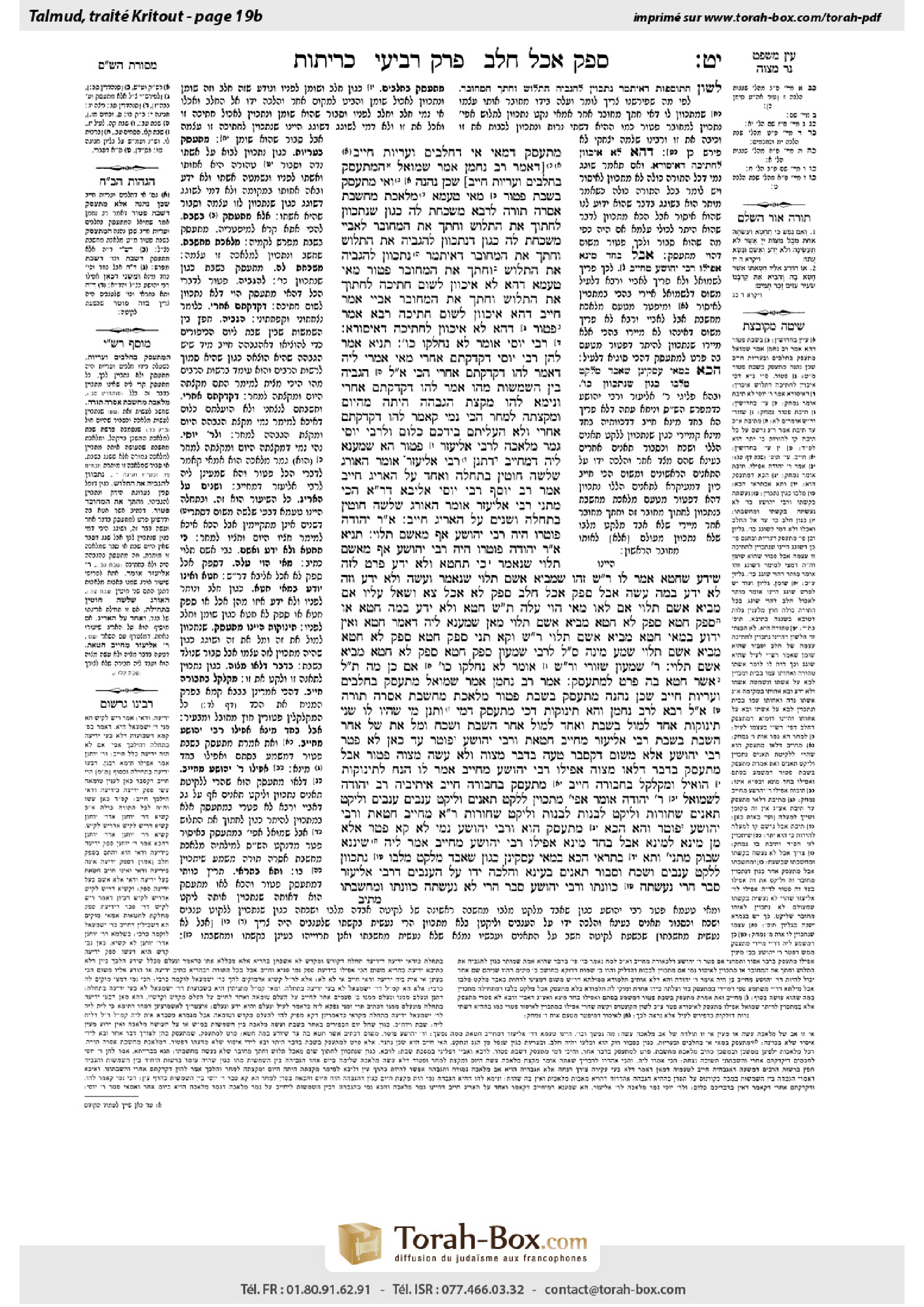
Keritot 19b: Talmud study for Daf Yomi
Daf Yomi is the daily study of one Talmud folio. Explore 37 tractates with scans, Hebrew text, Sefaria English and AI-generated French translations where annotated.
Passage selection and English or AI-generated French translation are available where the scan has annotations. Daf Study is independent of Torah-Box and Sefaria.
Browse Keritot · כריתות · All tractatesKeritot 19b text and translations
This page of Keritot includes the Aramaic text, an English translation and an AI-generated French translation, alongside the scan above.
כריתות י״ט ב · Aramaic and Hebrew text
מִתְעַסֵּק דְּמַאי? אִי דַּחֲלָבִים וַעֲרָיוֹת – חַיָּיב, דְּאָמַר רַב נַחְמָן אָמַר שְׁמוּאֵל: הַמִּתְעַסֵּק בַּחֲלָבִים וַעֲרָיוֹת – חַיָּיב, שֶׁכֵּן נֶהֱנָה!
וְאִי מִתְעַסֵּק בְּשַׁבָּת – פָּטוּר, מַאי טַעְמָא? מְלֶאכֶת מַחְשֶׁבֶת אָסְרָה תּוֹרָה!
לְרָבָא, מַשְׁכַּחַתְּ לַהּ כְּגוֹן שֶׁנִּתְכַּוֵּון לַחְתּוֹךְ אֶת הַתָּלוּשׁ וְחָתַךְ אֶת הַמְחוּבָּר. לְאַבָּיֵי, מַשְׁכַּחַתְּ לַהּ כְּגוֹן דְּנִתְכַּוֵּון לְהַגְבִּיהַּ אֶת הַתָּלוּשׁ וְחָתַךְ אֶת הַמְחוּבָּר.
דְּאִיתְּמַר: נִתְכַּוֵּון לְהַגְבִּיהַּ אֶת הַתָּלוּשׁ וְחָתַךְ אֶת הַמְחוּבָּר – פָּטוּר, מַאי טַעְמָא? דְּהָא לָא אִיכַּוַּון לְשׁוּם חֲתִיכָה. לַחְתּוֹךְ אֶת הַתָּלוּשׁ וְחָתַךְ אֶת הַמְחוּבָּר – אַבָּיֵי אָמַר: חַיָּיב, דְּהָא אִיכַּוַּון לְשׁוּם חֲתִיכָה. רָבָא אָמַר: פָּטוּר, דְּהָא לָא אִיכַּוַּון לַחֲתִיכָה דְּאִיסּוּרָא.
רַבִּי יוֹסֵי אוֹמֵר: לֹא נֶחְלְקוּ כּוּ׳. תַּנְיָא, אָמַר לָהֶן רַבִּי יוֹסֵי: דִּקְדַּקְתֶּם אַחֲרַי.
מַאי אָמְרִי לֵיהּ דַּאֲמַר לְהוּ דִּקְדַּקְתֶּם אַחֲרַי? הָכִי אֲמַרוּ לֵיהּ: הִגְבִּיהַּ בֵּין הַשְּׁמָשׁוֹת, מַהוּ? אֲמַר לְהוּ: דִּקְדַּקְתֶּם אַחֲרַי.
וְנֵימָא לְהוּ: מִקְצָת הַגְבָּהָה הָיְתָה מֵהַיּוֹם וּמִקְצָתָהּ לְמָחָר! הָכִי נָמֵי קָאָמַר לְהוּ: דִּקְדַּקְתֶּם אַחֲרַי, וְלֹא הֶעֱלִיתֶם בְּיֶדְכֶם כְּלוּם.
וּלְרַבִּי יוֹסֵי גְּמַר מְלָאכָה, לְרַבִּי אֱלִיעֶזֶר פָּטוּר? הָא שָׁמַעְנָא לֵיהּ דִּמְחַיֵּיב! דִּתְנַן, רַבִּי אֱלִיעֶזֶר אוֹמֵר: הָאוֹרֵג שְׁלֹשָׁה חוּטִין בַּתְּחִלָּה, וְאֶחָד עַל הָאָרִיג – חַיָּיב!
אָמַר רַב יוֹסֵף: רַבִּי יוֹסֵי אַלִּיבָּא דְּרַבִּי אֱלִיעֶזֶר הָכִי מַתְנֵי, רַבִּי אֱלִיעֶזֶר אוֹמֵר: הָאוֹרֵג שְׁלֹשָׁה חוּטִין בַּתְּחִלָּה, וּשְׁנַיִם עַל הָאָרִיג – חַיָּיב.
אָמַר רַבִּי יְהוּדָה: פּוֹטְרוֹ הָיָה רַבִּי יְהוֹשֻׁעַ אַף מֵאָשָׁם תָּלוּי. תַּנְיָא, אָמַר רַבִּי יְהוּדָה: פּוֹטְרוֹ הָיָה רַבִּי יְהוֹשֻׁעַ אַף מֵאָשָׁם תָּלוּי, שֶׁנֶּאֱמַר ״כִּי תֶחֱטָא וְלֹא יָדַע״ – פְּרָט לָזֶה שֶׁיָּדַע שֶׁחָטָא. אָמַר לוֹ רַבִּי שִׁמְעוֹן: זֶהוּ שֶׁמֵּבִיא אָשָׁם תָּלוּי, שֶׁנֶּאֱמַר: ״וְעָשָׂה וְלֹא יָדַע״, וְזֶה לֹא יָדַע בַּמֶּה עָשָׂה.
אֲבָל סָפֵק אָכַל חֵלֶב סָפֵק לֹא אָכַל – צֵא וּשְׁאַל עָלָיו אִם מֵבִיא אָשָׁם תָּלוּי אִם לָאו. מַאי הָוֵי עֲלַהּ?
תָּא שְׁמַע: חָטָא וְלֹא יָדַע בַּמֶּה חָטָא, אוֹ סָפֵק חָטָא סָפֵק לֹא חָטָא – מֵבִיא אָשָׁם תָּלוּי. מַאן שְׁמַעְנָא לֵיהּ דְּאָמַר: חָטָא וְאֵין יָדוּעַ בְּמַאי חָטָא מֵבִיא אָשָׁם תָּלוּי? רַבִּי שִׁמְעוֹן, וְקָא תָנֵי: סָפֵק חָטָא סָפֵק לֹא חָטָא – מֵבִיא אָשָׁם תָּלוּי, שְׁמַע מִינַּהּ: סְבִירָא לֵיהּ לְרַבִּי שִׁמְעוֹן: סָפֵק חָטָא סָפֵק לֹא חָטָא – מֵבִיא אָשָׁם תָּלוּי.
רַבִּי שִׁמְעוֹן שֵׁזוּרִי וְרַבִּי שִׁמְעוֹן אוֹמֵר לֹא נֶחְלְקוּ כּוּ׳ אִם כֵּן, מָה תַּלְמוּד לוֹמַר ׳אֲשֶׁר חָטָא בָּהּ׳״? פְּרָט לַמִּתְעַסֵּק.
אָמַר רַב נַחְמָן אָמַר שְׁמוּאֵל: מִתְעַסֵּק בַּחֲלָבִים וַעֲרָיוֹת – חַיָּיב, שֶׁכֵּן נֶהֱנָה. מִתְעַסֵּק בַּשַּׁבָּת – פָּטוּר, מְלֶאכֶת מַחְשֶׁבֶת אָסְרָה תּוֹרָה.
אֲמַר לֵיהּ רָבָא לְרַב נַחְמָן: וְהָא תִּינוֹקוֹת, דְּכִי מִתְעַסֵּק דָּמֵי, וּתְנַן: מִי שֶׁהָיוּ לוֹ שְׁנֵי תִּינוֹקוֹת, אֶחָד לָמוּל בַּשַּׁבָּת וְאֶחָד לָמוּל אַחַר הַשַּׁבָּת, וְשָׁכַח וּמָל אֶת שֶׁל אַחַר הַשַּׁבָּת בַּשַּׁבָּת – רַבִּי אֱלִיעֶזֶר מְחַיֵּיב חַטָּאת, וְרַבִּי יְהוֹשֻׁעַ פּוֹטֵר.
עַד כָּאן לָא פָּטַר רַבִּי יְהוֹשֻׁעַ אֶלָּא מִשּׁוּם דְּקָסָבַר: טָעָה בִּדְבַר מִצְוָה וְלֹא עָשָׂה מִצְוָה – פָּטוּר, אֲבָל מִתְעַסֵּק בְּדָבָר דְּלָאו מִצְוָה – אֲפִילּוּ רַבִּי יְהוֹשֻׁעַ מְחַיַּיב!
אָמַר לוֹ: הַנַּח לַתִּינוֹקוֹת, הוֹאִיל וּמְקַלְקֵל בְּחַבּוּרָה – חַיָּיב, מִתְעַסֵּק בְּחַבּוּרָה – חַיָּיב.
אֵיתִיבֵיהּ רַב יְהוּדָה לִשְׁמוּאֵל: רַבִּי יְהוּדָה אוֹמֵר: אֲפִילּוּ מִתְכַּוֵּין לְלַקֵּט תְּאֵנִים וְלִיקֵּט עֲנָבִים, עֲנָבִים וְלִיקֵּט תְּאֵנִים, שְׁחוֹרוֹת וְלִיקֵּט לְבָנוֹת, לְבָנוֹת וְלִיקֵּט שְׁחוֹרוֹת – רַבִּי אֱלִיעֶזֶר מְחַיֵּיב חַטָּאת, וְרַבִּי יְהוֹשֻׁעַ פּוֹטֵר.
וְהָא הָכָא מִתְעַסֵּק הוּא, וְרַבִּי יְהוֹשֻׁעַ נָמֵי לָא קָא פָטַר אֶלָּא מִן מִינָא לְמִינָא, אֲבָל בְּחַד מִינָא – אֲפִילּוּ רַבִּי יְהוֹשֻׁעַ מְחַיַּיב!
אֲמַר לֵיהּ: שִׁינָּנָא, שְׁבוֹק מַתְנִיתִין וְתָא בָּתְרַאי, הָכָא בְמַאי עָסְקִינַן: כְּגוֹן שֶׁאָבַד מְלַקֵּט מִלִּבּוֹ, נִתְכַּוֵּון לְלַקֵּט עֲנָבִים, וְשָׁכַח וְסָבוּר תְּאֵנִים בָּעֵינָא, וְהָלְכָה יָדוֹ עַל הָעֲנָבִים, דְּרַבִּי אֱלִיעֶזֶר סָבַר: הֲרֵי נֶעֶשְׂתָה כַּוּוֹנָתוֹ, וְרַבִּי יְהוֹשֻׁעַ סָבַר: הֲרֵי לֹא נֶעֶשְׂתָה כַּוּוֹנָתוֹ וּמַחְשַׁבְתּוֹ.
Keritot 19b · English translation
The Gemara asks: The halakha that one who acts unawares is exempt is stated in which case? If you say it applies to the cases of forbidden fats and those with whom intercourse is forbidden this cannot be correct, as in those cases one who acts unawares is liable to bring a sin offering. As Rav Naḥman says that Shmuel says: With regard to one who acts unawares and transgresses the prohibitions of eating forbidden fats or engaging in intercourse with those with whom intercourse is forbidden, he is liable to bring a sin offering because he derived pleasure.
And if you say it is referring a case of one who acts unawares on Shabbat this cannot be correct either, as it is already established that one who acts unawares on Shabbat is exempt. What is the reason? The Torah prohibited only planned, constructive labor on Shabbat. Acts of labor that are not intended, or whose result is unintended, or whose consequence is destructive, are not included in this category. Therefore, it is already a known halakha that one who performs labor unawares on Shabbat is exempt.
The Gemara answers: According to Rava, you find it is necessary to teach that one is exempt from bringing a sin offering for performing labor unawares on Shabbat in a case where one intended to cut a detached plant and he mistakenly cut a plant still attached. According to Abaye, who maintains he is liable in such a case, you find it necessary to teach that one who acts unawares is exempt in a case where he intended to lift a plant detached from the ground and mistakenly cut a plant still attached to the ground.
As it was stated: With regard to one who intended to lift a plant detached from the ground and mistakenly cut a plant still attached to the ground, all agree he is exempt from bringing a sin offering. What is the reason? It is due to the fact that he did not intend to act for the sake of cutting, i.e., he merely intended to lift the plant. By contrast, if one intended to cut a detached plant and he mistakenly cut a plant that is still attached, Abaye said he is liable, due to the fact that he intended to act for the sake of cutting. Although his intention was not to perform a prohibited cutting, nevertheless he had intent to cut, and therefore he is liable for the prohibited cutting he performed in practice. Rava said: He is exempt, due to the fact that he did not intend to perform a prohibited cutting.
§ The mishna teaches that Rabbi Yosei says: Rabbi Eliezer and Rabbi Yehoshua did not disagree with regard to one who performs prohibited labor during the intervening twilight period; rather, they both agree that he is exempt, as I say: He performed part of the labor today and he performed part of the labor the following day. It is taught in a baraita that Rabbi Yosei said to the other Sages: You were diligent to examine my opinion, and you found a refutation of my statement.
The Gemara asks: What did they say to him that led Rabbi Yosei to say to them: You were diligent to examine my opinion? The Gemara explains that this is what they said to him: What is the halakha in a case where one lifted an item at twilight between Shabbat and Yom Kippur and carried it from one domain to another? If the domains are adjacent, this act can be performed so quickly that even at twilight it does not span two days. For this reason, Rabbi Yosei said to them: You were diligent to examine my opinion.
Since according to Rabbi Yosei the period of twilight is instantaneous, the Gemara objects: But let him say to them: In this case as well, part of the lifting was performed today and part of it was performed tomorrow. The Gemara explains: That is also what he is saying to them: You were diligent to examine my opinion, and yet you have not accomplished anything, as I remain steadfast in my opinion.
The Gemara objects: And according to Rabbi Yosei, had the start of the labor been on Shabbat and the completion of the labor on Yom Kippur, Rabbi Eliezer and Rabbi Yehoshua would agree that he is exempt. But according to Rabbi Eliezer, would he really be exempt? Didn’t we hear that Rabbi Eliezer deems one liable for the final stage of a prohibited labor? As we learned in a mishna (Shabbat 105a) that Rabbi Eliezer says: One who weaves on Shabbat is liable to bring a sin offering if he weaves three threads at the beginning of work on a new item, or if he adds one thread to a preexisting woven fabric. Although the minimum number of threads required for the prohibited labor of weaving is generally three, Rabbi Eliezer deems one liable for a single thread that he adds to a woven fabric.
Rav Yosef said in response: Rabbi Yosei, in accordance with the opinion of Rabbi Eliezer, would explain that this is what the mishna teaches: Rabbi Eliezer says: One who weaves on Shabbat is liable if he weaves three threads at the beginning of work on a new item, or if he adds two threads to a preexisting woven fabric.
§ The mishna teaches that Rabbi Yehuda said: Rabbi Yehoshua would deem exempt one who does not know the nature of his sin even from bringing a provisional guilt offering. It is taught in a baraita that Rabbi Yehuda said: Rabbi Yehoshua would deem exempt one who does not know the nature of his sin even from bringing a provisional guilt offering, as it is stated: “And if anyone sin, and do any of the commandments of the Lord that are not to be done, though he does not know it; yet is he guilty, and shall bear his iniquity” (Leviticus 5:17). The verse excludes this case, where he knew that he sinned. Rabbi Shimon said to Rabbi Yehuda: It can be inferred from this same verse that he does in fact bring a provisional guilt offering. The phrase “and do…though he does not know it” indicates that one brings an offering in a case such as this, when he did not know with which item he sinned.
The baraita continues: But in a case where there is uncertainty whether one ate forbidden fat and uncertainty whether one did not eat forbidden fat, which is a situation where he did not know if he sinned at all, it is unclear whether Rabbi Shimon maintains he is liable to bring a provisional guilt offering. Therefore, go and ask about it, to determine whether one brings a provisional guilt offering in such a case or not. The Gemara asks: What conclusion was reached about it?
The Gemara suggests: Come and hear a proof from a baraita: If one sinned and did not know with what item he sinned, or if there is uncertainty whether he sinned and uncertainty whether he did not sin, he brings a provisional guilt offering. The Gemara infers: Whom did you hear who says that if one sinned and did not know with what item he sinned he must bring a provisional guilt offering? It is Rabbi Shimon. Consequently, this baraita must be in accordance with his opinion, and it teaches: If there is uncertainty whether one sinned and uncertainty whether one did not sin, he brings a provisional guilt offering. Conclude from the baraita that Rabbi Shimon holds: If there is uncertainty if one sinned and uncertainty if one did not sin, he brings a provisional guilt offering.
§ The mishna teaches that Rabbi Shimon and Rabbi Shimon Shezuri say: Rabbi Eliezer and Rabbi Yehoshua did not disagree with regard to a case where his lack of knowledge involves items from one category. And the last clause in the mishna concludes: If it is so, what is the meaning when the verse states: “If his sin, wherein he has sinned” (Leviticus 4:23), from which it is derived that one is liable only if the object of the sin was the one he intended? It serves to exclude one who acts unawares and does not intend to perform a prohibited action at all.
In connection to this halakha about one who acts unawares, Rav Naḥman says that Shmuel says: With regard to one who acts unawares and transgresses the prohibitions of eating forbidden fats or engaging in intercourse with those with whom intercourse is forbidden, he is liable to bring a sin offering because he derived pleasure from his actions. By contrast, one who acts unawares and performs a prohibited labor on Shabbat is exempt, as the Torah prohibited only planned, constructive labor on Shabbat, which does not include an act of labor that is not intended, or whose result is unintended.
Rava said to Rav Naḥman: But isn’t the case of the two babies considered like a case where one acts unawares, and yet we learned in a mishna (Shabbat 137a): In the case of one who had two babies to circumcise, one of whom he was required to circumcise on Shabbat and one whom he was required to circumcise the day after Shabbat, and he forgot and circumcised the one that should have been circumcised after Shabbat on Shabbat, Rabbi Eliezer deems him liable to bring a sin offering, as circumcision before its appointed time does not override Shabbat. And Rabbi Yehoshua deems him exempt from bringing a sin offering.
Rava explains his objection: Rabbi Yehoshua deemed him exempt only here, in that particular case, because he holds that if one erred with regard to a mitzva and did not perform the mitzva but committed a transgression instead, he is exempt. But in a case where one acts unawares in a matter that does not involve a mitzva, even Rabbi Yehoshua deems him liable. This indicates that according to both opinions, in general one who commits a transgression on Shabbat while acting unawares is liable.
Rav Naḥman said to Rava: Leave aside the case of the babies. No proof can be derived from there, as the transgression in that case is the act of inflicting a wound on Shabbat. This is an exceptional case, since one who inflicts a destructive wound is liable despite the fact that one is usually exempt from liability if he performs perform non-constructive acts on Shabbat. Consequently, the standard requirement of constructive labor on Shabbat does not apply, which is why one who acts unawares and inflicts a wound is also liable.
The Gemara cites another difficulty with regard to the claim that one who acts unawares when he performs a labor on Shabbat is exempt. Rav Yehuda raised an objection to Shmuel from the mishna. Rabbi Yehuda says: Even if one intended to pick figs and he picked grapes, or to pick grapes and he picked figs, or to pick black figs and he picked white figs, or to pick white figs and he picked black figs, Rabbi Eliezer deems him liable to bring a sin offering and Rabbi Yehoshua deems him exempt.
Rav Yehuda explained his objection: And this case here is concerning one who acts unawares, and yet not only does Rabbi Eliezer deem him liable, but Rabbi Yehoshua too deemed him exempt from bringing a sin offering only if he unwittingly switched one type for another type, e.g., grapes for figs, or white figs for black figs. But in a case where he unwittingly switches one for another within one type, even Rabbi Yehoshua deems him liable.
Shmuel said to Rav Yehuda in response: Large-toothed one [shinnana], leave the mishna and follow after me, i.e., it should not be understood as you think. What are we dealing with here? We are dealing with a case where the picker lost his train of thought. He had initially intended to pick grapes and then he forgot his initial intention and thought: It is figs that I want. But his hand unwittingly went among the grapes and he picked the grapes he had initially intended. In that case Rabbi Eliezer holds he is liable, as his initial intention was fulfilled. And Rabbi Yehoshua holds f his current intention and thought are not fulfilled, and therefore he is exempt. By contrast, in a standard case where one acts unawares, both agree that he is exempt.
Keritot 19b · Traduction française (IA)
La Guemara demande : Dans quel cas enseigne-t-on la halakha selon laquelle celui qui agit sans le savoir est exempt ? Si l’on dit qu’elle s’applique aux cas des graisses interdites et des relations interdites, cela ne peut pas être exact, car, dans ces cas, celui qui agit sans le savoir est tenu d’apporter un sacrifice expiatoire. En effet, Rav Naḥman dit au nom de Shmuel : Celui qui agit sans le savoir et transgresse les interdits de consommer des graisses interdites ou d’avoir des relations avec des personnes avec lesquelles les relations sont interdites est tenu d’apporter un sacrifice expiatoire, car il a éprouvé du plaisir.
Et si l’on dit qu’il s’agit d’un cas où quelqu’un agit sans le savoir pendant Chabbat, cela ne peut pas être exact non plus, puisqu’il est déjà établi que celui qui agit sans le savoir pendant Chabbat est exempt. Pour quelle raison ? La Torah n’a interdit que les travaux intentionnels et constructifs pendant Chabbat. Les travaux qui ne sont pas intentionnels, dont le résultat n’est pas voulu ou dont la conséquence est destructrice n’entrent pas dans cette catégorie. On sait donc déjà que celui qui effectue un travail sans le savoir pendant Chabbat est exempt.
La Guemara répond : Selon Rava, il est nécessaire d’enseigner qu’on est exempt d’apporter un sacrifice expiatoire pour avoir effectué un travail sans le savoir pendant Chabbat dans le cas où quelqu’un avait l’intention de couper une plante détachée du sol, mais a coupé par erreur une plante encore attachée. Selon Abaye, qui estime qu’il est tenu d’apporter un sacrifice dans un tel cas, il est nécessaire d’enseigner que celui qui agit sans le savoir est exempt dans le cas où quelqu’un avait l’intention de soulever une plante détachée du sol, mais a coupé par erreur une plante encore attachée au sol.
Car il a été enseigné : Au sujet de celui qui avait l’intention de soulever une plante détachée du sol, mais a coupé par erreur une plante encore attachée, tous conviennent qu’il est exempt d’apporter un sacrifice expiatoire. Pour quelle raison ? Parce qu’il n’avait pas l’intention d’agir en vue de couper, c’est-à-dire qu’il voulait seulement soulever la plante. En revanche, si quelqu’un avait l’intention de couper une plante détachée, mais a coupé par erreur une plante encore attachée, Abaye a dit qu’il est tenu d’apporter un sacrifice, car il avait l’intention d’agir en vue de couper. Bien qu’il n’ait pas eu l’intention d’effectuer une coupe interdite, il avait néanmoins l’intention de couper ; il est donc tenu d’apporter un sacrifice pour la coupe interdite qu’il a effectivement effectuée. Rava a dit : Il est exempt, car il n’avait pas l’intention d’effectuer une coupe interdite.
§ La Michna enseigne que Rabbi Yosei dit : Rabbi Eliezer et Rabbi Yehoshua n’étaient pas en désaccord au sujet de celui qui effectue un travail interdit pendant la période intermédiaire du crépuscule ; ils conviennent tous deux qu’il est exempt, car, selon moi, il a effectué une partie du travail aujourd’hui et une partie le lendemain. Une baraïta enseigne que Rabbi Yosei dit aux autres Sages : Vous avez examiné mon avis avec diligence et vous avez trouvé une réfutation de mon propos.
La Guemara demande : Que lui ont-ils dit pour que Rabbi Yosei leur réponde : « Vous avez examiné mon avis avec diligence » ? Elle explique qu’ils lui ont dit ceci : Quelle est la halakha dans le cas où quelqu’un a soulevé un objet au crépuscule entre Chabbat et Yom Kippour et l’a transporté d’un domaine à un autre ? Si les domaines sont contigus, cet acte peut être effectué si rapidement que, même au crépuscule, il ne s’étend pas sur deux jours. C’est pourquoi Rabbi Yosei leur a dit : « Vous avez examiné mon avis avec diligence. »
Puisque, selon Rabbi Yosei, la période du crépuscule est instantanée, la Guemara objecte : Mais qu’il leur dise aussi que, dans ce cas, une partie du soulèvement a eu lieu aujourd’hui et une partie demain. La Guemara explique : C’est bien ce qu’il leur dit : « Vous avez examiné mon avis avec diligence, et pourtant vous n’avez rien obtenu, car je reste fermement attaché à mon avis. »
La Guemara objecte : Selon Rabbi Yosei, si le travail avait commencé pendant Chabbat et s’était achevé à Yom Kippour, Rabbi Eliezer et Rabbi Yehoshua conviendraient qu’il est exempt. Mais, selon Rabbi Eliezer, serait-il vraiment exempt ? N’avons-nous pas appris que Rabbi Eliezer tient quelqu’un pour responsable de la dernière étape d’un travail interdit ? Comme nous l’avons appris dans une Michna (Chabbat 105a), Rabbi Eliezer dit : Celui qui tisse pendant Chabbat est tenu d’apporter un sacrifice expiatoire s’il tisse trois fils au début du travail sur une nouvelle pièce, ou s’il ajoute un seul fil à un tissu déjà tissé. Bien que le nombre minimal de fils requis pour le travail interdit de tisser soit généralement de trois, Rabbi Eliezer tient quelqu’un pour responsable dès qu’il ajoute un seul fil à un tissu.
Rav Yosef répondit : Rabbi Yosei expliquerait, conformément à l’avis de Rabbi Eliezer, que la Michna enseigne ceci : Rabbi Eliezer dit que celui qui tisse pendant Chabbat est tenu d’apporter un sacrifice expiatoire s’il tisse trois fils au début du travail sur une nouvelle pièce, ou s’il ajoute deux fils à un tissu déjà tissé.
§ La Michna enseigne que Rabbi Yehuda a dit : Rabbi Yehoshua exempterait même d’apporter un sacrifice de culpabilité provisoire celui qui ignore la nature de sa faute. Une baraïta enseigne que Rabbi Yehuda a dit : Rabbi Yehoshua exempterait même d’apporter un sacrifice de culpabilité provisoire celui qui ignore la nature de sa faute, comme il est dit : « Si quelqu’un pèche et fait l’une des choses que l’Éternel a défendu de faire, sans le savoir, il est coupable et portera la peine de sa faute » (Lévitique 5:17). Le verset exclut ce cas, celui où il savait qu’il avait péché. Rabbi Shimon dit à Rabbi Yehuda : On peut déduire de ce même verset qu’il apporte bien un sacrifice de culpabilité provisoire. Les mots « et fait… sans le savoir » indiquent qu’on apporte un sacrifice dans un cas comme celui-ci, lorsqu’il ne savait pas avec quel élément il avait péché.
La baraïta poursuit : Mais dans un cas où il est incertain qu’il ait consommé de la graisse interdite et tout aussi incertain qu’il n’en ait pas consommé — c’est-à-dire lorsqu’il ne sait pas s’il a péché ou non —, on ne sait pas clairement si Rabbi Shimon estime qu’il est tenu d’apporter un sacrifice de culpabilité provisoire. Allez donc vous renseigner pour déterminer si l’on apporte un sacrifice de culpabilité provisoire dans un tel cas ou non. La Guemara demande : Quelle conclusion a-t-on tirée à ce sujet ?
La Guemara propose : Venez et écoutez une preuve tirée d’une baraïta : Si quelqu’un a péché sans savoir avec quel élément il a péché, ou s’il est incertain qu’il ait péché et tout aussi incertain qu’il n’ait pas péché, il apporte un sacrifice de culpabilité provisoire. La Guemara déduit : Qui avez-vous entendu dire que celui qui a péché sans savoir avec quel élément il a péché doit apporter un sacrifice de culpabilité provisoire ? C’est Rabbi Shimon. Par conséquent, cette baraïta doit être conforme à son avis, et elle enseigne que, s’il est incertain qu’il ait péché et tout aussi incertain qu’il n’ait pas péché, il apporte un sacrifice de culpabilité provisoire. Déduisez de la baraïta que Rabbi Shimon estime que, si l’on ne sait pas s’il a péché ou non, il apporte un sacrifice de culpabilité provisoire.
§ La Michna enseigne que Rabbi Shimon et Rabbi Shimon Shezuri disent : Rabbi Eliezer et Rabbi Yehoshua n’étaient pas en désaccord dans un cas où l’ignorance portait sur des éléments appartenant à une seule catégorie. Et la dernière clause de la Michna conclut : Si tel est le cas, que signifient les mots du verset : « Si sa faute, par laquelle il a péché » (Lévitique 4:23), dont on déduit qu’il n’est responsable que si l’objet de la faute était celui qu’il avait l’intention de prendre ? Ces mots servent à exclure celui qui agit sans le savoir et n’a pas du tout l’intention d’accomplir une action interdite.
À propos de cette halakha concernant celui qui agit sans le savoir, Rav Naḥman dit au nom de Shmuel : Celui qui agit sans le savoir et transgresse les interdits de consommer des graisses interdites ou d’avoir des relations avec des personnes avec lesquelles les relations sont interdites est tenu d’apporter un sacrifice expiatoire, car il a éprouvé du plaisir en agissant ainsi. En revanche, celui qui agit sans le savoir et effectue un travail interdit pendant Chabbat est exempt, car la Torah n’a interdit que les travaux intentionnels et constructifs pendant Chabbat, ce qui exclut un travail qui n’est pas intentionnel ou dont le résultat n’est pas voulu.
Rava dit à Rav Naḥman : Mais le cas des deux bébés n’est-il pas considéré comme un cas où quelqu’un agit sans le savoir ? Pourtant, nous avons appris dans une Michna (Chabbat 137a) : Au sujet de quelqu’un qui avait deux bébés à circoncire, dont l’un devait être circoncis pendant Chabbat et l’autre le lendemain de Chabbat, et qui, ayant oublié, a circoncis pendant Chabbat celui qui devait l’être après Chabbat, Rabbi Eliezer le tient pour responsable et le rend passible d’apporter un sacrifice expiatoire, car la circoncision avant le moment prescrit ne l’emporte pas sur Chabbat. Rabbi Yehoshua l’exempte d’apporter un sacrifice expiatoire.
Rava explique son objection : Rabbi Yehoshua ne l’a exempté que dans ce cas précis, parce qu’il estime que si quelqu’un se trompe au sujet d’une mitsva et, au lieu d’accomplir la mitsva, commet une transgression, il est exempt. Mais si quelqu’un agit sans le savoir dans un domaine qui n’implique pas de mitsva, même Rabbi Yehoshua le tient pour responsable. Cela indique que, selon les deux avis, en règle générale, celui qui commet une transgression pendant Chabbat en agissant sans le savoir est tenu pour responsable.
Rav Naḥman dit à Rava : Écarte le cas des bébés. On ne peut en tirer aucune preuve, car, dans ce cas, la transgression consiste à infliger une blessure pendant Chabbat. C’est un cas exceptionnel, puisque celui qui inflige une blessure destructrice est tenu pour responsable, même si, en général, on n’est pas tenu pour responsable lorsqu’on accomplit des actes non constructifs pendant Chabbat. Par conséquent, l’exigence habituelle d’un travail constructif pendant Chabbat ne s’applique pas ; c’est pourquoi celui qui agit sans le savoir et inflige une blessure est lui aussi tenu pour responsable.
La Guemara soulève une autre difficulté concernant l’affirmation selon laquelle celui qui agit sans le savoir en effectuant un travail pendant Chabbat est exempt. Rav Yehuda objecta à Shmuel en s’appuyant sur la Michna. Rabbi Yehuda dit : Même si quelqu’un avait l’intention de cueillir des figues et a cueilli des raisins, ou avait l’intention de cueillir des raisins et a cueilli des figues, ou avait l’intention de cueillir des figues noires et a cueilli des figues blanches, ou avait l’intention de cueillir des figues blanches et a cueilli des figues noires, Rabbi Eliezer le tient pour responsable et le rend passible d’apporter un sacrifice expiatoire, tandis que Rabbi Yehoshua l’en exempte.
Rav Yehuda expliqua son objection : Or, ce cas concerne quelqu’un qui agit sans le savoir ; pourtant, non seulement Rabbi Eliezer le tient pour responsable, mais Rabbi Yehoshua ne l’exempte d’apporter un sacrifice expiatoire que s’il a, par erreur, substitué une espèce à une autre, par exemple des raisins à des figues ou des figues blanches à des figues noires. Mais s’il substitue par erreur un élément à un autre au sein d’une même espèce, même Rabbi Yehoshua le tient pour responsable.
Shmuel répondit à Rav Yehuda : Grande dent [shinnana], laisse la Michna et suis-moi, c’est-à-dire qu’il ne faut pas la comprendre comme tu le fais. De quoi s’agit-il ici ? D’un cas où le cueilleur a perdu le fil de ses pensées. Il avait d’abord eu l’intention de cueillir des raisins, puis il a oublié son intention initiale et s’est dit : « Ce sont des figues que je veux. » Mais sa main s’est dirigée sans qu’il le sache vers les raisins et il a cueilli ceux qu’il avait initialement l’intention de cueillir. Dans ce cas, Rabbi Eliezer estime qu’il est responsable, car son intention initiale s’est réalisée. Rabbi Yehoshua estime que son intention et sa pensée actuelles ne se sont pas réalisées ; il est donc exempt. En revanche, dans un cas habituel où quelqu’un agit sans le savoir, tous conviennent qu’il est exempt.
Traduction française générée par IA à partir de l’édition anglaise de Sefaria. Vérifie toujours un passage avec le texte source.
Text from Sefaria: William Davidson Edition - Vocalized Aramaic (CC BY NC); William Davidson Edition - English (CC BY NC).