Keritot 20a: Talmud study for Daf Yomi
Daf Yomi is the daily study of one Talmud folio. Explore 37 tractates with scans, Hebrew text, Sefaria English and AI-generated French translations where annotated.
Passage selection and English or AI-generated French translation are available where the scan has annotations. Daf Study is independent of Torah-Box and Sefaria.
Browse Keritot · כריתות · All tractatesKeritot 20a text and translations
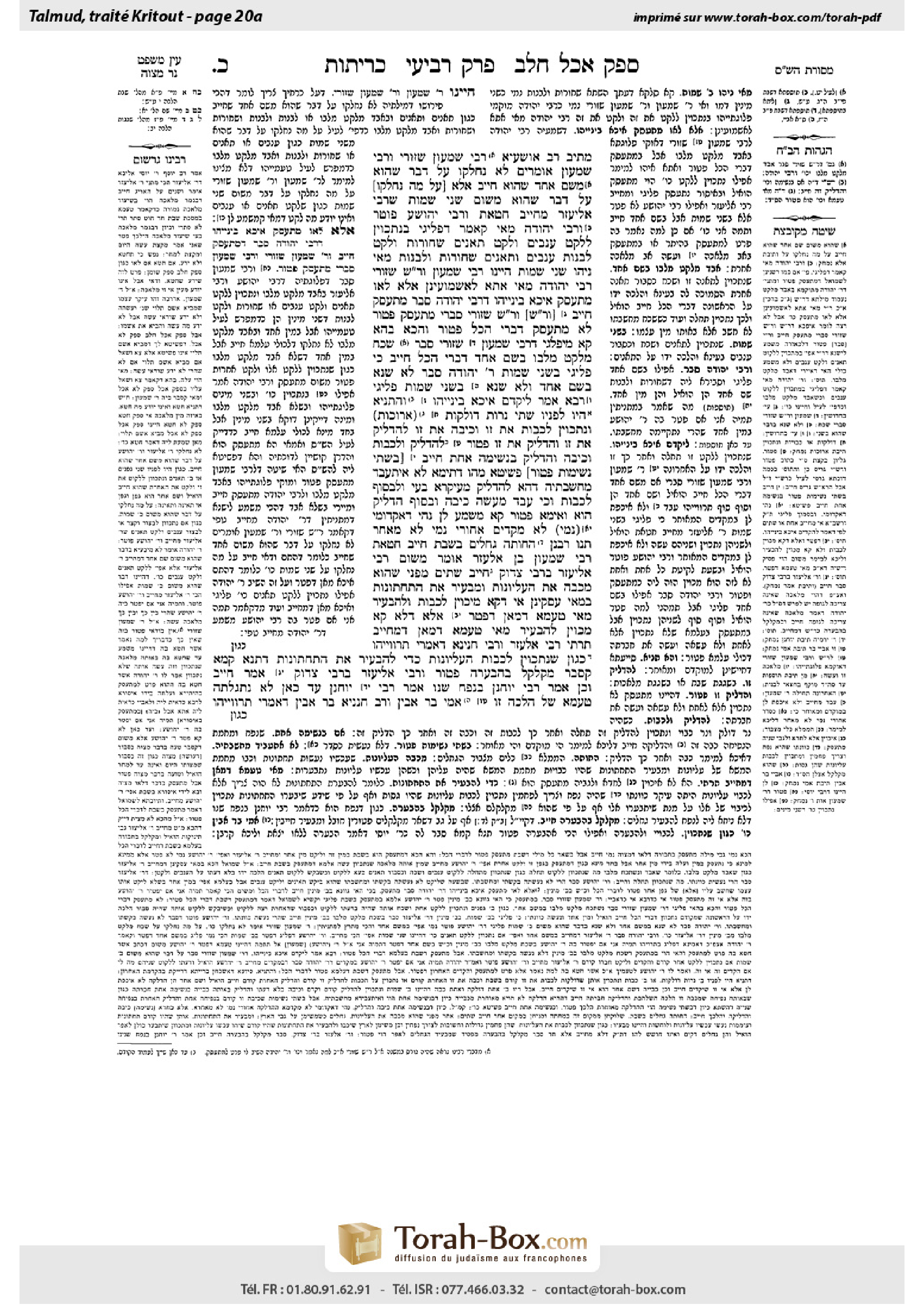
This page of Keritot includes the Aramaic text, an English translation and an AI-generated French translation, alongside the scan above.
כריתות כ׳ א · Aramaic and Hebrew text
מֵתִיב רַב אוֹשַׁעְיָא: רַבִּי שִׁמְעוֹן שֵׁזוּרִי וְרַבִּי שִׁמְעוֹן אוֹמְרִים: לֹא נֶחְלְקוּ עַל דָּבָר שֶׁהוּא מִשֵּׁם אֶחָד שֶׁהוּא חַיָּיב, אֶלָּא עַל דָּבָר שֶׁהוּא מִשּׁוּם שְׁנֵי שֵׁמוֹת, שֶׁרַבִּי אֱלִיעֶזֶר מְחַיֵּיב חַטָּאת, וְרַבִּי יְהוֹשֻׁעַ פּוֹטֵר.
וְרַבִּי יְהוּדָה מַאי קָאָמַר דִּפְלִיגִי? בְּנִתְכַּוֵּין לְלַקֵּט עֲנָבִים וְלִקֵּט תְּאֵנִים, שְׁחוֹרוֹת וְלִקֵּט לְבָנוֹת – עֲנָבִים וּתְאֵנִים, שְׁחוֹרוֹת וּלְבָנוֹת, מַאי נִיהוּ? שְׁנֵי שֵׁמוֹת? הַיְינוּ רַבִּי שִׁמְעוֹן וְרַבִּי שִׁמְעוֹן שֵׁזוּרִי! רַבִּי יְהוּדָה מַאי אֲתָא לְאַשְׁמוֹעִינַן?
אֶלָּא לָאו מִתְעַסֵּק אִיכָּא בֵּינַיְיהוּ, דְּרַבִּי יְהוּדָה סָבַר: מִתְעַסֵּק חַיָּיב, וְרַבִּי שִׁמְעוֹן שֵׁזוּרִי סָבְרִי: מִתְעַסֵּק פָּטוּר?
לָא, מִתְעַסֵּק – דִּבְרֵי הַכֹּל פָּטוּר, וְהָכָא בְּהָא קָא מִיפַּלְגִי, דְּרַבִּי שִׁמְעוֹן שֵׁזוּרִי סָבַר: שָׁכַח מְלַקֵּט מִלִּבּוֹ. בְּשֵׁם אֶחָד – דִּבְרֵי הַכֹּל חַיָּיב,
כִּי פְּלִיגִי – בִּשְׁנֵי שֵׁמוֹת. רַבִּי יְהוּדָה סָבַר: לָא שְׁנָא בְּשֵׁם אֶחָד וְלָא שְׁנָא בִּשְׁנֵי שֵׁמוֹת – פְּלִיגִי.
רָבָא אָמַר: לִיקְדֹּם אִיכָּא בֵינַיְיהוּ.
וְהָתַנְיָא: הָיוּ לְפָנָיו שְׁתֵּי נֵרוֹת דּוֹלְקוֹת אֲרוּכּוֹת, וְנִתְכַּוֵּין לְכַבּוֹת אֶת זוֹ וְכִיבָּה אֶת זוֹ, לְהַדְלִיק אֶת זוֹ וְהִדְלִיק אֶת זוֹ – פָּטוּר. לְהַדְלִיק וּלְכַבּוֹת, וְכִיבָּה וְהִדְלִיק בִּנְשִׁימָה אַחַת – חַיָּיב.
פְּשִׁיטָא! מַהוּ דְּתֵימָא: לָא אִיתְעֲבִד מַחְשַׁבְתֵּיהּ, דְּהָא לְהַדְלִיק מֵעִיקָּרָא בָּעֵי וּלְבַסּוֹף לְכַבּוֹת, וְכִי עֲבַד מַעֲשֶׂה – כִּיבָּה וּבַסּוֹף הִדְלִיק הוּא, וְאֵימָא פָּטוּר, קָא מַשְׁמַע לַן: נְהִי דְּאַקְדּוֹמֵי נָמֵי לָא מַקְדֵּים, אַחוֹרֵי נָמֵי לָא מְאַחַר.
תָּנוּ רַבָּנַן: הַחוֹתֶה גֶּחָלִים בַּשַּׁבָּת – חַיָּיב חַטָּאת. רַבִּי שִׁמְעוֹן בֶּן אֶלְעָזָר אוֹמֵר מִשּׁוּם רַבִּי אֱלִיעֶזֶר בְּרַבִּי צָדוֹק: חַיָּיב שְׁתַּיִם, מִפְּנֵי שֶׁהוּא מְכַבֶּה אֶת הָעֶלְיוֹנוֹת, וּמַבְעִיר אֶת הַתַּחְתּוֹנוֹת. בְּמַאי עָסְקִינַן? אִי דְּקָא מִיכַּוֵּין לְכַבּוֹת וּלְהַבְעִיר – מַאי טַעְמָא דְּמַאן דְּפָטַר? אֶלָּא דְּלָא קָא מִכַּוֵּין לְהַבְעִיר – מַאי טַעְמָא דְּמַאן דִּמְחַיֵּיב תַּרְתֵּי?
רַבִּי אֶלְעָזָר וְרַבִּי חֲנִינָא דְּאָמְרִי תַּרְוַויְיהוּ: כְּגוֹן שֶׁנִּתְכַּוֵּין לְכַבּוֹת הָעֶלְיוֹנוֹת כְּדֵי לְהַבְעִיר אֶת הַתַּחְתּוֹנוֹת, דְּתַנָּא קַמָּא קָסָבַר: מְקַלְקֵל בְּהַבְעָרָה פָּטוּר, וְרַבִּי אֱלִיעֶזֶר בְּרַבִּי צָדוֹק אָמַר: חַיָּיב. וְכֵן אָמַר רַבִּי יוֹחָנָן: בְּנַפָּח שָׁנוּ. אָמַר רַבִּי יוֹחָנָן: עַד כָּאן לֹא נִתְגַּלְּתָה טַעְמָהּ שֶׁל הֲלָכָה זוֹ.
אַמֵּי בַּר אָבִין וְרַב חֲנַנְיָא בַּר אָבִין דְּאָמְרִי תַּרְוַויְיהוּ:
Keritot 20a · English translation
Rav Oshaya raises an objection from the mishna to Shmuel’s opinion that all agree that one who acts unawares on Shabbat is exempt: Rabbi Shimon Shezuri and Rabbi Shimon say: Rabbi Eliezer and Rabbi Yehoshua did not disagree with regard to a case involving a matter where his lack of knowledge involves items from one category, as in that case they both agree he is liable. Rather, they disagree with regard to a case involving a matter where his lack of knowledge involves items from two categories, as in that case Rabbi Eliezer deems him liable to bring a sin offering, and Rabbi Yehoshua deems him exempt.
Rav Oshaya continues: And with regard to Rabbi Yehuda, about what matter is he saying that they disagree? If you say he maintains that they disagree in a case where one intended to pick grapes and he picked figs, or to pick black ones and he picked white ones, that is problematic. Rav Oshaya explains: Grapes and figs, black ones and white ones, what are they? Aren’t they two categories? If so, this is identical to the opinion of Rabbi Shimon and Rabbi Shimon Shezuri, who say that Rabbi Eliezer and Rabbi Yehoshua disagree specifically with regard to a mistake involving two categories. If so, what is Rabbi Yehuda coming to teach us?
Rav Oshaya concludes: Rather, is it not correct to say that that the difference between them is the halakha concerning one who performs a transgression while acting unawares? As Rabbi Yehuda holds that one who acts unawares when committing a transgression is liable, and Rabbi Shimon and Rabbi Shimon Shezuri hold that one who acts unawares when committing a transgression is exempt. If so, the opinion of Rabbi Yehuda refutes Shmuel’s statement that all agree that one who acts unawares while performing a prohibited labor on Shabbat is exempt.
The Gemara answers: No, this is not a refutation. In fact, everyone agrees that one who acts unawares is exempt. The difference between the opinions involves a case where the picker lost his train of thought. He initially intended to pick one item, then he forgot and thought that he wanted a different item, and subsequently he unwittingly picked the item he had initially intended to pick. And here it is with regard to this matter that they disagree: As Rabbi Shimon Shezuri holds that when the picker forgot his initial train of thought and instead thought he wanted a different fruit, and both fruits are of one category, all agree he is liable if he ends up unwittingly picking the fruit he initially intended to pick.
When do Rabbi Eliezer and Rabbi Yehoshua disagree? They disagree with regard to a case involving two categories, i.e., when the picker forgot his initial thought and instead thought he required a fruit of a different category. By contrast, Rabbi Yehuda holds that there is no difference between a case of one category and a case of two categories: In both cases they disagree, as Rabbi Yehoshua rules he is exempt because his action did not follow his current intention. But in a case where one acts fully unawares, all agree he is exempt.
The Gemara cites another answer: Rava said that the difference between them is with regard to a case where one intended to perform two transgressions in a specific order and he mistakenly performed the second transgression first. According to Rabbi Shimon and Rabbi Shimon Shezuri, Rabbi Eliezer and Rabbi Yehoshua disagree with regard to a situation where one intended to pick two fruits of two different categories and he unwittingly picked them in the reverse order. In such a case Rabbi Yehoshua holds he is exempt. But when he intended to pick two pieces of fruit of the same category and he unwittingly reversed the order, Rabbi Yehoshua agrees he is liable. According to Rabbi Yehuda, whether the case involves one category or two categories, in both instances Rabbi Yehoshua holds that he is exempt.
With regard to Rava’s explanation, the Gemara cites a baraita that supports the claim that if one intended to perform two prohibited labors in one order and mistakenly reversed the order, he is exempt. And it is taught: If someone had before him two long candles that were lit, and he intended to extinguish this one and instead he extinguished that one, or if he intended to light this one and instead he lit that one, he is exempt. But in a case where he intended to light one and then extinguish the other, and instead he drew a breath and blew the flame from one candle to the other, as he accomplished his intention and extinguished one and lit the other, albeit with one breath, he is liable. This indicates that if he had not performed the two acts simultaneously, but in the reverse order, he is exempt.
With regard to the last ruling, the Gemara asks: Isn’t this obvious? Since he accomplished his act as he had intended, he is clearly liable. The Gemara answers that the ruling is necessary, lest you say: He did not actually perform the labors in accordance with his thought, as he wanted to light one initially and ultimately to extinguish the other, but when he performed the action, it might be considered as though he first extinguished one and ultimately lit the other. And therefore one might say he is exempt. Consequently, the baraita teaches us that although he did not perform the lighting first, as he had intended, nevertheless he also did not perform the lighting after the extinguishing, as they occurred simultaneously. Since his action did not entirely contradict his intention, he is liable.
§ The Sages taught in a baraita: One who stokes coals on Shabbat is liable to bring a sin offering. Rabbi Shimon ben Elazar says in the name of Rabbi Eliezer, son of Rabbi Tzadok: He is liable to bring two sin offerings, because he extinguishes the upper coals that are moved to the bottom, due to lack of oxygen, and he ignites the bottom coals as he moves them to the top. The Gemara asks: What are we dealing with here? If it is a case where he intends to extinguish and kindle, what is the reason of the one who exempts him? Rather, it must be that he does not intend to kindle, but only to extinguish. If so, what is the reason of the one who deems him liable to bring two sin offerings?
Rabbi Elazar and Rabbi Ḥanina both say in explanation: The baraita is referring to a case where a blacksmith needed the coals on top and he therefore intended to extinguish the upper coals, and in order to do that he knew he would ignite the bottom ones. The tanna’im disagree with regard to an undesired act of kindling on Shabbat, which is tantamount to a destructive act. As, the first tanna holds that one who produces an undesired or destructive outcome when he performs the labor of kindling is exempt, and Rabbi Eliezer, son of Rabbi Tzadok, says he is liable. And similarly, Rabbi Yoḥanan says: That disagreement was taught with regard to the case of a blacksmith. And Rabbi Yoḥanan says: Until it was taught that the case involves a blacksmith, the reason for this halakha was not revealed.
Ami bar Avin and Rav Ḥananya bar Avin both say another explanation:
Keritot 20a · Traduction française (IA)
Rav Oshaya soulève contre l’opinion de Shmuel, selon laquelle tous s’accordent à dire que celui qui agit sans en avoir conscience le Chabbat est exempt, une objection tirée de la Michna : Rabbi Shimon Shezuri et Rabbi Shimon disent : Rabbi Eliezer et Rabbi Yehoshua n’étaient pas en désaccord dans un cas où l’ignorance porte sur des éléments appartenant à une seule catégorie, car tous deux s’accordent alors à dire qu’il est passible. Ils sont plutôt en désaccord dans un cas où l’ignorance porte sur des éléments appartenant à deux catégories : Rabbi Eliezer le juge alors passible d’apporter un sacrifice expiatoire, tandis que Rabbi Yehoshua le juge exempt.
Rav Oshaya poursuit : Et selon Rabbi Yehuda, sur quoi porte leur désaccord ? Si tu dis qu’à son avis, ils sont en désaccord dans le cas où quelqu’un avait l’intention de cueillir des raisins et a cueilli des figues, ou de cueillir des fruits noirs et a cueilli des fruits blancs, cela pose problème. Rav Oshaya explique : Les raisins et les figues, les fruits noirs et les fruits blancs, que sont-ils ? Ne s’agit-il pas de deux catégories ? Si c’est le cas, cette opinion est identique à celle de Rabbi Shimon et de Rabbi Shimon Shezuri, qui disent que Rabbi Eliezer et Rabbi Yehoshua ne sont en désaccord qu’au sujet d’une erreur portant sur deux catégories. Que vient donc nous apprendre Rabbi Yehuda ?
Rav Oshaya conclut : Ne faut-il pas plutôt dire que leur désaccord porte sur la halakha concernant celui qui commet une transgression sans en avoir conscience ? Rabbi Yehuda considère en effet que celui qui commet une transgression sans en avoir conscience est passible, tandis que Rabbi Shimon et Rabbi Shimon Shezuri le considèrent comme exempt. Si c’est le cas, l’opinion de Rabbi Yehuda réfute la déclaration de Shmuel, selon laquelle tous s’accordent à dire que celui qui accomplit sans en avoir conscience un travail interdit le Chabbat est exempt.
La Guemara répond : Non, cela ne réfute pas son propos. En réalité, tous s’accordent à dire que celui qui agit sans en avoir conscience est exempt. La divergence entre les opinions porte sur le cas d’un cueilleur qui a perdu le fil de sa pensée. Il avait d’abord l’intention de cueillir un fruit, puis il a oublié et a pensé qu’il voulait un autre fruit, avant de cueillir par inadvertance celui qu’il avait initialement eu l’intention de cueillir. C’est sur ce point qu’ils sont en désaccord : Rabbi Shimon Shezuri considère que, lorsque le cueilleur a oublié sa pensée initiale et a pensé vouloir un autre fruit, si les deux fruits appartiennent à une même catégorie, tous s’accordent à dire qu’il est passible s’il finit par cueillir par inadvertance le fruit qu’il avait d’abord eu l’intention de cueillir.
Dans quel cas Rabbi Eliezer et Rabbi Yehoshua sont-ils en désaccord ? Ils le sont dans le cas de deux catégories, c’est-à-dire lorsque le cueilleur a oublié sa pensée initiale et a pensé qu’il lui fallait un fruit d’une autre catégorie. Rabbi Yehuda, en revanche, considère qu’il n’y a pas de différence entre le cas d’une seule catégorie et celui de deux catégories : dans les deux cas, ils sont en désaccord, car Rabbi Yehoshua statue qu’il est exempt, puisque son acte ne correspondait pas à son intention du moment. Mais dans le cas où quelqu’un agit sans en avoir conscience, tous s’accordent à dire qu’il est exempt.
La Guemara cite une autre réponse : Rava dit que leur désaccord porte sur le cas où quelqu’un avait l’intention de commettre deux transgressions dans un ordre précis, mais a par erreur commis la seconde en premier. Selon Rabbi Shimon et Rabbi Shimon Shezuri, Rabbi Eliezer et Rabbi Yehoshua sont en désaccord dans le cas où quelqu’un avait l’intention de cueillir deux fruits appartenant à deux catégories différentes et les a cueillis par inadvertance dans l’ordre inverse. Dans un tel cas, Rabbi Yehoshua considère qu’il est exempt. Mais s’il avait l’intention de cueillir deux fruits de la même catégorie et qu’il a par inadvertance inversé l’ordre, Rabbi Yehoshua reconnaît qu’il est passible. Selon Rabbi Yehuda, qu’il s’agisse d’une seule catégorie ou de deux catégories, dans les deux cas Rabbi Yehoshua considère qu’il est exempt.
À l’appui de l’explication de Rava, la Guemara cite une baraïta qui étaye l’affirmation selon laquelle celui qui avait l’intention d’effectuer deux travaux interdits dans un certain ordre, mais les a par erreur effectués dans l’ordre inverse, est exempt. Il est enseigné : Si quelqu’un avait devant lui deux longues bougies allumées et avait l’intention d’éteindre celle-ci, mais a éteint celle-là, ou s’il avait l’intention d’allumer celle-ci, mais a allumé celle-là, il est exempt. Mais s’il avait l’intention d’allumer l’une, puis d’éteindre l’autre, et qu’au lieu de cela il a pris une inspiration et a soufflé la flamme d’une bougie vers l’autre, accomplissant ainsi son intention en éteignant l’une et en allumant l’autre, bien qu’en un seul souffle, il est passible. Cela indique que s’il n’avait pas accompli les deux actes simultanément, mais dans l’ordre inverse, il aurait été exempt.
À propos de cette dernière règle, la Guemara demande : N’est-ce pas évident ? Puisqu’il a accompli l’acte comme il en avait eu l’intention, il est clairement passible. La Guemara répond que cette règle est nécessaire, de peur que tu ne dises : Il n’a pas réellement effectué les travaux conformément à son intention, puisqu’il voulait d’abord allumer l’une des bougies et finalement éteindre l’autre ; or, au moment où il a agi, on pourrait considérer qu’il a d’abord éteint l’une et finalement allumé l’autre. On pourrait donc dire qu’il est exempt. La baraïta nous apprend par conséquent que, bien qu’il n’ait pas allumé en premier, comme il en avait eu l’intention, il n’a pas non plus allumé après avoir éteint, puisque les deux actes se sont produits simultanément. Comme son acte ne contredisait pas entièrement son intention, il est passible.
§ Les Sages ont enseigné dans une baraïta : Celui qui attise des braises le Chabbat est passible d’apporter un sacrifice expiatoire. Rabbi Shimon ben Elazar dit au nom de Rabbi Eliezer, fils de Rabbi Tzadok : Il est passible d’apporter deux sacrifices expiatoires, car il éteint les braises supérieures qu’il déplace vers le bas, faute d’oxygène, et il allume les braises du bas en les déplaçant vers le haut. La Guemara demande : De quel cas s’agit-il ? S’il s’agit d’un cas où il a l’intention d’éteindre et d’allumer, quelle est la raison de celui qui le dispense ? Il faut donc plutôt dire qu’il n’a pas l’intention d’allumer, mais seulement d’éteindre. Si c’est le cas, quelle est la raison de celui qui le juge passible d’apporter deux sacrifices expiatoires ?
Rabbi Elazar et Rabbi Ḥanina expliquent tous deux : La baraïta parle du cas d’un forgeron qui avait besoin des braises du dessus et avait donc l’intention d’éteindre les braises supérieures, sachant que, pour cela, il allumerait celles du bas. Les tannaïm sont en désaccord au sujet d’un allumage non désiré le Chabbat, qui équivaut à un acte destructeur. En effet, le premier tanna considère que celui qui produit un résultat non désiré ou destructeur en accomplissant le travail d’allumage est exempt, tandis que Rabbi Eliezer, fils de Rabbi Tzadok, dit qu’il est passible. De même, Rabbi Yoḥanan dit : Ce désaccord a été enseigné à propos du cas d’un forgeron. Et Rabbi Yoḥanan dit : Tant qu’on n’avait pas enseigné que le cas concernait un forgeron, la raison de cette halakha n’avait pas été révélée.
Ami bar Avin et Rav Ḥananya bar Avin donnent tous deux une autre explication :
Traduction française générée par IA à partir de l’édition anglaise de Sefaria. Vérifie toujours un passage avec le texte source.
Text from Sefaria: William Davidson Edition - Vocalized Aramaic (CC BY NC); William Davidson Edition - English (CC BY NC).