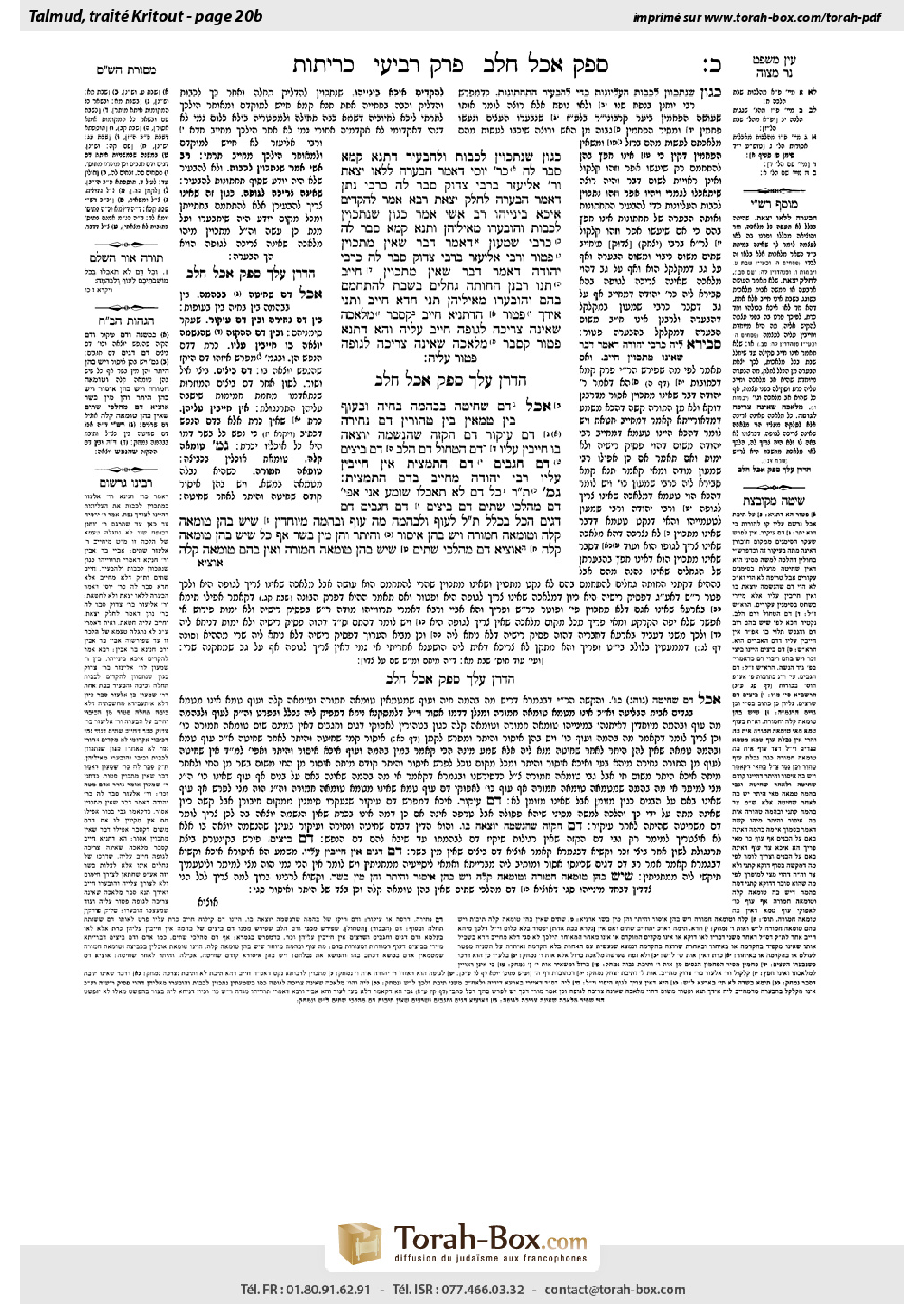
Keritot 20b: Talmud study for Daf Yomi
Daf Yomi is the daily study of one Talmud folio. Explore 37 tractates with scans, Hebrew text, Sefaria English and AI-generated French translations where annotated.
Passage selection and English or AI-generated French translation are available where the scan has annotations. Daf Study is independent of Torah-Box and Sefaria.
Browse Keritot · כריתות · All tractatesKeritot 20b text and translations
This page of Keritot includes the Aramaic text, an English translation and an AI-generated French translation, alongside the scan above.
כריתות כ׳ ב · Aramaic and Hebrew text
כְּגוֹן שֶׁנִּתְכַּוֵּין לְכַבּוֹת וּלְהַבְעִיר, דְּתַנָּא קַמָּא סָבַר לַהּ כְּרַבִּי יוֹסֵי, דְּאָמַר: הַבְעָרָה לְלָאו יָצָאת,
וְרַבִּי אֱלִיעֶזֶר בְּרַבִּי צָדוֹק סָבַר לַהּ כְּרַבִּי נָתָן, דְּאָמַר: הַבְעָרָה לְחַלֵּק יָצָאת.
רָבָא אָמַר: לְהַקְדִּים אִיכָּא בֵינַיְיהוּ.
רַב אָשֵׁי אָמַר: כְּגוֹן שֶׁנִּתְכַּוֵּין לְכַבּוֹת וְהוּבְעֲרוּ מֵאֵילֵיהֶן, וְתַנָּא קַמָּא סָבַר לַהּ כְּרַבִּי שִׁמְעוֹן, דְּאָמַר: דָּבָר שֶׁאֵין מִתְכַּוֵּין – פָּטוּר, וְרַבִּי אֱלִיעֶזֶר בְּרַבִּי צָדוֹק סָבַר לַהּ כְּרַבִּי יְהוּדָה, דְּאָמַר: דָּבָר שֶׁאֵין מִתְכַּוֵּין – חַיָּיב.
תָּנוּ רַבָּנַן: הַחוֹתֶה גֶּחָלִים בְּשַׁבָּת לְהִתְחַמֵּם בָּהֶם וְהוּבְעֲרוּ מֵאֵילֵיהֶן – תָּנֵי חֲדָא: חַיָּיב, וְתָנֵי אִידַּךְ: פָּטוּר. הָדְתַנְיָא: חַיָּיב, קָסָבַר: מְלָאכָה שֶׁאֵינָהּ צְרִיכָה לְגוּפָהּ – חַיָּיב עָלֶיהָ. וְהָא דִּתְנָא: פָּטוּר, קָסָבַר: מְלָאכָה שֶׁאֵינָהּ צְרִיכָה לְגוּפָהּ פָּטוּר עָלֶיהָ.
הֲדַרַן עֲלָךְ סָפֵק אָכַל חֵלֶב
מַתְנִי׳ אָכַל דַּם שְׁחִיטָה, בַּבְּהֵמָה בְּחַיָּה וּבָעוֹף, בֵּין טְמֵאִין בֵּין טְהוֹרִין, דַּם נְחִירָה, דַּם עִיקּוּר, דַּם הַקָּזָה שֶׁהַנְּשָׁמָה יוֹצְאָה בּוֹ – חַיָּיבִין עָלָיו.
דַּם הַטְּחוֹל, דַּם הַלֵּב, דַּם בֵּיצִים, דַּם חֲגָבִים, דַּם הַתַּמְצִית – אֵין חַיָּיבִין עָלָיו, רַבִּי יְהוּדָה מְחַיֵּיב בְּדַם הַתַּמְצִית.
גְּמָ׳ תָּנוּ רַבָּנַן: ״כָּל דָּם לֹא תֹאכְלוּ״, שׁוֹמֵעַ אֲנִי אֲפִילּוּ דַּם מְהַלְּכֵי שְׁתַּיִם, דַּם בֵּיצִים, דַּם חֲגָבִים, דַּם דָּגִים, הַכֹּל בַּכְּלָל? תַּלְמוּד לוֹמַר: ״לְעוֹף וְלִבְהֵמָה״,
מָה עוֹף וּבְהֵמָה מְיוּחָדִין, שֶׁיֵּשׁ בָּהֶן טוּמְאָה קַלָּה וְטוּמְאָה חֲמוּרָה, וְיֵשׁ בָּהֶן אִיסּוּר וְהֶיתֵּר, וְהֵן מִין בָּשָׂר – אַף כֹּל שֶׁיֵּשׁ בָּהֶן טוּמְאָה קַלָּה.
אוֹצִיא דַּם מְהַלְּכֵי שְׁתַּיִם – שֶׁיֵּשׁ בָּהֶן טוּמְאָה חֲמוּרָה, וְאֵין בָּהֶן טוּמְאָה קַלָּה.
Keritot 20b · English translation
This is referring to a case where he intended both to extinguish and to kindle. The Torah singles out the labor of kindling on Shabbat, as it is written: “You shall not kindle fire in all your dwelling places on the day of Shabbat” (Exodus 35:3). The Sages disagree with regard to the interpretation of this verse. As the first tanna holds in accordance with the opinion of Rabbi Yosei, who says: Kindling was singled out from the general category of prohibited labors in order to teach that it is unlike other labors, teaching that it is a regular prohibition, i.e., it is punishable only with lashes and does not entail karet or stoning for an intentional transgression, or a sin offering for an unwitting transgression. Consequently, he is not liable to bring a sin offering for the kindling.
And Rabbi Eliezer, son of Rabbi Tzadok, holds in accordance with the opinion of Rabbi Natan, who says: Kindling was singled out in the Torah to divide the various primary categories of labor and to establish liability for the performance of each of them. According to this opinion, the prescribed punishments for kindling are the same as for the rest of the prohibited labors.
Rava said yet another explanation of the disagreement in the baraita: The difference between them involves a case where one intended to ignite the lower coals and subsequently extinguish the upper coals, and instead he extinguished the upper ones and ignited the lower ones simultaneously. Since he performed the extinguishing first and did not perform it after he ignited as he had intended, the first tanna rules he is liable to bring only one sin offering. By contrast, Rabbi Eliezer, son of Rabbi Tzadok, maintains there is no exemption for performing the prohibited labors in a different sequence than intended.
Rav Ashi said another explanation: The baraita is referring to a case where he intended to extinguish a flame and he was not aware that the bottom coals would be kindled. Rather, they ignited by themselves, as he moved aside and extinguished the upper coals. And the first tanna holds in accordance with the opinion of Rabbi Shimon, who says: If one commits an unintentional act, an action from which an unintended prohibited result ensues on Shabbat, as he did not intend to perform a prohibited labor, he is exempt. And Rabbi Eliezer, son of Rabbi Tzadok, holds in accordance with the opinion of Rabbi Yehuda, who says: One who commits an unintentional act from which a prohibited labor inadvertently results is liable.
The Sages taught in a baraita: Concerning one who stokes coals on Shabbat with the intention to move them in order to be warmed by them, and they ignited by themselves; it is taught in one baraita that he is liable and it is taught in another baraita that he is exempt. The Gemara explains: The reason for that which is taught in the first baraita, i.e., that he is liable, is that this tanna holds that one who performs a labor on Shabbat that is not necessary for its own sake, i.e., he performs the labor for a purpose other than the direct result of the action, is held liable for it. And the reason for that which is taught in the second baraita, i.e., that he is exempt, is that he holds that one who performs a labor that is not necessary for its own sake is exempt from liability for it.
MISHNA: If one consumed an olive-bulk of blood that spurted during the slaughter of a domesticated animal, an undomesticated animal, or a bird, whether it is a kosher or non-kosher species; or if one consumed blood that flowed after stabbing an animal or killing it in a manner other than by ritual slaughter, or blood that spurted after ripping the animal’s windpipe or gullet, or blood that spurted during bloodletting with which the soul departs, one is liable to receive karet for consuming it intentionally or to bring a sin offering for consuming it unwittingly.
But with regard to blood of the spleen, blood of the heart, blood of eggs, blood of grasshoppers, or blood of exudate [tamtzit], i.e., that oozes from the neck of the animal after the initial spurt of its slaughter concludes,one is not liable for consuming it. Rabbi Yehuda deems one liable in the case of blood of exudate.
GEMARA: The Sages taught in a baraita: The verse states: “And you shall consume no manner of blood” (Leviticus 7:26). I would derive from here that even with regard to the blood of bipeds, i.e., human beings, and the blood of eggs, the blood of grasshoppers, and the blood of fish, all these are included in the prohibition against consuming blood. Therefore, the verse states: “Whether it is of bird or of animal” (Leviticus 7:26).
The baraita explains the derivation from the verse: Just as birds and animals are unique in that they have the capacity for both a light form of ritual impurity, if they become impure after they are slaughtered, in which case they are considered impure food, and a severe form of impurity, if they die without valid ritual slaughter, and they have the possibility of being forbidden or permitted, and they are a type of meat, so too, everything that has the capacity for both a light form of impurity and a severe form of ritual impurity, and has the possibility of being forbidden or permitted, and is a type of meat, is included in the prohibition.
I will therefore exclude the blood of bipeds, as they have the capacity for a severe form of ritual impurity, i.e., the impurity of a corpse, but they do not have the capacity for a light form of ritual impurity, since the halakhot of the impurity of food do not apply to the human body.
Keritot 20b · Traduction française (IA)
Cela fait référence au cas où il avait l’intention à la fois d’éteindre et d’allumer. La Torah distingue le travail d’allumage le Chabbat, comme il est écrit : « Vous n’allumerez pas de feu dans toutes vos demeures le jour du Chabbat » (Exode 35:3). Les Sages sont en désaccord quant à l’interprétation de ce verset. En effet, le premier tanna suit l’opinion de Rabbi Yossei, qui dit : L’allumage a été distingué de la catégorie générale des travaux interdits afin d’enseigner qu’il diffère des autres travaux, c’est-à-dire qu’il constitue une interdiction ordinaire : il n’est passible que de coups de fouet et n’entraîne ni karet ni lapidation en cas de transgression intentionnelle, ni sacrifice expiatoire en cas de transgression involontaire. Par conséquent, il n’est pas tenu d’apporter un sacrifice expiatoire pour l’allumage.
Rabbi Eliezer, fils de Rabbi Tsadok, suit l’opinion de Rabbi Natan, qui dit : L’allumage a été distingué dans la Torah afin de séparer les différentes catégories principales de travaux et d’établir que chacun d’eux engage une responsabilité. Selon cette opinion, les peines prescrites pour l’allumage sont les mêmes que pour les autres travaux interdits.
Rava donna une autre explication du désaccord dans la baraïta : la différence entre eux porte sur le cas où quelqu’un avait l’intention d’allumer les braises du bas, puis d’éteindre celles du haut, mais qu’au lieu de cela, il éteignit celles du haut et alluma simultanément celles du bas. Puisqu’il a d’abord effectué l’extinction et ne l’a pas effectuée après avoir allumé, comme il en avait l’intention, le premier tanna décide qu’il n’est tenu d’apporter qu’un seul sacrifice expiatoire. Rabbi Eliezer, fils de Rabbi Tsadok, soutient au contraire qu’il n’y a pas d’exemption lorsqu’on effectue les travaux interdits dans un ordre différent de celui prévu.
Rav Ashi donna une autre explication : la baraïta parle du cas où il avait l’intention d’éteindre une flamme et ignorait que les braises du bas s’allumeraient. Elles s’embrasèrent plutôt d’elles-mêmes, tandis qu’il écartait les braises du haut et les éteignait. Le premier tanna suit l’opinion de Rabbi Shimon, qui dit : Celui qui accomplit un acte involontaire — une action dont découle, le Chabbat, un résultat interdit qu’il n’avait pas voulu, puisqu’il n’avait pas l’intention d’effectuer un travail interdit — est exempt. Rabbi Eliezer, fils de Rabbi Tsadok, suit l’opinion de Rabbi Yehouda, qui dit : Celui qui accomplit un acte involontaire dont découle par inadvertance un travail interdit est responsable.
Les Sages ont enseigné dans une baraïta : au sujet de celui qui attise des braises le Chabbat dans l’intention de les déplacer afin de se réchauffer à leur chaleur, et qui les voit s’embraser d’elles-mêmes, une baraïta enseigne qu’il est responsable, et une autre baraïta enseigne qu’il est exempt. La Guemara explique : la raison de l’enseignement de la première baraïta, selon lequel il est responsable, est que ce tanna soutient que celui qui accomplit le Chabbat un travail qui n’est pas nécessaire en lui-même — c’est-à-dire qu’il effectue le travail dans un but autre que son résultat direct — en est tenu responsable. La raison de l’enseignement de la seconde baraïta, selon lequel il est exempt, est qu’elle soutient que celui qui accomplit un travail qui n’est pas nécessaire en lui-même est exempt de responsabilité à ce titre.
Michna : Si quelqu’un a consommé l’équivalent du volume d’une olive de sang ayant jailli lors de l’abattage d’un animal domestique, d’un animal sauvage ou d’un oiseau, qu’il s’agisse d’une espèce cachère ou non cachère ; ou s’il a consommé du sang qui a coulé après qu’un animal a été poignardé ou tué autrement que par abattage rituel, ou du sang ayant jailli après que la trachée ou l’œsophage de l’animal a été déchiré, ou du sang ayant jailli lors d’une saignée entraînant la mort, il est passible de karet s’il en a consommé intentionnellement, ou doit apporter un sacrifice expiatoire s’il en a consommé involontairement.
En revanche, pour le sang de la rate, le sang du cœur, le sang des œufs, le sang des sauterelles ou le sang d’exsudation [tamtzit], c’est-à-dire celui qui suinte du cou de l’animal après la fin du premier jaillissement lors de son abattage, on n’est pas passible pour en avoir consommé. Rabbi Yehouda estime que l’on est passible dans le cas du sang d’exsudation.
Guemara : Les Sages ont enseigné dans une baraïta : le verset dit : « Vous ne consommerez aucune sorte de sang » (Lévitique 7:26). J’aurais déduit de là que l’interdiction de consommer du sang inclut également le sang des bipèdes, c’est-à-dire des êtres humains, le sang des œufs, le sang des sauterelles et le sang des poissons. Le verset dit donc : « qu’il s’agisse d’un oiseau ou d’un animal » (Lévitique 7:26).
La baraïta explique la déduction tirée du verset : de même que les oiseaux et les animaux se distinguent par leur capacité à contracter une forme légère d’impureté rituelle, s’ils deviennent impurs après avoir été abattus, auquel cas ils sont considérés comme des aliments impurs, ainsi qu’une forme grave d’impureté, s’ils meurent sans abattage rituel valide ; de même, ils peuvent être interdits ou permis, et ils sont une sorte de viande. De même, tout ce qui peut contracter à la fois une forme légère et une forme grave d’impureté rituelle, qui peut être interdit ou permis et qui est une sorte de viande, est inclus dans l’interdiction.
J’exclurai donc le sang des bipèdes, car ils peuvent contracter une forme grave d’impureté rituelle, c’est-à-dire l’impureté d’un cadavre, mais ils ne peuvent pas contracter une forme légère d’impureté rituelle, puisque les lois relatives à l’impureté des aliments ne s’appliquent pas au corps humain.
Traduction française générée par IA à partir de l’édition anglaise de Sefaria. Vérifie toujours un passage avec le texte source.
Text from Sefaria: William Davidson Edition - Vocalized Aramaic (CC BY NC); William Davidson Edition - English (CC BY NC).