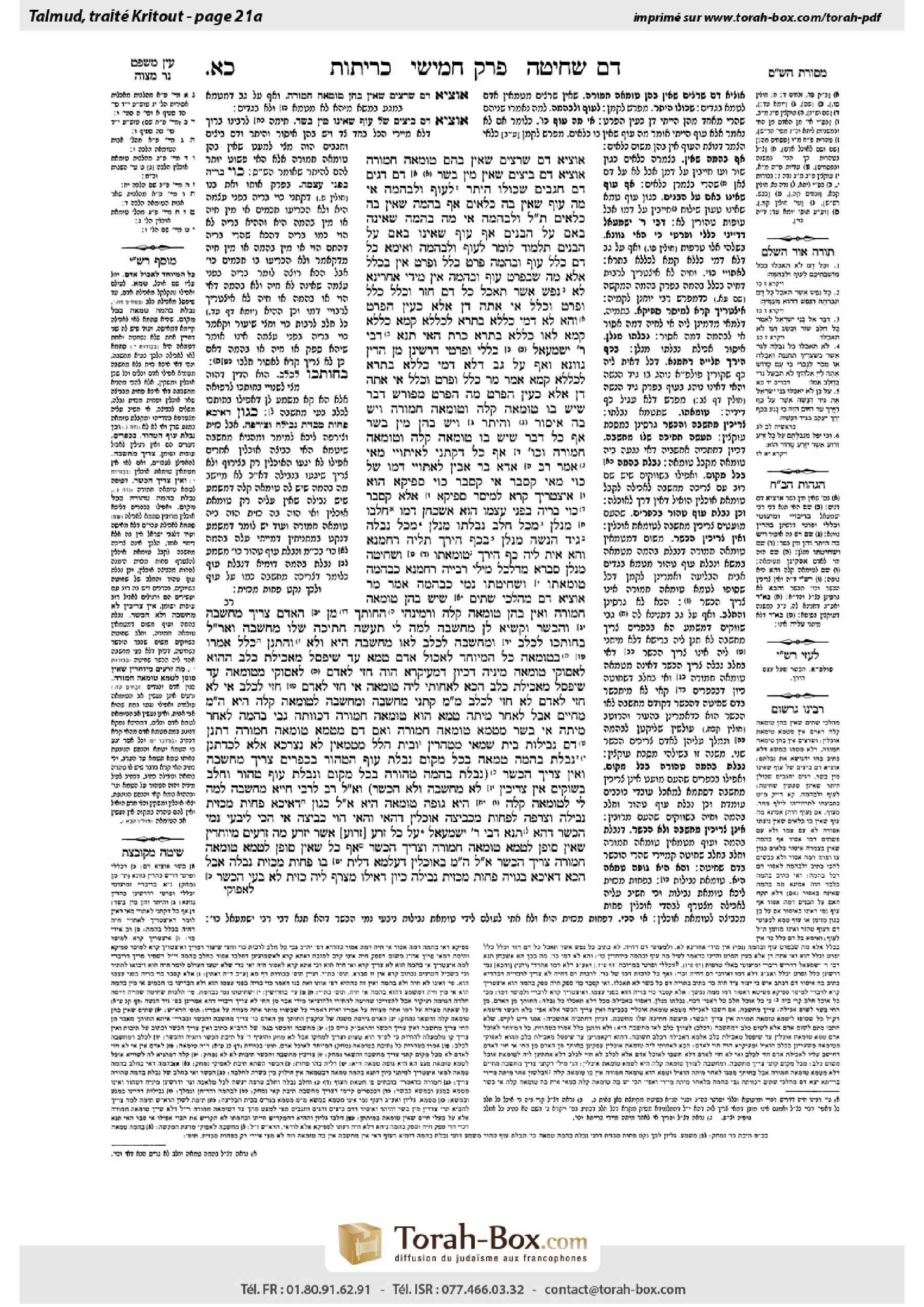
Keritot 21a: Talmud study for Daf Yomi
Daf Yomi is the daily study of one Talmud folio. Explore 37 tractates with scans, Hebrew text, Sefaria English and AI-generated French translations where annotated.
Passage selection and English or AI-generated French translation are available where the scan has annotations. Daf Study is independent of Torah-Box and Sefaria.
Browse Keritot · כריתות · All tractatesKeritot 21a text and translations
This page of Keritot includes the Aramaic text, an English translation and an AI-generated French translation, alongside the scan above.
כריתות כ״א א · Aramaic and Hebrew text
אוֹצִיא דַּם שְׁרָצִים – שֶׁאֵין בָּהֶם טוּמְאָה חֲמוּרָה. אוֹצִיא דַּם בֵּיצִים – שֶׁאֵין מִין בָּשָׂר, דַּם דָּגִים דַּם חֲגָבִים – שֶׁכּוּלּוֹ הֶיתֵּר.
״לָעוֹף וְלַבְּהֵמָה״? אִי מָה עוֹף שֶׁאֵין בָּהּ כִּלְאַיִם, אַף בְּהֵמָה – שֶׁאֵין בָּהּ כִּלְאַיִם! תַּלְמוּד לוֹמַר: ״וְלַבְּהֵמָה״.
אִי מָה בְּהֵמָה שֶׁאֵינָהּ בְּאֵם עַל הַבָּנִים, אַף עוֹף שֶׁאֵינוֹ בְּאֵם עַל הַבָּנִים! תַּלְמוּד לוֹמַר: ״לָעוֹף וְלַבְּהֵמָה״.
וְאֵימָא: ״כׇּל דָּם״ – כָּלַל, ״עוֹף וּבְהֵמָה״ – פָּרַט, כְּלָל וּפְרָט, אֵין בַּכְּלָל אֶלָּא מַה שֶּׁבַּפְּרָט, עוֹף וּבְהֵמָה – אִין, מִידִּי אַחֲרִינָא – לָא!
״נֶפֶשׁ אֲשֶׁר תֹּאכַל כׇּל דָּם״ – חָזַר וְכָלַל, כְּלָל וּפְרָט וְכָלַל, אִי אַתָּה דָן אֶלָּא כְּעֵין הַפְּרָט.
וְהָא לָא דָּמֵי כְּלָלָא בָּתְרָא לִכְלָלָא קַמָּא, כְּלָלָא קַמָּא לָאו, כְּלָלָא בָּתְרָא כָּרֵת!
הַאי תַּנָּא דְּבֵי רַבִּי יִשְׁמָעֵאל [בְּרִיבּוּיֵי וּמִיעוּטֵי וּ]כְלָלֵי וּפְרָטֵי דָּרְשִׁינַן מִן הָדֵין גַּוְונָא, וְאַף עַל גַּב דְּלָא דָּמֵי כְּלָלָא בָּתְרָא לִכְלָלָא קַמָּא.
אָמַר מָר: כְּלָל וּפְרָט וּכְלָל אִי אַתָּה דָן אֶלָּא כְעֵין הַפְּרָט, מָה הַפְּרָט מְפוֹרָשׁ – דָּבָר שֶׁיֵּשׁ בּוֹ טוּמְאָה קַלָּה וְטוּמְאָה חֲמוּרָה, וְיֵשׁ בָּהֶ[ן] אִיסּוּר וְהֶיתֵּר וְיֵשׁ בָּהֶן מִין בָּשָׂר, אַף כׇּל דָּבָר שֶׁיֵּשׁ בּוֹ טוּמְאָה קַלָּה וְטוּמְאָה חֲמוּרָה וְכוּ׳.
״אַף כֹּל״ דְּקָתָנֵי לְאֵיתוֹיֵי מַאי?
אָמַר רַב אַדָּא בַּר אָבִין: לְאֵתוֹיֵי דָּמוֹ שֶׁל כּוֹי. מַאי קָסָבַר? אִי קָסָבַר כּוֹי סְפֵיקָא הוּא, אִיצְטְרִיךְ קְרָא לְמֵיסַר סְפֵיקָא? אֶלָּא קָסָבַר כּוֹי בְּרִיָּה בִּפְנֵי עַצְמוֹ הוּא.
אַשְׁכְּחַן דָּמוֹ, חֶלְבּוֹ מְנָלַן? ״מִכׇּל חֵלֶב״. נִבְלָתוֹ מְנָלַן? ״מִכׇּל נְבֵלָה״.
גִּיד הַנָּשֶׁה מְנָלַן? בְּכַף הַיָּרֵךְ תַּלְיֵהּ רַחֲמָנָא, וְהָא אִית לֵיהּ כַּף הַיָּרֵךְ.
טוּמְאָתוֹ וּשְׁחִיטָה, מְנָלַן? סְבָרָא, מִדִּלְכֹל מִילֵּי רַבְּיֵיהּ רַחֲמָנָא כִּבְהֵמָה, טוּמְאָתוֹ וּשְׁחִיטָתוֹ נָמֵי כִּבְהֵמָה.
אָמַר מָר: אוֹצִיא דַּם מְהַלְּכֵי שְׁתַּיִם, שֶׁיֵּשׁ בָּהֶן טוּמְאָה חֲמוּרָה וְאֵין בָּהֶן טוּמְאָה קַלָּה. וּרְמִינְהִי: הַחוֹתֵךְ מִן הָאָדָם – צָרִיךְ מַחְשָׁבָה וְהֶכְשֵׁר.
וְקַשְׁיָא לַן: מַחְשָׁבָה לְמָה לִי? תֵּעָשֶׂה חֲתִיכָה שֶׁלּוֹ מַחְשָׁבָה! וְאָמַר רֵישׁ לָקִישׁ: בְּחוֹתְכוֹ לַכֶּלֶב, וּמַחְשָׁבָה לַכֶּלֶב לָאו מַחְשָׁבָה הִיא.
וְלָא? וְהָתְנַן, כְּלָל אָמְרוּ בְּטוּמְאָה: כֹּל הַמְיוּחָד לֶאֱכוֹל אָדָם – טָמֵא, עַד שֶׁיִּפָּסֵל מֵאֲכִילַת כֶּלֶב!
הָהוּא לְאַסּוֹקֵי טוּמְאָה מִינֵּיהּ, דְּכֵיוָן דְּמֵעִיקָּרָא הֲוָה חֲזֵי לְאָדָם, לְאַסּוֹקֵי מִטּוּמְאָה עַד שֶׁיִּפָּסֵל מֵאֲכִילַת כֶּלֶב. הָכָא לְאַחוֹתֵי לֵיהּ טוּמְאָה, אִי חֲזֵי לְאָדָם – חֲזֵי לְכֶלֶב, אִי לָא חֲזֵי לְאָדָם – לָא חֲזֵי לְכֶלֶב.
מִכׇּל מָקוֹם קָתָנֵי מַחְשָׁבָה, וּמַחְשָׁבָה – לְטוּמְאָה קַלָּה הִיא! הָנֵי מִילֵּי מֵחַיִּים, אֲבָל לְאַחַר מִיתָה – טָמֵא הוּא טוּמְאָה חֲמוּרָה.
דִּכְווֹתַהּ גַּבֵּי בְּהֵמָה לְאַחַר מִיתָה, אִי בָּשָׂר – מְטַמֵּא טוּמְאָה חֲמוּרָה, וְאִם דָּם – מְטַמֵּא טוּמְאָה חֲמוּרָה,
דִּתְנַן: דַּם נְבֵילוֹת – בֵּית שַׁמַּאי מְטַהֲרִין, וּבֵית הִלֵּל מְטַמְּאִין.
לֹא נִצְרְכָא אֶלָּא לִכְדִתְנַן: נִבְלַת בְּהֵמָה טְמֵאָה בְּכׇל מָקוֹם, נִבְלַת [הָ]עוֹף הַטָּהוֹר בַּכְּפָרִים – צָרִיךְ מַחְשָׁבָה, וְאֵין צָרִיךְ הֶכְשֵׁר.
נִבְלַת בְּהֵמָה טְהוֹרָה בְּכׇל מָקוֹם, וְנִבְלַת עוֹף טָהוֹר וְחֵלֶב בַּשְּׁוָקִים – אֵין צְרִיכִין לֹא מַחְשָׁבָה וְלֹא הֶכְשֵׁר.
וַאֲמַר לֵיהּ רַב לְרַבִּי חִיָּיא: מַחְשָׁבָה, לְמָה לִי לְטוּמְאָה קַלָּה? הִיא גּוּפַהּ טוּמְאָה הִיא! אֲמַר לֵיהּ: כְּגוֹן דְּאִיכָּא פָּחוֹת מִכְּזַיִת נְבֵילָה, וְצֵרְפָהּ לְפָחוֹת מִכְּבֵיצָה אוֹכָלִין, דְּהַאי וְהַאי הָוֵי כְּבֵיצָה.
אִי הָכִי, לִיבְעֵי נָמֵי הֶכְשֵׁר, דְּהָא תָּנָא דְּבֵי רַבִּי יִשְׁמָעֵאל: ״עַל כׇּל זֶרַע [זֵרוּעַ] אֲשֶׁר יִזָּרֵעַ״ – מָה זְרָעִים מְיוּחָדִין שֶׁאֵין סוֹפָן לְטַמֵּא טוּמְאָה חֲמוּרָה וְצָרִיךְ הֶכְשֵׁר, אַף כֹּל שֶׁאֵין סוֹפָן לְטַמֵּא טוּמְאָה חֲמוּרָה צָרִיךְ הֶכְשֵׁר!
אֲמַר לֵיהּ: הָנֵי מִילֵּי בָּאוֹכָלִין דְּעָלְמָא, דְּלֵית בְּהוּ פָּחוֹת מִכְּזַיִת נְבֵלָה, אֲבָל הָכָא, דְּאִיכָּא בְּגַוֵּיהּ פָּחוֹת מִכְּזַיִת נְבֵילָה, כֵּיוָן דְּאִילּוּ מְצָרֵף לֵיהּ כְּזַיִת – לָא בָּעֵי הֶכְשֵׁר.
Keritot 21a · English translation
I will likewise exclude the blood of creeping animals, which do not have a severe form of ritual impurity. Impurity transmitted to a person by the carcass of a creeping animal does not render clothing impure, whereas impurity transmitted by the carcass of an animal or bird does render one’s clothing impure. I will also exclude the blood of eggs, as they are not a type of meat, and finally I will exclude the blood of fish and the blood of grasshoppers, as they are entirely permitted, as explained on 21b.
The baraita continues: The verse states: “And you shall consume no manner of blood, whether it is of bird or of animal, in any of your dwellings” (Leviticus 7:26). The verse mentions both “bird” and “animal,” because if the verse had stated only “bird,” one might have said that just as a bird is a creature concerning which the prohibition of diverse kinds does not apply, as will be explained, so too, the prohibition against consuming blood applies only to an animal concerning which the prohibition of diverse kinds does not apply, whereas the blood of other animals is not forbidden. Therefore, the verse states: “Or of animal.”
And if the verse had mentioned only “animal,” one might have said that just as an animal is not included in the prohibition against taking the mother bird with her young (see Deuteronomy 22:6–7), so too, a bird whose blood is forbidden is that which is not included in the prohibition against taking the mother bird with the young, i.e., non-kosher birds, whereas the blood of kosher birds is permitted. Therefore, the verse states: “Whether it is of bird or of animal.”
The Gemara raises a difficulty: But say that the verse should be interpreted as follows: The phrase “no manner of blood” is a generalization, and the mention of “bird or animal” is a detail. This is a generalization and a detail, and the hermeneutical principle in such cases is that the generalization includes only what is mentioned in the detail. Consequently, with regard to a bird and an animal, yes, it is prohibited to consume their blood, but with regard to anything else, the prohibition does not apply.
The Gemara explains that when the next verse states: “Whoever consumes any blood, that soul shall be cut off from his people” (Leviticus 7:27), it then generalized again. Therefore, this is a case of a generalization, and a detail, and a generalization, in which case the relevant hermeneutical principle dictates that you may deduce that the verse is referring only to items similar to the detail. Accordingly, the verse includes everything that has the following three components, as stated above: The capacity for both a light form of ritual impurity and a severe form of ritual impurity; the possibility of being forbidden or permitted; and categorization as a type of meat.
The Gemara objects: But the last generalization is not similar to the first generalization. The first generalization, where it states: “You shall consume no manner of blood,” indicates a regular prohibition, punishable by lashes, whereas the last generalization, where it states: “That soul shall be cut off from his people,” indicates that the prohibition is punishable by karet. Consequently, the hermeneutical principle for cases of a generalization, a detail, and a generalization should not apply.
The Gemara responds: This tanna, whose opinion is recorded in this baraita, is of the school of Rabbi Yishmael, who maintains that we expound generalizations and details even in a case like this, even though the last generalization is not similar to the first generalization.
The Gemara further analyzes the baraita. The Master said that there is a generalization, and a detail, and a generalization, and therefore you may deduce that the verse is referring only to items similar to the detail. Just as the detail is explicit in that it is referring to an item that has the capacity for both a light form of impurity and a severe form of impurity, and it has the possibility of being forbidden or permitted, and it is a type of meat, so too, every item that has the capacity for both a light form of ritual impurity and a severe form of ritual impurity, and has the possibility of being forbidden or permitted, and is a type of meat, is included in the prohibition against consuming blood.
The Gemara asks: What does this phrase: So too every item, which the baraita teaches, serve to include beyond birds and animals, which are mentioned explicitly in the verse? After all, the blood of human beings, creeping animals, fish, and grasshoppers have already been excluded from the prohibition.
Rav Adda bar Avin said: It serves to include the blood of a koy, an animal that is not definitively categorized as either a domesticated animal or an undomesticated animal. The Gemara asks: What does Rav Adda bar Avin maintain in this regard? If he maintains that a koy is an uncertain case, is a verse necessary to teach the halakha in a case of uncertainty? Rather, Rav Adda bar Avin maintains that the koy is a distinct entity, i.e., it is not in the category of domesticated animals or undomesticated animals, and therefore its halakha must be taught.
The Gemara asks: We found a source for the prohibition against consuming the blood of a koy. From where do we derive that its fat is also forbidden? The Gemara answers that this is derived from the verse: “You shall not eat any [kol] fat” (Leviticus 7:23). The additional word “kol” serves to include the fat of a koy as being forbidden. The Gemara inquires further: From where do we derive that its carcass is prohibited? The Gemara answers that this is derived from the verse: “You shall not eat any [kol] animal carcass” (Deuteronomy 14:21). Here too, the additional word “kol” serves to include the carcass of a koy as being prohibited.
The Gemara asks: From where do we derive that the sciatic nerve of a koy is prohibited? The Gemara answers that the Merciful One rendered the prohibition of the sciatic nerve dependent on the presence of the spoon of the thigh, as it is stated: “Therefore the children of Israel shall not eat the sciatic nerve which is upon the spoon of the thigh” (Genesis 32:33), and this koy has a spoon [kaf ] of the thigh, i.e., a round protrusion of flesh in its thigh that is shaped like a spoon.
The Gemara further asks: From where do we derive the impurity status of the carcass of a koy, and that ritual slaughter renders its meat permitted for consumption? The Gemara answers that these halakhot are derived by logical reasoning: From the fact that in all the matters mentioned above the Merciful One included the koy and rendered it like a domesticated animal, it is logical that the halakhot concerning its impurity and its slaughter are also like those concerning a domesticated animal.
§ The Gemara continues to analyze the baraita. The Master said in the baraita: I will therefore exclude the blood of bipeds, as they have the capacity for a severe form of impurity, the impurity of a corpse, but they do not have the capacity for a light form of impurity, since the halakhot of the impurity of food do not apply to human flesh. But one can raise a contradiction from a mishna (Okatzin 3:2): With regard to one who cuts flesh from a living person for food, there are two conditions under which it becomes impure with the impurity of food: First, the flesh requires intent to eat it or feed it to others, and second, it must be rendered susceptible to impurity by coming into contact with water or one of the other six liquids that render food items susceptible to impurity.
Before explaining the contradiction between this mishna and the baraita cited above, the Gemara seeks to clarify the mishna itself: And the following was difficult for us: Why do I need intent? Let his act of cutting serve as intent to eat the flesh. And Reish Lakish said: This is referring to one who cuts the flesh in order to feed it to a dog, and intent to feed it to a dog is not considered intent to use the flesh as food.
The Gemara asks: And is intent to feed a dog not considered intent to use the flesh as food? But didn’t we learn in a mishna (Teharot 8:6): The Sages stated a principle with regard to ritual impurity: With regard to any food that is assumed to be food designated for a person, once it becomes impure with the impurity of food, it remains impure until it is rendered unfit to be consumed by a dog?
The Gemara answers: That mishna is referring to removing impurity from it. Since the food was initially fit to be eaten by a person, its status of impurity cannot be removed from it until it is rendered unfit to be consumed by a dog. By contrast, here, with regard to one who cuts flesh, the mishna is referring to granting it susceptibility to impurity. In this case, if it is fit for a person then it is fit for a dog, i.e., it is susceptible to the impurity of food; if it is not fit for a person, it is not fit for a dog, i.e., it is not susceptible to ritual impurity.
The Gemara addresses the contradiction between the mishna in Teharot and the baraita cited above: In any case, that mishna teaches that human flesh requires intent, and intent is for a light form of ritual impurity, i.e., this requirement of intent is necessary only for the flesh to become susceptible to ritual impurity as a food item. This apparently contradicts the claim of the baraita that the impurity of food items does not apply to human flesh. The Gemara answers: This statement of the mishna that human flesh is susceptible to impurity as a food item applies while the person is alive. But after death his corpse is impure by a severe form of impurity and is no longer susceptible to impurity as a food item, and that is the meaning of the baraita.
The Gemara objects: The baraita contrasts animals, which are susceptible to both light and more severe forms of impurity, and people, who are susceptible only to severe ritual impurity, and the Gemara has explained the baraita as referring to a human being after death. But in the corresponding situation with regard to an animal after death, if one is referring to its meat, then it transmits impurity by a severe form of impurity, the impurity of a carcass, and if one is referring to its blood, it likewise transmits impurity by a severe form of ritual impurity, and not a light form of ritual impurity.
As we learned in a mishna (Eduyyot 5:1): With regard to the blood of animal carcasses, Beit Shammai deem it pure, and Beit Hillel deem it impure just like the carcass itself, which transmits severe ritual impurity. Why, then, does the baraita differentiate between people and animals and indicate that dead animals are susceptible to a light form of ritual impurity?
The Gemara answers: The statement of the baraita that animals are susceptible to a light form of impurity after death while people are not is necessary only for that which we learned in a mishna with regard to the impurity of food (Okatzin 3:3): A carcass of a non-kosher animal, e.g., a horse or donkey, found in any location, and likewise an unslaughtered carcass of a kosher bird found in villages, where there are not many people and it is unlikely to be eaten, require express intent to be eaten in order for them to be considered food and susceptible to impurity of food. But they are not required to come into contact with a liquid in order to be rendered susceptible to impurity.
By contrast, the carcass of a kosher animal anywhere, and the unslaughtered carcass of a kosher bird or forbidden fat found in marketplaces, will presumably be eaten, and therefore they require neither intent to be eaten nor contact with liquid in order to be rendered susceptible to impurity.
And Rav said to Rabbi Ḥiyya: Why do I need intent for a carcass to be eaten so that it will be considered food and therefore susceptible to the impurity of food, which is a light form of ritual impurity? After all, the carcass itself is already impure with a severe form of impurity. Rabbi Ḥiyya said to Rav: It is necessary for a case where there is less than an olive-bulk of the carcass, which is not susceptible to the impurity of a carcass, and one combined it with less than an egg-bulk of food, so that this and that together are an egg-bulk, which is the minimum amount of food that is susceptible to food impurity.
Rav raised a difficulty to Rabbi Ḥiyya: If so, that less than an olive-bulk of an animal carcass does not transmit impurity, it should also require contact with a liquid in order to be rendered susceptible to impurity as a food. As the school of Rabbi Yishmael taught that with regard to the impurity of foods, the verse states: “Upon any sowing seed which is to be sown” (Leviticus 11:37), which teaches: Just as seeds are unique in that they will not ultimately become impure with a severe form of ritual impurity and they require contact with liquid in order to be rendered susceptible to impurity, so too, anything that will not ultimately become impure with a severe form of ritual impurity requires contact with liquid in order to be rendered susceptible to impurity.
Rabbi Ḥiyya said to Rav: This statement applies to foods in general, which do not contain less than an olive-bulk of an animal carcass. But here, where the food does contain less than an olive-bulk of an animal carcass, the halakha is different: Since it would be impure with a severe form of ritual impurity if one were to add to the amount of animal carcass so that there would be a full olive-bulk, it does not require contact with a liquid in order to be rendered susceptible to impurity. In any case, this halakha that less than an olive-bulk of a carcass combines with less than an egg-bulk of food to equal a full egg-bulk that is susceptible to food impurity, applies only to the flesh of an animal,
Keritot 21a · Traduction française (IA)
J’exclus également le sang des reptiles, qui ne présentent pas une forme grave d’impureté rituelle. L’impureté transmise à une personne par la carcasse d’un reptile ne rend pas ses vêtements impurs, contrairement à celle que transmet la carcasse d’un animal ou d’un oiseau, qui rend ses vêtements impurs. J’exclus aussi le sang des œufs, car ils ne sont pas une sorte de viande, et enfin le sang des poissons et des sauterelles, car ils sont entièrement permis, comme cela est expliqué en 21b.
La baraïta poursuit : Le verset énonce : « Vous ne consommerez aucune sorte de sang, ni d’oiseau ni d’animal, dans toutes vos demeures » (Lévitique 7,26). Le verset mentionne à la fois « oiseau » et « animal », car s’il n’avait mentionné que « oiseau », on aurait pu dire que, de même qu’un oiseau est une créature à laquelle ne s’applique pas l’interdiction des mélanges d’espèces, comme cela sera expliqué, de même l’interdiction de consommer du sang ne s’applique qu’à un animal auquel ne s’applique pas l’interdiction des mélanges d’espèces, tandis que le sang des autres animaux n’est pas interdit. C’est pourquoi le verset précise : « ou d’animal ».
Et si le verset n’avait mentionné que « animal », on aurait pu dire que, de même qu’un animal n’est pas concerné par l’interdiction de prendre la mère oiseau avec ses petits (voir Deutéronome 22,6-7), de même, parmi les oiseaux, le sang interdit est celui d’un oiseau qui n’est pas concerné par cette interdiction, c’est-à-dire celui des oiseaux non cachères, tandis que le sang des oiseaux cachères est permis. C’est pourquoi le verset précise : « ni d’oiseau ni d’animal ».
La Guemara soulève une difficulté : Mais ne pourrait-on pas interpréter le verset ainsi ? L’expression « aucune sorte de sang » est une généralité, et la mention « oiseau ou animal » est un détail. Il s’agit donc d’une généralité suivie d’un détail, et le principe herméneutique applicable en pareil cas veut que la généralité n’inclue que ce qui est mentionné dans le détail. Par conséquent, le sang d’un oiseau et celui d’un animal sont bien interdits, mais l’interdiction ne s’applique à rien d’autre.
La Guemara explique que le verset suivant, lorsqu’il énonce : « Quiconque consommera du sang, cette personne sera retranchée de son peuple » (Lévitique 7,27), formule à nouveau une généralité. Il s’agit donc d’une généralité, d’un détail, puis d’une généralité ; le principe herméneutique applicable permet alors d’en déduire que le verset ne vise que des éléments semblables à ceux du détail. Ainsi, le verset inclut tout ce qui possède les trois caractéristiques suivantes, mentionnées plus haut : la capacité de relever à la fois d’une forme légère et d’une forme grave d’impureté rituelle ; la possibilité d’être interdit ou permis ; et le fait d’être une sorte de viande.
La Guemara objecte : Mais la dernière généralité n’est pas semblable à la première. La première généralité, « Vous ne consommerez aucune sorte de sang », indique une interdiction ordinaire, passible de coups de fouet, tandis que la dernière généralité, « Cette personne sera retranchée de son peuple », indique que l’interdiction est passible de karet. Par conséquent, le principe herméneutique applicable aux cas d’une généralité suivie d’un détail puis d’une généralité ne devrait pas s’appliquer.
La Guemara répond : Ce tanna, dont l’opinion est rapportée dans cette baraïta, appartient à l’école de Rabbi Yishmaël, qui estime que l’on interprète les généralités et les détails même dans un cas comme celui-ci, bien que la dernière généralité ne soit pas semblable à la première.
La Guemara analyse plus avant la baraïta. Le Maître a dit qu’il y a une généralité, un détail, puis une généralité, et que l’on peut donc en déduire que le verset ne vise que des éléments semblables au détail. De même que le détail désigne explicitement un élément qui peut relever à la fois d’une forme légère et d’une forme grave d’impureté rituelle, qui peut être interdit ou permis et qui est une sorte de viande, de même tout élément qui peut relever à la fois d’une forme légère et d’une forme grave d’impureté rituelle, qui peut être interdit ou permis et qui est une sorte de viande, est inclus dans l’interdiction de consommer du sang.
La Guemara demande : Qu’est-ce que l’expression « de même, tout élément », enseignée par la baraïta, sert à inclure au-delà des oiseaux et des animaux, explicitement mentionnés dans le verset ? En effet, le sang des êtres humains, des reptiles, des poissons et des sauterelles a déjà été exclu de l’interdiction.
Rav Adda bar Avin a dit : Cela sert à inclure le sang du koy, un animal qui n’est catégorisé avec certitude ni comme animal domestique ni comme animal sauvage. La Guemara demande : Quelle est la position de Rav Adda bar Avin à cet égard ? S’il estime que le koy est un cas douteux, faut-il un verset pour enseigner la halakha dans un cas de doute ? Rav Adda bar Avin estime plutôt que le koy constitue une catégorie distincte, c’est-à-dire qu’il ne relève ni des animaux domestiques ni des animaux sauvages ; il faut donc enseigner sa halakha.
La Guemara demande : Nous avons trouvé une source pour l’interdiction de consommer le sang d’un koy. D’où déduisons-nous que sa graisse est également interdite ? La Guemara répond que cela se déduit du verset : « Vous ne mangerez aucune [kol] graisse » (Lévitique 7,23). Le mot supplémentaire « kol » sert à inclure la graisse du koy parmi les graisses interdites. La Guemara poursuit : D’où déduisons-nous que sa carcasse est interdite ? La Guemara répond que cela se déduit du verset : « Vous ne mangerez aucune [kol] carcasse d’animal » (Deutéronome 14,21). Ici aussi, le mot supplémentaire « kol » sert à inclure la carcasse du koy parmi les carcasses interdites.
La Guemara demande : D’où déduisons-nous que le nerf sciatique du koy est interdit ? La Guemara répond que le Miséricordieux a fait dépendre l’interdiction du nerf sciatique de la présence de la partie arrondie de la cuisse, comme il est écrit : « C’est pourquoi les enfants d’Israël ne mangent pas le nerf sciatique qui se trouve sur la partie arrondie de la cuisse » (Genèse 32,33). Or, ce koy possède une partie arrondie [kaf] de la cuisse, c’est-à-dire une saillie de chair arrondie sur sa cuisse, en forme de cuillère.
La Guemara demande encore : D’où déduisons-nous que la carcasse d’un koy est impure et que l’abattage rituel rend sa viande propre à la consommation ? La Guemara répond que ces halakhot se déduisent par raisonnement logique : puisque, dans tous les cas mentionnés plus haut, le Miséricordieux a inclus le koy et l’a assimilé à un animal domestique, il est logique que les halakhot relatives à son impureté et à son abattage soient elles aussi identiques à celles d’un animal domestique.
§ La Guemara poursuit l’analyse de la baraïta. Le Maître a dit dans la baraïta : J’exclus donc le sang des bipèdes, car ils peuvent relever d’une forme grave d’impureté, celle d’un cadavre, mais non d’une forme légère d’impureté, puisque les halakhot de l’impureté des aliments ne s’appliquent pas à la chair humaine. Mais on peut opposer à cela une Michna (Okatzin 3,2) : celui qui découpe de la chair sur une personne vivante pour en faire un aliment doit satisfaire à deux conditions pour qu’elle devienne impure au titre de l’impureté des aliments : premièrement, il faut avoir l’intention de la manger ou de la donner à manger à d’autres ; deuxièmement, elle doit être rendue apte à contracter l’impureté en entrant en contact avec de l’eau ou l’un des six autres liquides qui rendent les aliments aptes à contracter l’impureté.
Avant d’expliquer la contradiction entre cette Michna et la baraïta citée plus haut, la Guemara cherche à clarifier la Michna elle-même. Une difficulté se posait : pourquoi faut-il une intention ? Que l’acte même de découper vaille intention de manger la chair. Reish Lakish a dit : Il s’agit de quelqu’un qui découpe la chair afin de la donner à manger à un chien ; or, l’intention de la donner à manger à un chien n’est pas considérée comme une intention de l’utiliser comme aliment.
La Guemara demande : L’intention de donner à manger à un chien n’est-elle pas considérée comme une intention d’utiliser la chair comme aliment ? N’avons-nous pas appris dans une Michna (Teharot 8,6) : Les Sages ont énoncé un principe concernant l’impureté rituelle : tout aliment considéré comme destiné à la consommation humaine, une fois devenu impur au titre de l’impureté des aliments, le reste jusqu’à ce qu’il soit devenu impropre à être consommé par un chien.
La Guemara répond : Cette Michna traite de la levée de l’impureté. Puisque l’aliment était initialement propre à la consommation humaine, il ne peut perdre son statut d’impureté avant d’être devenu impropre à être consommé par un chien. En revanche, ici, à propos de celui qui découpe de la chair, la Michna traite du fait de la rendre apte à contracter l’impureté. Dans ce cas, si elle est propre à la consommation humaine, elle est aussi propre à être consommée par un chien, c’est-à-dire qu’elle est apte à contracter l’impureté des aliments ; si elle n’est pas propre à la consommation humaine, elle ne l’est pas non plus à être consommée par un chien, c’est-à-dire qu’elle n’est pas apte à contracter l’impureté rituelle.
La Guemara aborde la contradiction entre la Michna de Teharot et la baraïta citée plus haut : Quoi qu’il en soit, cette Michna enseigne que la chair humaine nécessite une intention, et que cette intention concerne une forme légère d’impureté rituelle ; autrement dit, cette exigence d’intention n’est nécessaire que pour que la chair devienne apte à contracter l’impureté rituelle en tant qu’aliment. Cela semble contredire l’affirmation de la baraïta selon laquelle l’impureté des aliments ne s’applique pas à la chair humaine. La Guemara répond : Cet enseignement de la Michna, selon lequel la chair humaine est susceptible de contracter l’impureté en tant qu’aliment, s’applique tant que la personne est vivante. Après sa mort, son cadavre est impur d’une forme grave d’impureté et n’est plus susceptible de contracter l’impureté en tant qu’aliment ; c’est cela que signifie la baraïta.
La Guemara objecte : La baraïta oppose les animaux, susceptibles à la fois de formes légères et de formes plus graves d’impureté, aux êtres humains, qui ne sont susceptibles que d’une forme grave d’impureté ; et la Guemara a expliqué que la baraïta parle d’un être humain après sa mort. Mais, dans la situation correspondante pour un animal après sa mort, si l’on parle de sa viande, elle transmet une forme grave d’impureté, celle d’une carcasse ; et si l’on parle de son sang, celui-ci transmet lui aussi une forme grave d’impureté rituelle, et non une forme légère.
Comme nous l’avons appris dans une Michna (Eduyyot 5,1) : concernant le sang des carcasses d’animaux, Beit Shammaï le déclarent pur, et Beit Hillel le déclarent impur, au même titre que la carcasse elle-même, qui transmet une forme grave d’impureté rituelle. Pourquoi, alors, la baraïta distingue-t-elle les êtres humains des animaux et indique-t-elle que les animaux morts sont susceptibles d’une forme légère d’impureté rituelle ?
La Guemara répond : L’enseignement de la baraïta, selon lequel les animaux morts sont susceptibles d’une forme légère d’impureté, contrairement aux êtres humains, n’est nécessaire qu’en raison de ce que nous avons appris dans une Michna sur l’impureté des aliments (Okatzin 3,3) : la carcasse d’un animal non cachère, par exemple un cheval ou un âne, trouvée en quelque lieu que ce soit, ainsi que la carcasse non abattue rituellement d’un oiseau cachère trouvée dans des villages, où la population est peu nombreuse et où il est peu probable qu’on la mange, nécessitent une intention explicite de les manger pour être considérées comme des aliments et devenir aptes à contracter l’impureté des aliments. En revanche, elles n’ont pas besoin d’entrer en contact avec un liquide pour être rendues aptes à contracter l’impureté.
En revanche, la carcasse d’un animal cachère, où qu’elle se trouve, ainsi que la carcasse non abattue rituellement d’un oiseau cachère ou la graisse interdite trouvées sur les marchés, seront vraisemblablement consommées ; elles n’ont donc besoin ni d’une intention de les manger ni d’entrer en contact avec un liquide pour être rendues aptes à contracter l’impureté.
Et Rav a dit à Rabbi Ḥiyya : Pourquoi faut-il avoir l’intention de manger une carcasse pour qu’elle soit considérée comme un aliment et puisse donc contracter l’impureté des aliments, qui est une forme légère d’impureté rituelle ? Après tout, la carcasse est déjà impure d’une forme grave d’impureté. Rabbi Ḥiyya a dit à Rav : C’est nécessaire dans le cas où la carcasse a un volume inférieur à celui d’une olive, et où elle n’est donc pas susceptible de transmettre l’impureté d’une carcasse, et où on l’a combinée à un volume de nourriture inférieur à celui d’un œuf, de sorte que les deux ensemble atteignent le volume d’un œuf, qui est la quantité minimale d’aliment susceptible de contracter l’impureté des aliments.
Rav souleva une difficulté à Rabbi Ḥiyya : Si tel est le cas, une carcasse animale d’un volume inférieur à celui d’une olive, qui ne transmet pas l’impureté, devrait également nécessiter un contact avec un liquide pour être rendue apte à contracter l’impureté en tant qu’aliment. Car l’école de Rabbi Yishmaël a enseigné qu’en matière d’impureté des aliments, le verset énonce : « Sur toute semence destinée à être semée » (Lévitique 11,37), ce qui enseigne : de même que les graines ont la particularité de ne pas pouvoir, en définitive, devenir impures d’une forme grave d’impureté rituelle et qu’elles nécessitent un contact avec un liquide pour être rendues aptes à contracter l’impureté, de même tout ce qui ne peut, en définitive, devenir impur d’une forme grave d’impureté rituelle nécessite un contact avec un liquide pour être rendu apte à contracter l’impureté.
Rabbi Ḥiyya a dit à Rav : Cet enseignement s’applique aux aliments en général, qui ne contiennent pas une carcasse animale d’un volume inférieur à celui d’une olive. Mais ici, où l’aliment contient une carcasse animale d’un volume inférieur à celui d’une olive, la halakha est différente : puisqu’il deviendrait impur d’une forme grave d’impureté rituelle si l’on ajoutait à la carcasse animale de quoi atteindre le volume d’une olive, il n’a pas besoin d’entrer en contact avec un liquide pour être rendu apte à contracter l’impureté. Quoi qu’il en soit, cette halakha, selon laquelle une carcasse d’un volume inférieur à celui d’une olive se combine à une quantité de nourriture inférieure à celle d’un œuf pour former le volume d’un œuf susceptible de contracter l’impureté des aliments, ne s’applique qu’à la chair d’un animal,
Traduction française générée par IA à partir de l’édition anglaise de Sefaria. Vérifie toujours un passage avec le texte source.
Text from Sefaria: William Davidson Edition - Vocalized Aramaic (CC BY NC); William Davidson Edition - English (CC BY NC).