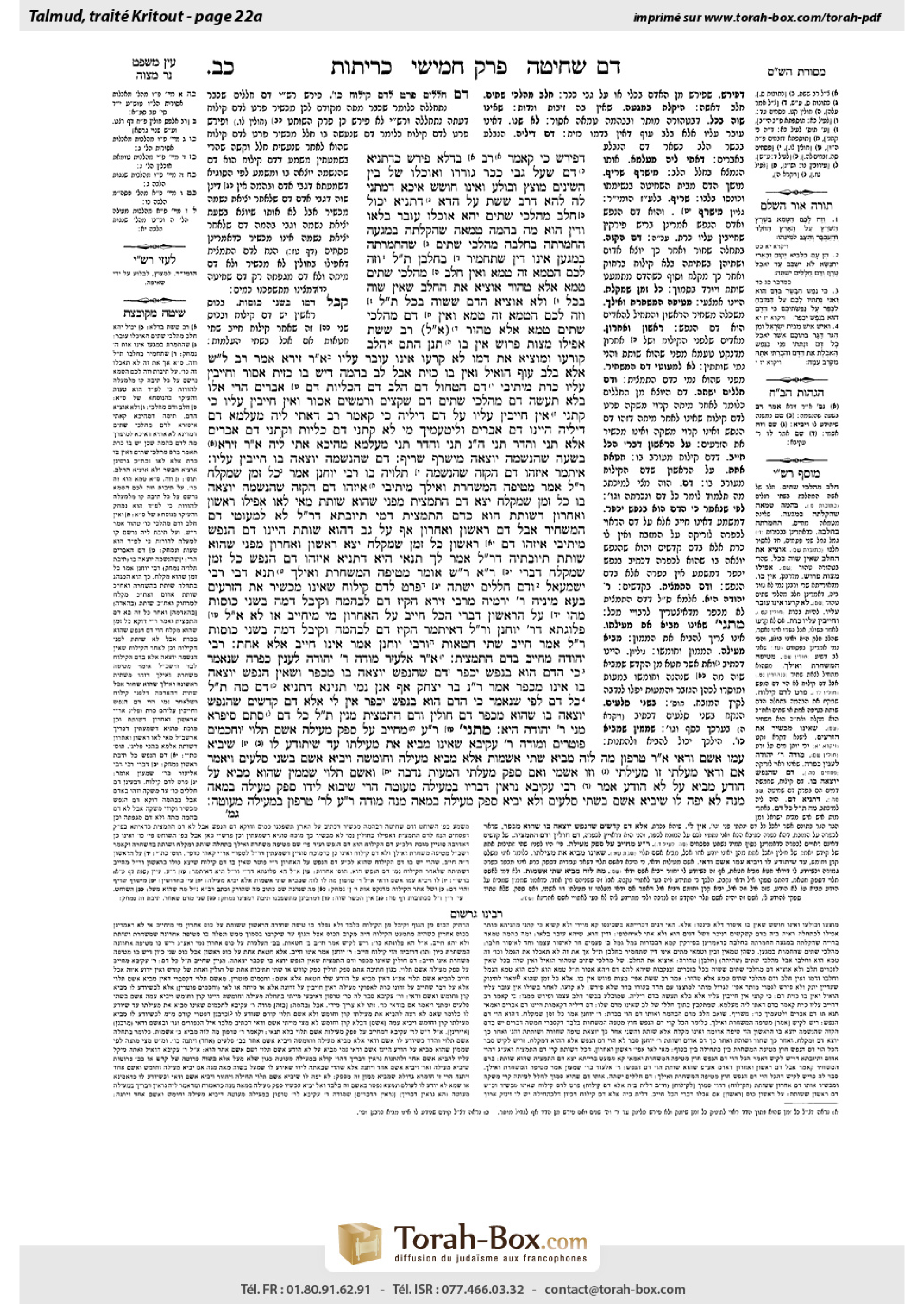
Keritot 22a: Talmud study for Daf Yomi
Daf Yomi is the daily study of one Talmud folio. Explore 37 tractates with scans, Hebrew text, Sefaria English and AI-generated French translations where annotated.
Passage selection and English or AI-generated French translation are available where the scan has annotations. Daf Study is independent of Torah-Box and Sefaria.
Browse Keritot · כריתות · All tractatesKeritot 22a text and translations
This page of Keritot includes the Aramaic text, an English translation and an AI-generated French translation, alongside the scan above.
כריתות כ״ב א · Aramaic and Hebrew text
דְּפֵירַשׁ. כִּי קָאָמַר רַב – בִּדְלָא פֵּירַשׁ, כִּדְתַנְיָא: דָּם שֶׁעַל גַּבֵּי כִּכָּר – גּוֹרְרוֹ וְאוֹכְלוֹ, שֶׁל בֵּין הַשִּׁינַּיִם – מוֹצֵץ וּבוֹלֵעַ וְאֵינוֹ חוֹשֵׁשׁ.
אִיכָּא דְמַתְנֵי לַהּ לְהָא דְּרַב שֵׁשֶׁת עַל הָדָא, דְּתַנְיָא: יָכוֹל חֲלֵב מְהַלְּכֵי שְׁתַּיִם יְהֵא אוֹכְלוֹ עוֹבֵר בְּלָאו? וְדִין הוּא: מָה בְּהֵמָה טְמֵאָה שֶׁהֵקַלְתָּה בְּמַגָּעָהּ, הֶחְמַרְתָּה בַּחֲלָבָהּ, מְהַלְּכֵי שְׁתַּיִם שֶׁהֶחְמַרְתָּה בְּמַגָּעָן – אֵינוֹ דִּין שֶׁתַּחְמִיר בַּחֲלָבָן?
תַּלְמוּד לוֹמַר: ״וְזֶה לָכֶם הַטָּמֵא״ – זֶה טָמֵא, וְאֵין חֲלֵב מְהַלְּכֵי שְׁתַּיִם טָמֵא אֶלָּא טָהוֹר.
אוֹצִיא אֶת הֶחָלָב, שֶׁאֵין שָׁוֶה בַּכֹּל, וְלֹא אוֹצִיא הַדָּם שֶׁשָּׁוֶה בַּכֹּל! תַּלְמוּד לוֹמַר: ״וְזֶה לָכֶם הַטָּמֵא״ – זֶה טָמֵא, וְאֵין דַּם מְהַלְּכֵי שְׁתַּיִם טָמֵא אֶלָּא טָהוֹר. אָמַר (לה) רַב שֵׁשֶׁת: אֲפִילּוּ מִצְוַת פְּרוֹשׁ אֵין בּוֹ.
תְּנַן הָתָם: הַלֵּב, קוֹרְעוֹ וּמוֹצִיא אֶת דָּמוֹ, לֹא קְרָעוֹ – אֵינוֹ עוֹבֵר עָלָיו. אָמַר רַבִּי זֵירָא אָמַר רַב: לֹא שָׁנוּ אֶלָּא בְּלֵב עוֹף, הוֹאִיל וְאֵין בּוֹ כְּזַיִת, אֲבָל לֵב בְּהֵמָה דְּיֵשׁ בּוֹ כְּזַיִת – אָסוּר, וְחַיָּיבִין עָלָיו כָּרֵת.
מֵיתִיבִי: דַּם הַטְּחוֹל, דַּם הַלֵּב, דַּם הַכְּלָיוֹת, דַּם אֵבָרִים – הֲרֵי אֵלּוּ בְּלֹא תַעֲשֶׂה. דַּם מְהַלְּכֵי שְׁתַּיִם, דַּם שְׁקָצִים וּרְמָשִׂים – אָסוּר, וְאֵין חַיָּיבִין עָלָיו!
כִּי קָתָנֵי ״אֵין חַיָּיבִין עָלָיו״ – עַל דָּם דִּילֵיהּ, כִּי קָאָמַר רַב – דְּאָתֵי לֵיהּ מֵעָלְמָא.
דָּם דִּילֵיהּ – הַיְינוּ דַּם אֵבָרִים! וְלִיטַעְמָיךְ, מִי לָא קָתָנֵי דַּם כְּלָיוֹת וְקָתָנֵי דַּם אֵבָרִים? אֶלָּא: תָּנֵי וַהֲדַר תָּנֵי – הָכָא נָמֵי, תָּנֵי וַהֲדַר תָּנֵי.
מֵעָלְמָא מֵהֵיכָא אָתֵי לֵיהּ? אָמַר רַבִּי זֵירָא: בְּשָׁעָה שֶׁהַנְּשָׁמָה יוֹצְאָה מִישְׂרָף שָׂרֵיף.
דָּם שֶׁהַנְּשָׁמָה יוֹצְאָה בּוֹ – חַיָּיבִין עָלָיו. אִיתְּמַר: אֵיזֶהוּ דַּם הַקָּזָה שֶׁהַנְּשָׁמָה תְּלוּיָה בּוֹ? רַבִּי יוֹחָנָן אָמַר: כׇּל זְמַן שֶׁמְּקַלֵּחַ. רֵישׁ לָקִישׁ אָמַר: מִטִּיפָּה הַמַּשְׁחֶרֶת וְאֵילָךְ.
מֵיתִיבִי: אֵיזֶהוּ דַּם הַקָּזָה שֶׁהַנְּשָׁמָה יוֹצְאָה בּוֹ? כׇּל זְמַן שֶׁמְּקַלֵּחַ. יָצָא דַּם הַתַּמְצִית, מִפְּנֵי שֶׁהוּא שׁוֹתֵת. מַאי לַָאו אֲפִילּוּ רִאשׁוֹן וְאַחֲרוֹן, דְּשׁוֹתֵת הוּא – כְּדַם הַתַּמְצִית דָּמֵי? תְּיוּבְתָּא דְּרֵישׁ לָקִישׁ!
לָא, לְמַעוֹטֵי דָּם הַמַּשְׁחִיר, אֲבָל דָּם רִאשׁוֹן וְאַחֲרוֹן, אַף עַל גַּב דְּהוּא שׁוֹתֵת – הַיְינוּ דַּם הַנֶּפֶשׁ.
מֵיתִיבִי: אֵיזֶהוּ דָּם רִאשׁוֹן? כׇּל זְמַן שֶׁמְּקַלֵּחַ. יָצָא רִאשׁוֹן וְאַחֲרוֹן, מִפְּנֵי שֶׁהוּא שׁוֹתֵת. תְּיוּבְתֵּיהּ דְּרֵישׁ לָקִישׁ! אָמַר לָךְ: תַּנָּאֵי הִיא, דְּתַנְיָא: אֵיזֶהוּ דַּם הַנֶּפֶשׁ? כׇּל זְמַן שֶׁמְּקַלֵּחַ, דִּבְרֵי רַבִּי אֶלְעָזָר. רַבִּי שִׁמְעוֹן אוֹמֵר: מִטִּיפָּה הַמַּשְׁחֶרֶת וְאֵילָךְ.
תָּנָא דְּבֵי רַבִּי יִשְׁמָעֵאל: ״וְדַם חֲלָלִים יִשְׁתֶּה״, פְּרָט לְדָם קִילּוּחַ שֶׁאֵינוֹ מַכְשִׁיר אֶת הַזְּרָעִים.
בְּעָא מִינֵּיהּ רַבִּי יִרְמְיָה מֵרַבִּי זֵירָא: הִקִּיז דָּם לִבְהֵמָה וְקִיבֵּל דָּמָהּ בִּשְׁנֵי כוֹסוֹת, מַהוּ? עַל הָרִאשׁוֹן – דִּבְרֵי הַכֹּל חַיָּיב, עַל הָאַחֲרוֹן – מִי מִיחַיַּיב אוֹ לָא?
אֲמַר לֵיהּ: פְּלוּגְתָּא דְּרַבִּי יוֹחָנָן וְרֵישׁ לָקִישׁ, דְּאִיתְּמַר: הִקִּיז דָּם לִבְהֵמָה וְקִיבֵּל דָּמָהּ בִּשְׁנֵי כוֹסוֹת – רֵישׁ לָקִישׁ אָמַר: חַיָּיב שְׁתֵּי חַטָּאוֹת. וְרַבִּי יוֹחָנָן אָמַר: אֵינוֹ חַיָּיב אֶלָּא אַחַת.
רַבִּי יְהוּדָה מְחַיֵּיב בְּדַם הַתַּמְצִית. אָמַר רַבִּי אֶלְעָזָר: מוֹדֶה רַבִּי יְהוּדָה לְעִנְיַן כַּפָּרָה, שֶׁנֶּאֱמַר: ״כִּי הַדָּם הוּא בַּנֶּפֶשׁ יְכַפֵּר״ – דָּם שֶׁהַנֶּפֶשׁ יוֹצְאָה בּוֹ מְכַפֵּר, וְשֶׁאֵין הַנֶּפֶשׁ יוֹצְאָה בּוֹ אֵינוֹ מְכַפֵּר.
אָמַר רַב נַחְמָן בַּר יִצְחָק: אַף אֲנַן נָמֵי תְּנֵינָא, דְּתַנְיָא: ״דָּם״, מָה תַּלְמוּד לוֹמַר ״כׇּל דָּם״?
לְפִי שֶׁנֶּאֱמַר: ״כִּי הַדָּם הוּא בַּנֶּפֶשׁ יְכַפֵּר״, אֵין לִי אֶלָּא דַּם קָדָשִׁים שֶׁהַנֶּפֶשׁ יוֹצְאָה בּוֹ, שֶׁהוּא מְכַפֵּר, דַּם חוּלִּין וְדַם הַתַּמְצִית, מִנַּיִן? תַּלְמוּד לוֹמַר: ״כׇּל דָּם״. סְתָם סִיפְרָא מַנִּי? רַבִּי יְהוּדָה הִיא.
מַתְנִי׳ רַבִּי עֲקִיבָא מְחַיֵּיב עַל סְפֵק מְעִילָה אָשָׁם תָּלוּי, וַחֲכָמִים פּוֹטְרִים. וּמוֹדֶה רַבִּי עֲקִיבָא שֶׁאֵינוֹ מֵבִיא אֶת מְעִילָתוֹ עַד שֶׁיִּתְוַדַּע לוֹ שֶׁיָּבִיא עִמּוֹ אָשָׁם וַדַּאי.
אָמַר רַבִּי טַרְפוֹן: מָה לָזֶה מֵבִיא שְׁתֵּי אֲשָׁמוֹת? אֶלָּא מֵבִיא מְעִילָה וְחוּמְשָׁהּ, וְיָבִיא אָשָׁם בִּשְׁנֵי סְלָעִים, וְיֹאמַר: ״אִם וַדַּאי מָעַלְתִּי – זוֹ מְעִילָתִי וְזוֹ אֲשָׁמִי, וְאִם סָפֵק מָעַלְתִּי – הַמָּעוֹת נְדָבָה, וְאָשָׁם תָּלוּי״. שֶׁמִּמִּין שֶׁהוּא מֵבִיא עַל הוֹדַע, מֵבִיא עַל לֹא הוֹדַע.
אָמַר רַבִּי עֲקִיבָא: נִרְאִין דְּבָרָיו בִּמְעִילָה מְעוּטָה. הֲרֵי שֶׁיָּבוֹא לְיָדוֹ סְפֵק מְעִילָה בְּמֵאָה מָנֶה, לֹא יָפֶה לוֹ שֶׁיָּבִיא אָשָׁם בִּשְׁתֵּי סְלָעִים, וְלֹא יָבִיא סְפֵק מְעִילָה בְּמֵאָה מָנֶה? מוֹדֶה רַבִּי עֲקִיבָא לְרַבִּי טַרְפוֹן בִּמְעִילָה מְעוּטָה.
Keritot 22a · English translation
where the blood was separated from a person. By contrast, when Rav Sheshet said that one need not abstain from human blood even ab initio, he was referring to a case where it was not separated from a person. As it is taught in a baraita: If blood was on a loaf of bread, one may scrape off the blood and then consume the bread. If blood was between the teeth, he may suck it and swallow it without concern.
Some teach this statement of Rav Sheshet with regard to this baraita, as it is taught: One might have thought that one who consumes the milk of bipeds would violate a prohibition. And this conclusion could be derived based upon a logical inference: Just as with regard to a non-kosher animal, where you were lenient with regard to its contact, i.e., it cannot render people or items impure through contact when it is alive, you were stringent with regard to its milk, which is prohibited, so too in the case of bipeds, where you were stringent with regard to their contact, as living people can render other people and objects impure, isn’t it logical that you should be stringent with regard to their milk?
Therefore, the verse states: “And these are they which are impure to you” (Leviticus 11:29), which indicates that these animals enumerated in that chapter are non-kosher and their milk is forbidden for consumption, but the milk of bipeds is not impure but rather pure, i.e., kosher.
Furthermore, one might have thought that I should exclude only the milk of women from forbidden status, as the forbidden status of milk does not apply equally to all creatures, since the milk of kosher animals is permitted, but I should not exclude human blood from the prohibition against consuming blood, which does apply equally to all creatures, since even the blood of kosher animals is forbidden. Consequently, the verse states: “And these are they which are impure to you,” which indicates that this is impure, but the blood of bipeds is not impure but rather pure, i.e., kosher. It was in this context that Rav Sheshet said: With regard to the blood of bipeds, there is not even a command to abstain from consuming it ab initio.
§ We learned in a mishna there (Ḥullin 109a): One who wants to eat the heart of a slaughtered animal tears it and removes its blood, and only then may he cook it and eat it. If he did not tear the heart before cooking it and he ate it, he does not violate the prohibition and is not liable to receive karet for consuming blood. The Gemara comments: Rabbi Zeira says that Rav says: They taught this only with regard to the heart of a bird, since it does not contain an olive-bulk of blood. But the heart of an animal, which does contain an olive-bulk of blood, is forbidden and one is liable to receive karet for its consumption.
The Gemara raises an objection from a baraita cited above: With regard to blood of the spleen, blood of the heart, blood of the kidneys, and blood of limbs, all these are forbidden for consumption by a regular prohibition, punishable by lashes, but their consumption is not punishable by karet. By contrast, the blood of bipeds, i.e., human beings, and the blood of repugnant creatures and crawling things are forbidden but one is not liable for their consumption. This proves that one is not liable to receive karet for consuming the blood of the heart.
The Gemara answers that when the baraita teaches that one is not liable for consuming the blood of the heart, it is referring to its own blood, i.e., the blood absorbed in the walls of the heart. By contrast, when Rav said that one is liable to receive karet, he was referring to blood that comes from the outside, i.e., from elsewhere in the body, and which is found in the cavity of the heart.
The Gemara challenges: Its own blood is the same as the blood of limbs, which is already included in the list. What is the difference between the blood absorbed in the walls of the heart and blood absorbed in any other limb? The Gemara responds: And according to your reasoning, doesn’t the baraita teach the halakha with regard to the blood of the kidneys, and yet it also teaches the halakha with regard to the blood of limbs? Rather, the baraita teaches the halakha with regard to the blood of the kidneys, and then teaches the principle with regard to the blood of limbs. Here too, the baraita teaches the halakha with regard to the blood of the heart, and then teaches the principle with regard to the blood of limbs.
The Gemara asks: From where does blood come to the heart from outside? Rabbi Zeira said: At the time when the soul departs, i.e., when the animal is dying, the heart draws [sharif ] blood from elsewhere, and one is liable to receive karet for consuming this blood.
§ The mishna teaches: With regard to blood that spurted during bloodletting with which the soul departs, one is liable to receive karet for consuming it intentionally or to bring a sin offering for consuming it unwittingly. It was stated: What is defined as the blood that spurts during bloodletting upon which the soul depends, whose consumption entails karet? Rabbi Yoḥanan says: As long as it is spurting forcefully, it is included in this category of blood. Reish Lakish says: From the last black drop and onward, i.e., even before the blood spurts out forcefully, it is included in this category. The first drops of blood are black, and once these have ended and the first red drops have begun to emerge, it is the blood upon which the soul depends.
The Gemara raises an objection from a baraita: What is defined as blood that spurts during bloodletting with which the soul departs? As long as it is spurting forcefully, it is considered this type of blood. This excludes blood of exudate, i.e., that oozes from the animal after the spurt concludes, because at this stage the blood merely flows rather than spurting forcefully. The Gemara infers: What, is it not correct to say that even with regard to the first and last appearances of blood to emerge, if it flows it is considered as blood of exudate? This is apparently a conclusive refutation of the opinion of Reish Lakish.
The Gemara answers: No, the baraita serves to exclude only black blood; but with regard to the first and last appearances of red blood, which emerge, respectively, after the black blood but before the blood spurts and after the blood is no longer spurting forcefully, even though it flows, this is considered blood with which the soul departs.
The Gemara raises an objection from a different baraita: What is defined as the first appearance of blood? As long as it is spurting forcefully, it is considered the first appearance of blood. This excludes the first and last appearances of blood, because that blood flows. This is apparently a conclusive refutation of the opinion of Reish Lakish. The Gemara answers: Reish Lakish could say to you that this matter is a dispute between tanna’im, as it is taught in a baraita: What is the blood with which the soul departs? As long as it is spurting out, it is considered this type of blood; this is the statement of Rabbi Elazar. Rabbi Shimon says: From the last black drop and onward it is considered blood with which the soul departs.
The Gemara mentions a related halakha involving blood. The school of Rabbi Yishmael taught: “And drinks the blood of the slain” (Numbers 23:24). This teaches that the blood that is considered a halakhically recognized liquid, and therefore renders other items susceptible to ritual impurity, is only blood that is exuded after death. This serves to exclude blood that spurts out forcefully at the time of the slaughter, before the animal is actually dead. Consequently, this type of blood does not render seeds susceptible to ritual impurity.
§ The Gemara returns to the prohibition against consuming blood. Rabbi Yirmeya raised a dilemma before Rabbi Zeira: If one performed bloodletting upon an animal and received its blood in two cups, from which he drank, what is the halakha? With regard to the first cup, everyone agrees that he is liable, as it contains blood that spurted forcefully. With regard to the last cup, which does not contain blood that spurted forcefully from the animal, is he liable or not?
Rabbi Zeira said to him: This is a dispute between Rabbi Yoḥanan and Reish Lakish, as it was stated: If one performed bloodletting upon an animal and received its blood in two cups, Reish Lakish says that he is liable to bring two sin offerings if he drank the contents of the cups in two lapses of awareness, as one is liable to receive karet even for blood that emerges after spurting; and Rabbi Yoḥanan says he is liable to bring only one sin offering, for the blood in the first cup.
§ The mishna teaches that one is not liable for consuming blood of exudate, i.e., that oozes from the neck of the animal after the initial spurt of blood concludes. Rabbi Yehuda deems one liable in the case of blood of exudate. The Gemara adds that Rabbi Elazar says: Rabbi Yehuda concedes with regard to atonement that if one sacrifices an offering and the priest sprinkles the blood of exudate on the corners of the altar, the blood does not atone. This is as it is stated: “For it is the blood that makes atonement by reason of the soul” (Leviticus 17:11), which teaches that blood with which the soul departs, i.e., the blood that spurts immediately upon slaughter, atones, but blood with which the soul does not depart, i.e., the blood that drains out after the initial spurt, does not atone.
Rav Naḥman bar Yitzḥak said: We learn this in a baraita, as well, as it is taught in a baraita that the verse states: “And any man from the house of Israel, or from the stranger who resides among them, who consumes any blood, I will set My face against that soul that consumes blood, and will cut him off from among his people” (Leviticus 17:10). The verse could simply have stated “blood”; what is the meaning when the verse states “any blood”?
The baraita explains: Since it is stated: “For it is the blood that makes atonement by reason of the soul,” I have derived nothing other than the fact that consuming the blood of sacrificial animals with which the soul departs renders one liable to receive karet, as this blood atones. From where is it derived that the same applies to blood of non-sacred animals and blood of exudate? The verse states: “Any blood.” Who is presumed to be the author of any unattributed baraita found in the Sifra, a collection of halakhic midrash on Leviticus, which is the source of this baraita? It is Rabbi Yehuda. This proves that according to Rabbi Yehuda, blood of exudate does not effect atonement.
MISHNA: This mishna resumes discussion of the provisional guilt offering addressed in the previous chapter. Rabbi Akiva deems one liable to bring a provisional guilt offering for a case where he is uncertain whether he is guilty of misuse of consecrated property, a transgression that renders one liable to bring a definite guilt offering (see Leviticus 5:15). And the Rabbis deem him exempt, as one brings a provisional guilt offering only in a case of uncertainty as to whether he is liable to bring a sin offering, not a guilt offering. And Rabbi Akiva concedes that one does not bring payment for his misuse until it becomes definitely known to him that he is guilty of misuse, as then he will bring a definite guilt offering with his payment.
Rabbi Tarfon said: For what purpose does that person bring two guilt offerings, one provisional and one definite? Rather, at the outset one brings the payment for misuse of consecrated property and its additional payment of one-fifth, as mandated by Torah law, and he will then bring a guilt offering worth two sela and say: If it is certain that I misused consecrated property, this is payment for my misuse and this is my definite guilt offering. And if it is uncertain whether I misused consecrated property, the money is a contribution to the Temple fund for the purchase of communal offerings and the guilt offering is provisional, as from the same type of animal that one brings a guilt offering for a case where it is known to him that he is guilty of misuse, he likewise brings a guilt offering for a case where it is unknown to him.
Rabbi Akiva says: The statement of Rabbi Tarfon appears correct in the case of minimal misuse, but in a case where he is confronted with a case of uncertainty with regard to misuse valued at ten thousand dinars, would it not be preferable for him that he will now bring a provisional guilt offering valued at two sela and he will not bring payment now for uncertain misuse valued at ten thousand dinars? The mishna concludes: Apparently, Rabbi Akiva concedes to Rabbi Tarfon in the case of minimal misuse. He agrees that at the outset one brings payment for misuse and its additional payment of one-fifth, and conditionally brings a guilt offering.
Keritot 22a · Traduction française (IA)
où le sang avait été séparé d’une personne. En revanche, lorsque Rav Sheshet a dit qu’il n’est pas nécessaire de s’abstenir de consommer du sang humain, même a priori, il parlait d’un cas où le sang n’avait pas été séparé d’une personne. En effet, il est enseigné dans une baraïta : si du sang se trouve sur une miche de pain, on peut le gratter, puis consommer le pain. Si du sang se trouve entre les dents, on peut le sucer et l’avaler sans inquiétude.
Certains transmettent cette déclaration de Rav Sheshet à propos de cette baraïta, comme il est enseigné : On aurait pu penser que celui qui consomme le lait des bipèdes transgresse une interdiction. On pourrait tirer cette conclusion d’un raisonnement a fortiori : de même que, pour un animal non casher, on a été indulgent quant à son contact — c’est-à-dire qu’étant vivant, il ne peut rendre impurs des personnes ou des objets par contact —, mais strict quant à son lait, qui est interdit, de même, dans le cas des bipèdes, où l’on a été strict quant à leur contact, puisque les êtres humains vivants peuvent rendre impurs d’autres personnes et des objets, ne devrait-on pas, à plus forte raison, être strict quant à leur lait ?
C’est pourquoi le verset dit : « Et voici ceux qui sont impurs pour vous » (Lévitique 11:29), ce qui indique que les animaux énumérés dans ce chapitre sont non casher et que leur lait est interdit à la consommation, tandis que le lait des bipèdes n’est pas impur, mais pur, c’est-à-dire casher.
En outre, on aurait pu penser que je devais exclure de l’interdiction le seul lait des femmes, puisque l’interdiction du lait ne s’applique pas de la même manière à toutes les créatures — le lait des animaux casher étant permis —, mais que je ne devais pas exclure le sang humain de l’interdiction de consommer du sang, qui s’applique à toutes les créatures, puisque même le sang des animaux casher est interdit. Par conséquent, le verset dit : « Et voici ceux qui sont impurs pour vous », ce qui indique que ceux-ci sont impurs, mais que le sang des bipèdes n’est pas impur, mais pur, c’est-à-dire casher. C’est dans ce contexte que Rav Sheshet a dit : concernant le sang des bipèdes, il n’existe même pas de prescription de s’abstenir de le consommer a priori.
§ Nous avons appris dans une Michna, là-bas (Houlin 109a) : Celui qui veut manger le cœur d’un animal abattu le fend et en retire le sang ; ensuite seulement, il peut le cuire et le manger. S’il n’a pas fendu le cœur avant de le cuire et qu’il l’a mangé, il ne transgresse pas l’interdiction et n’est pas passible de retranchement pour avoir consommé du sang. La Guemara commente : Rabbi Zeira dit au nom de Rav : Ils n’ont enseigné cela qu’au sujet du cœur d’un oiseau, car celui-ci ne contient pas le volume d’une olive de sang. Mais le cœur d’un animal, qui contient le volume d’une olive de sang, est interdit, et celui qui le consomme est passible de retranchement.
La Guemara soulève une objection à partir d’une baraïta citée plus haut : le sang de la rate, le sang du cœur, le sang des reins et le sang des membres sont tous interdits à la consommation par une interdiction ordinaire, passible de flagellation, mais leur consommation n’est pas passible de retranchement. En revanche, le sang des bipèdes, c’est-à-dire des êtres humains, ainsi que le sang des créatures répugnantes et des animaux rampants, sont interdits, mais celui qui les consomme n’encourt pas de peine. Cela prouve que celui qui consomme le sang du cœur n’est pas passible de retranchement.
La Guemara répond que, lorsque la baraïta enseigne que celui qui consomme le sang du cœur n’encourt pas de peine, elle parle de son propre sang, c’est-à-dire du sang absorbé dans les parois du cœur. En revanche, lorsque Rav a dit que l’on est passible de retranchement, il parlait du sang provenant de l’extérieur, c’est-à-dire d’une autre partie du corps, qui se trouve dans la cavité du cœur.
La Guemara objecte : son propre sang est identique au sang des membres, déjà inclus dans la liste. Quelle différence y a-t-il entre le sang absorbé dans les parois du cœur et celui qui est absorbé dans n’importe quel autre membre ? La Guemara répond : et selon ton raisonnement, la baraïta n’enseigne-t-elle pas la halakha concernant le sang des reins, tout en enseignant aussi celle concernant le sang des membres ? Il faut plutôt comprendre que la baraïta enseigne la halakha concernant le sang des reins, puis énonce le principe concernant le sang des membres. Ici aussi, la baraïta enseigne la halakha concernant le sang du cœur, puis énonce le principe concernant le sang des membres.
La Guemara demande : d’où le sang vient-il de l’extérieur pour arriver au cœur ? Rabbi Zeira a dit : au moment où l’âme s’en va, c’est-à-dire lorsque l’animal meurt, le cœur aspire [sharif ] le sang provenant d’ailleurs, et celui qui consomme ce sang est passible de retranchement.
§ La Michna enseigne : celui qui consomme du sang qui a jailli lors d’une saignée au moment où l’âme s’en va est passible de retranchement s’il l’a consommé intentionnellement, ou doit apporter un sacrifice expiatoire s’il l’a consommé par inadvertance. Il a été rapporté : qu’est-ce qui est défini comme le sang qui jaillit lors de la saignée et dont dépend l’âme, dont la consommation entraîne le retranchement ? Rabbi Yo'hanan dit : tant que le sang jaillit avec force, il entre dans cette catégorie. Reish Lakish dit : à partir de la dernière goutte noire, et au-delà ; autrement dit, même avant que le sang ne jaillisse avec force, il entre dans cette catégorie. Les premières gouttes de sang sont noires ; une fois celles-ci écoulées et dès que les premières gouttes rouges commencent à apparaître, il s’agit du sang dont dépend l’âme.
La Guemara soulève une objection à partir d’une baraïta : qu’est-ce qui est défini comme le sang qui jaillit lors de la saignée au moment où l’âme s’en va ? Tant qu’il jaillit avec force, il est considéré comme ce type de sang. Cela exclut le sang d’écoulement, c’est-à-dire celui qui suinte de l’animal après la fin du jaillissement, car à ce stade, le sang coule simplement au lieu de jaillir avec force. La Guemara en déduit : n’est-il pas juste de dire que même les premières et les dernières apparitions de sang, si le sang coule, sont considérées comme du sang d’écoulement ? Voilà apparemment une réfutation concluante de l’opinion de Reish Lakish.
La Guemara répond : Non, la baraïta vise à exclure uniquement le sang noir ; mais les premières et les dernières apparitions de sang rouge — qui se produisent respectivement après le sang noir mais avant le jaillissement, et après que le sang a cessé de jaillir avec force — sont considérées, même si le sang coule, comme le sang dont dépend l’âme.
La Guemara soulève une objection à partir d’une autre baraïta : qu’est-ce qui est défini comme la première apparition du sang ? Tant qu’il jaillit avec force, il est considéré comme la première apparition du sang. Cela exclut les premières et les dernières apparitions du sang, car ce sang coule. Voilà apparemment une réfutation concluante de l’opinion de Reish Lakish. La Guemara répond : Reish Lakish pourrait te dire que cette question fait l’objet d’une controverse entre les tannaïm, comme il est enseigné dans une baraïta : quel est le sang dont dépend l’âme ? Tant qu’il jaillit, il est considéré comme ce type de sang ; telle est la déclaration de Rabbi Elazar. Rabbi Shimon dit : à partir de la dernière goutte noire, et au-delà, le sang est considéré comme celui dont dépend l’âme.
La Guemara mentionne une halakha connexe concernant le sang. L’école de Rabbi Yishmaël enseignait : « Et boit le sang des victimes » (Nombres 23:24). Cela enseigne que seul le sang exsudé après la mort est reconnu comme un liquide au regard de la halakha et rend donc les autres éléments susceptibles de contracter l’impureté rituelle. Cela exclut le sang qui jaillit avec force au moment de l’abattage, avant que l’animal ne soit effectivement mort. Par conséquent, ce type de sang ne rend pas les graines susceptibles de contracter l’impureté rituelle.
§ La Guemara revient à l’interdiction de consommer du sang. Rabbi Yirmeya souleva une question devant Rabbi Zeira : si quelqu’un saigne un animal et recueille son sang dans deux coupes, dont il boit le contenu, quelle est la halakha ? Tout le monde s’accorde à dire qu’il est passible pour la première coupe, car elle contient du sang qui a jailli avec force. Mais est-il passible pour la dernière coupe, qui ne contient pas de sang ayant jailli avec force de l’animal, ou non ?
Rabbi Zeira lui dit : cela fait l’objet d’une controverse entre Rabbi Yo'hanan et Reish Lakish, comme il a été rapporté : si quelqu’un saigne un animal et recueille son sang dans deux coupes, Reish Lakish dit qu’il est tenu d’apporter deux sacrifices expiatoires s’il a bu le contenu des coupes lors de deux pertes de conscience, car on est passible de retranchement même pour le sang qui s’écoule après le jaillissement ; Rabbi Yo'hanan dit qu’il n’est tenu d’apporter qu’un seul sacrifice expiatoire, pour le sang de la première coupe.
§ La Michna enseigne que celui qui consomme du sang d’écoulement, c’est-à-dire le sang qui suinte du cou de l’animal après la fin du jaillissement initial, n’encourt pas de peine. Rabbi Yehouda estime que l’on est passible dans le cas du sang d’écoulement. La Guemara ajoute que Rabbi Elazar dit : Rabbi Yehouda reconnaît, en ce qui concerne l’expiation, que si quelqu’un offre un sacrifice et que le prêtre asperge les angles de l’autel avec du sang d’écoulement, ce sang n’expie pas. Car il est dit : « Car c’est le sang qui fait expiation en raison de l’âme » (Lévitique 17:11), ce qui enseigne que le sang dont dépend l’âme, c’est-à-dire celui qui jaillit immédiatement après l’abattage, expie, mais que le sang dont ne dépend pas l’âme, c’est-à-dire celui qui s’écoule après le jaillissement initial, n’expie pas.
Rav Na'hman bar Yitz'hak a dit : nous apprenons également cela d’une baraïta, comme il est enseigné dans une baraïta que le verset dit : « Tout homme de la maison d’Israël, ou parmi les étrangers qui séjournent au milieu d’eux, qui consommera du sang quelconque, Je tournerai Ma face contre la personne qui consomme du sang et Je la retrancherai du milieu de son peuple » (Lévitique 17:10). Le verset aurait pu simplement dire « du sang » ; que signifie donc l’expression « du sang quelconque » ?
La baraïta explique : puisqu’il est dit : « Car c’est le sang qui fait expiation en raison de l’âme », je n’ai déduit que ceci : celui qui consomme le sang d’animaux consacrés dont dépend l’âme est passible de retranchement, car ce sang expie. D’où déduit-on qu’il en va de même pour le sang d’animaux non consacrés et le sang d’écoulement ? Le verset dit : « Du sang quelconque ». Qui est réputé être l’auteur de toute baraïta anonyme du Sifra, recueil de midrach halakhique sur Lévitique, qui est la source de cette baraïta ? Rabbi Yehouda. Cela prouve que, selon Rabbi Yehouda, le sang d’écoulement n’a pas de vertu expiatoire.
MICHNA : cette Michna reprend la discussion sur le sacrifice de culpabilité conditionnel abordé au chapitre précédent. Rabbi Akiva estime que l’on doit apporter un sacrifice de culpabilité conditionnel lorsqu’on ne sait pas avec certitude si l’on est coupable d’un détournement de biens consacrés, transgression qui oblige à apporter un sacrifice de culpabilité déterminé (voir Lévitique 5:15). Les Sages l’en exemptent, car on n’apporte un sacrifice de culpabilité conditionnel que lorsqu’on doute d’être passible d’un sacrifice expiatoire, et non d’un sacrifice de culpabilité. Rabbi Akiva reconnaît toutefois qu’on ne paie pas le montant dû pour le détournement avant de savoir avec certitude qu’on en est coupable ; c’est alors qu’on apporte, avec le paiement, un sacrifice de culpabilité déterminé.
Rabbi Tarfon a dit : pourquoi cette personne apporterait-elle deux sacrifices de culpabilité, l’un conditionnel et l’autre déterminé ? Il faut plutôt verser d’abord le montant dû pour le détournement de biens consacrés ainsi que le supplément d’un cinquième prévu par la Torah, puis apporter un sacrifice de culpabilité valant deux séla et dire : si je suis certain d’avoir commis un détournement de biens consacrés, ceci est le paiement dû pour mon détournement et ceci est mon sacrifice de culpabilité déterminé. Et si je ne suis pas certain d’avoir commis un détournement de biens consacrés, l’argent est une contribution au fonds du Temple destinée à l’achat de sacrifices communautaires, et le sacrifice de culpabilité est conditionnel ; car on apporte un sacrifice de culpabilité du même type d’animal aussi bien lorsqu’on sait qu’on est coupable d’un détournement que lorsqu’on ne le sait pas.
Rabbi Akiva dit : la déclaration de Rabbi Tarfon semble juste dans le cas d’un détournement de valeur minime, mais, lorsqu’on est confronté à un doute concernant un détournement d’une valeur de dix mille dinars, ne serait-il pas préférable d’apporter maintenant un sacrifice de culpabilité conditionnel valant deux séla et de ne pas verser maintenant le montant dû pour un détournement incertain de dix mille dinars ? La Michna conclut : apparemment, Rabbi Akiva reconnaît la justesse de l’avis de Rabbi Tarfon dans le cas d’un détournement de valeur minime. Il reconnaît qu’on verse d’abord le montant dû pour le détournement ainsi que le supplément d’un cinquième, et qu’on apporte conditionnellement un sacrifice de culpabilité.
Traduction française générée par IA à partir de l’édition anglaise de Sefaria. Vérifie toujours un passage avec le texte source.
Text from Sefaria: William Davidson Edition - Vocalized Aramaic (CC BY NC); William Davidson Edition - English (CC BY NC).