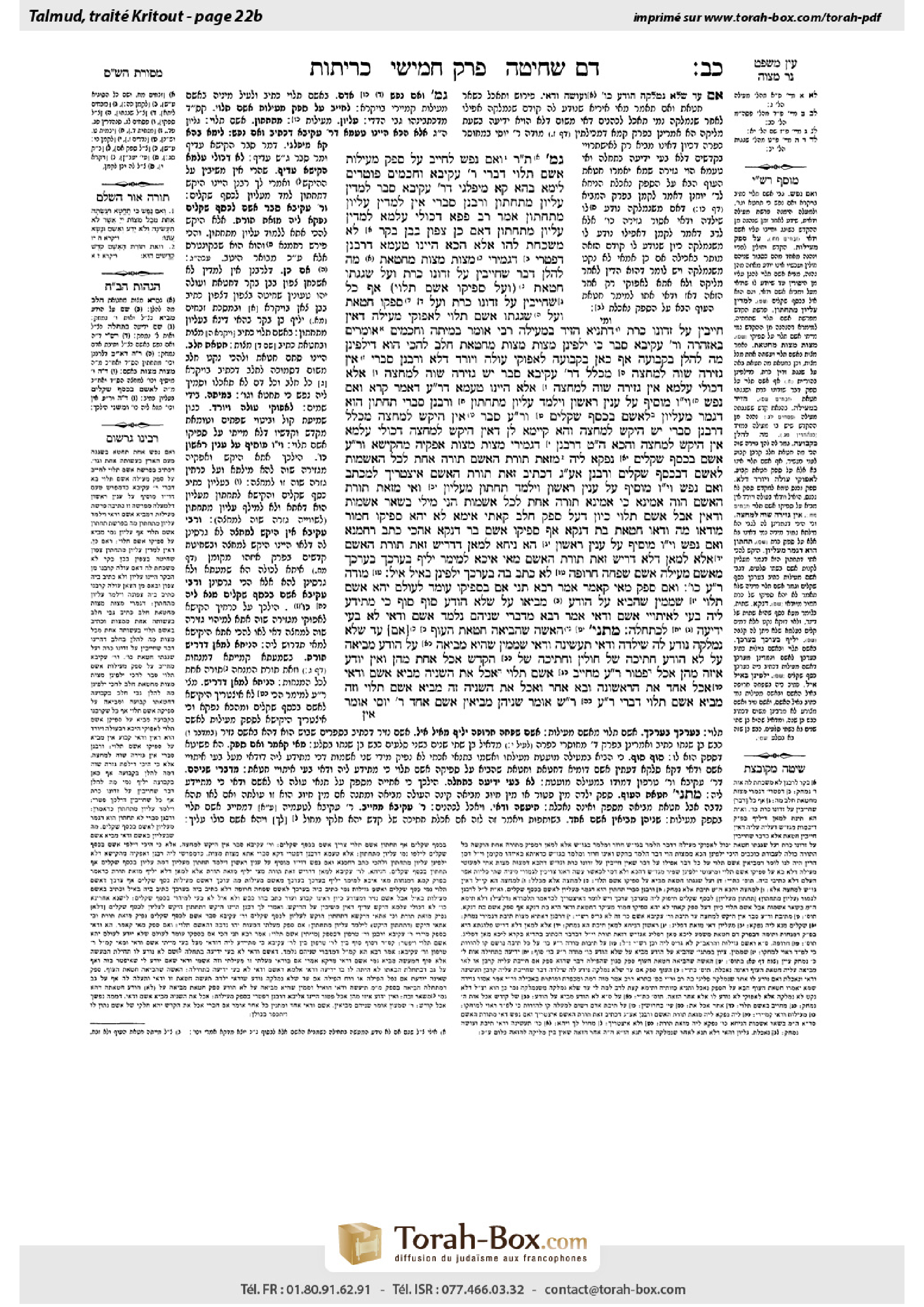
Keritot 22b: Talmud study for Daf Yomi
Daf Yomi is the daily study of one Talmud folio. Explore 37 tractates with scans, Hebrew text, Sefaria English and AI-generated French translations where annotated.
Passage selection and English or AI-generated French translation are available where the scan has annotations. Daf Study is independent of Torah-Box and Sefaria.
Browse Keritot · כריתות · All tractatesKeritot 22b text and translations
This page of Keritot includes the Aramaic text, an English translation and an AI-generated French translation, alongside the scan above.
כריתות כ״ב ב · Aramaic and Hebrew text
גְּמָ׳ תָּנוּ רַבָּנַן: ״וְאִם נֶפֶשׁ״ – לְחַיֵּיב עַל סְפֵק מְעִילוֹת אָשָׁם תָּלוּי, דִּבְרֵי רַבִּי עֲקִיבָא, וַחֲכָמִים פּוֹטְרִים.
לֵימָא בְּהָא קָא מִיפַּלְגִי, דְּרַבִּי עֲקִיבָא סָבַר: לְמֵדִין עֶלְיוֹן מִתַּחְתּוֹן, וְרַבָּנַן סָבְרִי: אֵין לְמֵדִין עֶלְיוֹן מִתַּחְתּוֹן?
אָמַר רַב פָּפָּא: דְּכוּלֵּי עָלְמָא לְמֵדִין עֶלְיוֹן מִתַּחְתּוֹן, דְּאִם כֵּן, צָפוֹן בְּבֶן בָּקָר לָא מַשְׁכַּחַתְּ לְהוּ,
אֶלָּא הָכָא הַיְינוּ טַעְמָא דְּרַבָּנַן דְּפָטְרִי: דִּגְמִירִי ״מִצְוֹת״ ״מִצְוֹת״ מֵחַטָּאת.
מָה לְהַלָּן דָּבָר שֶׁחַיָּיבִין עַל זְדוֹנוֹ כָּרֵת וְעַל שִׁגְגָתוֹ חַטָּאת, וְעַל סְפֵיקוֹ אָשָׁם תָּלוּי, אַף כֹּל שֶׁחַיָּיבִין עַל זְדוֹנוֹ כָּרֵת וְעַל סְפֵקוֹ חַטָּאת וְעַל שִׁגְגָתוֹ אָשָׁם תָּלוּי,
לְאַפּוֹקֵי מְעִילָה, דְּאֵין חַיָּיבִין עַל זְדוֹנוֹ כָּרֵת, דְּתַנְיָא: הֵזִיד בִּמְעִילָה – רַבִּי אוֹמֵר: בְּמִיתָה, וַחֲכָמִים אוֹמְרִים: בְּאַזְהָרָה.
וְרַבִּי עֲקִיבָא סָבַר: כִּי יָלְפִינַן ״מִצְוֹת״ ״מִצְוֹת״ מֵחַטַּאת חֵלֶב, לְהָכִי הוּא דְּיָלְפִינַן: מָה לְהַלָּן בִּקְבוּעָה, אַף כָּאן בִּקְבוּעָה,
לְאַפּוֹקֵי עוֹלֶה וְיוֹרֵד, דְּלָא.
וְרַבָּנַן סָבְרִי: אֵין גְּזֵירָה שָׁוָה לְמֶחֱצָה. מִכְּלָל דְּרַבִּי עֲקִיבָא סָבַר: יֵשׁ גְּזֵירָה שָׁוָה לְמֶחֱצָה? אֶלָּא, דְּכוּלֵּי עָלְמָא אֵין גְּזֵירָה שָׁוָה לְמֶחֱצָה,
אֶלָּא הַיְינוּ טַעְמָא דְּרַבִּי עֲקִיבָא, דַּאֲמַר קְרָא: ״וְאִם נֶפֶשׁ״ – וָיו מוֹסִיף עַל עִנְיָן רִאשׁוֹן, וְיִלְמַד עֶלְיוֹן מִתַּחְתּוֹן.
וְרַבָּנַן סָבְרִי: תַּחְתּוֹן הוּא דְּגָמַר מֵעֶלְיוֹן לְאָשָׁם בְּכֶסֶף שְׁקָלִים.
וְרַבִּי עֲקִיבָא סָבַר: אֵין הֶיקֵּשׁ לְמֶחֱצָה. מִכְּלָל דְּרַבָּנַן סָבְרִי: יֵשׁ הֶיקֵּשׁ לְמֶחֱצָה? וְהָא קַיְימָא לַן דְּאֵין הֶיקֵּשׁ לְמֶחֱצָה!
דְּכוּלֵּי עָלְמָא אֵין הֶיקֵּשׁ לְמֶחֱצָה, וְהָכָא הַיְינוּ טַעְמָא דְּרַבָּנַן: דִּגְמִירִי ״מִצְוֹת״ ״מִצְוֹת״, אַפְּקֵיהּ מֵהֶקֵּישָׁא.
וְרַבִּי עֲקִיבָא, אָשָׁם בְּכֶסֶף שְׁקָלִים נָפְקָא לֵיהּ מִ״זֹּאת תּוֹרַת הָאָשָׁם״ – תּוֹרָה אַחַת לְכׇל הָאֲשָׁמוֹת, לְאָשָׁם דִּבְכֶסֶף שְׁקָלִים.
וְרַבָּנַן? אַף עַל גַּב דִּכְתִיב ״זֹאת תּוֹרַת הָאָשָׁם״, אִיצְטְרִיךְ לְמִכְתַּב ״וְאִם נֶפֶשׁ״ – וָיו מוֹסִיף עַל עִנְיָן רִאשׁוֹן, וְיִלְמַד תַּחְתּוֹן מֵעֶלְיוֹן.
וְאִי מִ״זֹּאת תּוֹרַת הָאָשָׁם״, הֲוָה אָמֵינָא: כִּי אָמֵינָא תּוֹרָה אַחַת לְכׇל אֲשָׁמוֹת – הָנֵי מִילֵּי בִּשְׁאָר אֲשָׁמוֹת וַדָּאִין,
אֲבָל אָשָׁם תָּלוּי, כֵּיוָן דְּעַל סְפֵק חֵלֶב קָאָתֵי, אֵימָא: לָא יְהֵא סְפֵיקוֹ חָמוּר מִוַּדָּאוֹ, מָה וַדָּאוֹ – חַטָּאת בַּת דַּנְקָא, אַף סְפֵיקוֹ – אָשָׁם בַּר דַּנְקָא, אַהָכִי כְּתַב רַחֲמָנָא: ״וְאִם נֶפֶשׁ״ – וָיו מוֹסִיף עַל עִנְיָן רִאשׁוֹן.
נִיחָא לְמַאן דְּדָרֵישׁ ״זֹאת תּוֹרַת הָאָשָׁם״, אֶלָּא לְמַאן דְּלָא דָּרֵישׁ ״זֹאת תּוֹרַת הָאָשָׁם״, מַאי אִיכָּא לְמֵימַר? יָלֵיף ״בְּעֶרְכְּךָ״ ״בְּעֶרְכְּךָ״ מֵאֲשַׁם מְעִילוֹת.
אֲשַׁם שִׁפְחָה חֲרוּפָה, לָא כְּתִב בֵּהּ ״בְּעֶרְכְּךָ״! יָלְפִינַן בְּ״אֵיל״
מוֹדֶה רַבִּי עֲקִיבָא כּוּ׳ וְאִם סָפֵק.
מַאי קָאָמַר? אָמַר רָבָא, תְּנִי: אִם בִּסְפֵיקוֹ עוֹמֵד לְעוֹלָם – יְהֵא אָשָׁם תָּלוּי, שֶׁמִּמִּין שֶׁהֵבִיא עַל הוֹדַע, מְבִיאוֹ עַל שֶׁלֹּא הוֹדַע.
סוֹף סוֹף, כִּי מִתְיְדַע לֵיהּ בָּעֵי לְאֵיתוֹיֵי אָשָׁם וַדַּאי!
אָמַר רָבָא: מִדִּבְרֵי שְׁנֵיהֶם נִלְמַד – אָשָׁם וַדַּאי לָא בָּעֵי יְדִיעָה לְכַתְּחִלָּה.
מַתְנִי׳ הָאִשָּׁה שֶׁהֵבִיאָה חַטַּאת הָעוֹף, עַד שֶׁלֹּא נִמְלְקָה נוֹדַע לָהּ שֶׁיָּלְדָה וַדַּאי – תַּעֲשֶׂינָּה וַדַּאי, שֶׁמִּמִּין שֶׁהִיא מְבִיאָה עַל הוֹדַע, מְבִיאָה עַל לֹא הוֹדַע.
חֲתִיכָה שֶׁל חוּלִּין וַחֲתִיכָה שֶׁל הֶקְדֵּשׁ, אָכַל אַחַת מֵהֶן וְאֵין יוֹדֵעַ אֵיזֶה מֵהֶן אָכַל – פָּטוּר, רַבִּי עֲקִיבָא מְחַיֵּיב אָשָׁם תָּלוּי. אָכַל אֶת הַשְּׁנִיָּה – מֵבִיא אָשָׁם וַדַּאי.
אָכַל אֶחָד אֶת הָרִאשׁוֹנָה וּבָא אַחֵר וְאָכַל אֶת הַשְּׁנִיָּה – זֶה מֵבִיא אָשָׁם תָּלוּי וְזֶה מֵבִיא אָשָׁם תָּלוּי, דִּבְרֵי רַבִּי עֲקִיבָא. רַבִּי שִׁמְעוֹן אוֹמֵר: שְׁנֵיהֶן מְבִיאִין אָשָׁם אֶחָד. רַבִּי יוֹסֵי אוֹמֵר:
Keritot 22b · English translation
GEMARA: With regard to the issue of whether one brings a provisional guilt offering for an uncertain misuse of consecrated property, the Sages taught in a baraita: Immediately following the passage in the Torah discussing a guilt offering for misuse of consecrated property the Torah introduces the halakhot of a provisional guilt offering by stating: “And if anyone sin” (Leviticus 5:17). The term “and” serves to render one liable to bring a provisional guilt offering for uncertain misuse of consecrated property; this is the statement of Rabbi Akiva. And the Rabbis deem him exempt in such a case.
The Gemara suggests: Let us say that they disagree about this following method of halakhic derivation: That Rabbi Akiva holds that when the Torah connects two topics with the term “and” one learns the halakhot of the earlier passage from those in the later passage. Consequently, it can be derived that one who is uncertain about whether he misused consecrated property must bring a provisional guilt offering. And the Rabbis hold that one does not learn the halakhot in the earlier passage from those of the later passage.
Rav Pappa said: In fact, everyone agrees that one learns the halakhot of the earlier passage from those of the later passage, as if one does not say so, you will not find a source for the requirement that a young bull brought as a burnt offering must be slaughtered in the north section of the Temple courtyard. This is derived from the fact that the Torah states the halakhot of a young bull brought as a burnt offering (Leviticus 1:3–9) and then states: “And if his offering is of the flock, from the sheep or from the goats, as a burnt offering, an unblemished male he shall present it, and he shall slaughter it on the side of the altar northward” (Leviticus 1:10–11).
Rather, here, in the case of one who is uncertain whether he misused consecrated property, this is the reason that the Rabbis deem him exempt from bringing a provisional guilt offering: It is because they derive the details of the halakha with regard to the provisional guilt offering written in the verse: “And if anyone sin, and perform one of all the commandments of the Lord that are not to be performed” (Leviticus 5:17), by means of a verbal analogy from the verse stated with regard to a sin offering: “And if any one of the common people sin through error, in his performance of any of the commandments of the Lord that may not be performed” (Leviticus 4:27).
The verbal analogy indicates that just as there, the sin offering is brought only for an act that renders one liable to be punished with karet for its intentional violation and liable to bring a sin offering for its unwitting violation, and to bring a provisional guilt offering for its uncertain violation, so too, for every transgression for which one is liable to be punished with karet for its intentional violation and one is liable to bring a sin offering for its unwitting violation, one is also liable to bring a provisional guilt offering for its uncertain violation.
This verbal analogy serves to exclude misuse of consecrated property from the transgressions for which one would bring a provisional guilt offering in a case of uncertainty, as one is not liable to receive karet for its intentional violation. As it is taught in a baraita: With regard to one who intentionally misused a consecrated item, Rabbi Yehuda HaNasi says that he is liable to the punishment of death at the hand of Heaven. And the Rabbis say: He has violated a standard prohibition, and is flogged. Everyone agrees that he is not liable to receive karet.
The Gemara comments: And with regard to the verbal analogy cited above as the source of the opinion of the Rabbis, Rabbi Akiva holds the following: When we derive the halakhot of provisional guilt offerings based upon the term “the commandments of” used in that context (Leviticus 5:17) and the identical expression “the commandments of” stated with regard to a sin offering brought for the consumption of forbidden fat (Leviticus 4:27), i.e., a standard sin offering, it is for this purpose that we derive it: Just as there, the verse is referring to a fixed sin offering, so too here, with regard to the provisional guilt offering, one brings it only for the uncertain transgression of a sin for which one would be liable to bring a fixed offering.
This serves to exclude transgressions for which one brings a sliding-scale sin offering, i.e., the defiling of the Temple or its sacrificial foods, taking a false oath of testimony, and violating an oath (see Leviticus 5:1–13). Since one who unwittingly violated these prohibitions brings an animal, bird, or meal offering depending on his financial status, if he is uncertain whether he violated one of these prohibitions he does not bring a provisional guilt offering.
And the Rabbis disagree with Rabbi Akiva and hold that there is no verbal analogy for half of a matter. Once a verbal analogy is accepted, the two cases are treated as entirely similar, which in this case means that the provisional guilt offering is brought only for a sin punishable by karet for its intentional violation. The Gemara asks: Should one conclude by inference that Rabbi Akiva holds that there is a verbal analogy for half of a matter? There is no record of any tanna maintaining this opinion. Rather, everyone agrees that there is no verbal analogy for half of a matter.
Rather, this is the reason for the opinion of Rabbi Akiva, as the verse states with regard to the provisional guilt offering: “And if anyone sin” (Leviticus 5:17). The term “and” in the form of the letter vav, adds to the previous matter. When a sentence begins with the conjunction vav, it is a continuation of the previous discussion, and therefore the halakhot of the earlier passage, in this case misuse of consecrated property, are learned from the later passage. Consequently, one brings a provisional guilt offering even for uncertain misuse of consecrated property.
And the Rabbis maintain that it is the halakhot of the later passage that are derived from the earlier passage. Consequently, the ram brought for a provisional guilt offering must be worth at least two silver shekels, just like the ram brought as a guilt offering in a case where one is certain that he misused consecrated property (see Leviticus 5:15).
And how would Rabbi Akiva respond to this opinion? He holds that there is no juxtaposition for half of a matter. Consequently, one must also derive the halakhot of the earlier passage from the later passage, and one is liable to bring a provisional guilt offering for uncertain misuse of consecrated property. The Gemara raises a difficulty: Should one conclude by inference that the Rabbis hold that there is a juxtaposition for half of a matter? But this is difficult, because we maintain as a principle that there is no juxtaposition for half of a matter.
Rather, everyone agrees that there is no juxtaposition for half of a matter. And here, this is the reason for the opinion of the Rabbis, as they derive from the verbal analogy of the expression “the commandments of the Lord” (Leviticus 5:17) stated with regard to the provisional guilt offering and the identical expression “the commandments of the Lord” (Leviticus 4:27) stated with regard to the sin offering that one is not liable to bring a provisional guilt offering for uncertain misuse of consecrated property. One does not derive the halakhot of the earlier passage based upon the later passage, as this aspect of the comparison has been explicitly excluded from the comparison of these two passages based upon their juxtaposition.
And Rabbi Akiva derives the halakha that the provisional guilt offering must be worth at least two silver shekels from the verse: “This is the law of the guilt offering” (Leviticus 7:1). This teaches that there is one law for all of the guilt offerings, and therefore each guilt offering must be worth at least two silver shekels. Since it is not necessary for him to derive this halakha from the juxtaposition of the passages concerning misuse of consecrated property and the provisional guilt offering, and the verbal analogy cannot entirely negate the comparison indicated by this juxtaposition, Rabbi Akiva derives from the juxtaposition that one is liable to bring a provisional guilt offering for uncertain misuse of consecrated property.
And the Rabbis would reply that even though it is written: “This is the law of the guilt offering,” nevertheless it was necessary for the verse to write: “And if anyone sin,” in which the letter vav adds to the previous matter and indicates that the halakhot of the later passage are learned from the earlier passage. This teaches that a provisional guilt offering must be worth at least two silver shekels.
And if you would say that this could be derived from the verse: “This is the law of the guilt offering,” that is impossible, as I would say: When I say that there is one law for all of the guilt offerings, that statement applies only to other definite guilt offerings. In other words, just as the guilt offering for definite misuse of consecrated property must be worth at least two silver shekels, the same applies to all definite guilt offerings.
But with regard to the provisional guilt offering, since it comes for an uncertain violation, e.g., in a case where one is uncertain whether he ate forbidden fat, one might say that the offering one brings for its uncertain violation should not be more stringent than the offering one brings for its definite violation: Just as for its definite violation one may bring a sin offering worth even one-sixth [danka] of a dinar, so too, for its uncertain violation one may bring a guilt offering worth even one-sixth of a dinar. It is for this reason that the Merciful One wrote: “And if anyone sin,” in which the letter vav adds to the previous matter. By contrast, since Rabbi Akiva does not derive the requirement for a provisional guilt offering to be worth at least two silver shekels from this verse, he derives from it that one brings a provisional guilt offering in a case of uncertain misuse of consecrated property.
The Gemara asks: This works out well according to the one who expounds the verse: “This is the law of the guilt offering,” as Rabbi Akiva derives from here that a provisional guilt offering must be worth at least two silver shekels. But according to the one who does not expound the verse: “This is the law of the guilt offering,” what is there to say? From where does he derive that all guilt offerings must have the same minimum value? The Gemara answers that he derives it from a verbal analogy between the term “your valuation” stated with regard to other guilt offerings (see Leviticus 5:18, 5:25), and the identical term “your valuation” (Leviticus 5:15) from the case of a guilt offering for misuse of consecrated property, which the verse indicates must be worth at least two silver shekels.
The Gemara asks: What is the source of this halakha with regard to the guilt offering for engaging in intercourse with an espoused maidservant, about which the term “your valuation” is not written in the Torah? The Gemara answers: We derive it from a verbal analogy between the word “ram” (Leviticus 5:15) in the verse about a guilt offering for misuse of consecrated property and the word “ram” (Leviticus 19:21) in a verse concerning the espoused maidservant.
§ The mishna teaches that Rabbi Akiva concedes that one does not bring payment for his misuse of consecrated property until it becomes known to him that he is guilty of misuse, as then he brings a definite guilt offering with his payment. Rabbi Tarfon said: One brings payment for misuse and its additional payment of one-fifth, and a guilt offering worth two sela, and says: If it is certain that I misused consecrated property, this is payment for my misuse and this is my definite guilt offering. And if it is uncertain whether I misused consecrated property, the money is a contribution to the Temple fund for the purchase of communal offerings and the guilt offering is provisional.
The Gemara asks: According to Rabbi Tarfon, what is this individual saying? How can he say: If it is uncertain, when he clearly is uncertain about whether he misused consecrated property? Rava said that one should teach the mishna as follows: If its uncertainty persists forever, this offering should be a provisional guilt offering, whereas if it becomes known that I misused consecrated property, this should be a regular guilt offering. This is an effective stipulation, as the offering one brings in a case where it is known to him that he misused consecrated property is from the same species as the offering he brings in a case where it is unknown to him whether he misused consecrated property.
The Gemara objects: Ultimately, even according to Rabbi Tarfon one cannot necessarily avoid bringing two guilt offerings. Since at the time when he brought his first offering he was uncertain whether he had misused consecrated property, when it becomes known to him that he misused consecrated property he is required to bring a definite guilt offering.
In response to this question Rava said: From the statement of both of the tanna’im, i.e., Rabbi Tarfon and Rabbi Akiva, it can be learned that a definite guilt offering does not require knowledge that the individual definitely sinned ab initio. Consequently, as long as it eventually becomes known that he sinned, he has fulfilled his obligation to bring a definite guilt offering.
MISHNA: Apropos the previous case in which one brings the same type of animal when liability is certain as when liability is uncertain, this mishna teaches: With regard to a woman who brought a bird sin offering in a case of uncertainty whether she miscarried a fetus that would have rendered her liable to bring a sin offering or whether what she expelled would not render her liable to bring an offering, in which case this sin offering may not be eaten by priests, the halakha is as follows: If before the nape of the neck of the bird was pinched it became known to her that she certainly gave birth, i.e., miscarried, in a manner that obligates her to bring a sin offering, she should render the offering a definite sin offering, as from the same type of animal that she brings a sin offering for a case where it is known to her that she miscarried, she brings a sin offering for a case where it is unknown to her.
The mishna resumes discussion of the provisional guilt offering. If one had a piece of non-sacred meat and a piece of sacrificial meat, and he ate one of them and does not know which of them he ate, he is exempt from the obligation to bring a guilt offering for misuse of consecrated property. Rabbi Akiva deems him liable to bring a provisional guilt offering, in accordance with his opinion in the previous mishna that one brings a provisional guilt offering even in a case of uncertainty with regard to misuse. If he then ate the second piece, he brings a definite guilt offering, as it is certain that he ate the sacrificial meat.
If one person ate the first piece and another person came and ate the second piece, this first person brings a provisional guilt offering and that second person brings a provisional guilt offering; this is the statement of Rabbi Akiva. Rabbi Shimon says: Both of them bring one definite guilt offering as partners, and they stipulate that the one who ate the non-sacred meat grants his share of the animal to the one who ate the sacrificial meat, and the guilt offering is sacrificed on his behalf. Rabbi Yosei says:
Keritot 22b · Traduction française (IA)
GUEMARA : À propos de la question de savoir si l’on apporte un sacrifice de culpabilité provisoire en cas de doute concernant un détournement de biens consacrés, les Sages ont enseigné dans une baraïta : Immédiatement après le passage de la Torah qui traite du sacrifice de culpabilité pour détournement de biens consacrés, la Torah introduit les halakhot du sacrifice de culpabilité provisoire en disant : « Et si quelqu’un pèche » (Lévitique 5:17). Le terme « et » rend passible d’apporter un sacrifice de culpabilité provisoire en cas de doute concernant un détournement de biens consacrés ; telle est la déclaration de Rabbi Akiva. Les Rabbins l’en exemptent dans un tel cas.
La Guemara suggère : Peut-on dire qu’ils divergent au sujet de la méthode de dérivation halakhique suivante : Rabbi Akiva estime que, lorsque la Torah relie deux sujets par le terme « et », on déduit les halakhot du passage antérieur de celles du passage suivant. On peut donc déduire que celui qui doute d’avoir détourné des biens consacrés doit apporter un sacrifice de culpabilité provisoire. Les Rabbins, quant à eux, estiment qu’on ne déduit pas les halakhot du passage antérieur de celles du passage suivant.
Rav Pappa a dit : En réalité, tous reconnaissent qu’on déduit les halakhot du passage antérieur de celles du passage suivant, car, si l’on n’admettait pas cela, on ne trouverait aucune source à l’exigence selon laquelle un jeune taureau apporté en holocauste doit être égorgé dans la partie nord du parvis du Temple. Cela se déduit du fait que la Torah énonce les halakhot relatives au jeune taureau apporté en holocauste (Lévitique 1:3–9), puis dit : « Et si son offrande est un holocauste pris du troupeau, parmi les moutons ou les chèvres, il présentera un mâle sans défaut et l’égorgera au nord de l’autel » (Lévitique 1:10–11).
Mais ici, dans le cas de celui qui doute d’avoir détourné des biens consacrés, voici pourquoi les Rabbins l’exemptent d’apporter un sacrifice de culpabilité provisoire : ils déduisent les détails de la halakha concernant le sacrifice de culpabilité provisoire, énoncés dans le verset « Et si quelqu’un pèche et commet l’une des choses que le Seigneur a interdites » (Lévitique 5:17), au moyen d’une analogie verbale avec le verset relatif au sacrifice expiatoire : « Si quelqu’un du peuple pèche par inadvertance en faisant l’une des choses que le Seigneur a interdites » (Lévitique 4:27).
L’analogie verbale indique que, de même que là, on n’apporte le sacrifice expiatoire que pour un acte dont la transgression intentionnelle rend passible de karet, dont la transgression involontaire rend passible d’apporter un sacrifice expiatoire et dont la transgression incertaine rend passible d’apporter un sacrifice de culpabilité provisoire, de même, pour toute transgression dont la violation intentionnelle rend passible de karet et dont la violation involontaire rend passible d’apporter un sacrifice expiatoire, on est également passible d’apporter un sacrifice de culpabilité provisoire en cas de violation incertaine.
Cette analogie verbale exclut le détournement de biens consacrés des transgressions pour lesquelles on apporterait un sacrifice de culpabilité provisoire en cas de doute, car sa violation intentionnelle ne rend pas passible de karet. Ainsi qu’il est enseigné dans une baraïta : Au sujet de celui qui détourne intentionnellement un objet consacré, Rabbi Yehouda HaNassi dit qu’il est passible de mort par la main du Ciel. Les Rabbins disent : Il a transgressé une interdiction ordinaire et reçoit la flagellation. Tous conviennent qu’il n’est pas passible de karet.
La Guemara commente : Quant à l’analogie verbale citée plus haut comme source de l’opinion des Rabbins, Rabbi Akiva considère ce qui suit : lorsque nous déduisons les halakhot des sacrifices de culpabilité provisoires à partir du terme « les commandements de », employé dans ce contexte (Lévitique 5:17), et de la même expression « les commandements de », utilisée à propos du sacrifice expiatoire apporté pour la consommation de graisse interdite (Lévitique 4:27), c’est dans le but suivant : de même que là, le verset parle d’un sacrifice expiatoire fixe, de même ici, pour le sacrifice de culpabilité provisoire, on ne l’apporte que pour une transgression incertaine d’un péché pour lequel on aurait à apporter un sacrifice fixe.
Cela exclut les transgressions pour lesquelles on apporte un sacrifice expiatoire à offrande variable, à savoir la souillure du Temple ou de ses aliments sacrificiels, le faux serment de témoignage et la violation d’un serment (voir Lévitique 5:1–13). Puisque celui qui transgresse involontairement ces interdictions apporte un animal, un oiseau ou une offrande de farine selon sa situation financière, s’il doute d’avoir transgressé l’une de ces interdictions, il n’apporte pas de sacrifice de culpabilité provisoire.
Les Rabbins sont en désaccord avec Rabbi Akiva et estiment qu’il n’existe pas d’analogie verbale portant sur une partie seulement d’un sujet. Dès lors qu’une analogie verbale est acceptée, les deux cas sont considérés comme entièrement semblables ; ici, cela signifie que le sacrifice de culpabilité provisoire n’est apporté que pour un péché dont la transgression intentionnelle est passible de karet. La Guemara demande : Faut-il en déduire que Rabbi Akiva estime qu’il existe une analogie verbale portant sur une partie seulement d’un sujet ? Aucun tanna n’est connu pour avoir soutenu cette opinion. En réalité, tous conviennent qu’il n’existe pas d’analogie verbale portant sur une partie seulement d’un sujet.
En réalité, voici pourquoi Rabbi Akiva soutient cette opinion : le verset dit au sujet du sacrifice de culpabilité provisoire : « Et si quelqu’un pèche » (Lévitique 5:17). Le terme « et », représenté par la lettre vav, s’ajoute au sujet précédent. Lorsqu’une phrase commence par la conjonction vav, elle prolonge la discussion précédente ; les halakhot du passage antérieur — ici, celles du détournement de biens consacrés — sont donc déduites du passage suivant. Par conséquent, on apporte un sacrifice de culpabilité provisoire même en cas de doute concernant un détournement de biens consacrés.
Les Rabbins, eux, soutiennent que ce sont les halakhot du passage suivant qui se déduisent du passage antérieur. Par conséquent, le bélier apporté en sacrifice de culpabilité provisoire doit valoir au moins deux sicles d’argent, comme le bélier apporté en sacrifice de culpabilité dans le cas où l’on est certain d’avoir détourné des biens consacrés (voir Lévitique 5:15).
Et comment Rabbi Akiva répondrait-il à cette opinion ? Il estime qu’il n’existe pas de juxtaposition portant sur une partie seulement d’un sujet. Par conséquent, il faut aussi déduire les halakhot du passage antérieur du passage suivant, et l’on est passible d’apporter un sacrifice de culpabilité provisoire en cas de doute concernant un détournement de biens consacrés. La Guemara soulève une difficulté : Faut-il en déduire que les Rabbins estiment qu’il existe une juxtaposition portant sur une partie seulement d’un sujet ? Cela est pourtant difficile, car nous tenons pour principe qu’il n’existe pas de juxtaposition portant sur une partie seulement d’un sujet.
En réalité, tous conviennent qu’il n’existe pas de juxtaposition portant sur une partie seulement d’un sujet. Voici pourquoi les Rabbins soutiennent cette opinion : ils déduisent, au moyen de l’analogie verbale entre l’expression « les commandements du Seigneur » (Lévitique 5:17), au sujet du sacrifice de culpabilité provisoire, et l’expression identique « les commandements du Seigneur » (Lévitique 4:27), au sujet du sacrifice expiatoire, qu’on n’est pas passible d’apporter un sacrifice de culpabilité provisoire en cas de doute concernant un détournement de biens consacrés. On ne déduit pas les halakhot du passage antérieur à partir du passage suivant, car cet aspect de la comparaison a été explicitement exclu de la comparaison entre ces deux passages en raison de leur juxtaposition.
Et Rabbi Akiva déduit du verset « Telle est la loi du sacrifice de culpabilité » (Lévitique 7:1) la halakha selon laquelle le sacrifice de culpabilité provisoire doit valoir au moins deux sicles d’argent. Cela enseigne qu’il existe une seule loi pour tous les sacrifices de culpabilité et que chacun doit donc valoir au moins deux sicles d’argent. Puisqu’il n’a pas besoin de déduire cette halakha de la juxtaposition des passages sur le détournement de biens consacrés et sur le sacrifice de culpabilité provisoire, et que l’analogie verbale ne peut entièrement annuler la comparaison indiquée par cette juxtaposition, Rabbi Akiva déduit de la juxtaposition qu’on est passible d’apporter un sacrifice de culpabilité provisoire en cas de doute concernant un détournement de biens consacrés.
Les Rabbins répondraient que, même si l’Écriture dit : « Telle est la loi du sacrifice de culpabilité », il fallait néanmoins que le verset dise : « Et si quelqu’un pèche », où la lettre vav s’ajoute au sujet précédent et indique que les halakhot du passage suivant se déduisent du passage antérieur. Cela enseigne que le sacrifice de culpabilité provisoire doit valoir au moins deux sicles d’argent.
Et si tu dis que cela pourrait se déduire du verset « Telle est la loi du sacrifice de culpabilité », c’est impossible, car j’aurais dit : lorsque j’affirme qu’il existe une seule loi pour tous les sacrifices de culpabilité, cela ne s’applique qu’aux autres sacrifices de culpabilité certains. Autrement dit, de même que le sacrifice de culpabilité pour le détournement certain de biens consacrés doit valoir au moins deux sicles d’argent, il en va de même pour tous les sacrifices de culpabilité certains.
Mais, concernant le sacrifice de culpabilité provisoire, puisqu’il est apporté pour une transgression incertaine — par exemple, lorsqu’on doute d’avoir consommé de la graisse interdite —, on pourrait dire que l’offrande apportée pour une transgression incertaine ne doit pas être plus contraignante que celle apportée pour une transgression certaine : de même que, pour une transgression certaine, on peut apporter un sacrifice expiatoire d’une valeur aussi faible qu’un sixième [danka] de dinar, de même, pour une transgression incertaine, on peut apporter un sacrifice de culpabilité d’une valeur aussi faible qu’un sixième de dinar. C’est pourquoi le Miséricordieux a écrit : « Et si quelqu’un pèche », où la lettre vav s’ajoute au sujet précédent. En revanche, puisque Rabbi Akiva ne déduit pas de ce verset l’exigence que le sacrifice de culpabilité provisoire vaille au moins deux sicles d’argent, il en déduit qu’on apporte un sacrifice de culpabilité provisoire en cas de doute concernant un détournement de biens consacrés.
La Guemara demande : Cela convient selon celui qui interprète le verset « Telle est la loi du sacrifice de culpabilité », puisque Rabbi Akiva en déduit qu’un sacrifice de culpabilité provisoire doit valoir au moins deux sicles d’argent. Mais, selon celui qui n’interprète pas le verset « Telle est la loi du sacrifice de culpabilité », que peut-on dire ? De quelle source déduit-il que tous les sacrifices de culpabilité doivent avoir la même valeur minimale ? La Guemara répond qu’il le déduit d’une analogie verbale entre le terme « selon ton estimation », employé au sujet d’autres sacrifices de culpabilité (voir Lévitique 5:18, 5:25), et le même terme « selon ton estimation » (Lévitique 5:15), dans le cas d’un sacrifice de culpabilité pour détournement de biens consacrés, dont le verset indique qu’il doit valoir au moins deux sicles d’argent.
La Guemara demande : Quelle est la source de cette halakha concernant le sacrifice de culpabilité pour avoir eu des rapports avec une servante fiancée, à propos duquel l’expression « selon ton estimation » ne figure pas dans la Torah ? La Guemara répond : Nous la déduisons d’une analogie verbale entre le mot « bélier » (Lévitique 5:15), dans le verset concernant un sacrifice de culpabilité pour détournement de biens consacrés, et le mot « bélier » (Lévitique 19:21), dans un verset concernant la servante fiancée.
§ La Michna enseigne que Rabbi Akiva reconnaît qu’on ne paie pas le détournement de biens consacrés avant d’avoir appris qu’on est coupable de détournement, car on apporte alors, avec le paiement, un sacrifice de culpabilité certain. Rabbi Tarfon a dit : On apporte le paiement du détournement et son supplément d’un cinquième, ainsi qu’un sacrifice de culpabilité valant deux sela, et l’on dit : « Si j’ai certainement détourné des biens consacrés, ceci est le paiement de mon détournement et ceci est mon sacrifice de culpabilité certain. Et si je ne sais pas si j’ai détourné des biens consacrés, l’argent est une contribution au fonds du Temple destiné à l’achat des sacrifices communautaires, et le sacrifice de culpabilité est provisoire. »
La Guemara demande : Selon Rabbi Tarfon, que dit cet individu ? Comment peut-il dire : « Si je ne sais pas », alors qu’il ne sait manifestement pas s’il a détourné des biens consacrés ? Rava a dit qu’il faut enseigner la Michna ainsi : Si le doute persiste à jamais, ce sacrifice sera un sacrifice de culpabilité provisoire ; mais s’il devient établi que j’ai détourné des biens consacrés, ce sera un sacrifice de culpabilité ordinaire. Cette stipulation est efficace, car le sacrifice apporté lorsqu’il est établi qu’il a détourné des biens consacrés appartient à la même espèce que celui apporté lorsqu’il ignore s’il a détourné des biens consacrés.
La Guemara objecte : En fin de compte, même selon Rabbi Tarfon, on ne peut pas nécessairement éviter d’apporter deux sacrifices de culpabilité. Puisqu’au moment où il a apporté son premier sacrifice, il ne savait pas s’il avait détourné des biens consacrés, lorsqu’il apprend qu’il les a effectivement détournés, il doit apporter un sacrifice de culpabilité certain.
En réponse à cette question, Rava a dit : De la déclaration des deux tannaïm, c’est-à-dire Rabbi Tarfon et Rabbi Akiva, on peut apprendre qu’un sacrifice de culpabilité certain n’exige pas que l’individu ait su d’emblée qu’il avait certainement péché. Par conséquent, dès lors qu’il est finalement établi qu’il a péché, il s’est acquitté de son obligation d’apporter un sacrifice de culpabilité certain.
MICHNA : À propos du cas précédent, où l’on apporte le même type d’animal que l’obligation soit certaine ou incertaine, cette Michna enseigne : Au sujet d’une femme qui a apporté un sacrifice expiatoire d’oiseau alors qu’elle doutait d’avoir fait une fausse couche d’un fœtus qui l’aurait obligée à apporter un sacrifice expiatoire, ou que ce qu’elle avait expulsé ne l’obligeait pas à apporter un sacrifice — auquel cas ce sacrifice expiatoire ne peut être consommé par les prêtres —, la halakha est la suivante : si, avant que la nuque de l’oiseau soit pincée, elle apprend qu’elle a certainement accouché, c’est-à-dire fait une fausse couche, d’une manière qui l’oblige à apporter un sacrifice expiatoire, elle doit faire de l’offrande un sacrifice expiatoire certain ; car elle apporte le même type d’animal en sacrifice expiatoire lorsqu’elle sait qu’elle a fait une fausse couche et lorsqu’elle l’ignore.
La Michna reprend la discussion sur le sacrifice de culpabilité provisoire. Si quelqu’un avait un morceau de viande non consacrée et un morceau de viande sacrificielle, qu’il en a mangé un sans savoir lequel, il est exempt de l’obligation d’apporter un sacrifice de culpabilité pour détournement de biens consacrés. Rabbi Akiva le déclare passible d’apporter un sacrifice de culpabilité provisoire, conformément à son opinion dans la Michna précédente, selon laquelle on apporte un sacrifice de culpabilité provisoire même en cas de doute concernant un détournement. S’il mange ensuite le second morceau, il apporte un sacrifice de culpabilité certain, puisqu’il est certain qu’il a mangé la viande sacrificielle.
Si une personne a mangé le premier morceau et qu’une autre est venue manger le second, la première apporte un sacrifice de culpabilité provisoire et la seconde apporte un sacrifice de culpabilité provisoire ; telle est la déclaration de Rabbi Akiva. Rabbi Shimon dit : Tous deux apportent ensemble un seul sacrifice de culpabilité certain, en stipulant que celui qui a mangé la viande non consacrée cède sa part de l’animal à celui qui a mangé la viande sacrificielle, et que le sacrifice de culpabilité est offert en son nom. Rabbi Yossei dit :
Traduction française générée par IA à partir de l’édition anglaise de Sefaria. Vérifie toujours un passage avec le texte source.
Text from Sefaria: William Davidson Edition - Vocalized Aramaic (CC BY NC); William Davidson Edition - English (CC BY NC).