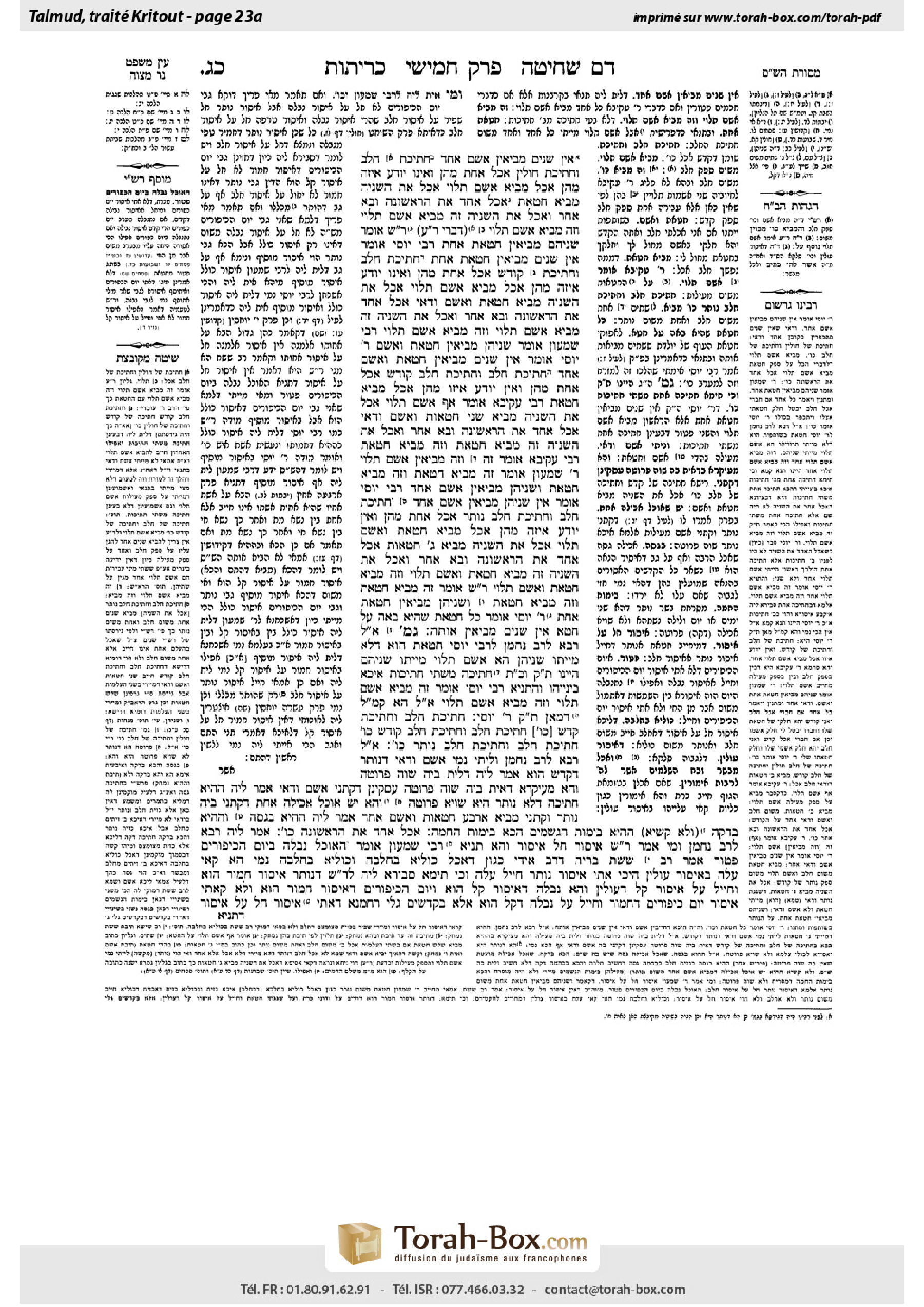
Keritot 23a: Talmud study for Daf Yomi
Daf Yomi is the daily study of one Talmud folio. Explore 37 tractates with scans, Hebrew text, Sefaria English and AI-generated French translations where annotated.
Passage selection and English or AI-generated French translation are available where the scan has annotations. Daf Study is independent of Torah-Box and Sefaria.
Browse Keritot · כריתות · All tractatesKeritot 23a text and translations
This page of Keritot includes the Aramaic text, an English translation and an AI-generated French translation, alongside the scan above.
כריתות כ״ג א · Aramaic and Hebrew text
אֵין שְׁנַיִם מְבִיאִין אָשָׁם אֶחָד.
חֲתִיכַת חֵלֶב וַחֲתִיכַת חוּלִּין, אָכַל אַחַת מֵהֶן וְאֵינוֹ יוֹדֵעַ אֵיזֶה מֵהֶן אָכַל – מֵבִיא אָשָׁם תָּלוּי. אָכַל אֶת הַשְּׁנִיָּה – מֵבִיא חַטָּאת. אָכַל אֶחָד אֶת הָרִאשׁוֹנָה וּבָא אַחֵר וְאָכַל אֶת הַשְּׁנִיָּה – זֶה מֵבִיא אָשָׁם תָּלוּי וְזֶה מֵבִיא אָשָׁם תָּלוּי, דִּבְרֵי רַבִּי עֲקִיבָא. רַבִּי שִׁמְעוֹן אוֹמֵר: שְׁנֵיהֶם מְבִיאִין חַטָּאת אַחַת. רַבִּי יוֹסֵי אוֹמֵר: אֵין שְׁנַיִם מְבִיאִין חַטָּאת אַחַת.
חֲתִיכַת חֵלֶב וַחֲתִיכַת קוֹדֶשׁ, אָכַל אַחַת מֵהֶן וְאֵינוֹ יוֹדֵעַ אֵיזֶה מֵהֶן אָכַל – מֵבִיא אָשָׁם תָּלוּי. אָכַל אֶת הַשְּׁנִיָּה – מֵבִיא חַטָּאת וְאָשָׁם וַדַּאי. אָכַל אֶחָד אֶת הָרִאשׁוֹנָה וּבָא אַחֵר וְאָכַל אֶת הַשְּׁנִיָּה – זֶה מֵבִיא אָשָׁם תָּלוּי וְזֶה מֵבִיא אָשָׁם תָּלוּי. רַבִּי שִׁמְעוֹן אוֹמֵר: שְׁנֵיהֶן מְבִיאִין חַטָּאת וְאָשָׁם. רַבִּי יוֹסֵי אוֹמֵר: אֵין שְׁנַיִם מְבִיאִין חַטָּאת וְאָשָׁם אֶחָד.
חֲתִיכַת חֵלֶב וַחֲתִיכַת חֵלֶב קוֹדֶשׁ, אָכַל אַחַת מֵהֶן וְאֵין יוֹדֵעַ אֵיזוֹ מֵהֶן אָכַל – מֵבִיא חַטָּאת, רַבִּי עֲקִיבָא אוֹמֵר: אַף אָשָׁם תָּלוּי. אָכַל אֶת הַשְּׁנִיָּה – מֵבִיא שְׁנֵי חַטָּאוֹת וְאָשָׁם וַדַּאי.
אָכַל אֶחָד אֶת הָרִאשׁוֹנָה וּבָא אַחֵר וְאָכַל אֶת הַשְּׁנִיָּה – זֶה מֵבִיא חַטָּאת וְזֶה מֵבִיא חַטָּאת. רַבִּי עֲקִיבָא אוֹמֵר: זֶה וָזֶה מְבִיאִין אָשָׁם תָּלוּי. רַבִּי שִׁמְעוֹן אוֹמֵר: זֶה מֵבִיא חַטָּאת וְזֶה מֵבִיא חַטָּאת, וּשְׁנֵיהֶן מְבִיאִין אָשָׁם אֶחָד. רַבִּי יוֹסֵי אוֹמֵר: אֵין שְׁנֵיהֶן מְבִיאִין אָשָׁם אֶחָד.
חֲתִיכַת חֵלֶב וַחֲתִיכַת חֵלֶב נוֹתָר, אָכַל אַחַת מֵהֶן וְאֵין יוֹדֵעַ אֵיזֶה מֵהֶן אָכַל – מֵבִיא חַטָּאת וְאָשָׁם תָּלוּי. אָכַל אֶת הַשְּׁנִיָּה – מֵבִיא שָׁלֹשׁ חַטָּאוֹת.
אָכַל אֶחָד אֶת הָרִאשׁוֹנָה וּבָא אַחֵר וְאָכַל אֶת הַשְּׁנִיָּה – זֶה מֵבִיא חַטָּאת וְאָשָׁם תָּלוּי, וְזֶה מֵבִיא חַטָּאת וְאָשָׁם תָּלוּי. רַבִּי שִׁמְעוֹן אוֹמֵר: זֶה מֵבִיא חַטָּאת וְזֶה מֵבִיא חַטָּאת, וּשְׁנֵיהֶן מְבִיאִין חַטָּאת אַחַת. רַבִּי יוֹסֵי אוֹמֵר: כׇּל חַטָּאת שֶׁהִיא בָּאָה עַל חֵטְא – אֵין שְׁנַיִם מְבִיאִין אוֹתָהּ.
גְּמָ׳ אֲמַר לֵיהּ רָבָא לְרַב נַחְמָן: לְרַבִּי יוֹסֵי, חַטָּאת הוּא דְּלָא מַיְיתוּ שְׁנֵיהֶן, הָא אָשָׁם תָּלוּי מַיְיתוּ שְׁנֵיהֶם? הַיְינוּ תַּנָּא קַמָּא!
וְכִי תֵימָא: חֲתִיכָה מִשְׁתֵּי חֲתִיכוֹת אִיכָּא בֵּינַיְיהוּ, וְהָתַנְיָא: רַבִּי יוֹסֵי אוֹמֵר: זֶה מֵבִיא אָשָׁם תָּלוּי וְזֶה מֵבִיא אָשָׁם תָּלוּי! אֲמַר לֵיהּ: הָא קָא מַשְׁמַע לַן, דְּמַאן תַּנָּא קַמָּא – רַבִּי יוֹסֵי.
חֲתִיכַת חֵלֶב וַחֲתִיכַת קֹדֶשׁ, חֲתִיכַת חֵלֶב וַחֲתִיכַת חֵלֶב קוֹדֶשׁ כּוּ׳ חֲתִיכַת חֵלֶב וַחֲתִיכַת חֵלֶב נוֹתָר כּוּ׳. אֲמַר לֵיהּ רָבָא לְרַב נַחְמָן: וְלַיְתֵי נָמֵי אָשָׁם וַדַּאי, דְּנוֹתָר דְּקֹדֶשׁ הוּא! אֲמַר לֵיהּ: דְּלֵית בֵּיהּ שָׁוֶה פְּרוּטָה.
וְהָא מֵעִיקָּרָא דְּאִית בֵּיהּ שָׁוֶה פְּרוּטָה עָסְקִינַן, דְּקָתָנֵי אָשָׁם וַדַּאי! אֲמַר לֵיהּ: הָהִיא חֲתִיכָה דְּלָא נוֹתָר הִיא שָׁוְיָא פְּרוּטָה.
וְהָא יֵשׁ אוֹכֵל אֲכִילָה אַחַת דְּקָתָנֵי בֵּיהּ נוֹתָר, וְקָתָנֵי: מֵבִיא אַרְבַּע חַטָּאוֹת וְאָשָׁם אֶחָד!
אֲמַר לֵיהּ: הָהִיא – בְּגַסָּה, וְהַהִיא – בְּדַקָּה, וְלָא קַשְׁיָא: הָהִיא – בִּימוֹת הַגְּשָׁמִים, הָכָא – בִּימוֹת הַחַמָּה.
אָכַל אֶחָד אֶת הָרִאשׁוֹנָה כּוּ׳. אֲמַר לֵיהּ רָבָא לְרַב נַחְמָן: וּמִי אָמַר רַבִּי שִׁמְעוֹן אִיסּוּר חָל אִיסּוּר?
וְהָא תַּנְיָא, רַבִּי שִׁמְעוֹן אוֹמֵר: הָאוֹכֵל נְבֵלָה בְּיוֹם הַכִּיפּוּרִים – פָּטוּר!
אָמַר רַב שֵׁשֶׁת בְּרֵיהּ דְּרַב אִידִי: כְּגוֹן דַּאֲכַל כּוּלְיָא בְּחֶלְבָּהּ. וְכוּלְיָא בְּחֶלְבָּהּ נָמֵי, הָא קָאֵי עֲלַהּ בְּאִיסּוּר עוֹלִין, הֵיכִי אָתֵי אִיסּוּר נוֹתָר חָיֵיל עֲלַהּ?
וְכִי תֵימָא: סְבִירָא לֵיהּ לְרַבִּי שִׁמְעוֹן דְּנוֹתָר אִיסּוּר חָמוּר הוּא, וְחָיֵיל עַל אִיסּוּר קַל דְּעוֹלִין, וְהָא נְבֵלָה, דְּאִיסּוּר קַל הוּא, וְיוֹם הַכִּיפּוּרִים, דְּאִיסּוּר חָמוּר הוּא, וְלָא קָאָתֵי אִיסּוּר יוֹם כִּיפּוּרִים דְּחָמוּר וְחָיֵיל עַל נְבֵלָה דְּקַל הוּא!
אֶלָּא: בְּקָדָשִׁים גַּלִּי רַחֲמָנָא דְּאָתֵי אִיסּוּר חָל עַל אִיסּוּר,
Keritot 23a · English translation
Two people do not bring one guilt offering, as one may not sacrifice atonement offerings conditionally.
If one had a piece of forbidden fat and a piece of non-sacred meat, and he ate one of them and does not know which of them he ate, he brings a provisional guilt offering, as perhaps he ate the forbidden fat. If he then ate the second piece, he brings a sin offering, as it is certain that he ate the fat. If one person ate the first piece and another person came and ate the second piece, this person brings a provisional guilt offering and that person brings a provisional guilt offering; this is the statement of Rabbi Akiva. Rabbi Shimon says: Both of them bring one sin offering as partners, and they stipulate that the sin offering should be credited to the one who ate the fat. Rabbi Yosei says: Two people do not bring one sin offering.
If one had a piece of forbidden fat and a piece of sacrificial permitted fat and he ate one of them and does not know which of them he ate, he brings a provisional guilt offering, as perhaps he ate the forbidden fat. If he then ate the second piece, he brings a sin offering, as he certainly ate the fat, and a definite guilt offering for misuse of consecrated property. If one person ate the first piece and another person came and ate the second piece, this person brings a provisional guilt offering and that person brings a provisional guilt offering. Rabbi Shimon says: Both of them bring a sin offering and a guilt offering as partners, and they stipulate that each offering should be credited to the one who is liable to bring it. Rabbi Yosei says: Two people do not bring one sin offering and one guilt offering.
If one had a piece of forbidden fat and a piece of sacrificial forbidden fat and he ate one of them and does not know which of them he ate, he brings a sin offering as he certainly ate forbidden fat. Rabbi Akiva says: He also brings a provisional guilt offering, as perhaps he ate the sacrificial fat, in accordance with his opinion that one brings a provisional guilt offering even in the case of uncertainty with regard to misuse of consecrated property. If he then ate the second piece, he brings two sin offerings, as he ate two pieces of forbidden fat, and a definite guilt offering for misuse of consecrated property.
If one person ate the first piece and another person came and ate the second piece, this person brings a sin offering and that person brings a sin offering. Rabbi Akiva says: This person and that person each bring a provisional guilt offering as well, due to the uncertainty as to which of them ate the sacrificial fat. Rabbi Shimon says: This person brings a sin offering and that person brings a sin offering and both of them bring one guilt offering as partners, and they stipulate that the offering should be credited to the one who ate the sacrificial fat. Rabbi Yosei says: The two of them do not bring one guilt offering.
If one had a piece of forbidden fat and a piece of forbidden fat that is notar, an offering whose designated time has passed for which one is liable to receive karet if he ate it intentionally and liable to bring a sin offering if he ate it unwittingly, and he ate one of them and does not know which of them he ate, he brings a sin offering, as he certainly ate forbidden fat, and a provisional guilt offering, due to the possibility that he ate the notar. If he then ate the second piece, he brings three sin offerings, two for the forbidden fat and one for the prohibition against eating notar.
If one person ate the first piece and another person came and ate the second piece, this person brings a sin offering and a provisional guilt offering, as he certainly ate forbidden fat and it is uncertain whether he ate the notar, and that person brings a sin offering and a provisional guilt offering. Rabbi Shimon says: This person brings a sin offering and that person brings a sin offering and both of them bring one additional sin offering as partners, and they stipulate that the offering should be credited to the one who ate the notar. Rabbi Yosei says: Two people do not bring any sin offering that comes as atonement for a sin.
GEMARA: The mishna teaches that in a case where there was a piece of forbidden fat and a piece of non-sacred meat and each piece was eaten by a different person, Rabbi Shimon maintains that both of them bring one sin offering by stipulating that the sin offering is credited to the one who ate the fat, whereas Rabbi Yosei says that two people do not bring one sin offering. Rava said to Rav Naḥman: According to Rabbi Yosei, it is apparently a sin offering that they both do not bring, whereas they do both bring a provisional guilt offering. If so, his opinion is the same as that of the first tanna, who explicitly stated that each of them brings a provisional guilt offering.
And if you would say that there is a difference between the opinions of Rabbi Yosei and the first tanna with regard to the requirement of one piece from two pieces, i.e., according to Rabbi Yosei only the first individual is liable to bring a provisional guilt offering, as he had two pieces before him, whereas the second is exempt, since there was only one piece before him when he ate it, this cannot be correct: But isn’t it taught in a baraita that Rabbi Yosei says: This person brings a provisional guilt offering and that person brings a provisional guilt offering. Rav Naḥman said to Rava in response: This is what the mishna teaches us, that who is the first tanna? It is Rabbi Yosei.
§ The mishna discusses the case of a piece of forbidden fat and a piece of sacrificial permitted fat, the case of a piece of forbidden fat and a piece of sacrificial forbidden fat, and the case of a piece of forbidden fat and a piece of forbidden fat that is notar. In the final case, if someone ate one of the pieces and then ate the second piece, he brings three sin offerings, two for the forbidden fat and one for the prohibition against eating notar. Rava said to Rav Naḥman: And let him also bring a definite guilt offering for misuse of consecrated property, as notar is sacrificial food. Rav Naḥman said to Rava: This is referring to a case where the piece does not have the value of one peruta, and one is not liable for misusing consecrated property of such little value.
Rava raised a difficulty to Rav Naḥman: But at the outset of the mishna we are dealing with a piece that does have the value of one peruta, as it teaches that if one ate both a piece of forbidden fat and a piece of sacrificial permitted fat, he brings a definite guilt offering for misuse of consecrated property. Rav Naḥman said to Rava: That clause of the mishna is referring to a piece that is not notar, and that piece is worth one peruta. The case of the piece of notar is different. Since it has been left over for a while, most people would not eat it, and it is no longer worth one peruta.
Rava raised another difficulty to Rav Naḥman: But the mishna (13b) states: There is a case where one performs one act of eating and is liable for having violated five transgressions, and that mishna teaches that the case is where a ritually impure person ate forbidden fat that was notar from sacrificial meat on Yom Kippur, and it teaches that he brings four sin offerings and one guilt offering. Since the guilt offering is for misusing consecrated property, the piece of meat, which is notar, is evidently worth at least one peruta.
Rav Naḥman said to Rava: That mishna is referring to an act of excessive eating, i.e., to a large piece of meat that is notar, which is worth one peruta, and this mishna here is referring to an act of light eating, i.e., a small piece of meat that is notar, which is not worth one peruta, and therefore it is not difficult. Alternatively, that mishna is referring to notar in the rainy season, when the meat does not spoil so quickly and therefore it is still worth one peruta, and this mishna here is referring to notar in the summer, when it spoils quickly.
§ The mishna further teaches with regard to the case of a piece of forbidden fat and a piece of forbidden fat that is notar, that if one person ate the first piece and another ate the second piece, Rabbi Shimon says: Each brings a sin offering for having eaten forbidden fat, and they bring an additional sin offering for the transgression of eating notar, with the stipulation that the offering is credited to the one who ate the notar. Rava said to Rav Naḥman: This indicates that the prohibition of notar takes effect despite the fact that the prohibition of forbidden fat already applied to this piece. And did Rabbi Shimon say that a prohibition takes effect where another prohibition already exists?
But isn’t it taught in a baraita that Rabbi Shimon says: One who unwittingly eats an unslaughtered animal carcass on Yom Kippur is exempt from bringing a sin offering for the sin of eating on Yom Kippur because the prohibition against eating on Yom Kippur does not take effect upon the meat of an animal carcass, which is already prohibited?
Rav Sheshet, son of Rav Idi, said: The mishna is referring to a case where he ate a kidney with its forbidden fat. Since the kidney is not forbidden fat, the prohibition against eating notar applies with regard to the kidney. The Gemara asks: But even with regard to a kidney with its forbidden fat, the prohibition of items that are supposed to ascend upon the altar applies to it, i.e., it is already forbidden for consumption because it is supposed to be burned on the altar. Consequently, how does the prohibition of notar come and apply to it?
And if you would say that Rabbi Shimon maintains that notar is a severe prohibition, and therefore it applies where the relatively lenient prohibition of items that are supposed to ascend upon the altar has already taken effect, this cannot be correct. The Gemara explains: But the prohibition of eating an animal carcass is a lenient prohibition, as it is punishable merely by lashes, and eating on Yom Kippur is a severe prohibition, as its violation is punishable by karet; and yet according to Rabbi Shimon the prohibition against eating on Yom Kippur, which is severe, does not come and apply where the prohibition of an animal carcass, which is lenient, has already taken effect.
Rather, one must say that specifically with regard to sacrificial food the Merciful One revealed that a prohibition takes effect where another prohibition already exists.
Keritot 23a · Traduction française (IA)
Deux personnes n’apportent pas un seul sacrifice de culpabilité, car on ne peut pas offrir conditionnellement des sacrifices expiatoires.
Si quelqu’un avait un morceau de graisse interdite et un morceau de viande profane, qu’il a mangé l’un des deux sans savoir lequel, il apporte un sacrifice de culpabilité provisoire, car il se peut qu’il ait mangé la graisse interdite. S’il mange ensuite le second morceau, il apporte un sacrifice expiatoire, car il est certain qu’il a mangé la graisse interdite. Si une personne a mangé le premier morceau et qu’une autre est venue manger le second, la première apporte un sacrifice de culpabilité provisoire et la seconde apporte un sacrifice de culpabilité provisoire ; telle est la déclaration de Rabbi Akiva. Rabbi Shimon dit : Toutes deux apportent un seul sacrifice expiatoire en tant qu’associées, en stipulant que le sacrifice expiatoire sera imputé à celle qui a mangé la graisse interdite. Rabbi Yosei dit : Deux personnes n’apportent pas un seul sacrifice expiatoire.
Si quelqu’un avait un morceau de graisse interdite et un morceau de graisse consacrée permise, qu’il a mangé l’un des deux sans savoir lequel, il apporte un sacrifice de culpabilité provisoire, car il se peut qu’il ait mangé la graisse interdite. S’il mange ensuite le second morceau, il apporte un sacrifice expiatoire, car il est certain qu’il a mangé de la graisse interdite, ainsi qu’un sacrifice de culpabilité certain pour détournement d’un bien consacré. Si une personne a mangé le premier morceau et qu’une autre est venue manger le second, la première apporte un sacrifice de culpabilité provisoire et la seconde apporte un sacrifice de culpabilité provisoire. Rabbi Shimon dit : Toutes deux apportent un sacrifice expiatoire et un sacrifice de culpabilité en tant qu’associées, en stipulant que chaque sacrifice sera imputé à celle qui est tenue de l’apporter. Rabbi Yosei dit : Deux personnes n’apportent ni un seul sacrifice expiatoire ni un seul sacrifice de culpabilité.
Si quelqu’un avait un morceau de graisse interdite et un morceau de graisse consacrée interdite, qu’il a mangé l’un des deux sans savoir lequel, il apporte un sacrifice expiatoire, car il est certain qu’il a mangé de la graisse interdite. Rabbi Akiva dit : Il apporte aussi un sacrifice de culpabilité provisoire, car il se peut qu’il ait mangé la graisse consacrée, conformément à son opinion selon laquelle on apporte un sacrifice de culpabilité provisoire même en cas d’incertitude concernant le détournement d’un bien consacré. S’il mange ensuite le second morceau, il apporte deux sacrifices expiatoires, car il a mangé deux morceaux de graisse interdite, ainsi qu’un sacrifice de culpabilité certain pour détournement d’un bien consacré.
Si une personne a mangé le premier morceau et qu’une autre est venue manger le second, la première apporte un sacrifice expiatoire et la seconde apporte un sacrifice expiatoire. Rabbi Akiva dit : La première et la seconde apportent chacune aussi un sacrifice de culpabilité provisoire, car on ne sait pas laquelle des deux a mangé la graisse consacrée. Rabbi Shimon dit : La première apporte un sacrifice expiatoire et la seconde apporte un sacrifice expiatoire, et toutes deux apportent un seul sacrifice de culpabilité en tant qu’associées, en stipulant que le sacrifice sera imputé à celle qui a mangé la graisse consacrée. Rabbi Yosei dit : Les deux n’apportent pas un seul sacrifice de culpabilité.
Si quelqu’un avait un morceau de graisse interdite et un morceau de graisse interdite qui est du notar, c’est-à-dire une offrande dont le délai prévu est dépassé et dont la consommation intentionnelle entraîne le karet, tandis que la consommation involontaire oblige à apporter un sacrifice expiatoire, et qu’il a mangé l’un des deux sans savoir lequel, il apporte un sacrifice expiatoire, car il est certain qu’il a mangé de la graisse interdite, ainsi qu’un sacrifice de culpabilité provisoire, car il se peut qu’il ait mangé le notar. S’il mange ensuite le second morceau, il apporte trois sacrifices expiatoires : deux pour la graisse interdite et un pour l’interdiction de manger du notar.
Si une personne a mangé le premier morceau et qu’une autre est venue manger le second, la première apporte un sacrifice expiatoire et un sacrifice de culpabilité provisoire, car il est certain qu’elle a mangé de la graisse interdite, mais on ne sait pas si elle a mangé du notar ; la seconde apporte un sacrifice expiatoire et un sacrifice de culpabilité provisoire. Rabbi Shimon dit : La première apporte un sacrifice expiatoire et la seconde apporte un sacrifice expiatoire, et toutes deux apportent un sacrifice expiatoire supplémentaire en tant qu’associées, en stipulant que le sacrifice sera imputé à celle qui a mangé le notar. Rabbi Yosei dit : Deux personnes n’apportent aucun sacrifice expiatoire servant à expier une faute.
GUEMARA : La Michna enseigne que, dans le cas où il y avait un morceau de graisse interdite et un morceau de viande profane, chacun ayant été mangé par une personne différente, Rabbi Shimon estime que toutes deux apportent un seul sacrifice expiatoire, en stipulant qu’il sera imputé à celle qui a mangé la graisse interdite, tandis que Rabbi Yosei dit que deux personnes n’apportent pas un seul sacrifice expiatoire. Rava dit à Rav Naḥman : Selon Rabbi Yosei, il semble qu’elles n’apportent pas de sacrifice expiatoire, mais qu’elles apportent toutes deux un sacrifice de culpabilité provisoire. Dans ce cas, son opinion est identique à celle du premier tanna, qui a explicitement déclaré que chacune apporte un sacrifice de culpabilité provisoire.
Et si tu dis qu’il y a une différence entre l’opinion de Rabbi Yosei et celle du premier tanna concernant l’exigence d’un morceau parmi deux, c’est-à-dire que, selon Rabbi Yosei, seul le premier individu est tenu d’apporter un sacrifice de culpabilité provisoire, puisqu’il avait deux morceaux devant lui, tandis que le second en est exempt, car un seul morceau se trouvait devant lui lorsqu’il l’a mangé, cela ne peut pas être juste. N’est-il pas enseigné dans une baraïta que Rabbi Yosei dit : La première personne apporte un sacrifice de culpabilité provisoire et la seconde personne apporte un sacrifice de culpabilité provisoire ? Rav Naḥman répondit à Rava : Voici ce que la Michna nous enseigne : Qui est le premier tanna ? C’est Rabbi Yosei.
§ La Michna traite du cas d’un morceau de graisse interdite et d’un morceau de graisse consacrée permise, de celui d’un morceau de graisse interdite et d’un morceau de graisse consacrée interdite, et de celui d’un morceau de graisse interdite et d’un morceau de graisse interdite qui est du notar. Dans ce dernier cas, si quelqu’un a mangé l’un des morceaux puis le second, il apporte trois sacrifices expiatoires : deux pour la graisse interdite et un pour l’interdiction de manger du notar. Rava dit à Rav Naḥman : Qu’il apporte aussi un sacrifice de culpabilité certain pour détournement d’un bien consacré, puisque le notar est un aliment consacré. Rav Naḥman dit à Rava : Cela concerne un morceau qui ne vaut pas une perouta, et l’on n’est pas tenu d’apporter un sacrifice pour détournement d’un bien consacré d’une valeur aussi faible.
Rava objecta à Rav Naḥman : Mais, au début de la Michna, il s’agit d’un morceau qui vaut bien une perouta, puisqu’elle enseigne que si quelqu’un a mangé à la fois un morceau de graisse interdite et un morceau de graisse consacrée permise, il apporte un sacrifice de culpabilité certain pour détournement d’un bien consacré. Rav Naḥman dit à Rava : Cette partie de la Michna concerne un morceau qui n’est pas du notar et qui vaut une perouta. Le cas du morceau de notar est différent. Comme il a été conservé quelque temps, la plupart des gens ne le mangeraient pas, et il ne vaut donc plus une perouta.
Rava souleva une autre difficulté à Rav Naḥman : Mais la Michna (13b) enseigne qu’il existe un cas où un seul acte de consommation rend quelqu’un passible pour cinq transgressions. Elle précise qu’il s’agit d’une personne rituellement impure qui a mangé de la graisse interdite qui était du notar, provenant d’une viande consacrée, le jour de Yom Kippour ; elle enseigne qu’elle apporte quatre sacrifices expiatoires et un sacrifice de culpabilité. Puisque le sacrifice de culpabilité est dû au détournement d’un bien consacré, le morceau de viande, qui est du notar, vaut manifestement au moins une perouta.
Rav Naḥman dit à Rava : Cette Michna concerne une consommation importante, c’est-à-dire un gros morceau de viande qui est du notar et qui vaut une perouta, tandis que la Michna présente concerne une consommation minime, c’est-à-dire un petit morceau de viande qui est du notar et qui ne vaut pas une perouta ; il n’y a donc pas de difficulté. Autre possibilité : cette Michna concerne du notar pendant la saison des pluies, lorsque la viande ne se gâte pas aussi vite et vaut donc encore une perouta, tandis que la présente Michna concerne du notar en été, lorsqu’il se gâte rapidement.
§ La Michna enseigne également, à propos du cas d’un morceau de graisse interdite et d’un morceau de graisse interdite qui est du notar, que si une personne a mangé le premier morceau et une autre le second, Rabbi Shimon dit : Chacune apporte un sacrifice expiatoire pour avoir mangé de la graisse interdite, et toutes deux apportent un sacrifice expiatoire supplémentaire pour la transgression consistant à manger du notar, en stipulant que le sacrifice sera imputé à celle qui a mangé le notar. Rava dit à Rav Naḥman : Cela indique que l’interdiction du notar prend effet même si l’interdiction relative à la graisse s’appliquait déjà à ce morceau. Or, Rabbi Shimon a-t-il dit qu’une interdiction prend effet alors qu’une autre interdiction existe déjà ?
N’est-il pas enseigné dans une baraïta que Rabbi Shimon dit : Celui qui mange involontairement une carcasse d’animal non abattu le jour de Yom Kippour est exempt d’apporter un sacrifice expiatoire pour la faute consistant à manger le jour de Yom Kippour, car l’interdiction de manger le jour de Yom Kippour ne prend pas effet sur la viande d’une carcasse animale, déjà interdite ?
Rav Sheshet, fils de Rav Idi, dit : La Michna concerne un cas où il a mangé un rein avec sa graisse interdite. Puisque le rein n’est pas de la graisse interdite, l’interdiction de manger du notar s’applique au rein. La Guemara demande : Mais même pour un rein accompagné de sa graisse interdite, l’interdiction relative aux éléments destinés à être offerts sur l’autel s’applique aussi, c’est-à-dire que le rein est déjà interdit à la consommation parce qu’il doit être brûlé sur l’autel. Dès lors, comment l’interdiction du notar peut-elle venir s’appliquer à lui ?
Et si tu dis que Rabbi Shimon estime que le notar relève d’une interdiction grave, et qu’elle s’applique donc alors que l’interdiction relativement légère concernant les éléments destinés à être offerts sur l’autel a déjà pris effet, cela ne peut pas être juste. La Guemara explique : Mais l’interdiction de manger une carcasse animale est une interdiction légère, puisqu’elle n’est passible que de coups, tandis que manger le jour de Yom Kippour relève d’une interdiction grave, puisque sa transgression est passible du karet ; pourtant, selon Rabbi Shimon, l’interdiction grave de manger le jour de Yom Kippour ne vient pas s’appliquer alors que l’interdiction légère de manger une carcasse animale a déjà pris effet.
Il faut plutôt dire que c’est spécifiquement au sujet des aliments consacrés que le Miséricordieux a révélé qu’une interdiction prend effet alors qu’une autre interdiction existe déjà.
Traduction française générée par IA à partir de l’édition anglaise de Sefaria. Vérifie toujours un passage avec le texte source.
Text from Sefaria: William Davidson Edition - Vocalized Aramaic (CC BY NC); William Davidson Edition - English (CC BY NC).