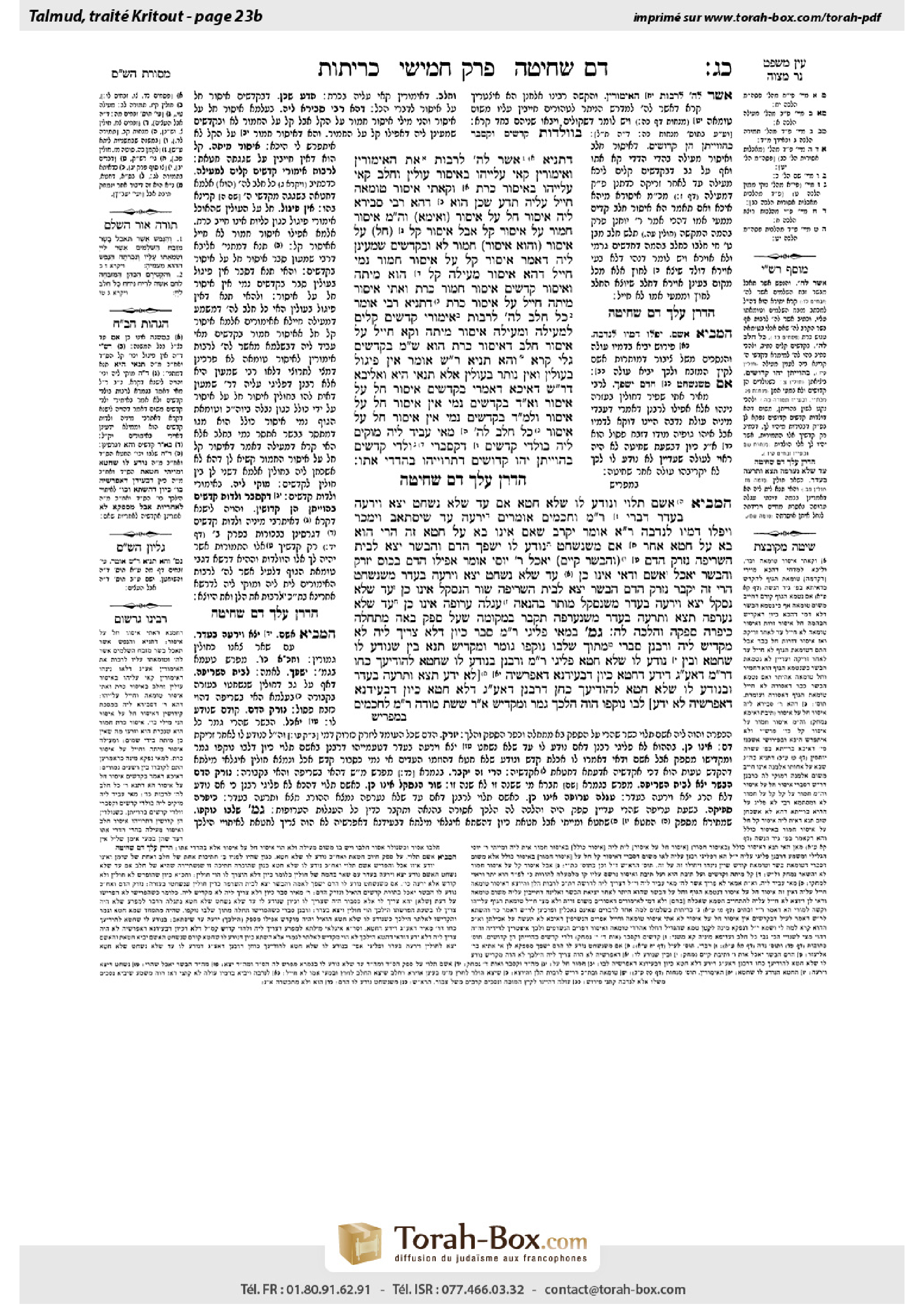
Keritot 23b: Talmud study for Daf Yomi
Daf Yomi is the daily study of one Talmud folio. Explore 37 tractates with scans, Hebrew text, Sefaria English and AI-generated French translations where annotated.
Passage selection and English or AI-generated French translation are available where the scan has annotations. Daf Study is independent of Torah-Box and Sefaria.
Browse Keritot · כריתות · All tractatesKeritot 23b text and translations
This page of Keritot includes the Aramaic text, an English translation and an AI-generated French translation, alongside the scan above.
כריתות כ״ג ב · Aramaic and Hebrew text
דְּתַנְיָא: ״אֲשֶׁר לַה׳״ – לְרַבּוֹת אֶת הָאֵימוּרִין.
וְאֵימוּרִין קָאֵי עֲלַיְיהוּ בְּאִיסּוּר עוֹלִין, וְחֵלֶב קָאֵי עֲלֵייהּו בְּאִיסּוּר כָּרֵת, וְקָאָתֵי אִיסּוּר טוּמְאָה חָיֵיל עֲלֵיהּ.
תֵּדַע שֶׁכֵּן הוּא, דְּהָא רַבִּי סְבִירָא לֵיהּ אִיסּוּר חָל עַל אִיסּוּר, (וְאֵימָא) וְהָנֵי מִילֵּי אִיסּוּר חָמוּר עַל אִיסּוּר קַל, אֲבָל אִיסּוּר קַל חָל עַל אִיסּוּר וְהוּא אִיסּוּר חָמוּר – לָא. וּבְקׇדָשִׁים שָׁמְעִינַן לֵיהּ דְּאָמַר: אִיסּוּר קַל עַל אִיסּוּר חָמוּר נָמֵי חָיֵיל,
דְּהָא אִיסּוּר מְעִילָה קַל הוּא – מִיתָה, וְאִיסּוּר קָדָשִׁים אִיסּוּר חָמוּר – כָּרֵת, וְאָתֵי אִיסּוּר מִיתָה חָיֵיל עַל אִיסּוּר כָּרֵת.
דְּתַנְיָא: רַבִּי אוֹמֵר: ״כׇּל חֵלֶב לַה׳״ – לְרַבּוֹת אֵימוּרֵי קָדָשִׁים קַלִּים לִמְעִילָה.
וּמְעִילָה אִיסּוּר מִיתָה, וְקָא חָיֵיל עַל אִיסּוּר חֵלֶב, דְּאִיסּוּר כָּרֵת הוּא, שְׁמַע מִינַּהּ: בְּקָדָשִׁים גַּלִּי קְרָא.
וְהָא תַּנְיָא, רַבִּי שִׁמְעוֹן אוֹמֵר: אֵין פִּיגּוּל בָּעוֹלִין וְאֵין נוֹתָר בָּעוֹלִין!
אֶלָּא תַּנָּאֵי הִיא, וְאַלִּיבָּא דְּרַבִּי שִׁמְעוֹן, דְּאִיכָּא דְאָמְרִי: בְּקָדָשִׁים אִיסּוּר חָל עַל אִיסּוּר, וְאִיכָּא דְאָמְרִי: בְּקָדָשִׁים נָמֵי אֵין אִיסּוּר חָל עַל אִיסּוּר.
וּלְמַאן דְּאָמַר: בְּקָדָשִׁים נָמֵי אֵין אִיסּוּר חָל עַל אִיסּוּר, ״כׇּל חֵלֶב לַה׳״ מַאי עָבֵיד לֵיהּ?
מוֹקֵים לֵיהּ בְּוַלְדֵי קָדָשִׁים, דְּקָסָבְרִי: וַלְדֵי קָדָשִׁים – בַּהֲוָיָיתָן יְהוּ קְדוֹשִׁים, דְּתַרְוַיְיהוּ בַּהֲדָדֵי אָתוּ.
הֲדַרַן עֲלָךְ דַּם שְׁחִיטָה
מַתְנִי׳ הַמֵּבִיא אָשָׁם תָּלוּי, וְנוֹדַע לוֹ שֶׁלֹּא חָטָא, אִם עַד שֶׁלֹּא נִשְׁחַט – יֵצֵא וְיִרְעֶה בָּעֵדֶר, דִּבְרֵי רַבִּי מֵאִיר.
וַחֲכָמִים אוֹמְרִים: יִרְעֶה עַד שֶׁיִּסְתָּאֵב וְיִמָּכֵר וְיִפְּלוּ דָּמָיו לִנְדָבָה. רַבִּי אֱלִיעֶזֶר אוֹמֵר: יִקְרַב, שֶׁאִם אֵינוֹ בָּא עַל חֵטְא זֶה – הֲרֵי הוּא בָּא עַל חֵטְא אַחֵר.
אִם מִשֶּׁנִּשְׁחַט נוֹדַע לוֹ – יִשָּׁפֵךְ הַדָּם, וְהַבָּשָׂר יֵצֵא לְבֵית הַשְּׂרֵיפָה. נִזְרַק הַדָּם וְהַבָּשָׂר קַיָּים – יֵאָכֵל. רַבִּי יוֹסֵי אוֹמֵר: אֲפִילּוּ הַדָּם בַּכּוֹס – יִזָּרֵק, וְהַבָּשָׂר יֵאָכֵל.
אָשָׁם וַדַּאי אֵינוֹ כֵּן, עַד שֶׁלֹּא נִשְׁחַט – יֵצֵא וְיִרְעֶה בָּעֵדֶר. מִשֶּׁנִּשְׁחַט – הֲרֵי זֶה יִקָּבֵר. נִזְרַק הַדָּם – הַבָּשָׂר יֵצֵא לְבֵית הַשְּׂרֵיפָה.
שׁוֹר הַנִּסְקָל אֵינוֹ כֵּן, עַד שֶׁלֹּא נִסְקָל – יֵצֵא וְיִרְעֶה בָּעֵדֶר. מִשֶּׁנִּסְקַל – מוּתָּר בַּהֲנָאָה.
עֶגְלָה עֲרוּפָה אֵינוֹ כֵּן, עַד שֶׁלֹּא נֶעֶרְפָה – תֵּצֵא וְתִרְעֶה בָּעֵדֶר, מִשֶּׁנֶּעֶרְפָה – תִּקָּבֵר בִּמְקוֹמָהּ, שֶׁעַל סָפֵק בָּאָה מִתְּחִלָּה, כִּיפְּרָה סְפֵקָהּ וְהָלְכָה לָהּ.
גְּמָ׳ בְּמַאי פְּלִיגִי? רַבִּי מֵאִיר סָבַר: כֵּיוָן דְּלָא צְרִיךְ לֵיהּ, לָא מַקְדֵּישׁ לֵיהּ. וְרַבָּנַן סָבְרִי: מִתּוֹךְ שֶׁלִּבּוֹ נוֹקְפוֹ, גּוֹמֵר וּמַקְדִּישׁ.
תָּנָא: בֵּין שֶׁנּוֹדַע לוֹ שֶׁחָטָא וּבֵין נוֹדַע לוֹ שֶׁלֹּא חָטָא פְּלִיגִי רַבִּי מֵאִיר וְרַבָּנַן. בְּנוֹדַע לוֹ שֶׁחָטָא – לְהוֹדִיעֲךָ כֹּחוֹ דְּרַבִּי מֵאִיר, דְּאַף עַל גַּב דְּיָדַע דַּחֲטָא, כֵּיוָן דִּבְעִידָּנָא דְּאַפְרְשֵׁיהּ [לָא יְדַע – תֵּצֵא וְתִרְעֶה בָּעֵדֶר.
וּבְנוֹדַע לוֹ שֶׁלֹּא חָטָא – לְהוֹדִיעֲךָ כֹּחָן דְּרַבָּנַן, דְּאַף עַל גַּב דְּלָא חֲטָא, כֵּיוָן דִּבְעִידָּנָא דְּאַפְרְשֵׁיהּ לָא יְדַע] – לִבּוֹ נוֹקְפוֹ הֲוָה, הִלְכָּךְ גָּמַר וּמַקְדֵּישׁ.
אָמַר רַב שֵׁשֶׁת: מוֹדֶה רַבִּי מֵאִיר לַחֲכָמִים
Keritot 23b · English translation
As it is taught in a baraita with regard to the prohibition against eating sacrificial meat in a state of ritual impurity: “But the soul that eats from the meat of the sacrifice of peace offerings, which belong to the Lord, having his impurity upon him, that soul shall be cut off from his people” (Leviticus 7:20). The phrase “which belong to the Lord” serves to include in the prohibition of an impure person consuming sacrificial food the sacrificial portions, which are meant to be sacrificed upon the altar and not eaten by other people. One who eats this meat while he is impure is liable to receive karet.
The Gemara explains the proof from this baraita: In the case of sacrificial portions, the prohibition of items that are supposed to ascend upon the altar applies to it, and with regard to the parts of the sacrificial portions that are forbidden fat, the prohibition against eating forbidden fat, which is punishable by karet, applies to it. And nevertheless the prohibition of eating sacrificial food in a state of impurity comes and applies in addition to that prohibition. This indicates that with regard to sacrificial meat specifically, a prohibition takes effect where another prohibition already exists.
The Gemara adds: Know that it is so, as Rabbi Yehuda HaNasi maintains in general that a prohibition takes effect where another prohibition already exists, but this statement applies only with regard to a relatively severe prohibition taking effect where a relatively lenient prohibition already exists. But in the case of a lenient prohibition taking effect where there is already an existing prohibition, and that original prohibition is more severe than the second one, no, Rabbi Yehuda HaNasi does not hold that the second prohibition takes effect. And yet with regard to sacrificial meat, we have heard that Rabbi Yehuda HaNasi says that even a lenient prohibition takes effect where a severe prohibition already exists.
The Gemara cites the source for this claim: As the prohibition of misuse of consecrated property is a relatively lenient prohibition, since according to Rabbi Yehuda HaNasi it is punishable by death at the hand of Heaven, and the prohibition against eating sacrificial meat is a severe prohibition, since it is punishable by karet,and yet the prohibition punishable by death comes and takes effect where there is already an existing prohibition punishable by karet.
As it is taught in a baraita that Rabbi Yehuda HaNasi says: It is stated with regard to peace offerings, which are offerings of lesser sanctity: “And the priest shall make them smoke upon the altar; it is the food of the offering made by fire, for a pleasing aroma; all the fat is the Lord’s” (Leviticus 3:16). This verse serves to include the sacrificial portions of offerings of lesser sanctity in the halakha of misuse of consecrated property.
The Gemara comments: And misuse of consecrated property, according to Rabbi Yehuda HaNasi, is a prohibition punishable by death at the hand of Heaven, and yet it takes effect where there is already an existing prohibition of forbidden fat, which is a prohibition punishable by karet. Conclude from this baraita that with regard to sacrificial food, the Merciful One revealed that a prohibition takes effect where another prohibition already exists. As stated above, it is for this reason that Rabbi Shimon states in the mishna that one is liable to bring two sin offerings for eating forbidden fat that is notar.
The Gemara objects: But isn’t it taught in a baraita that Rabbi Shimon says: The prohibition against eating an offering that was sacrificed with the intent to consume it after its designated time [piggul] does not apply to items that are supposed to ascend onto the altar, and similarly, the prohibition against eating notar does not apply to items that are supposed to ascend onto the altar? This indicates that even with regard to sacrificial meat, a prohibition does not take effect where another prohibition already exists.
The Gemara suggests: Rather, this matter is a dispute between tanna’im with regard to the opinion of Rabbi Shimon, as some say that Rabbi Shimon maintains that with regard to sacrificial meat a prohibition takes effect where another prohibition already exists, as indicated in the mishna. And some say that even with regard to sacrificial meat, Rabbi Shimon holds that a prohibition does not take effect where another prohibition already exists.
The Gemara challenges: And according to the one who says that even with regard to sacrificial meat a prohibition does not take effect where another prohibition already exists, what does he do with the verse: “All the fat is the Lord’s” (Leviticus 3:16), from which it was derived above that the sacrificial parts of offerings of lesser sanctity are included in the prohibition of misuse of consecrated property?
The Gemara answers that he interprets it as referring to the offspring of sacrificial animals, as he holds that the offspring of sacrificial animals become sanctified when they begin to exist, i.e., when they are born. Since the prohibition of forbidden fat also takes effect at that time, both of them, i.e., the prohibitions of forbidden fat and misuse of consecrated property, come into effect simultaneously.
MISHNA: In the case of one who brings a provisional guilt offering due to uncertainty as to whether he sinned, and it became known to him that he did not sin, if he made that discovery before the ram was slaughtered, it shall emerge and graze with the flock as a non-sacred animal, since its consecration was in error. This is the statement of Rabbi Meir.
And the Rabbis say: Its status is not that of a non-sacred animal; rather it is that of a guilt offering that was disqualified for sacrifice. Therefore, it shall graze until it becomes blemished; and then it shall be sold, and the money received for it shall be allocated for the purchase of communal gift offerings by the Temple treasury. Rabbi Eliezer says: It shall be sacrificed as a provisional guilt offering, as if it does not come to atone for this sin that he initially thought, it comes to atone for another sin of which he is unaware.
If it became known to him that he did not sin after the ram was slaughtered and its blood collected in a container, the blood shall be poured into the canal that flows through the Temple courtyard, and the flesh shall go out to the place of burning, like any disqualified offering. If the blood was sprinkled before he discovered that he did not sin, and the meat is intact, the meat may be eaten by the priests like any other sin offering, as from the moment that its blood was sprinkled the meat is permitted to the priests. Rabbi Yosei says: Even if the blood was still in the cup when he discovered that he did not sin, the blood shall be sprinkled and the meat may be eaten.
In the case of a definite guilt offering, it is not so, i.e., the halakha is different than with regard to a provisional guilt offering. If he made the discovery that he did not sin before the ram was slaughtered, it shall go out and graze among the flock, as it is not consecrated. If it became known to him that he did not sin after the ram was slaughtered, it shall be buried like a non-sacred animal that was slaughtered in the Temple courtyard, and its blood is poured. If he discovered that he did not sin after the blood was sprinkled, the flesh shall go out to the place of burning, like any disqualified offering.
In the case of an ox that is sentenced to be stoned (see Exodus 21:28–32), e.g., for killing a person, it is not so, i.e., it also does not have the same halakhic status as a provisional guilt offering. If it is discovered that the testimony with regard to the ox was false before it was stoned, it shall go out and graze among the flock as it never had the status of an ox sentenced to be stoned. If this was discovered after the ox was stoned, its halakhic status is as though it had not been sentenced, and therefore deriving benefit from its carcass is permitted.
In the case of a heifer whose neck is broken, when a corpse is found between two cities and the identity of the murderer is unknown (see Deuteronomy 21:1–9), it is not so i.e., the halakha is different than with regard to a provisional guilt offering. If the identity of the murderer is discovered before the heifer’s neck was broken, it shall go out and graze among the flock, as it is not consecrated. But if the identity of the murderer was discovered after the heifer’s neck was broken, it shall be buried in its place, like any other heifer whose neck is broken. The reason is that from the outset the heifer whose neck is broken comes to atone for a situation of uncertainty. Once its neck was broken before the identity of the murderer was revealed, its mitzva was fulfilled, as it atoned for its uncertainty and that uncertainty is gone.
GEMARA: The mishna teaches with regard to one who brings a provisional guilt offering and it became known to him before the ram was slaughtered that he did not sin that Rabbi Meir says the animal is non-sacred and the Rabbis say its status is that of a guilt offering that was disqualified. The Gemara asks: With regard to what do Rabbi Meir and the Rabbis disagree? The Gemara answers that Rabbi Meir holds: He initially consecrated the animal with the intention to sacrifice it. Since later it became clear to him that he does not require the animal, the sanctity is nullified and it is as though he did not consecrate it. And the Rabbis hold: Since initially his heart struck him [nokfo] with pangs of conscience over sins that he might have committed, he wholeheartedly resolved to consecrate the animal, and that sanctity is not nullified.
A Sage taught in a baraita: Rabbi Meir and the Rabbis disagree whether it became known to him that he sinned, or whether it became known to him that he did not sin. The Gemara elaborates: Their dispute is stated by the baraita in a case where it became known to him that he sinned, in order to convey to you the far-reaching nature of the opinion of Rabbi Meir. As Rabbi Meir maintains that even though he now knows that he sinned and therefore he must bring a sin offering and is no longer obligated to sacrifice the provisional guilt offering, nevertheless, since at the time that he designated the animal as a provisional guilt offering he did not know for certain that he sinned, that animal shall go out and graze among the flock, as it is unconsecrated.
And similarly, their dispute is stated in a case where it became known to him that he did not sin, in order to convey to you the far-reaching nature of the opinion of the Rabbis. As the Rabbis maintain that even though he now knows that he did not sin, since at the time that he designated the animal as a provisional guilt offering he did not know, his heart struck him with pangs of conscience. Therefore, he wholeheartedly resolved to consecrate the animal.
Rav Sheshet said: Rabbi Meir concedes to the Rabbis
Keritot 23b · Traduction française (IA)
Comme il est enseigné dans une baraïta au sujet de l’interdiction de manger de la viande sacrificielle en état d’impureté rituelle : « Mais la personne qui mangera de la chair du sacrifice de paix, qui appartient à l’Éternel, alors qu’elle est en état d’impureté, cette personne sera retranchée de son peuple » (Lévitique 7,20). L’expression « qui appartient à l’Éternel » inclut dans l’interdiction faite à une personne impure de consommer des aliments consacrés les portions sacrificielles destinées à être offertes sur l’autel et non consommées par d’autres. Celui qui mange cette viande alors qu’il est impur est passible de karet.
La Guemara explique la preuve tirée de cette baraïta : dans le cas des portions sacrificielles, l’interdiction visant les éléments destinés à monter sur l’autel s’applique à ces éléments ; et, pour les parties de ces portions qui sont des graisses interdites, l’interdiction de manger des graisses interdites, passible de karet, s’applique également. Pourtant, l’interdiction de manger des aliments sacrificiels en état d’impureté vient s’ajouter à ces interdictions. Cela indique que, pour la viande sacrificielle, une interdiction peut prendre effet alors qu’une autre existe déjà.
La Guemara ajoute : sachez qu’il en est ainsi, car Rabbi Yehouda HaNassi estime de manière générale qu’une interdiction peut prendre effet alors qu’une autre existe déjà, mais cela ne vaut que lorsqu’une interdiction relativement sévère prend effet alors qu’une interdiction relativement légère existe déjà. En revanche, lorsqu’une interdiction légère prend effet alors qu’une interdiction préexistante est plus sévère que la seconde, non, Rabbi Yehouda HaNassi ne considère pas que la seconde interdiction prend effet. Pourtant, au sujet de la viande sacrificielle, nous avons entendu Rabbi Yehouda HaNassi dire que même une interdiction légère prend effet alors qu’une interdiction sévère existe déjà.
La Guemara cite la source de cette affirmation : l’interdiction de détourner un bien consacré de son usage est relativement légère, car selon Rabbi Yehouda HaNassi elle est passible de mort par la main du Ciel, tandis que l’interdiction de manger de la viande sacrificielle est sévère, car elle est passible de karet. Pourtant, l’interdiction passible de mort vient prendre effet alors qu’une interdiction préexistante passible de karet s’applique déjà.
Comme il est enseigné dans une baraïta, Rabbi Yehouda HaNassi dit : au sujet des sacrifices de paix, qui sont des sacrifices de moindre sainteté, il est dit : « Le prêtre les fera fumer sur l’autel ; c’est la nourriture de l’offrande faite par le feu, d’odeur agréable ; toute la graisse appartient à l’Éternel » (Lévitique 3,16). Ce verset inclut les portions sacrificielles des sacrifices de moindre sainteté dans la halakha du détournement d’un bien consacré de son usage.
La Guemara fait remarquer : or, selon Rabbi Yehouda HaNassi, le détournement d’un bien consacré de son usage est une interdiction passible de mort par la main du Ciel ; pourtant, elle prend effet alors qu’il existe déjà une interdiction concernant les graisses interdites, passible de karet. Concluez de cette baraïta qu’en matière d’aliments sacrificiels, le Miséricordieux a révélé qu’une interdiction peut prendre effet alors qu’une autre existe déjà. Comme indiqué plus haut, c’est pour cette raison que Rabbi Shimon affirme dans la Michna qu’on est passible d’apporter deux sacrifices expiatoires pour avoir mangé des graisses interdites qui sont notar.
La Guemara objecte : mais n’est-il pas enseigné dans une baraïta que Rabbi Shimon dit : l’interdiction de manger une offrande sacrifiée avec l’intention de la consommer après le délai prévu [piggul] ne s’applique pas aux éléments destinés à monter sur l’autel ; de même, l’interdiction de manger du notar ne s’applique pas aux éléments destinés à monter sur l’autel ? Cela indique que, même pour la viande sacrificielle, une interdiction ne prend pas effet lorsqu’une autre existe déjà.
La Guemara suggère : il s’agit plutôt d’un désaccord entre tannaïm au sujet de l’opinion de Rabbi Shimon. Certains disent que Rabbi Shimon estime qu’en matière de viande sacrificielle, une interdiction prend effet alors qu’une autre existe déjà, comme l’indique la Michna. D’autres disent que même en matière de viande sacrificielle, Rabbi Shimon considère qu’une interdiction ne prend pas effet lorsqu’une autre existe déjà.
La Guemara soulève une difficulté : selon celui qui dit que même en matière de viande sacrificielle, une interdiction ne prend pas effet lorsqu’une autre existe déjà, que fait-il du verset : « Toute la graisse appartient à l’Éternel » (Lévitique 3,16), dont on a déduit plus haut que les portions sacrificielles des sacrifices de moindre sainteté sont incluses dans l’interdiction de détourner un bien consacré de son usage ?
La Guemara répond qu’il interprète ce verset comme faisant référence aux petits des animaux consacrés, car il estime que ceux-ci deviennent consacrés dès qu’ils commencent à exister, c’est-à-dire à leur naissance. Puisque l’interdiction concernant les graisses interdites prend également effet à ce moment-là, les deux interdictions, celle des graisses interdites et celle du détournement d’un bien consacré de son usage, prennent effet simultanément.
MICHNA : Dans le cas de quelqu’un qui apporte un sacrifice de culpabilité provisoire parce qu’il ne sait pas s’il a péché, puis apprend qu’il n’a pas péché, si cette découverte a lieu avant que le bélier soit égorgé, celui-ci sortira et paîtra avec le troupeau comme un animal profane, puisque sa consécration reposait sur une erreur. Telle est l’opinion de Rabbi Meïr.
Les Sages disent : son statut n’est pas celui d’un animal profane ; c’est plutôt celui d’un sacrifice de culpabilité devenu impropre à être offert. Il paîtra donc jusqu’à ce qu’il devienne atteint d’un défaut ; il sera alors vendu, et l’argent obtenu sera affecté par le trésor du Temple à l’achat d’offrandes volontaires communautaires. Rabbi Eliezer dit : il sera offert comme sacrifice de culpabilité provisoire ; même s’il ne vient pas expier le péché qu’il croyait avoir commis au départ, il viendra expier un autre péché dont il n’a pas connaissance.
S’il apprend qu’il n’a pas péché après que le bélier a été égorgé et que son sang a été recueilli dans un récipient, le sang sera versé dans le canal qui traverse le parvis du Temple, et la chair sera transportée au lieu de combustion, comme pour toute offrande disqualifiée. Si le sang a été aspergé avant qu’il découvre qu’il n’a pas péché et que la viande est intacte, les prêtres peuvent la manger comme toute autre offrande expiatoire, car dès que le sang a été aspergé, la viande est permise aux prêtres. Rabbi Yossei dit : même si le sang se trouvait encore dans la coupe lorsqu’il a découvert qu’il n’avait pas péché, le sang sera aspergé et la viande pourra être mangée.
Pour un sacrifice de culpabilité certain, il n’en va pas ainsi, c’est-à-dire que la halakha diffère de celle du sacrifice de culpabilité provisoire. S’il découvre qu’il n’a pas péché avant que le bélier soit égorgé, celui-ci sortira et paîtra avec le troupeau, car il n’est pas consacré. S’il apprend qu’il n’a pas péché après que le bélier a été égorgé, il sera enterré comme un animal profane égorgé dans le parvis du Temple, et son sang sera versé. S’il découvre qu’il n’a pas péché après que le sang a été aspergé, la chair sera transportée au lieu de combustion, comme pour toute offrande disqualifiée.
Pour un bœuf condamné à être lapidé (voir Exode 21,28–32), par exemple pour avoir tué une personne, il n’en va pas ainsi, c’est-à-dire qu’il n’a pas non plus le même statut halakhique qu’un sacrifice de culpabilité provisoire. Si l’on découvre que le témoignage concernant le bœuf était faux avant qu’il ne soit lapidé, il sortira et paîtra avec le troupeau, puisqu’il n’a jamais eu le statut de bœuf condamné à être lapidé. Si cela est découvert après que le bœuf a été lapidé, son statut halakhique est celui d’un bœuf qui n’a pas été condamné ; il est donc permis de tirer profit de sa carcasse.
Pour une génisse dont la nuque est brisée, lorsqu’on trouve un cadavre entre deux villes et que l’identité du meurtrier est inconnue (voir Deutéronome 21,1–9), il n’en va pas ainsi, c’est-à-dire que la halakha diffère de celle du sacrifice de culpabilité provisoire. Si l’identité du meurtrier est découverte avant que la nuque de la génisse soit brisée, elle sortira et paîtra avec le troupeau, car elle n’est pas consacrée. Mais si l’identité du meurtrier est découverte après que la nuque de la génisse a été brisée, elle sera enterrée sur place, comme toute autre génisse dont la nuque a été brisée. La raison en est que, dès le départ, la génisse dont la nuque est brisée vient expier une situation d’incertitude. Une fois sa nuque brisée avant que l’identité du meurtrier ne soit révélée, sa mitsva est accomplie, puisqu’elle a expié cette incertitude et que celle-ci a disparu.
GUEMARA : La Michna enseigne, au sujet de quelqu’un qui apporte un sacrifice de culpabilité provisoire et apprend avant que le bélier soit égorgé qu’il n’a pas péché, que Rabbi Meïr dit que l’animal est profane, tandis que les Sages disent qu’il a le statut d’un sacrifice de culpabilité devenu impropre. La Guemara demande : sur quoi porte le désaccord entre Rabbi Meïr et les Sages ? La Guemara répond que Rabbi Meïr estime qu’au départ, il a consacré l’animal dans l’intention de l’offrir. Puisqu’il a appris par la suite qu’il n’a pas besoin de cet animal, sa sainteté est annulée, comme s’il ne l’avait pas consacré. Les Sages, eux, estiment qu’au départ, son cœur l’a tourmenté [nokfo] de remords au sujet des péchés qu’il avait peut-être commis ; il a donc résolu de tout cœur de consacrer l’animal, et cette sainteté n’est pas annulée.
Un Sage a enseigné dans une baraïta : Rabbi Meïr et les Sages sont en désaccord sur le cas où l’homme apprend qu’il a péché comme sur celui où il apprend qu’il n’a pas péché. La Guemara précise : la baraïta expose leur désaccord dans le cas où il apprend qu’il a péché, afin de te faire connaître la portée extrême de l’opinion de Rabbi Meïr. Celui-ci estime en effet que, même s’il sait désormais qu’il a péché et doit donc apporter un sacrifice expiatoire, et qu’il n’est plus tenu d’offrir le sacrifice de culpabilité provisoire, puisque, lorsqu’il a désigné l’animal comme sacrifice de culpabilité provisoire, il ne savait pas avec certitude qu’il avait péché, cet animal sortira et paîtra avec le troupeau, car il n’est pas consacré.
De même, leur désaccord est exposé dans le cas où il apprend qu’il n’a pas péché, afin de te faire connaître la portée extrême de l’opinion des Sages. Ceux-ci estiment en effet que, même s’il sait désormais qu’il n’a pas péché, puisqu’au moment où il a désigné l’animal comme sacrifice de culpabilité provisoire il ne le savait pas, son cœur l’a tourmenté de remords. Il a donc résolu de tout cœur de consacrer l’animal.
Rav Sheshet a dit : Rabbi Meïr reconnaît l’opinion des Sages.
Traduction française générée par IA à partir de l’édition anglaise de Sefaria. Vérifie toujours un passage avec le texte source.
Text from Sefaria: William Davidson Edition - Vocalized Aramaic (CC BY NC); William Davidson Edition - English (CC BY NC).