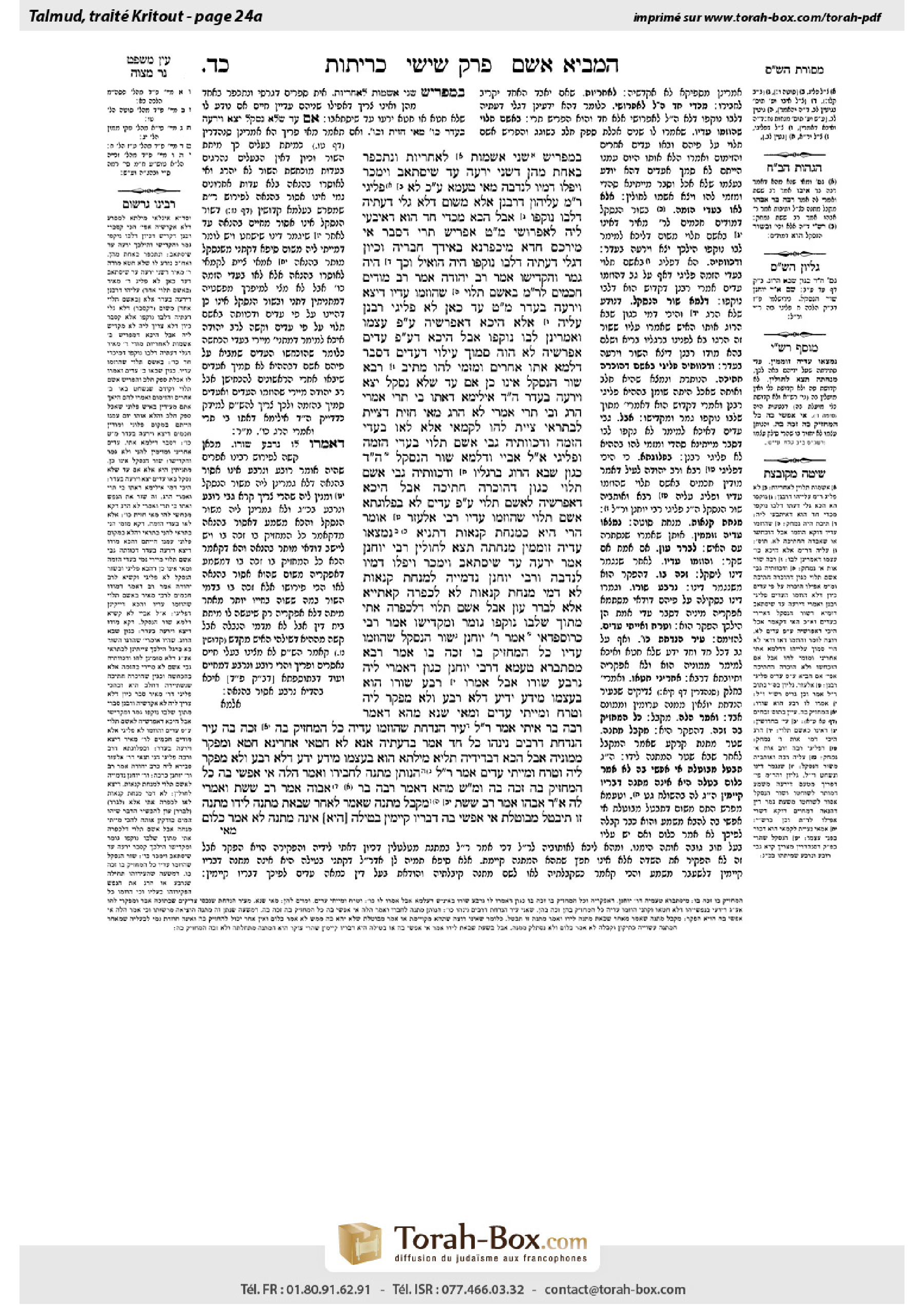
Keritot 24a: Talmud study for Daf Yomi
Daf Yomi is the daily study of one Talmud folio. Explore 37 tractates with scans, Hebrew text, Sefaria English and AI-generated French translations where annotated.
Passage selection and English or AI-generated French translation are available where the scan has annotations. Daf Study is independent of Torah-Box and Sefaria.
Browse Keritot · כריתות · All tractatesKeritot 24a text and translations
This page of Keritot includes the Aramaic text, an English translation and an AI-generated French translation, alongside the scan above.
כריתות כ״ד א · Aramaic and Hebrew text
בְּמַפְרִישׁ שְׁנֵי אֲשָׁמוֹת לְאַחְרָיוּת וְנִתְכַּפֵּר בְּאַחַת מֵהֶן, דְּשֵׁנִי יִרְעֶה עַד שֶׁיִּסְתָּאֵב וְיִמָּכֵר וְיִפְּלוּ דָּמָיו לִנְדָבָה.
מַאי טַעְמָא? עַד כָּאן לָא פְּלִיגִי רַבִּי מֵאִיר עֲלֵיהוֹן דְּרַבָּנַן אֶלָּא מִשּׁוּם דְּלָא גַּלִּי דַּעְתֵּיהּ דְּלִבּוֹ נוֹקְפוֹ, אֲבָל הָכָא, מִכְּדִי חַד הוּא דְּאִיבְּעִי לֵיהּ לְאַפְרוֹשֵׁי, מַאי טַעְמָא אַפְרֵישׁ תְּרֵי? דְּסָבַר: אִי מִירְכַס חֲדָא מִיכַּפַּרְנָא בְּאִידַּךְ חַבְרֵיהּ, וְכֵיוָן דְּגַלִּי דַּעְתֵּיהּ דְּלִבּוֹ נוֹקְפוֹ הָיָה, הוֹאִיל וְכָךְ הָיָה גָּמַר וְהִקְדִּישׁוֹ.
אָמַר רַב יְהוּדָה אָמַר רַב: מוֹדִים חֲכָמִים לְרַבִּי מֵאִיר בְּאָשָׁם תָּלוּי שֶׁהוּזַּמּוּ עֵדָיו, דְּיֵצֵא וְיִרְעֶה בָּעֵדֶר.
מַאי טַעְמָא? עַד כָּאן לָא פְּלִיגִי רַבָּנַן עֲלֵיהּ אֶלָּא הֵיכָא דְּאַפְרְשֵׁיהּ עַל פִּי עַצְמוֹ, וְאָמְרִינַן לִבּוֹ נוֹקְפוֹ, אֲבָל הֵיכָא דְּעַל פִּי עֵדִים אַפְרְשֵׁיהּ – לָא הֲוָה סָמֵיךְ עִילָּוֵי עֵדִים, דְּסָבַר: דִּלְמָא אָתוּ אֲחֵרִים וּמַזְּמִי לְהוּ.
מֵתִיב רָבָא: שׁוֹר הַנִּסְקָל אֵינוֹ כֵּן, אִם עַד שֶׁלֹּא נִסְקַל – יֵצֵא וְיִרְעֶה בָּעֵדֶר. הֵיכִי דָּמֵי? אִילֵּימָא דְּאָתוּ בֵּי תְרֵי אָמְרִי ״הָרַג״, וּבֵי תְרֵי אָמְרִי ״לֹא הָרַג״ – מַאי חָזֵית דְּצָיְיתַ[תְּ] לְבָתְרָאֵי? צִיית לְהוּ לְקַמָּאֵי!
אֶלָּא לָאו בְּעֵדֵי הֲזָמָה. וְדִכְווֹתֵיהּ גַּבֵּי אָשָׁם תָּלוּי – בְּעֵדֵי הֲזָמָה, וּפְלִיגִי!
אֲמַר לֵיהּ אַבָּיֵי: וְדִלְמָא שׁוֹר הַנִּסְקָל הֵיכִי דָמֵי – כְּגוֹן שֶׁבָּא הָרוּג בְּרַגְלָיו.
וְדִכְווֹתֵיהּ גַּבֵּי אָשָׁם תָּלוּי – כְּגוֹן דְּהוּכְּרָה חֲתִיכָה. אֲבָל הֵיכָא דְּאַפְרְשֵׁיהּ לְאָשָׁם תָּלוּי עַל פִּי עֵדִים – לָא.
בִּפְלוּגְתָּא: אָשָׁם תָּלוּי שֶׁהוּזַּמּוּ עֵדָיו – רַבִּי אֶלְעָזָר אוֹמֵר: הֲרֵי הִיא כְּמִנְחַת קְנָאוֹת, דְּתַנְיָא: נִמְצְאוּ עֵדֶיהָ זוֹמְמִין – מִנְחָתָהּ תֵּצֵא לְחוּלִּין.
רַבִּי יוֹחָנָן אָמַר: יִרְעֶה עַד שֶׁיִּסְתָּאֵב וְיִמָּכֵר וְיִפְּלוּ דָּמָיו לִנְדָבָה. וְרַבִּי יוֹחָנָן, נְדַמְּיֵיהּ לְמִנְחַת קְנָאוֹת! לָא דָּמֵי, מִנְחַת קְנָאוֹת לָא לְכַפָּרָה קָאָתְיָיא, אֶלָּא לְבָרֵר עָוֹן. אֲבָל אָשָׁם תָּלוּי, דִּלְכַפָּרָה אָתֵי, מִתּוֹךְ שֶׁלִּבּוֹ נוֹקְפוֹ גּוֹמֵר וּמַקְדִּישׁוֹ.
אָמַר רַבִּי כְּרוּסְפָּדַאי אָמַר רַבִּי יוֹחָנָן: שׁוֹר הַנִּסְקָל שֶׁהוּזַּמּוּ עֵדָיו – כׇּל הַמַּחֲזִיק בּוֹ זָכָה בּוֹ.
אָמַר רָבָא: מִסְתַּבְּרָא טַעְמָא דְּרַבִּי יוֹחָנָן, כְּגוֹן דְּאָמְרִי לֵיהּ: נִרְבַּע שׁוֹרוֹ. אֲבָל אָמְרוּ: רָבַע שׁוֹרוֹ, הוּא בְּעַצְמוֹ מִידָּע יָדַיע דְּלָא רְבַע וְלָא מַפְקַר לֵיהּ, וְטָרַח וּמַיְיתֵי עֵדִים.
וּמַאי שְׁנָא מֵהָא דְּאָמַר רַבָּה בַּר אִיתַּי אָמַר רֵישׁ לָקִישׁ: עִיר הַנִּדַּחַת שֶׁהוּזַּמּוּ עֵדֶיהָ – כׇּל הַמַּחֲזִיק בָּהּ זָכָה בָּהּ?
עִיר הַנִּדַּחַת, דְּרַבִּים נִינְהוּ, כֹּל חַד אָמַר בְּדַעְתֵּיהּ: אֲנָא לָא חֲטַאי, אַחֲרִינָא חֲטָא, וּמַפְקַר מָמוֹנֵיהּ. אֲבָל הָכָא, דִּבְדִידֵיהּ תַּלְיָא מִילְּתָא, הוּא בְּעַצְמוֹ מִידָּע יָדַע דְּלָא רְבַע, וְלָא מַפְקַר לֵיהּ, וְטָרַח וּמַיְיתֵי עֵדִים.
אָמַר רֵישׁ לָקִישׁ: הַנּוֹתֵן מַתָּנָה לַחֲבֵירוֹ, וְאָמַר הַלָּה: ״אִי אֶפְשִׁי בָּהּ״ – כׇּל הַמַּחֲזִיק בָּהּ זָכָה בָּהּ.
וּמַאי שְׁנָא מֵהָא דְּאָמַר רַבָּה בַּר אֲבוּהּ אָמַר רַב שֵׁשֶׁת, וְאָמְרִי לַהּ אָמַר רַבִּי אֲבָהוּ אָמַר רַב שֵׁשֶׁת: מְקַבֵּל מַתָּנָה שֶׁאָמַר לְאַחַר שֶׁבָּאת מַתָּנָה לְיָדוֹ: ״מַתָּנָה זוֹ תִּיבָּטֵל״, ״מְבוּטֶּלֶת״, ״אִי אֶפְשִׁי בָּהּ״ – דְּבָרָיו קַיָּימִין. ״בְּטֵילָה״, ״אֵינָהּ מַתָּנָה״ – לֹא אָמַר כְּלוּם.
Keritot 24a · English translation
in a case where one designates two provisional guilt offerings from the outset as a guarantee, so that if one is lost he may achieve atonement with the other, and he achieved atonement with one of them. He concedes that the second animal retains its sanctity and shall graze until it becomes blemished and that then it shall be sold and the money received for it shall be allocated for communal gift offerings.
What is the reason that Rabbi Meir agrees in such a case? Rabbi Meir disagrees with the Rabbis in a case where one brings a provisional guilt offering and later discovers with certainty that he did not sin, only because Rabbi Meir holds that the one consecrating the animal did not initially reveal that his heart was striking him with pangs of conscience. But here, in a case where he set aside two animals as provisional guilt offerings, since he was required to designate only one animal, what is the reason that he designated two? Evidently, the reason is that he thought: If one of the animals is lost, I will achieve atonement with the other one. And as he revealed by this scrupulous behavior that his heart was striking him with pangs of conscience, since that was so, he wholeheartedly resolved to consecrate the animal.
§ Rav Yehuda says that Rav says: The Rabbis concede to Rabbi Meir in a case of a provisional guilt offering where two witnesses testified that someone may have committed a sin, e.g., that he ate a piece of fat with regard to which there was uncertainty if it was permitted or forbidden fat, and later those witnesses were rendered conspiring witnesses, that the animal shall go out and graze among the flock as a non-sacred animal.
What is the reason? It is that the Rabbis disagree with Rabbi Meir only in a case where the person designated the animal as a provisional guilt offering of his own volition, and therefore we say that his heart was striking him with pangs of conscience and he wholeheartedly resolved to consecrate the animal. But in a case where he designated the animal as a provisional guilt offering due to the testimony of witnesses, he was not relying on the witnesses. Rather, he thought: Perhaps other witnesses will come and render these witnesses conspiring witnesses.
Rava raises an objection from the mishna: The case of an ox that is sentenced to be stoned is not similar to the case of a provisional guilt offering, as even the Rabbis agree that if it is discovered that the testimony with regard to the ox was false before it was stoned, it shall go out and graze among the flock. Rava explains his objection: What are the circumstances? If we say that initially two people came and said that the ox killed someone and the animal was therefore sentenced to be stoned, and two people later say that the ox did not kill, what did you see that you listen to the latter pair? You could just as well listen to the former pair.
Rather, isn’t the mishna referring to conspiring witnesses, i.e., the second pair of witnesses testified that the first pair were not in the vicinity at the time of the incident and therefore the testimony of the second pair of witnesses is accepted? And if so, in the corresponding situation in the mishna with regard to a provisional guilt offering, it is likewise referring to conspiring witnesses, i.e., one designated an animal as a provisional guilt offering due to the testimony of witnesses, and they were subsequently proven to be conspiring witnesses. And yet the Rabbis disagree with Rabbi Meir in that case and rule that this provisional guilt offering is not rendered non-sacred.
Abaye said to Rava: This proof is inconclusive. Perhaps one can say that in the case of an ox that is sentenced to be stoned, which goes out and grazes among the flock, what are the circumstances? It is not referring to conspiring witnesses, but rather to a case where the supposedly killed individual comes to the court on his feet, thereby conclusively disproving the testimony.
And in the corresponding situation in the mishna of a provisional guilt offering, it is referring to a case where one designated the animal as a provisional guilt offering of his own volition, and, for example, it later became known that the uncertain piece of fat that he ate was permitted fat. But in a case where he designated an animal as a provisional guilt offering due to the testimony of witnesses, he did not wholeheartedly resolve to consecrate the animal, and therefore it shall go out and graze among the flock.
The Gemara notes that Rav Yehuda and Rava, who discuss the case of conspiring witness above, disagree with regard to the issue that is the subject of the dispute between Rabbi Elazar and Rabbi Yoḥanan: If one designated an animal as a provisional guilt offering due to the testimony of witnesses and then those witnesses were rendered conspiring witnesses, Rabbi Elazar says: This case is similar to a meal offering of jealousy, sacrificed as part of the trial undergone by a sota, i.e., a suspected adulteress (see Numbers 5:25–26). As it is taught in a baraita: If the witnesses who testified about her were later found to be conspiring, her meal offering is transferred to non-sacred status. Likewise, a provisional guilt offering whose witnesses were proven to be conspiring witnesses becomes non-sacred.
Rabbi Yoḥanan says: That provisional guilt offering shall graze until it becomes blemished; and then it shall be sold, and the money received for it shall be allocated for communal gift offerings. The Gemara raises a difficulty: But according to Rabbi Yoḥanan, let us compare that case to a meal offering of jealousy, as claimed by Rabbi Elazar. The Gemara explains that Rabbi Yoḥanan would claim that the cases are not similar: A meal offering of jealousy does not come for atonement, but rather to clarify the sin of the sota. Since it has been clarified that she did not sin, the meal offering becomes non-sacred. But with regard to a provisional guilt offering, which comes for atonement, one must explain as follows: Since his heart strikes him with pangs of conscience, he wholeheartedly resolves to consecrate the animal, and therefore it remains sacred.
§ Rabbi Keruspedai says that Rabbi Yoḥanan says: With regard to an ox that is stoned whose witnesses were rendered conspiring,anyone who takes possession of the ox acquires it, as the owner of the ox relinquished his possession upon hearing that the animal is sentenced to die.
Rava said: The explanation of Rabbi Yoḥanan stands to reason in a case where the witnesses said to him that his ox was the object of bestiality; since he assumes that the witnesses are telling the truth, he relinquishes his ownership of the animal. But if the witnesses said that the owner himself engaged in bestiality with his ox, he knows about himself that he did not engage in bestiality with the ox, and therefore he will not relinquish his ownership of the ox. But rather, he will make an effort and bring other witnesses to prove that those witnesses are conspiring.
The Gemara asks: And what is different between this case and that which Rava bar Ittai says that Reish Lakish says: In a case of an idolatrous city, where witnesses testified that the majority of inhabitants committed idolatry, and the halakha is that all of the city’s property must be burned, if its witnesses were rendered conspiring witnesses, anyone who takes possession of the city’s property acquires it? In this case, the residents of the city know about themselves that they did not commit idolatry.
The Gemara responds: With regard to an idolatrous city, which involves many people, each person says to himself: Although I did not sin, others sinned, and consequently the city will be entirely burned; and he therefore relinquished ownership of his property. But here, with regard to the ox sentenced to be stoned, where the matter is dependent solely upon the owner himself, he knows about himself that he did not engage in bestiality with the ox, and therefore he does not relinquish his ownership of the ox. But rather, he will make an effort and bring other witnesses to prove that these are conspiring witnesses. Therefore, if they are in fact found to be conspiring witnesses, the ox remains in his possession.
§ The Gemara cites another example of a case where anyone who takes possession acquires an item. Reish Lakish says: In the case of one who gives a gift to another and that person receiving the gift says: I do not want [ee efshi] it, anyone who takes possession of the item acquires it, as ownership of the item has been relinquished.
The Gemara raises a difficulty: And what is different between this case and that statement which Rabba bar Avuh says that Rav Sheshet says, and some say that Rabbi Abbahu says that Rav Sheshet says: With regard to one who receives a gift who, after the gift entered his possession, said: Let this gift become void, or said: This gift is rendered void, or said: I do not want it, his statement is effective. But if he said: It is void, or: It is not a gift, it is as though he said nothing.
Keritot 24a · Traduction française (IA)
Dans le cas où quelqu’un désigne d’emblée deux sacrifices de culpabilité provisoires en garantie, afin que, si l’un est perdu, il puisse obtenir l’expiation grâce à l’autre, et où il obtient l’expiation grâce à l’un d’eux, il reconnaît que le second animal conserve sa sainteté : il doit paître jusqu’à ce qu’il soit atteint d’un défaut, puis être vendu, et le produit de la vente doit être affecté aux offrandes volontaires de la communauté.
Pourquoi Rabbi Meïr est-il d’accord dans un tel cas ? Rabbi Meïr est en désaccord avec les Sages lorsqu’une personne apporte un sacrifice de culpabilité provisoire, puis découvre avec certitude qu’elle n’a pas péché, uniquement parce que, selon lui, celui qui a consacré l’animal n’a pas révélé au départ que son cœur le tourmentait de remords. Mais ici, dans le cas où il a mis à part deux animaux comme sacrifices de culpabilité provisoires, puisqu’il ne devait en désigner qu’un seul, pourquoi en a-t-il désigné deux ? De toute évidence, c’est parce qu’il s’est dit : « Si l’un des animaux est perdu, j’obtiendrai l’expiation grâce à l’autre. » En révélant par cette conduite scrupuleuse que son cœur le tourmentait de remords, il a donc pris de tout cœur la résolution de consacrer l’animal.
§ Rav Yehouda dit au nom de Rav : Les Sages concèdent à Rabbi Meïr que, dans le cas d’un sacrifice de culpabilité provisoire pour lequel deux témoins ont attesté qu’une personne avait peut-être commis un péché — par exemple, qu’elle avait mangé un morceau de graisse dont on ne savait pas s’il s’agissait de graisse permise ou interdite —, si ces témoins sont ensuite reconnus comme témoins comploteurs, l’animal doit être libéré et paître parmi le troupeau comme un animal profane.
Pourquoi ? Parce que les Sages ne sont en désaccord avec Rabbi Meïr que dans le cas où la personne a désigné l’animal de son propre chef comme sacrifice de culpabilité provisoire ; on considère alors que son cœur la tourmentait de remords et qu’elle a pris de tout cœur la résolution de consacrer l’animal. Mais lorsqu’elle a désigné l’animal comme sacrifice de culpabilité provisoire à la suite du témoignage de témoins, elle ne se fiait pas à eux. Elle se disait plutôt : « Peut-être d’autres témoins viendront-ils et feront-ils reconnaître ceux-ci comme témoins comploteurs. »
Rava soulève une objection à partir de la Michna : le cas du taureau condamné à être lapidé n’est pas comparable à celui d’un sacrifice de culpabilité provisoire, car même les Sages conviennent que, si l’on découvre avant qu’il ne soit lapidé que le témoignage concernant le taureau était faux, celui-ci doit être libéré et paître parmi le troupeau. Rava explique son objection : dans quelles circonstances ? Si l’on suppose que deux personnes sont d’abord venues affirmer que le taureau avait tué quelqu’un, à la suite de quoi l’animal a été condamné à être lapidé, puis que deux autres personnes ont affirmé qu’il n’avait pas tué, pourquoi écouter le second groupe ? Qu’est-ce qui justifie de privilégier son témoignage ? On pourrait tout aussi bien écouter le premier groupe.
Ne faut-il pas plutôt dire que la Michna parle de témoins comploteurs, c’est-à-dire que le second groupe de témoins a déclaré que le premier ne se trouvait pas dans les environs au moment de l’incident, de sorte que le témoignage du second groupe est accepté ? Si tel est le cas, la situation correspondante dans la Michna, concernant un sacrifice de culpabilité provisoire, porte également sur des témoins comploteurs : quelqu’un a désigné un animal comme sacrifice de culpabilité provisoire à la suite du témoignage de témoins, puis ceux-ci ont été reconnus comme témoins comploteurs. Pourtant, dans ce cas, les Sages sont en désaccord avec Rabbi Meïr et statuent que ce sacrifice de culpabilité provisoire ne devient pas profane.
Abayé dit à Rava : cette preuve n’est pas concluante. On peut peut-être dire que, dans le cas du taureau condamné à être lapidé qui est libéré et paît parmi le troupeau, les circonstances sont les suivantes : il ne s’agit pas de témoins comploteurs, mais d’un cas où la personne prétendument tuée se présente au tribunal sur ses deux pieds, réfutant ainsi définitivement le témoignage.
Et, dans la situation correspondante de la Michna concernant un sacrifice de culpabilité provisoire, il s’agit d’un cas où quelqu’un a désigné de son propre chef l’animal comme sacrifice de culpabilité provisoire et où, par exemple, on a appris par la suite que le morceau de graisse qu’il avait mangé, dont on ignorait s’il était permis ou interdit, était en réalité de la graisse permise. Mais lorsqu’il désigne un animal comme sacrifice de culpabilité provisoire à la suite du témoignage de témoins, il n’a pas pris de tout cœur la résolution de le consacrer ; l’animal doit donc être libéré et paître parmi le troupeau.
La Guemara relève que Rav Yehouda et Rava, qui discutent plus haut du cas des témoins comploteurs, sont en désaccord sur la question qui fait l’objet du différend entre Rabbi Elazar et Rabbi Yoḥanan : si quelqu’un désigne un animal comme sacrifice de culpabilité provisoire à la suite du témoignage de témoins, puis que ceux-ci sont reconnus comme témoins comploteurs, Rabbi Elazar dit que ce cas est comparable à celui de l’offrande de jalousie, apportée dans le cadre de l’épreuve subie par une sota, c’est-à-dire une femme soupçonnée d’adultère (voir Nombres 5:25–26). En effet, il est enseigné dans une baraïta : si les témoins qui ont témoigné à son sujet sont ensuite reconnus comme témoins comploteurs, son offrande devient profane. De même, un sacrifice de culpabilité provisoire dont les témoins ont été reconnus comme témoins comploteurs devient profane.
Rabbi Yoḥanan dit : ce sacrifice de culpabilité provisoire doit paître jusqu’à ce qu’il soit atteint d’un défaut ; il sera alors vendu, et le produit de la vente sera affecté aux offrandes volontaires de la communauté. La Guemara soulève une difficulté : mais, selon Rabbi Yoḥanan, ne faut-il pas comparer ce cas à celui de l’offrande de jalousie, comme le soutient Rabbi Elazar ? La Guemara explique que Rabbi Yoḥanan répondrait que les deux cas ne sont pas comparables : l’offrande de jalousie n’est pas apportée pour obtenir l’expiation, mais pour établir si la sota a péché. Puisqu’il a été établi qu’elle n’a pas péché, l’offrande devient profane. En revanche, le sacrifice de culpabilité provisoire est apporté pour obtenir l’expiation ; il faut donc expliquer ainsi : puisque son cœur le tourmente de remords, il prend de tout cœur la résolution de consacrer l’animal, qui conserve par conséquent sa sainteté.
§ Rabbi Keruspedai dit au nom de Rabbi Yoḥanan : dans le cas d’un taureau condamné à être lapidé dont les témoins ont été reconnus comme témoins comploteurs, quiconque prend possession du taureau en devient propriétaire, car le propriétaire a renoncé à ses droits sur l’animal lorsqu’il a appris que celui-ci était condamné à mourir.
Rava dit : l’explication de Rabbi Yoḥanan est logique lorsque les témoins lui ont dit que son taureau avait été l’objet d’un acte de bestialité : puisqu’il suppose que les témoins disent la vérité, il renonce à ses droits sur l’animal. Mais si les témoins ont dit que le propriétaire lui-même avait commis un acte de bestialité avec son taureau, il sait, pour sa part, qu’il n’a pas commis un tel acte ; il ne renoncera donc pas à ses droits sur le taureau. Au contraire, il fera des démarches pour faire venir d’autres témoins et prouver que les premiers témoins sont des témoins comploteurs.
La Guemara demande : en quoi ce cas diffère-t-il de celui que mentionne Rava bar Ittai au nom de Reish Lakish ? Dans le cas d’une ville idolâtre, où des témoins ont affirmé que la majorité des habitants avait commis un acte d’idolâtrie et où la halakha exige que tous les biens de la ville soient brûlés, si ces témoins sont reconnus comme témoins comploteurs, quiconque prend possession des biens de la ville en devient propriétaire. Pourtant, dans ce cas, les habitants savent, pour leur part, qu’ils n’ont pas commis d’acte d’idolâtrie.
La Guemara répond : dans le cas d’une ville idolâtre, qui concerne de nombreuses personnes, chacun se dit : « Même si je n’ai pas péché, d’autres ont péché, et la ville entière sera donc brûlée. » Il renonce par conséquent à ses droits sur ses biens. Mais ici, s’agissant du taureau condamné à être lapidé, puisque l’affaire dépend uniquement du propriétaire, celui-ci sait qu’il n’a pas commis d’acte de bestialité avec le taureau et ne renonce donc pas à ses droits sur l’animal. Au contraire, il fera des démarches pour faire venir d’autres témoins et prouver que les premiers témoins sont des témoins comploteurs. Par conséquent, si ces derniers sont effectivement reconnus comme témoins comploteurs, le taureau reste en sa possession.
§ La Guemara cite un autre exemple de cas où quiconque prend possession d’un bien en devient propriétaire. Reish Lakish dit : lorsqu’une personne fait don d’un bien à une autre et que le bénéficiaire dit : « Je n’en veux pas » [ee efshi], quiconque prend possession du bien en devient propriétaire, car son propriétaire y a renoncé.
La Guemara soulève une difficulté : en quoi ce cas diffère-t-il de l’enseignement de Rabba bar Avouha au nom de Rav Sheshet — et, selon certains, de Rabbi Abbahou au nom de Rav Sheshet ? Celui qui reçoit un don et qui, après que le don est entré en sa possession, dit : « Que ce don soit annulé », « Ce don est annulé » ou « Je n’en veux pas » voit sa déclaration prendre effet. Mais s’il dit : « Il est annulé » ou « Ce n’est pas un don », c’est comme s’il n’avait rien dit.
Traduction française générée par IA à partir de l’édition anglaise de Sefaria. Vérifie toujours un passage avec le texte source.
Text from Sefaria: William Davidson Edition - Vocalized Aramaic (CC BY NC); William Davidson Edition - English (CC BY NC).