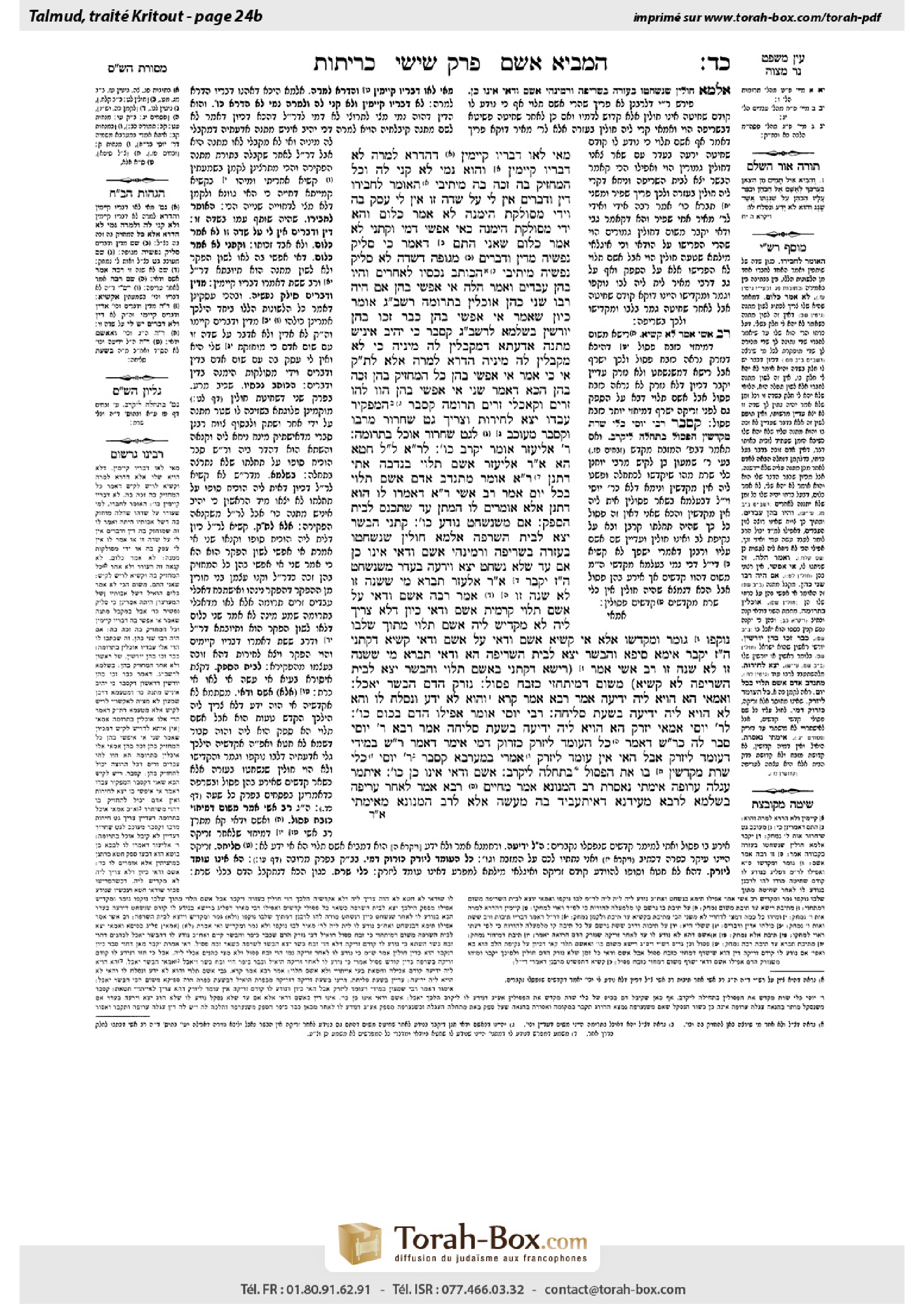
Keritot 24b: Talmud study for Daf Yomi
Daf Yomi is the daily study of one Talmud folio. Explore 37 tractates with scans, Hebrew text, Sefaria English and AI-generated French translations where annotated.
Passage selection and English or AI-generated French translation are available where the scan has annotations. Daf Study is independent of Torah-Box and Sefaria.
Browse Keritot · כריתות · All tractatesKeritot 24b text and translations
This page of Keritot includes the Aramaic text, an English translation and an AI-generated French translation, alongside the scan above.
כריתות כ״ד ב · Aramaic and Hebrew text
מַאי לָאו ״דְּבָרָיו קַיָּימִין״ – דְּהָדְרָא לְמָרַהּ? לָא, דְּבָרָיו קַיָּימִין – וְהוּא נָמֵי לָא קָנֵי לַהּ, וְכׇל הַמַּחֲזִיק בָּהּ זָכָה בָּהּ.
מֵיתִיבִי: הָאוֹמֵר לַחֲבֵירוֹ: ״דִּין וּדְבָרִים אֵין לִי עַל שָׂדֶה זוֹ״, ״אֵין לִי עֵסֶק בָּהּ״, וְ״יָדִי מְסוּלֶּקֶת הֵימֶנָּה״ – לֹא אָמַר כְּלוּם. וְהָא ״יָדִי מְסוּלֶּקֶת הֵימֶנָּה״ כְּאִי אֶפְשִׁי דָּמֵי, וְקָתָנֵי: לֹא אָמַר כְּלוּם!
שָׁאנֵי הָתָם, דְּאָמַר: כִּי סַלֵּיק נַפְשֵׁיהּ מִדִּין וּדְבָרִים, מִגּוּפַהּ דְּשָׂדֶה לָא סַלֵּיק נַפְשֵׁיהּ.
מֵיתִיבִי: הַכּוֹתֵב נְכָסָיו לַאֲחֵרִים וְהָיוּ בָּהֶן עֲבָדִים, וְאָמַר הַלָּה: ״אִי אֶפְשִׁי בָּהֶן״, אִם הָיָה רַבּוֹ שֵׁנִי כֹּהֵן – אוֹכְלִין בִּתְרוּמָה. רַבָּן שִׁמְעוֹן בֶּן גַּמְלִיאֵל אוֹמֵר: כֵּיוָן שֶׁאָמַר: ״אִי אֶפְשִׁי בָּהֶן״ – כְּבָר זָכוּ בָּהֶן יוֹרְשִׁין.
בִּשְׁלָמָא לְרַבָּן שִׁמְעוֹן בֶּן גַּמְלִיאֵל, קָסָבַר: כִּי יָהֵיב אִינִישׁ מַתָּנָה אַדַּעְתָּא דִּמְקַבְּלִין לַהּ מִינֵּיהּ, כִּי לָא מְקַבְּלִין לַהּ מִינֵּיהּ הָדְרָא לְמָרַהּ.
אֶלָּא לְתַנָּא קַמָּא, אִי כִּי אָמַר ״אִי אֶפְשִׁי בָּהֶן״ – כׇּל הַמַּחֲזִיק בָּהֶן זָכָה בָּהֶן, הָכָא, דְּאָמַר שֵׁנִי ״אִי אֶפְשִׁי בָּהֶן״ – הָווּ לְהוּ זָרִים, וְקָאָכְלִי זָרִים תְּרוּמָה! קָסָבַר: הַמַּפְקִיר עַבְדּוֹ – יָצָא לְחֵירוּת, וְצָרִיךְ גֵּט שִׁחְרוּר מֵרַבּוֹ, וְקָסָבַר: מְעוּכָּב לְגֵט שִׁחְרוּר – אוֹכֵל בִּתְרוּמָה.
רַבִּי אֱלִיעֶזֶר אוֹמֵר: יִקְרַב כּוּ׳. לְרַבִּי אֱלִיעֶזֶר, לְמָה לִי חֵטְא? הָא אָמַר רַבִּי אֱלִיעֶזֶר: אָשָׁם תָּלוּי בִּנְדָבָה אָתֵי, דִּתְנַן, רַבִּי אֱלִיעֶזֶר אוֹמֵר: מִתְנַדֵּב אָדָם אָשָׁם תָּלוּי בְּכׇל יוֹם!
אָמַר רַב אָשֵׁי: רַבִּי אֱלִיעֶזֶר דְּאָמְרוּ לוֹ הוּא, דִּתְנַן: אֶלָּא אוֹמְרִים לוֹ: הַמְתֵּן עַד שֶׁתִּכָּנֵס לְבֵית הַסָּפֵק.
אִם מִשֶּׁנִּשְׁחַט נוֹדַע כּוּ׳. קָתָנֵי: הַבָּשָׂר יֵצֵא לְבֵית הַשְּׂרֵפָה. אַלְמָא: חוּלִּין שֶׁנִּשְׁחֲטוּ בַּעֲזָרָה – בִּשְׂרֵיפָה.
וּרְמִינְהִי: אָשָׁם וַדַּאי אֵינוֹ כֵּן, אִם עַד שֶׁלֹּא נִשְׁחַט – יֵצֵא וְיִרְעֶה בָּעֵדֶר, מִשֶּׁנִּשְׁחַט – הֲרֵי זֶה יִקָּבֵר! אָמַר רַבִּי אֶלְעָזָר: תִּבְרַאּ, מִי שֶׁשָּׁנָה זוֹ לֹא שָׁנָה זוֹ.
אָמַר רַבָּה: אָשָׁם וַדַּאי עַל אָשָׁם תָּלוּי קָרָמֵית? אָשָׁם וַדַּאי, כֵּיוָן דְּלָא צְרִיךְ לֵיהּ – לָא מַקְדֵּישׁ לֵיהּ. אָשָׁם תָּלוּי, מִתּוֹךְ שֶׁלִּבּוֹ נוֹקְפוֹ – גּוֹמֵר וּמַקְדִּשׁוֹ.
אֶלָּא אִי קַשְׁיָא, אָשָׁם וַדַּאי עַל אָשָׁם וַדַּאי קַשְׁיָא, דְּקָתָנֵי: הֲרֵי זֶה יִקָּבֵר, אֵימָא סֵיפָא: וְהַבָּשָׂר יֵצֵא לְבֵית הַשְּׂרֵיפָה! הָא וַדַּאי תִּבְרַאּ, מִי שֶׁשָּׁנָה זוֹ לֹא שָׁנָה זוֹ.
רַב אָשֵׁי אָמַר: רֵישָׁא דְּקָתָנֵי בְּאָשָׁם תָּלוּי: ״וְהַבָּשָׂר יֵצֵא לְבֵית הַשְּׂרֵיפָה״ – לָא קַשְׁיָא, מִשּׁוּם דְּמִיתְחֲזֵי כְּזֶבַח פָּסוּל.
נִזְרַק הַדָּם – הַבָּשָׂר יֵאָכֵל. וְאַמַּאי? הָא הַוְיָא לֵיהּ יְדִיעָה! אָמַר רָבָא, אֲמַר קְרָא: ״וְהוּא לֹא יָדַע וְנִסְלַח לוֹ״, וְהָא לָא הָוְיָא לֵיהּ יְדִיעָה בִּשְׁעַת סְלִיחָה.
רַבִּי יוֹסֵי אוֹמֵר: אֲפִילּוּ הַדָּם בַּכּוֹס כּוּ׳. לְרַבִּי יוֹסֵי, אַמַּאי יִזָּרֵק? הָא הָוְיָא לֵיהּ יְדִיעָה בִּשְׁעַת סְלִיחָה! אָמַר רָבָא: רַבִּי יוֹסֵי סָבַר לַהּ כְּרַבִּי שִׁמְעוֹן, דְּאָמַר: כׇּל הָעוֹמֵד לִיזָּרֵק – כְּזָרוּק דָּמֵי.
אֵימַר דְּאָמַר רַבִּי שִׁמְעוֹן, בְּמִידֵּי דְּעוֹמֵד לִיזָּרֵק, אֲבָל הַאי, אֵין עוֹמֵד לִיזָּרֵק! אָמְרִי בְּמַעְרְבָא, קָסָבַר רַבִּי יוֹסֵי: כְּלֵי שָׁרֵת מְקַדְּשִׁין בּוֹ אֶת הַפָּסוּל בַּתְּחִלָּה לִיקְרַב.
אָשָׁם וַדַּאי אֵינוֹ כֵּן כּוּ׳. אִיתְּמַר: עֶגְלָה עֲרוּפָה אֵימָתַי נֶאֱסֶרֶת? רַב הַמְנוּנָא אָמַר: מֵחַיִּים, רָבָא אָמַר: לְאַחַר עֲרִיפָה.
בִּשְׁלָמָא לְרָבָא – מֵעִידָּנָא דְּאִיתְעֲבִיד בַּהּ מַעֲשֶׂה, אֶלָּא לְרַב הַמְנוּנָא, מֵאֵימָתַי?
Keritot 24b · English translation
What, is it not that when the baraita states: His statement is effective, this means that the gift returns to its previous owner? This ruling contradicts the opinion of Reish Lakish, who holds that in such a case anyone who takes possession of the item acquires it. The Gemara answers: No, the phrase: His statement is effective, means that the previous owner also does not acquire the item; and as the item is not in the possession of either the giver or receiver of the gift, anyone who takes possession of it acquires it.
The Gemara raises an objection to the statement of Reish Lakish from a baraita: With regard to one who says to another person with whom he shares property: I have no legal dealings or involvement with this field, or: I have no business with it, or: My hand is removed from it, he has not said anything of consequence, i.e., he does not relinquish his ownership of the property. But the phrase: My hand is removed from it, is like the phrase: I do not want it, and yet it is taught in the baraita that he has not said anything. This ruling apparently contradicts the opinion of Reish Lakish, who holds that in such a case anyone who takes possession of the item acquires it.
The Gemara responds: That case in the baraita there is different, as when he says that he is removing himself, he is referring to removal from legal dealings or involvement. He is not removing himself from the field itself.
The Gemara raises another objection to the opinion of Reish Lakish from a baraita: In the case of a person on his deathbed who wrote a document granting his property as a gift to another, and there were slaves among his property, and the other person said: I do not want them, his objection is disregarded. Consequently, if their second master, the recipient, was a priest, his slaves may partake of teruma, as they are now slaves of a priest. Rabban Shimon ben Gamliel says: Once the other person said: I do not want them, the previous owner’s heirs have already acquired them.
Granted there is no difficulty according to Rabban Shimon ben Gamliel, as he holds that when a person gives a gift, it is with the intention that the other person will accept the gift from him. Therefore, when the other individual does not accept it from him, the gift returns to its previous owner.
But according to the opinion of the first tanna, if Reish Lakish is correct that when one says: I do not want it, anyone who takes possession of the item acquires it, as the item becomes ownerless, then here, where the second master said: I do not want them, the slaves are non-priests, and this would mean that non-priests are partaking of teruma. The Gemara answers: The first tanna holds that with regard to one who renounces ownership of his slave, the slave is emancipated but nevertheless requires a bill of manumission from his master. And he further holds that a slave detained in his master’s possession only due to not having received a bill of manumission may partake of teruma if he is the slave of a priest.
§ The mishna teaches: In the case of one who brings a provisional guilt offering and it became known to him that he did not sin, if he made that discovery before the ram was slaughtered, Rabbi Eliezer says: It shall be sacrificed as a provisional guilt offering, as if it does not come to atone for that sin that he thought, it comes to atone for another sin. The Gemara asks: According to the opinion of Rabbi Eliezer, why do I need another sin? Doesn’t Rabbi Eliezer say that a provisional guilt offering may come as a gift offering? As we learned in a mishna (25a) that Rabbi Eliezer says: A person may volunteer to bring a provisional guilt offering every day.
Rav Ashi said: The opinion of Rabbi Eliezer that is taught in the mishna here is in accordance with the opinion of those who spoke to Bava ben Buta in the mishna below, as we learned in the continuation of that mishna (25a): Rabbi Eliezer said that Bava ben Buta would bring a provisional guilt offering every day, and he wanted to bring one even immediately after Yom Kippur. But they said to him: Wait until you enter into a situation of potential uncertainty, so that the provisional guilt offering is brought for some sort of uncertain sin, and do not sacrifice it purely as a gift offering.
§ With regard to one who brought a provisional guilt offering and after the ram was slaughtered it became known to him that he did not sin, the mishna teaches: The flesh shall go out to the place of burning. Evidently, according to the opinion of the tanna of the mishna, non-sacred animals that were slaughtered in the Temple courtyard, such as this provisional guilt offering that was mistakenly consecrated, are to be burned.
But one may raise a contradiction from a ruling later in the mishna: In the case of a definite guilt offering, that is not so; if he made that discovery before the ram was slaughtered, it shall go out and graze among the flock. If it became known to him after the ram was slaughtered that he did not sin, it shall be buried. This indicates that non-sacred animals slaughtered in the Temple courtyard are buried. Rabbi Elazar said: This mishna is disjointed, i.e., it cites the opinions of two different Sages. He who taught this halakha did not teach that halakha.
Rabba said: Are you raising a contradiction from the halakha of a definite guilt offering with regard to the halakha of a provisional guilt offering? In the case of a definite guilt offering, he consecrated it under the assumption that he was obligated to sacrifice it. Since it later became clear to him that he does not need to sacrifice the animal, it is considered as though he did not consecrate it, and the animal is non-sacred. But with regard to a provisional guilt offering, since initially his heart struck him with pangs of conscience over a sin that he might have committed, he wholeheartedly resolves to consecrate the animal. Therefore, the animal remains consecrated, and its status is that of a guilt offering disqualified for sacrifice.
Rather, if the mishna poses a difficulty, then the apparent contradiction between this halakha of a definite guilt offering and another halakha of a definite guilt offering is difficult. As it is taught in the mishna: If after the ram was slaughtered it became known to him that he did not sin, it shall be buried. Now say the latter clause of that section of the mishna: If after the blood was sprinkled he discovered that he did not sin, the flesh shall go out to the place of burning. Accordingly, this mishna is certainly disjointed, and he who taught this halakha did not teach that halakha.
Rav Ashi said: The first clause, which teaches with regard to a provisional guilt offering: The flesh shall go out to the place of burning, is not difficult. Its flesh is not treated like that of a non-sacred animal that was slaughtered in the courtyard, which must be buried. It is burned because it has the appearance of a disqualified offering, which must be burned. This reason applies equally in the case of a definite guilt offering where it became known to him that he did not sin only after the blood was sprinkled, which is why it too must be burned. But if he discovered that he was not obligated to bring the definite guilt offering after the ram was slaughtered but before its blood was sprinkled, it shall be buried, as this does not appear like a disqualified offering, since it is no longer a definite guilt offering and its blood was not sprinkled.
The mishna teaches: With regard to one who brought a provisional guilt offering, if the blood was sprinkled and then he discovered that he did not sin and the meat is intact, the meat may be eaten by the priests. The Gemara asks: But why is the meat eaten? After all, he now has certain knowledge of his sin, and a provisional guilt offering is brought only by one who is uncertain about his sin. Rava said that the verse states: “And he knew it not, and he shall be forgiven” (Leviticus 5:18), and this person did not have knowledge of his sin at the time of forgiveness, i.e., when he achieved atonement, which is the moment of the sprinkling of the blood.
§ The mishna further teaches that Rabbi Yosei says: Even if the blood of the provisional guilt offering was still in the cup but had not yet been sprinkled when he discovered that he did not sin, the blood shall be sprinkled and the meat may be eaten. The Gemara asks: According to Rabbi Yosei, why is the blood sprinkled? This person had knowledge of his sin at the moment of forgiveness. Rava said that Rabbi Yosei holds in accordance with the opinion of Rabbi Shimon, who says: The halakhic status of any blood that is received in a vessel and is ready to be sprinkled is like that of blood that has already been sprinkled.
The Gemara raises a difficulty: Say that Rabbi Shimon said this principle only with regard to an item that is ready to be sprinkled with certainty, but not with regard to the blood of this provisional guilt offering, with regard to which it will be discovered before the sprinkling that he did not sin. In this case, from the outset it was not ready to be sprinkled. They say in the West, Eretz Yisrael, that Rabbi Yosei holds: The service vessel consecrates disqualified offerings to be sacrificed on the altar ab initio.
§ The mishna teaches: In the case of a definite guilt offering, that is not so, and likewise in the case of a heifer whose neck is broken that is not so. If the identity of the murderer is discovered before the heifer’s neck was broken, it shall go out and graze among the flock as a non-sacred animal. But if the identity of the murderer was discovered after the heifer’s neck was broken, it shall be buried in its place. It was stated that there is a related dispute between amora’im: From when is it prohibited to derive benefit from a heifer whose neck is broken? Rav Hamnuna says: The prohibition takes effect from when the animal is still alive. Rava says: The prohibition goes into effect after the breaking of the neck of the animal.
The Gemara raises a difficulty: Granted, according to Rava the prohibition takes effect from the moment that an action, i.e., breaking of the neck, was performed on the heifer. But according to Rav Hamnuna, from when exactly does the prohibition take effect?
Keritot 24b · Traduction française (IA)
N’est-ce pas que, lorsque la baraïta dit : « Sa déclaration est effective », cela signifie que le don revient à son ancien propriétaire ? Cette décision contredit l’opinion de Reish Lakish, selon laquelle, dans un tel cas, quiconque prend possession de l’objet l’acquiert. La Guemara répond : Non, l’expression « Sa déclaration est effective » signifie que l’ancien propriétaire ne l’acquiert pas non plus ; puisque l’objet n’est en possession ni du donateur ni du bénéficiaire, quiconque en prend possession l’acquiert.
La Guemara soulève une objection à l’affirmation de Reish Lakish à partir d’une baraïta : Celui qui dit à une autre personne avec laquelle il possède un bien en commun : « Je n’ai aucun lien juridique avec ce champ », ou : « Je n’ai aucune affaire avec ce champ », ou : « Je m’en retire », n’a rien dit de conséquent, c’est-à-dire qu’il ne renonce pas à sa propriété du bien. Or, l’expression « Je m’en retire » équivaut à « Je n’en veux pas », et pourtant la baraïta enseigne qu’il n’a rien dit. Cette décision semble contredire l’opinion de Reish Lakish, selon laquelle, dans un tel cas, quiconque prend possession de l’objet l’acquiert.
La Guemara répond : Le cas de cette baraïta est différent, car, lorsqu’il dit qu’il se retire, il veut dire qu’il se retire de tout lien ou de toute implication juridique. Il ne se retire pas du champ lui-même.
La Guemara soulève une autre objection à l’opinion de Reish Lakish à partir d’une baraïta : Dans le cas d’un homme à l’agonie qui a rédigé un acte faisant don de ses biens à une autre personne, parmi lesquels se trouvaient des esclaves, si cette personne dit : « Je n’en veux pas », son refus est ignoré. Par conséquent, si le second maître des esclaves, c’est-à-dire le bénéficiaire, est un prêtre, ceux-ci peuvent consommer de la terouma, puisqu’ils sont désormais les esclaves d’un prêtre. Rabban Shimon ben Gamliel dit : Dès que l’autre personne a dit : « Je n’en veux pas », les héritiers de l’ancien propriétaire les ont déjà acquis.
Certes, il n’y a pas de difficulté selon Rabban Shimon ben Gamliel, car il estime que lorsqu’une personne fait un don, elle entend que l’autre personne l’accepte d’elle. Par conséquent, si l’autre personne ne l’accepte pas, le don revient à son ancien propriétaire.
Mais selon l’opinion du premier tanna, si Reish Lakish a raison de dire que, lorsqu’on dit : « Je n’en veux pas », quiconque prend possession de l’objet l’acquiert, puisque celui-ci devient sans maître, alors, ici, lorsque le second maître a dit : « Je n’en veux pas », les esclaves ne sont pas des esclaves d’un prêtre, ce qui signifierait que des non-prêtres consomment de la terouma. La Guemara répond : Le premier tanna estime que celui qui renonce à la propriété de son esclave l’affranchit, mais que l’esclave a néanmoins besoin d’un acte d’affranchissement de son maître. Il estime en outre qu’un esclave qui reste sous l’autorité de son maître uniquement parce qu’il n’a pas reçu d’acte d’affranchissement peut consommer de la terouma s’il est l’esclave d’un prêtre.
§ La Michna enseigne : Dans le cas de celui qui apporte un sacrifice de culpabilité provisoire et apprend qu’il n’a pas péché, s’il le découvre avant l’égorgement du bélier, Rabbi Eliezer dit : Il sera offert comme sacrifice de culpabilité provisoire ; même s’il ne vient pas expier le péché qu’il pensait avoir commis, il vient expier un autre péché. La Guemara demande : Selon l’opinion de Rabbi Eliezer, pourquoi faut-il qu’il y ait un autre péché ? Rabbi Eliezer ne dit-il pas qu’un sacrifice de culpabilité provisoire peut être offert comme don ? En effet, nous avons appris dans une Michna (25a) que Rabbi Eliezer dit : Une personne peut volontairement apporter un sacrifice de culpabilité provisoire chaque jour.
Rav Ashi dit : L’opinion de Rabbi Eliezer enseignée ici dans la Michna correspond à celle de ceux qui ont parlé à Bava ben Buta dans la Michna suivante, car nous avons appris dans la suite de cette Michna (25a) que Rabbi Eliezer disait que Bava ben Buta apportait un sacrifice de culpabilité provisoire chaque jour et voulait même en apporter un immédiatement après Yom Kippour. Mais ils lui dirent : « Attends de te trouver dans une situation d’incertitude, afin que le sacrifice de culpabilité provisoire soit apporté pour une sorte de péché incertain ; ne l’offre pas uniquement comme un don. »
§ À propos de celui qui a apporté un sacrifice de culpabilité provisoire et qui, après l’égorgement du bélier, apprend qu’il n’a pas péché, la Michna enseigne : « La chair sera portée au lieu de l’incinération. » Il ressort donc que, selon le tanna de la Michna, les animaux non consacrés égorgés dans la cour du Temple, comme ce sacrifice de culpabilité provisoire consacré par erreur, doivent être incinérés.
Mais on peut opposer à cela une décision énoncée plus loin dans la Michna : Dans le cas d’un sacrifice de culpabilité certain, il n’en va pas ainsi ; s’il découvre qu’il n’a pas péché avant l’égorgement du bélier, celui-ci sera relâché et ira paître parmi le troupeau. S’il apprend après l’égorgement du bélier qu’il n’a pas péché, il sera enterré. Cela indique que les animaux non consacrés égorgés dans la cour du Temple sont enterrés. Rabbi Elazar dit : Cette Michna est décousue, c’est-à-dire qu’elle rapporte les opinions de deux Sages différents. Celui qui a enseigné cette halakha n’a pas enseigné l’autre.
Rabba dit : Opposez-vous la halakha concernant un sacrifice de culpabilité certain à celle concernant un sacrifice de culpabilité provisoire ? Dans le cas d’un sacrifice de culpabilité certain, il l’a consacré en supposant qu’il était tenu de l’offrir. Puisqu’il apprend ensuite qu’il n’a pas besoin d’offrir l’animal, c’est comme s’il ne l’avait pas consacré, et l’animal n’est pas consacré. Mais, dans le cas d’un sacrifice de culpabilité provisoire, puisque, dès le départ, son cœur l’a tourmenté de remords au sujet d’un péché qu’il a peut-être commis, il se résout de tout cœur à consacrer l’animal. Celui-ci demeure donc consacré et a le statut d’un sacrifice de culpabilité impropre à être offert.
En revanche, si la Michna pose une difficulté, c’est la contradiction apparente entre cette halakha concernant un sacrifice de culpabilité certain et une autre halakha concernant un sacrifice de culpabilité certain qui est problématique. La Michna enseigne en effet : « Si, après l’égorgement du bélier, il apprend qu’il n’a pas péché, celui-ci sera enterré. » Or, examinons la clause suivante de cette section de la Michna : « S’il découvre après l’aspersion du sang qu’il n’a pas péché, la chair sera portée au lieu de l’incinération. » Cette Michna est donc certainement décousue, et celui qui a enseigné cette halakha n’a pas enseigné l’autre.
Rav Ashi dit : La première clause, qui enseigne au sujet d’un sacrifice de culpabilité provisoire : « La chair sera portée au lieu de l’incinération », ne pose pas de difficulté. Sa chair n’est pas traitée comme celle d’un animal non consacré égorgé dans la cour, qui doit être enterré. Elle est incinérée parce qu’elle a l’apparence d’un sacrifice impropre, qui doit être incinéré. La même raison s’applique au cas d’un sacrifice de culpabilité certain lorsque l’intéressé apprend qu’il n’a pas péché seulement après l’aspersion du sang ; c’est pourquoi celui-ci aussi doit être incinéré. Mais s’il découvre, après l’égorgement du bélier et avant l’aspersion de son sang, qu’il n’était pas tenu d’apporter le sacrifice de culpabilité certain, celui-ci sera enterré, car il n’a pas l’apparence d’un sacrifice impropre : ce n’est plus un sacrifice de culpabilité certain et son sang n’a pas été aspergé.
La Michna enseigne : Celui qui a apporté un sacrifice de culpabilité provisoire, si le sang a été aspergé puis qu’il découvre qu’il n’a pas péché et que la viande est intacte, les prêtres peuvent la consommer. La Guemara demande : Mais pourquoi la viande est-elle consommée ? Après tout, il sait désormais avec certitude qu’il n’a pas péché, et un sacrifice de culpabilité provisoire n’est apporté que par celui qui doute d’avoir péché. Rava dit que le verset énonce : « Il ne le savait pas, et il lui sera pardonné » (Lévitique 5:18). Or, cet homme ne savait pas s’il avait péché au moment où il a reçu le pardon, c’est-à-dire lorsqu’il a obtenu l’expiation, au moment même de l’aspersion du sang.
§ La Michna enseigne en outre que Rabbi Yosei dit : Même si le sang du sacrifice de culpabilité provisoire se trouvait encore dans le récipient et n’avait pas encore été aspergé lorsqu’il a découvert qu’il n’avait pas péché, le sang sera aspergé et la viande pourra être consommée. La Guemara demande : Selon Rabbi Yosei, pourquoi le sang est-il aspergé ? Cet homme savait qu’il n’avait pas péché au moment du pardon. Rava dit que Rabbi Yosei suit l’opinion de Rabbi Shimon, qui dit : Le statut halakhique de tout sang recueilli dans un récipient et prêt à être aspergé est celui d’un sang qui a déjà été aspergé.
La Guemara soulève une difficulté : Admettons que Rabbi Shimon n’ait énoncé ce principe que pour un élément certainement prêt à être aspergé, mais pas pour le sang de ce sacrifice de culpabilité provisoire, puisqu’il sera découvert avant l’aspersion que l’homme n’a pas péché. Dans ce cas, dès le départ, le sang n’était pas prêt à être aspergé. En Occident, c’est-à-dire en Eretz Israël, on dit que Rabbi Yosei estime que le récipient de service consacre d’emblée les sacrifices impropres en vue de leur offrande sur l’autel.
§ La Michna enseigne : Dans le cas d’un sacrifice de culpabilité certain, il n’en va pas ainsi ; il en va de même dans le cas d’une génisse dont la nuque doit être brisée. Si l’identité du meurtrier est découverte avant que la nuque de la génisse soit brisée, celle-ci sera relâchée et ira paître parmi le troupeau comme un animal non consacré. Mais si l’identité du meurtrier est découverte après que la nuque de la génisse a été brisée, elle sera enterrée à cet endroit. Une controverse connexe entre amoraïm a été rapportée : À partir de quand est-il interdit de tirer profit d’une génisse dont la nuque doit être brisée ? Rav Hamnuna dit : L’interdiction prend effet alors que l’animal est encore vivant. Rava dit : L’interdiction entre en vigueur après que la nuque de l’animal a été brisée.
La Guemara soulève une difficulté : Il est compréhensible que, selon Rava, l’interdiction prenne effet au moment où une action, à savoir la fracture de la nuque, est accomplie sur la génisse. Mais, selon Rav Hamnuna, à quel moment précis l’interdiction prend-elle effet ?
Traduction française générée par IA à partir de l’édition anglaise de Sefaria. Vérifie toujours un passage avec le texte source.
Text from Sefaria: William Davidson Edition - Vocalized Aramaic (CC BY NC); William Davidson Edition - English (CC BY NC).