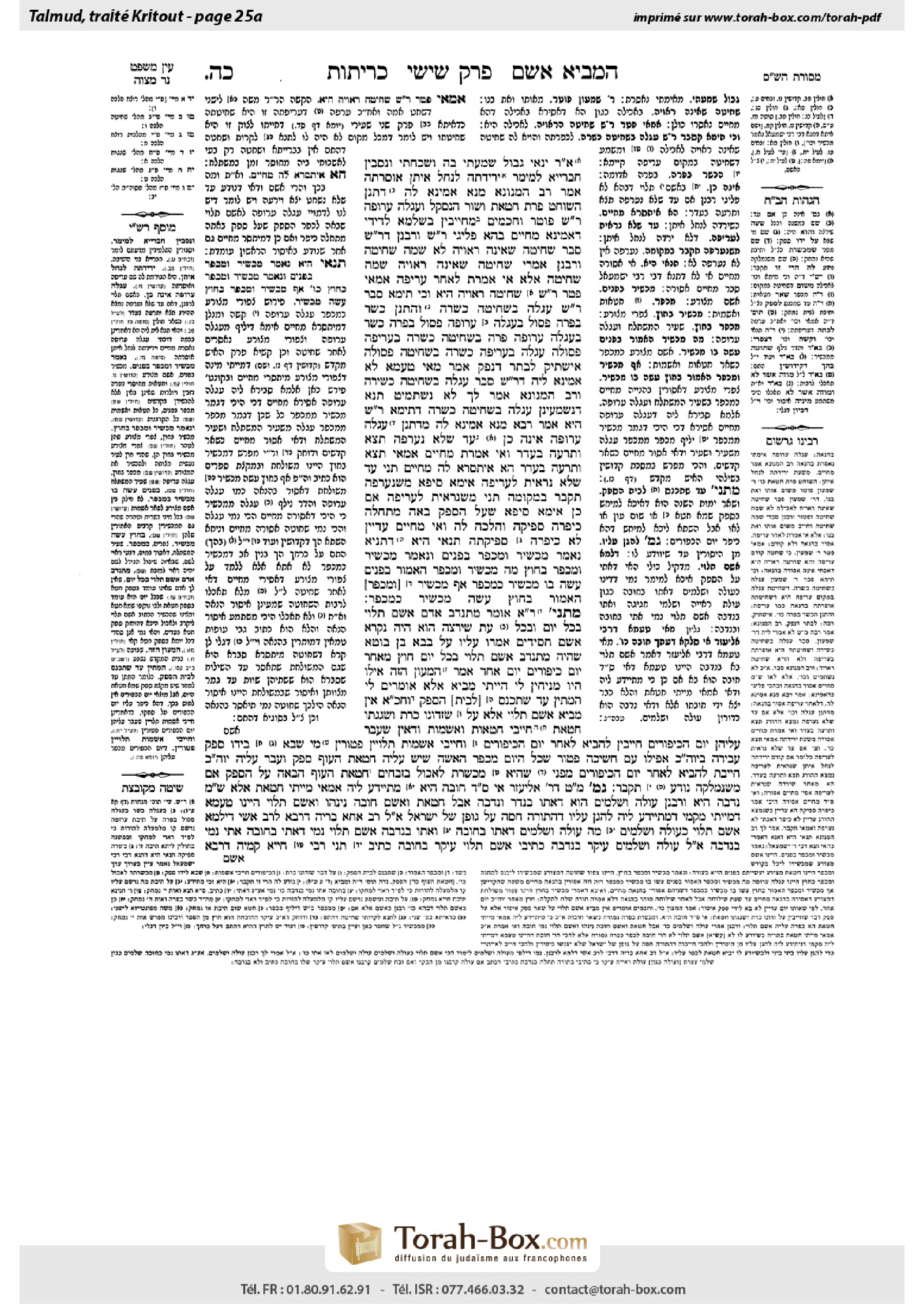
Keritot 25a: Talmud study for Daf Yomi
Daf Yomi is the daily study of one Talmud folio. Explore 37 tractates with scans, Hebrew text, Sefaria English and AI-generated French translations where annotated.
Passage selection and English or AI-generated French translation are available where the scan has annotations. Daf Study is independent of Torah-Box and Sefaria.
Browse Keritot · כריתות · All tractatesKeritot 25a text and translations
This page of Keritot includes the Aramaic text, an English translation and an AI-generated French translation, alongside the scan above.
כריתות כ״ה א · Aramaic and Hebrew text
אָמַר רַבִּי יַנַּאי: גְּבוּל שָׁמַעְתִּי בָּהּ וְשָׁכַחְתִּי, וְנָסְבִין חַבְרַיָּיא לְמֵימַר: יְרִידָתָהּ לְנַחַל אֵיתָן אוֹסַרְתָּהּ.
אָמַר רַב הַמְנוּנָא: מְנָא אָמֵינָא לַהּ? דִּתְנַן: הַשּׁוֹחֵט פָּרַת חַטָּאת, וְשׁוֹר הַנִּסְקָל, וְעֶגְלָה עֲרוּפָה – רַבִּי שִׁמְעוֹן פּוֹטֵר, וַחֲכָמִים מְחַיְּיבִין.
בִּשְׁלָמָא לְדִידִי, דְּאָמֵינָא מֵחַיִּים, בְּהָא פְּלִיגִי רַבִּי שִׁמְעוֹן וְרַבָּנַן, דְּרַבִּי שִׁמְעוֹן סָבַר: שְׁחִיטָה שֶׁאֵינָהּ רְאוּיָה – לֹא שְׁמָהּ שְׁחִיטָה.
וְרַבָּנַן אָמְרִי: שְׁחִיטָה שֶׁאֵינָהּ רְאוּיָה – שְׁמָהּ שְׁחִיטָה. אֶלָּא אִי אָמְרַתְּ לְאַחַר עֲרִיפָה, אַמַּאי פָּטַר רַבִּי שִׁמְעוֹן? שְׁחִיטָה רְאוּיָה הִיא!
וְכִי תֵּימָא: סָבַר רַבִּי שִׁמְעוֹן עֶגְלָה בִּשְׁחִיטָה כְּשֵׁרָה, וְהָתְנַן: כָּשֵׁר בַּפָּרָה פָּסוּל – בְּעֶגְלָה עֲרוּפָה, פָּסוּל בַּפָּרָה – כָּשֵׁר בְּעֶגְלָה עֲרוּפָה. פָּרָה, בִּשְׁחִיטָה – כְּשֵׁרָה, בַּעֲרִיפָה – פְּסוּלָה, עֶגְלָה, בַּעֲרִיפָה – כְּשֵׁרָה, בִּשְׁחִיטָה – פְּסוּלָה!
אִישְׁתִּיק. לְבָתַר דִּנְפַק, אֲמַר: מַאי טַעְמָא לָא אָמֵינָא לֵיהּ דְּרַבִּי שִׁמְעוֹן סָבַר: עֶגְלָה בִּשְׁחִיטָה כְּשֵׁירָה!
וְרַב הַמְנוּנָא אָמַר לָךְ: לָא נִשְׁתְּמִיט תַּנָּא דְּנַשְׁמְעִינַן עֶגְלָה בִּשְׁחִיטָה כְּשֵׁרָה, דְּתֵימָא רַבִּי שִׁמְעוֹן הִיא.
אָמַר רָבָא: מְנָא אָמֵינָא לַהּ? מִדִּתְנַן: עֶגְלָה עֲרוּפָה אֵינָהּ כֵּן, עַד שֶׁלֹּא נֶעֶרְפָה – תֵּצֵא וְתִרְעֶה בָּעֵדֶר. וְאִי אָמְרַתְּ מֵחַיִּים, אַמַּאי תֵּצֵא וְתִרְעֶה בָּעֵדֶר? הָא אִיתַּסְרָא לַהּ מֵחַיִּים!
תְּנִי: עַד שֶׁלֹּא נִרְאֵית לַעֲרִיפָה. אֵימָא סֵיפָא: מִשֶּׁנֶּעֶרְפָה – תִּקָּבֵר בִּמְקוֹמָהּ! תְּנִי: מִשֶּׁנִּרְאֵית לַעֲרִיפָה.
אִם כֵּן, אֵימָא סֵיפָא: שֶׁעַל הַסָּפֵק בָּאָה מִתְּחִלָּה, כִּיפְּרָה סְפֵיקָהּ וְהָלְכָה לָהּ. וְאִי מֵחַיִּים, עֲדַיִין לֹא כִּיפְּרָה סְפֵיקָהּ!
תַּנָּאֵי הִיא, דְּתַנְיָא: נֶאֱמַר מַכְשִׁיר וּמְכַפֵּר בִּפְנִים, וְנֶאֱמַר מַכְשִׁיר וּמְכַפֵּר בַּחוּץ.
מָה מַכְשִׁיר וּמְכַפֵּר הָאָמוּר בִּפְנִים, עָשָׂה בּוֹ מַכְשִׁיר כִּמְכַפֵּר – אַף מַכְשִׁיר [וּמְכַפֵּר] הָאָמוּר בַּחוּץ, עָשָׂה מַכְשִׁיר כִּמְכַפֵּר.
מַתְנִי׳ רַבִּי אֱלִיעֶזֶר אוֹמֵר: מִתְנַדֵּב אָדָם אָשָׁם תָּלוּי בְּכׇל יוֹם וּבְכׇל עֵת שֶׁיִּרְצֶה. הוּא הָיָה נִקְרָא אֲשַׁם חֲסִידִים. אָמְרוּ עָלָיו עַל בָּבָא בֶּן בּוּטָא שֶׁהָיָה מִתְנַדֵּב אָשָׁם תָּלוּי בְּכׇל יוֹם, חוּץ מֵאַחַר יוֹם כִּיפּוּרִים יוֹם אֶחָד.
אָמַר: הַמָּעוֹן הַזֶּה! אִילּוּ הָיוּ מַנִּיחִין לִי הָיִיתִי מֵבִיא, אֶלָּא אוֹמְרִים לִי: הַמְתֵּין עַד שֶׁתִּכָּנֵס לְסָפֵק. וַחֲכָמִים אוֹמְרִים: אֵין מֵבִיא אָשָׁם תָּלוּי אֶלָּא עַל שֶׁזְּדוֹנוֹ כָּרֵת וְשִׁגְגָתוֹ חַטָּאת.
חַיָּיבֵי חַטָּאוֹת וַאֲשָׁמוֹת וַדָּאִין שֶׁעָבַר עֲלֵיהֶן יוֹם הַכִּיפּוּרִים – חַיָּיבִין לְהָבִיא לְאַחַר יוֹם הַכִּיפּוּרִים, וְחַיָּיבֵי אֲשָׁמוֹת תְּלוּיִין – פְּטוּרִין. מִי שֶׁבָּא בְּיָדוֹ סְפֵק עֲבֵירָה בְּיוֹם הַכִּפּוּרִים, אֲפִילּוּ עִם חֲשֵׁיכָה – פָּטוּר, שֶׁכׇּל הַיּוֹם מְכַפֵּר.
הָאִשָּׁה שֶׁיֵּשׁ עָלֶיהָ חַטַּאת הָעוֹף סָפֵק, וְעָבַר עָלֶיהָ יוֹם הַכִּפּוּרִים – חַיֶּיבֶת לְהָבִיא לְאַחַר יוֹם הַכִּיפּוּרִים, מִפְּנֵי שֶׁהִיא מַכְשֶׁרֶת לֶאֱכוֹל בִּזְבָחִים. חַטַּאת הָעוֹף הַבָּאָה עַל הַסָּפֵק, אִם מִשֶּׁנִּמְלְקָה נוֹדַע – תִּקָּבֵר.
גְּמָ׳ מַאי טַעְמָא דְּרַבִּי אֱלִיעֶזֶר? אִי סָלְקָא דַעְתָּךְ חוֹבָה הִיא, [כִּי] מִתְיְידַע לֵיהּ, אַמַּאי מַיְיתֵי חַטָּאת? אֶלָּא שְׁמַע מִינָּה: נְדָבָה הִיא.
וְרַבָּנַן: עוֹלָה וּשְׁלָמִים הוּא דְּאָתוּ בְּנֶדֶר וּנְדָבָה, אֲבָל חַטָּאת וְאָשָׁם – חוֹבָה נִינְהוּ. וְאָשָׁם תָּלוּי, הַיְינוּ טַעְמָא דְּמַיְיתֵי מִקַּמֵּי דְּמִתְיְידַע לֵיהּ – לְהָגֵן עָלָיו, דְּהַתּוֹרָה חָסָה עַל גּוּפָן שֶׁל יִשְׂרָאֵל.
אֲמַר לֵיהּ רַב אַחָא בְּרֵיהּ דְּרָבָא לְרַב אָשֵׁי: דִּילְמָא אָשָׁם תָּלוּי כְּעוֹלָה וּשְׁלָמִים, מָה עוֹלָה וּשְׁלָמִים דְּאָתוּ בְּחוֹבָה וְאָתוּ בִּנְדָבָה, אָשָׁם תָּלוּי נָמֵי, דְּאָתֵי בְּחוֹבָה, אָתֵי נָמֵי בִּנְדָבָה!
אֲמַר לֵיהּ: עוֹלָה וּשְׁלָמִים עִיקָּר בִּנְדָבָה כְּתִיבִי, אָשָׁם תָּלוּי עִיקָּר בְּחוֹבָה כְּתִיב.
תָּנֵי רַבִּי חִיָּיא קַמֵּיהּ דְּרָבָא:
Keritot 25a · English translation
Rabbi Yannai says: I heard an answer with regard to the boundary, i.e., the stage, beyond which it is prohibited, but I have forgotten what it is; and the members of the group of Sages were inclined to say that its descent to the rough, dried-up stream, where its neck is broken, is the action that renders it prohibited.
Rav Hamnuna said: From where do I say that the prohibition takes effect when the animal is alive? I say it from that which we learned in a mishna (Ḥullin 81b): With regard to one who slaughters the red heifer of purification, or an ox that was sentenced to be stoned, or a heifer whose neck is broken, all of which are animals from which deriving benefit is prohibited, Rabbi Shimon exempts one who slaughters them from receiving lashes for violating the prohibition of the slaughter of a mother and its offspring, if the mother was slaughtered on that same day; and the Rabbis deem him liable.
Rav Hamnuna explains his proof: Granted, according to my opinion, that I say the prohibition takes effect from the time when the animal is alive, Rabbi Shimon and the Rabbis disagree with regard to this matter, as Rabbi Shimon holds: Slaughter that does not render the animal fit for consumption is not considered slaughter. The slaughter of the heifer does not render it fit for consumption, as it was already prohibited to derive benefit from the animal while it is alive. Therefore, he does not violate the prohibition against slaughtering a mother and its offspring.
Rav Hamnuna continues: And the Rabbis say: Slaughter that does not render the animal fit for consumption is considered slaughter, and therefore he is liable for the slaughter of a mother and its offspring. But if you say that the prohibition does not take effect until after the breaking of the neck of the heifer, why does Rabbi Shimon exempt him; it is a slaughter that renders the animal fit for consumption?
And if you would say the reason is that Rabbi Shimon holds that one who performs the breaking of the neck of the heifer by slaughter has performed the mitzva in a fit manner, and consequently that slaughter rendered the heifer prohibited with regard to deriving benefit from it and it is therefore unfit for consumption, that suggestion cannot be correct. Didn’t we learn in a mishna (Ḥullin 23b): That which is fit in a red heifer is unfit in a heifer whose neck is broken; that which is fit in a heifer whose neck is broken is unfit in a red heifer. How so? With regard to the red heifer, it is fit with slaughter; it is unfit with breaking the neck. With regard to the heifer whose neck is to be broken, it is fit with breaking the neck; it is unfit with slaughter.
Rava, who holds that the prohibition takes effect only from when the heifer’s neck is broken, was silent, as he had no immediate answer. After Rav Hamnuna left the study hall, Rava said: What is the reason I did not say to him that Rabbi Shimon disagrees with the ruling of that mishna and holds that a heifer whose neck is to be broken is fit even if it is killed by slaughtering?
The Gemara notes: But if Rava had given that answer, Rav Hamnuna could have said to you in response to that claim: The mishna would not have left out the opinion of the tanna who teaches us that a heifer whose neck is to be broken is fit if it is killed by slaughtering. In other words, there should be some source for this opinion, and in the absence of a source, there is no basis for saying that this is the opinion of Rabbi Shimon.
Rava said: From where do I say that the prohibition takes effect when the animal’s neck is broken? I say it from that which we learned in the mishna: In the case of a heifer whose neck is broken, that is not so; if the identity of the murderer is discovered before the heifer’s neck was broken, it shall go out and graze among the flock, as it is not consecrated, like all other animals. And if you say that the prohibition takes effect from the time when the animal is alive, why does it go out and graze among the flock? Wasn’t the animal prohibited already from when it was alive?
The Gemara rejects this proof: One should teach the mishna as follows: If the identity of the murderer is discovered before the heifer was fit for having its neck broken, i.e., before it descended to a rough, dried-up stream, it shall go out and graze among the flock, but after that time it is prohibited to derive benefit from the animal. Rava raises a further difficulty: Say the latter clause of the mishna: But if the identity of the murderer was discovered after the heifer’s neck was broken, it shall be buried in its place. This indicates that the prohibition takes effect only after the heifer’s neck is broken. The Gemara rejects this proof in a similar manner: Teach that the mishna says: If the identity of the murderer was discovered after the heifer was fit for having its neck broken it shall be buried.
Rava continues to ask: If so, say the latter clause of the mishna: The reason for this halakha is that from the outset, the heifer whose neck is broken comes to atone for a situation of uncertainty. If its neck was broken before the identity of the murderer was revealed, its mitzva was fulfilled, as it atoned for its uncertainty and that uncertainty is gone. And if the mishna is discussing a case where the animal is alive, the heifer has still not atoned for its uncertainty. Rather, it is clear from the last clause of the mishna that the prohibition takes effect when the heifer’s neck is broken.
The Gemara explains: Although it is evident that the mishna rules that the prohibition takes effect when the heifer’s neck is broken, this matter is a dispute between tanna’im, as it is taught in a baraita in accordance with the opinion of Rav Hamnuna: It is stated in the Torah that there are offerings that enable one to partake of sacrificial foods, e.g., the guilt offering of a leper, and there are offerings that atone, e.g., a sin offering or guilt offering, all of which are brought inside the Temple. And it is also stated in the Torah that there are offerings that enable one to partake of sacrificial foods, e.g., the birds of a leper’s purification ritual, and offerings that atone, e.g., the heifer whose neck is broken, that are brought outside the Temple.
The baraita continues: Therefore, the offerings brought outside the Temple are compared to those offered inside: Just as with regard to the offerings that enable or atone which are stated in the Torah that are sacrificed inside the Temple, the Torah made the offering that enables like the offering that atones, as even the former has portions of it that are burned on the altar, so too, with regard to offerings that enable or atone which are stated in the Torah that are sacrificed outside the Temple, the Torah made the offering that enables, e.g., the birds of a leper, like the offering that atones, e.g., the heifer whose neck is broken, in that one is prohibited from deriving benefit from either while they are still alive. According to this baraita, the heifer whose neck is broken is prohibited while it is still alive.
MISHNA: Rabbi Eliezer says: A person may volunteer to bring a provisional guilt offering every day and at any time that he chooses, even if there is no uncertainty as to whether he sinned, and this type of offering was called the guilt offering of the pious, as they brought it due to their constant concern that they might have sinned. They said about Bava ben Buta that he would volunteer to bring a provisional guilt offering every day except for one day after Yom Kippur, when he would not bring the offering.
Bava ben Buta said: I take an oath by this abode of the Divine Presence that if they would have allowed me, I would have brought a guilt offering even on that day. But they would say to me: Wait until you enter into a situation of potential uncertainty. And the Rabbis say: One brings a provisional guilt offering only in a case where there is uncertainty as to whether he performed a sin for whose intentional performance one is liable to receive karet and for whose unwitting performance one is liable to bring a sin offering.
Those liable to bring sin offerings and definite guilt offerings for whom Yom Kippur has passed are liable to bring them after Yom Kippur.By contrast, those liable to bring provisional guilt offerings are exempt from bringing them after Yom Kippur. With regard to one who encountered uncertainty as to whether he performed a sin on Yom Kippur, even if it was at nightfall at the end of the day, he is exempt, as the entire day atones for uncertain sins.
A woman upon whom it is incumbent to bring a bird sin offering due to uncertainty, e.g., uncertainty with regard to whether or not her miscarriage obligated her to bring the sin offering of a woman who gave birth, for whom Yom Kippur has passed, is liable to bring it after Yom Kippur. This is because the offering does not come as atonement for a sin; rather, it renders her eligible to partake of the meat of offerings. With regard to this bird sin offering that is brought due to uncertainty, if it became known to her that she was exempt from bringing the offering after the nape of the neck of the bird was pinched, the bird must be buried.
GEMARA: What is the reason that Rabbi Eliezer holds that one may volunteer to bring a provisional guilt offering every day and at any time that he chooses? If it enters your mind that a provisional guilt offering is obligatory, then why does he bring a sin offering when it becomes known to him that he sinned? In that case, he has already fulfilled his obligation by sacrificing a provisional guilt offering. Rather, conclude from this inference that a provisional guilt offering is a gift offering.
And the Rabbis would respond: It is a burnt offering and a peace offering that come as a vow and gift offering, but a sin offering and a guilt offering, including a provisional guilt offering, are obligatory. And as for a provisional guilt offering, this is the reason that he brings it before his sin is known to him: It is not to achieve atonement, but to protect him from suffering until his sin is known to him, as the Torah spared the bodies of the Jewish people by commanding them to bring this offering.
Rav Aḥa, son of Rava, said to Rav Ashi: According to the opinion of the Rabbis, one can suggest that perhaps a provisional guilt offering is like a burnt offering and a peace offering: Just as a burnt offering and a peace offering sometimes come as obligatory offerings, e.g., the Festival peace offering and the burnt offering of appearance brought on the pilgrimage Festivals, and they sometimes come as gift offerings, likewise, a provisional guilt offering also sometimes comes as an obligatory offering and sometimes comes as a gift offering as well.
Rav Ashi said to Rav Aḥa, son of Rava: A burnt offering and a peace offering are primarily written, i.e., discussed, in the context of a gift offering, and they are brought as obligatory offerings only in specific cases mentioned explicitly in the Torah. By contrast, a provisional guilt offering is primarily written in the context of an obligatory offering, similar to a sin offering and a guilt offering.
Rabbi Ḥiyya teaches before Rava:
Keritot 25a · Traduction française (IA)
Rabbi Yannai dit : « J’ai entendu une réponse concernant le seuil, c’est-à-dire le stade au-delà duquel il est interdit d’en tirer profit, mais je l’ai oubliée. » Les membres du groupe des Sages étaient enclins à dire que c’est sa descente dans le torrent rocailleux et asséché, où l’on brise sa nuque, qui la rend interdite.
Rav Hamnouna dit : D’où déduis-je que l’interdiction prend effet alors que l’animal est encore vivant ? Je le déduis de ce que nous avons appris dans une Michna (Houlin 81b) : Celui qui abat la vache rousse destinée à la purification, un bœuf condamné à être lapidé ou une génisse dont on brise la nuque — autant d’animaux dont il est interdit de tirer profit — Rabbi Shimon exempte de la flagellation celui qui les abat, pour avoir enfreint l’interdiction d’abattre une mère et son petit le même jour, si la mère a été abattue ce jour-là ; les Sages le déclarent passible.
Rav Hamnouna explique son argument : Certes, selon mon opinion, l’interdiction prenant effet dès que l’animal est encore vivant, Rabbi Shimon et les Sages sont en désaccord sur ce point, car Rabbi Shimon considère qu’un abattage qui ne rend pas l’animal propre à la consommation n’est pas considéré comme un abattage. L’abattage de la génisse ne la rend pas propre à la consommation, puisqu’il était déjà interdit d’en tirer profit alors qu’elle était encore vivante. Par conséquent, il n’enfreint pas l’interdiction d’abattre une mère et son petit.
Rav Hamnouna poursuit : Les Sages, eux, disent qu’un abattage qui ne rend pas l’animal propre à la consommation est considéré comme un abattage ; il est donc passible pour avoir abattu une mère et son petit. Mais si tu dis que l’interdiction ne prend effet qu’après qu’on a brisé la nuque de la génisse, pourquoi Rabbi Shimon l’exempte-t-il ? Il s’agit alors d’un abattage qui rend l’animal propre à la consommation.
Et si tu dis que la raison est que, selon Rabbi Shimon, celui qui accomplit le rite de la génisse en lui brisant la nuque par abattage accomplit la mitsva comme il convient, de sorte que cet abattage rend la génisse interdite à tout profit et donc impropre à la consommation, cette explication ne peut être juste. N’avons-nous pas appris dans une Michna (Houlin 23b) : Ce qui est valable pour une vache rousse ne l’est pas pour une génisse dont on brise la nuque, et ce qui est valable pour une génisse dont on brise la nuque ne l’est pas pour une vache rousse. En quoi cela consiste-t-il ? Pour la vache rousse, l’abattage est valable, mais le bris de la nuque ne l’est pas. Pour la génisse dont on doit briser la nuque, le bris de la nuque est valable, mais l’abattage ne l’est pas.
Rava, qui considère que l’interdiction ne prend effet qu’au moment où l’on brise la nuque de la génisse, garda le silence, car il n’avait pas de réponse immédiate. Après que Rav Hamnouna eut quitté la maison d’étude, Rava dit : Pourquoi ne lui ai-je pas répondu que Rabbi Shimon conteste la décision de cette Michna et considère que la génisse dont on doit briser la nuque peut être abattue ?
La Guemara relève : Mais si Rava avait donné cette réponse, Rav Hamnouna aurait pu lui rétorquer : La Michna n’aurait pas omis l’opinion du tanna qui nous enseigne qu’une génisse dont on doit briser la nuque peut être abattue. Autrement dit, cette opinion devrait être attestée par une source ; en l’absence d’une telle source, rien ne permet d’affirmer que c’est l’opinion de Rabbi Shimon.
Rava dit : D’où déduis-je que l’interdiction prend effet lorsqu’on brise la nuque de l’animal ? Je le déduis de ce que nous avons appris dans la Michna : Pour une génisse dont on brise la nuque, il n’en va pas ainsi : si l’identité du meurtrier est découverte avant qu’on ait brisé la nuque de la génisse, celle-ci ira paître avec le troupeau, puisqu’elle n’est pas consacrée, comme les autres animaux. Or, si tu dis que l’interdiction prend effet alors que l’animal est encore vivant, pourquoi ira-t-elle paître avec le troupeau ? N’était-elle pas déjà interdite alors qu’elle était encore vivante ?
La Guemara rejette cette preuve : Il faut enseigner la Michna ainsi : Si l’identité du meurtrier est découverte avant que la génisse ne soit apte à avoir la nuque brisée, c’est-à-dire avant qu’elle ne descende dans un torrent rocailleux et asséché, elle ira paître avec le troupeau ; après ce stade, il est interdit d’en tirer profit. Rava soulève une autre difficulté : Considère la dernière partie de la Michna : « Mais si l’identité du meurtrier est découverte après qu’on a brisé la nuque de la génisse, celle-ci sera enterrée à l’endroit même. » Cela indique que l’interdiction ne prend effet qu’après qu’on a brisé sa nuque. La Guemara rejette cette preuve de la même manière : Il faut enseigner que la Michna dit : Si l’identité du meurtrier est découverte après que la génisse est devenue apte à avoir la nuque brisée, elle sera enterrée.
Rava poursuit son raisonnement : Dans ce cas, considère la dernière partie de la Michna : La raison de cette halakha est que, dès le départ, la génisse dont on brise la nuque vient expier une situation d’incertitude. Si l’on a brisé sa nuque avant que l’identité du meurtrier ne soit révélée, sa mitsva a été accomplie, car elle a expié cette incertitude, qui a ainsi disparu. Mais si la Michna parle d’un cas où l’animal est encore vivant, la génisse n’a toujours pas expié cette incertitude. Il ressort donc clairement de la dernière partie de la Michna que l’interdiction prend effet lorsqu’on brise la nuque de la génisse.
La Guemara explique : Bien qu’il ressorte clairement de la Michna que l’interdiction prend effet lorsqu’on brise la nuque de la génisse, ce point fait l’objet d’un désaccord entre tannaim, car une baraïta enseigne conformément à l’opinion de Rav Hamnouna : La Torah mentionne des offrandes qui permettent de consommer des aliments consacrés, par exemple le sacrifice de culpabilité d’un lépreux, et des offrandes qui expient, par exemple un sacrifice expiatoire ou un sacrifice de culpabilité, toutes apportées à l’intérieur du Temple. La Torah mentionne aussi des offrandes qui permettent de consommer des aliments consacrés, par exemple les oiseaux du rituel de purification du lépreux, et des offrandes qui expient, par exemple la génisse dont on brise la nuque, apportées à l’extérieur du Temple.
La baraïta poursuit : Par conséquent, les offrandes apportées à l’extérieur du Temple sont comparées à celles qui sont offertes à l’intérieur. De même que, pour les offrandes que la Torah mentionne comme étant offertes à l’intérieur du Temple, qu’elles permettent de consommer des aliments consacrés ou qu’elles expient, la Torah a assimilé l’offrande qui permet de consommer à celle qui expie, puisque même des portions de la première sont brûlées sur l’autel, de même, pour les offrandes que la Torah mentionne comme étant offertes à l’extérieur du Temple, qu’elles permettent de consommer des aliments consacrés ou qu’elles expient, la Torah a assimilé l’offrande qui permet de consommer, par exemple les oiseaux du lépreux, à celle qui expie, par exemple la génisse dont on brise la nuque : il est interdit de tirer profit de l’une comme de l’autre alors qu’elles sont encore vivantes. Selon cette baraïta, il est donc interdit de tirer profit de la génisse dont on brise la nuque alors qu’elle est encore vivante.
MICHNA : Rabbi Eliezer dit : Une personne peut apporter volontairement un sacrifice de culpabilité provisoire chaque jour et au moment de son choix, même si elle n’a aucun doute quant au fait d’avoir péché. Ce type d’offrande était appelé le sacrifice de culpabilité des pieux, car ils l’apportaient par crainte constante d’avoir pu pécher. On racontait au sujet de Bava ben Bouta qu’il apportait volontairement un sacrifice de culpabilité provisoire chaque jour, sauf un jour après Yom Kippour, où il n’en apportait pas.
Bava ben Bouta dit : « Je jure par cette demeure de la Présence divine que, si l’on m’en avait donné la permission, j’aurais apporté un sacrifice de culpabilité même ce jour-là. Mais on me disait : “Attends de te trouver dans une situation d’incertitude potentielle.” » Les Sages disent : On n’apporte un sacrifice de culpabilité provisoire que lorsqu’on doute d’avoir commis un péché dont la commission intentionnelle entraîne le karet et dont la commission par inadvertance oblige à apporter un sacrifice expiatoire.
Ceux qui sont tenus d’apporter des sacrifices expiatoires ou des sacrifices de culpabilité certains et pour lesquels Yom Kippour est passé restent tenus de les apporter après Yom Kippour. En revanche, ceux qui sont tenus d’apporter des sacrifices de culpabilité provisoires en sont dispensés après Yom Kippour. Celui qui doute d’avoir commis un péché à Yom Kippour, même au crépuscule, à la fin du jour, en est dispensé, car toute la journée expie les péchés incertains.
Une femme tenue d’apporter un sacrifice expiatoire d’oiseau en raison d’une incertitude — par exemple, si elle ignore si sa fausse couche l’obligeait à apporter le sacrifice expiatoire d’une femme ayant accouché — et pour laquelle Yom Kippour est passé, reste tenue de l’apporter après Yom Kippour. En effet, cette offrande n’expie pas un péché ; elle la rend plutôt apte à consommer la viande des offrandes. Concernant ce sacrifice expiatoire d’oiseau apporté en raison d’une incertitude, si elle apprend qu’elle n’était pas tenue de l’apporter après qu’on a pincé la nuque de l’oiseau, celui-ci doit être enterré.
GUEMARA : Pourquoi Rabbi Eliezer considère-t-il qu’on peut apporter volontairement un sacrifice de culpabilité provisoire chaque jour et au moment de son choix ? Si l’on devait penser qu’un sacrifice de culpabilité provisoire est obligatoire, pourquoi apporte-t-il un sacrifice expiatoire lorsqu’il apprend qu’il a péché ? Dans ce cas, il aurait déjà rempli son obligation en apportant un sacrifice de culpabilité provisoire. Il faut plutôt en déduire qu’un sacrifice de culpabilité provisoire est une offrande volontaire.
Les Sages répondraient : Ce sont l’holocauste et le sacrifice de paix qui peuvent être apportés comme offrandes votives et volontaires ; mais le sacrifice expiatoire et le sacrifice de culpabilité, y compris le sacrifice de culpabilité provisoire, sont obligatoires. Quant au sacrifice de culpabilité provisoire, voici pourquoi on l’apporte avant d’apprendre qu’on a péché : non pour obtenir l’expiation, mais pour se protéger des souffrances jusqu’à ce que l’on apprenne qu’on a péché, car la Torah a épargné les corps du peuple juif en lui ordonnant d’apporter cette offrande.
Rav Aḥa, fils de Rava, dit à Rav Ashi : Selon l’opinion des Sages, on pourrait suggérer qu’un sacrifice de culpabilité provisoire est peut-être semblable à un holocauste et à un sacrifice de paix : de même qu’un holocauste et un sacrifice de paix sont parfois apportés comme offrandes obligatoires — par exemple, le sacrifice de paix de la fête et l’holocauste de présentation apporté lors des fêtes de pèlerinage — et parfois comme offrandes volontaires, de même, un sacrifice de culpabilité provisoire est parfois obligatoire et parfois volontaire.
Rav Ashi dit à Rav Aḥa, fils de Rava : L’holocauste et le sacrifice de paix sont principalement mentionnés dans le contexte d’une offrande volontaire ; ils ne sont apportés comme offrandes obligatoires que dans des cas précis explicitement mentionnés dans la Torah. En revanche, le sacrifice de culpabilité provisoire est principalement mentionné dans le contexte d’une offrande obligatoire, comme le sacrifice expiatoire et le sacrifice de culpabilité.
Rabbi Ḥiyya enseigne devant Rava :
Traduction française générée par IA à partir de l’édition anglaise de Sefaria. Vérifie toujours un passage avec le texte source.
Text from Sefaria: William Davidson Edition - Vocalized Aramaic (CC BY NC); William Davidson Edition - English (CC BY NC).