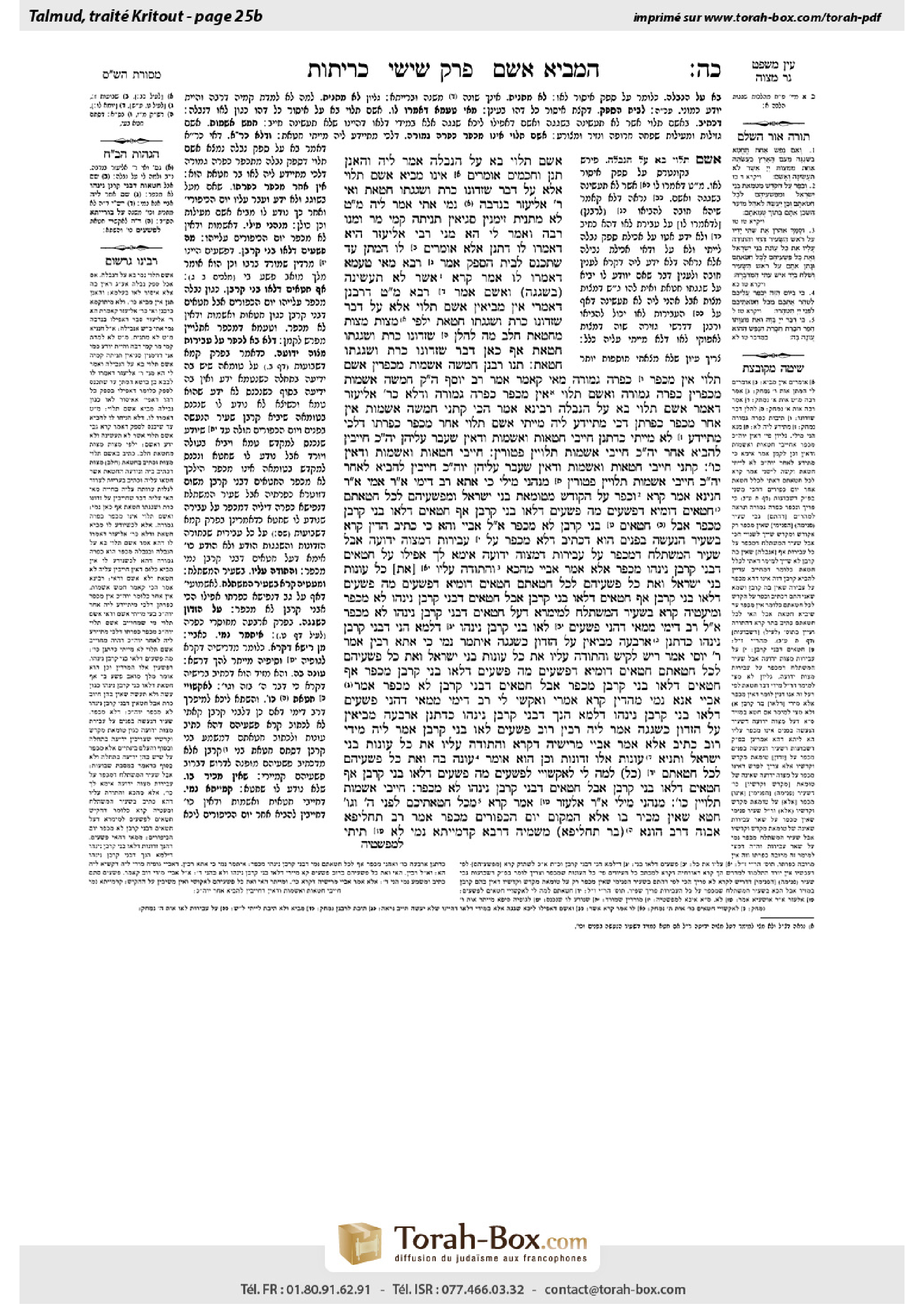
Keritot 25b: Talmud study for Daf Yomi
Daf Yomi is the daily study of one Talmud folio. Explore 37 tractates with scans, Hebrew text, Sefaria English and AI-generated French translations where annotated.
Passage selection and English or AI-generated French translation are available where the scan has annotations. Daf Study is independent of Torah-Box and Sefaria.
Browse Keritot · כריתות · All tractatesKeritot 25b text and translations
This page of Keritot includes the Aramaic text, an English translation and an AI-generated French translation, alongside the scan above.
כריתות כ״ה ב · Aramaic and Hebrew text
אָשָׁם תָּלוּי בָּא עַל הַנְּבֵלָה. אֲמַר לֵיהּ: וְהָאֲנַן תְּנַן, וַחֲכָמִים אוֹמְרִים: אֵינוֹ מֵבִיא אָשָׁם תָּלוּי אֶלָּא עַל דָּבָר שֶׁזְּדוֹנוֹ כָּרֵת וְשִׁגְגָתוֹ חַטָּאת! וְאִי רַבִּי אֱלִיעֶזֶר, בִּנְדָבָה נָמֵי אָתֵי!
אֲמַר לֵיהּ: מַאי טַעְמָא לָא מַתְנֵית? זִימְנִין סַגִּיאִין תְּנֵיתַהּ קַמֵּי מָר, וּמַנּוּ – רַבָּה, וְאָמַר לִי: הָא מַנִּי? רַבִּי אֱלִיעֶזֶר הִיא דְּאָמְרוּ לוֹ, דִּתְנַן: אֶלָּא אוֹמְרִים לוֹ הַמְתֵּן עַד שֶׁתִּכָּנֵס לְבֵית הַסָּפֵק.
אָמַר רָבָא: מַאי טַעְמָא דְּאָמְרוּ לוֹ? אָמַר קְרָא: ״אֲשֶׁר לֹא תֵעָשֶׂינָה (בִּשְׁגָגָה) וְאָשֵׁם״.
אָמַר רָבָא: מַאי טַעְמָא דְּרַבָּנַן, דְּאָמְרִי: אֵין מְבִיאִין אָשָׁם תָּלוּי אֶלָּא עַל דָּבָר שֶׁזְּדוֹנוֹ כָּרֵת וְשִׁגְגָתוֹ חַטָּאת? ״מִצְוֹת״ ״מִצְוֹת״, מֵחַטַּאת חֵלֶב,
מָה לְהַלָּן, שֶׁזְּדוֹנוֹ כָּרֵת וְשִׁגְגָתוֹ חַטָּאת, אַף כָּאן, דָּבָר שֶׁזְּדוֹנוֹ כָּרֵת וְשִׁגְגָתוֹ חַטָּאת.
תָּנוּ רַבָּנַן: חֲמִשָּׁה אֲשָׁמוֹת מְכַפְּרִין, אָשָׁם תָּלוּי אֵין מְכַפֵּר כַּפָּרָה גְּמוּרָה. מַאי קָאָמַר? אָמַר רַב יוֹסֵף, הָכִי קָאָמַר: חֲמִשָּׁה אֲשָׁמוֹת מְכַפְּרִין כַּפָּרָה גְּמוּרָה, וְאָשָׁם תָּלוּי אֵין מְכַפֵּר כַּפָּרָה גְּמוּרָה.
וּדְלָא כְּרַבִּי אֱלִיעֶזֶר, דְּאָמַר: אָשָׁם תָּלוּי בָּא עַל הַנְּבֵלָה.
רָבִינָא אָמַר: הָכִי קָתָנֵי: חֲמִשָּׁה אֲשָׁמוֹת – אֵין אַחֵר מְכַפֵּר כַּפָּרָתָן, דְּכִי מִתְיְידַע לֵיהּ מַיְיתֵי. אָשָׁם תָּלוּי – אַחֵר מְכַפֵּר כַּפָּרָתוֹ, דִּלְכִי מִתְיְידַע [לֵיהּ] לָא מַיְיתֵי, כְּדִתְנַן: חַיָּיבֵי חַטָּאוֹת וַאֲשָׁמוֹת וַדָּאִין שֶׁעָבַר עֲלֵיהֶן יוֹם הַכִּפּוּרִים – חַיָּיבִין לְהָבִיא אַחַר יוֹם הַכִּפּוּרִים. חַיָּיבֵי אֲשָׁמוֹת תְּלוּיִין – פְּטוּרִין.
חַיָּיבֵי חַטָּאוֹת וַאֲשָׁמוֹת וַדָּאִין כּוּ׳. קָתָנֵי: חַיָּיבֵי חַטָּאוֹת וַאֲשָׁמוֹת וַדָּאִין שֶׁעָבַר עֲלֵיהֶן יוֹם הַכִּפּוּרִים – חַיָּיבִין לְהָבִיא לְאַחַר יוֹם הַכִּפּוּרִים, חַיָּיבֵי אֲשָׁמוֹת תְּלוּיִין – פְּטוּרִין. מְנָהָנֵי מִילֵּי?
כִּי אֲתָא רַב דִּימִי אָמַר רַבִּי אַמֵּי אָמַר רַבִּי חֲנִינָא: אֲמַר קְרָא: ״וְכִפֶּר עַל הַקֹּדֶשׁ מִטּוּמְאֹת בְּנֵי יִשְׂרָאֵל וּמִפִּשְׁעֵיהֶם לְכׇל חַטֹּאתָם״, חֲטָאִים דּוּמְיָא דִּפְשָׁעִים, מָה פְּשָׁעִים דְּלָאו בְּנֵי קׇרְבָּן – אַף חֲטָאִים דְּלָאו בְּנֵי קׇרְבָּן – מְכַפֵּר, אֲבָל חֲטָאִים בְּנֵי קׇרְבָּן – לָא מְכַפַּר.
אֲמַר לֵיהּ אַבָּיֵי: וְהָא כִּי כְּתִיב הָדֵין קָרָא בְּשָׂעִיר הַנַּעֲשֶׂה בִּפְנִים הוּא דִּכְתִיב, דְּלָא מְכַפַּר עַל עֲבֵירוֹת דְּמִצְוָה יְדוּעָה, אֲבָל שָׂעִיר הַמִּשְׁתַּלֵּחַ, דִּמְכַפַּר עַל עֲבֵירוֹת דְּמִצְוָה יְדוּעָה, אֵימָא לָךְ: אֲפִילּוּ עַל חֲטָאִים דִּבְנֵי קׇרְבָּן נִינְהוּ מְכַפַּר!
אֶלָּא אָמַר אַבָּיֵי, מֵהָכָא: ״וְהִתְוַדָּה עָלָיו [אֶת] כׇּל עֲוֹנוֹת בְּנֵי יִשְׂרָאֵל וְאֶת כׇּל פִּשְׁעֵיהֶם לְכׇל חַטֹּאתָם״, חֲטָאִים דּוּמְיָא דִּפְשָׁעִים, מָה פְּשָׁעִים דְּלָאו בְּנֵי קׇרְבָּן – אַף חֲטָאִים דְּלָאו בְּנֵי קׇרְבָּן, אֲבָל חֲטָאִים דִּבְנֵי קׇרְבָּן נִינְהוּ – לָא מְכַפַּר. וּמַיעֲטֵיהּ קְרָא בְּשָׂעִיר הַמִּשְׁתַּלֵּחַ, לְמֵימְרָא דְּעַל חֲטָאִים דִּבְנֵי קׇרְבָּן נִינְהוּ לָא מְכַפַּר.
אֲמַר לֵיהּ רַב דִּימִי: מִמַּאי דְּהָנֵי פְּשָׁעִים לָאו בְּנֵי קׇרְבָּן נִינְהוּ? דִּלְמָא הָנֵי דִּבְנֵי קׇרְבָּן נִינְהוּ, כְּדִתְנַן: אַרְבָּעָה מְבִיאִין עַל הַזָּדוֹן כִּשְׁגָגָה.
אִיתְּמַר נָמֵי: כִּי אֲתָא רָבִין, אָמַר רַבִּי יוֹסֵי אָמַר רֵישׁ לָקִישׁ: ״וְהִתְוַדָּה עָלָיו אֶת כׇּל עֲוֹנוֹת בְּנֵי יִשְׂרָאֵל וְאֶת כׇּל פִּשְׁעֵיהֶם לְכׇל חַטֹּאתָם״, חֲטָאִים דּוּמְיָא דִּפְשָׁעִים, מָה פְּשָׁעִים דְּלָאו בְּנֵי קׇרְבָּן מְכַפֵּר, אַף חֲטָאִים דְּלָאו בְּנֵי קׇרְבָּן מְכַפֵּר, אֲבָל חֲטָאִים דִּבְנֵי קׇרְבָּן – לָא מְכַפַּר.
אָמַר אַבָּיֵי: אֲנָא נָמֵי מֵהָדֵין קְרָא אָמְרִי, וְאַקְשִׁי לִי רַב דִּימִי: מִמַּאי דְּהָנֵי פְּשָׁעִים דְּלָאו בְּנֵי קׇרְבָּן נִינְהוּ? דִּלְמָא הָנָךְ דִּבְנֵי קׇרְבָּן נִינְהוּ, כְּדִתְנַן: אַרְבָּעָה מְבִיאִין עַל הַזָּדוֹן כִּשְׁגָגָה! אֲמַר לֵיהּ רָבִין: רוֹב פְּשָׁעִים לָאו בְּנֵי קׇרְבָּן. אֲמַר לֵיהּ: מִידֵי רוֹב כְּתִיב?
אֶלָּא אָמַר אַבָּיֵי: מֵרֵישֵׁיהּ דִּקְרָא: ״וְהִתְוַדָּה עָלָיו אֶת כׇּל עֲוֹנוֹת בְּנֵי יִשְׂרָאֵל״, וְתַנְיָא: ״עֲוֹנוֹת״ – אֵלּוּ זְדוֹנוֹת. וְכֵן הוּא אוֹמֵר: ״עֲוֹנָהּ בָּהּ״.
״וְאֶת כׇּל פִּשְׁעֵיהֶם לְכׇל חַטֹּאתָם״ – ״כׇּל״ לְמָה לִי? לְאַקְשׁוֹיֵי לִפְשָׁעִים, מָה פְּשָׁעִים דְּלָאו בְּנֵי קׇרְבָּן, אַף חֲטָאִים דְּלָאו בְּנֵי קׇרְבָּן, אֲבָל חֲטָאִים דִּבְנֵי קׇרְבָּן נִינְהוּ – לָא מְכַפַּר.
חַיָּיבֵי אֲשָׁמוֹת תְּלוּיִין כּוּ׳. מְנָהָנֵי מִילֵּי? אָמַר רַבִּי אֶלְעָזָר, אֲמַר קְרָא: ״מִכֹּל חַטֹּאתֵיכֶם לִפְנֵי ה׳ וְגוֹ׳״ – חֵטְא שֶׁאֵין מַכִּיר בּוֹ אֶלָּא הַמָּקוֹם – יוֹם הַכִּפּוּרִים מְכַפֵּר.
אָמַר רַב תַּחְלִיפָא אֲבוּהּ דְּרַב הוּנָא בַּר תַּחְלִיפָא מִשְּׁמֵיהּ דְּרָבָא: קַדְמָיְיתָא נָמֵי לָא תֵּיתֵי
Keritot 25b · English translation
A provisional guilt offering comes for the uncertain consumption of a non-kosher animal carcass. Rava said to him: But didn’t we learn in the mishna: And the Rabbis say that one brings a provisional guilt offering only for uncertain performance of a matter for whose intentional performance one is liable to receive karet and for whose unwitting performance one is liable to bring a sin offering? But here the consumption of an animal carcass is a violation of a prohibition that does not entail karet or a sin offering. And if you are referring to the opinion of Rabbi Eliezer, he maintains that a provisional guilt offering comes also as a gift offering, without any uncertain sin.
Rabbi Ḥiyya said to Rava: What is the reason that you did not learn from Rabba? Many times I taught this baraita before the Master. And who is the Master? It is Rabba. And he said to me: In accordance with whose opinion is this baraita? It is in accordance with the opinion of Rabbi Eliezer; nevertheless, it is not in accordance with Rabbi Eliezer’s own opinion that a provisional guilt offering is brought as a gift offering, but rather it is in accordance with the opinion of those who spoke to Bava ben Buta. As we learned in the mishna: But they say to him: Wait until you enter into a situation of potential uncertainty. According to this opinion, one brings a provisional guilt offering for any manner of uncertain sin.
Rava said: What is the reason for the opinion of those who spoke to Bava ben Buta and said that one may bring a provisional guilt offering for any uncertain sin, not only those stated by the Rabbis? With regard to a provisional guilt offering, the verse states: “And if anyone sins, and does any of the mitzvot of the Lord which may not be done, and he did not know, and he is guilty” (Leviticus 5:17). This indicates that one brings a provisional guilt offering for any form of sin.
Rava said: What is the reason for the opinion of the Rabbis, who say: One brings a provisional guilt offering only for the uncertain performance of a matter for whose intentional performance one is liable to receive karet and for whose unwitting performance one is liable to bring a sin offering? They derive this halakha by a verbal analogy between the word “mitzvot” with regard to a provisional guilt offering and the word “mitzvot” from a sin offering of forbidden fat, i.e., a standard sin offering, where it is written: “Any of the mitzvot of the Lord” (Leviticus 4:27).
The Gemara explains the verbal analogy: Just as there, it is referring to a sin for whose intentional performance one is liable to receive karet and for whose unwitting performance one is liable to bring a sin offering, so too here, a provisional guilt offering is brought for a matter for whose intentional performance one is liable to receive karet and for whose unwitting performance one is liable to bring a sin offering.
§ The Sages taught in a baraita: Five guilt offerings atone, whereas a provisional guilt offering does not atone with a complete atonement. The Gemara asks: What is the tanna of this baraita saying? Rav Yosef said that this is what the baraita is saying: Five guilt offerings atone with a complete atonement to the extent that no further atonement is necessary, but a provisional guilt offering does not atone with a complete atonement, since if it later became known to him that he sinned, he must bring a sin offering to achieve atonement.
And this statement of the baraita is not in accordance with the opinion of Rabbi Eliezer, i.e., the opinion of those who spoke to Bava ben Buta, as they say: A provisional guilt offering may come for an uncertain eating of a non-kosher animal carcass. In the case of one who brought a provisional guilt offering for a sin such as the uncertain eating of an animal carcass and later found out that he sinned, he does not bring a sin offering and does not require any additional atonement.
Ravina said that this is what the baraita is teaching: With regard to five guilt offerings, nothing else achieves the atonement that they achieve, as one brings these offerings when it becomes known to him that he sinned. By contrast, with regard to a provisional guilt offering, another item achieves the atonement that it achieves, as one does not bring this offering when his uncertain sin becomes known to him. As we learned in the mishna: Those liable to bring sin offerings and definite guilt offerings for whom Yom Kippur has passed are liable to bring them after Yom Kippur, whereas those liable to bring provisional guilt offerings are exempt from bringing them after Yom Kippur.
§ With regard to those liable to bring sin offerings and definite guilt offerings, the mishna teaches: Those liable to bring sin offerings and definite guilt offerings for whom Yom Kippur has passed are liable to bring them after Yom Kippur. By contrast, those liable to bring provisional guilt offerings are exempt from bringing them after Yom Kippur. The Gemara asks: From where is this matter derived, that Yom Kippur does not atone for those liable to bring sin offerings and definite guilt offerings?
When Rav Dimi came from Eretz Yisrael, he said that Rabbi Ami says that Rabbi Ḥanina says that the verse states with regard to Yom Kippur: “And he shall make atonement for the holy place, from the impurity of the children of Israel, and from their transgressions, for all their sins” (Leviticus 16:16). This indicates that sins, i.e., violations committed unwittingly, are similar to transgressions, violations committed intentionally: Just as Yom Kippur atones for transgressions, which are not subject to atonement through an offering, as personal sin offerings are brought only for unwitting sins, so too with regard to sins, Yom Kippur atones only for sins that are not subject to atonement through an offering, but Yom Kippur does not atone for sins that are subject to atonement through an offering.
Abaye said to Rav Dimi: But how can one derive this matter from the verse? When that verse is written, it is written with regard to the goat whose blood presentation is performed inside the Sanctuary on Yom Kippur,which does not atone for a known violation of a mitzva, but only for a violation that is unknown. Perhaps only that offering does not atone for sins that are subject to atonement through an offering, but with regard to the scapegoat that is dispatched to Azazel, which atones for a known violation of a mitzva, I could say to you that it atones even for those sins that are subject to atonement through an offering.
Rather, Abaye said that the matter is derived from here, a verse that deals with the scapegoat: “And he shall confess over it all the iniquities of the children of Israel, and all their transgressions, for all their sins” (Leviticus 16:21). This indicates that sins are similar to transgressions: Just as the scapegoat atones for transgressions, which are not subject to atonement through an offering, so too with regard to sins, the scapegoat atones only for sins that are not subject to atonement through an offering, but it does not atone for sins that are subject to atonement through an offering. And the verse limited the scope of atonement specifically with regard to the scapegoat, in order to say that despite the scapegoat’s greater capacity to achieve atonement, it does not atone for sins that are subject to atonement through an offering.
Rav Dimi said to Abaye: From where is it known that those transgressions mentioned in that verse are not subject to atonement through an offering? Perhaps those transgressions are subject to atonement through an offering, as we learned in a mishna (9a): There are four who bring an offering for an intentional transgression as they do for an unwitting sin: One who engages in intercourse with an espoused maidservant, a nazirite who became ritually impure, one who falsely takes the oath of testimony that he does not know testimony on behalf of another, and one who falsely takes the oath on a deposit that the item belonging to another is not in his possession. The Gemara does not provide Abaye’s answer to this question at this point.
It was also stated with regard to this matter that when Ravin came from Eretz Yisrael he related a statement that Rabbi Yosei says that Reish Lakish says: The verse states: “And he shall confess over it all the iniquities of the children of Israel, and all their transgressions, for all their sins” (Leviticus 16:21). This indicates that sins are similar to transgressions: Just as the scapegoat atones for transgressions, which are not subject to atonement through an offering, so too with regard to sins, the scapegoat atones only for sins that are not subject to atonement through an offering, but it does not atone for sins that are subject to atonement through an offering.
Abaye said: I also said that this halakha was derived from that verse, and Rav Dimi raised the following difficulty before me: From where is it known that those transgressions mentioned in the verse are not subject to atonement through an offering? Perhaps those transgressions are subject to atonement through an offering, as we learned in a mishna that there are four who bring an offering for an intentional transgression as they do for an unwitting sin. Ravin said to Abaye: The majority of transgressions are not subject to atonement through an offering. Abaye said to him: Is the term majority written in that verse?
Rather, Abaye said that an answer to Rav Dimi’s question can be inferred from the beginning of the verse: “And he shall confess over it all the iniquities of the children of Israel” (Leviticus 16:21), and it is taught in a baraita: The term “iniquities” is referring to those sins that were performed intentionally. And similarly, the verse states: “Because he despised the word of the Lord, and has broken His commandment; that soul shall utterly be cut off, his iniquity shall be upon him” (Numbers 15:31).
Abaye continues: If so, when it states: “And all their transgressions, for all their sins,” why do I need the verse to mention “all their transgressions,” which is also referring to sins that were intentionally performed? It is written to juxtapose sins to transgressions: Just as the scapegoat atones for transgressions, the majority of which are not subject to atonement through an offering, so too with regard to sins, it atones only for sins that are not subject to atonement through an offering, but it does not atone for sins that are subject to atonement through an offering.
§ The mishna teaches: Those liable to bring provisional guilt offerings are exempt from bringing them after Yom Kippur. The Gemara asks: From where is this matter derived? Rabbi Elazar said: With regard to Yom Kippur the verse states: “For on this day shall atonement be made for you, to cleanse you; from all your sins you shall be pure before the Lord” (Leviticus 16:30). This indicates that Yom Kippur atones for a sin of which only the Omnipresent is aware, i.e., an uncertain sin that renders one liable to bring a provisional guilt offering.
Rav Taḥlifa, father of Rav Huna bar Taḥlifa, said in the name of Rava: With regard to the first clause in the mishna as well: Those liable to bring sin offerings and definite guilt offerings for whom Yom Kippur has passed are liable to bring them after Yom Kippur, one cannot bring a convincing proof
Keritot 25b · Traduction française (IA)
Un sacrifice de culpabilité provisoire est apporté pour avoir consommé, dans le doute, la carcasse d’un animal non cachère. Rava lui dit : Mais n’avons-nous pas appris dans la Michna : « Les Sages disent qu’on n’apporte un sacrifice de culpabilité provisoire que pour l’accomplissement incertain d’un acte dont l’accomplissement intentionnel rend passible de karet et dont l’accomplissement par inadvertance rend passible d’apporter un sacrifice expiatoire » ? Or, ici, la consommation d’une carcasse animale constitue la transgression d’un interdit qui n’entraîne ni karet ni sacrifice expiatoire. Et si tu fais référence à l’opinion de Rabbi Eliezer, celui-ci soutient qu’un sacrifice de culpabilité provisoire peut aussi être apporté comme offrande volontaire, sans qu’il y ait de péché incertain.
Rabbi Ḥiyya dit à Rava : Pourquoi n’as-tu pas appris cela de Rabba ? J’ai enseigné cette baraïta devant le Maître à de nombreuses reprises. Et qui est le Maître ? C’est Rabba. Il m’a dit : De l’avis de qui est cette baraïta ? Elle est conforme à l’opinion de Rabbi Eliezer ; néanmoins, elle ne suit pas l’opinion personnelle de Rabbi Eliezer selon laquelle on apporte un sacrifice de culpabilité provisoire comme offrande volontaire, mais plutôt l’opinion de ceux qui s’adressèrent à Bava ben Buta. Car nous avons appris dans la Michna : « Mais ils lui disent : Attends d’être dans une situation d’incertitude potentielle. » Selon cette opinion, on apporte un sacrifice de culpabilité provisoire pour toute sorte de péché incertain.
Rava dit : Quelle est la raison de l’opinion de ceux qui s’adressèrent à Bava ben Buta et dirent qu’on peut apporter un sacrifice de culpabilité provisoire pour tout péché incertain, et pas seulement pour ceux que les Sages ont mentionnés ? Au sujet du sacrifice de culpabilité provisoire, le verset dit : « Si quelqu’un pèche et commet l’une des mitsvot de l’Éternel qu’il ne faut pas commettre, sans le savoir, et qu’il est coupable » (Lévitique 5:17). Cela indique qu’on apporte un sacrifice de culpabilité provisoire pour toute forme de péché.
Rava dit : Quelle est la raison de l’opinion des Sages, qui disent qu’on n’apporte un sacrifice de culpabilité provisoire que pour l’accomplissement incertain d’un acte dont l’accomplissement intentionnel rend passible de karet et dont l’accomplissement par inadvertance rend passible d’apporter un sacrifice expiatoire ? Ils déduisent cette halakha par une analogie verbale entre le mot « mitsvot », à propos du sacrifice de culpabilité provisoire, et le mot « mitsvot », dans le cas d’un sacrifice expiatoire pour la consommation de graisse interdite, c’est-à-dire un sacrifice expiatoire ordinaire, où il est écrit : « L’une des mitsvot de l’Éternel » (Lévitique 4:27).
La Guemara explique l’analogie verbale : de même que là-bas, il s’agit d’un péché dont l’accomplissement intentionnel rend passible de karet et dont l’accomplissement par inadvertance rend passible d’apporter un sacrifice expiatoire, de même ici, un sacrifice de culpabilité provisoire est apporté pour un acte dont l’accomplissement intentionnel rend passible de karet et dont l’accomplissement par inadvertance rend passible d’apporter un sacrifice expiatoire.
§ Les Sages ont enseigné dans une baraïta : cinq sacrifices de culpabilité apportent l’expiation, tandis qu’un sacrifice de culpabilité provisoire n’apporte pas une expiation complète. La Guemara demande : Que dit le tanna de cette baraïta ? Rav Yosef dit que voici ce que la baraïta enseigne : cinq sacrifices de culpabilité apportent une expiation complète, au point qu’aucune expiation supplémentaire n’est nécessaire, tandis qu’un sacrifice de culpabilité provisoire n’apporte pas une expiation complète, car si la personne apprend par la suite qu’elle a péché, elle doit apporter un sacrifice expiatoire pour obtenir l’expiation.
Cette déclaration de la baraïta n’est pas conforme à l’opinion de Rabbi Eliezer, c’est-à-dire à celle de ceux qui s’adressèrent à Bava ben Buta, car ils disent qu’un sacrifice de culpabilité provisoire peut être apporté pour avoir consommé, dans le doute, la carcasse d’un animal non cachère. Si une personne a apporté un sacrifice de culpabilité provisoire pour un péché tel que la consommation incertaine d’une carcasse animale, puis apprend qu’elle a péché, elle n’apporte pas de sacrifice expiatoire et n’a besoin d’aucune expiation supplémentaire.
Ravina dit que voici ce que la baraïta enseigne : pour les cinq sacrifices de culpabilité, rien d’autre ne procure l’expiation qu’ils apportent, car on apporte ces sacrifices lorsqu’on apprend que l’on a péché. En revanche, pour un sacrifice de culpabilité provisoire, une autre chose procure l’expiation qu’il apporte, car on n’apporte pas ce sacrifice lorsque le péché incertain est clarifié. En effet, nous avons appris dans la Michna : ceux qui sont tenus d’apporter des sacrifices expiatoires et des sacrifices de culpabilité certains et pour qui Yom Kippour est passé restent tenus de les apporter après Yom Kippour, tandis que ceux qui sont tenus d’apporter des sacrifices de culpabilité provisoires en sont dispensés après Yom Kippour.
§ Au sujet de ceux qui sont tenus d’apporter des sacrifices expiatoires et des sacrifices de culpabilité certains, la Michna enseigne : ceux pour qui Yom Kippour est passé restent tenus de les apporter après Yom Kippour. En revanche, ceux qui sont tenus d’apporter des sacrifices de culpabilité provisoires en sont dispensés après Yom Kippour. La Guemara demande : D’où déduit-on que Yom Kippour n’apporte pas l’expiation à ceux qui sont tenus d’apporter des sacrifices expiatoires et des sacrifices de culpabilité certains ?
Lorsque Rav Dimi vint de la terre d’Israël, il dit que Rabbi Ami rapporte au nom de Rabbi Ḥanina que le verset dit au sujet de Yom Kippour : « Il fera expiation pour le sanctuaire, à cause des impuretés des enfants d’Israël et de leurs transgressions, pour tous leurs péchés » (Lévitique 16:16). Cela indique que les péchés, c’est-à-dire les transgressions commises par inadvertance, sont comparables aux transgressions commises intentionnellement : de même que Yom Kippour apporte l’expiation pour les transgressions, qui ne sont pas susceptibles d’être expiées par un sacrifice, puisque les sacrifices expiatoires individuels ne sont apportés que pour les péchés commis par inadvertance, de même, concernant les péchés, Yom Kippour n’apporte l’expiation que pour ceux qui ne sont pas susceptibles d’être expiés par un sacrifice ; il n’apporte pas l’expiation pour les péchés susceptibles d’être expiés par un sacrifice.
Abaye dit à Rav Dimi : Mais comment peut-on déduire cela du verset ? Lorsque ce verset a été écrit, il concernait le bouc dont le sang est présenté à l’intérieur du sanctuaire le jour de Yom Kippour, lequel n’apporte pas l’expiation pour une transgression connue d’une mitsva, mais seulement pour une transgression inconnue. Peut-être ce sacrifice n’apporte-t-il pas l’expiation pour les péchés susceptibles d’être expiés par un sacrifice, mais, au sujet du bouc émissaire envoyé à Azazel, qui apporte l’expiation pour une transgression connue d’une mitsva, pourrais-je te dire qu’il apporte l’expiation même pour les péchés susceptibles d’être expiés par un sacrifice ?
Abaye dit plutôt que la règle se déduit d’un autre verset, qui traite du bouc émissaire : « Il confessera sur lui toutes les iniquités des enfants d’Israël et toutes leurs transgressions, pour tous leurs péchés » (Lévitique 16:21). Cela indique que les péchés sont comparables aux transgressions : de même que le bouc émissaire apporte l’expiation pour les transgressions qui ne sont pas susceptibles d’être expiées par un sacrifice, de même, concernant les péchés, il n’apporte l’expiation que pour ceux qui ne sont pas susceptibles d’être expiés par un sacrifice ; il n’apporte pas l’expiation pour les péchés susceptibles d’être expiés par un sacrifice. Le verset a précisément limité la portée de l’expiation à propos du bouc émissaire afin d’indiquer que, malgré sa plus grande capacité à apporter l’expiation, il n’apporte pas l’expiation pour les péchés susceptibles d’être expiés par un sacrifice.
Rav Dimi dit à Abaye : D’où sait-on que les transgressions mentionnées dans ce verset ne sont pas susceptibles d’être expiées par un sacrifice ? Peut-être le sont-elles, comme nous avons appris dans une Michna (9a) qu’il y en a quatre qui apportent un sacrifice pour une transgression intentionnelle, comme pour un péché commis par inadvertance : celui qui a des relations avec une servante fiancée, le nazir devenu rituellement impur, celui qui prête faussement le serment de témoignage en affirmant ne pas connaître un témoignage en faveur d’autrui, et celui qui prête faussement serment au sujet d’un dépôt en affirmant que l’objet appartenant à autrui ne se trouve pas en sa possession. La Guemara ne donne pas ici la réponse d’Abaye à cette question.
À ce sujet, on rapporte également que lorsque Ravin vint de la terre d’Israël, il rapporta une déclaration de Rabbi Yosei au nom de Reish Lakish : le verset dit : « Il confessera sur lui toutes les iniquités des enfants d’Israël et toutes leurs transgressions, pour tous leurs péchés » (Lévitique 16:21). Cela indique que les péchés sont comparables aux transgressions : de même que le bouc émissaire apporte l’expiation pour les transgressions qui ne sont pas susceptibles d’être expiées par un sacrifice, de même, concernant les péchés, il n’apporte l’expiation que pour ceux qui ne sont pas susceptibles d’être expiés par un sacrifice ; il n’apporte pas l’expiation pour les péchés susceptibles d’être expiés par un sacrifice.
Abaye dit : Moi aussi, j’ai dit que cette halakha se déduisait de ce verset, et Rav Dimi m’a soulevé la difficulté suivante : D’où sait-on que les transgressions mentionnées dans le verset ne sont pas susceptibles d’être expiées par un sacrifice ? Peut-être le sont-elles, comme nous avons appris dans une Michna qu’il y en a quatre qui apportent un sacrifice pour une transgression intentionnelle, comme pour un péché commis par inadvertance. Ravin dit à Abaye : La majorité des transgressions ne sont pas susceptibles d’être expiées par un sacrifice. Abaye lui dit : Le terme « majorité » figure-t-il dans ce verset ?
Abaye dit plutôt qu’on peut déduire une réponse à la question de Rav Dimi du début du verset : « Il confessera sur lui toutes les iniquités des enfants d’Israël » (Lévitique 16:21). Or, une baraïta enseigne que le terme « iniquités » désigne les péchés commis intentionnellement. De même, le verset dit : « Parce qu’il a méprisé la parole de l’Éternel et violé Son commandement, cette personne sera retranchée ; son iniquité sera sur elle » (Nombres 15:31).
Abaye poursuit : Si c’est ainsi, pourquoi le verset dit-il : « Et toutes leurs transgressions, pour tous leurs péchés » ? Pourquoi faut-il qu’il mentionne « toutes leurs transgressions », qui désigne également les péchés commis intentionnellement ? C’est pour rapprocher les péchés des transgressions : de même que le bouc émissaire apporte l’expiation pour les transgressions, dont la majorité ne sont pas susceptibles d’être expiées par un sacrifice, de même, concernant les péchés, il n’apporte l’expiation que pour ceux qui ne sont pas susceptibles d’être expiés par un sacrifice ; il n’apporte pas l’expiation pour les péchés susceptibles d’être expiés par un sacrifice.
§ La Michna enseigne : ceux qui sont tenus d’apporter des sacrifices de culpabilité provisoires en sont dispensés après Yom Kippour. La Guemara demande : D’où déduit-on cela ? Rabbi Elazar dit : au sujet de Yom Kippour, le verset dit : « Car en ce jour il sera fait expiation pour vous, afin de vous purifier ; vous serez purs de tous vos péchés devant l’Éternel » (Lévitique 16:30). Cela indique que Yom Kippour apporte l’expiation pour un péché dont seul le Tout-Puissant a connaissance, c’est-à-dire un péché incertain qui rend passible d’apporter un sacrifice de culpabilité provisoire.
Rav Taḥlifa, père de Rav Huna bar Taḥlifa, dit au nom de Rava : Concernant également la première partie de la Michna, selon laquelle ceux qui sont tenus d’apporter des sacrifices expiatoires et des sacrifices de culpabilité certains et pour qui Yom Kippour est passé restent tenus de les apporter après Yom Kippour, on ne peut pas en apporter une preuve concluante
Traduction française générée par IA à partir de l’édition anglaise de Sefaria. Vérifie toujours un passage avec le texte source.
Text from Sefaria: William Davidson Edition - Vocalized Aramaic (CC BY NC); William Davidson Edition - English (CC BY NC).