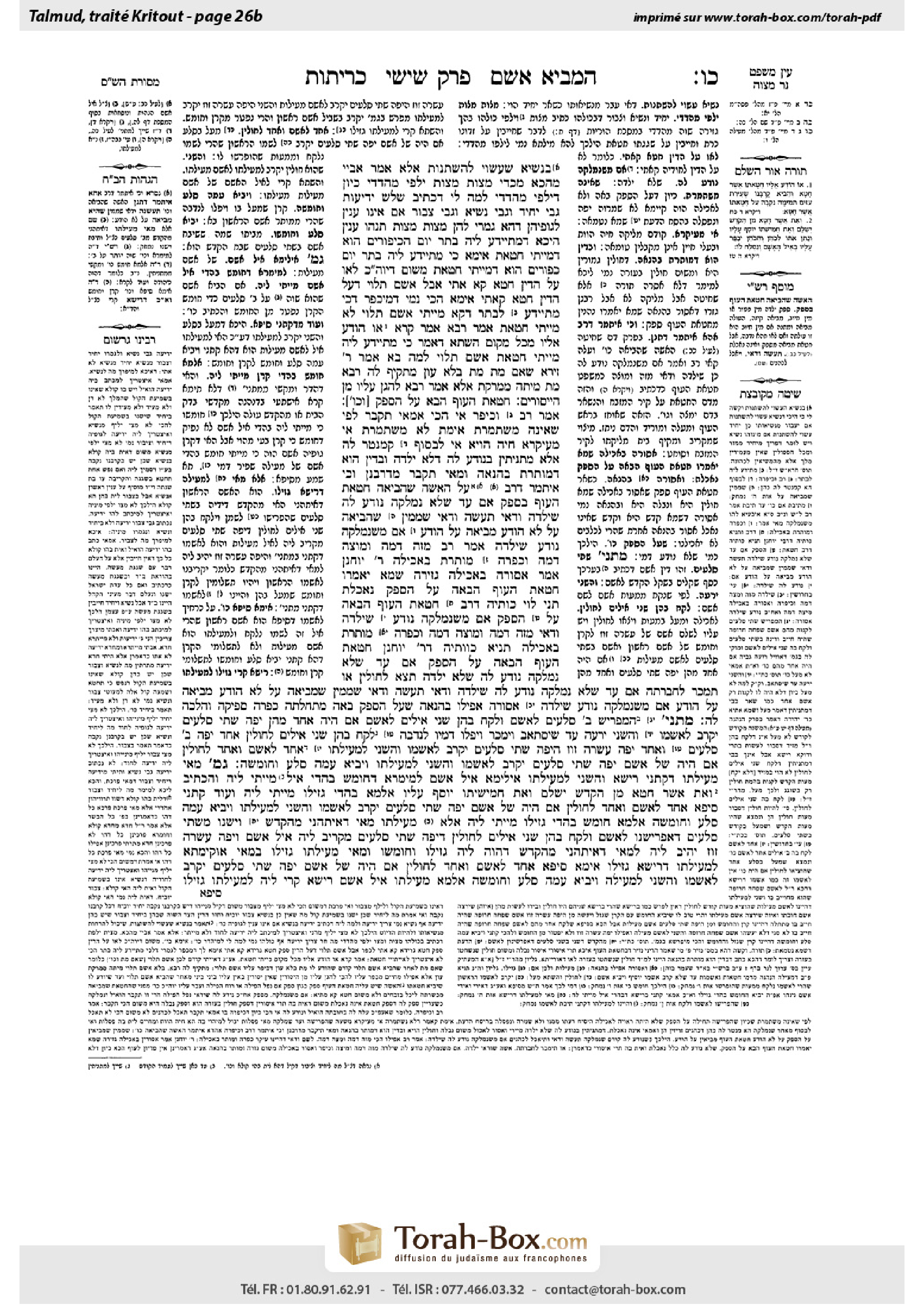
Keritot 26b: Talmud study for Daf Yomi
Daf Yomi is the daily study of one Talmud folio. Explore 37 tractates with scans, Hebrew text, Sefaria English and AI-generated French translations where annotated.
Passage selection and English or AI-generated French translation are available where the scan has annotations. Daf Study is independent of Torah-Box and Sefaria.
Browse Keritot · כריתות · All tractatesKeritot 26b text and translations
This page of Keritot includes the Aramaic text, an English translation and an AI-generated French translation, alongside the scan above.
כריתות כ״ו ב · Aramaic and Hebrew text
בְּנָשִׂיא שֶׁעָשׂוּי לְהִשְׁתַּנּוֹת!
אֶלָּא אָמַר אַבָּיֵי, מֵהָכָא: מִכְּדֵי ״מִצְוֹת״ ״מִצְוֹת״ יָלְפִי מֵהֲדָדֵי,
כֵּיוָן דְּיָלְפִי מֵהֲדָדֵי, לְמָה לִי דִּכְתִיב שָׁלֹשׁ יְדִיעוֹת גַּבֵּי יָחִיד וְגַבֵּי נָשִׂיא וְגַבֵּי צִבּוּר? אִם אֵינוֹ עִנְיָן לְגוּפֵיהֶן, דְּהָא גָּמְרִי לְהוֹן ״מִצְוֹת״ ״מִצְוֹת״, תְּנֵהוּ עִנְיָן הֵיכָא דְּמִתְיְידַע לֵיהּ בָּתַר יוֹם הַכִּיפּוּרִים הוּא דְּמַיְיתֵי חַטָּאת.
אֵימָא כִּי מִתְיְידַע לֵיהּ בָּתַר יוֹם כִּפּוּרִים הוּא דְּמַיְיתֵי חַטָּאת, מִשּׁוּם דְּיוֹם הַכִּפּוּרִים לָאו עַל הָדֵין חֵטְא קָא אָתֵי, אֲבָל אָשָׁם תָּלוּי, דְּעַל הָדֵין חֵטְא קָאָתֵי, אֵימָא הָכִי נָמֵי דְּמִיכַּפַּר, דְּכִי מִתְיְידַע [לֵיהּ] לְבָתַר דְּקָא מַיְיתֵי אָשָׁם תָּלוּי לָא מַיְיתֵי חַטָּאת.
אָמַר רָבָא: אֲמַר קְרָא: ״אוֹ הוֹדַע אֵלָיו״ – מִכׇּל מָקוֹם. הַשְׁתָּא דְּאָמַר: כִּי מִתְיְידַע לֵיהּ מַיְיתֵי חַטָּאת, אָשָׁם תָּלוּי לָמָּה בָּא? אָמַר רַבִּי זֵירָא: שֶׁאִם מֵת, מֵת בְּלֹא עָוֹן. מַתְקֵיף לַהּ רָבָא: מֵת, מִיתָה מְמָרֶקֶת! אֶלָּא אָמַר רָבָא: לְהָגֵן עָלָיו מִן הַיִּיסּוּרִים.
חַטַּאת הָעוֹף הַבָּא עַל הַסָּפֵק. אָמַר רַב: וְכִיפֵּר. אִי הָכִי, אַמַּאי תִּקָּבֵר?
לְפִי שֶׁאֵינָהּ מִשְׁתַּמֶּרֶת. אֵימַת לֹא מִשְׁתַּמֶּרֶת? אִי מֵעִיקָּרָא – חַיָּה הָוְיָא! אִי לְבַסּוֹף – קָמְנַטַּר לַהּ!
אֶלָּא מַתְנִיתִין בְּנוֹדַע לָהּ דְּלֹא יָלְדָה, וּבְדִין הוּא דְּמוּתֶּרֶת בַּהֲנָאָה, וּמַאי ״תִּקָּבֵר״ – מִדְּרַבָּנַן.
וְכִי אִיתְּמַר דְּרַב, עַל הָאִשָּׁה שֶׁהֵבִיאָה חַטַּאת הָעוֹף בְּסָפֵק, אִם עַד שֶׁלֹּא נִמְלְקָה נוֹדַע לָהּ שֶׁיָּלְדָה וַדַּאי – תַּעֲשֶׂה וַדַּאי, שֶׁמִּמִּין שֶׁהֵבִיאָה עַל לֹא הוֹדַע – מְבִיאָה עַל הוֹדַע.
אִם מִשֶּׁנִּמְלְקָה נוֹדַע שֶׁיָּלְדָה – אָמַר רַב: מַזֶּה דָּמָהּ וּמוֹצֶה דָּמָהּ, וְכִפְּרָה, [וּ]מוּתֶּרֶת בַּאֲכִילָה. רַבִּי יוֹחָנָן אָמַר: אֲסוּרָה בַּאֲכִילָה, גְּזֵירָה שֶׁמָּא יֹאמְרוּ: חַטַּאת הָעוֹף הַבָּאָה עַל הַסָּפֵק נֶאֱכֶלֶת.
תָּנֵי לֵוִי כְּוָתֵיהּ דְּרַב: חַטַּאת הָעוֹף הַבָּאָה עַל הַסָּפֵק, אִם מִשֶּׁנִּמְלְקָה נוֹדַע שֶׁיָּלְדָה וַדַּאי – מַזֶּה דָּמָהּ וּמוֹצֶה דָּמָהּ, וְכִפְּרָה, [וּ]מוּתֶּרֶת בַּאֲכִילָה.
תַּנְיָא כְּווֹתֵיהּ דְּרַבִּי יוֹחָנָן: חַטַּאת הָעוֹף הַבָּאָה עַל הַסָּפֵק, אִם עַד שֶׁלֹּא נִמְלְקָה נוֹדַע לָהּ שֶׁלֹּא יָלְדָה – תֵּצֵא לְחוּלִּין, אוֹ תִּמָּכֵר לַחֲבֶרְתָּהּ. אִם עַד שֶׁלֹּא נִמְלְקָה נוֹדַע לָהּ שֶׁיָּלְדָה וַדַּאי – תַּעֲשֶׂה וַדַּאי, שֶׁמִּמִּין שֶׁמְּבִיאָה עַל לֹא הוֹדַע מְבִיאָה עַל הוֹדַע.
אִם מִשֶּׁנִּמְלְקָה נוֹדַע שֶׁיָּלְדָה – אֲסוּרָה אֲפִילּוּ בַּהֲנָאָה. שֶׁעַל הַסָּפֵק בָּאָה מִתְּחִלָּתָהּ, כִּפְּרָה סְפֵיקָהּ וְהָלְכָה לָהּ.
מַתְנִי׳ הַמַּפְרִישׁ שְׁנֵי סְלָעִים לְאָשָׁם וְלָקַח בָּהֶן שְׁנֵי אֵילִים לְאָשָׁם, אִם הָיָה אֶחָד מֵהֶן יָפֶה שְׁתֵּי סְלָעִים – יִקְרַב לַאֲשָׁמוֹ, וְהַשֵּׁנִי יִרְעֶה עַד שֶׁיִּסְתָּאֵב וְיִמָּכֵר וְיִפְּלוּ דָּמָיו לִנְדָבָה.
לָקַח בָּהֶן שְׁנֵי אֵילִים לְחוּלִּין, אֶחָד יָפֶה שְׁתֵּי סְלָעִים וְאֶחָד יָפֶה עֲשָׂרָה זוּז – הַיָּפֶה שְׁתֵּי סְלָעִים יִקְרַב לַאֲשָׁמוֹ, וְהַשֵּׁנִי – לִמְעִילָתוֹ.
אֶחָד לְאָשָׁם וְאֶחָד לְחוּלִּין, אִם הָיָה שֶׁל אָשָׁם יָפֶה שְׁתֵּי סְלָעִים – יִקְרַב לַאֲשָׁמוֹ, וְהַשֵּׁנִי לִמְעִילָתוֹ, וְיָבִיא עִמָּהּ סֶלַע וְחוּמְשָׁהּ.
גְּמָ׳ מַאי ״מְעִילָתוֹ״ דְּקָתָנֵי רֵישָׁא, וְהַשֵּׁנִי לִמְעִילָתוֹ?
אִילֵּימָא אֵיל אָשָׁם, לְמֵימְרָא דְּחוֹמֶשׁ בַּהֲדֵי אַיִל מַיְיתֵי לֵיהּ? וְהָכְתִיב: ״וְאֵת אֲשֶׁר חָטָא מִן הַקֹּדֶשׁ יְשַׁלֵּם וְאֶת חֲמִישִׁיתוֹ יוֹסֵף עָלָיו״, אַלְמָא בַּהֲדֵי גְּזֵילוֹ מַיְיתֵי לֵיהּ!
וְעוֹד, קָתָנֵי סֵיפָא: אֶחָד לְאָשָׁם וְאֶחָד לְחוּלִּין, אִם הָיָה שֶׁל אָשָׁם יָפֶה שְׁתֵּי סְלָעִים – יִקְרַב לַאֲשָׁמוֹ, וְהַשֵּׁנִי לִמְעִילָתוֹ, וְיָבִיא עִמָּהּ סֶלַע וְחוּמְשָׁהּ, אַלְמָא חוֹמֶשׁ בַּהֲדֵי גְּזֵילוֹ מַיְיתֵי לֵיהּ!
אֶלָּא, ״מְעִילָתוֹ״ – מַאי דְּאִיתְהֲנִי מֵהֶקְדֵּשׁ וְיֶשְׁנוֹ מִשְׁתֵּי סְלָעִים דְּאַפְרֵישִׁנּוּ[ן] לְאָשָׁם וְלָקַח בָּהֶן שְׁנֵי אֵילִים לְחוּלִּין, דְּיָפֶה שְׁתֵּי סְלָעִים מַקְרֵיב לֵיהּ אֵיל אָשָׁם, וְיָפֶה עֲשָׂרָה זוּז יָהֵיב לֵיהּ לְמַאי דְּאִיתְהֲנִי מֵהֶקְדֵּשׁ דְּהָוֵה לֵיהּ גְּזֵילוֹ, וְחוּמְשׁוֹ. וּמַאי ״מְעִילָתוֹ״? גְּזֵילוֹ.
בְּמַאי אוֹקֵימְתַּאּ לִ״מְעִילָתוֹ״ דְּרֵישָׁא – גְּזֵילוֹ. אֵימָא סֵיפָא: אֶחָד לְאָשָׁם וְאֶחָד לְחוּלִּין, אִם הָיָה שֶׁל אָשָׁם יָפֶה שְׁתֵּי סְלָעִים – יִקְרַב לַאֲשָׁמוֹ, וְהַשֵּׁנִי לִמְעִילָה וְיָבִיא עִמָּהּ, סֶלַע וְחוּמְשָׁהּ.
אַלְמָא ״מְעִילָתוֹ״ – אֵיל אָשָׁם. רֵישָׁא קָרֵי לֵיהּ לִ״מְעִילָתוֹ״ גְּזֵילוֹ,
Keritot 26b · English translation
the same with regard to a Nasi, whose offering is apt to change if he leaves his position, e.g., when he becomes impure as a leper (see Horayot 10a), as in such a case he brings the sin offering of an individual?
Rather, Abaye said: The halakha that Yom Kippur does not atone for one who is liable to bring a sin offering can be derived from here: Since there is a verbal analogy between the word “mitzvot” mentioned with regard to the sin offerings of an individual and the word “mitzvot” mentioned with regard to a Nasi and with regard to the community, the halakhot of these three cases are derived from one another.
And since the halakhot of these cases are derived from one another, why do I need a term of knowing to be written three separate times, with regard to an individual, and with regard to a Nasi, and with regard to the community? If this term of knowing is not necessary for the matters of these sin offerings themselves, to teach that one brings a sin offering only for a known sin, as this is already derived from the verbal analogy of “mitzvot” and “mitzvot,” apply it to the matter of a case where his sin becomes known to him only after Yom Kippur. The halakha in that case would therefore be that he brings a sin offering.
The Gemara raises a difficulty: But say that it is only when his sin becomes known to him after Yom Kippur that he brings a sin offering, because Yom Kippur did not come to atone for that specific sin. But with regard to a provisional guilt offering, which comes to atone for that specific sin, say indeed that he has achieved atonement. Therefore, if his sin becomes known to him after he brought a provisional guilt offering he should not bring a sin offering.
Rava said in explanation that the verse states: “If his sin that he has sinned be known to him” (Leviticus 4:28), indicating that one is obligated to bring a sin offering in any case where his sin becomes known to him. The Gemara asks: Now that you say that when one’s sin becomes known to him he brings a sin offering, why does a provisional guilt offering come? Rabbi Zeira said: The reason is that if one dies before his sin becomes known to him, he dies without iniquity. Rava objects to this claim: If he dies, death itself absolves him, and therefore there is no need for a provisional guilt offering. Rather, Rava said: The reason that a provisional guilt offering is brought is in order to protect him from suffering until he brings his sin offering.
§ The mishna teaches: With regard to a bird sin offering that is brought due to uncertainty, e.g., it is uncertain if she gave birth to a non-viable newborn, which results in an obligation to bring an offering, or if it was an amorphous mass, which does not, if it became known to her after the nape of the neck of the bird was pinched, the bird must be buried. It is assumed at this point that the phrase: It became known to her, is referring to a case where it became known to her that she certainly gave birth in a manner for which she is obligated to bring the sin offering of a woman after childbirth. In this context, Rav says: And the bird atoned for her after its blood was sprinkled and squeezed out on the wall of the altar. The Gemara asks: If so, that the bird atones, then it should be eaten by the priests, in accordance with the halakha of a bird sacrificed as a sin offering. Why, then, does the mishna state that it must be buried?
The Gemara answers: Since a bird brought due to uncertainty is unfit to be eaten, the priest diverted his attention from the bird, and it was left unguarded. Therefore, there is a concern that the meat became impure. The Gemara asks: When was it left unguarded? If this means it was unguarded at the outset, before the pinching of the nape, the bird was still alive, and a living animal is not susceptible to ritual impurity. If this means later, after the pinching of the nape, the priest guards it at that stage.
Rather, the mishna is referring to a case where it became known to her that she did not give birth to a non-viable newborn and therefore she did not need to bring an offering.And by right it should have been permitted to derive benefit from the bird, as it is non-sacred. And if so, what is the reason for the mishna’s statement that it must be buried? This obligation applies by rabbinic law, to prevent people from mistakenly thinking that it is permitted to derive benefit from a bird brought as a sin offering due to uncertainty.
And that statement of Rav, that she receives atonement, was stated with regard to the ruling of a previous mishna (22b): In the case of a woman who brought a bird sin offering in a situation of uncertainty as to whether her miscarriage obligated her to bring a sin offering, in which case the sin offering may not be eaten by priests, the halakha is as follows: If before the nape of the neck of the bird was pinched it became known to her that she certainly gave birth to a non-viable newborn, she should render the offering a definite sin offering, as from the same type of animal that she brings a sin offering in a case where it is unknown to her that she gave birth, she likewise brings a sin offering in a case where it is known to her.
If after the nape of the bird was pinched it became known to her that she certainly gave birth, in such a case Rav says: The priest sprinkles its blood and squeezes out its blood on the wall of the altar, and she has achieved atonement and fulfilled her obligation; and the bird is permitted in consumption by the priests. Rabbi Yoḥanan says: In such a case, even if the blood was sprinkled and squeezed out on the wall of the altar, the bird is prohibited in consumption, due to a rabbinic decree, lest people say: A bird that is brought as a sin offering due to uncertainty is consumed.
Levi teaches a baraita in accordance with the opinion of Rav: With regard to a bird sin offering that is brought due to uncertainty, if after the nape of the neck of the bird was pinched it became known that she certainly gave birth, the priest sprinkles its blood and squeezes out its blood, and she has achieved atonement; and the bird is permitted in consumption.
It is taught in a baraita in accordance with the opinion of Rabbi Yoḥanan: With regard to a bird sin offering that is brought due to uncertainty, if before the nape of the bird was pinched it became known to her that she did not give birth, the bird is transferred to non-sacred status or is sold to another woman who is obligated to bring a bird sin offering. If before the nape of the bird was pinched it became known to her that she certainly gave birth,she should render the offering a definite sin offering, as from the type of animal that she brings a sin offering in a case where it is unknown to her that she gave birth, she brings a sin offering in a case where it is known to her.
If after the nape of the bird was pinched it became known that she gave birth, the priest sprinkles its blood and squeezes out its blood, and she has received atonement; but consumption of the bird is prohibited. And if the blood was already squeezed out, then it is even prohibited to derive benefit from the bird, in accordance with the halakha of any bird brought as a sin offering due to uncertainty. The reason is that this sin offering was initially brought due to uncertainty; and it atoned for its uncertainty, and that uncertainty is gone.
MISHNA: With regard to one who designates two sela, which is the minimal value of a guilt offering,to purchase a ram for a guilt offering,and he purchased two rams for a guilt offering with the two sela, if one of them is now worth two sela, he shall sacrifice it for his guilt offering. And the second ram that he purchased with the money he designated does not become non-sacred. Rather, it shall graze until it becomes blemished; and then it shall be sold, and the money received for it shall be allocated for communal gift offerings.
If he purchased two rams for non-sacred use with those two sela designated for a guilt offering, he has misused consecrated property. He is therefore liable to bring a guilt offering and to compensate the Temple treasury for those two sela and add one-fifth to the sum for a total of ten dinars, as there are four dinars in a sela. If one of the rams is now worth two sela, and the other one is now worth ten dinars, i.e., two and a half sela, the one that is worth two sela shall be sacrificed as his guilt offering for misuse of the two sela, and the second one shall be sacrificed for his initial misuse, as it is worth two sela plus one-fifth.
In a case where he purchased two rams with those two sela designated for a guilt offering, one for a guilt offering and one for non-sacred use, if the ram for the guilt offering is now worth two sela, it shall be sacrificed for his initial guilt offering. And with regard to the second ram that he purchased for non-sacred use, if it is now worth two sela, it shall be sacrificed as a guilt offering for his present misuse, and he brings with it the sum of one sela and one-fifth to the Temple treasury as payment for his misuse.
GEMARA: What is the term: His misuse, referring to, with regard to the halakha that is taught in the first clause of the mishna: If he purchased two rams for non-sacred use with those two sela designated for a guilt offering, if one of the rams is now worth two sela and the other one is worth ten dinars, the one that is worth two sela shall be sacrificed as his guilt offering and the second one shall be sacrificed for his misuse?
If we say that the term: His misuse, is referring to the ram that one is obligated to bring as a guilt offering for misuse of consecrated property, is this to say that the additional one-fifth for misuse of consecrated property is brought together with the ram that he brings as a guilt offering for that sin? If so, then this would explain why if that ram offering is valued as more than two sela, the additional value fulfills the obligation of giving an additional one-fifth. But isn’t it written: “And he shall make restitution for that which he has done amiss with consecrated property, and he shall add to it one-fifth” (Leviticus 5:16)? The verse apparently indicates that he brings the additional one-fifth together with his repayment for that which he stole from consecrated property.
And furthermore, it is taught in the latter clause of the mishna: In a case where he purchased two rams with those two sela designated for a guilt offering, one for a guilt offering and one for non-sacred use, if the ram for the guilt offering is now worth two sela, it shall be sacrificed for his guilt offering. And with regard to the second ram that he purchased for non-sacred use, if it is now worth two sela, it shall be sacrificed for his misuse, and he brings with it payment of one sela and one-fifth to the Temple treasury as payment for his misuse. Evidently, he brings the one-fifth together with his repayment for that which he stole from consecrated property.
Rather, when the mishna states: The ram worth ten dinars shall be sacrificed for his misuse, it means as repayment for that which he derived benefit from consecrated property. And those are the two sela that he initially designated for a guilt offering and with which he bought two rams as non-sacred animals. The Gemara explains: The reason for this is that the ram worth two sela he sacrifices for his ram of the guilt offering for his trespass, and the ram worth ten dinars he gives for that which he derived benefit from consecrated property, as he used two sela of consecrated property, which are for that which he stole, equal to eight dinars plus an additional one-fifth, the extra two dinars. And if so, to what is the term: His misuse, referring? It is not referring to the ram brought as a guilt offering for his misuse of consecrated property, but rather to the repayment for that which he stole from consecrated property.
The Gemara asks: With reference to what case did you interpret the term: His misuse, in the first clause of the mishna? It was interpreted as referring to the repayment for that which he stole from consecrated property. If so, say the latter clause of the mishna: In a case where he purchased two rams with those two sela designated for a guilt offering, one for a guilt offering and one for non-sacred use, if the ram for the guilt offering is now worth two sela, it shall be sacrificed for his initial guilt offering. And with regard to the second ram that he purchased for non-sacred use, if it is now worth two sela, it shall be sacrificed for his misuse of consecrated property, and he brings with it payment of one sela and one-fifth to the Temple treasury as payment for his misuse.
Since the mishna teaches that he gives one sela and one-fifth as repayment for that which he stole, evidently the term: His misuse, is referring to the ram that he brings as a guilt offering. The Gemara questions this inconsistency: The first clause uses the term: His misuse, in reference to the repayment for that which he stole,
Keritot 26b · Traduction française (IA)
La même chose vaut pour un Nasi, dont l’offrande est susceptible de changer s’il quitte ses fonctions, par exemple lorsqu’il devient impur comme un lépreux (voir Horayot 10a), car, dans ce cas, il apporte le sacrifice expiatoire d’un particulier ?
Abaye dit plutôt : on peut déduire d’ici la halakha selon laquelle Yom Kippour n’expie pas pour celui qui est tenu d’apporter un sacrifice expiatoire. En effet, puisqu’il existe une analogie verbale entre le mot « mitsvot », mentionné à propos des sacrifices expiatoires d’un particulier, et le mot « mitsvot », mentionné à propos d’un Nasi et de la communauté, les halakhot de ces trois cas se déduisent les unes des autres.
Et puisque les halakhot de ces cas se déduisent les unes des autres, pourquoi le terme indiquant la connaissance est-il écrit trois fois, séparément, à propos d’un particulier, d’un Nasi et de la communauté ? Si ce terme n’est pas nécessaire pour les sacrifices expiatoires eux-mêmes, afin d’enseigner qu’on n’apporte un sacrifice expiatoire que pour une faute connue — puisque cela se déduit déjà de l’analogie verbale entre « mitsvot » et « mitsvot » —, appliquons-le au cas où sa faute ne lui est révélée qu’après Yom Kippour. La halakha serait alors qu’il apporte un sacrifice expiatoire.
La Guemara soulève une difficulté : ne peut-on pas dire qu’il n’apporte un sacrifice expiatoire que si sa faute ne lui est révélée qu’après Yom Kippour, car Yom Kippour n’est pas venu expier cette faute précise ? En revanche, s’agissant d’un sacrifice de culpabilité provisoire, qui vient expier cette faute précise, disons qu’il a effectivement obtenu l’expiation. Par conséquent, si sa faute lui est révélée après qu’il a apporté un sacrifice de culpabilité provisoire, il ne devrait pas apporter de sacrifice expiatoire.
Rava explique que le verset dit : « Si la faute qu’il a commise lui est connue » (Lévitique 4:28), ce qui indique qu’il est tenu d’apporter un sacrifice expiatoire dans tous les cas où sa faute lui est connue. La Guemara demande : maintenant que tu dis que, lorsqu’une faute lui est connue, il apporte un sacrifice expiatoire, pourquoi apporte-t-on un sacrifice de culpabilité provisoire ? Rabbi Zeira dit : c’est parce que, s’il meurt avant que sa faute lui soit connue, il meurt sans faute. Rava conteste cette affirmation : s’il meurt, la mort elle-même l’absout ; il n’est donc pas nécessaire d’apporter un sacrifice de culpabilité provisoire. Rava dit plutôt : on apporte un sacrifice de culpabilité provisoire afin de le protéger des souffrances jusqu’à ce qu’il apporte son sacrifice expiatoire.
§ La Michna enseigne : concernant un sacrifice expiatoire d’oiseau apporté en raison d’un doute — par exemple, on ne sait pas si elle a donné naissance à un nouveau-né non viable, ce qui entraîne l’obligation d’apporter une offrande, ou s’il s’agissait d’une masse informe, ce qui ne l’entraîne pas —, si elle apprend ce qu’il en est après que la nuque de l’oiseau a été pincée, l’oiseau doit être enterré. On suppose ici que l’expression « elle apprend ce qu’il en est » désigne le cas où elle apprend qu’elle a certainement accouché dans des conditions qui l’obligent à apporter le sacrifice expiatoire d’une femme après l’accouchement. Dans ce contexte, Rav dit : l’oiseau a expié pour elle après que son sang a été aspergé et pressé contre le mur de l’autel. La Guemara demande : dans ce cas, si l’oiseau expie, les prêtres devraient le manger, conformément à la halakha d’un oiseau offert en sacrifice expiatoire. Pourquoi la Michna dit-elle alors qu’il doit être enterré ?
La Guemara répond : puisqu’un oiseau apporté en raison d’un doute est impropre à la consommation, le prêtre a cessé d’y prêter attention et l’a laissé sans surveillance. On craint donc que sa viande soit devenue impure. La Guemara demande : quand a-t-il été laissé sans surveillance ? Si cela signifie qu’il a été laissé sans surveillance dès le début, avant qu’on pince la nuque de l’oiseau, celui-ci était encore vivant, et un animal vivant n’est pas susceptible de contracter l’impureté rituelle. Si cela signifie qu’il a été laissé sans surveillance par la suite, après qu’on a pincé sa nuque, le prêtre le surveille à ce stade.
La Michna parle plutôt d’un cas où elle apprend qu’elle n’a pas donné naissance à un nouveau-né non viable et n’avait donc pas besoin d’apporter une offrande. L’oiseau aurait dû pouvoir être utilisé à des fins profanes, puisqu’il n’est pas consacré. Pourquoi, alors, la Michna dit-elle qu’il doit être enterré ? Cette obligation relève de la loi rabbinique, afin d’éviter que les gens ne pensent, par erreur, qu’il est permis de tirer profit d’un oiseau apporté en sacrifice expiatoire en raison d’un doute.
Cette déclaration de Rav, selon laquelle elle obtient l’expiation, concerne la décision d’une Michna précédente (22b) : dans le cas d’une femme qui a apporté un sacrifice expiatoire d’oiseau parce qu’elle ne savait pas si sa fausse couche l’obligeait à apporter un sacrifice expiatoire — auquel cas le sacrifice expiatoire ne peut pas être consommé par les prêtres —, la halakha est la suivante : si, avant que la nuque de l’oiseau soit pincée, elle apprend qu’elle a certainement donné naissance à un nouveau-né non viable, elle doit faire de l’offrande un sacrifice expiatoire certain, car elle apporte un sacrifice expiatoire du même type d’animal, qu’elle sache ou non qu’elle a accouché.
Si elle apprend qu’elle a certainement accouché après que la nuque de l’oiseau a été pincée, Rav dit : le prêtre asperge son sang et le presse contre le mur de l’autel ; elle obtient l’expiation et s’acquitte de son obligation, et l’oiseau peut être consommé par les prêtres. Rabbi Yoḥanan dit : dans ce cas, même si le sang a été aspergé et pressé contre le mur de l’autel, la consommation de l’oiseau est interdite en vertu d’un décret rabbinique, de peur que les gens ne disent : « Un oiseau apporté en sacrifice expiatoire en raison d’un doute peut être consommé. »
Levi enseigne une baraïta conforme à l’opinion de Rav : concernant un sacrifice expiatoire d’oiseau apporté en raison d’un doute, si, après que la nuque de l’oiseau a été pincée, il est établi qu’elle a certainement accouché, le prêtre asperge son sang et le presse contre le mur de l’autel ; elle obtient l’expiation, et l’oiseau peut être consommé.
Une baraïta est enseignée conformément à l’opinion de Rabbi Yoḥanan : concernant un sacrifice expiatoire d’oiseau apporté en raison d’un doute, si elle apprend, avant que la nuque de l’oiseau soit pincée, qu’elle n’a pas accouché, l’oiseau est libéré de son statut sacré ou vendu à une autre femme tenue d’apporter un sacrifice expiatoire d’oiseau. Si, avant que la nuque de l’oiseau soit pincée, elle apprend qu’elle a certainement accouché, elle doit faire de l’offrande un sacrifice expiatoire certain, car elle apporte un sacrifice expiatoire du même type d’animal, qu’elle sache ou non qu’elle a accouché.
Si elle apprend, après que la nuque de l’oiseau a été pincée, qu’elle a accouché, le prêtre asperge son sang et le presse contre le mur de l’autel, et elle obtient l’expiation ; mais l’oiseau ne peut pas être consommé. Et si le sang a déjà été pressé contre le mur, il est même interdit de tirer profit de l’oiseau, conformément à la halakha de tout oiseau apporté en sacrifice expiatoire en raison d’un doute. La raison en est que ce sacrifice expiatoire a d’abord été apporté en raison d’un doute : il a expié pour ce doute, qui a maintenant disparu.
MICHNA : Si quelqu’un affecte deux séla — valeur minimale d’un sacrifice de culpabilité — à l’achat d’un bélier pour un sacrifice de culpabilité, puis achète deux béliers pour un sacrifice de culpabilité avec ces deux séla, et que l’un d’eux vaut désormais deux séla, il l’offre en sacrifice de culpabilité. Le second bélier, acheté avec l’argent qu’il avait affecté à cet usage, ne devient pas profane. Il doit plutôt paître jusqu’à ce qu’il présente un défaut ; il sera alors vendu, et l’argent reçu en échange sera affecté aux offrandes volontaires de la communauté.
S’il achète deux béliers à usage profane avec ces deux séla affectés à un sacrifice de culpabilité, il a fait un usage abusif de biens consacrés. Il est donc tenu d’apporter un sacrifice de culpabilité, de rembourser au trésor du Temple ces deux séla et d’y ajouter un cinquième, soit dix dinars au total, puisqu’un séla vaut quatre dinars. Si l’un des béliers vaut désormais deux séla et l’autre dix dinars, c’est-à-dire deux séla et demi, celui qui vaut deux séla sera offert comme sacrifice de culpabilité pour l’usage abusif des deux séla, et le second sera offert pour l’usage abusif initial, car il vaut deux séla plus un cinquième.
S’il achète deux béliers avec ces deux séla affectés à un sacrifice de culpabilité, l’un pour un sacrifice de culpabilité et l’autre à usage profane, et que le bélier destiné au sacrifice de culpabilité vaut désormais deux séla, il l’offre pour son sacrifice de culpabilité initial. Quant au second bélier, acheté à usage profane, s’il vaut désormais deux séla, il est offert comme sacrifice de culpabilité pour l’usage abusif qu’il vient de commettre, et il verse au trésor du Temple un séla et un cinquième en paiement de cet usage abusif.
GUEMARA : À quoi se rapporte le terme « son usage abusif » dans la halakha enseignée dans la première partie de la Michna ? Celle-ci dit que, si quelqu’un achète deux béliers à usage profane avec ces deux séla affectés à un sacrifice de culpabilité, si l’un des béliers vaut désormais deux séla et l’autre dix dinars, celui qui vaut deux séla sera offert comme son sacrifice de culpabilité et le second sera offert en réparation de son usage abusif.
Si nous disons que le terme « son usage abusif » se rapporte au bélier qu’il est tenu d’apporter comme sacrifice de culpabilité pour l’usage abusif de biens consacrés, cela signifie-t-il que le cinquième supplémentaire dû pour cet usage abusif est apporté avec le bélier qu’il offre en sacrifice de culpabilité pour cette faute ? Cela expliquerait alors pourquoi, si la valeur de ce bélier dépasse deux séla, l’excédent remplit l’obligation d’ajouter un cinquième. Mais n’est-il pas écrit : « Il remboursera ce dont il a fait un usage abusif parmi les choses consacrées et y ajoutera un cinquième » (Lévitique 5:16) ? Le verset semble indiquer qu’il apporte le cinquième supplémentaire avec le remboursement de ce qu’il a détourné des biens consacrés.
En outre, la dernière partie de la Michna enseigne : dans le cas où il achète deux béliers avec ces deux séla affectés à un sacrifice de culpabilité, l’un pour un sacrifice de culpabilité et l’autre à usage profane, si le bélier destiné au sacrifice de culpabilité vaut désormais deux séla, il est offert pour son sacrifice de culpabilité. Quant au second bélier, acheté à usage profane, s’il vaut désormais deux séla, il est offert en réparation de son usage abusif, et il verse au trésor du Temple un séla et un cinquième en paiement de cet usage abusif. Il est donc évident qu’il apporte le cinquième avec le remboursement de ce qu’il a détourné des biens consacrés.
Il faut plutôt comprendre que, lorsque la Michna dit : « Le bélier qui vaut dix dinars sera offert pour son usage abusif », cela signifie qu’il sert à rembourser ce qu’il a retiré de l’usage de biens consacrés. Il s’agit des deux séla qu’il avait initialement affectés à un sacrifice de culpabilité et avec lesquels il a acheté deux béliers comme animaux profanes. La Guemara explique : la raison en est que le bélier qui vaut deux séla est offert comme sacrifice de culpabilité pour son délit, tandis que le bélier qui vaut dix dinars sert à rembourser ce qu’il a retiré de l’usage de biens consacrés : il a utilisé deux séla de biens consacrés, soit huit dinars détournés, auxquels s’ajoute un cinquième, soit deux dinars. Dans ce cas, à quoi se rapporte le terme « son usage abusif » ? Il ne se rapporte pas au bélier apporté comme sacrifice de culpabilité pour son usage abusif de biens consacrés, mais au remboursement de ce qu’il a détourné des biens consacrés.
La Guemara demande : à quel cas as-tu rapporté le terme « son usage abusif » dans la première partie de la Michna ? Il a été interprété comme se rapportant au remboursement de ce qu’il a détourné des biens consacrés. Dans ce cas, interprète ainsi la dernière partie de la Michna : dans le cas où il achète deux béliers avec ces deux séla affectés à un sacrifice de culpabilité, l’un pour un sacrifice de culpabilité et l’autre à usage profane, si le bélier destiné au sacrifice de culpabilité vaut désormais deux séla, il est offert pour son sacrifice de culpabilité initial. Quant au second bélier, acheté à usage profane, s’il vaut désormais deux séla, il est offert en réparation de son usage abusif de biens consacrés, et il verse au trésor du Temple un séla et un cinquième en paiement de cet usage abusif.
Puisque la Michna enseigne qu’il verse un séla et un cinquième en remboursement de ce qu’il a détourné, il est évident que le terme « son usage abusif » se rapporte au bélier qu’il apporte comme sacrifice de culpabilité. La Guemara relève cette incohérence : dans la première partie, le terme « son usage abusif » se rapporte au remboursement de ce qu’il a détourné,
Traduction française générée par IA à partir de l’édition anglaise de Sefaria. Vérifie toujours un passage avec le texte source.
Text from Sefaria: William Davidson Edition - Vocalized Aramaic (CC BY NC); William Davidson Edition - English (CC BY NC).