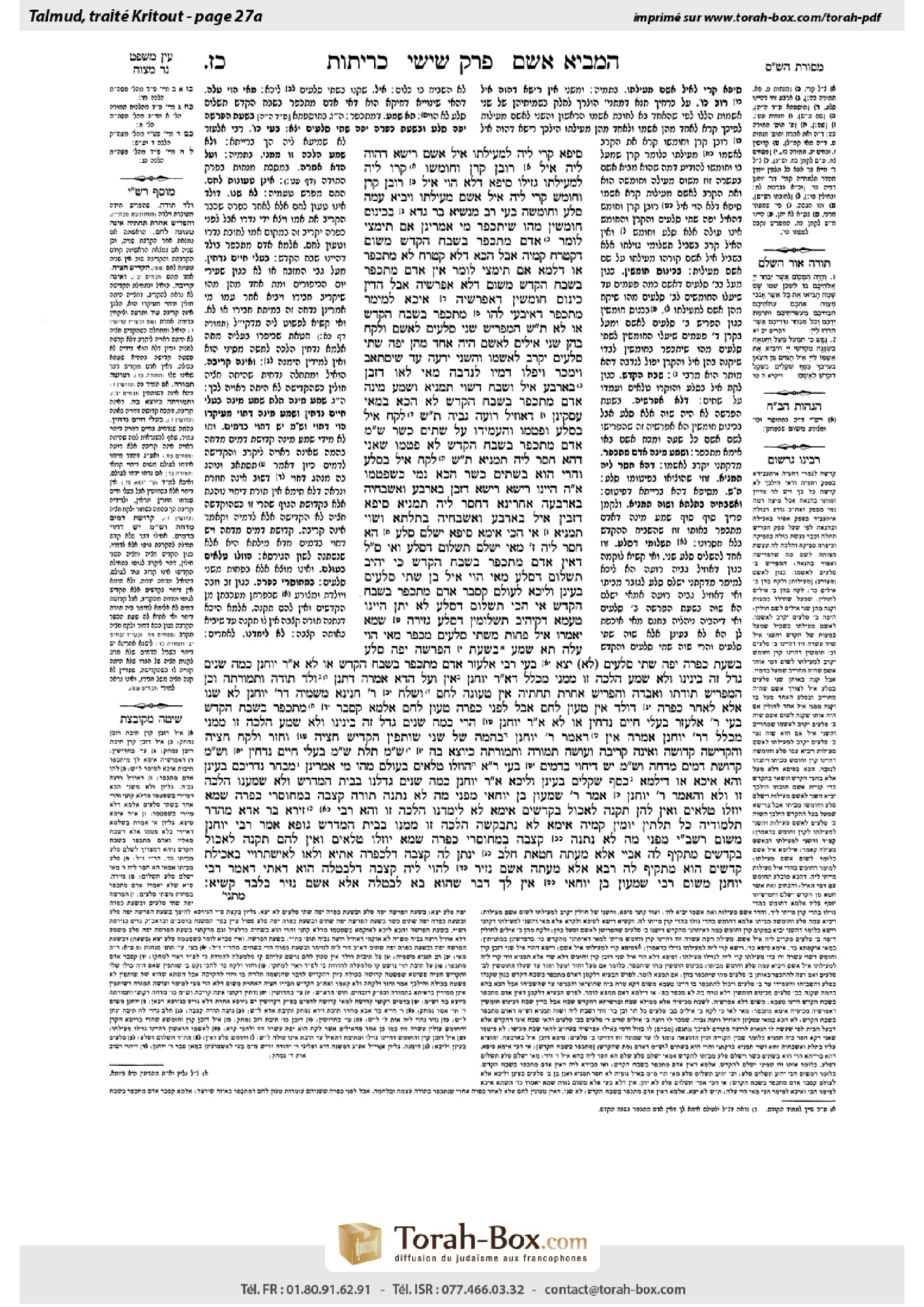
Keritot 27a: Talmud study for Daf Yomi
Daf Yomi is the daily study of one Talmud folio. Explore 37 tractates with scans, Hebrew text, Sefaria English and AI-generated French translations where annotated.
Passage selection and English or AI-generated French translation are available where the scan has annotations. Daf Study is independent of Torah-Box and Sefaria.
Browse Keritot · כריתות · All tractatesKeritot 27a text and translations
This page of Keritot includes the Aramaic text, an English translation and an AI-generated French translation, alongside the scan above.
כריתות כ״ז א · Aramaic and Hebrew text
סֵיפָא קָרֵי לֵיהּ לִ״מְעִילָתוֹ״ אֵיל אָשָׁם!
רֵישָׁא, דְּהָוֵה לֵיהּ אַיִל רוּבָּן קֶרֶן וְחוּמְשׁוֹ – קָרוּ לֵיהּ לִ״מְעִילָתוֹ״ גְּזֵילוֹ. סֵיפָא, דְּלָא הָוֵי אַיִל דִּזְבַן קֶרֶן וָחוֹמֶשׁ – קָרֵי לֵיהּ אֵיל אָשָׁם ״מְעִילָתוֹ״, וְיָבִיא עִמָּהּ סֶלַע וְחוּמְשָׁהּ.
בָּעֵי רַב מְנַשְּׁיָא בַּר גַּדָּא: בְּכִינּוּס חוּמְשִׁין מַהוּ שֶׁיִּתְכַּפֵּר?
מִי אָמְרִינַן: אִם תִּימְצֵי לוֹמַר אָדָם מִתְכַּפֵּר בִּשְׁבַח הֶקְדֵּשׁ – מִשּׁוּם דְּקָטָרַח קַמֵּיהּ, אֲבָל הָכָא דְּלָא קָטָרַח – לָא מִתְכַּפֵּר.
אוֹ דִלְמָא אִם תִּימְצֵי לוֹמַר אֵין אָדָם מִתְכַּפֵּר בִּשְׁבַח הֶקְדֵּשׁ – מִשּׁוּם דְּלָא אַפְרְשֵׁיהּ, אֲבָל הָדֵין כִּינּוּס חוּמְשִׁין – דְּאַפְרְשֵׁיהּ, אִיכָּא לְמֵימַר מִתְכַּפֵּר. דְּאִיבְּעִי לְהוּ: [אָדָם] מִתְכַּפֵּר בִּשְׁבַח הֶקְדֵּשׁ, אוֹ לָא?
תָּא שְׁמַע: הַמַּפְרִישׁ שְׁנֵי סְלָעִים לְאָשָׁם, וְלָקַח בָּהֶן שְׁנֵי אֵילִים לְאָשָׁם, הָיָה אֶחָד מֵהֶן יָפֶה שְׁתֵּי סְלָעִים – יִקְרַב לַאֲשָׁמוֹ, וְהַשֵּׁנִי יִרְעֶה עַד שֶׁיִּסְתָּאֵב וְיִמָּכֵר וְיִפְּלוּ דָּמָיו לִנְדָבָה.
מַאי לָאו, דִּזְבַן בְּאַרְבְּעָה אַיִל, וּשְׁבַח, דְּשָׁוֵי תְּמָנְיָא? וּשְׁמַע מִינַּהּ אָדָם מִתְכַּפֵּר בִּשְׁבַח הֶקְדֵּשׁ! לָא, הָכָא בְמַאי עָסְקִינַן? דְּאוֹזֵיל רוֹעֶה גַּבֵּיהּ.
תָּא שְׁמַע: לָקַח אַיִל בְּסֶלַע, וּפִטְּמוֹ וְהֶעֱמִידוֹ עַל שְׁתַּיִם – כָּשֵׁר. שְׁמַע מִינַּהּ אָדָם מִתְכַּפֵּר בִּשְׁבַח הֶקְדֵּשׁ! לָא, פִּטְּמוֹ שָׁאנֵי, דְּהָא חָסַר לֵיהּ תְּמָנְיָא.
תָּא שְׁמַע: לָקַח אַיִל בְּסֶלַע וַהֲרֵי הוּא בִּשְׁתַּיִם – כָּשֵׁר. הָכָא נָמֵי כְּשֶׁפִּטְּמוֹ.
אִי הָכִי הַיְינוּ רֵישָׁא! רֵישָׁא דִּזְבַן בְּאַרְבְּעָה וְאַשְׁבְּחֵיהּ בְּאַרְבְּעָה אַחֲרִינֵא, דְּחָסַר לֵיהּ תְּמָנְיָא. סֵיפָא דִּזְבַן אַיִל בְּאַרְבְּעָה וְאַשְׁבְּחֵיהּ בִּתְלָתָא, וְשָׁוֵי תְּמָנְיָא.
אִי הָכִי, אֵימָא סֵיפָא: יְשַׁלֵּם סֶלַע – הָא חֲסַר לֵיהּ שִׁבְעָה! מַאי יְשַׁלֵּם? תַּשְׁלוּם דְּסֶלַע.
וְאִי סְבִירָא לֵיהּ דְּאֵין אָדָם מִתְכַּפֵּר בִּשְׁבַח הֶקְדֵּשׁ, כִּי יָהֵיב תַּשְׁלוּם דְּסֶלַע מַאי הָוֵי? אַיִל בֶּן שְׁתֵּי סְלָעִים בָּעֵינַן, וְלֵיכָּא! לְעוֹלָם קָסָבַר: אָדָם מִתְכַּפֵּר בִּשְׁבַח הֶקְדֵּשׁ.
אִי הָכִי, תַּשְׁלוּם דְּסֶלַע לֹא יִתֵּן! הַיְינוּ טַעְמָא דְּקָיָהֵיב תַּשְׁלוּמִין דְּסֶלַע – גְּזֵירָה שֶׁמָּא יֹאמְרוּ: אַיִל פָּחוּת מִשְׁתֵּי סְלָעִים מְכַפֵּר.
מַאי הָוֵי עֲלַהּ? תָּא שְׁמַע: בִּשְׁעַת הַפְרָשָׁה יָפֶה סֶלַע, בִּשְׁעַת כַּפָּרָה יָפֶה שְׁתֵּי סְלָעִים – לֹא יָצָא.
בָּעֵי רַבִּי אֶלְעָזָר: אָדָם מִתְכַּפֵּר בִּשְׁבַח הֶקְדֵּשׁ, אוֹ לֹא? אָמַר רַבִּי יוֹחָנָן: כַּמָּה שָׁנִים גָּדַל זֶה בֵּינֵינוּ, וְלֹא שָׁמַע הֲלָכָה זוֹ מִמֶּנִּי!
מִכְּלָל דְּאַמְרַהּ רַבִּי יוֹחָנָן? אִין, וְעַל הָדָא אַמְרַהּ, דִּתְנַן: וְלַד תּוֹדָה וּתְמוּרָתָהּ, וְכֵן הַמַּפְרִישׁ תּוֹדָתוֹ וְאָבְדָה וְהִפְרִישׁ אַחֶרֶת תַּחְתֶּיהָ, אֵין טְעוּנָה לֶחֶם.
[רַב חֲנַנְיָה] מִשְּׁמֵיהּ דְּרַבִּי יוֹחָנָן: לֹא שָׁנוּ אֶלָּא לְאַחַר כַּפָּרָה, דְּוָלָד אֵין טָעוּן לֶחֶם.
אֲבָל לִפְנֵי כַּפָּרָה – טָעוּן לֶחֶם, אַלְמָא קָסָבַר מִתְכַּפֵּר בִּשְׁבַח הֶקְדֵּשׁ.
בָּעֵי רַבִּי אֶלְעָזָר: בַּעֲלֵי חַיִּים נִדְחִין אוֹ לֹא? אָמַר רַבִּי יוֹחָנָן: הֲרֵי כַּמָּה שָׁנִים גָּדַל זֶה בֵּינֵינוּ, וְלֹא שָׁמַע הֲלָכָה זוֹ מִמֶּנִּי!
מִכְּלָל דְּרַבִּי יוֹחָנָן אַמְרַהּ? אִין, דְּאָמַר רַבִּי יוֹחָנָן: בְּהֵמָה שֶׁל שְׁנֵי שׁוּתָּפִין, הִקְדִּישׁ חֶצְיָהּ, וְחָזַר וְלָקַח חֶצְיָהּ וְהִקְדִּישָׁהּ – קְדוֹשָׁה, וְאֵינָהּ קְרֵיבָה, וְעוֹשָׂה תְּמוּרָה, וּתְמוּרָתָהּ כַּיּוֹצֵא בָּהּ.
שְׁמַע מִינַּהּ תְּלָת: שְׁמַע מִינַּהּ בַּעֲלֵי חַיִּים נִדְחִין. וּשְׁמַע מִינַּהּ קְדוּשַּׁת דָּמִים מְדַחָה. וּשְׁמַע מִינַּהּ יֵשׁ דִּיחוּי בְּדָמִים.
בָּעֵי רַבִּי אֶלְעָזָר: הוּזְלוּ טְלָאִים בָּעוֹלָם, מַהוּ? מִי אָמְרִינַן ״מִבְחַר נִדְרֵיכֶם״ בָּעֵינַן, וְהָא אִיכָּא, אוֹ דִילְמָא ״כֶּסֶף שְׁקָלִים״ בָּעֵינַן, וְלֵיכָּא?
אָמַר רַבִּי יוֹחָנָן: כַּמָּה שָׁנִים גָּדַלְנוּ בְּבֵית הַמִּדְרָשׁ וְלֹא שָׁמַעְנוּ הֲלָכָה זוֹ. וְלָא? וְהָאָמַר רַבִּי יוֹחָנָן אָמַר רַבִּי שִׁמְעוֹן בֶּן יוֹחַאי: מִפְּנֵי מָה לֹא נָתְנָה תּוֹרָה קִצְבָה בִּמְחוּסְּרֵי כַפָּרָה? שֶׁמָּא יוּזְלוּ טְלָאִים, וְאֵין לָהֶן תַּקָּנָה לֶאֱכוֹל בְּקָדָשִׁים. אֵימָא: לֹא לִימַּדְנוּ הֲלָכָה זוֹ.
וְהָא רַבִּי זֵירָא בַּר אַדָּא מַהְדַּר תַּלְמוּדֵיהּ כֹּל תְּלָתִין יוֹמִין קַמֵּיהּ! אֵימָא: לֹא נִתְבַּקְּשָׁה הֲלָכָה זוֹ מִמֶּנּוּ בְּבֵית הַמִּדְרָשׁ.
גּוּפָא, אָמַר רַבִּי יוֹחָנָן מִשּׁוּם רַבִּי שִׁמְעוֹן בֶּן יוֹחַאי: מִפְּנֵי מָה לֹא נִתְּנָה קִצְבָה בִּמְחוּסְּרֵי כַּפָּרָה? שֶׁמָּא יוּזְלוּ טְלָאִים, וְאֵין לָהֶם תַּקָּנָה לֶאֱכוֹל בְּקָדָשִׁים.
מַתְקֵיף לַהּ אַבָּיֵי: אֶלָּא מֵעַתָּה, חַטַּאת חֵלֶב, יִנָּתֵן לָהּ קִצְבָה, דִּלְכַפָּרָה אָתְיָא וְלָאו לְאִישְׁתְּרוֹיֵי בַּאֲכִילַת קָדָשִׁים הוּא! מַתְקֵיף לַהּ רָבָא: אֶלָּא מֵעַתָּה, אֲשַׁם נָזִיר לֶהֱוֵי לֵיהּ קִצְבָה, דִּלְבַטָּלָה הוּא דְּאָתֵי, דְּאָמַר רַבִּי יוֹחָנָן מִשּׁוּם רַבִּי שִׁמְעוֹן בֶּן יוֹחַאי: אֵין לְךָ דָּבָר שֶׁהוּא בָּא לְבַטָּלָה, אֶלָּא אֲשַׁם נָזִיר בִּלְבָד! קַשְׁיָא.
Keritot 27a · English translation
whereas the latter clause uses the term: His misuse, in reference to the ram he brings as a guilt offering.
The Gemara answers: In the first clause, where he purchased two non-sacred rams with two dinars of consecrated money, the value of the bigger ram is equal to the principal plus its one-fifth that he is obligated to repay for that which he stole. Therefore, the mishna uses the term: His misuse, in reference to repayment for that which he stole. In the latter clause, where he purchased one non-sacred ram with one dinar of consecrated money, the value of the bigger ram is not equal to the principal plus one-fifth. Consequently, the mishna uses the term: His misuse, in reference to the ram he brings as a guilt offering, and he brings together with it payment of one sela and its one-fifth.
§ Rav Menashya bar Gadda raises a dilemma: What is the halakha with regard to one who misused consecrated property several times until the accumulation of one-fifths that he owes totals two sela: May he bring a guilt offering with that money and thereby achieve atonement?
The Gemara explains the sides of the dilemma. Do we say: If you say that a person can achieve atonement with an enhancement of consecrated property, e.g., if one initially purchased a ram worth one sela and then its market value increased to two sela while the animal was in his possession, this is because he exerted himself with regard to the animal by caring for it while it was in his possession. But here, where he did not exert himself, but the value accumulated on its own, he cannot achieve atonement.
Or perhaps we say the opposite: If you say that a person cannot achieve atonement with an enhancement of consecrated property, this is because he did not designate the ram as an offering when it was worth two sela, and its value appreciated on its own. But here, with regard to the accumulation of one-fifths, where he designated the total value as consecrated property, it is possible to say that he can receive atonement by bringing a guilt offering with that money. The Gemara notes that this dilemma itself was raised before the Sages: Can one achieve atonement with an enhancement of consecrated property that occurred while the animal was in his possession, or not?
The Gemara suggests: Come and hear a proof from the mishna: With regard to one who designates two sela to purchase a ram for a guilt offering and he purchased two rams for a guilt offering with the two sela, if one of them was now worth two sela, he shall sacrifice it for his guilt offering. And the second ram that he purchased with the money that he designated does not become non-sacred. Rather, it shall graze until it becomes blemished; and then it shall be sold, and the money received for it shall be allocated for communal gift offerings.
The Gemara explains the proof: What, is it not that the mishna is referring to a case where he bought the ram for four dinars, which is equal to one sela, and its value appreciated while in his possession until it was worth eight dinars, or two sela, and the mishna rules he may bring this ram as a guilt offering? And if so, conclude from this mishna that a person can achieve atonement with an enhancement of consecrated property. The Gemara rejects this proof: No; what are we dealing with here? It is with a ram that was worth two sela at the time of purchase, but the shepherd who sold it reduced the price for him.
The Gemara suggests: Come and hear a proof from a baraita (Tosefta 4:9): With regard to one who purchased a ram for one sela and he fattened the ram and thereby established its value at two sela, it is valid for sacrifice as a guilt offering. Conclude from this baraita that a person can achieve atonement with an enhancement of consecrated property. The Gemara rejects this proof: No; the case of one who fattened an animal is different, as he lost eight dinars, which is two sela, in expenses for the animal, including the price he paid. But he cannot achieve atonement if the animal’s value appreciated on its own while in his possession.
The Gemara further suggests: Come and hear a proof from the continuation of the same baraita: If one purchased a ram for one sela and now it has appreciated to the value of two sela, it is valid for sacrifice as a guilt offering. The Gemara explains: Here too, it is referring to a case where one fattened the ram.
The Gemara raises a difficulty: If so, this is the same case as in the first clause of that baraita and is therefore unnecessary. The Gemara answers: The first clause is dealing with one who purchased a ram for four dinars and he increased its value by spending another four dinars to fatten the animal, which means that he lost eight dinars, which equal two sela, in total expenses on the ram. The latter clause is discussing a case of one who purchased a ram for four dinars and he increased its value by spending another three dinars to fatten it, and then the ram appreciated one more dinar on its own, and is now worth eight dinars.
The Gemara objects: If so, say the latter clause of that baraita: And in addition he shall pay one sela to the Temple treasury. Why is this the halakha? Didn’t he lose seven dinars in total expenses on the ram, four dinars for its purchase and three for fattening it, and therefore the ram added only one dinar of value on its own? The Gemara answers: What is the meaning of the statement: He shall pay? The baraita is teaching that he must complete the payment of the sela, i.e., by giving one additional dinar.
The Gemara asks: But if one maintains that a person cannot achieve atonement with an enhancement of consecrated property, what is the significance of the fact that he gives one dinar that is the completion of the payment of the sela? We require him to bring a ram that cost him two sela, and there is no such animal here. The Gemara answers: Actually, the tanna of this baraita in the Tosefta holds that a person can achieve atonement with an enhancement of consecrated property.
The Gemara objects: If so, he should not give the one dinar that is the completion of the payment of one sela, as the ram is now worth two sela. The Gemara explains: This is the reason that he must give the one dinar that is the completion of the payment of one sela: It is a rabbinic decree, lest people say that a ram worth less than two sela atones as a guilt offering.
The Gemara asks: What halakhic conclusion was reached about the question of whether a person can achieve atonement with an enhancement of consecrated property? The Gemara suggests: Come and hear a proof from a baraita: With regard to a ram that was worth one sela at the time that it was designated as a guilt offering, and then its value appreciated until it was worth two sela at the time of atonement, one who sacrificed it has not fulfilled his obligation with that ram. This demonstrates that one cannot achieve atonement with an enhancement of consecrated property.
Rabbi Elazar, who was apparently unaware of the previously cited baraita, raised the same dilemma: Can a person achieve atonement with an enhancement of consecrated property that occurred while the animal was in his possession, or not? Rabbi Yoḥanan said, in puzzlement: How many years has this Rabbi Elazar grown among us and learned Torah from me, and yet he did not hear this halakha from me.
The Gemara asks: Should one conclude by inference from this statement that Rabbi Yoḥanan said the halakha with regard to this matter? The Gemara answers: Yes, and he said that halakha with regard to this ruling, as we learned in a mishna (Menaḥot 79b): In the case of the offspring of an animal designated as a thanks offering or an animal that is its substitute, and likewise if one designated an animal as his thanks offering and it was lost and he designated another in its stead, and the first animal was then found, in all three cases, the second animal, i.e., the offspring, the substitute, or the replacement, is sacrificed, but it does not require the bringing of loaves with it.
And with regard to the offspring of a thanks offering, Rabbi Ḥanina sent a letter from Eretz Yisrael to the Sages in Babylonia containing the following statement in the name of Rabbi Yoḥanan: That mishna taught that the offspring does not require loaves only in a case where they were sacrificed after the owner achieved atonement by sacrificing the mother and sprinkling its blood, since he has thereby fulfilled his obligation, as the offspring does not require the bringing of loaves.
But if one sacrificed the offspring before he achieved atonement through sacrifice of the mother, then the offspring requires the bringing of loaves, as it is the fulfillment of his obligation to bring a thanks offering. Evidently, Rabbi Yoḥanan holds that a person can achieve atonement with an enhancement of consecrated property, as this offspring of a consecrated animal is considered its enhancement.
§ Rabbi Elazar raises a dilemma: If consecrated living animals were rendered unfit to be sacrificed, are they permanently disqualified or not? Rabbi Yoḥanan said, in puzzlement: How many years has this Rabbi Elazar grown among us and learned Torah from me, and yet he did not hear this halakha from me.
The Gemara asks: Should one conclude by inference from this statement that Rabbi Yoḥanan said the halakha with regard to this matter? The Gemara answers: Yes, as Rabbi Yoḥanan says: With regard to an animal that belongs to two partners, if one of them consecrated the half of it that belonged to him, and then acquired its other half from his partner and consecrated it,it is consecrated but it may not be sacrificed. And it renders a non-sacred animal for which it is exchanged consecrated as a substitute, and its substitution is like it, i.e., it too is consecrated but it may not be sacrificed.
One can conclude from this ruling of Rabbi Yoḥanan three halakhot. Conclude from it that consecrated living animals can be permanently disqualified. When he consecrated only half of the animal it was not fit for sacrifice, and this meant that the animal was permanently disqualified even after it became fully consecrated. And conclude from it that sanctity that inheres in an animal’s value disqualifies another animal, i.e., the substitute. The sanctity is considered inherent in its value because only half of the animal was initially consecrated. And conclude from it that there is disqualification with regard to monetary value, i.e., even an animal that is consecrated only for its monetary value can be disqualified from sacrifice.
§ Rabbi Elazar raises a dilemma: If the price of lambs depreciated in the world and one cannot find a ram valued at two sela, what is the halakha? The Gemara explains the sides of the dilemma: Do we say that we require an offering that fulfills the condition: “Your choice vows” (Deuteronomy 12:11), and that requirement is fulfilled, as he is bringing the best animal available? Or perhaps we require a guilt offering to be purchased in accordance with the verse: “Silver by shekels” (Leviticus 5:15), i.e., two sela, and that requirement is not fulfilled.
Rabbi Yoḥanan said: How many years have we grown in the study hall and we have not heard this halakha. The Gemara asks: And has this halakha not been heard? But doesn’t Rabbi Yoḥanan say that Rabbi Shimon ben Yoḥai says: For what reason did the Torah not provide a fixed value for offerings brought by those lacking atonement, who must bring an offering of purification for them to be permitted to eat consecrated meat, e.g., a zav and a leper? It is because the price of lambs might depreciate below the Torah’s fixed value and they would have no remedy to eat sacrificial food. This statement indicates that one may not bring a ram that is worth less than two sela for a guilt offering, as the Torah fixed its value. The Gemara answers: Say that Rabbi Yoḥanan said: How many years have we not taught this halakha in the study hall.
The Gemara raises a difficulty: But didn’t Rabbi Zeira bar Adda review his studies before Rabbi Yoḥanan every thirty days, which indicates that the statements of Rabbi Yoḥanan were repeatedly studied? The Gemara answers: Say that Rabbi Yoḥanan said that this halakha was not asked from us in the study hall.
The Gemara discusses the matter itself: Rabbi Yoḥanan says in the name of Rabbi Shimon ben Yoḥai: For what reason did the Torah not provide a fixed value for offerings brought by those lacking atonement? It is because the price of lambs might depreciate below the Torah’s fixed value and they would have no remedy to eat sacrificial food.
Abaye objects to this statement: If that is so, let a fixed value be provided for a sin offering brought for eating prohibited fat, i.e., a regular sin offering, as it is brought for atonement and it is not brought to permit consumption of sacrificial food. Similarly, Rava objects to this statement: If that is so, let there be a fixed value in the Torah for a guilt offering brought by an impure nazirite, as it comes for naught, i.e., it does not come to permit consumption of sacrificial food, which is achieved by his purification rite of the sprinkling from the ashes of the red heifer upon him on the third and seventh days. As Rabbi Yoḥanan says in the name of Rabbi Shimon ben Yoḥai: Nothing comes for naught other than the guilt offering of a nazirite alone. The Gemara notes that this matter is indeed difficult.
Keritot 27a · Traduction française (IA)
tandis que la dernière proposition emploie l’expression « son détournement », en référence au bélier qu’il apporte comme sacrifice de culpabilité.
La Guemara répond : dans la première proposition, où il a acheté deux béliers profanes avec deux dinars d’argent consacré, la valeur du plus gros bélier équivaut au principal augmenté du cinquième qu’il est tenu de rembourser pour ce qu’il a détourné. C’est pourquoi la Michna emploie l’expression « son détournement » en référence au remboursement de ce qu’il a détourné. Dans la dernière proposition, où il a acheté un bélier profane avec un dinar d’argent consacré, la valeur du plus gros bélier n’équivaut pas au principal augmenté du cinquième. Par conséquent, la Michna emploie l’expression « son détournement » en référence au bélier qu’il apporte comme sacrifice de culpabilité, et il apporte avec celui-ci le paiement d’un séla et de son cinquième.
§ Rav Menashya bar Gadda soulève un dilemme : quelle est la halakha concernant celui qui a détourné des biens consacrés à plusieurs reprises, jusqu’à ce que le total des cinquièmes dont il est redevable atteigne deux séla ? Peut-il apporter un sacrifice de culpabilité avec cet argent et obtenir ainsi l’expiation ?
La Guemara expose les deux aspects du dilemme. Faut-il dire que si l’on admet qu’une personne peut obtenir l’expiation grâce à la plus-value d’un bien consacré — par exemple, si quelqu’un a d’abord acheté un bélier valant un séla, puis que sa valeur marchande est passée à deux séla alors que l’animal était en sa possession —, c’est parce qu’il a pris soin de l’animal pendant qu’il était en sa possession ? Mais ici, puisqu’il n’a fait aucun effort et que la valeur s’est accrue d’elle-même, il ne peut pas obtenir l’expiation.
Ou peut-être faut-il dire l’inverse : si l’on admet qu’une personne ne peut pas obtenir l’expiation grâce à la plus-value d’un bien consacré, c’est parce qu’elle n’a pas désigné le bélier comme offrande lorsqu’il valait deux séla et que sa valeur a augmenté d’elle-même. Mais ici, dans le cas de l’accumulation des cinquièmes, où il a consacré la valeur totale, on peut dire qu’il peut obtenir l’expiation en apportant un sacrifice de culpabilité avec cet argent. La Guemara note que ce dilemme même a été soumis aux Sages : peut-on obtenir l’expiation grâce à la plus-value d’un bien consacré survenue alors que l’animal était en sa possession, ou non ?
La Guemara propose : Viens et entends une preuve tirée de la Michna. Celui qui met de côté deux séla pour acheter un bélier en vue d’un sacrifice de culpabilité, puis achète deux béliers pour un sacrifice de culpabilité avec ces deux séla, sacrifiera l’un d’eux comme sacrifice de culpabilité s’il vaut désormais deux séla. Le second bélier, acheté avec l’argent qu’il avait mis de côté, ne devient pas profane. Il paîtra jusqu’à ce qu’il soit atteint d’un défaut ; il sera alors vendu, et l’argent obtenu sera affecté aux offrandes volontaires communautaires.
La Guemara explique la preuve : la Michna ne parle-t-elle pas d’un cas où il a acheté le bélier pour quatre dinars, soit un séla, et où sa valeur a augmenté pendant qu’il était en sa possession jusqu’à atteindre huit dinars, soit deux séla, et où la Michna statue qu’il peut apporter ce bélier comme sacrifice de culpabilité ? Si tel est le cas, conclus de cette Michna qu’une personne peut obtenir l’expiation grâce à la plus-value d’un bien consacré. La Guemara rejette cette preuve : non, de quoi s’agit-il ici ? D’un bélier qui valait deux séla au moment de l’achat, mais dont le berger qui le lui a vendu a baissé le prix.
La Guemara propose : Viens et entends une preuve tirée d’une baraïta (Tosefta 4:9). Celui qui a acheté un bélier pour un séla et l’a engraissé, portant ainsi sa valeur à deux séla, peut le faire sacrifier comme sacrifice de culpabilité. Conclus de cette baraïta qu’une personne peut obtenir l’expiation grâce à la plus-value d’un bien consacré. La Guemara rejette cette preuve : non, le cas de celui qui a engraissé un animal est différent, puisqu’il a dépensé huit dinars, soit deux séla, pour l’animal, prix d’achat compris. Mais il ne peut pas obtenir l’expiation si la valeur de l’animal a augmenté d’elle-même pendant qu’il était en sa possession.
La Guemara propose encore : Viens et entends une preuve tirée de la suite de cette même baraïta. Si quelqu’un a acheté un bélier pour un séla et que sa valeur est maintenant passée à deux séla, il peut le faire sacrifier comme sacrifice de culpabilité. La Guemara explique : ici aussi, il s’agit d’un cas où l’on a engraissé le bélier.
La Guemara soulève une difficulté : dans ce cas, il s’agit du même cas que dans la première proposition de cette baraïta, et cette dernière est donc superflue. La Guemara répond : la première proposition traite de celui qui a acheté un bélier pour quatre dinars et en a augmenté la valeur en dépensant quatre dinars supplémentaires pour l’engraisser, ce qui signifie qu’il a dépensé au total huit dinars, soit deux séla, pour le bélier. La dernière proposition traite d’un cas où quelqu’un a acheté un bélier pour quatre dinars, en a augmenté la valeur en dépensant trois dinars supplémentaires pour l’engraisser, puis où le bélier a pris de lui-même un dinar de valeur supplémentaire et vaut maintenant huit dinars.
La Guemara objecte : dans ce cas, citons la dernière proposition de cette baraïta : « Et en plus, il paiera un séla au Trésor du Temple. » Pourquoi telle est-elle la halakha ? N’a-t-il pas dépensé au total sept dinars pour le bélier, quatre dinars pour l’achat et trois pour l’engraissement, de sorte que le bélier n’a gagné de lui-même qu’un dinar de valeur ? La Guemara répond : que signifie l’énoncé « il paiera » ? La baraïta enseigne qu’il doit compléter le paiement du séla, c’est-à-dire en donnant un dinar supplémentaire.
La Guemara demande : mais si l’on soutient qu’une personne ne peut pas obtenir l’expiation grâce à la plus-value d’un bien consacré, quelle importance y a-t-il à ce qu’il donne un dinar pour compléter le paiement du séla ? Il faut qu’il apporte un bélier qui lui ait coûté deux séla, et il n’y a ici aucun animal de cette sorte. La Guemara répond : en réalité, le tanna de cette baraïta de la Tosefta soutient qu’une personne peut obtenir l’expiation grâce à la plus-value d’un bien consacré.
La Guemara objecte : dans ce cas, il ne devrait pas donner le dinar qui complète le paiement du séla, puisque le bélier vaut maintenant deux séla. La Guemara explique : voici pourquoi il doit donner le dinar qui complète le paiement du séla : c’est un décret rabbinique, de peur que les gens ne disent qu’un bélier valant moins de deux séla peut expier comme sacrifice de culpabilité.
La Guemara demande : quelle conclusion halakhique a-t-on tirée de la question de savoir si une personne peut obtenir l’expiation grâce à la plus-value d’un bien consacré ? La Guemara propose : Viens et entends une preuve tirée d’une baraïta. Un bélier qui valait un séla au moment où il a été désigné comme sacrifice de culpabilité, puis dont la valeur a augmenté jusqu’à atteindre deux séla au moment de l’expiation, ne permet pas à celui qui l’a sacrifié de s’acquitter de son obligation. Cela démontre qu’on ne peut pas obtenir l’expiation grâce à la plus-value d’un bien consacré.
Rabbi Elazar, qui apparemment ne connaissait pas la baraïta citée précédemment, souleva le même dilemme : une personne peut-elle obtenir l’expiation grâce à la plus-value d’un bien consacré survenue alors que l’animal était en sa possession, ou non ? Rabbi Yoḥanan dit, perplexe : combien d’années ce Rabbi Elazar a-t-il grandi parmi nous et étudié la Torah auprès de moi, et pourtant il ne m’a pas entendu enseigner cette halakha !
La Guemara demande : faut-il déduire de cette déclaration que Rabbi Yoḥanan a enseigné la halakha sur cette question ? La Guemara répond : oui, il a enseigné cette halakha dans le cadre de cette décision, comme nous l’avons appris dans une Michna (Menaḥot 79b) : dans le cas du petit d’un animal désigné comme offrande de reconnaissance, ou d’un animal qui lui sert de substitut, et de même si quelqu’un a désigné un animal comme offrande de reconnaissance, qu’il a perdu, puis en a désigné un autre à sa place, avant que le premier animal soit retrouvé, dans les trois cas le second animal — le petit, le substitut ou l’animal de remplacement — est sacrifié, mais il n’est pas nécessaire d’apporter des pains avec lui.
Et concernant le petit d’une offrande de reconnaissance, Rabbi Ḥanina envoya une lettre depuis la Terre d’Israël aux Sages de Babylonie, dans laquelle il rapportait la déclaration suivante au nom de Rabbi Yoḥanan : la Michna enseigne que le petit ne requiert pas l’apport de pains uniquement dans le cas où il a été sacrifié après que son propriétaire a obtenu l’expiation en sacrifiant la mère et en aspergeant son sang, puisqu’il s’est ainsi acquitté de son obligation ; le petit ne requiert alors pas l’apport de pains.
Mais si l’on a sacrifié le petit avant d’obtenir l’expiation en sacrifiant la mère, alors le petit requiert l’apport de pains, puisqu’il constitue l’accomplissement de son obligation d’apporter une offrande de reconnaissance. Il ressort de là que Rabbi Yoḥanan soutient qu’une personne peut obtenir l’expiation grâce à la plus-value d’un bien consacré, puisque ce petit d’un animal consacré est considéré comme sa plus-value.
§ Rabbi Elazar soulève un dilemme : si des animaux vivants consacrés sont devenus inaptes au sacrifice, sont-ils disqualifiés de façon permanente ou non ? Rabbi Yoḥanan dit, perplexe : combien d’années ce Rabbi Elazar a-t-il grandi parmi nous et étudié la Torah auprès de moi, et pourtant il ne m’a pas entendu enseigner cette halakha !
La Guemara demande : faut-il déduire de cette déclaration que Rabbi Yoḥanan a enseigné la halakha sur cette question ? La Guemara répond : oui, car Rabbi Yoḥanan dit : concernant un animal appartenant à deux associés, si l’un d’eux a consacré la moitié qui lui appartenait, puis a acquis l’autre moitié auprès de son associé et l’a consacrée, l’animal est consacré, mais ne peut pas être sacrifié. Il rend également consacré, comme substitut, un animal profane donné en échange, et le substitut de celui-ci est comme lui, c’est-à-dire qu’il est lui aussi consacré, mais ne peut pas être sacrifié.
On peut déduire de cette décision de Rabbi Yoḥanan trois halakhot. Déduis-en que des animaux vivants consacrés peuvent être disqualifiés de façon permanente. Lorsque seule la moitié de l’animal a été consacrée, celui-ci n’était pas apte au sacrifice ; il a donc été disqualifié de façon permanente, même après avoir été entièrement consacré. Déduis-en aussi que la sainteté portant sur la valeur d’un animal disqualifie un autre animal, c’est-à-dire son substitut. La sainteté est considérée comme portant sur sa valeur, puisque seule la moitié de l’animal avait été consacrée au départ. Déduis-en enfin qu’il existe une disqualification liée à la valeur monétaire : même un animal consacré uniquement pour sa valeur monétaire peut être disqualifié du sacrifice.
§ Rabbi Elazar soulève un dilemme : si le prix des agneaux a baissé dans le monde et qu’on ne peut trouver de bélier valant deux séla, quelle est la halakha ? La Guemara expose les deux aspects du dilemme : faut-il dire que nous exigeons une offrande qui satisfasse à la condition des « vœux de choix » (Deutéronome 12:11), condition qui est remplie puisqu’il apporte le meilleur animal disponible ? Ou bien exigeons-nous qu’un sacrifice de culpabilité soit acheté conformément au verset « argent par sicles » (Lévitique 5:15), c’est-à-dire pour deux séla, condition qui n’est pas remplie ?
Rabbi Yoḥanan dit : combien d’années avons-nous étudié dans la maison d’étude sans entendre cette halakha ! La Guemara demande : cette halakha n’a-t-elle donc pas été entendue ? Rabbi Yoḥanan ne dit-il pas que Rabbi Shimon ben Yoḥai enseigne : pour quelle raison la Torah n’a-t-elle pas fixé de valeur pour les offrandes apportées par ceux qui doivent encore obtenir l’expiation, lesquels doivent apporter une offrande de purification pour être autorisés à consommer de la viande consacrée, par exemple un zav et un lépreux ? C’est parce que le prix des agneaux pourrait baisser en dessous de la valeur fixée par la Torah et qu’ils n’auraient alors aucun moyen d’obtenir l’autorisation de consommer des aliments sacrificiels. Cette déclaration indique qu’on ne peut pas apporter comme sacrifice de culpabilité un bélier valant moins de deux séla, puisque la Torah en a fixé la valeur. La Guemara répond : dis plutôt que Rabbi Yoḥanan a dit : combien d’années n’avons-nous pas enseigné cette halakha dans la maison d’étude !
La Guemara soulève une difficulté : Rabbi Zeira bar Adda ne révisait-il pas ses études devant Rabbi Yoḥanan tous les trente jours, ce qui indique que les enseignements de Rabbi Yoḥanan étaient étudiés régulièrement ? La Guemara répond : dis plutôt que Rabbi Yoḥanan a dit que cette halakha ne nous avait pas été soumise dans la maison d’étude.
La Guemara revient sur le sujet lui-même : Rabbi Yoḥanan dit au nom de Rabbi Shimon ben Yoḥai : pour quelle raison la Torah n’a-t-elle pas fixé de valeur pour les offrandes apportées par ceux qui doivent encore obtenir l’expiation ? C’est parce que le prix des agneaux pourrait baisser en dessous de la valeur fixée par la Torah et qu’ils n’auraient alors aucun moyen d’obtenir l’autorisation de consommer des aliments sacrificiels.
Abaye objecte à cette déclaration : si tel est le cas, qu’une valeur fixe soit établie pour un sacrifice expiatoire apporté après avoir consommé du suif interdit, c’est-à-dire un sacrifice expiatoire ordinaire, puisqu’il est apporté pour obtenir l’expiation et non pour autoriser la consommation d’aliments sacrificiels. De même, Rava objecte à cette déclaration : si tel est le cas, que la Torah fixe une valeur pour le sacrifice de culpabilité apporté par un nazir impur, puisqu’il est apporté pour rien, c’est-à-dire qu’il ne sert pas à autoriser la consommation d’aliments sacrificiels, laquelle est rendue possible par son rite de purification : l’aspersion sur lui des cendres de la vache rousse, les troisième et septième jours. Car Rabbi Yoḥanan dit au nom de Rabbi Shimon ben Yoḥai : rien n’est apporté pour rien, sauf le sacrifice de culpabilité d’un nazir. La Guemara note que cette difficulté est effectivement sérieuse.
Traduction française générée par IA à partir de l’édition anglaise de Sefaria. Vérifie toujours un passage avec le texte source.
Text from Sefaria: William Davidson Edition - Vocalized Aramaic (CC BY NC); William Davidson Edition - English (CC BY NC).