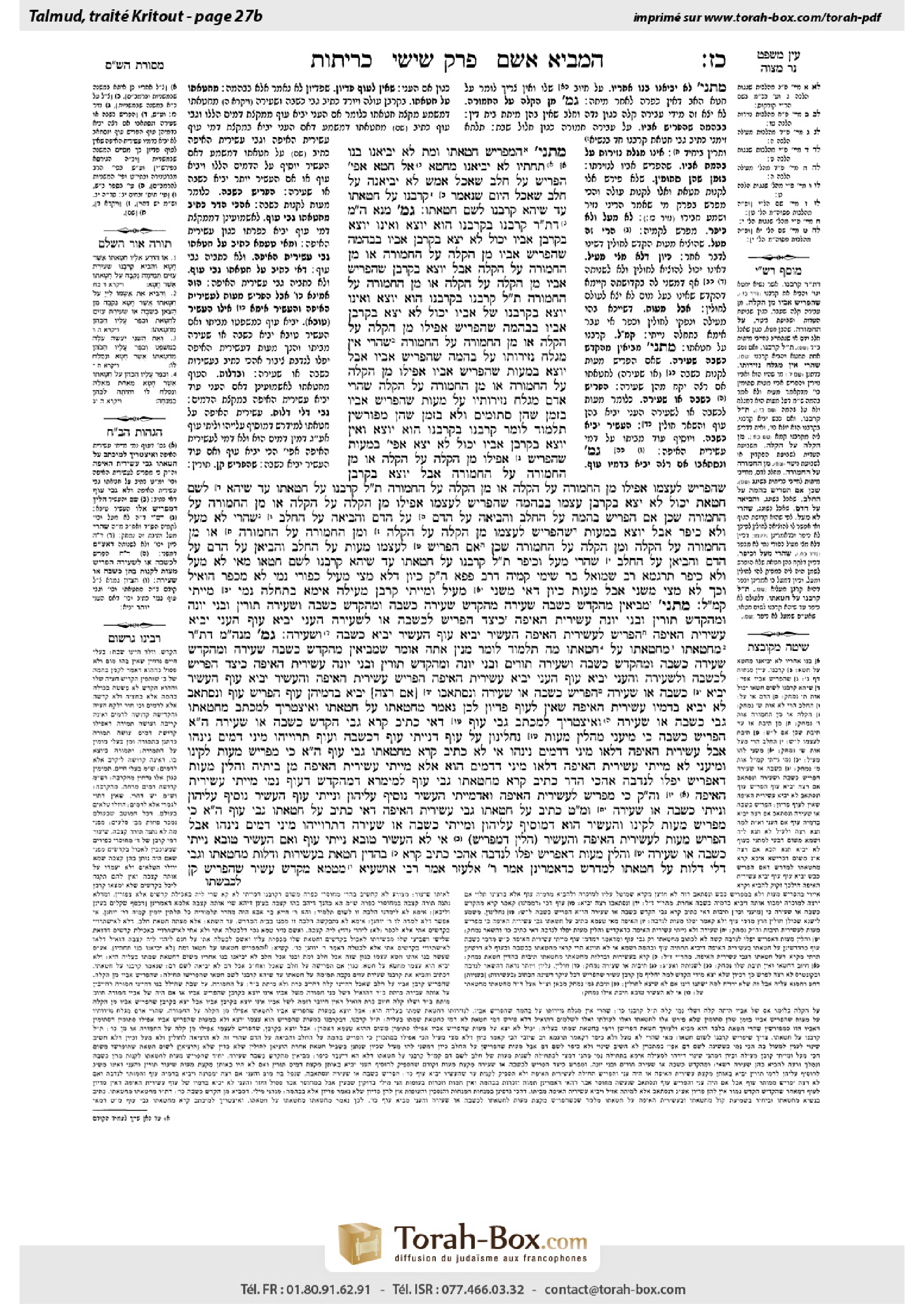
Keritot 27b: Talmud study for Daf Yomi
Daf Yomi is the daily study of one Talmud folio. Explore 37 tractates with scans, Hebrew text, Sefaria English and AI-generated French translations where annotated.
Passage selection and English or AI-generated French translation are available where the scan has annotations. Daf Study is independent of Torah-Box and Sefaria.
Browse Keritot · כריתות · All tractatesKeritot 27b text and translations
This page of Keritot includes the Aramaic text, an English translation and an AI-generated French translation, alongside the scan above.
כריתות כ״ז ב · Aramaic and Hebrew text
מַתְנִי׳ הַמַּפְרִישׁ חַטָּאתוֹ וָמֵת – לֹא יְבִיאֶנּוּ בְּנוֹ תַּחְתָּיו. לֹא יְבִיאֶנּוּ מֵחֵטְא אֶל חֵטְא. אֲפִילּוּ הִפְרִישׁ עַל חֵלֶב שֶׁאָכַל אֶמֶשׁ – לֹא יְבִיאֶנָּה עַל חֵלֶב שֶׁאָכַל הַיּוֹם, שֶׁנֶּאֱמַר: ״קׇרְבָּנוֹ עַל חַטָּאתוֹ״ – עַד שֶׁיְּהֵא קׇרְבָּנוֹ לְשֵׁם חַטָּאתוֹ.
גְּמָ׳ מְנָא הָנֵי מִילֵּי? דְּתָנוּ רַבָּנַן: ״קׇרְבָּנוֹ״ – בְּקׇרְבָּנוֹ הוּא יוֹצֵא, וְאֵינוֹ יוֹצֵא בְּקׇרְבַּן אָבִיו.
יָכוֹל לֹא יֵצֵא בְּקׇרְבַּן אָבִיו בִּבְהֵמָה שֶׁהִפְרִישׁ אָבִיו, מִן הַקַּלָּה עַל הַחֲמוּרָה, אוֹ מִן הַחֲמוּרָה עַל הַקַּלָּה, אֲבָל יוֹצֵא בְּקׇרְבָּן שֶׁהִפְרִישׁ אָבִיו מִן הַקַּלָּה עַל הַקַּלָּה, אוֹ מִן הַחֲמוּרָה עַל הַחֲמוּרָה? תַּלְמוּד לוֹמַר: ״קׇרְבָּנוֹ״ – בְּקׇרְבָּנוֹ הוּא יוֹצֵא, וְאֵינוֹ יוֹצֵא בְּקׇרְבָּנוֹ שֶׁל אָבִיו.
יָכוֹל לֹא יֵצֵא בְּקׇרְבַּן אָבִיו בִּבְהֵמָה שֶׁהִפְרִישׁ, אֲפִילּוּ מִן הַקַּלָּה עַל הַקַּלָּה, אוֹ מִן הַחֲמוּרָה עַל הַחֲמוּרָה, שֶׁהֲרֵי אֵין מְגַלֵּחַ נְזִירוּתוֹ עַל בְּהֵמָה שֶׁהִפְרִישׁ אָבִיו,
אֲבָל יוֹצֵא בְּמָעוֹת שֶׁהִפְרִישׁ אָבִיו, אֲפִילּוּ מִן הַקַּלָּה עַל הַחֲמוּרָה, אוֹ מִן הַחֲמוּרָה עַל הַקַּלָּה, שֶׁהֲרֵי אָדָם מְגַלֵּחַ נְזִירוֹתָיו עַל מָעוֹת שֶׁהִפְרִישׁ אָבִיו, בִּזְמַן שֶׁהֵן סְתוּמִים, וְלֹא בִּזְמַן שֶׁהֵן מְפוֹרָשִׁין? תַּלְמוּד לוֹמַר: ״קׇרְבָּנוֹ״ – בְּקׇרְבָּנוֹ הוּא יוֹצֵא, וְאֵין יוֹצֵא בְּקׇרְבַּן אָבִיו.
יָכוֹל לֹא יֵצֵא אֲפִילּוּ בְּמָעוֹת שֶׁהִפְרִישׁ, אֲפִילּוּ מִן הַקַּלָּה עַל הַקַּלָּה אוֹ מִן הַחֲמוּרָה עַל הַחֲמוּרָה, אֲבָל יוֹצֵא בְּקׇרְבָּן שֶׁהִפְרִישׁ לְעַצְמוֹ, אֲפִילּוּ מִן הַחֲמוּרָה עַל הַקַּלָּה אוֹ מִן הַקַּלָּה עַל הַחֲמוּרָה? תַּלְמוּד לוֹמַר: ״קׇרְבָּנוֹ עַל חַטָּאתוֹ״ – עַד שֶׁיְּהֵא לְשֵׁם חַטָּאת.
יָכוֹל לֹא יֵצֵא בְּקׇרְבָּן עַצְמוֹ בִּבְהֵמָה שֶׁהִפְרִישׁ לְעַצְמוֹ, אֲפִילּוּ מִן הַקַּלָּה עַל הַקַּלָּה, אוֹ מִן הַחֲמוּרָה עַל הַחֲמוּרָה, שֶׁכֵּן אִם הִפְרִישׁ בְּהֵמָה עַל הַחֵלֶב וֶהֱבִיאָהּ עַל הַדָּם, עַל הַדָּם וֶהֱבִיאָהּ עַל הַחֵלֶב – שֶׁהֲרֵי לֹא מָעַל וְלֹא כִּיפֵּר,
אֲבָל יוֹצֵא בְּמָעוֹת שֶׁהִפְרִישׁ לְעַצְמוֹ מִן הַקַּלָּה עַל הַקַּלָּה וּמִן הַחֲמוּרָה עַל הַחֲמוּרָה, אוֹ מִן הַחֲמוּרָה עַל הַקַּלָּה וּמִן הַקַּלָּה עַל הַחֲמוּרָה,
שֶׁכֵּן אִם הִפְרִישׁ לְעַצְמוֹ מָעוֹת עַל הַחֵלֶב וֶהֱבִיאָן עַל הַדָּם, עַל הַדָּם וֶהֱבִיאָן עַל הַחֵלֶב – שֶׁהֲרֵי מָעַל, וְכִיפֵּר? תַּלְמוּד לוֹמַר: ״קׇרְבָּנוֹ עַל חַטָּאתוֹ״ – עַד שֶׁיְּהֵא קׇרְבָּנוֹ לְשֵׁם חֶטְאוֹ.
מַאי לֹא מָעַל וְלֹא כִּיפֵּר? תַּרְגְּמַהּ רַב שְׁמוּאֵל בַּר שִׁימִי קַמֵּיהּ דְּרַב פָּפָּא, הָכִי קָאָמַר: כֵּיוָן דְּלָא מָצֵי מָעֵיל, כַּפּוֹרֵי נָמֵי לָא מְכַפַּר, הוֹאִיל וְכָךְ לָא מָצֵי מְשַׁנֵּי.
אֲבָל מָעוֹת, כֵּיוָן דְּאִי מְשַׁנֵּי מָעֵיל וּמַיְיתֵי קׇרְבַּן מְעִילָה – אֵימָא בַּתְּחִלָּה נָמֵי מַיְיתֵי, קָא מַשְׁמַע לַן.
מַתְנִי׳ מְבִיאִין מֵהֶקְדֵּשׁ כִּשְׂבָּה – שְׂעִירָה, מֵהֶקְדֵּשׁ שְׂעִירָה – כִּשְׂבָּה, וּמֵהֶקְדֵּשׁ כִּשְׂבָּה וּשְׂעִירָה – תּוֹרִין וּבְנֵי יוֹנָה, וּמֵהֶקְדֵּשׁ תּוֹרִין וּבְנֵי יוֹנָה – עֲשִׂירִית הָאֵיפָה.
כֵּיצַד? הִפְרִישׁ לְכִשְׂבָּה אוֹ לִשְׂעִירָה, הֶעֱנִי – יָבִיא עוֹף, הֶעֱנִי – יָבִיא עֲשִׂירִית הָאֵיפָה. הִפְרִישׁ לַעֲשִׂירִית הָאֵיפָה, הֶעֱשִׁיר – יָבִיא עוֹף, הֶעֱשִׁיר – יָבִיא כִּשְׂבָּה וּשְׂעִירָה.
גְּמָ׳ מְנָא הָנֵי מִילֵּי? דְּתָנוּ רַבָּנַן: ״מֵחַטָּאתוֹ״, ״מֵחַטָּאתוֹ״, ״עַל חַטָּאתוֹ״, מָה תַּלְמוּד לוֹמַר?
מִנַּיִן אַתָּה אוֹמֵר שֶׁמְּבִיאִין מֵהֶקְדֵּשׁ כִּשְׂבָּה – שְׂעִירָה, וּמֵהֶקְדֵּשׁ שְׂעִירָה – כִּשְׂבָּה, וּמֵהֶקְדֵּשׁ כִּשְׂבָּה וּשְׂעִירָה – תּוֹרִים וּבְנֵי יוֹנָה, וּמֵהֶקְדֵּשׁ תּוֹרִין וּבְנֵי יוֹנָה – עֲשִׂירִית הָאֵיפָה,
כֵּיצַד? הִפְרִישׁ לְכִשְׂבָּה וְלִשְׂעִירָה וְהֶעֱנִי – יָבִיא עוֹף, הֶעֱנִי – יָבִיא עֲשִׂירִית הָאֵיפָה, הִפְרִישׁ עֲשִׂירִית הָאֵיפָה וְהֶעֱשִׁיר – יָבִיא עוֹף, הֶעֱשִׁיר – יָבִיא כִּשְׂבָּה אוֹ שְׂעִירָה.
הִפְרִישׁ כִּשְׂבָּה אוֹ שְׂעִירָה וְנִסְתָּאֲבוּ – יָבִיא בִּדְמֵיהֶן עוֹף, הִפְרִישׁ עוֹף וְנִסְתָּאֵב – לֹא יָבִיא בְּדָמָיו עֲשִׂירִית הָאֵיפָה, שֶׁאֵין לָעוֹף פִּדְיוֹן.
לָכֵן נֶאֱמַר ״מֵחַטָּאתוֹ״ ״עַל חַטָּאתוֹ״.
וְאִיצְטְרִיךְ לְמִכְתַּב ״מֵחַטָּאתוֹ״ גַּבֵּי כִּשְׂבָּה אוֹ שְׂעִירָה, וְאִיצְטְרִיךְ לְמִכְתַּב גַּבֵּי עוֹף. דְּאִי כְּתִיב קְרָא גַּבֵּי הֶקְדֵּשׁ כִּשְׂבָּה אוֹ שְׂעִירָה, הֲוָה אָמֵינָא: הִפְרִישׁ כִּשְׂבָּה, כִּי מִיעֲנֵי מֵהָלֵין מָעוֹת נַחֲלִינּוּן עַל עוֹף, דְּנַיְיתֵי עוֹף, דְּכִשְׂבָּה וָעוֹף תַּרְוַיְיהוּ מִינֵי דָּמִים נִינְהוּ.
אֲבָל עֲשִׂירִית הָאֵיפָה דְּלָאו מִינֵי דְּדָמִים נִינְהוּ, אִי לָא כְּתִיב קְרָא ״מֵחַטָּאתוֹ״ גַּבֵּי עוֹף, הֲוָה אָמֵינָא: כִּי מַפְרֵישׁ מָעוֹת לְקִינּוֹ וּמִיעֲנֵי – לָא מַיְיתֵי עֲשִׂירִית הָאֵיפָה, דְּלָאו מִינֵי דְּדָמִים הוּא, אֶלָּא מַיְיתֵי עֲשִׂירִית הָאֵיפָה מִן בֵּיתֵיהּ, וְהָלֵין מָעוֹת דְּאַפְרֵישׁ יִפְּלוּ לִנְדָבָה – אַהָכִי הֲדַר כְּתִיב קְרָא ״מֵחַטָּאתוֹ״ גַּבֵּי עוֹף, לְמֵימְרָא דְּמֵהֶקְדֵּשׁ דְּעוֹף נָמֵי מַיְיתֵי עֲשִׂירִית הָאֵיפָה,
וְהָכִי קָאָמַר: כִּי מַפְרִישׁ לַעֲשִׂירִית הָאֵיפָה, וְאַדְּמַיְיתֵי הֶעֱשִׁיר – נוֹסֵיף עֲלֵיהוֹן וְנַיְיתֵי עוֹף, הֶעֱשִׁיר – נוֹסֵיף עֲלֵיהוֹן וְנַיְיתֵי כִּשְׂבָּה אוֹ שְׂעִירָה.
וּמַאי טַעְמָא כְּתִיב ״עַל חַטָּאתוֹ״ גַּבֵּי עֲשִׂירִית הָאֵיפָה? דְּאִי כְּתַיב ״עַל חַטָּאתוֹ״ גַּבֵּי עוֹף, הֲוָה אָמֵינָא: כִּי מַפְרֵישׁ מָעוֹת לְקִינּוֹ וְהֶעֱשִׁיר – הוּא דְּמוֹסֵיף עֲלֵיהוֹן וּמַיְיתֵי כִּשְׂבָּה אוֹ שְׂעִירָה, דְּתַרְוַיְיהוּ מִינֵי דָמִים נִינְהוּ,
אֲבָל הִפְרִישׁ מָעוֹת לַעֲשִׂירִית הָאֵיפָה וְהֶעֱשִׁיר, הָלֵין דְּמַפְרֵישׁ, אִי לָא הֶעֱשִׁיר טוּבָא – נַיְיתֵי עוֹף, וְאִם הֶעֱשִׁיר טוּבָא – נַיְיתֵי כִּשְׂבָּה אוֹ שְׂעִירָה, וְהָלֵין מָעוֹת דְּאַפְרֵישׁ יִפְּלוּ לִנְדָבָה, אַהָכִי כְּתִיב קְרָא בְּהָדֵין חַטָּאת בַּעֲשִׁירוּת וְדַלּוּת ״מֵחַטָּאתוֹ״, וְגַבֵּי דַּלֵּי דַלּוּת ״עַל חַטָּאתוֹ״ – לְמִדְרַשׁ כִּדְאָמְרִינַן.
אָמַר רַבִּי אֶלְעָזָר אָמַר רַבִּי אוֹשַׁעְיָא: מְטַמֵּא מִקְדָּשׁ עָשִׁיר שֶׁהִפְרִישׁ קֵן
Keritot 27b · English translation
MISHNA: In the case of one who designates a sin offering for his performance of an unwitting sin and dies, his son shall not bring it in his stead, neither on behalf of his father nor for his own unwitting sin, even if it was the same transgression. Likewise, one may not bring a sin offering by reassigning it from the sin for which it is designated to atone and sacrificing it for atonement of another sin. Even if he designated a sin offering as atonement for forbidden fat that he unwittingly ate yesterday, he may not bring it as atonement for forbidden fat that he unwittingly ate today, as it is stated: “And he shall bring his sin offering, an unblemished female goat, for his sin that he has sinned” (Leviticus 4:28), indicating that he does not satisfy his obligation until his offering is brought for the sake of the sin for which he designated it.
GEMARA: The Gemara asks: From where is this matter, i.e., that a son may not bring his father’s sin offering, derived? The Gemara answers that it is derived as the Sages taught in a baraita: The Torah states with regard to a sin offering: “And he shall bring for his offering” (Leviticus 4:23). This indicates that one fulfills his obligation with his own offering, but he does not fulfill his obligation with his father’s offering, if his father was obligated to bring a sin offering and died after he designated an animal for this purpose.
One might have thought that one does not fulfill his obligation with his father’s offering by means of an animal that his father designated, only in a case where the son’s transgression is not equal in severity to his father’s sin, e.g., from a lenient transgression committed by the father for a severe sin of the son, or from a severe transgression of the father for a lenient one of the son. But perhaps he does fulfill his obligation with the offering that his father designated, from a lenient sin for a lenient sin of the son, or from a severe transgression committed by the father for a severe one of the son. Therefore, the verse states a second time: “His offering” (Leviticus 4:28), to emphasize that he fulfills his obligation with his own offering, but he does not fulfill his obligation with his father’s offering, even for similar transgressions.
The baraita continues: One might have thought that one does not fulfill his obligation with his father’s offering by means of an animal that the father designated, even from a lenient sin for a lenient one, or from a severe transgression for a severe one, as stated above, as a person cannot shave, i.e., bring the offerings sacrificed, at the end of his term of naziriteship with an animal that his father designated. If the father died, the son cannot bring an animal that the father designated as an offering for the conclusion of his naziriteship.
But one might think that a son can fulfill his obligation with money that his father designated for his offering, even from a lenient sin for a severe one, or from a severe transgression for a lenient one, as a person can shave i.e., bring the offerings sacrificed, at the end of his term of naziriteship with the money his father designated for naziriteship when the money is unallocated but not when it is allocated for a specific nazirite offering. Therefore, the verse states again: “His offering” (Leviticus 4:32), indicating that he fulfills his obligation with his own offering, but he does not fulfill his obligation even with money that was designated for his father’s offering.
The baraita further states: One might have thought that one does not fulfill his obligation even with the money that his father designated, even when father and son committed transgressions of the same severity, i.e., from a lenient sin for a lenient one or from a severe transgression for a severe one; but one may fulfill his obligation with the offering that he designated for himself, even from a severe transgression for a lenient one, or from a lenient one for a severe one. Therefore, the verse states: “His offering for his sin” (Leviticus 4:28), indicating that he does not fulfill his obligation until his offering is sacrificed for the sake of the specific sin for which it was designated.
Furthermore, one might have thought that one has not fulfilled his obligation to bring an offering for himself with an animal that he designated for himself, even with an animal designated for a lenient sin that is then used for a different lenient sin or from a severe one for a different severe one. This is because if he designated an animal as a sin offering for unintentionally eating forbidden fat and he brought that sin offering for unintentionally consuming blood, or if he designated a sin offering for consuming blood and brought it for the transgression of consuming forbidden fat, it is invalid, as in this case he is not considered to have misused consecrated property and this animal does not atone for him. This statement will be explained below.
The baraita continues: But it might have been thought that one fulfills his obligation with money that he designated for himself, with money designated for a lenient sin for a different lenient sin, or with money designated for a severe sin for another severe sin, or from a severe one for a lenient one, or from a lenient one for a severe one.
The reason is that if he designated money for himself for purchasing a sin offering for unintentionally eating forbidden fat and he instead brought a sin offering with that money for consuming blood; or if he designated money for purchasing a sin offering for the transgression of consuming blood and brought the sin offering for the transgression of consuming forbidden fat, in that case he has misused Temple property, and the money atones for him. Therefore, the verse states: “His offering for his sin,” which indicates that he does not fulfill his obligation until his offering, and even the money designated for an offering, is designated for the sake of his particular sin.
The Gemara asks: What is the meaning of the phrase in the baraita: He is not considered to have misused consecrated property and this animal does not atone for him? Rav Shmuel bar Shimi interpreted this before Rav Pappa: This is what the baraita is saying: Since one cannot misuse this animal, i.e., an animal consecrated for sacrifice upon the altar cannot be desacralized, so too, one cannot achieve atonement for another sin with that animal. Since it is so, it is clear that one is unable to convert the animal for use as an offering for a different sin.
But with regard to money, since if one unwittingly converted the money for a different use he has misused consecrated property, the money is consequently desacralized, and he is liable to bring an offering for misuse of consecrated property, therefore one might say that from the outset too, he may use the money to bring an offering for a different sin. Consequently, the baraita teaches us that one may not do so.
MISHNA: One may bring a female goat from money consecrated for a sin offering of a female lamb, and a female lamb from money consecrated for a sin offering of a female goat. And likewise, one may bring doves and pigeons from money consecrated for a sin offering of a female lamb and a female goat; and one-tenth of an ephah of fine flour from money consecrated for a sin offering of doves and pigeons.
How so? If one unwittingly performed a sin for which he is liable to bring a sliding-scale sin offering, which varies based on economic status (see Leviticus 5:1–13; see also 9a), and he designated money to purchase a female lamb or for a female goat and then became poorer, he may bring a bird, and the remaining money is non-sacred. If he became yet poorer, he may bring one-tenth of an ephah of fine flour. Likewise, if he designated money to purchase one-tenth of an ephah of fine flour and became wealthier, he shall bring a bird. If he became yet wealthier, he shall bring a female lamb or a female goat.
GEMARA: The Gemara asks: From where are these matters that are mentioned in the mishna derived? The Gemara answers that they are derived from a verse, as the Sages taught in a baraita that discusses the sliding-scale offering: It is written with regard to one who brings a lamb for his obligation: “And the priest shall make atonement for him from his sin” (Leviticus 5:6); and it is written with regard to one who brings a bird: “And the priest shall make atonement for him from his sin” (Leviticus 5:10); and it is written with regard to one who brings one-tenth of an ephah of fine flour: “Over his sin” (Leviticus 5:13). What is the meaning of these phrases that the verse states?
The baraita explains: From where is it derived that you say that one may bring a female goat from money consecrated for a sin offering of a female lamb, and a female lamb from money consecrated for a sin offering of a female goat? And likewise, from where is it derived that one may bring doves and pigeons from money consecrated for a sin offering of a female lamb and a female goat, and one-tenth of an ephah of fine flour from money consecrated for a sin offering of doves and pigeons?
How so? If a person designated money to purchase a female lamb or to purchase a female goat and then became poorer, he shall bring a bird, and the remaining money is non-sacred. If he became yet poorer, he shall bring one-tenth of an ephah of fine flour. Likewise, if he designated money to purchase one-tenth of an ephah of fine flour and became wealthier, he shall bring a bird. If he became yet wealthier, he shall bring a female lamb or a female goat.
If one designated a female lamb or goat as an offering and it developed a blemish, he must redeem the animal and bring another offering with the money. If he became poorer, he may bring a bird with its money. But if one designated a bird as an offering and it developed a blemish, he may not bring one-tenth of an ephah of fine flour with its money, as there is no possibility of redemption for birds.
The baraita provides the source for this entire halakha: Therefore, with regard to an offering of a female goat or lamb and a bird offering it is stated: “From his sin,” which indicates that one fulfills his obligation with even part of the money that was designated for his offering. By contrast, with regard to an offering of one-tenth of an ephah of fine flour it is written: “Over his sin,” indicating that if one becomes wealthier he must add to the value of his offering.
And it was necessary for the Torah to write: “From his sin,” with regard to a female lamb or a female goat, and it was necessary to write the same phrase with regard to a bird. The Gemara explains: As, if the verse had written this phrase only with regard to a consecrated female lamb or a female goat, I would say that if one designated money to purchase a female lamb, then when he became poorer he may redeem that money on a bird and bring a bird offering, as a female lamb and a bird are both types of blood offerings.
But with regard to one-tenth of an ephah of fine flour, which is not a type of blood offering but a meal offering, if the verse had not written: “From his sin,” with regard to a bird, I would say that if one designates money for his nest, i.e., pair of birds, and then becomes poorer, he may not bring one-tenth of an ephah of fine flour with that money, as it is not a type of blood offering. Rather, he brings one-tenth of an ephah of fine flour from his house, i.e., with other money, and that money that he designated for his bird pair is allocated for communal gift offerings. Therefore, the verse repeats and writes: “From his sin,” with regard to a bird, to say that one may also bring one-tenth of an ephah of fine flour from money consecrated for a sin offering of birds.
And with regard to the phrase: “Over his sin,” which is written in connection to the one-tenth of an ephah of fine flour, this is what the verse is saying: When one designates money for an offering of one-tenth of an ephah of fine flour, and before he brought the money to the Temple to purchase the offering he grew wealthier, he must add money to those coins and bring a bird. If he grew even wealthier, he must add money to them and bring a female lamb or a female goat.
And what is the reason that the phrase: “Over his sin,” is written specifically with regard to the one-tenth of an ephah of fine flour? The reason is that if the verse had stated: Over his sin, with regard to a bird, I would say that it is only when one designates money for his nest and then becomes wealthier that one must add money and bring a female lamb or a female goat, as they are both types of blood offerings.
But in a case where one designated money to purchase one-tenth of an ephah of fine flour and became wealthier, perhaps he may not add to the money that he designated earlier. And if he did not become much wealthier he now brings a bird, and if he became much wealthier he now brings a female lamb or a female goat, without using the money he had designated for the one-tenth of the ephah of flour. And that money which he initially designated for one-tenth of an ephah of fine flour is allocated for communal gift offerings. It is for this reason that the verse states: “From his sin,” with regard to that sin offering which one brings when rich and when poor, i.e., a lamb and a bird, and: “Over his sin,” with regard to that which he brings when he is exceedingly poor, i.e., one-tenth of an ephah of fine flour, so that one should interpret the verses as we said, that in either case he adds to the money he had designated to bring the more expensive offering.
Rabbi Elazar says that Rabbi Oshaya says: A wealthy person who defiles the Temple, i.e., he enters the Temple while ritually impure, is obligated to bring a female lamb or goat as his offering in accordance with his wealth. If he designated a nest, i.e., a pair of birds,
Keritot 27b · Traduction française (IA)
MICHNA : Si quelqu’un désigne un sacrifice expiatoire pour une faute qu’il a commise par inadvertance, puis meurt, son fils ne peut pas l’apporter à sa place, ni au nom de son père ni pour expier sa propre faute commise par inadvertance, même s’il s’agit de la même transgression. De même, on ne peut pas réaffecter un sacrifice expiatoire, désigné pour expier une faute, afin de l’offrir pour une autre faute. Même s’il a désigné un sacrifice expiatoire pour la consommation involontaire de graisse interdite la veille, il ne peut pas l’apporter pour expier la consommation involontaire de graisse interdite commise le jour même, comme il est dit : « Et il apportera son sacrifice expiatoire, une chèvre sans défaut, pour la faute qu’il a commise » (Lévitique 4,28). Cela indique qu’il ne s’acquitte de son obligation que lorsque son sacrifice est offert pour la faute en vue de laquelle il l’a désigné.
GUEMARA : La Guemara demande : D’où tire-t-on cette règle, selon laquelle un fils ne peut pas apporter le sacrifice expiatoire de son père ? La Guemara répond qu’elle découle de l’enseignement des Sages dans une baraïta : À propos du sacrifice expiatoire, la Torah dit : « Et il apportera son offrande » (Lévitique 4,23). Cela indique qu’on s’acquitte de son obligation avec sa propre offrande, mais pas avec celle de son père, si celui-ci était tenu d’apporter un sacrifice expiatoire et est mort après avoir désigné un animal à cette fin.
On aurait pu penser qu’on ne s’acquitte pas de son obligation avec l’animal désigné par son père uniquement lorsque la transgression du fils n’est pas d’une gravité égale à celle de la faute de son père, par exemple si le père a commis une faute légère et le fils une faute grave, ou si le père a commis une faute grave et le fils une faute légère. Mais peut-être le fils s’acquitte-t-il de son obligation avec l’offrande désignée par son père lorsque leurs fautes sont de même gravité : une faute légère pour une faute légère, ou une faute grave pour une faute grave. C’est pourquoi le verset dit une seconde fois : « Son offrande » (Lévitique 4,28), pour souligner qu’on s’acquitte de son obligation avec sa propre offrande, mais pas avec celle de son père, même pour des transgressions semblables.
La baraïta poursuit : On aurait pu penser qu’on ne s’acquitte pas de son obligation avec l’animal désigné par son père, même lorsque leurs fautes sont de même gravité, comme on l’a dit, puisqu’un homme ne peut pas accomplir les rites de la fin de son naziréat — c’est-à-dire apporter les sacrifices requis — avec un animal que son père avait désigné. Si le père meurt, son fils ne peut pas apporter un animal que son père avait désigné comme offrande pour la fin de son naziréat.
Mais on aurait pu penser qu’un fils peut s’acquitter de son obligation avec l’argent que son père avait désigné pour son offrande, même si le père l’avait destiné à expier une faute légère et le fils une faute grave, ou inversement. En effet, un homme peut accomplir les rites de la fin de son naziréat — c’est-à-dire apporter les sacrifices requis — avec l’argent que son père avait désigné pour son naziréat, lorsque cet argent n’a pas été affecté, mais pas lorsqu’il a été affecté à une offrande précise de naziréen. C’est pourquoi le verset dit encore : « Son offrande » (Lévitique 4,32), indiquant qu’on s’acquitte de son obligation avec sa propre offrande, mais pas même avec l’argent désigné pour l’offrande de son père.
La baraïta ajoute : On aurait pu penser qu’on ne s’acquitte pas de son obligation même avec l’argent que son père avait désigné lorsque le père et le fils ont commis des transgressions de même gravité, c’est-à-dire une faute légère pour une faute légère ou une faute grave pour une faute grave ; mais qu’on peut s’acquitter de son obligation avec l’offrande qu’on a désignée pour soi-même, même si elle a été désignée pour une faute grave et qu’on l’apporte pour une faute légère, ou inversement. C’est pourquoi le verset dit : « Son offrande pour sa faute » (Lévitique 4,28), indiquant qu’on ne s’acquitte de son obligation que lorsque son offrande est sacrifiée pour la faute précise en vue de laquelle elle a été désignée.
En outre, on aurait pu penser qu’on ne s’acquitte pas de l’obligation d’apporter une offrande pour soi-même avec un animal qu’on a désigné pour soi-même, même si l’on a désigné un animal pour une faute légère et qu’on l’utilise ensuite pour une autre faute légère, ou pour une faute grave et qu’on l’utilise ensuite pour une autre faute grave. En effet, si quelqu’un désigne un animal comme sacrifice expiatoire pour avoir consommé par inadvertance de la graisse interdite et qu’il l’apporte pour avoir consommé du sang par inadvertance, ou s’il désigne un sacrifice expiatoire pour avoir consommé du sang et l’apporte pour avoir consommé de la graisse interdite, l’offrande est invalide : dans ce cas, il n’est pas considéré comme ayant détourné un bien consacré, et cet animal n’expie pas sa faute. Cette affirmation sera expliquée plus loin.
La baraïta poursuit : Mais on aurait pu penser qu’on s’acquitte de son obligation avec l’argent qu’on a désigné pour soi-même, que cet argent ait été destiné à expier une faute légère et qu’on l’utilise pour une autre faute légère, une faute grave pour une autre faute grave, une faute grave pour une faute légère, ou une faute légère pour une faute grave.
En effet, si quelqu’un a désigné de l’argent pour acheter un sacrifice expiatoire en raison de la consommation involontaire de graisse interdite et qu’il utilise cet argent pour apporter un sacrifice expiatoire en raison de la consommation de sang, ou s’il a désigné de l’argent pour acheter un sacrifice expiatoire en raison de la consommation de sang et l’utilise pour apporter un sacrifice expiatoire en raison de la consommation de graisse interdite, il a alors détourné un bien du Temple, et l’argent expie sa faute. C’est pourquoi le verset dit : « Son offrande pour sa faute », ce qui indique qu’on ne s’acquitte de son obligation que lorsque son offrande — et même l’argent destiné à une offrande — a été affectée à sa faute particulière.
La Guemara demande : Que signifie la phrase de la baraïta : « Il n’est pas considéré comme ayant détourné un bien consacré, et cet animal n’expie pas sa faute » ? Rav Shmuel bar Shimi l’a expliquée devant Rav Pappa : Voici ce que dit la baraïta : puisqu’on ne peut pas détourner cet animal — c’est-à-dire qu’un animal consacré à un sacrifice sur l’autel ne peut pas être désacralisé —, on ne peut pas non plus obtenir l’expiation d’une autre faute au moyen de cet animal. Dès lors, il est clair qu’on ne peut pas réaffecter l’animal pour en faire une offrande destinée à une autre faute.
Mais pour l’argent, puisque celui qui le réaffecte par inadvertance à un autre usage détourne un bien consacré, l’argent est alors désacralisé et il est tenu d’apporter une offrande pour le détournement d’un bien consacré. On pourrait donc dire qu’il peut aussi, dès le départ, utiliser cet argent pour apporter une offrande destinée à une autre faute. La baraïta nous enseigne qu’il ne peut pas agir ainsi.
MICHNA : On peut acheter une chèvre avec de l’argent consacré à l’achat d’un sacrifice expiatoire constitué d’une agnelle, et une agnelle avec de l’argent consacré à l’achat d’un sacrifice expiatoire constitué d’une chèvre. De même, on peut acheter des tourterelles ou des pigeons avec de l’argent consacré à l’achat d’un sacrifice expiatoire constitué d’une agnelle ou d’une chèvre ; et un dixième d’épha de farine fine avec de l’argent consacré à l’achat d’un sacrifice expiatoire constitué de tourterelles ou de pigeons.
Comment cela ? Si quelqu’un commet par inadvertance une faute pour laquelle il est tenu d’apporter un sacrifice expiatoire à offrande variable, dont la nature dépend de sa situation financière (voir Lévitique 5,1-13 ; voir aussi 9a), et qu’il désigne de l’argent pour acheter une agnelle ou une chèvre, puis s’appauvrit, il peut apporter un oiseau, et l’argent restant est profane. S’il s’appauvrit davantage, il peut apporter un dixième d’épha de farine fine. De même, s’il désigne de l’argent pour acheter un dixième d’épha de farine fine et qu’il s’enrichit, il doit apporter un oiseau. S’il s’enrichit davantage, il doit apporter une agnelle ou une chèvre.
GUEMARA : La Guemara demande : D’où viennent les règles mentionnées dans la Michna ? La Guemara répond qu’elles découlent d’un verset, comme l’enseignent les Sages dans une baraïta sur l’offrande à valeur variable : À propos de celui qui apporte un agneau pour s’acquitter de son obligation, il est écrit : « Et le prêtre fera expiation pour lui à cause de sa faute » (Lévitique 5,6) ; à propos de celui qui apporte un oiseau, il est écrit : « Et le prêtre fera expiation pour lui à cause de sa faute » (Lévitique 5,10) ; et à propos de celui qui apporte un dixième d’épha de farine fine, il est écrit : « Pour sa faute » (Lévitique 5,13). Que signifient ces expressions dans le verset ?
La baraïta explique : D’où tire-t-on qu’on peut acheter une chèvre avec de l’argent consacré à l’achat d’un sacrifice expiatoire constitué d’une agnelle, et une agnelle avec de l’argent consacré à l’achat d’un sacrifice expiatoire constitué d’une chèvre ? De même, d’où tire-t-on qu’on peut acheter des tourterelles ou des pigeons avec de l’argent consacré à l’achat d’un sacrifice expiatoire constitué d’une agnelle ou d’une chèvre, et un dixième d’épha de farine fine avec de l’argent consacré à l’achat d’un sacrifice expiatoire constitué de tourterelles ou de pigeons ?
Comment cela ? Si quelqu’un désigne de l’argent pour acheter une agnelle ou une chèvre, puis s’appauvrit, il doit apporter un oiseau, et l’argent restant est profane. S’il s’appauvrit davantage, il doit apporter un dixième d’épha de farine fine. De même, s’il désigne de l’argent pour acheter un dixième d’épha de farine fine et qu’il s’enrichit, il doit apporter un oiseau. S’il s’enrichit davantage, il doit apporter une agnelle ou une chèvre.
Si quelqu’un désigne une agnelle ou une chèvre comme offrande et que l’animal développe un défaut, il doit le racheter et apporter une autre offrande avec l’argent obtenu. S’il s’est appauvri, il peut apporter un oiseau avec cet argent. Mais si quelqu’un désigne un oiseau comme offrande et que celui-ci développe un défaut, il ne peut pas apporter un dixième d’épha de farine fine avec l’argent obtenu, car les oiseaux ne peuvent pas être rachetés.
La baraïta donne la source de cette halakha dans son ensemble : à propos de l’offrande d’une chèvre ou d’une agnelle et de l’offrande d’un oiseau, il est écrit : « À cause de sa faute », ce qui indique qu’on s’acquitte de son obligation même avec une partie de l’argent désigné pour son offrande. En revanche, à propos de l’offrande d’un dixième d’épha de farine fine, il est écrit : « Pour sa faute », ce qui indique que si l’on s’enrichit, on doit augmenter la valeur de son offrande.
Il était nécessaire que la Torah écrive « À cause de sa faute » à propos d’une agnelle ou d’une chèvre, et qu’elle écrive la même expression à propos d’un oiseau. La Guemara explique : en effet, si le verset n’avait employé cette expression qu’à propos d’une agnelle ou d’une chèvre consacrée, j’aurais dit que si quelqu’un désigne de l’argent pour acheter une agnelle, puis s’appauvrit, il peut convertir cet argent pour acheter un oiseau et apporter une offrande d’oiseau, puisque l’agnelle et l’oiseau sont tous deux des offrandes sanglantes.
Mais, pour un dixième d’épha de farine fine, qui n’est pas une offrande sanglante mais une offrande végétale, si le verset n’avait pas employé l’expression « À cause de sa faute » à propos d’un oiseau, j’aurais dit que si quelqu’un désigne de l’argent pour son nid, c’est-à-dire une paire d’oiseaux, puis s’appauvrit, il ne peut pas acheter un dixième d’épha de farine fine avec cet argent, puisqu’il ne s’agit pas d’une offrande sanglante. Il apporte plutôt un dixième d’épha de farine fine avec de l’argent provenant de ses propres fonds, et l’argent qu’il avait désigné pour sa paire d’oiseaux est affecté aux offrandes volontaires de la communauté. C’est pourquoi le verset répète l’expression « À cause de sa faute » à propos d’un oiseau, pour enseigner qu’on peut également acheter un dixième d’épha de farine fine avec de l’argent consacré à un sacrifice expiatoire d’oiseaux.
Quant à l’expression « Pour sa faute », employée à propos du dixième d’épha de farine fine, voici ce que dit le verset : lorsqu’on désigne de l’argent pour une offrande d’un dixième d’épha de farine fine et qu’on s’enrichit avant d’apporter l’argent au Temple pour acheter l’offrande, on doit ajouter de l’argent à la somme désignée et apporter un oiseau. Si l’on s’enrichit davantage, on doit encore ajouter de l’argent à cette somme et apporter une agnelle ou une chèvre.
Pourquoi l’expression « Pour sa faute » est-elle employée précisément à propos du dixième d’épha de farine fine ? Parce que si le verset l’avait employée à propos d’un oiseau, j’aurais dit que c’est uniquement lorsqu’on désigne de l’argent pour son nid puis qu’on s’enrichit qu’on doit ajouter de l’argent et apporter une agnelle ou une chèvre, puisque les deux sont des offrandes sanglantes.
Mais lorsqu’une personne désigne de l’argent pour acheter un dixième d’épha de farine fine puis s’enrichit, peut-être n’a-t-elle pas à ajouter de l’argent à la somme désignée auparavant. Si elle ne s’est pas beaucoup enrichie, elle apporte alors un oiseau ; et si elle s’est beaucoup enrichie, elle apporte alors une agnelle ou une chèvre, sans utiliser l’argent qu’elle avait désigné pour le dixième d’épha de farine fine. Cet argent, initialement désigné pour un dixième d’épha de farine fine, est affecté aux offrandes volontaires de la communauté. C’est pourquoi le verset emploie l’expression « À cause de sa faute » à propos du sacrifice expiatoire qu’on apporte lorsqu’on est riche ou pauvre, c’est-à-dire une agnelle ou un oiseau, et l’expression « Pour sa faute » à propos de l’offrande qu’on apporte lorsqu’on est extrêmement pauvre, c’est-à-dire un dixième d’épha de farine fine, afin que l’on interprète les versets comme nous l’avons indiqué : dans les deux cas, on ajoute de l’argent à la somme désignée pour apporter l’offrande la plus coûteuse.
Rabbi Elazar dit au nom de Rabbi Oshaya : Un homme riche qui profane le Temple, c’est-à-dire qui y entre en état d’impureté rituelle, est tenu d’apporter une agnelle ou une chèvre comme offrande, conformément à sa richesse. S’il a désigné un nid, c’est-à-dire une paire d’oiseaux,
Traduction française générée par IA à partir de l’édition anglaise de Sefaria. Vérifie toujours un passage avec le texte source.
Text from Sefaria: William Davidson Edition - Vocalized Aramaic (CC BY NC); William Davidson Edition - English (CC BY NC).