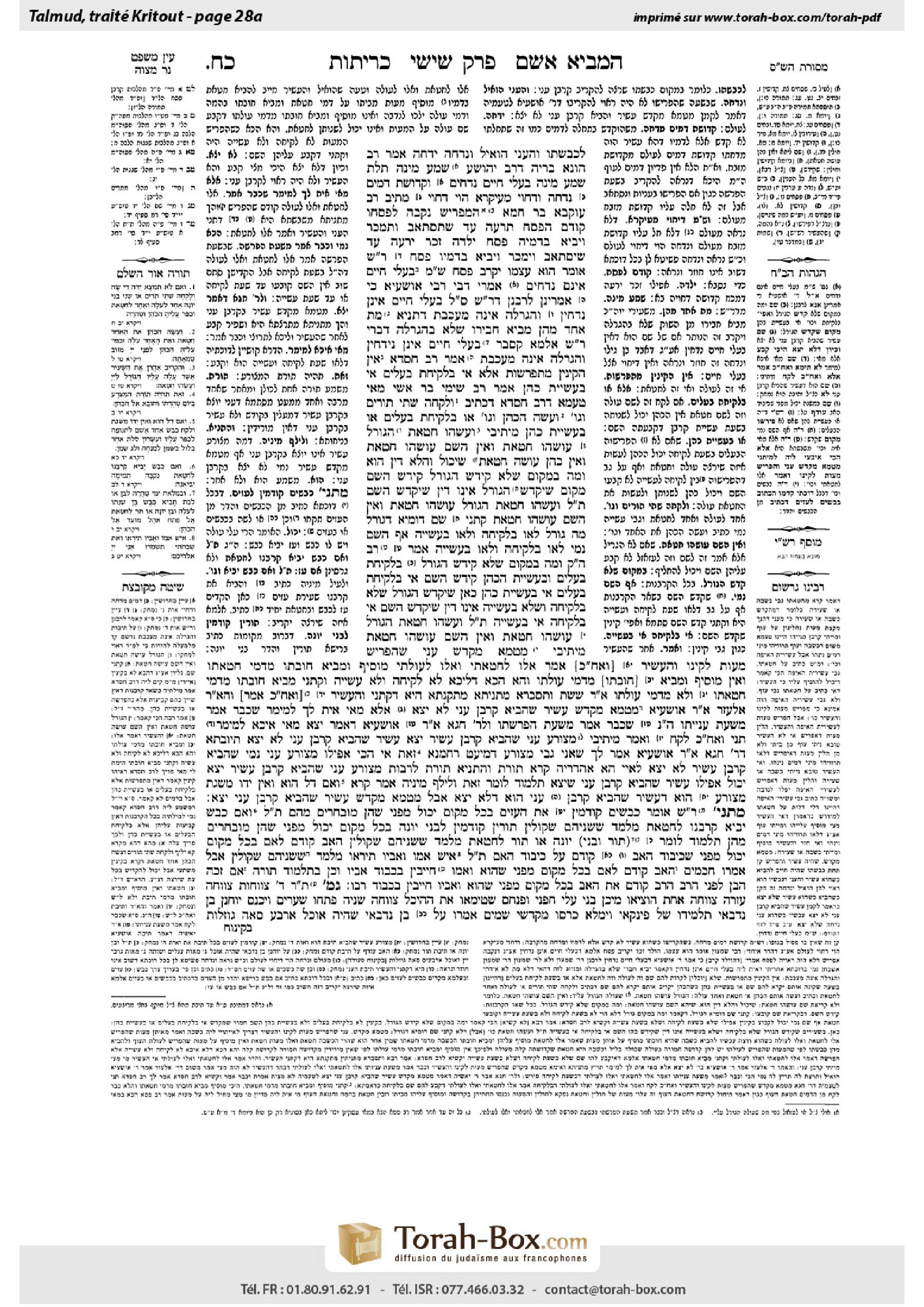
Keritot 28a: Talmud study for Daf Yomi
Daf Yomi is the daily study of one Talmud folio. Explore 37 tractates with scans, Hebrew text, Sefaria English and AI-generated French translations where annotated.
Passage selection and English or AI-generated French translation are available where the scan has annotations. Daf Study is independent of Torah-Box and Sefaria.
Browse Keritot · כריתות · All tractatesKeritot 28a text and translations
This page of Keritot includes the Aramaic text, an English translation and an AI-generated French translation, alongside the scan above.
כריתות כ״ח א · Aramaic and Hebrew text
לְכִבְשָׂתוֹ, וְהֶעֱנִי. הוֹאִיל וְנִדְחָה – יִדָּחֶה.
אָמַר רַב הוּנָא בְּרֵיהּ דְּרַב יְהוֹשֻׁעַ, שְׁמַע מִינָה תְּלָת: שְׁמַע מִינַּהּ בַּעֲלֵי חַיִּים נִדְחִים. וּקְדוּשַּׁת דָּמִים (נִדְחָה).
וְדָחוּי מֵעִיקָּרָא הָוֵי דָּחוּי.
מֵתִיב רַב עוּקְבָא בַּר חָמָא: הַמַּפְרִישׁ נְקֵבָה לְפִסְחוֹ קוֹדֶם הַפֶּסַח – תִּרְעֶה עַד שֶׁתִּסְתָּאֵב, וְתִמָּכֵר וְיָבִיא בְּדָמֶיהָ פֶּסַח. יָלְדָה זָכָר – יִרְעֶה עַד שֶׁיִּסְתָּאֵב, וְיִמָּכֵר וְיָבִיא בְּדָמָיו פֶּסַח.
רַבִּי שִׁמְעוֹן אוֹמֵר: הוּא עַצְמוֹ יִקְרַב פֶּסַח. שְׁמַע מִינַּהּ, בַּעֲלֵי חַיִּים אֵינָם נִדְחִים!
אָמְרִי דְּבֵי רַבִּי אוֹשַׁעְיָא: כִּי אָמְרִינַן לְרַבָּנַן (דְ)רַבִּי שִׁמְעוֹן סְבִירָא לֵיהּ בַּעֲלֵי חַיִּים אֵינָן נִדְחִין,
וְהַגְרָלָה אֵינָהּ מְעַכֶּבֶת. דְּתַנְיָא: מֵת אֶחָד מֵהֶן – מֵבִיא חֲבֵירוֹ שֶׁלֹּא בְּהַגְרָלָה, דִּבְרֵי רַבִּי שִׁמְעוֹן.
אַלְמָא קָסָבַר בַּעֲלֵי חַיִּים אֵינָן נִידְחִין, וְהַגְרָלָה אֵינָהּ מְעַכֶּבֶת.
אָמַר רַב חִסְדָּא: אֵין הַקִּינִּין מִתְפָּרְשׁוֹת, אֶלָּא אִי בִּלְקִיחַת בְּעָלִים, אִי בַּעֲשִׂיַּית כֹּהֵן.
אָמַר רַב שִׁימִי בַּר אָשֵׁי: מַאי טַעְמָא דְּרַב חִסְדָּא? דִּכְתִיב: ״וְלָקְחָה שְׁתֵּי תוֹרִים וְגוֹ׳״, ״וְעָשָׂה הַכֹּהֵן וְגוֹ׳״ – אוֹ בִּלְקִיחַת בְּעָלִים, אוֹ בַּעֲשִׂיַּית כֹּהֵן.
מֵיתִיבִי: ״וְעָשָׂהוּ חַטָּאת״ – הַגּוֹרָל עוֹשֵׂהוּ חַטָּאת, וְאֵין הַשֵּׁם עוֹשֵׂהוּ חַטָּאת, וְאֵין כֹּהֵן עוֹשֶׂה חַטָּאת.
שֶׁיָּכוֹל: וַהֲלֹא דִין הוּא, וּמָה בִּמְקוֹם שֶׁלֹּא קִידֵּשׁ הַגּוֹרָל – קִידֵּשׁ הַשֵּׁם, מְקוֹם שֶׁיקִּדֵּשׁ הַגּוֹרָל – אֵינוֹ דִּין שֶׁיְּקַדֵּשׁ הַשֵּׁם?
תַּלְמוּד לוֹמַר: ״וְעָשָׂהוּ חַטָּאת״, הַגּוֹרָל עוֹשֵׂהוּ חַטָּאת, וְאֵין הַשֵּׁם עוֹשֵׂהוּ חַטָּאת.
קָתָנֵי שֵׁם דּוּמְיָא דְּגוֹרָל: מָה גּוֹרָל לָאו בִּלְקִיחָה וְלָאו בַּעֲשִׂיָּיה, אַף הַשֵּׁם נָמֵי לָאו בִּלְקִיחָה וְלָאו בַּעֲשִׂיָּיה!
אָמַר רַב, הָכִי קָאָמַר: וּמָה בִּמְקוֹם שֶׁלֹּא קִידֵּשׁ הַגּוֹרָל בִּלְקִיחַת בְּעָלִים וּבַעֲשִׂיַּית הַכֹּהֵן – קִידֵּשׁ הַשֵּׁם, אִי בִּלְקִיחַת בְּעָלִים אִי בַּעֲשִׂיַּית כֹּהֵן. כָּאן שֶׁקִּדֵּשׁ הַגּוֹרָל שֶׁלֹּא בִּלְקִיחָה וְשֶׁלֹּא בַּעֲשִׂיָּיה – אֵינוֹ דִּין שֶׁיקִּדֵּשׁ הַשֵּׁם, אִי בִּלְקִיחָה אִי בַּעֲשִׂיָּיה?
תַּלְמוּד לוֹמַר: ״וְעָשָׂהוּ חַטָּאת״, הַגּוֹרָל עוֹשֵׂהוּ חַטָּאת, וְאֵין הַשֵּׁם עוֹשֵׂהוּ חַטָּאת.
מֵיתִיבִי: מְטַמֵּא מִקְדָּשׁ עָנִי שֶׁהִפְרִישׁ מָעוֹת לְקִינּוֹ, וְהֶעֱשִׁיר.
אָמַר ״אֵלּוּ לְחַטָּאתִי וְאֵלּוּ לְעוֹלָתִי״ – מוֹסִיף וּמֵבִיא חוֹבָתוֹ מִדְּמֵי חַטָּאתוֹ, וְאֵין מוֹסִיף וּמֵבִיא מִדְּמֵי עוֹלָתוֹ.
וְהָא הָכָא דְּלֵיכָּא לָא לְקִיחָה וְלָא עֲשִׂיָּיה, וְקָתָנֵי: מֵבִיא חוֹבָתוֹ מִדְּמֵי חַטָּאתוֹ, וְלָא מִדְּמֵי עוֹלָתוֹ!
אָמַר רַב שֵׁשֶׁת: וְתִסְבְּרַאּ מַתְנִיתָא מְתַקַּנְתָּא הִיא, דְּקָתָנֵי ״וְהֶעֱשִׁיר״? וְהָאָמַר רַבִּי אֶלְעָזָר אָמַר רַבִּי אוֹשַׁעְיָא: מְטַמֵּא מִקְדָּשׁ עָשִׁיר שֶׁהֵבִיא קׇרְבַּן עָנִי – לֹא יָצָא!
אֶלָּא, מַאי אִית לָךְ לְמֵימַר? שֶׁכְּבָר אָמַר מִשְּׁעַת עֲנִיּוּתוֹ, הָכִי נָמֵי שֶׁכְּבָר אָמַר מִשְּׁעַת הַפְרָשָׁתוֹ.
וּלְרַבִּי חַגָּא אָמַר רַבִּי אוֹשַׁעְיָא דְּאָמַר יָצָא, מַאי אִיכָּא לְמֵימַר? תְּנִי: וְאַחַר כָּךְ לָקַח וְאָמַר.
מֵיתִיבִי: מְצוֹרָע עָנִי שֶׁהֵבִיא קׇרְבַּן עָשִׁיר – יָצָא, עָשִׁיר שֶׁהֵבִיא קׇרְבַּן עָנִי – לֹא יָצָא, תְּיוּבְתָּא דְּרַבִּי חַגָּא אָמַר רַבִּי אוֹשַׁעְיָא!
אָמַר לָךְ: שָׁאנֵי גַּבֵּי מְצוֹרָע, דְּמַיעֵט רַחֲמָנָא ״זֹאת״.
אִי הָכִי, אֲפִילּוּ מְצוֹרָע עָנִי נָמֵי שֶׁהֵבִיא קׇרְבַּן עָשִׁיר – לֹא יָצָא! לָאיֵי, הָא אַהְדְּרֵיהּ קְרָא ״תּוֹרַת״. וְהָתַנְיָא: ״תּוֹרַת״ – לְרַבּוֹת מְצוֹרָע עָנִי שֶׁהֵבִיא קׇרְבַּן עָשִׁיר יָצָא. יָכוֹל אֲפִילּוּ עָשִׁיר שֶׁהֵבִיא קׇרְבַּן עָנִי, שֶׁיָּצָא? תַּלְמוּד לוֹמַר: ״זֹאת״.
וְלֵילַף מִינֵּיהּ! אֲמַר קְרָא: ״וְאִם דַּל הוּא וְאֵין יָדוֹ מַשֶּׂגֶת״. מְצוֹרָע, הוּא דְּעָשִׁיר שֶׁהֵבִיא קׇרְבַּן עָנִי הוּא דְּלֹא יָצָא, אֲבָל מְטַמֵּא מִקְדָּשׁ עָשִׁיר שֶׁהֵבִיא קׇרְבַּן עָנִי – יָצָא.
מַתְנִי׳ רַבִּי שִׁמְעוֹן אוֹמֵר: כְּבָשִׂים קוֹדְמִין אֶת הָעִזִּים בְּכׇל מָקוֹם, יָכוֹל מִפְּנֵי שֶׁהֵן מוּבְחָרִים מֵהֶם? תַּלְמוּד לוֹמַר: ״וְאִם כֶּבֶשׂ יָבִיא קׇרְבָּנוֹ לְחַטָּאת״ – מְלַמֵּד שֶׁשְּׁנֵיהֶם שְׁקוּלִין.
תּוֹרִין קוֹדְמִין לִבְנֵי יוֹנָה בְּכׇל מָקוֹם, יָכוֹל מִפְּנֵי שֶׁהֵן מוּבְחָרִים מֵהֶן? תַּלְמוּד לוֹמַר: ״(תּוֹר וּבְנֵי) [וּבֵן] יוֹנָה אוֹ תוֹר לְחַטָּאת״ – מְלַמֵּד שֶׁשְּׁנֵיהֶם שְׁקוּלִין.
הָאָב קוֹדֵם לָאֵם בְּכׇל מָקוֹם, יָכוֹל מִפְּנֵי שֶׁכִּיבּוּד הָאָב קוֹדֵם עַל כִּיבּוּד הָאֵם? תַּלְמוּד לוֹמַר: ״אִישׁ אִמּוֹ וְאָבִיו תִּירָאוּ״ – מְלַמֵּד שֶׁשְּׁנֵיהֶם שְׁקוּלִין, אֲבָל אָמְרוּ חֲכָמִים: הָאָב קוֹדֵם לָאֵם בְּכׇל מָקוֹם, מִפְּנֵי שֶׁהוּא וְאִמּוֹ חַיָּיבִין בִּכְבוֹד אָבִיו.
וְכֵן בְּתַלְמוּד תּוֹרָה, אִם זָכָה הַבֵּן לִפְנֵי הָרַב – הָרַב קוֹדֵם אֶת הָאָב בְּכׇל מָקוֹם: מִפְּנֵי שֶׁהוּא וְאָבִיו חַיָּיבִין בִּכְבוֹד רַבּוֹ.
גְּמָ׳ תָּנוּ רַבָּנַן: אַרְבַּע צְווֹחוֹת צָוְוחָה עֲזָרָה. צְווֹחָה רִאשׁוֹנָה: הוֹצִיאוּ מִיכָּן בְנֵי עֵלִי, חׇפְנִי וּפִנְחָס שֶׁטִּימְּאוּ אֶת הַהֵיכָל.
צְווֹחָה שְׁנִיָּה: פִּתְחוּ שְׁעָרִים וְיִכָּנֵס יוֹחָנָן בֶּן נִדְבַּאי תַּלְמִידוֹ שֶׁל פִּינְקַאי וִימַלֵּא כְּרֵסוֹ מִקׇּדְשֵׁי שָׁמַיִם. אָמְרוּ עַל בֶּן נִדְבַּאי שֶׁהָיָה אוֹכֵל אַרְבָּעִים סְאָה גּוֹזָלוֹת
Keritot 28a · English translation
instead of a female lamb, and he then became poorer, a bird pair is now the appropriate offering for him. Nevertheless, since his offering was disqualified at the outset because at that time he was obligated to bring a female lamb, it is permanently disqualified.
Rav Huna, son of Rav Yehoshua, said: One can conclude from this ruling three halakhot. Conclude from it that consecrated living animals can be permanently disqualified even if the animal is unblemished, as is the case with regard to this pair of birds. And conclude from it that when there is sanctity that inheres in an animal’s value, where the consecrated item will not be sacrificed as an offering, it can be disqualified. When he was wealthy and designated the bird pair as his offering, the two birds were consecrated only with sanctity that inheres in their value because they were unfit for sacrifice, and yet the birds were permanently disqualified.
And finally, conclude from this that a disqualification at the outset, when the animal is initially consecrated, is considered a permanent disqualification. Not only is an animal that was initially fit to be sacrificed and was later disqualified permanently disqualified, but even in a case such as this, where the birds were unfit for sacrifice from the beginning, the disqualification is permanent.
Rav Ukva bar Ḥama raises an objection from a baraita (Tosefta, Temura 2:3): With regard to one who designates a female animal for his Paschal offering before Passover, since the Paschal offering must be a male it is left to graze until it becomes blemished, at which point it is sold and one brings a Paschal offering with the money received from its sale. Similarly, if this animal gave birth to a male animal, the offspring is left to graze until it becomes blemished, at which point it is sold and one brings a Paschal offering with the money received from its sale.
Rabbi Shimon says: It is not necessary to sell the offspring in such a case, as the offspring itself is sacrificed as a Paschal offering. Conclude from this statement of Rabbi Shimon that consecrated living animals are not permanently disqualified, as the mother was unfit to be a Paschal offering and yet the offspring, which is an extension of the mother’s sanctity, is fit for sacrifice.
The school of Rabbi Oshaya say: When we say that consecrated living animals can be permanently disqualified, this applies according to the opinion of the Rabbis, who maintain that the offspring is not sacrificed. Nevertheless, it is correct that Rabbi Shimon holds that consecrated living animals are not permanently disqualified.
And Rabbi Shimon likewise maintains that the drawing of the lots for the two goats on Yom Kippur to decide which goat is designated as a sacrifice and which is designated as the scapegoat, is not indispensable. As it is taught in a baraita: If one of the goats died following their designation, one brings another goat instead of it, and it is designated without drawing lots. The surviving goat is still used for the purpose for which it was designated by the lot; this is the statement of Rabbi Shimon.
Evidently, Rabbi Shimon holds: Consecrated living animals are not permanently disqualified. Although the surviving goat was disqualified when the other goat died, it is once again fit when a new goat is designated as its partner. And Rabbi Shimon also holds that the drawing of the lots is not indispensable, as the new goat was designated without drawing lots.
§ Rav Ḥisda says: Nests, i.e., pairs of birds, are designated,one as a burnt offering and one as a sin offering, only in the following manner: Either by the owner at the time of purchase or, if the owner did not designate the birds at that stage, by the priest at the time of sacrifice.
Rav Shimi bar Ashi said: What is the reason of Rav Ḥisda? As it is written with regard to the offering of a woman after childbirth: “And she shall purchase two doves or two pigeons, one for a burnt offering and the other for a sin offering” (Leviticus 12:8). And with regard to the offering of a leper it is written: “And the priest shall sacrifice the one for a sin offering, and the other for a burnt offering” (Leviticus 15:30). Together, these verses indicate that one bird is designated as a burnt offering and the other as a sin offering either by the owner at the time of purchase or by the priest at the time of sacrifice.
The Gemara raises an objection from a baraita in the Sifra that discusses the drawing of lots for the two goats of Yom Kippur. The verse states: “Aaron shall bring forward the goat upon which the lot came up for the Lord, and he shall sacrifice it for a sin offering” (Leviticus 16:9). This teaches that the drawing of the lot renders it a sin offering, but verbally designating the name of the goat does not render it a sin offering, and likewise the act of the priest, placing the lot on the goat, does not render it a sin offering.
A verse is required to teach this halakha, as one might have come to the opposite conclusion: Could this not be derived through an a fortiori inference, as follows: And if in a case where the drawing of a lot does not sanctify an animal with a specific designation, e.g., a woman after childbirth, who cannot determine by lot the status of the two birds she must bring, one as a sin offering and one as a burnt offering, nevertheless, in such a case a verbal designation of the name does sanctify with a specific designation; is it not logical in a case where the drawing of a lot sanctifies an animal with a specific designation, i.e., the two goats of Yom Kippur, that verbally designating the name should sanctify it with a specific designation?
The baraita concludes: Therefore the verse states, with regard to one of the two goats of Yom Kippur: “He shall sacrifice it for a sin offering,” to teach that the drawing of the lot renders it a sin offering, but verbally designating the name of the goat does not render it a sin offering.
The Gemara explains the objection: The baraita teaches that verbally designating the name of an offering is similar to drawing a lot. If so, one can reason as follows: Just as the drawing of a lot is not performed at the time of purchase nor at the time of sacrifice, so too verbal designation of the name also does not have to be performed at the time of purchase nor at the time of sacrifice. This contradicts the opinion of Rav Ḥisda.
Rav said that this is what the baraita is saying: And if in a place where the drawing of a lot, either by the owner at the time of purchase or by the priest at the time of sacrifice, does not sanctify an animal with a specific designation, and nevertheless a verbal designation of the name, either by the owner at the time of purchase or by the priest at the time of sacrifice, does sanctify it with a specific designation; here, with regard to the two goats, where the drawing of a lot that does not take place at the time of purchase nor at the time of sacrifice sanctifies the animal with a specific designation, is it not logical that verbally designating the name, either at the time of purchase or at the time of sacrifice, should sanctify it with a specific designation?
Therefore, the verse states: “He shall sacrifice it for a sin offering,” to teach that drawing the lot renders it a sin offering, but verbally designating the name of the goat does not render it a sin offering.
The Gemara raises another objection to the opinion of Rav Ḥisda from a baraita: In the case of a poor person who defiles the Temple, i.e., he entered the Temple while ritually impure, who designated money for his nest, as he is required to bring one bird as a sin offering and another bird as a burnt offering, and he then became wealthier, he is now obligated to bring a female lamb or goat as a sin offering.
If he was unaware that he is no longer obligated to bring a pair of birds, and he says: This money is for my sin offering and this money is for my burnt offering, which is an error, as he is not obligated to bring a burnt offering, he adds more money and brings his obligation of a lamb or goat for his sin offering from the money designated for his sin offering. But he may not add more money and bring his obligation of a sin offering from the money designated for his burnt offering, as one may not use money that is designated for a burnt offering for the purchase of a sin offering.
The Gemara explains the objection: But here, the baraita is dealing with a case where he said: This money is for my sin offering and that money is for my burnt offering, which means that he designated the money at a stage that was not the time of purchase nor the time of sacrifice; and yet the baraita teaches that the designation is established and therefore he brings his obligation of a sin offering from the money designated for a sin offering but not from the money designated for a burnt offering.
Rav Sheshet said: And can you understand that this baraita is properly explained, i.e., the baraita as it stands is difficult, as it teaches: He became wealthier and said: This money is for my sin offering and this money is for my burnt offering. But this is difficult, as doesn’t Rabbi Elazar say that Rabbi Oshaya says: A wealthy person who defiles the Temple, i.e., he entered the Temple while ritually impure,who brought the offering of a poor person to atone for his transgression has not fulfilled his obligation. Since he cannot fulfill his obligation with that offering, how can his designation permanently establish the status of the money?
Rather, what have you to say? You must say that the baraita is referring to a case where he already said: This money is for my sin offering and this money is for my burnt offering, at the time when he was poor. So too, it is referring to a case where he already said it even earlier, at the time when he designated the money, and therefore there is no difficulty for Rav Ḥisda.
The Gemara asks: But according to Rabbi Ḥagga, who says that Rabbi Oshaya says that a wealthy person who brings the offering of a poor person has fulfilled his obligation, what can be said? According to this opinion, there is no inherent difficulty in the baraita that necessitates Rav Sheshet’s interpretation, and therefore that baraita apparently contradicts Rav Ḥisda’s ruling. The Gemara answers that one should teach the baraita as follows: And after he became wealthier, he purchased animals and said at the time of purchase: This is designated as my sin offering and this as my burnt offering.
With regard to the dispute between Rabbi Elazar and Rabbi Ḥagga in the case of a wealthy person who brings the offering of a poor person, the Gemara raises an objection from a baraita: A poor leper who brought the offering of a wealthy person has fulfilled his obligation. By contrast, a wealthy leper who brought the offering of a poor person has not fulfilled his obligation. This is apparently a conclusive refutation of the opinion that Rabbi Ḥagga says that Rabbi Oshaya says.
The Gemara explains that Rabbi Ḥagga could have said to you: The halakha is different with regard to a wealthy leper, as the Merciful One excluded the possibility of a wealthy person bringing the offering of a poor person in the verse: “This shall be the law of the leper” (Leviticus 14:2). The emphasis of “this” teaches that a leper fulfills his obligation only with the appropriate offering.
The Gemara objects: If so, that this halakha is derived from a verse, then even in the case of a poor leper who brings the offering of a wealthy person as well, he should not fulfill his obligation. The Gemara rejects that suggestion: This is not so, as the verse returned to state: “This shall be the law of the leper,” which includes a leper who brings an inappropriate offering. As it is taught in a baraita that the phrase “the law of the leper” serves to include a poor leper who brought the offering of a wealthy person, that he has fulfilled his obligation. One might have thought that even in the case of a wealthy leper who brought the offering of a poor person, he has fulfilled his obligation. Therefore, the verse states: “This shall be the law.”
The Gemara raises a difficulty: But why not derive a principle from that verse that with regard to any sliding-scale offering, a wealthy person who brings a poor person’s offering has not fulfilled his obligation? The Gemara answers: With regard to a leper the verse states: “And if he is poor and cannot afford” (Leviticus 14:21). The emphasis of “he” teaches that it is only with regard to a leper that a wealthy person who brought a poor person’s offering has not fulfilled his obligation. But in the case of one who defiles the Temple, i.e., he entered the Temple while ritually impure, a wealthy person who brought a poor person’s offering has fulfilled his obligation.
MISHNA: Rabbi Shimon says: Lambs precede goats almost everywhere in the Torah that they are both mentioned, as in the verse: “You shall take it from the lambs or from the goats” (Exodus 12:5). One might have thought that it is due to the fact that sheep are more select than goats. Therefore, the verse states: “And he shall bring for his offering a goat” (Leviticus 4:28), after which it is written: “And if he bring a lamb as his offering for a sin offering” (Leviticus 4:32), which teaches that both of them are equal.
Similarly, doves precede pigeons almost everywhere in the Torah, as in the verse: “And he shall bring his guilt offering…two doves, or two pigeons” (Leviticus 5:7). One might have thought that it is due to the fact that doves are more select than pigeons. Therefore, the verse states: “And a pigeon or a dove for a sin offering” (Leviticus 12:6), with the usual order reversed, which teaches that both of them are equal.
Likewise, mention of the father precedes that of the mother almost everywhere in the Torah, as in the verse: “Honor your father and your mother” (Exodus 20:12). One might have thought that it is due to the fact that the honor of the father takes precedence over the honor of the mother. Therefore, the verse states: “Every man shall fear his mother and his father” (Leviticus 19:3), with the order reversed, which teaches that both of them are equal. But the Sages said: Honor of the father takes precedence over honor of the mother everywhere, due to the fact that both the son and his mother are obligated in the honor of his father.
And likewise with regard to Torah study, if the son was privileged to acquire most of his Torah knowledge from studying before the teacher, honor of the teacher takes precedence over honor of the father, due to the fact that both the son and his father are obligated in the honor of his teacher, as everyone is obligated in the honor of Torah scholars.
GEMARA: With regard to the mishna’s discussion of lambs and goats, the Sages taught in a baraita: The Temple courtyard cried four cries. The first cry was: Remove Ḥofni and Pineḥas the sons of Eli the priest from here, as they have rendered the Sanctuary in Shiloh impure (see I Samuel 4:13–22).
The second cry was: Open the gates, and let Yoḥanan ben Nedavai, the student of Pinkai, enter and fill his belly with meat of offerings consecrated to Heaven, as he is worthy to eat offerings. They said about ben Nedavai that he would eat four se’a of doves
Keritot 28a · Traduction française (IA)
à la place d’une agnelle, puis il s’est appauvri : une paire d’oiseaux constitue désormais l’offrande qui convient à son cas. Néanmoins, puisque son offrande a été invalidée dès le départ, car à ce moment-là il était tenu d’apporter une agnelle, elle est définitivement invalidée.
Rav Houna, fils de Rav Yehoshoua, dit : On peut tirer de cette décision trois halakhot. On en déduit que des animaux vivants consacrés peuvent être définitivement invalidés, même s’ils sont sans défaut, comme c’est le cas de cette paire d’oiseaux. On en déduit aussi que lorsqu’un animal est consacré avec une sainteté portant sur sa valeur, et que l’objet consacré ne sera pas sacrifié comme offrande, il peut être invalidé. Lorsqu’il était riche et qu’il a désigné la paire d’oiseaux comme offrande, les deux oiseaux n’étaient consacrés qu’avec une sainteté portant sur leur valeur, puisqu’ils étaient impropres au sacrifice ; pourtant, ils ont été définitivement invalidés.
Enfin, on en déduit qu’une invalidation dès le départ, au moment où l’animal est initialement consacré, est considérée comme définitive. Non seulement un animal initialement apte au sacrifice, puis invalidé par la suite, est définitivement invalidé, mais même dans un cas comme celui-ci, où les oiseaux étaient impropres au sacrifice dès le début, l’invalidation est définitive.
Rav Ukva bar Ḥama soulève une objection à partir d’une baraïta (Tosefta, Temoura 2:3) : Celui qui désigne une femelle comme offrande pascale avant Pessa’h, puisque l’offrande pascale doit être un mâle, la laisse paître jusqu’à ce qu’elle ait un défaut ; elle est alors vendue, et il apporte une offrande pascale avec l’argent de sa vente. De même, si cet animal a donné naissance à un mâle, le petit est laissé à paître jusqu’à ce qu’il ait un défaut ; il est alors vendu, et il apporte une offrande pascale avec l’argent de sa vente.
Rabbi Shimon dit : Il n’est pas nécessaire de vendre le petit dans un tel cas, car le petit lui-même est sacrifié comme offrande pascale. On déduit de cette déclaration de Rabbi Shimon que les animaux vivants consacrés ne sont pas définitivement invalidés : la mère était impropre à servir d’offrande pascale, et pourtant le petit, qui prolonge la sainteté de sa mère, est apte au sacrifice.
Les disciples de Rabbi Oshaïa disent : Lorsque nous affirmons que les animaux vivants consacrés peuvent être définitivement invalidés, cela s’applique selon l’opinion des Rabbins, qui soutiennent que le petit n’est pas sacrifié. Il reste néanmoins exact que Rabbi Shimon considère que les animaux vivants consacrés ne sont pas définitivement invalidés.
Rabbi Shimon soutient également que le tirage au sort des deux boucs de Yom Kippour, qui détermine lequel est désigné comme sacrifice et lequel comme bouc émissaire, n’est pas indispensable. Car il est enseigné dans une baraïta : Si l’un des boucs meurt après leur désignation, on en apporte un autre à sa place, et celui-ci est désigné sans tirage au sort. Le bouc survivant sert toujours à la fin pour laquelle il avait été désigné par le sort ; telle est la déclaration de Rabbi Shimon.
Il ressort de là que Rabbi Shimon soutient que les animaux vivants consacrés ne sont pas définitivement invalidés. Bien que le bouc survivant ait été invalidé à la mort de l’autre bouc, il redevient apte lorsqu’un nouveau bouc est désigné comme son partenaire. Rabbi Shimon soutient aussi que le tirage au sort n’est pas indispensable, puisque le nouveau bouc a été désigné sans tirage au sort.
§ Rav Ḥisda dit : Les nids, c’est-à-dire les paires d’oiseaux, sont désignés — l’un comme holocauste et l’autre comme sacrifice expiatoire — uniquement de l’une des deux façons suivantes : soit par le propriétaire au moment de l’achat, soit, si le propriétaire n’a pas désigné les oiseaux à ce stade, par le prêtre au moment du sacrifice.
Rav Shimi bar Ashi dit : Quelle est la raison de Rav Ḥisda ? Car il est écrit au sujet de l’offrande d’une femme après l’accouchement : « Elle achètera deux tourterelles ou deux jeunes pigeons, l’un pour l’holocauste et l’autre pour le sacrifice expiatoire » (Lévitique 12:8). Et au sujet de l’offrande d’un lépreux, il est écrit : « Le prêtre sacrifiera l’un en sacrifice expiatoire et l’autre en holocauste » (Lévitique 15:30). Ensemble, ces versets indiquent que l’un des oiseaux est désigné comme holocauste et l’autre comme sacrifice expiatoire, soit par le propriétaire au moment de l’achat, soit par le prêtre au moment du sacrifice.
La Guemara soulève une objection à partir d’une baraïta du Sifra qui traite du tirage au sort des deux boucs de Yom Kippour. Le verset dit : « Aaron fera approcher le bouc sur lequel est tombé le sort pour le Seigneur, et il le sacrifiera en sacrifice expiatoire » (Lévitique 16:9). Cela enseigne que le tirage au sort en fait un sacrifice expiatoire, mais que désigner verbalement le bouc n’en fait pas un sacrifice expiatoire ; de même, le geste du prêtre qui pose le sort sur le bouc n’en fait pas un sacrifice expiatoire.
Un verset est nécessaire pour enseigner cette halakha, car on aurait pu parvenir à la conclusion inverse : ne pourrait-on pas la déduire par un raisonnement a fortiori, comme suit ? Si, dans un cas où le tirage au sort ne confère pas à un animal une désignation spécifique — par exemple celui d’une femme après l’accouchement, qui ne peut déterminer par le sort le statut des deux oiseaux qu’elle doit apporter, l’un en sacrifice expiatoire et l’autre en holocauste —, la désignation verbale du nom lui confère néanmoins une désignation spécifique, n’est-il pas logique que, dans un cas où le tirage au sort confère à un animal une désignation spécifique, c’est-à-dire les deux boucs de Yom Kippour, désigner verbalement le bouc lui confère une désignation spécifique ?
La baraïta conclut : Le verset dit donc, au sujet de l’un des deux boucs de Yom Kippour : « Il le sacrifiera en sacrifice expiatoire », pour enseigner que le tirage au sort en fait un sacrifice expiatoire, mais que désigner verbalement le bouc n’en fait pas un sacrifice expiatoire.
La Guemara explique l’objection : La baraïta enseigne que désigner verbalement le nom d’une offrande est comparable au tirage au sort. Si tel est le cas, on peut raisonner ainsi : de même que le tirage au sort n’a lieu ni au moment de l’achat ni au moment du sacrifice, de même la désignation verbale du nom n’a pas non plus à avoir lieu au moment de l’achat ou du sacrifice. Cela contredit l’opinion de Rav Ḥisda.
Rav dit que voici ce qu’enseigne la baraïta : Si, dans un cas où le tirage au sort, effectué soit par le propriétaire au moment de l’achat, soit par le prêtre au moment du sacrifice, ne confère pas à un animal une désignation spécifique, la désignation verbale du nom, effectuée soit par le propriétaire au moment de l’achat, soit par le prêtre au moment du sacrifice, lui confère néanmoins une désignation spécifique ; ici, au sujet des deux boucs, où le tirage au sort — qui n’a lieu ni au moment de l’achat ni au moment du sacrifice — confère à l’animal une désignation spécifique, n’est-il pas logique que désigner verbalement le bouc, soit au moment de l’achat, soit au moment du sacrifice, lui confère une désignation spécifique ?
Le verset dit donc : « Il le sacrifiera en sacrifice expiatoire », pour enseigner que le tirage au sort en fait un sacrifice expiatoire, mais que désigner verbalement le bouc n’en fait pas un sacrifice expiatoire.
La Guemara soulève une autre objection à l’opinion de Rav Ḥisda à partir d’une baraïta : Un pauvre qui a profané le Temple, c’est-à-dire qui y est entré en état d’impureté rituelle, a désigné de l’argent pour son nid — puisqu’il doit apporter un oiseau en sacrifice expiatoire et un autre en holocauste —, puis s’est enrichi. Il est désormais tenu d’apporter une agnelle ou une chèvre comme sacrifice expiatoire.
S’il ne savait pas qu’il n’était plus tenu d’apporter une paire d’oiseaux et dit : « Cet argent est pour mon sacrifice expiatoire, et cet argent est pour mon holocauste » — ce qui est une erreur, puisqu’il n’est pas tenu d’apporter un holocauste —, il ajoute de l’argent et acquitte son obligation d’apporter une agnelle ou une chèvre en sacrifice expiatoire avec l’argent désigné pour son sacrifice expiatoire. Mais il ne peut pas ajouter de l’argent et acquitter son obligation de sacrifice expiatoire avec l’argent désigné pour son holocauste, car on ne peut pas utiliser l’argent désigné pour un holocauste afin d’acheter un sacrifice expiatoire.
La Guemara explique l’objection : Or, ici, la baraïta traite d’un cas où il a dit : « Cet argent est pour mon sacrifice expiatoire et cet argent est pour mon holocauste », ce qui signifie qu’il a désigné l’argent à un moment qui n’était ni celui de l’achat ni celui du sacrifice. Pourtant, la baraïta enseigne que la désignation est établie et qu’il acquitte donc son obligation de sacrifice expiatoire avec l’argent désigné pour son sacrifice expiatoire, mais pas avec l’argent désigné pour son holocauste.
Rav Sheshet dit : Peut-on vraiment considérer que cette baraïta s’explique ainsi ? Autrement dit, telle qu’elle se présente, elle pose une difficulté, puisqu’elle enseigne : Il s’est enrichi et a dit : « Cet argent est pour mon sacrifice expiatoire et cet argent est pour mon holocauste. » Or, cela est difficile, car Rabbi Elazar ne dit-il pas au nom de Rabbi Oshaïa : Un riche qui a profané le Temple, c’est-à-dire qui y est entré en état d’impureté rituelle, et a apporté l’offrande d’un pauvre pour expier sa faute n’a pas acquitté son obligation ? Puisqu’il ne peut pas acquitter son obligation avec cette offrande, comment sa désignation peut-elle établir définitivement le statut de l’argent ?
Mais que peux-tu donc répondre ? Tu dois dire que la baraïta parle d’un cas où il avait déjà dit : « Cet argent est pour mon sacrifice expiatoire et cet argent est pour mon holocauste », au moment où il était pauvre. De même, elle parle d’un cas où il l’avait déjà dit plus tôt, au moment où il a désigné l’argent ; il n’y a donc pas de difficulté pour Rav Ḥisda.
La Guemara demande : Mais, selon Rabbi Ḥagga, qui dit au nom de Rabbi Oshaïa qu’un riche qui apporte l’offrande d’un pauvre a acquitté son obligation, que peut-on répondre ? Selon cette opinion, la baraïta ne présente aucune difficulté intrinsèque qui nécessite l’interprétation de Rav Sheshet ; elle semble donc contredire la décision de Rav Ḥisda. La Guemara répond qu’il faut enseigner la baraïta ainsi : Après s’être enrichi, il a acheté des animaux et a dit au moment de l’achat : « Celui-ci est désigné comme mon sacrifice expiatoire, et celui-ci comme mon holocauste. »
Au sujet du désaccord entre Rabbi Elazar et Rabbi Ḥagga concernant le cas d’un riche qui apporte l’offrande d’un pauvre, la Guemara soulève une objection à partir d’une baraïta : Un lépreux pauvre qui a apporté l’offrande d’un riche a acquitté son obligation. En revanche, un lépreux riche qui a apporté l’offrande d’un pauvre n’a pas acquitté son obligation. Cela constitue apparemment une réfutation décisive de l’opinion attribuée à Rabbi Ḥagga au nom de Rabbi Oshaïa.
La Guemara explique que Rabbi Ḥagga aurait pu te répondre : La halakha est différente dans le cas d’un lépreux riche, car le Miséricordieux a exclu la possibilité qu’un riche apporte l’offrande d’un pauvre par le verset : « Telle sera la loi du lépreux » (Lévitique 14:2). L’accent mis sur « telle » enseigne qu’un lépreux n’acquitte son obligation qu’avec l’offrande qui convient.
La Guemara objecte : Dans ce cas, si cette halakha est déduite d’un verset, même un lépreux pauvre qui apporte l’offrande d’un riche ne devrait pas acquitter son obligation. La Guemara rejette cette proposition : Il n’en est pas ainsi, car le verset énonce à nouveau : « Telle sera la loi du lépreux », ce qui inclut un lépreux qui apporte une offrande inappropriée. En effet, il est enseigné dans une baraïta que l’expression « la loi du lépreux » sert à inclure le lépreux pauvre qui a apporté l’offrande d’un riche : il a acquitté son obligation. On aurait pu penser qu’un lépreux riche qui apporte l’offrande d’un pauvre acquitte lui aussi son obligation. C’est pourquoi le verset dit : « Telle sera la loi. »
La Guemara soulève une difficulté : Pourquoi ne pas déduire de ce verset un principe selon lequel, pour toute offrande à échelle variable, un riche qui apporte l’offrande d’un pauvre n’acquitte pas son obligation ? La Guemara répond : Au sujet du lépreux, le verset dit : « Et s’il est pauvre et n’a pas les moyens » (Lévitique 14:21). L’accent mis sur « il » enseigne que seul un lépreux riche qui a apporté l’offrande d’un pauvre n’acquitte pas son obligation. Mais dans le cas de celui qui profane le Temple, c’est-à-dire qui y entre en état d’impureté rituelle, un riche qui apporte l’offrande d’un pauvre acquitte son obligation.
MICHNA : Rabbi Shimon dit : Dans presque tous les passages de la Torah où les agneaux et les chèvres sont mentionnés ensemble, les agneaux sont cités avant les chèvres, comme dans le verset : « Vous le prendrez parmi les agneaux ou parmi les chèvres » (Exode 12:5). On aurait pu penser que c’est parce que les moutons sont plus estimés que les chèvres. C’est pourquoi le verset dit : « Il apportera en offrande une chèvre » (Lévitique 4:28), puis il est écrit : « Et s’il apporte un agneau comme sacrifice expiatoire » (Lévitique 4:32), ce qui enseigne qu’ils sont égaux.
De même, les tourterelles sont citées avant les jeunes pigeons dans presque tous les passages de la Torah, comme dans le verset : « Il apportera son sacrifice de culpabilité… deux tourterelles ou deux jeunes pigeons » (Lévitique 5:7). On aurait pu penser que c’est parce que les tourterelles sont plus estimées que les jeunes pigeons. C’est pourquoi le verset dit : « Un jeune pigeon ou une tourterelle en sacrifice expiatoire » (Lévitique 12:6), inversant l’ordre habituel, ce qui enseigne qu’ils sont égaux.
De même, le père est mentionné avant la mère dans presque tous les passages de la Torah, comme dans le verset : « Honore ton père et ta mère » (Exode 20:12). On aurait pu penser que c’est parce que l’honneur dû au père prime sur celui dû à la mère. C’est pourquoi le verset dit : « Que chacun craigne sa mère et son père » (Lévitique 19:3), inversant l’ordre, ce qui enseigne qu’ils sont égaux. Mais les Sages ont dit : Partout, l’honneur dû au père prime sur celui dû à la mère, parce que le fils comme sa mère sont tenus d’honorer le père du fils.
De même, en matière d’étude de la Torah, si le fils a eu le privilège d’acquérir l’essentiel de sa connaissance de la Torah en étudiant auprès de son maître, l’honneur dû au maître prime sur celui dû au père, parce que le fils comme son père sont tenus d’honorer le maître du fils, puisque chacun est tenu d’honorer les sages de la Torah.
GUEMARA : À propos du passage de la Michna sur les agneaux et les chèvres, les Sages ont enseigné dans une baraïta : Le parvis du Temple a poussé quatre cris. Le premier cri disait : « Faites sortir d’ici Ḥofni et Pineḥas, les fils d’Eli le prêtre, car ils ont rendu impur le Sanctuaire de Shilo » (voir I Samuel 4:13–22).
Le deuxième cri disait : « Ouvrez les portes et laissez entrer Yoḥanan ben Nedavai, le disciple de Pinkai, afin qu’il remplisse son ventre de viande d’offrandes consacrées au Ciel, car il est digne de manger des offrandes. » On disait de ben Nedavai qu’il mangeait quatre séa de tourterelles
Traduction française générée par IA à partir de l’édition anglaise de Sefaria. Vérifie toujours un passage avec le texte source.
Text from Sefaria: William Davidson Edition - Vocalized Aramaic (CC BY NC); William Davidson Edition - English (CC BY NC).