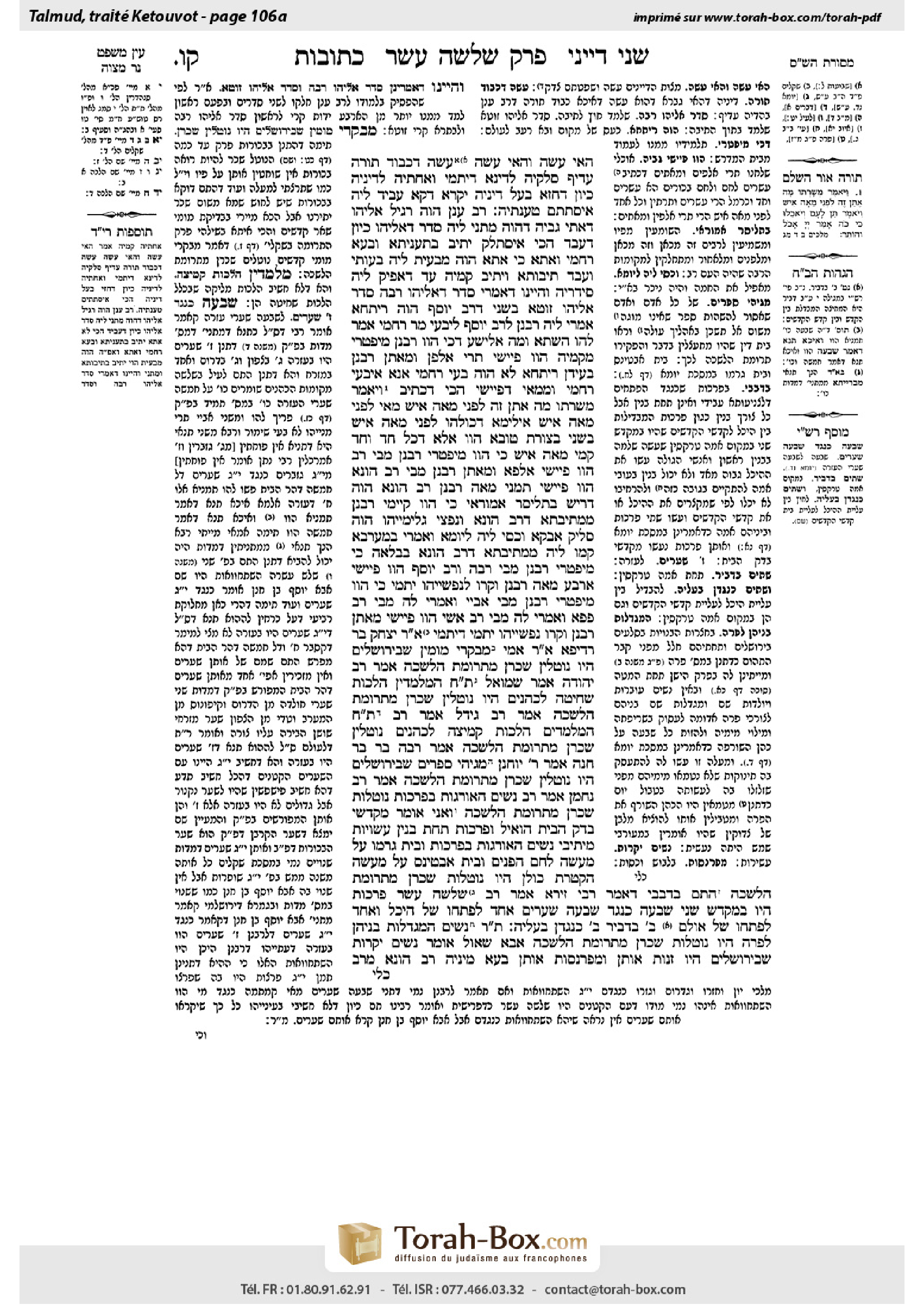
Ketubot 106a: Talmud study for Daf Yomi
Daf Yomi is the daily study of one Talmud folio. Explore 37 tractates with scans, Hebrew text, Sefaria English and AI-generated French translations where annotated.
Passage selection and English or AI-generated French translation are available where the scan has annotations. Daf Study is independent of Torah-Box and Sefaria.
Browse Ketubot · כתובות · All tractatesKetubot 106a text and translations
This page of Ketubot includes the Aramaic text, an English translation and an AI-generated French translation, alongside the scan above.
כתובות ק״ו א · Aramaic and Hebrew text
הַאי עֲשֵׂה וְהַאי עֲשֵׂה — עֲשֵׂה דִּכְבוֹד תּוֹרָה עֲדִיף. סַלְּקֵיהּ לְדִינָא דְּיַתְמֵי וְאַחֲתֵיהּ לְדִינֵיהּ, כֵּיוָן דַּחֲזָא בַּעַל דִּינֵיהּ יְקָרָא דְּקָא עָבֵיד לַיהּ, אִיסְתַּתֻּם טַעְנָתֵיהּ.
רַב עָנָן הֲוָה רְגִיל אֵלִיָּהוּ דְּאָתֵי גַּבֵּיהּ, דַּהֲוָה מַתְנֵי לֵיהּ סֵדֶר דְּאֵלִיָּהוּ. כֵּיוָן דַּעֲבַד הָכִי, אִיסְתַּלַּק. יְתֵיב בְּתַעֲנִיתָא וּבְעָא רַחֲמֵי וַאֲתָא. כִּי אֲתָא, הֲוָה מְבַעֵית לֵיהּ בַּעוֹתֵי.
וַעֲבַד תֵּיבוּתָא וִיתֵיב קַמֵּיהּ עַד דְּאַפֵּיק לֵיהּ סִידְרֵיהּ. וְהַיְינוּ דְּאָמְרִי: סֵדֶר דְּאֵלִיָּהוּ רַבָּה, סֵדֶר אֵלִיָּהוּ זוּטָא.
בִּשְׁנֵי דְּרַב יוֹסֵף הֲוָה רִיתְחָא. אָמְרִי לֵיהּ רַבָּנַן לְרַב יוֹסֵף: לִיבְעֵי מָר רַחֲמֵי. אֲמַר לְהוּ: הַשְׁתָּא וּמָה אֱלִישָׁע דְּכִי הֲווֹ רַבָּנַן מִיפַּטְרִי מִקַּמֵּיהּ, הֲווֹ פָּיְישִׁי תְּרֵי אַלְפֵי וּמָאתַן רַבָּנַן, בְּעִידָּן רִיתְחָא לָא הֲוָה בָּעֵי רַחֲמֵי, אֲנָא אֶיבְעֵי רַחֲמֵי?
וּמִמַּאי דְּפָיְישִׁי הָכִי? דִּכְתִיב: ״וַיֹּאמֶר מְשָׁרְתוֹ מָה אֶתֵּן זֶה לִפְנֵי מֵאָה אִישׁ״. מַאי ״לִפְנֵי מֵאָה אִישׁ״? אִילֵימָא דְּכוּלְּהוּ, לִפְנֵי מֵאָה אִישׁ בִּשְׁנֵי בַצּוֹרֶת טוּבָא הֲווֹ! אֶלָּא דְּכֹל חַד וְחַד קַמֵּי מֵאָה אִישׁ.
כִּי הֲווֹ מִיפַּטְרִי רַבָּנַן מִבֵּי רַב, הֲווֹ פָּיְישִׁי אַלְפָּא וּמָאתַן רַבָּנַן. מִבֵּי רַב הוּנָא, הֲווֹ פָּיְישִׁי תַּמְנֵי מְאָה רַבָּנַן. רַב הוּנָא הֲוָה דָּרֵישׁ בִּתְלֵיסַר אָמוֹרָאֵי. כִּי הֲווֹ קָיְימִי רַבָּנַן מִמְּתִיבְתָּא דְּרַב הוּנָא וְנָפְצִי גְּלִימַיְיהוּ הֲוָה סָלֵיק אַבְקָא וְכָסֵי לֵיהּ לְיוֹמָא, וְאָמְרִי בְּמַעְרְבָא: קָמוּ לֵיהּ מִמְּתִיבְתָּא דְּרַב הוּנָא בַּבְלָאָה.
כִּי מִיפַּטְרִי רַבָּנַן מִבֵּי רַבָּה וְרַב יוֹסֵף, הֲווֹ פָּיְישִׁי אַרְבַּע מְאָה רַבָּנַן, וְקָרוּ לְנַפְשַׁיְיהוּ: ״יַתְמֵי״. כִּי הֲווֹ מִיפַּטְרִי רַבָּנַן מִבֵּי אַבָּיֵי, וְאָמְרִי לַהּ מִבֵּי רַב פָּפָּא, וְאָמְרִי לַהּ מִבֵּי רַב אָשֵׁי, הֲווֹ פָּיְישִׁי מָאתַן רַבָּנַן, וְקָרוּ נַפְשַׁיְיהוּ ״יַתְמֵי דְּיַתְמֵי״.
אָמַר רַבִּי יִצְחָק בַּר רְדִיפָא אָמַר רַבִּי אַמֵּי: מְבַקְּרֵי מוּמִין שֶׁבִּירוּשָׁלַיִם, הָיוּ נוֹטְלִין שְׂכָרָן מִתְּרוּמַת הַלִּשְׁכָּה. אָמַר רַב יְהוּדָה אָמַר שְׁמוּאֵל: תַּלְמִידֵי חֲכָמִים הַמְלַמְּדִין הִלְכוֹת שְׁחִיטָה לְכֹהֲנִים, הָיוּ נוֹטְלִין שְׂכָרָן מִתְּרוּמַת הַלִּשְׁכָּה.
אָמַר רַב גִּידֵּל אָמַר רַב: תַּלְמִידֵי חֲכָמִים הַמְלַמְּדִים הִלְכוֹת קְמִיצָה לַכֹּהֲנִים, נוֹטְלִין שְׂכָרָן מִתְּרוּמַת הַלִּשְׁכָּה. אָמַר רַבָּה בַּר בַּר חָנָה אָמַר רַבִּי יוֹחָנָן: מַגִּיהֵי סְפָרִים שֶׁבִּירוּשָׁלַיִם, הָיוּ נוֹטְלִין שְׂכָרָן מִתְּרוּמַת הַלִּשְׁכָּה.
אָמַר רַב נַחְמָן אָמַר רַב: נָשִׁים הָאוֹרְגוֹת בַּפָּרֹכוֹת, נוֹטְלוֹת שְׂכָרָן מִתְּרוּמַת הַלִּשְׁכָּה. וַאֲנִי אוֹמֵר, מִקׇּדְשֵׁי בֶּדֶק הַבַּיִת. הוֹאִיל וּפָרֹכוֹת תַּחַת בִּנְיָן עֲשׂוּיוֹת.
מֵיתִיבִי: נָשִׁים הָאוֹרְגוֹת בַּפָּרֹכוֹת, וּבֵית גַּרְמוּ עַל מַעֲשֵׂה לֶחֶם הַפָּנִים, וּבֵית אַבְטִינָס עַל מַעֲשֵׂה הַקְּטֹרֶת — כּוּלָּן הָיוּ נוֹטְלוֹת שְׂכָרָן מִתְּרוּמַת הַלִּשְׁכָּה!
הָתָם בִּדְבָבֵי. דְּאָמַר רַבִּי זֵירָא אָמַר רַב: שְׁלֹשׁ עֶשְׂרֵה פָּרֹכוֹת הָיוּ בְּמִקְדָּשׁ שֵׁנִי, שֶׁבַע כְּנֶגֶד שִׁבְעָה שְׁעָרִים, אַחַת לְפִתְחוֹ שֶׁל הֵיכָל, וְאַחַת לְפִתְחוֹ שֶׁל אוּלָם. שְׁתַּיִם בַּדְּבִיר, שְׁתַּיִם כְּנֶגְדָּן בָּעֲלִיָּה.
תָּנוּ רַבָּנַן: נָשִׁים הַמְגַדְּלוֹת בְּנֵיהֶן לַפָּרָה — הָיוּ נוֹטְלוֹת שְׂכָרָן מִתְּרוּמַת הַלִּשְׁכָּה. אַבָּא שָׁאוּל אוֹמֵר: נָשִׁים יְקָרוֹת שֶׁבִּירוּשָׁלַיִם הָיוּ זָנוֹת אוֹתָן וּמְפַרְנְסוֹת אוֹתָן.
בְּעָא מִינֵּיהּ רַב הוּנָא מֵרַב:
Ketubot 106a · English translation
This is a positive mitzva, for judges to judge cases properly, and this is a positive mitzva, to honor Torah scholars and their families. Rav Naḥman concluded that the positive mitzva of giving honor to the Torah takes precedence. Therefore, he put aside the case of the orphans and settled down to judge the case of that man, under the mistaken assumption that he was a relative of Rav Anan. Once the other litigant saw the honor being accorded to that man by the judge, he grew nervous until his mouth, i.e., his ability to argue his claim, became closed, and he lost the case. In this manner, justice was perverted by Rav Anan, albeit unwittingly and indirectly.
Elijah the Prophet was accustomed to come and visit Rav Anan, as the prophet was teaching him the statements that would later be recorded in the volume Seder deEliyahu, the Order of Elijah. Once Rav Anan did this and caused a miscarriage of justice, Elijah departed. Rav Anan sat in observance of a fast and prayed for mercy, and Elijah came back. However, when Elijah came after that, he would scare him, as he would appear in frightening forms.
And Rav Anan made a box where he settled himself down and he sat before Elijah until he took out for him, i.e., taught him, all of his Seder. And this is what the Sages mean when they say: Seder deEliyahu Rabba, the Major Order of Elijah, and Seder Eliyahu Zuta, the Minor Order of Elijah, as the first order was taught prior to this incident and the second came after it.
§ The Gemara relates: In the years of Rav Yosef there was a divine anger, manifested by world hunger. The Sages said to Rav Yosef: Let the Master pray for mercy concerning this decree. He said to them: Now, if in the case of the prophet Elisha, when the Sages would take their leave of him, 2,200 Sages would remain behind whom he would support from his own pocket, and yet he would not pray for mercy at a time of divine anger and famine, should I pray for mercy?
The Gemara asks: And from where is it derived that this number of scholars would remain behind with Elisha? As it is written: “And his servant said: How should I set this before a hundred men” (II Kings 4:43). What is the meaning of “before a hundred men”? If we say that all of the gifts that he had received, i.e., the first fruits, twenty loaves of barley, and fresh ears of corn mentioned in the preceding verse, were meant to be placed before one hundred men, in years of drought and famine this was a good deal of food, which would have sufficed for them. Rather, it must mean that each and every one of the loaves was to be placed before one hundred men. Since he had twenty loaves plus two meals of first-fruits and ears of corn, there must have been 2,200 people present.
§ Incidentally, the Gemara relates: When the Sages would take their leave from the school of Rav, 1,200 Sages would remain behind to continue their studies. When the Sages would take their leave from the school of Rav Huna, eight hundred Sages would remain behind. Rav Huna would expound the lesson by means of thirteen speakers, who would repeat his statements to the crowds that had gathered to hear him. When the Sages would arise from listening to lectures in the yeshiva of Rav Huna and dust off their cloaks, the dust would rise and block out the sun, forming a dust cloud that could be seen from afar. And they would say in the West, in Eretz Yisrael: The scholars have just arisen in the yeshiva of Rav Huna the Babylonian.
When the Sages would take their leave from the school of Rabba and Rav Yosef, four hundred Sages would remain behind, and they would refer to themselves as orphans, as they were the only ones left from the entire crowd. When the Sages would take their leave from the school of Abaye, and some say from the school of Rav Pappa, and some say from the school of Rav Ashi, two hundred scholars would remain behind, and they would refer to themselves as orphans of orphans.
§ The Gemara returns to the issue of those who receive their wages from public funds. Rabbi Yitzḥak bar Redifa said that Rabbi Ami said: Inspectors of blemishes of consecrated animals in Jerusalem, who would examine all animals brought to be sacrificed in the Temple to verify that they were free of any blemishes that would disqualify them from being sacrificed on the altar, would take their wages from the collection of the Temple treasury chamber. Rav Yehuda said that Shmuel said: Torah scholars who teach the halakhot of slaughter to the priests of the Temple would take their wages from the collection of the chamber.
Rav Giddel said that Rav said: Torah scholars who teach the halakhot of the removal of a handful to the priests would take their wages from the collection of the chamber. All these scholars were constantly engaged in work necessary for the functioning of the Temple, and therefore they would receive their wages from the Temple treasury. Rabba bar bar Ḥana said that Rabbi Yoḥanan said: The proofreaders of the Torah scrolls in Jerusalem would take their wages from the collection of the chamber.
Rav Naḥman said that Rav said: The women who weave the curtains that separate the Temple Sanctuary from the Holy of Holies would take their wages from the collection of the chamber. Rav Naḥman added: But I say that they would not be paid from the collection of the chamber; rather, their salary would come from the funds consecrated for Temple maintenance. Why? Since the curtains served in place of the solid construction of the building, they were part of the Temple itself. Therefore, any work performed for the curtains should be paid for from money allocated for building purposes, not from the funds collected to pay for offerings and the daily needs of the Temple.
The Gemara raises an objection to this: The women who weave the curtains, and the house of Garmu, who were in charge of the preparation of the shewbread, and the house of Avtinas, who were in charge of the preparation of the incense, all would take their wages from the collection of the chamber. This contradicts Rav Naḥman’s claim.
The Gemara answers: There, it is referring to the curtains of the gates, which were not considered part of the actual Temple building but were decorative in purpose. As Rabbi Zeira said that Rav said: There were thirteen curtains in the Second Temple, seven opposite, i.e., on the inside of, seven gates, one at the entrance to the Sanctuary, one at the entrance to the Entrance Hall, two additional curtains within the partition, in the Holy of Holies in place of the one-cubit partition, and two corresponding to them above in the upper chamber.
The Sages taught: With regard to the women who raise their children for the red heifer, i.e., who would raise their children in special places so that they would live their entire lives up to that point in a state of ritual purity, enabling them to draw the water for the purposes of the ritual of the red heifer, these women would take their wages from the collection of the chamber. Abba Shaul said: Their wages would not come from the collection of the chamber. Instead, wealthy and prominent women of Jerusalem would sustain them and provide them with a livelihood.
Rav Huna raised a dilemma before Rav:
Ketubot 106a · Traduction française (IA)
Il s’agit d’une mitsva positive, celle qui impose aux juges de juger correctement les affaires, et d’une autre mitsva positive, celle d’honorer les érudits de la Torah et leurs familles. Rav Naḥman conclut que la mitsva positive d’honorer la Torah avait priorité. Il laissa donc de côté l’affaire des orphelins et s’installa pour juger l’affaire de cet homme, croyant à tort qu’il était un parent de Rav Anan. Lorsque l’autre plaideur vit l’honneur que le juge accordait à cet homme, il fut si nerveux que sa bouche — c’est-à-dire sa capacité à défendre sa cause — se ferma, et il perdit le procès. Ainsi, Rav Anan faussa la justice, quoique involontairement et indirectement.
Le prophète Élie avait l’habitude de venir rendre visite à Rav Anan, car il lui enseignait les propos qui seraient consignés plus tard dans le livre Seder deEliyahu, l’Ordre d’Élie. Un jour, Rav Anan agit ainsi et provoqua une erreur judiciaire ; Élie s’en alla. Rav Anan jeûna et implora la miséricorde, et Élie revint. Cependant, par la suite, lorsqu’Élie venait le voir, il l’effrayait en prenant des apparences terrifiantes.
Rav Anan se fabriqua une boîte, s’y installa et s’assit devant Élie jusqu’à ce que celui-ci lui transmette, c’est-à-dire lui enseigne, tout son Seder. C’est ce que les Sages désignent par les expressions Seder deEliyahu Rabba, le Grand Ordre d’Élie, et Seder Eliyahu Zuta, le Petit Ordre d’Élie : le premier ordre fut enseigné avant cet incident, et le second après.
§ La Guemara rapporte : Du temps de Rav Yosef, la colère divine se manifesta par une famine dans le monde. Les Sages dirent à Rav Yosef : « Que le Maître implore la miséricorde au sujet de ce décret. » Il leur répondit : « Si, dans le cas du prophète Élisée, lorsque les Sages prenaient congé de lui, 2 200 d’entre eux restaient auprès de lui et qu’il les entretenait de ses propres deniers, et qu’il n’implorait pourtant pas la miséricorde en période de colère divine et de famine, devrais-je, moi, l’implorer ? »
La Guemara demande : D’où sait-on que ce nombre d’érudits restait auprès d’Élisée ? Car il est écrit : « Son serviteur dit : “Comment pourrais-je servir cela à cent hommes ?” » (II Rois 4,43). Que signifie « à cent hommes » ? Si l’on dit que tous les dons qu’il avait reçus — c’est-à-dire les prémices, les vingt pains d’orge et les épis frais mentionnés dans le verset précédent — devaient être présentés à cent hommes, alors, en période de sécheresse et de famine, cela représentait une quantité considérable de nourriture, qui aurait suffi à les nourrir. Il faut donc dire que chacun des pains devait être présenté à cent hommes. Puisqu’il y avait vingt pains, auxquels s’ajoutaient deux portions de prémices et d’épis frais, il devait y avoir 2 200 personnes présentes.
§ À ce propos, la Guemara rapporte : Lorsque les Sages prenaient congé de l’école de Rav, 1 200 Sages restaient pour poursuivre leurs études. Lorsque les Sages prenaient congé de l’école de Rav Huna, huit cents Sages restaient. Rav Huna faisait exposer son cours par treize orateurs, qui répétaient ses propos aux foules rassemblées pour l’entendre. Lorsque les Sages se levaient après avoir écouté les cours à la yéchiva de Rav Huna et dépoussiéraient leurs manteaux, la poussière s’élevait et masquait le soleil, formant un nuage visible de loin. En Occident, c’est-à-dire en Eretz Israël, on disait alors : « Les érudits viennent de se lever à la yéchiva de Rav Huna le Babylonien. »
Lorsque les Sages prenaient congé de l’école de Rabba et de Rav Yosef, quatre cents Sages restaient, et ils se qualifiaient eux-mêmes d’orphelins, car ils étaient les seuls à rester de toute l’assemblée. Lorsque les Sages prenaient congé de l’école d’Abaye — certains disent de l’école de Rav Pappa, et d’autres de celle de Rav Ashi —, deux cents érudits restaient, et ils se qualifiaient d’orphelins d’orphelins.
§ La Guemara revient à la question de ceux qui reçoivent leur salaire des fonds publics. Rabbi Yitzḥak bar Redifa a dit au nom de Rabbi Ami : Les inspecteurs des défauts des animaux consacrés à Jérusalem, qui examinaient tous les animaux amenés pour être sacrifiés au Temple afin de vérifier qu’ils ne présentaient aucun défaut qui les disqualifierait pour le sacrifice sur l’autel, recevaient leur salaire sur les fonds recueillis dans la chambre du trésor du Temple. Rav Yehuda a dit au nom de Shmuel : Les érudits de la Torah qui enseignaient aux prêtres du Temple les halakhot de l’abattage rituel recevaient leur salaire sur les fonds recueillis dans la chambre.
Rav Giddel a dit au nom de Rav : Les érudits de la Torah qui enseignaient aux prêtres les halakhot du prélèvement d’une poignée recevaient leur salaire sur les fonds recueillis dans la chambre. Tous ces érudits étaient constamment occupés à des tâches nécessaires au fonctionnement du Temple, et c’est pourquoi ils recevaient leur salaire du trésor du Temple. Rabba bar bar Ḥana a dit au nom de Rabbi Yoḥanan : Les correcteurs des rouleaux de la Torah à Jérusalem recevaient leur salaire sur les fonds recueillis dans la chambre.
Rav Naḥman a dit au nom de Rav : Les femmes qui tissaient les rideaux séparant le Sanctuaire du Saint des saints recevaient leur salaire sur les fonds recueillis dans la chambre. Rav Naḥman ajouta : Mais, selon moi, elles n’étaient pas rémunérées sur ces fonds ; leur salaire provenait plutôt des fonds consacrés à l’entretien du Temple. Pourquoi ? Puisque les rideaux tenaient lieu de construction solide du bâtiment, ils faisaient partie du Temple lui-même. Par conséquent, tout travail effectué pour ces rideaux devait être payé avec les fonds affectés à la construction, et non avec les fonds recueillis pour les sacrifices et les besoins quotidiens du Temple.
La Guemara soulève une objection : Les femmes qui tissaient les rideaux, la maison de Garmu, chargée de la préparation des pains de proposition, et la maison d’Avtinas, chargée de la préparation de l’encens, recevaient toutes leur salaire sur les fonds recueillis dans la chambre. Cela contredit l’affirmation de Rav Naḥman.
La Guemara répond : Là, il s’agit des rideaux des portes, qui n’étaient pas considérés comme faisant partie du bâtiment proprement dit du Temple, mais avaient une fonction décorative. En effet, Rabbi Zeira a dit au nom de Rav : Il y avait treize rideaux dans le Second Temple : sept à l’intérieur des sept portes ; un à l’entrée du Sanctuaire ; un à l’entrée du Vestibule ; deux rideaux supplémentaires à l’intérieur de la cloison, dans le Saint des saints, à la place de la cloison d’une coudée ; et deux autres leur correspondant, au-dessus, dans la chambre haute.
Les Sages ont enseigné : Les femmes qui élevaient leurs enfants en vue du rituel de la vache rousse — c’est-à-dire qui les élevaient dans des lieux particuliers afin qu’ils vivent jusque-là dans un état de pureté rituelle et puissent puiser l’eau nécessaire au rituel de la vache rousse — recevaient leur salaire sur les fonds recueillis dans la chambre. Abba Shaul a dit : Leur salaire ne provenait pas de ces fonds. Au contraire, des femmes riches et éminentes de Jérusalem les entretenaient et subvenaient à leurs besoins.
Rav Huna soumit une question à Rav :
Traduction française générée par IA à partir de l’édition anglaise de Sefaria. Vérifie toujours un passage avec le texte source.
Text from Sefaria: William Davidson Edition - Vocalized Aramaic (CC BY NC); William Davidson Edition - English (CC BY NC).