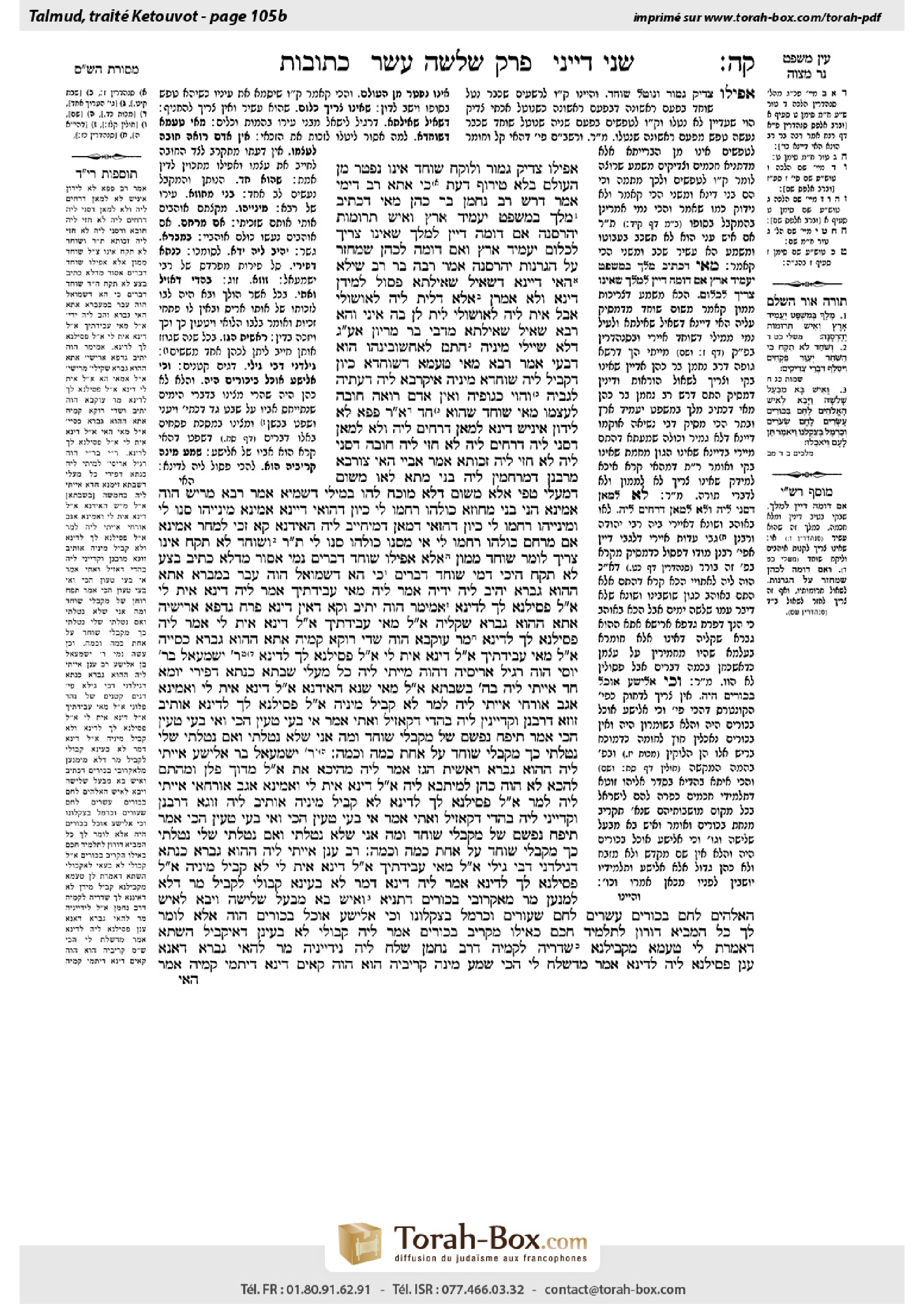
Ketubot 105b: Talmud study for Daf Yomi
Daf Yomi is the daily study of one Talmud folio. Explore 37 tractates with scans, Hebrew text, Sefaria English and AI-generated French translations where annotated.
Passage selection and English or AI-generated French translation are available where the scan has annotations. Daf Study is independent of Torah-Box and Sefaria.
Browse Ketubot · כתובות · All tractatesKetubot 105b text and translations
This page of Ketubot includes the Aramaic text, an English translation and an AI-generated French translation, alongside the scan above.
כתובות ק״ה ב · Aramaic and Hebrew text
אֲפִילּוּ צַדִּיק גָּמוּר וְלוֹקֵחַ שׁוֹחַד — אֵינוֹ נִפְטָר מִן הָעוֹלָם בְּלֹא טֵירוּף דַּעַת.
כִּי אֲתָא רַב דִּימִי אֲמַר: דָּרֵשׁ רַב נַחְמָן בַּר כֹּהֵן, מַאי דִּכְתִיב ״מֶלֶךְ בְּמִשְׁפָּט יַעֲמִיד אָרֶץ וְאִישׁ תְּרוּמוֹת יֶהֶרְסֶנָּה״ — אִם דּוֹמֶה דַּיָּין לְמֶלֶךְ, שֶׁאֵינוֹ צָרִיךְ לִכְלוּם — ״יַעֲמִיד אָרֶץ״. וְאִם דּוֹמֶה לְכֹהֵן שֶׁמְּחַזֵּר עַל הַגֳּרָנוֹת — ״יֶהֶרְסֶנָּה״.
אָמַר רַבָּה בַּר רַב שֵׁילָא: הַאי דַּיָּינָא דְּשָׁאֵיל שְׁאֵילְתָא — פָּסוּל לְמֵידַן דִּינָא. וְלָא אֲמַרַן אֶלָּא דְּלֵית לֵיהּ לְאוֹשׁוֹלֵי, אֲבָל אִית לֵיהּ לְאוֹשׁוֹלֵי — לֵית לַן בַּהּ.
אִינִי? וְהָא רָבָא שָׁאֵיל שְׁאֵילְתָא מִדְּבֵי בַּר מָרִיּוֹן אַף עַל גַּב דְּלָא שָׁיְילִי מִינֵּיהּ? הָתָם לְאַחְשׁוֹבִינְהוּ הוּא דְּבָעֵי.
אָמַר רָבָא: מַאי טַעְמָא דְּשׁוּחְדָּא? כֵּיוָן דְּקַבֵּיל לֵיהּ שׁוּחְדָּא מִינֵּיהּ, אִיקָּרְבָא לֵיהּ דַּעְתֵּיהּ לְגַבֵּיהּ וְהָוֵי כְּגוּפֵיהּ, וְאֵין אָדָם רוֹאֶה חוֹבָה לְעַצְמוֹ. מַאי ״שׁוֹחַד״ — שֶׁהוּא חַד. אָמַר רַב פָּפָּא: לָא לֵידוּן אִינִישׁ דִּינָא לְמַאן דְּרָחֵים לֵיהּ, וְלָא לְמַאן דְּסָנֵי לֵיהּ. דְּרָחֵים לֵיהּ — לָא חָזֵי לֵיהּ חוֹבָה, דְּסָנֵי לֵיהּ — לָא חָזֵי לֵיהּ זְכוּתָא.
אָמַר אַבָּיֵי: הַאי צוּרְבָּא מֵרַבָּנַן דִּמְרַחֲמִין לֵיהּ בְּנֵי מָתָא — לָאו מִשּׁוּם דִּמְעַלֵּי טְפֵי, אֶלָּא מִשּׁוּם דְּלָא מוֹכַח לְהוּ בְּמִילֵּי דִּשְׁמַיָּא.
אָמַר רָבָא, מֵרֵישׁ הֲוָה אָמֵינָא: הָנֵי בְּנֵי מָחוֹזָא כּוּלְּהוּ רָחֲמוּ לִי. כֵּיוָן דַּהֲוַאי דַּיָּינָא, אָמֵינָא: מִינַּיְיהוּ סָנוּ לִי וּמִינַּיְיהוּ רָחֲמוּ לִי. כֵּיוָן דַּחֲזַאי דְּמַאן דְּמִיחַיַּיב (לֵיהּ) הָאִידָּנָא קָא זָכֵי לִמְחַר, אָמֵינָא: אִם מִרְחָם — כּוּלְּהוּ רָחֲמוּ לִי, אִי מִסְנוֹ — כּוּלְּהוּ סָנוּ לִי.
תָּנוּ רַבָּנַן: ״וְשׁוֹחַד לֹא תִקָּח״, אֵינוֹ צָרִיךְ לוֹמַר שׁוֹחַד מָמוֹן, אֶלָּא אֲפִילּוּ שׁוֹחַד דְּבָרִים נָמֵי אָסוּר, מִדְּלָא כְּתִיב ״בֶּצַע לֹא תִקָּח״. הֵיכִי דָּמֵי שׁוֹחַד דְּבָרִים?
כִּי הָא דִּשְׁמוּאֵל הֲוָה עָבַר בְּמַבָּרָא, אֲתָא הָהוּא גַּבְרָא יָהֵיב לֵיהּ יְדֵיהּ, אֲמַר לֵיהּ: מַאי עֲבִידְתָּיךְ? אֲמַר לֵיהּ: דִּינָא אִית לִי. אֲמַר לֵיהּ: פְּסִילְנָא לָךְ לְדִינָא.
אַמֵּימָר הֲוָה יָתֵיב וְקָא דָאֵין דִּינָא. פְּרַח גַּדְפָּא אַרֵישֵׁיהּ, אֲתָא הָהוּא גַּבְרָא שַׁקְלֵיהּ. אֲמַר לֵיהּ: מַאי עֲבִידְתָּיךְ? אֲמַר לֵיהּ: דִּינָא אִית לִי. אֲמַר לֵיהּ: פְּסִילְנָא לָךְ לְדִינָא. מָר עוּקְבָא הֲוָה שְׁדֵי רוּקָּא קַמֵּיהּ, אֲתָא הָהוּא גַּבְרָא כַּסְּיֵיהּ, אֲמַר לֵיהּ: מַאי עֲבִידְתָּיךְ? אֲמַר לֵיהּ: דִּינָא אִית לִי. אֲמַר לֵיהּ: פְּסִילְנָא לָךְ לְדִינָא.
רַבִּי יִשְׁמָעֵאל בְּרַבִּי יוֹסֵי הֲוָה רְגִיל אֲרִיסֵיהּ דַּהֲוָה מַיְיתֵי לֵיהּ כׇּל מַעֲלֵי שַׁבְּתָא כַּנְתָּא דְפֵירֵי. יוֹמָא חַד אַיְיתִי לֵיהּ בְּחַמְשָׁה בְּשַׁבְּתָא. אֲמַר לֵיהּ: מַאי שְׁנָא הָאִידָּנָא? אֲמַר לֵיהּ: דִּינָא אִית לִי, וְאָמֵינָא, אַגַּב אוֹרְחִי אַיְיתֵי לֵיהּ לְמָר. לָא קַבֵּיל מִינֵּיהּ. אֲמַר לֵיהּ: פְּסִילְנָא לָךְ לְדִינָא.
אוֹתֵיב זוּזָא דְרַבָּנַן וְקָדָיְינִין לֵיהּ. בַּהֲדֵי דְּקָאָזֵיל וְאָתֵי אֲמַר: אִי בָּעֵי — טָעֵין הָכִי, וְאִי בָּעֵי — טָעֵין הָכִי. אָמַר: תִּיפַּח נַפְשָׁם שֶׁל מְקַבְּלֵי שׁוֹחַד! וּמָה אֲנִי שֶׁלֹּא נָטַלְתִּי, וְאִם נָטַלְתִּי — שֶׁלִּי נָטַלְתִּי, כָּךְ, מְקַבְּלֵי שׁוֹחַד — עַל אַחַת כַּמָּה וְכַמָּה.
רַבִּי יִשְׁמָעֵאל בַּר אֱלִישָׁע אַיְיתִי לֵיהּ הַהוּא גַּבְרָא רֵאשִׁית הַגֵּז. אֲמַר לֵיהּ: מֵהֵיכָא אַתְּ? אֲמַר לֵיהּ: מִדּוּךְ פְּלָן. וּמֵהָתָם לְהָכָא לָא הֲוָה כֹּהֵן לְמִיתְּבָא לֵיהּ? אֲמַר לֵיהּ: דִּינָא אִית לִי, וְאָמֵינָא, אַגַּב אוֹרְחַאי אַיְיתֵי לֵיהּ לְמָר. אֲמַר לֵיהּ: פְּסִילְנָא לָךְ לְדִינָא, לָא קַבֵּיל מִינֵּיהּ.
אוֹתֵיב לֵיהּ זוּגָא דְרַבָּנַן וְקָדָיְינִי לֵיהּ. בַּהֲדֵי דְּקָאָזֵיל וְאָתֵי, אֲמַר: אִי בָּעֵי טָעֵין הָכִי, וְאִי בָּעֵי טָעֵין הָכִי. אָמַר: תִּיפַּח נַפְשָׁם שֶׁל מְקַבְּלֵי שׁוֹחַד! וּמָה אֲנִי שֶׁלֹּא נָטַלְתִּי, וְאִם נָטַלְתִּי — שֶׁלִּי נָטַלְתִּי, כָּךְ, מְקַבְּלֵי שׁוֹחַד — עַל אַחַת כַּמָּה וְכַמָּה.
רַב עָנָן אַיְיתִי לֵיהּ הַהוּא גַּבְרָא כַּנְתָּא דְגִילְדָּנֵי דְּבֵי גִילֵי. אֲמַר לֵיהּ: מַאי עֲבִידְתָּיךְ? אֲמַר לֵיהּ: דִּינָא אִית לִי. לָא קַבֵּיל מִינֵּיהּ. אֲמַר לֵיהּ: פְּסִילְנָא לָךְ לְדִינָא.
אֲמַר לֵיהּ: דִּינָא דְּמָר לָא בָּעֵינָא, קַבּוֹלֵי לְקַבֵּיל מָר דְּלָא לִמְנְעַן מָר מֵאַקְרוֹבֵי בִּכּוּרִים. דְּתַנְיָא: ״וְאִישׁ בָּא מִבַּעַל שָׁלִישָׁה וַיָּבֵא לְאִישׁ הָאֱלֹהִים לֶחֶם בִּכּוּרִים עֶשְׂרִים לֶחֶם שְׂעוֹרִים וְכַרְמֶל בְּצִקְלוֹנוֹ״. וְכִי אֱלִישָׁע אוֹכֵל בִּכּוּרִים הֲוָה? אֶלָּא לוֹמַר לָךְ: כׇּל הַמֵּבִיא דּוֹרוֹן לְתַלְמִיד חָכָם — כְּאִילּוּ מַקְרִיב בִּכּוּרִים.
אֲמַר לֵיהּ: קַבּוֹלֵי לָא בָּעֵינַן דְּאֵיקַבֵּיל, הַשְׁתָּא דְּאָמְרַתְּ לִי טַעְמָא, מְקַבֵּילְנָא. שַׁדְּרֵיהּ לְקַמֵּיהּ דְּרַב נַחְמָן, שְׁלַח לֵיהּ: נִידַיְּינֵיהּ מָר לְהַאי גַּבְרָא, דַּאֲנָא עָנָן פְּסִילְנָא לֵיהּ לְדִינָא. אָמַר: מִדִּשְׁלַח לִי הָכִי, שְׁמַע מִינַּהּ קָרִיבֵיהּ הוּא. הֲוָה קָאֵים דִּינָא דְיַתְמֵי קַמֵּיהּ, אֲמַר:
Ketubot 105b · English translation
even if he is completely righteous but he took a bribe, he will not leave this world without becoming demented.
When Rav Dimi came from Eretz Yisrael to Babylonia, he said that Rav Naḥman bar Kohen interpreted a verse homiletically as follows. What is the meaning of that which is written: “The king by justice establishes the land, but he who exacts gifts [terumot] overthrows it” (Proverbs 29:4)? If a judge is like a king, in that he does not need anything and is not dependent on anyone, he establishes the land, i.e., he can serve as a judge. But if he is like a priest, who seeks out his terumot from various granaries, as he is dependent on others, he overthrows the land.
§ Rabba bar Rav Sheila said: This judge who borrows items from others is disqualified from rendering judgment because it is as though he accepts a salary. And we said this only in a case where he does not have articles to lend out to others but is constantly borrowing without lending objects in turn. However, if he has items to lend out to others, we have no problem with it.
The Gemara asks: Is that so? But Rava would borrow items from the house of bar Maryon even though they would not borrow from him. The Gemara answers: There, he wanted to cause them to be considered more important in the community. Rava was very wealthy and did not need to borrow for his own benefit. On the contrary, by borrowing from the house of bar Maryon he raised their standing in the community.
Rava said: What is the reason for the prohibition against taking a bribe? Once a judge accepts a bribe from one party, his thoughts draw closer to him and he becomes like his own self, and a person does not find fault in himself. The Gemara notes that the term itself alludes to this idea: What is the meaning of shoḥad, bribe? It can be read as: Shehu ḥad, as he is one, i.e., at one mind with the litigant. Rav Pappa said: A person should not judge a case involving one whom he loves, nor involving one whom he hates. He should not judge one whom he loves, as he will not find any fault in him, while with regard to one whom he hates, he will not find any merit in him.
Abaye said: With regard to this Torah scholar who is beloved by the residents of his town, it is not because he is a superior Sage than others; rather, it is because he does not reprove them in Heavenly matters. He is beloved because he is not strict with them with regard to the observance of mitzvot.
Rava said: At first I would say that all these residents of Meḥoza love me; however, once I became a judge I said that some of them hate me and some of them love me, as I assumed that their feelings toward me depended on the success of their case. When I saw that the one I declared guilty today would be found innocent the following day, I realized that my rulings do not determine their attitudes, and therefore I said: If they love, then they all love me, and if they hate, then they all hate me, regardless of what happens in the courtroom.
§ The Sages taught: “And you shall take no bribe” (Exodus 23:8). It is not necessary to say that this includes bribery by means of money; however, even verbal bribery, assisting by means of speech, is also prohibited. The halakha that a bribe is not necessarily monetary is derived from the fact that it is not written: And you shall take no profit. The Gemara asks: What are the circumstances of bribing with words?
The Gemara explains: This can be demonstrated by that episode involving Shmuel, who was once crossing a river on a narrow ferry. A certain man came along and gave him a hand to help him out of the ferryboat. Shmuel said to him: What are you doing in this place? The man said to him: I have a case to present before you for judgment. Shmuel said to him: I am disqualified from presiding over your case, as you did me a favor. Although no money changed hands, a bond was formed between the pair.
The Gemara relates a similar story. Ameimar was sitting and judging a case when a feather floated and landed on his head. A certain man came by and removed it from his head. Ameimar said to him: What are you doing here? He said to him: I have a case to present before you. Ameimar said to him: I am disqualified from presiding over your case, due to the favor you performed for me. The Gemara likewise relates: There was spittle lying before Mar Ukva. A certain man came by and covered it. He said to him: What are you doing here? He said to him: I have a case to present before you. Mar Ukva said to him: I am disqualified from presiding over your case.
The Gemara cites another incident. The sharecropper of Rabbi Yishmael, son of Rabbi Yosei, was accustomed to bringing him a basket [kanta] full of fruits every Shabbat eve. One day, he brought him the basket on a Thursday. Rabbi Yishmael said to him: What is different that you came early now, this week? The sharecropper said to him: I have a case to present before you, and I said to myself that along my way I will bring to the Master the basket of fruits, as in any case I am coming on Thursday, the day the courts are in session. Rabbi Yishmael did not accept the basket of fruits from him, and he said to him: I am disqualified from presiding over your case.
Rabbi Yishmael seated a pair of rabbinic scholars and they judged the sharecropper’s case. As Rabbi Yishmael was coming and going, he said to himself: If he wants, he could claim this, and if he wants, he could claim that, i.e., he kept thinking of all the ways in which the litigant who brought him the fruits could win his case. He said to himself: Blast the souls of those who accept bribes. If I, who did not accept anything, and if I had accepted, I would have accepted my own property, as it is my sharecropper and the fruits legally belong to me, am nevertheless in this state of mind due to the proposed gift, all the more so are those who actually accept bribes inevitably biased in favor of the one who bribed them.
The Gemara likewise relates with regard to Rabbi Yishmael bar Elisha, who was a priest, that a certain man once brought him the first shearing. Rabbi Yishmael said to him: From where are you? The man said to him: I am from such and such a place. Rabbi Yishmael said to him: And from there to here was there no priest to whom you could give the first shearing? He said to him: I have a case to present before you, and I said to myself that along my way I will bring to the Master the first shearing. Rabbi Yishmael said to him: I am disqualified from presiding over your case, and he would not accept the first shearing from him.
Rabbi Yishmael bar Elisha seated a pair of rabbinic scholars and they judged his case. As Rabbi Yishmael was coming and going, he said to himself: If he wants, he could claim this, and if he wants, he could claim that. He said to himself: Blast the souls of those who accept bribes. If I, who did not accept anything, and if I had accepted, I would have accepted my own property, as I am a priest and am entitled to receive the first shearing, am nevertheless in this state of mind, all the more so are those who accept bribes.
The Gemara relates: There was a certain man who once brought to Rav Anan a basket of small fish [gildanei devei gilei]. He said to him: What are you doing here? The man said to him: I have a case to present before you. Rav Anan would not accept the basket from him, and he said to him: I am disqualified from presiding over your case, due to your actions.
The man said to him: I do not need the Master’s judgment. However, let the Master accept my gift anyway, so that the Master does not prevent me from presenting first fruits. What does the mitzva of first fruits have to with this situation? As it is taught in a baraita: “And there came a man came from Ba’al Shalisha, and he brought the man of God bread of the first fruits, twenty loaves of barley and fresh ears of corn in his sack” (II Kings 4:42). But did Elisha, the recipient of these gifts, eat first fruits? After all, he was not a priest. Rather, this verse comes to tell you: Whoever brings a gift to a Torah scholar, it is as though he has presented first fruits. This visitor to Rav Anan wished to fulfill this mitzva.
Rav Anan said to him: I do not want to take it from you, but now that you have explained to me the reason that you wish to give it to me I will accept it from you. Rav Anan sent the man to Rav Naḥman, and he also sent him a letter: Let the Master judge this man’s case because I, Anan, am disqualified from judging his cases. Rav Naḥman said to himself: From the fact that he sent me this letter, I can conclude from here that the reason he is disqualified from judging the case is because he is his relative. At that time, a case involving orphans was being heard before Rav Naḥman. He said:
Ketubot 105b · Traduction française (IA)
Même s’il est parfaitement juste, s’il a accepté un pot-de-vin, il ne quittera pas ce monde sans devenir dément.
Lorsque Rav Dimi vint d’Eretz Israël en Babylonie, il rapporta que Rav Naḥman bar Kohen avait interprété un verset de manière homilétique comme suit. Que signifie ce qui est écrit : « Le roi affermit le pays par la justice, mais celui qui exige des présents [terumot] le renverse » (Proverbes 29, 4) ? Si un juge est comme un roi, en ce qu’il n’a besoin de rien et ne dépend de personne, il affermit le pays, c’est-à-dire qu’il peut exercer la fonction de juge. Mais s’il est comme un prêtre, qui recherche ses terumot dans divers greniers, puisqu’il dépend des autres, il renverse le pays.
§ Rabba bar Rav Sheila dit : Ce juge qui emprunte des objets à autrui est inapte à rendre la justice, car c’est comme s’il recevait un salaire. Cela n’a été dit que dans le cas où il ne possède pas d’objets qu’il puisse prêter à autrui, mais emprunte constamment sans rien prêter en retour. En revanche, s’il possède des objets qu’il peut prêter à autrui, il n’y a pas de problème.
La Guemara demande : Est-ce vraiment ainsi ? Pourtant, Rava empruntait des objets à la maison de bar Maryon, bien que ses membres ne lui en empruntassent pas. La Guemara répond : Dans ce cas, il voulait les faire considérer comme plus importants dans la communauté. Rava était très riche et n’avait pas besoin d’emprunter pour son propre bénéfice. Au contraire, en empruntant à la maison de bar Maryon, il rehaussait leur statut dans la communauté.
Rava dit : Pourquoi est-il interdit d’accepter un pot-de-vin ? Dès qu’un juge accepte un pot-de-vin de l’une des parties, ses pensées se rapprochent de cette personne et il devient comme un seul avec elle ; or, on ne trouve pas de défaut en soi-même. La Guemara fait remarquer que le terme lui-même évoque cette idée : que signifie shoḥad, « pot-de-vin » ? On peut le lire comme shehu ḥad, « car il est un », c’est-à-dire qu’il partage le même état d’esprit que le plaideur. Rav Pappa dit : On ne doit juger ni une affaire impliquant quelqu’un qu’on aime, ni une affaire impliquant quelqu’un qu’on déteste. On ne doit pas juger quelqu’un qu’on aime, car on ne trouvera aucun défaut en lui ; quant à celui qu’on déteste, on ne lui trouvera aucun mérite.
Abaye dit : Si ce talmudiste est aimé des habitants de sa ville, ce n’est pas parce qu’il est un Sage supérieur aux autres, mais parce qu’il ne les réprimande pas au sujet des questions célestes. Il est aimé parce qu’il n’est pas strict avec eux quant à l’observance des mitsvot.
Rava dit : Au début, je me disais que tous les habitants de Meḥoza m’aimaient. Mais lorsque je devins juge, je me dis que certains me détestaient et que d’autres m’aimaient, car je supposais que leurs sentiments à mon égard dépendaient de l’issue de leur affaire. Quand je vis que celui que j’avais déclaré coupable un jour était déclaré innocent le lendemain, je compris que mes décisions ne déterminaient pas leur attitude. Je me dis donc : s’ils m’aiment, ils m’aiment tous ; et s’ils me détestent, ils me détestent tous, quelle que soit l’issue des procès.
§ Les Sages enseignèrent : « Tu n’accepteras pas de pot-de-vin » (Exode 23, 8). Il n’est pas nécessaire de préciser que cela comprend les pots-de-vin en argent ; même le pot-de-vin verbal, c’est-à-dire le fait d’aider quelqu’un par ses paroles, est également interdit. Le fait qu’un pot-de-vin ne soit pas nécessairement pécuniaire se déduit de ce qu’il n’est pas écrit : « Tu n’accepteras pas de profit. » La Guemara demande : Dans quelles circonstances s’agit-il d’un pot-de-vin par des paroles ?
La Guemara explique : On peut l’illustrer par cet épisode concernant Shmuel, qui traversait un fleuve sur un bac étroit. Un homme arriva et lui tendit la main pour l’aider à descendre du bac. Shmuel lui demanda : « Que fais-tu ici ? » L’homme lui répondit : « J’ai une affaire à soumettre à ton jugement. » Shmuel lui dit : « Je ne peux pas présider ton procès, car tu m’as rendu service. » Bien qu’aucun argent n’ait changé de mains, un lien s’était créé entre eux.
La Guemara rapporte une histoire semblable. Ameimar était assis et jugeait une affaire lorsqu’une plume flotta et se posa sur sa tête. Un homme passa et la lui retira. Ameimar lui demanda : « Que fais-tu ici ? » Il lui répondit : « J’ai une affaire à soumettre à ton jugement. » Ameimar lui dit : « Je ne peux pas présider ton procès, en raison du service que tu m’as rendu. » La Guemara rapporte également qu’un crachat se trouvait devant Mar Ukva. Un homme passa et le recouvrit. Mar Ukva lui demanda : « Que fais-tu ici ? » Il lui répondit : « J’ai une affaire à soumettre à ton jugement. » Mar Ukva lui dit : « Je ne peux pas présider ton procès. »
La Guemara cite un autre épisode. Le métayer de Rabbi Yishmael, fils de Rabbi Yosei, avait l’habitude de lui apporter un panier [kanta] rempli de fruits chaque veille de Chabbat. Un jour, il lui apporta le panier un jeudi. Rabbi Yishmael lui demanda : « Pourquoi es-tu venu plus tôt cette semaine ? » Le métayer lui répondit : « J’ai une affaire à soumettre à ton jugement, et je me suis dit qu’en chemin, j’apporterais au Maître le panier de fruits, puisque de toute façon je viens jeudi, jour où les tribunaux siègent. » Rabbi Yishmael n’accepta pas le panier de fruits et lui dit : « Je ne peux pas présider ton procès. »
Rabbi Yishmael installa deux érudits rabbiniques, qui jugèrent l’affaire du métayer. Tandis que Rabbi Yishmael allait et venait, il se disait : « S’il le veut, il peut avancer cet argument ; s’il le veut, il peut avancer cet autre argument. » Autrement dit, il ne cessait d’imaginer toutes les façons dont le plaideur qui lui avait apporté les fruits pouvait gagner son procès. Il se dit : « Maudites soient les âmes de ceux qui acceptent des pots-de-vin ! Si moi, qui n’ai rien accepté — et si j’avais accepté, j’aurais accepté mon propre bien, puisque c’est mon métayer et que les fruits me reviennent légalement —, je suis néanmoins dans cet état d’esprit à cause du cadeau proposé, à plus forte raison ceux qui acceptent réellement des pots-de-vin sont-ils nécessairement biaisés en faveur de celui qui les a soudoyés. »
La Guemara rapporte également au sujet de Rabbi Yishmael bar Elisha, qui était prêtre, qu’un homme lui apporta un jour la première tonte. Rabbi Yishmael lui demanda : « D’où viens-tu ? » L’homme lui répondit : « Je viens de tel endroit. » Rabbi Yishmael lui demanda : « Et de là jusqu’ici, n’y avait-il aucun prêtre à qui tu aurais pu donner la première tonte ? » Il lui répondit : « J’ai une affaire à soumettre à ton jugement, et je me suis dit qu’en chemin, j’apporterais au Maître la première tonte. » Rabbi Yishmael lui dit : « Je ne peux pas présider ton procès », et il n’accepta pas la première tonte.
Rabbi Yishmael bar Elisha installa deux érudits rabbiniques, qui jugèrent son affaire. Tandis que Rabbi Yishmael allait et venait, il se disait : « S’il le veut, il peut avancer cet argument ; s’il le veut, il peut avancer cet autre argument. » Il se dit : « Maudites soient les âmes de ceux qui acceptent des pots-de-vin ! Si moi, qui n’ai rien accepté — et si j’avais accepté, j’aurais accepté mon propre bien, puisque je suis prêtre et que j’ai droit à la première tonte —, je suis néanmoins dans cet état d’esprit, à plus forte raison ceux qui acceptent des pots-de-vin ! »
La Guemara rapporte : Un homme apporta un jour à Rav Anan un panier de petits poissons [gildanei devei gilei]. Rav Anan lui demanda : « Que fais-tu ici ? » L’homme lui répondit : « J’ai une affaire à soumettre à ton jugement. » Rav Anan refusa le panier et lui dit : « Je ne peux pas présider ton procès, à cause de ce que tu as fait. »
L’homme lui dit : « Je n’ai pas besoin que le Maître me juge. Toutefois, que le Maître accepte mon cadeau, afin qu’il ne m’empêche pas de présenter les prémices. » Quel rapport la mitsva des prémices a-t-elle avec cette situation ? Car il est enseigné dans une baraïta : « Un homme vint de Baal Shalisha et apporta à l’homme de Dieu du pain des prémices, vingt pains d’orge et des épis frais dans son sac » (II Rois 4, 42). Mais Élisée, qui reçut ces présents, mangeait-il des prémices ? Après tout, il n’était pas prêtre. Ce verset vient plutôt t’enseigner que quiconque apporte un cadeau à un talmudiste, c’est comme s’il avait présenté des prémices. Ce visiteur de Rav Anan souhaitait accomplir cette mitsva.
Rav Anan lui dit : « Je ne veux pas te le prendre, mais puisque tu m’as expliqué pourquoi tu souhaites me le donner, je l’accepterai. » Rav Anan envoya l’homme auprès de Rav Naḥman et lui adressa également une lettre : « Que le Maître juge l’affaire de cet homme, car moi, Anan, je ne peux pas juger ses affaires. » Rav Naḥman se dit : « Puisqu’il m’a envoyé cette lettre, j’en conclus que s’il ne peut pas juger l’affaire, c’est parce que cet homme est son parent. » À ce moment-là, une affaire concernant des orphelins était en cours devant Rav Naḥman. Il dit :
Traduction française générée par IA à partir de l’édition anglaise de Sefaria. Vérifie toujours un passage avec le texte source.
Text from Sefaria: William Davidson Edition - Vocalized Aramaic (CC BY NC); William Davidson Edition - English (CC BY NC).