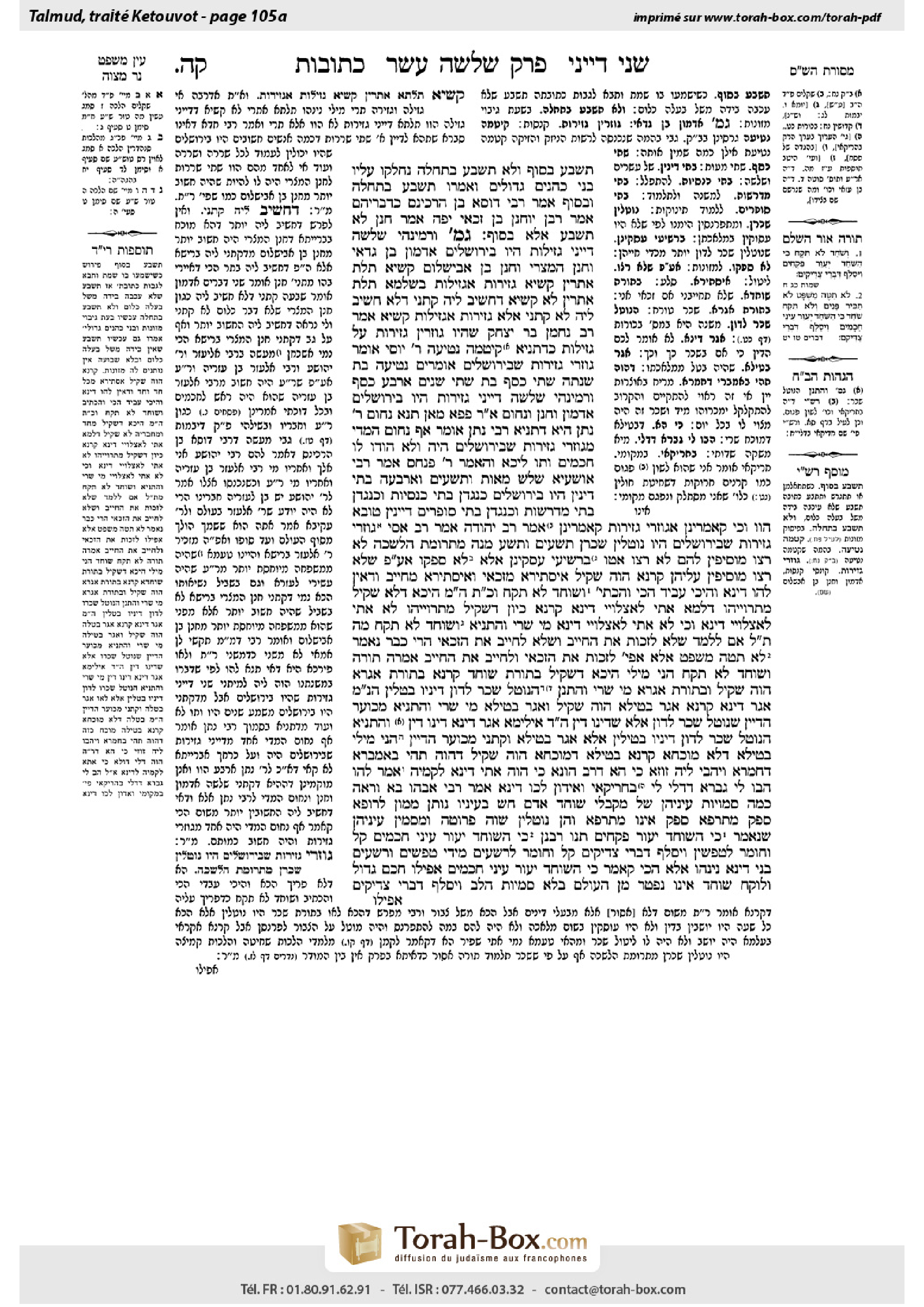
Ketubot 105a: Talmud study for Daf Yomi
Daf Yomi is the daily study of one Talmud folio. Explore 37 tractates with scans, Hebrew text, Sefaria English and AI-generated French translations where annotated.
Passage selection and English or AI-generated French translation are available where the scan has annotations. Daf Study is independent of Torah-Box and Sefaria.
Browse Ketubot · כתובות · All tractatesKetubot 105a text and translations
This page of Ketubot includes the Aramaic text, an English translation and an AI-generated French translation, alongside the scan above.
כתובות ק״ה א · Aramaic and Hebrew text
תִּשָּׁבַע בַּסּוֹף, וְלֹא תִּשָּׁבַע בַּתְּחִלָּה. נֶחְלְקוּ עָלָיו בְּנֵי כֹּהֲנִים גְּדוֹלִים, וְאָמְרוּ: תִּשָּׁבַע בַּתְּחִלָּה וּבַסּוֹף. אָמַר רַבִּי דּוֹסָא בֶּן הַרְכִּינָס כְּדִבְרֵיהֶם. אָמַר רַבָּן יוֹחָנָן בֶּן זַכַּאי: יָפֶה אָמַר חָנָן, לֹא תִּשָּׁבַע אֶלָּא בַּסּוֹף.
גְּמָ׳ וּרְמִינְהִי: שְׁלֹשָׁה דַּיָּינֵי גְזֵילוֹת הָיוּ בִּירוּשָׁלַיִם: אַדְמוֹן בֶּן גַּדַּאי, וְחָנָן הַמִּצְרִי, וְחָנָן בֶּן אֲבִישָׁלוֹם. קַשְׁיָא תְּלָת אַתְּרֵין, קַשְׁיָא גְּזֵירוֹת אַגְּזֵילוֹת!
בִּשְׁלָמָא תְּלָת אַתְּרֵין לָא קַשְׁיָא: דַּחֲשִׁיב לֵיהּ — קָתָנֵי, דְּלָא חֲשִׁיב לֵיהּ — לָא קָתָנֵי. אֶלָּא גְּזֵירוֹת אַגְּזֵילוֹת קַשְׁיָא!
אָמַר רַב נַחְמָן בַּר יִצְחָק: שֶׁהָיוּ גּוֹזְרִין גְּזֵירוֹת עַל גְּזֵילוֹת. כִּדְתַנְיָא: קִיטְּמָה נְטִיעָה, רַבִּי יוֹסֵי אוֹמֵר: גּוֹזְרֵי גְזֵירוֹת שֶׁבִּירוּשָׁלַיִם אוֹמְרִים: נְטִיעָה בַּת שְׁנָתָהּ — שְׁתֵּי כֶסֶף, בַּת שְׁתֵּי שָׁנִים — אַרְבַּע כֶּסֶף.
וּרְמִינְהִי, שְׁלֹשָׁה דַּיָּינֵי גְזֵירוֹת הָיוּ בִּירוּשָׁלַיִם: אַדְמוֹן וְחָנָן וְנַחוּם! אָמַר רַב פָּפָּא: מַאן תְּנָא נַחוּם — רַבִּי נָתָן הִיא. דְּתַנְיָא, רַבִּי נָתָן אוֹמֵר: אַף נַחוּם הַמָּדִי מִגּוֹזְרֵי גְזֵירוֹת שֶׁבִּירוּשָׁלַיִם הָיָה, וְלֹא הוֹדוּ לוֹ חֲכָמִים.
וְתוּ לֵיכָּא? וְהָאָמַר רַבִּי פִּנְחָס אָמַר רַבִּי אוֹשַׁעְיָא: שְׁלֹשׁ מֵאוֹת וְתִשְׁעִים וְאַרְבָּעָה בָּתֵּי דִינִין הָיוּ בִּירוּשָׁלַיִם, כְּנֶגְדָּן בָּתֵּי כְנֵסִיּוֹת, וּכְנֶגְדָּן בָּתֵּי מִדְרָשׁוֹת, וּכְנֶגְדָּן בָּתֵּי סוֹפְרִים! דַּיָּינִין טוּבָא הֲווֹ, וְכִי קָאָמְרִינַן — אַגּוֹזְרֵי גְזֵירוֹת קָאָמְרִינַן.
אָמַר רַב יְהוּדָה אָמַר רַב אַסִּי: גּוֹזְרֵי גְזֵירוֹת שֶׁבִּירוּשָׁלַיִם הָיוּ נוֹטְלִין שְׂכָרָן תִּשְׁעִים וָתֵשַׁע מָנֶה מִתְּרוּמַת הַלִּשְׁכָּה, לֹא רָצוּ — מוֹסִיפִין לָהֶם. לֹא רָצוּ? אַטּוּ בְּרַשִּׁיעֵי עָסְקִינַן? אֶלָּא: לֹא סָפְקוּ, אַף עַל פִּי שֶׁלֹּא רָצוּ — מוֹסִיפִין עֲלֵיהֶן.
קַרְנָא הֲוָה שָׁקֵיל אִיסְתֵּירָא מִזַּכַּאי וְאִיסְתֵּירָא מֵחַיָּיב, וְדָאֵין לְהוּ דִּינָא. וְהֵיכִי עָבֵיד הָכִי? וְהָכְתִיב: ״וְשׁוֹחַד לֹא תִקָּח״!
וְכִי תֵּימָא הָנֵי מִילֵּי הֵיכָא דְּלָא שָׁקֵיל מִתַּרְוַיְיהוּ דִּלְמָא אָתֵי לְאַצְלוֹיֵי דִּינָא, קַרְנָא כֵּיוָן דְּשָׁקֵיל מִתַּרְוַיְיהוּ — לָא אָתֵי לְאַצְלוֹיֵי דִּינָא, וְכִי לָא אָתֵי לְאַצְלוֹיֵי דִּינָא מִי שְׁרֵי?
וְהָתַנְיָא: ״וְשׁוֹחַד לֹא תִקָּח״ מָה תַּלְמוּד לוֹמַר? אִם לְלַמֵּד שֶׁלֹּא לְזַכּוֹת אֶת הַחַיָּיב וְשֶׁלֹּא לְחַיֵּיב אֶת הַזַּכַּאי — הֲרֵי כְּבָר נֶאֱמַר ״לֹא תַטֶּה מִשְׁפָּט״, אֶלָּא אֲפִילּוּ לְזַכּוֹת אֶת הַזַּכַּאי וּלְחַיֵּיב אֶת הַחַיָּיב אָמְרָה תּוֹרָה ״וְשׁוֹחַד לֹא תִקָּח״!
הָנֵי מִילֵּי הֵיכָא דְּשָׁקֵיל בְּתוֹרַת שׁוֹחַד, קַרְנָא בְּתוֹרַת אַגְרָא הֲוָה שָׁקֵיל. וּבְתוֹרַת אַגְרָא מִי שְׁרֵי? וְהָתְנַן: הַנּוֹטֵל שָׂכָר לָדוּן — דִּינָיו בְּטֵלִין! הָנֵי מִילֵּי אֲגַר דִּינָא, קַרְנָא אֲגַר בְּטֵילָא הֲוָה שָׁקֵיל.
וַאֲגַר בְּטֵילָא מִי שְׁרֵי? וְהָתַנְיָא: מְכוֹעָר הַדַּיָּין שֶׁנּוֹטֵל שָׂכָר לָדוּן, אֶלָּא שֶׁדִּינוֹ דִּין. הֵיכִי דָּמֵי? אִילֵּימָא אֲגַר דִּינָא, דִּינוֹ דִּין? וְהָתַנְיָא: הַנּוֹטֵל שָׂכָר לָדוּן — דִּינָיו בְּטֵילִין! אֶלָּא אֲגַר בְּטֵילָא, וְקָתָנֵי: מְכוֹעָר הַדַּיָּין!
הָנֵי מִילֵּי בְּטֵילָא דְּלָא מוֹכְחָא. קַרְנָא בְּטֵילָא דְמוֹכְחָא הֲוָה שָׁקֵיל, דַּהֲוָה תָּהֵי בְּאַמְבָּרָא דְחַמְרָא וְיָהֲבִי לֵיהּ זוּזָא.
כִּי הָא דְּרַב הוּנָא כִּי הֲוָה אָתֵי דִּינָא לְקַמֵּיהּ, אֲמַר לְהוּ: הַבוּ לִי גַּבְרָא דְּדָלֵי לִי בַּחֲרִיקַאי וְאֵידוּן לְכוּ דִּינָא.
אָמַר רַבִּי אֲבָהוּ: בֹּא וּרְאֵה כַּמָּה סְמוּיוֹת עֵינֵיהֶן שֶׁל מְקַבְּלֵי שׁוֹחַד. אָדָם חָשׁ בְּעֵינָיו, נוֹתֵן מָמוֹן לָרוֹפֵא — סָפֵק מִתְרַפֵּא סָפֵק אֵינוֹ מִתְרַפֵּא. וְהֵן נוֹטְלִין שָׁוֶה פְּרוּטָה וּמְסַמִּין עֵינֵיהֶן, שֶׁנֶּאֱמַר: ״כִּי הַשּׁוֹחַד יְעַוֵּר פִּקְחִים״.
תָּנוּ רַבָּנַן: ״כִּי הַשּׁוֹחַד יְעַוֵּר עֵינֵי חֲכָמִים״, קַל וָחוֹמֶר לַטִּפְּשִׁין. ״וִיסַלֵּף דִּבְרֵי צַדִּיקִים״, קַל וָחוֹמֶר לָרְשָׁעִים. מִידֵּי טִפְּשִׁים וּרְשָׁעִים בְּנֵי דִינָא נִינְהוּ? אֶלָּא הָכִי קָאָמַר: ״כִּי הַשּׁוֹחַד יְעַוֵּר עֵינֵי חֲכָמִים״, אֲפִילּוּ חָכָם גָּדוֹל וְלוֹקֵחַ שׁוֹחַד — אֵינוֹ נִפְטָר מִן הָעוֹלָם בְּלֹא סַמְיוּת הַלֵּב. ״וִיסַלֵּף דִּבְרֵי צַדִּיקִים״,
Ketubot 105a · English translation
She takes an oath at the end of their marriage, i.e., when she learns that her husband died. The oath is to the effect that he did not leave her any funds when he departed overseas, as she is claiming full payment of her marriage contract. And she does not take an oath at the outset of his trip overseas, when she demands support soon after his departure. The sons of High Priests disagreed with Ḥanan’s opinion and said: She takes an oath both at the outset and at the end. Rabbi Dosa ben Harkinas said: The halakha is in accordance with their statement, i.e., that of the sons of the High Priests. Rabban Yoḥanan ben Zakkai said that Ḥanan spoke well: She takes an oath only at the end.
GEMARA: The mishna states that there were two judges who issued decrees [gezeirot] in Jerusalem. And the Gemara raises a contradiction from the following baraita: There were three judges who adjudicated cases of theft [gezeilot] in Jerusalem: Admon ben Gaddai, Ḥanan the Egyptian, and Ḥanan ben Avishalom. The fact that the baraita mentions three judges is difficult, as the mishna includes only two; and the fact that the judges are described in the mishna as those who issue decrees is also difficult as they are described in the baraita as judges who adjudicate cases of theft.
The Gemara continues: Granted, the contradiction between the statement that there were three judges and the statement that there were two is not difficult, as those who are important to him the tanna teaches in the mishna, and those who are not important to him the tanna does not teach in the mishna. Although there were other judges, the tanna mentioned only those pertinent to the topic at hand. However, the contradiction between the ruling that refers to decrees and the ruling that refers to theft is difficult.
Rav Naḥman bar Yitzḥak said: There is no contradiction, as they would issue decrees concerning matters of theft, as it is taught in a baraita: With regard to an animal that severed a young plant in the field of another, Rabbi Yosei says that those who issue decrees in Jerusalem said: For a plant one year old, the animal’s owner must pay two silver pieces; for a plant two years old, he pays four silver pieces.
The Gemara raises a contradiction between the baraita cited above and another baraita: There were three prominent judges who issued decrees in Jerusalem: Admon, Ḥanan, and Naḥum. In the previous baraita, Naḥum was not listed. Rav Pappa said: Who is the tanna who taught that the third judge was Naḥum? It is Rabbi Natan, as it is taught in a baraita that Rabbi Natan says: Naḥum HaMadi was also among those who would issue decrees in Jerusalem, but the Sages did not agree with his opinion.
The Gemara asks: And were there no more judges? Didn’t Rabbi Pineḥas say that Rabbi Oshaya said: There were 394 courts in Jerusalem, and a comparable number of synagogues, and a comparable number of study halls, and a comparable number of houses of teachers of schoolchildren. The Gemara answers: There were many judges, but when we say that there were a small number, it is specifically concerning those who issue decrees that we say so.
§ Rav Yehuda said that Rav Asi said: Those who issue decrees in Jerusalem would take their wages, ninety-nine maneh, equal to 9,900 dinars per year, from the collection of the Temple treasury chamber. If they did not wish to do so, one adds to their wages. The Gemara asks: What is the meaning of the phrase: If they did not wish to do so? Does this mean that if they desired higher wages, they were paid more? Is that to say that we are dealing with wicked people who demand wages beyond what they need? Rather, on the contrary, Rav Asi said that if their wages were insufficient for their needs, then even if they did not wish to receive higher wages, one adds to their wages so that they may devote themselves to their communal service.
The Gemara relates: The Sage Karna would take an istera, a small coin, from the innocent party, and an istera from the guilty party, i.e., he would charge both parties that came to him for judgment, and then he would judge their case. The Gemara asks: But how could he do so? Isn’t it written: “And you shall take no bribe” (Exodus 23:8), which indicates that a judge may not take money from either of the two litigants?
And if you say that this prohibition against taking a bribe applies only when a judge does not take from both parties, as there is a concern that perhaps he may come to pervert the judgment in favor of the party that gave him the bribe, whereas in the case of Karna, since he took from both parties he will not come to pervert the judgment, who says that the verse is referring only to those circumstances? Is it permitted to take a bribe even in a case when one will not pervert the judgment?
But isn’t it taught in a baraita: “And you shall take no bribe” (Exodus 23:8); what is the meaning when the verse states this? If it comes to teach that one should not acquit the guilty and one should not convict the innocent due to a bribe, it is already stated: “You shall not wrest judgment” (Deuteronomy 16:19). Rather, this verse teaches that even if the purpose of the bribe is to ensure that one acquit the innocent and convict the guilty, the Torah nevertheless says: “And you shall take no bribe.” This indicates that it is prohibited for a judge to receive anything from the litigants, even if there is no concern at all that justice will be perverted.
The Gemara answers: This applies only when one takes the money in the form of a bribe, even if he does not intend to pervert the judgment, whereas Karna took the money in the form of a salary, not a bribe. The Gemara asks: But is it permitted to take money from litigants in the form of a salary? Didn’t we learn in a mishna (Kiddushin 58b): With regard to one who takes a salary to judge cases, his judgments are void? The Gemara answers: This applies only when he took money as his compensation for judging the case, whereas Karna accepted the money as compensation for unemployment, i.e., as he could not engage in his usual work while dealing with the case, he would take compensation for this unemployment.
The Gemara asks: And is it permitted to take money as compensation for unemployment? Isn’t it taught in a baraita: Ugly is the judge who takes a salary to judge cases; however, his judgments are valid judgments? The Gemara clarifies: What are the circumstances of this baraita? If we say that it is referring to one who accepted money as his compensation for judging, are his judgments valid judgments? But didn’t we learn in a mishna (Kiddushin 58b): With regard to one who takes a salary to judge cases, his judgments are void? Rather, it must certainly be referring to a situation where he takes money as compensation for unemployment, and yet the baraita teaches: Ugly is the judge.
The Gemara answers: This statement that the judge is ugly applies only when the fact that he is taking a salary for his unemployment is not evident, as he was not engaged in some other type of work at the time. Karna, however, would take money for his unemployment when it was evident that he was taking time off work to judge the case, as he was examining people's wine stores [ambara] to see which casks would last and which were going sour, and they would pay him one dinar as a salary. Consequently, when Karna paused from his work to deal with a case, it was clear that he was losing money.
This resembles an incident involving Rav Huna. When people would come for judgment before him, he would say to them: As I am unable to take time off from my work, give me a man who can draw water for me, to irrigate the fields in my place, and I will judge your case.
Rabbi Abbahu said: Come and see how blind are the eyes of those who accept bribes, and how they ruin themselves. If a person has pain in his eyes, he gives a doctor money, and even then it is uncertain whether he will be healed or whether he will not be healed. And yet those judges take the value of a peruta, a small amount of money as a bribe, and actively blind their eyes, as it is stated: “For a bribe blinds those who have sight” (Exodus 23:8).
The Sages taught: “For a bribe blinds the eyes of the wise” (Deuteronomy 16:19); a fortiori it will certainly blind the eyes of fools. “And perverts the words of the righteous” (Deuteronomy 16:19); a fortiori it will certainly pervert the statements of the wicked. The Gemara asks: Are fools and the wicked suitable for judgment, i.e., to be appointed as judges? Rather, this is what the tanna of the baraita said: “For a bribe blinds the eyes of the wise”; even if he were very wise but he took a bribe, he will not leave this world without suffering blindness of the heart, i.e., he will eventually turn foolish. “And perverts the words of the righteous”;
Ketubot 105a · Traduction française (IA)
Elle prête serment à la fin de leur mariage, c’est-à-dire lorsqu’elle apprend que son mari est mort. Elle jure qu’il ne lui a laissé aucun fonds en partant outre-mer, puisqu’elle réclame le paiement intégral de sa ketouba. Elle ne prête pas serment au début de son voyage outre-mer, lorsqu’elle réclame son entretien peu après son départ. Les fils des grands prêtres étaient en désaccord avec l’avis de Ḥanan et disaient qu’elle prête serment aussi bien au début qu’à la fin. Rabbi Dosa ben Harkinas a dit : « La halakha est conforme à leur avis », c’est-à-dire à celui des fils des grands prêtres. Rabban Yoḥanan ben Zakkaï a dit que Ḥanan avait bien parlé : elle ne prête serment qu’à la fin.
GUEMARA : La Michna dit qu’il y avait à Jérusalem deux juges qui rendaient des décrets [gezeirot]. La Guemara soulève une contradiction à partir de la baraïta suivante : il y avait à Jérusalem trois juges qui statuaient sur les affaires de vol [gezeilot] : Admon ben Gaddai, Ḥanan l’Égyptien et Ḥanan ben Avishalom. Le fait que la baraïta mentionne trois juges pose problème, puisque la Michna n’en mentionne que deux ; et le fait que la Michna les décrive comme rendant des décrets pose également problème, puisqu’ils sont décrits dans la baraïta comme des juges statuant sur des affaires de vol.
La Guemara poursuit : certes, la contradiction entre l’affirmation qu’il y avait trois juges et celle qu’il y en avait deux ne pose pas de difficulté, car le tanna enseigne dans la Michna les juges qui sont importants à ses yeux, et n’y enseigne pas ceux qui ne le sont pas. Bien qu’il y eût d’autres juges, le tanna n’a mentionné que ceux qui étaient pertinents pour le sujet traité. En revanche, la contradiction entre la décision qui parle de décrets et celle qui parle de vol pose problème.
Rav Naḥman bar Yitzḥak a dit : il n’y a pas de contradiction, car ils rendaient des décrets concernant des affaires de vol, comme l’enseigne une baraïta : au sujet d’un animal qui a arraché une jeune pousse dans le champ d’autrui, Rabbi Yosei dit que ceux qui rendaient des décrets à Jérusalem ont statué : pour une pousse âgée d’un an, le propriétaire de l’animal doit payer deux pièces d’argent ; pour une pousse âgée de deux ans, il paie quatre pièces d’argent.
La Guemara soulève une contradiction entre la baraïta citée plus haut et une autre baraïta : il y avait à Jérusalem trois juges éminents qui rendaient des décrets : Admon, Ḥanan et Naḥum. Naḥum ne figurait pas dans la baraïta précédente. Rav Pappa a dit : « Qui est le tanna qui enseigne que le troisième juge était Naḥum ? C’est Rabbi Natan », comme l’enseigne une baraïta dans laquelle Rabbi Natan dit : « Naḥum HaMadi faisait lui aussi partie de ceux qui rendaient des décrets à Jérusalem, mais les Sages n’étaient pas d’accord avec son avis. »
La Guemara demande : n’y avait-il donc pas d’autres juges ? Rabbi Pineḥas n’a-t-il pas dit que Rabbi Oshaya avait dit : « Il y avait à Jérusalem 394 tribunaux, ainsi qu’un nombre comparable de synagogues, de maisons d’étude et de maisons d’enseignants pour les enfants » ? La Guemara répond : il y avait beaucoup de juges, mais lorsque nous disons qu’ils étaient peu nombreux, nous parlons précisément de ceux qui rendaient des décrets.
§ Rav Yehuda a dit au nom de Rav Asi : ceux qui rendaient des décrets à Jérusalem recevaient leur salaire, quatre-vingt-dix-neuf mané, soit 9 900 dinars par an, sur les fonds collectés dans la chambre du trésor du Temple. S’ils ne souhaitaient pas accepter ce salaire, on l’augmentait. La Guemara demande : que signifie l’expression « s’ils ne souhaitaient pas le faire » ? Cela signifie-t-il que s’ils désiraient un salaire plus élevé, on les payait davantage ? Faut-il dire que nous avons affaire à des hommes méchants qui réclament un salaire supérieur à leurs besoins ? Au contraire, Rav Asi a dit que si leur salaire ne suffisait pas à leurs besoins, on l’augmentait même s’ils ne souhaitaient pas recevoir davantage, afin qu’ils puissent se consacrer à leur service communautaire.
La Guemara rapporte : le Sage Karna prenait un istera, une petite pièce, à la partie innocente, et un istera à la partie coupable ; autrement dit, il faisait payer les deux parties qui venaient lui demander de trancher un litige, puis statuait sur leur affaire. La Guemara demande : mais comment pouvait-il agir ainsi ? N’est-il pas écrit : « Tu n’accepteras pas de pot-de-vin » (Exode 23, 8), ce qui indique qu’un juge ne peut recevoir d’argent d’aucun des deux plaideurs ?
Et si tu dis que l’interdiction d’accepter un pot-de-vin ne s’applique que lorsqu’un juge ne reçoit pas d’argent des deux parties, car on craint qu’il ne fausse le jugement en faveur de celle qui lui a donné le pot-de-vin, tandis que, dans le cas de Karna, puisqu’il a reçu de l’argent des deux parties, il ne faussera pas le jugement, qui dit que le verset ne vise que ces circonstances ? Est-il permis d’accepter un pot-de-vin même lorsqu’on ne faussera pas le jugement ?
N’est-il pas enseigné dans une baraïta : « Tu n’accepteras pas de pot-de-vin » (Exode 23, 8) ? Pourquoi le verset le dit-il ? S’il s’agit d’enseigner qu’on ne doit ni acquitter le coupable ni condamner l’innocent à cause d’un pot-de-vin, cela est déjà dit : « Tu ne fausseras pas le droit » (Deutéronome 16, 19). Ce verset enseigne plutôt que même si le pot-de-vin a pour but de faire acquitter l’innocent et condamner le coupable, la Torah dit néanmoins : « Tu n’accepteras pas de pot-de-vin. » Cela indique qu’il est interdit à un juge de recevoir quoi que ce soit des plaideurs, même s’il n’y a absolument aucun risque que la justice soit faussée.
La Guemara répond : cela ne s’applique que lorsqu’on reçoit l’argent à titre de pot-de-vin, même sans avoir l’intention de fausser le jugement ; Karna, quant à lui, recevait l’argent à titre de salaire, et non de pot-de-vin. La Guemara demande : mais est-il permis de recevoir des plaideurs de l’argent à titre de salaire ? N’avons-nous pas appris dans une Michna (Kiddouchin 58b) : « Celui qui reçoit un salaire pour juger des affaires rend des jugements invalides » ? La Guemara répond : cela ne s’applique que lorsqu’il a reçu de l’argent en rémunération de son jugement dans l’affaire, tandis que Karna acceptait l’argent à titre de compensation pour le temps perdu ; ne pouvant exercer son travail habituel pendant qu’il s’occupait de l’affaire, il recevait une compensation pour cette interruption de travail.
La Guemara demande : est-il permis de recevoir de l’argent à titre de compensation pour le temps perdu ? N’est-il pas enseigné dans une baraïta : « Il est honteux qu’un juge reçoive un salaire pour juger des affaires ; toutefois, ses jugements sont valides » ? La Guemara précise : dans quelles circonstances s’applique cette baraïta ? Si nous disons qu’elle parle de quelqu’un qui a accepté de l’argent en rémunération de son jugement, ses jugements sont-ils valides ? N’avons-nous pas appris dans une Michna (Kiddouchin 58b) que celui qui reçoit un salaire pour juger des affaires rend des jugements invalides ? Elle parle donc nécessairement d’une situation où il reçoit de l’argent à titre de compensation pour le temps perdu ; pourtant, la baraïta enseigne qu’il est honteux qu’un juge le fasse.
La Guemara répond : cette affirmation selon laquelle le juge agit de manière honteuse ne s’applique que lorsque le fait qu’il reçoive un salaire pour compenser son temps perdu n’est pas manifeste, puisqu’il n’était pas occupé à un autre travail à ce moment-là. Karna, en revanche, recevait une compensation pour le temps perdu lorsque le fait qu’il interrompait son travail pour juger l’affaire était manifeste : il examinait les caves à vin [ambara] des gens pour voir quels tonneaux se conserveraient et lesquels tournaient au vinaigre, et on lui versait un dinar pour ce travail. Ainsi, lorsqu’il interrompait son travail pour s’occuper d’une affaire, il était clair qu’il perdait de l’argent.
Cela ressemble à un épisode concernant Rav Huna. Lorsque des gens venaient lui demander de trancher un litige, il leur disait : « Puisque je ne peux pas interrompre mon travail, donnez-moi quelqu’un qui puisse puiser de l’eau pour moi afin d’irriguer mes champs à ma place, et je trancherai votre affaire. »
Rabbi Abbahu a dit : « Venez voir à quel point les yeux de ceux qui acceptent des pots-de-vin sont aveuglés, et à quel point ils se ruinent. Si quelqu’un a mal aux yeux, il donne de l’argent à un médecin, et même alors, il n’est pas certain qu’il guérisse. Pourtant, ces juges prennent comme pot-de-vin l’équivalent d’une perouta, une somme infime, et s’aveuglent eux-mêmes délibérément, comme il est dit : “Car le pot-de-vin aveugle ceux qui voient” » (Exode 23, 8).
Les Sages ont enseigné : « Car le pot-de-vin aveugle les yeux des sages » (Deutéronome 16, 19) ; à plus forte raison aveuglera-t-il les yeux des insensés. « Et il fausse les paroles des justes » (Deutéronome 16, 19) ; à plus forte raison faussera-t-il les paroles des méchants. La Guemara demande : les insensés et les méchants sont-ils aptes à rendre la justice, c’est-à-dire à être nommés juges ? Le tanna de la baraïta voulait plutôt dire ceci : « Car le pot-de-vin aveugle les yeux des sages » ; même s’il était très sage, s’il acceptait un pot-de-vin, il ne quitterait pas ce monde sans avoir souffert d’un aveuglement du cœur, c’est-à-dire qu’il finirait par devenir insensé. « Et il fausse les paroles des justes » ;
Traduction française générée par IA à partir de l’édition anglaise de Sefaria. Vérifie toujours un passage avec le texte source.
Text from Sefaria: William Davidson Edition - Vocalized Aramaic (CC BY NC); William Davidson Edition - English (CC BY NC).