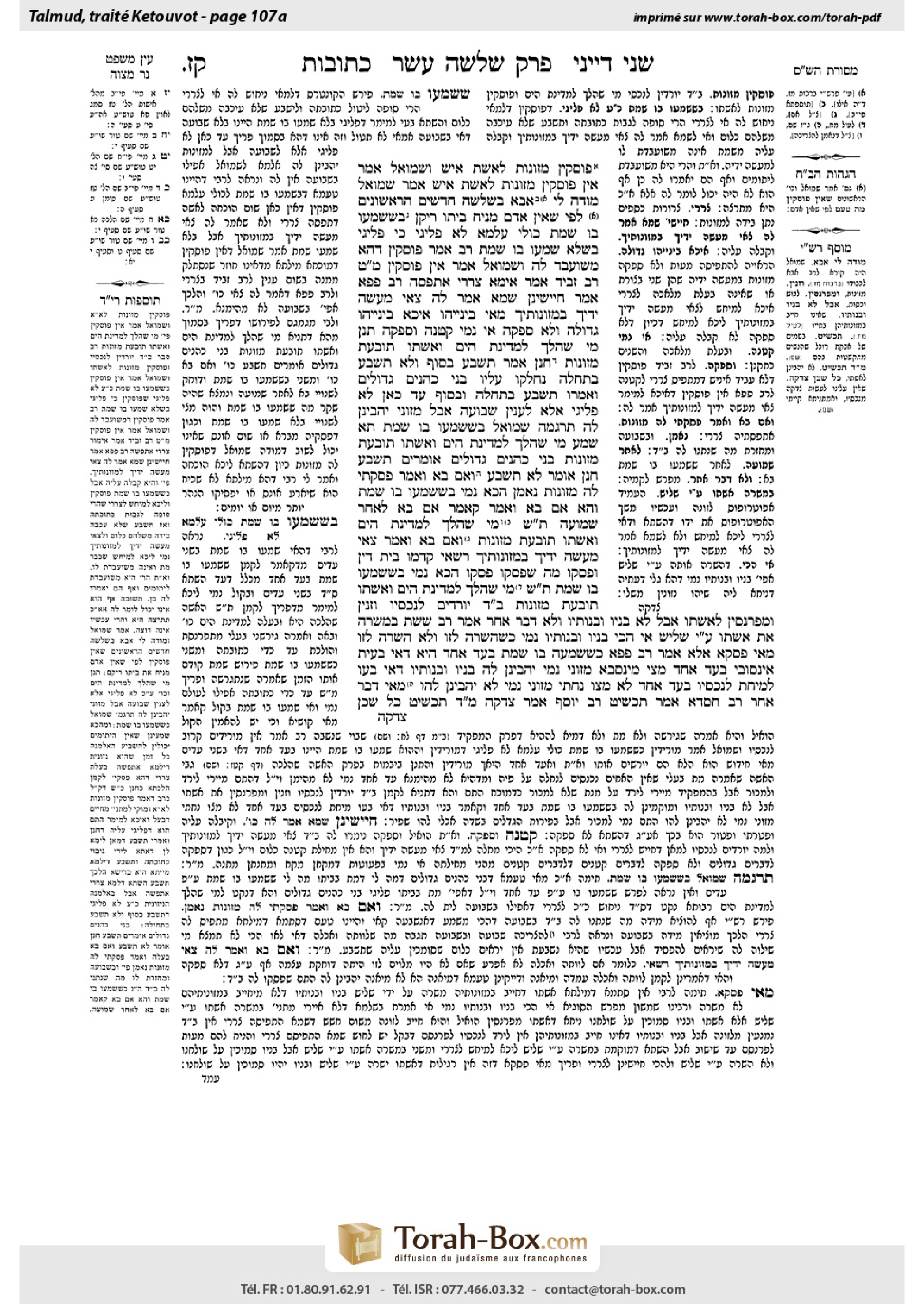
Ketubot 107a: Talmud study for Daf Yomi
Daf Yomi is the daily study of one Talmud folio. Explore 37 tractates with scans, Hebrew text, Sefaria English and AI-generated French translations where annotated.
Passage selection and English or AI-generated French translation are available where the scan has annotations. Daf Study is independent of Torah-Box and Sefaria.
Browse Ketubot · כתובות · All tractatesKetubot 107a text and translations
This page of Ketubot includes the Aramaic text, an English translation and an AI-generated French translation, alongside the scan above.
כתובות ק״ז א · Aramaic and Hebrew text
פּוֹסְקִין מְזוֹנוֹת לְאֵשֶׁת אִישׁ. וּשְׁמוּאֵל אָמַר: אֵין פּוֹסְקִין מְזוֹנוֹת לְאֵשֶׁת אִישׁ. אָמַר שְׁמוּאֵל: מוֹדֶה לִי אַבָּא בִּשְׁלֹשָׁה חֳדָשִׁים הָרִאשׁוֹנִים, לְפִי שֶׁאֵין אָדָם מַנִּיחַ בֵּיתוֹ רֵיקָן.
בְּשֶׁשָּׁמְעוּ בּוֹ שֶׁמֵּת כּוּלֵּי עָלְמָא לָא פְּלִיגִי. כִּי פְּלִיגִי, בְּשֶׁלֹּא שָׁמְעוּ בּוֹ שֶׁמֵּת. רַב אָמַר: פּוֹסְקִין, דְּהָא מְשׁוּעְבַּד לַהּ. וּשְׁמוּאֵל אָמַר: אֵין פּוֹסְקִין.
מַאי טַעְמָא? רַב זְבִיד אָמַר: אֵימָא צְרָרֵי אַתְפְּסַהּ. רַב פָּפָּא אָמַר: חָיְישִׁינַן שֶׁמָּא אָמַר לָהּ ״צְאִי מַעֲשֵׂה יָדַיִךְ בִּמְזוֹנוֹתַיִךְ״.
מַאי בֵּינַיְיהוּ? אִיכָּא בֵּינַיְיהוּ גְּדוֹלָה, וְלָא סָפְקָה.
אִי נָמֵי קְטַנָּה וְסָפְקָה.
תְּנַן: מִי שֶׁהָלַךְ לִמְדִינַת הַיָּם וְאִשְׁתּוֹ תּוֹבַעַת מְזוֹנוֹת, חָנָן אָמַר: תִּשָּׁבַע בַּסּוֹף, וְלֹא תִּשָּׁבַע בַּתְּחִלָּה. נֶחְלְקוּ עָלָיו בְּנֵי כֹּהֲנִים גְּדוֹלִים וְאָמְרוּ: תִּשָּׁבַע בַּתְּחִלָּה וּבַסּוֹף. עַד כָּאן לָא פְּלִיגִי אֶלָּא לְעִנְיַן שְׁבוּעָה, אֲבָל מְזוֹנֵי יָהֲבִינַן לַהּ! תַּרְגְּמַהּ שְׁמוּאֵל: בְּשֶׁשָּׁמְעוּ בּוֹ שֶׁמֵּת.
תָּא שְׁמַע: מִי שֶׁהָלַךְ לִמְדִינַת הַיָּם וְאִשְׁתּוֹ תּוֹבַעַת מְזוֹנוֹת, בְּנֵי כֹּהֲנִים גְּדוֹלִים אוֹמְרִים: תִּשָּׁבַע, חָנָן אוֹמֵר: לֹא תִּשָּׁבַע. וְאִם בָּא וְאָמַר: פָּסַקְתִּי לָהּ מְזוֹנוֹת — נֶאֱמָן!
הָכָא נָמֵי בְּשֶׁשָּׁמְעוּ בּוֹ שֶׁמֵּת. וְהָא ״אִם בָּא וְאָמַר״ קָאָמַר! אִם בָּא לְאַחַר שְׁמוּעָה.
תָּא שְׁמַע: מִי שֶׁהָלַךְ לִמְדִינַת הַיָּם וְאִשְׁתּוֹ תּוֹבַעַת מְזוֹנוֹת, וְאִם בָּא וְאָמַר ״צְאִי מַעֲשֵׂה יָדַיִךְ בִּמְזוֹנוֹתַיִךְ״ — רַשַּׁאי. קָדְמוּ בֵּית דִּין וּפָסְקוּ — מַה שֶּׁפָּסְקוּ פָּסְקוּ. הָכָא נָמֵי בְּשֶׁשָּׁמְעוּ בּוֹ שֶׁמֵּת.
תָּא שְׁמַע: מִי שֶׁהָלַךְ לִמְדִינַת הַיָּם וְאִשְׁתּוֹ תּוֹבַעַת מְזוֹנוֹת — בֵּית דִּין יוֹרְדִים לִנְכָסָיו וְזָנִין וּמְפַרְנְסִין לְאִשְׁתּוֹ, אֲבָל לֹא בָּנָיו וּבְנוֹתָיו, וְלֹא דָּבָר אַחֵר!
אָמַר רַב שֵׁשֶׁת: בְּמַשְׁרֶה אֶת אִשְׁתּוֹ עַל יְדֵי שָׁלִישׁ. אִי הָכִי, בָּנָיו וּבְנוֹתָיו נָמֵי! כְּשֶׁהִשְׁרָה לָזוֹ, וְלֹא הִשְׁרָה לָזוֹ. מַאי פַּסְקָא?
אֶלָּא אָמַר רַב פָּפָּא: כְּשֶׁשָּׁמְעָה בּוֹ שֶׁמֵּת בְּעֵד אֶחָד. הִיא, דְּאִי בָּעֲיָא אִינְּסוֹבֵי בְּעֵד אֶחָד מָצְיָא מִינַּסְבָא — מְזוֹנֵי נָמֵי יָהֲבִינַן לַהּ.
בָּנָיו וּבְנוֹתָיו, דְּאִי בָּעוּ לְמֵיחַת לִנְכָסָיו בְּעֵד אֶחָד לָא מָצוּ נָחֲתִי — מְזוֹנֵי נָמֵי לָא יָהֲבִינַן לְהוּ.
מַאי ״דָּבָר אַחֵר״? רַב חִסְדָּא אָמַר: תַּכְשִׁיט. רַב יוֹסֵף אָמַר: צְדָקָה. מַאן דְּאָמַר תַּכְשִׁיט, כׇּל שֶׁכֵּן
Ketubot 107a · English translation
The court apportions sustenance for a married woman, i.e., if a husband went overseas and left behind nothing with which his wife could provide for her sustenance, the court withdraws money from his estate for this purpose. And Shmuel said: The court does not apportion sustenance for a married woman. Shmuel further said: Abba, i.e., Rav, concedes to me that the court does not touch the husband’s estate for the first three months. This is because a person does not leave his house empty, and therefore it is certain that he left something with which his wife can sustain herself at least in the short term.
The Gemara comments: In a case where they heard that the husband died, everyone agrees that the court sustains his wife from his estate. When they disagree it is in a case where they did not hear that he had died abroad. Rav said that the court apportions sustenance for the wife, as his estate is legally mortgaged to her and must provide her with sustenance, and Shmuel said that in this case the court does not apportion sustenance for her.
The Gemara asks: What is the reason for Shmuel’s ruling? Rav Zevid said: One can say that he gave her a bundle of money before he departed. Rav Pappa said: We are concerned that perhaps he said to her before his departure: Spend your earnings to sustain yourself, i.e., he renounced his rights to her earnings and in exchange he is no longer required to provide her with support.
The Gemara asks: What is the practical difference between these two explanations? The Gemara answers: There is a practical difference between them in a case where the woman is an adult, and therefore it is possible that he left her money, and the amount she earns is not enough for her needs. According to the opinion of Rav Zevid, one can assume that he gave her money and therefore it is not necessary for the court to allocate her sustenance from his estate, whereas according to the opinion of Rav Pappa, as her earnings are not enough for her sustenance the court apportions more for her from his estate, despite the husband’s possible stipulation.
Alternatively, there is a difference between them in the case of a minor wife, with whom the husband would not have left money, but her earnings are enough for her sustenance. Rav Zevid would claim that the court must provide for her from his estate, as he would not have left her money, whereas Rav Pappa would argue that he might have told her to sustain herself from her own earnings.
§ We learned in the mishna: With regard to one who went overseas and his wife is demanding sustenance, Ḥanan says: She takes an oath at the end, and she does not take an oath at the outset. The sons of High Priests disputed Ḥanan’s opinion and said: She takes an oath both at the outset and at the end. The Gemara comments: They disagree only with regard to an oath; however, with regard to sustenance everyone agrees that the court gives it to her. This apparently contradicts the opinion of Shmuel. The Gemara explains that Shmuel interpreted the mishna in accordance with his opinion as referring to a case when they heard concerning him that he died overseas. In this scenario, everyone agrees that the court provides her with sustenance from the husband’s estate.
Come and hear a baraita: With regard to one who went overseas and his wife is demanding sustenance, the sons of High Priests say: She takes an oath. Ḥanan says: She does not take an oath, i.e., she receives sustenance without having to swear. And if he came and said: I apportioned money for her sustenance and left her with sufficient funds, he is deemed credible and she must return all that she received from his estate through the court. This poses a difficulty for the opinion of Shmuel, who maintains that the court does not supply her with sustenance ab initio.
The Gemara answers: Here, too, it is referring to a case where they heard concerning him that he died abroad. The Gemara asks: But the tanna said: If he came and said, which indicates that the husband is not dead. The Gemara explains that the baraita means: If he came after the rumor. There was a rumor that he had died, and for this reason the court provided her with sustenance, and later it was determined that the rumor was false.
Come and hear another baraita: With regard to one who went overseas and his wife is demanding sustenance, if he came and said that prior to his departure he told her: Spend your earnings to sustain yourself, he is permitted to act accordingly. If the court went ahead and apportioned sustenance for her, what they apportioned is apportioned, and she is not required to return it. Again, this poses a difficulty for the opinion of Shmuel. The Gemara answers: Here, too, it is referring to a case where they heard concerning him that he died abroad.
Come and hear another baraita: With regard to one who went overseas and his wife is demanding sustenance, the court descends to his property and feeds and provides a livelihood for his wife, but not for his sons and daughters, and they do not give her something else. Once again this presents a difficulty for the opinion of Shmuel.
Rav Sheshet said: This is referring to one who feeds his wife by means of a third party. In this case, even if the husband was available he would not be providing her with her sustenance directly, as he appointed someone else to give her money in accordance with her needs. The Gemara asks: If so, his sons and daughters should also receive this support. The Gemara answers: It is referring to a case where he appointed a third party for this purpose, his wife’s sustenance, but he did not appoint a third party for this purpose, the sustenance of his children. The Gemara asks: If that is correct, why was it stated without qualification? There is no hint in the baraita that the husband differentiated in this manner.
Rather, Rav Pappa said that Shmuel would explain this baraita as referring to a case where she heard that he had died, and she was told this by one witness. Therefore, as far as she is concerned, since this is a case where if she wanted to remarry based on the testimony of that one witness she may marry, as in this situation the Sages permitted her to rely on the account of a single witness so that she not end up a deserted woman, the court also provides her with sustenance, as she may claim her marriage contract based on this testimony.
However, with regard to his sons and daughters, since this is a case where if they wanted to descend to his estate on the basis of the testimony of one witness, they may not descend and take the property, as two witnesses are required for matters of inheritance, the court also does not provide them with sustenance. As far as the children are concerned, there is still insufficient evidence for the death of their father.
Incidentally, the Gemara asks: What is: Something else, mentioned in the baraita? Rav Ḥisda said: This is a wife’s ornaments, to which she is entitled in addition to her sustenance. Rav Yosef said: It is money for charity. The Gemara comments: According to the one who said that the court does not pay for her ornaments if the husband has gone overseas, all the more so
Ketubot 107a · Traduction française (IA)
Le tribunal attribue une pension alimentaire à une femme mariée, c’est-à-dire que si son mari est parti outre-mer sans laisser à sa femme de quoi subvenir à ses besoins, le tribunal prélève de l’argent sur le patrimoine du mari à cette fin. Chmouel a dit : Le tribunal n’attribue pas de pension alimentaire à une femme mariée. Chmouel a également dit : Abba, c’est-à-dire Rav, reconnaît que le tribunal ne touche pas au patrimoine du mari pendant les trois premiers mois. En effet, on ne quitte pas sa maison les mains vides ; il est donc certain qu’il a laissé quelque chose qui permet à sa femme de subvenir à ses besoins, au moins à court terme.
La Guemara fait remarquer : Dans le cas où l’on a appris que le mari était mort, tous sont d’accord pour que le tribunal entretienne sa femme sur son patrimoine. Leur désaccord porte sur le cas où l’on n’a pas appris qu’il était mort à l’étranger. Rav dit que le tribunal attribue une pension alimentaire à la femme, car son patrimoine est juridiquement grevé en sa faveur et doit assurer sa subsistance ; Chmouel dit que, dans ce cas, le tribunal ne lui attribue pas de pension alimentaire.
La Guemara demande : Quelle est la raison de la décision de Chmouel ? Rav Zevid a dit : On peut supposer qu’il lui a donné une bourse d’argent avant son départ. Rav Pappa a dit : Nous craignons qu’avant de partir, il lui ait dit : « Dépense tes revenus pour subvenir à tes besoins », c’est-à-dire qu’il a renoncé à ses droits sur ses revenus et qu’en contrepartie, il n’est plus tenu de pourvoir à sa subsistance.
La Guemara demande : Quelle différence pratique y a-t-il entre ces deux explications ? La Guemara répond : Il y a une différence dans le cas où la femme est majeure et où il est donc possible qu’il lui ait laissé de l’argent, mais où ses revenus ne suffisent pas à ses besoins. Selon Rav Zevid, on peut supposer qu’il lui a donné de l’argent ; il n’est donc pas nécessaire que le tribunal lui attribue une pension alimentaire prélevée sur son patrimoine. Selon Rav Pappa, en revanche, puisque ses revenus ne suffisent pas à sa subsistance, le tribunal lui attribue un complément prélevé sur son patrimoine, malgré la possibilité que le mari ait stipulé le contraire.
Autrement, il y a une différence dans le cas d’une épouse mineure, à qui le mari n’aurait pas laissé d’argent, mais dont les revenus suffisent à assurer la subsistance. Rav Zevid soutiendrait que le tribunal doit pourvoir à ses besoins sur le patrimoine du mari, puisqu’il ne lui aurait pas laissé d’argent, tandis que Rav Pappa soutiendrait qu’il a pu lui dire de subvenir à ses besoins avec ses propres revenus.
§ Nous avons appris dans la Michna : À propos d’un homme parti outre-mer dont la femme réclame une pension alimentaire, Ḥanan dit : Elle prête serment à la fin, mais pas au début. Les fils des grands prêtres contestent l’avis de Ḥanan et disent : Elle prête serment aussi bien au début qu’à la fin. La Guemara fait remarquer : Leur désaccord porte uniquement sur le serment ; en ce qui concerne la pension alimentaire, tous sont d’accord pour que le tribunal la lui accorde. Cela semble contredire l’avis de Chmouel. La Guemara explique que Chmouel interprète la Michna conformément à son avis : elle traite du cas où l’on a appris que le mari était mort outre-mer. Dans cette situation, tous sont d’accord pour que le tribunal assure sa subsistance sur le patrimoine du mari.
Viens entendre une baraïta : À propos d’un homme parti outre-mer dont la femme réclame une pension alimentaire, les fils des grands prêtres disent : Elle prête serment. Ḥanan dit : Elle ne prête pas serment, c’est-à-dire qu’elle reçoit une pension alimentaire sans avoir à jurer. Et s’il revient et dit : « Je lui ai attribué de l’argent pour sa subsistance et lui en ai laissé suffisamment », on le croit et elle doit restituer tout ce qu’elle a reçu de son patrimoine par l’intermédiaire du tribunal. Cela soulève une difficulté contre l’avis de Chmouel, selon lequel le tribunal ne lui fournit pas de pension alimentaire d’emblée.
La Guemara répond : Ici aussi, il s’agit du cas où l’on a appris que le mari était mort à l’étranger. La Guemara demande : Mais le tanna a dit : « S’il revient », ce qui indique que le mari n’est pas mort. La Guemara explique que la baraïta veut dire : « S’il revient après la rumeur. » Une rumeur avait annoncé sa mort ; c’est pourquoi le tribunal avait pourvu à la subsistance de sa femme, puis il a été établi que cette rumeur était fausse.
Viens entendre une autre baraïta : À propos d’un homme parti outre-mer dont la femme réclame une pension alimentaire, s’il revient et dit qu’avant son départ il lui a dit : « Dépense tes revenus pour subvenir à tes besoins », il est en droit d’agir ainsi. Si le tribunal a néanmoins attribué une pension alimentaire à la femme, ce qui a été attribué reste acquis et elle n’est pas tenue de le restituer. Là encore, cela soulève une difficulté contre l’avis de Chmouel. La Guemara répond : Ici aussi, il s’agit du cas où l’on a appris que le mari était mort à l’étranger.
Viens entendre une autre baraïta : À propos d’un homme parti outre-mer dont la femme réclame une pension alimentaire, le tribunal saisit les biens du mari et nourrit sa femme et pourvoit à sa subsistance, mais il ne fait pas de même pour ses fils et ses filles, et ne lui accorde rien d’autre. Une fois encore, cela soulève une difficulté contre l’avis de Chmouel.
Rav Chéchet a dit : Cela concerne un homme qui fait parvenir à sa femme sa pension alimentaire par l’intermédiaire d’un tiers. Dans ce cas, même si le mari était présent, il ne lui aurait pas remis directement sa pension, puisqu’il avait chargé quelqu’un d’autre de lui donner de l’argent selon ses besoins. La Guemara demande : Si c’est le cas, ses fils et ses filles devraient eux aussi recevoir cette aide. La Guemara répond : Il s’agit d’un cas où il avait chargé un tiers de cette tâche — assurer la subsistance de sa femme —, mais n’avait pas chargé de tiers d’assurer celle de ses enfants. La Guemara demande : Si c’est bien cela, pourquoi cette règle a-t-elle été énoncée sans réserve ? Rien dans la baraïta ne laisse entendre que le mari a fait cette distinction.
Rav Pappa a plutôt dit que Chmouel expliquerait cette baraïta comme concernant le cas où la femme a appris la mort de son mari par un témoin unique. Par conséquent, de son point de vue, puisqu’elle peut se remarier sur le témoignage de ce témoin unique — les Sages lui ayant permis de se fier au témoignage d’un seul témoin afin qu’elle ne reste pas une femme abandonnée —, le tribunal lui assure également sa subsistance, car elle peut réclamer sa ketouba sur la foi de ce témoignage.
Toutefois, en ce qui concerne ses fils et ses filles, puisqu’ils ne peuvent pas prendre possession du patrimoine de leur père sur la foi du témoignage d’un seul témoin — deux témoins étant nécessaires en matière d’héritage —, le tribunal ne pourvoit pas non plus à leur subsistance. Pour les enfants, les éléments de preuve établissant la mort de leur père restent insuffisants.
À ce propos, la Guemara demande : Qu’est-ce que « rien d’autre », mentionné dans la baraïta ? Rav Ḥisda a dit : Il s’agit des parures d’une épouse, auxquelles elle a droit en plus de sa pension alimentaire. Rav Yossef a dit : Il s’agit d’argent destiné à la tsédaka. La Guemara fait remarquer : Selon celui qui dit que le tribunal ne paie pas ses parures si le mari est parti outre-mer, à plus forte raison
Traduction française générée par IA à partir de l’édition anglaise de Sefaria. Vérifie toujours un passage avec le texte source.
Text from Sefaria: William Davidson Edition - Vocalized Aramaic (CC BY NC); William Davidson Edition - English (CC BY NC).