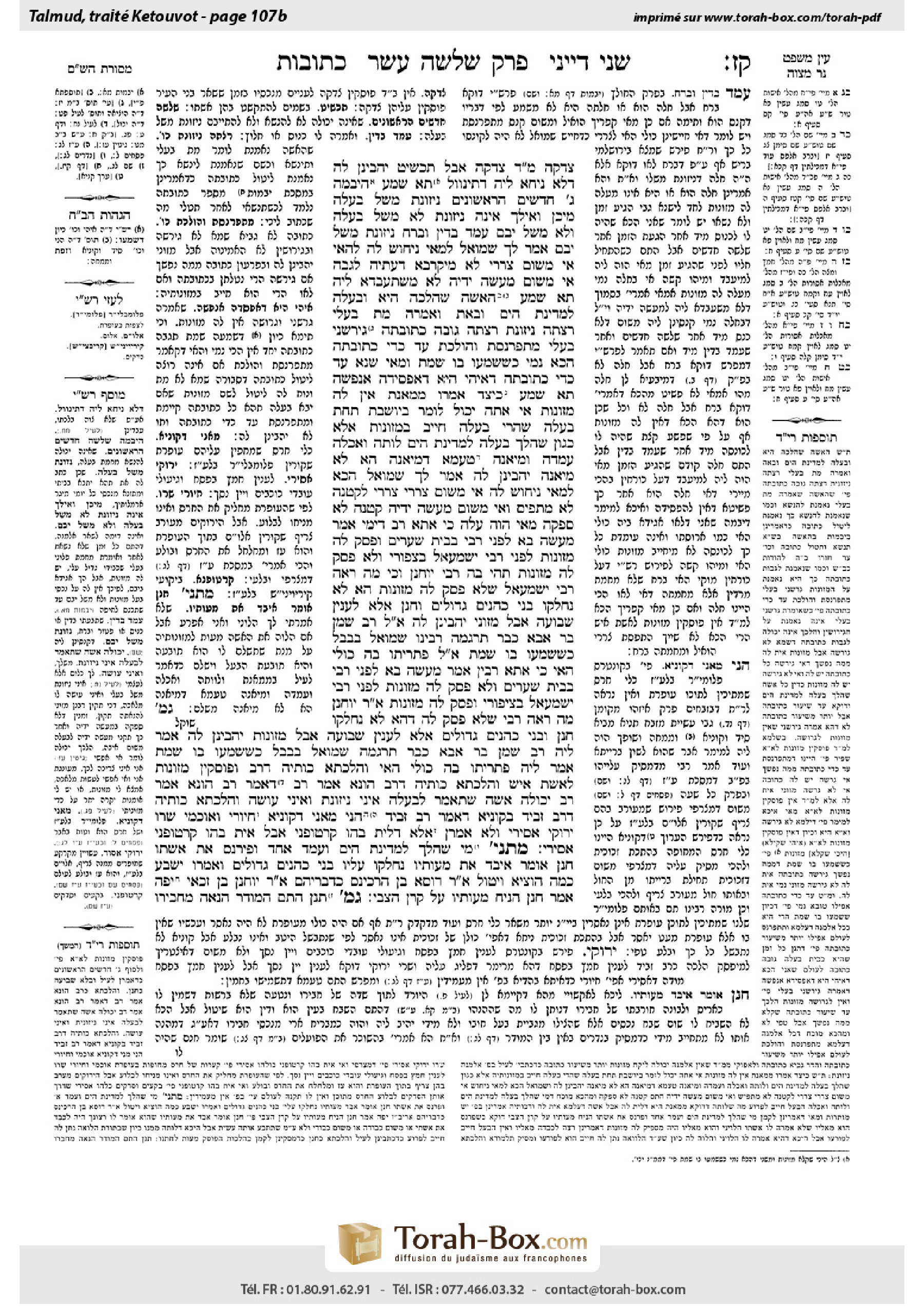
Ketubot 107b: Talmud study for Daf Yomi
Daf Yomi is the daily study of one Talmud folio. Explore 37 tractates with scans, Hebrew text, Sefaria English and AI-generated French translations where annotated.
Passage selection and English or AI-generated French translation are available where the scan has annotations. Daf Study is independent of Torah-Box and Sefaria.
Browse Ketubot · כתובות · All tractatesKetubot 107b text and translations
This page of Ketubot includes the Aramaic text, an English translation and an AI-generated French translation, alongside the scan above.
כתובות ק״ז ב · Aramaic and Hebrew text
צְדָקָה. מַאן דְּאָמַר צְדָקָה — אֲבָל תַּכְשִׁיט יָהֲבִינַן לַהּ, דְּלָא נִיחָא לֵיהּ דְּתִינַּוַּול.
תָּא שְׁמַע: הַיְּבָמָה — שְׁלֹשָׁה חֳדָשִׁים הָרִאשׁוֹנִים נִיזּוֹנֶת מִשֶּׁל בַּעְלָהּ,
מִיכָּן וְאֵילָךְ, אֵינָהּ נִיזּוֹנֶת לֹא מִשֶּׁל בַּעְלָהּ וְלֹא מִשֶּׁל יָבָם. עָמַד בַּדִּין וּבָרַח — נִיזּוֹנֶת מִשֶּׁל יָבָם.
אָמַר לְךָ שְׁמוּאֵל: לְמַאי נֵיחוּשׁ לַהּ לְהַאי? אִי מִשּׁוּם צְרָרֵי — לָא מִיקָּרְבָא דַּעְתֵּיהּ לְגַבַּהּ, אִי מִשּׁוּם מַעֲשֵׂה יָדֶיהָ — לָא מִשְׁתַּעְבְּדָא לֵיהּ.
תָּא שְׁמַע: הָאִשָּׁה שֶׁהָלְכָה הִיא וּבַעְלָהּ לִמְדִינַת הַיָּם, וּבָאת וְאָמְרָה ״מֵת בַּעְלִי״, רָצְתָה — נִיזּוֹנֶת, רָצְתָה — גּוֹבָה כְּתוּבָּתָהּ. ״גֵּירְשַׁנִי בַּעֲלִי״ — מִתְפַּרְנֶסֶת וְהוֹלֶכֶת עַד כְּדֵי כְתוּבָּתָהּ.
הָכָא נָמֵי כְּשֶׁשָּׁמְעוּ בּוֹ שֶׁמֵּת. וּמַאי שְׁנָא עַד כְּדֵי כְתוּבָּתָהּ? דְּאִיהִי הִיא דְּאַפְסֵידָה אַנַּפְשַׁהּ.
תָּא שְׁמַע: כֵּיצַד אָמְרוּ מְמָאֶנֶת אֵין לָהּ מְזוֹנוֹת? אִי אַתָּה יָכוֹל לוֹמַר בְּיוֹשֶׁבֶת תַּחַת בַּעְלָהּ — שֶׁהֲרֵי בַּעְלָהּ חַיָּיב בִּמְזוֹנוֹת. אֶלָּא כְּגוֹן שֶׁהָלַךְ בַּעְלָהּ לִמְדִינַת הַיָּם, לָוְתָה וְאָכְלָה עָמְדָה וּמֵיאֲנָה. טַעְמָא דְּמֵיאֲנָה, הָא לֹא מֵיאֲנָה — יָהֲבִינַן לַהּ!
אָמַר לָךְ שְׁמוּאֵל: הָכָא לְמַאי נֵיחוּשׁ לַהּ? אִי מִשּׁוּם צְרָרֵי — צְרָרֵי לִקְטַנָּה לָא מַתְפֵּיס, וְאִי מִשּׁוּם מַעֲשֵׂה יָדֶיהָ — קְטַנָּה לָא סָפְקָה.
מַאי הֲוָה עֲלַהּ? כִּי אֲתָא רַב דִּימִי, אָמַר: מַעֲשֶׂה בָּא לִפְנֵי רַבִּי בְּבֵית שְׁעָרִים וּפָסַק לָהּ מְזוֹנוֹת. לִפְנֵי רַבִּי יִשְׁמָעֵאל בְּצִפּוֹרִי, וְלֹא פָּסַק לָהּ מְזוֹנוֹת. תָּהֵי בַּהּ רַבִּי יוֹחָנָן: וְכִי מָה רָאָה רַבִּי יִשְׁמָעֵאל שֶׁלֹּא פָּסַק לָהּ מְזוֹנוֹת? הָא לֹא נֶחְלְקוּ בְּנֵי כֹּהֲנִים גְּדוֹלִים וְחָנָן אֶלָּא לְעִנְיַן שְׁבוּעָה, אֲבָל מְזוֹנֵי יָהֲבִינַן לַהּ!
אֲמַר לֵיהּ רַב שֶׁמֶן בַּר אַבָּא: כְּבָר תַּרְגְּמַהּ רַבֵּינוּ שְׁמוּאֵל בְּבָבֶל כְּשֶׁשָּׁמְעוּ בּוֹ שֶׁמֵּת. אֲמַר לֵיהּ: פָּתְרִיתוּ בָּהּ כּוּלֵּי הַאי?
כִּי אֲתָא רָבִין, אָמַר: מַעֲשֶׂה בָּא לִפְנֵי רַבִּי בְּבֵית שְׁעָרִים, וְלֹא פָּסַק לָהּ מְזוֹנוֹת. לִפְנֵי רַבִּי יִשְׁמָעֵאל בְּצִיפּוֹרִי, וּפָסַק לָהּ מְזוֹנוֹת. אָמַר רַבִּי יוֹחָנָן: מָה רָאָה רַבִּי שֶׁלֹּא פָּסַק לָהּ? דְּהָא לֹא נֶחְלְקוּ חָנָן וּבְנֵי כֹּהֲנִים גְּדוֹלִים אֶלָּא לְעִנְיַן שְׁבוּעָה, אֲבָל מְזוֹנוֹת יָהֲבִינַן לַהּ. אֲמַר לֵיהּ רַב שֶׁמֶן בַּר אַבָּא: כְּבָר תַּרְגְּמַהּ שְׁמוּאֵל בְּבָבֶל כְּשֶׁשָּׁמְעוּ בּוֹ שֶׁמֵּת. אֲמַר לֵיהּ: פָּתְרִיתוּ בָּהּ כּוּלֵּי הַאי?
וְהִלְכְתָא כְּוָתֵיהּ דְּרַב, וּפוֹסְקִין מְזוֹנוֹת לְאֵשֶׁת אִישׁ. וְהִלְכְתָא כְּוָתֵיהּ דְּרַב הוּנָא אָמַר רַב. דְּאָמַר רַב הוּנָא אָמַר רַב: יְכוֹלָה אִשָּׁה שֶׁתֹּאמַר לְבַעְלָהּ ״אֵינִי נִיזּוֹנֶת וְאֵינִי עוֹשָׂה״.
וְהִלְכְתָא כְּוָתֵיהּ דְּרַב זְבִיד בְּקוּנְיָא. דְּאָמַר רַב זְבִיד: הָנֵי מָאנֵי דְקוּנְיָא — חִיוָּרֵי וְאוּכָּמֵי שְׁרוּ.
יְרוּקֵּי אֲסִירִי. וְלָא אֲמַרַן אֶלָּא דְּלֵית בְּהוּ קַרְטוּפָנֵי, אֲבָל אִית בְּהוּ קַרְטוּפָנֵי — אֲסִירִי.
מַתְנִי׳ מִי שֶׁהָלַךְ לִמְדִינַת הַיָּם, וְעָמַד אֶחָד וּפִירְנֵס אֶת אִשְׁתּוֹ, חָנָן אוֹמֵר: אִיבֵּד אֶת מְעוֹתָיו.
נֶחְלְקוּ עָלָיו בְּנֵי כֹּהֲנִים גְּדוֹלִים וְאָמְרוּ: יִשָּׁבַע כַּמָּה הוֹצִיא וְיִטּוֹל. אָמַר רַבִּי דּוֹסָא בֶּן הַרְכִּינָס כְּדִבְרֵיהֶם. אָמַר רַבִּי יוֹחָנָן בֶּן זַכַּאי: יָפֶה אָמַר חָנָן, הִנִּיחַ מְעוֹתָיו עַל קֶרֶן הַצְּבִי.
גְּמָ׳ תְּנַן הָתָם: הַמּוּדָּר הֲנָאָה מֵחֲבֵירוֹ —
Ketubot 107b · English translation
he maintains that she does not receive money from his property for charity, as the court does not take donations of charity from one’s property without his knowledge. Conversely, the one who said that the court does not give money for charity would argue: However, they do give her ornaments, as it is assumed that it is not satisfactory for him for his wife to be degraded by a lack of jewelry.
The Gemara further suggests: Come and hear: With regard to a yevama, a woman whose husband died childless and he has a brother [yavam], and who is waiting either to enter into levirate marriage with the yavam or perform ḥalitza, for the first three months after her husband’s death she is sustained from the property of her husband.
From then on, as long as she has not entered into levirate marriage, she is not sustained, neither from the property of her husband nor from that of the yavam. If the yavam stood in judgment and the court ruled that he should enter into levirate marriage, and he fled, she is sustained from the property of the yavam. This apparently contradicts Shmuel’s ruling, as here the woman is provided with sustenance from the estate of the yavam in his absence, despite the fact that his obligation toward her is less than that of a husband.
The Gemara answers that Shmuel could have said to you: With regard to what need we be concerned in this case? If the concern is due to the possibility that he gave her a bundle of money before his departure, the mind of the yavam is not that close to this woman that he would leave money with her; if the concern is due to her earnings, i.e., that he said to her: Spend your earnings to sustain yourself, she is not yet obligated to give him her earnings.
Come and hear: With regard to a wife who went with her husband overseas, and she came back and said: My husband died, if she wishes she is sustained from his property, and if she wishes she collects payment of her marriage contract. If she said: My husband divorced me, but she does not present a bill of divorce, she is continually sustained from his property up to the amount of her marriage contract. The reason is that she may collect this money whether or not her claim is believed: If she is still married, she is entitled to her sustenance, and if she is divorced she receives the marriage contract. This once again presents a difficulty for the opinion of Shmuel, as she collects money from her husband’s estate in his absence.
The Gemara answers: Here, too, it is referring to a case where they heard concerning the husband that he died. The Gemara asks: And what is different about the sum up to the amount of her marriage contract; why is she given no more than this? If he is dead, she should be allowed to sustain herself from all his property until she weds another. The Gemara answers: The reason is that she is the one who caused the loss to herself. By claiming that she was divorced, she forfeits her right to more sustenance.
The Gemara further suggests: Come and hear: How, i.e., in what case, did the Sages say that a minor who refuses her husband does not receive sustenance? You cannot say that this halakha applies to a young girl who is living under the authority of her husband, as her husband is obligated in her sustenance. Rather, it applies to a case where her husband went overseas, and she borrowed money and sustained herself for a while, and subsequently she arose and refused him. The Gemara infers: The reason is that she refused him, which indicates that if she did not refuse her husband, the court gives her sustenance. This apparently shows that a woman is sustained from her husband’s property when he goes overseas.
The Gemara answers that Shmuel could have said to you: With regard to what need we be concerned here? If the concern is due to the possibility that he left her a bundle of money before his departure, one does not give a bundle of money to a minor. If the concern is due to the possibility that he instructed her to subsist on her earnings, the earnings of a minor are not enough to cover the expenses of her sustenance. In summary, no resolution has been found for the dispute between Rav and Shmuel, notwithstanding the numerous sources cited by the Gemara.
The Gemara asks: What is the conclusion that was reached about this dispute? How should this case be treated in practice? When Rav Dimi came from Eretz Yisrael, he said: An incident of this kind came before Rabbi Yehuda HaNasi in Beit She’arim, and he apportioned sustenance for her. However, a similar incident came before Rabbi Yishmael in Tzippori, and he did not apportion sustenance for her. Rabbi Yoḥanan wondered about this ruling: And what did Rabbi Yishmael see such that he did not apportion sustenance for her? After all, the sons of High Priests and Ḥanan disagreed in the mishna only with regard to whether she is obligated to swear an oath, but as far as sustenance is concerned, they concur that the court gives it to her.
Rav Shemen bar Abba said to Rabbi Yoḥanan: Our Rabbi in Babylonia, Shmuel, already interpreted it as referring to a case where they heard concerning the husband that he died. Rabbi Yoḥanan said to him in astonishment: Have you gone that far in your analysis of this case that you were able to resolve this problem?
When Ravin came from Eretz Yisrael, he said a different version of this discussion: An incident came before Rabbi Yehuda HaNasi in Beit She’arim, and he did not apportion sustenance for her; an incident came before Rabbi Yishmael in Tzippori, and he apportioned sustenance for her. Rabbi Yoḥanan said: And what did Rabbi Yehuda HaNasi see such that he did not apportion sustenance for her? As, the sons of High Priests and Ḥanan disagreed only with regard to an oath, but when it comes to sustenance, the court gives it to her. Rav Shemen bar Abba said to Rabbi Yoḥanan: Shmuel in Babylonia already interpreted it as referring to a case where they heard concerning him that he died. Rabbi Yoḥanan said to him in astonishment: Have you gone that far in your analysis of this case?
The Gemara concludes: And the halakha is in accordance with the opinion of Rav, and therefore one apportions sustenance for a married woman whose husband went overseas. In passing, the Gemara mentions other rulings of halakha. And the halakha is in accordance with that which Rav Huna said that Rav said. As Rav Huna said that Rav said: A woman can say to her husband: I will not be sustained by you and in turn I will not work, i.e., you will not keep my earnings. The reason is that this arrangement was enacted by the Sages for the wife’s benefit. Consequently, she can relinquish her rights to her sustenance in this manner.
And the halakha is in accordance with the opinion of Rav Zevid with regard to glazed [kunya] vessels. As Rav Zevid said: With regard to these glazed vessels [manei dekunya], i.e., earthenware vessels that are glazed over, the white and black ones are permitted after they have been washed, as the glazing prevents the vessels from absorbing the foods placed inside them. Some earthenware vessels absorb the food and drink that is cooked in them and are therefore rendered forbidden if at any time they contained forbidden food, e.g., wine poured as a libation or leaven on Passover. The white and black vessels are not considered like regular earthenware vessels, which are rendered permanently forbidden.
Conversely, green ones are forbidden, as they absorb from the substances placed inside them. And we said that white and black ones are permitted only if they do not have cracks; however, if they have cracks they are forbidden, as the forbidden food is absorbed by the earthenware through the cracks.
MISHNA: In the case of a husband who went overseas, and someone arose and sustained his wife in his absence, and upon the husband’s return the provider demands from him the money he spent on his wife, Ḥanan says: He has lost his money, i.e., the husband is not obligated to repay him, as the provider acted of his own free will and was not instructed to do so by the husband.
The sons of High Priests disagreed with Ḥanan’s opinion and said: The man swears how much he spent on behalf of the woman, and he takes that sum from the husband. Rabbi Dosa ben Harkinas said that the halakha is in accordance with their statement. Rabbi Yoḥanan ben Zakkai said: Ḥanan spoke well in this case, as this man is like one who placed his money on the horn of a deer in midflight, i.e., he has no reasonable expectation of reimbursement.
GEMARA: We learned in a mishna there (Nedarim 33a): With regard to one who is prohibited by a vow from deriving benefit from another,
Ketubot 107b · Traduction française (IA)
Il estime qu’elle ne reçoit pas d’argent provenant des biens de son mari pour la charité, car le tribunal ne prélève pas de dons sur les biens d’une personne à son insu. À l’inverse, celui qui a dit que le tribunal ne lui donne pas d’argent pour la charité pourrait soutenir : toutefois, on lui donne des bijoux, car on présume que son mari ne souhaite pas que son épouse soit dégradée faute de bijoux.
La Guemara propose encore : Viens et entends. À propos d’une yevama, une femme dont le mari est mort sans enfant et qui a un frère [yavam], et qui attend soit d’épouser son yavam par lévirat, soit d’accomplir la ḥalitsa, pendant les trois premiers mois suivant la mort de son mari, elle est entretenue sur les biens de son mari.
À partir de ce moment, tant qu’elle n’est pas entrée en lévirat, elle n’est entretenue ni sur les biens de son mari ni sur ceux du yavam. Si le yavam s’est présenté devant le tribunal et que celui-ci a statué qu’il devait l’épouser par lévirat, mais qu’il s’est enfui, elle est entretenue sur les biens du yavam. Cela semble contredire la décision de Chmouel : dans ce cas, la femme reçoit un entretien sur la succession du yavam en son absence, alors que l’obligation de celui-ci envers elle est moindre que celle d’un mari.
La Guemara répond que Chmouel aurait pu vous dire : de quoi faut-il se préoccuper dans ce cas ? Si l’on craint qu’il lui ait laissé une somme d’argent avant son départ, le yavam n’est pas assez proche de cette femme pour lui laisser de l’argent ; et si l’on craint qu’il s’agisse de ses gains, c’est-à-dire qu’il lui ait dit : « Dépense tes gains pour subvenir à tes besoins », elle n’est pas encore tenue de lui remettre ses gains.
Viens et entends : une femme est partie à l’étranger avec son mari, puis elle est revenue en disant : « Mon mari est mort. » Si elle le souhaite, elle est entretenue sur ses biens ; si elle le souhaite, elle perçoit le montant de sa ketouba. Si elle dit : « Mon mari m’a répudiée », mais ne présente pas de guet, elle continue d’être entretenue sur ses biens jusqu’à concurrence du montant de sa ketouba. Elle peut percevoir cette somme, que sa déclaration soit ou non jugée crédible : si elle est encore mariée, elle a droit à son entretien ; si elle est divorcée, elle reçoit sa ketouba. Cela pose de nouveau une difficulté à l’opinion de Chmouel, puisqu’elle perçoit de l’argent sur la succession de son mari en son absence.
La Guemara répond : ici aussi, il s’agit d’un cas où l’on a appris que son mari était mort. La Guemara demande : pourquoi la somme est-elle limitée au montant de sa ketouba ? Pourquoi ne lui donne-t-on pas davantage ? S’il est mort, elle devrait pouvoir subvenir à ses besoins sur l’ensemble de ses biens jusqu’à ce qu’elle épouse un autre homme. La Guemara répond : c’est parce qu’elle est elle-même à l’origine de sa perte. En affirmant qu’elle a été répudiée, elle renonce à son droit à un entretien au-delà de ce montant.
La Guemara propose encore : Viens et entends : dans quel cas, c’est-à-dire dans quelle situation, les Sages ont-ils dit qu’une mineure qui refuse son mari ne reçoit pas d’entretien ? On ne peut pas dire que cette halakha s’applique à une jeune fille qui vit sous l’autorité de son mari, car celui-ci est tenu de subvenir à ses besoins. Elle s’applique plutôt au cas où son mari est parti à l’étranger, où elle a emprunté de l’argent et a subvenu à ses besoins pendant un certain temps, puis s’est levée et l’a refusé. La Guemara en déduit que c’est parce qu’elle l’a refusé ; cela indique que si elle n’avait pas refusé son mari, le tribunal lui assurerait un entretien. Cela semble montrer qu’une femme est entretenue sur les biens de son mari lorsque celui-ci part à l’étranger.
La Guemara répond que Chmouel aurait pu vous dire : de quoi faut-il se préoccuper ici ? Si l’on craint qu’il lui ait laissé une somme d’argent avant son départ, on ne laisse pas une telle somme à une mineure. Si l’on craint qu’il lui ait ordonné de vivre de ses gains, les gains d’une mineure ne suffisent pas à couvrir les dépenses de son entretien. En résumé, aucun règlement du désaccord entre Rav et Chmouel n’a été trouvé, malgré les nombreuses sources citées par la Guemara.
La Guemara demande : quelle conclusion a-t-on tirée de ce désaccord ? Comment faut-il procéder en pratique dans ce cas ? Lorsque Rav Dimi arriva d’Eretz Israël, il dit : un cas de ce genre fut soumis à Rabbi Yehouda HaNassi à Beit She’arim, et il lui accorda un entretien. Mais un cas semblable fut soumis à Rabbi Yichmaël à Tsippori, et il ne lui accorda pas d’entretien. Rabbi Yoḥanan s’étonna de cette décision : qu’a donc vu Rabbi Yichmaël pour ne pas lui accorder d’entretien ? Après tout, les fils des grands prêtres et Ḥanan ne se sont opposés dans la Michna que sur la question de savoir si elle doit prêter serment ; quant à l’entretien, ils s’accordent à dire que le tribunal le lui accorde.
Rav Chemen bar Abba dit à Rabbi Yoḥanan : « Notre maître de Babylonie, Chmouel, l’a déjà interprété comme se rapportant à un cas où l’on avait appris que le mari était mort. » Rabbi Yoḥanan lui dit avec étonnement : « Es-tu allé si loin dans ton analyse de ce cas que tu as pu résoudre cette difficulté ? »
Lorsque Ravin arriva d’Eretz Israël, il rapporta une autre version de cette discussion : un cas fut soumis à Rabbi Yehouda HaNassi à Beit She’arim, et il ne lui accorda pas d’entretien ; un cas fut soumis à Rabbi Yichmaël à Tsippori, et il lui accorda un entretien. Rabbi Yoḥanan dit : « Qu’a donc vu Rabbi Yehouda HaNassi pour ne pas lui accorder d’entretien ? » En effet, les fils des grands prêtres et Ḥanan ne se sont opposés que sur la question du serment ; pour ce qui est de l’entretien, le tribunal le lui accorde. Rav Chemen bar Abba dit à Rabbi Yoḥanan : « Chmouel, en Babylonie, l’a déjà interprété comme se rapportant à un cas où l’on avait appris que son mari était mort. » Rabbi Yoḥanan lui dit avec étonnement : « Es-tu allé si loin dans ton analyse de ce cas ? »
La Guemara conclut : la halakha suit l’opinion de Rav ; par conséquent, on accorde un entretien à une femme mariée dont le mari est parti à l’étranger. À cette occasion, la Guemara mentionne d’autres décisions halakhiques. La halakha suit également l’opinion que Rav Houna a rapportée au nom de Rav. Rav Houna a en effet dit au nom de Rav : une femme peut dire à son mari : « Je ne veux pas que tu subviennes à mes besoins et, en contrepartie, je ne travaillerai pas », c’est-à-dire qu’il ne touchera pas à ses gains. Cet arrangement ayant été institué par les Sages dans l’intérêt de l’épouse, elle peut renoncer de cette manière à son droit à l’entretien.
La halakha suit également l’opinion de Rav Zevid concernant les récipients émaillés [kunya]. Rav Zevid a en effet dit : ces récipients émaillés [manei dekunya], c’est-à-dire des récipients en terre cuite recouverts d’émail, sont permis après lavage s’ils sont blancs ou noirs, car l’émail empêche les récipients d’absorber les aliments qu’on y place. Certains récipients en terre cuite absorbent les aliments et les boissons qui y sont cuits ; ils deviennent donc interdits s’ils ont contenu à un moment donné un aliment interdit, par exemple du vin versé en libation ou du levain à Pessaḥ. Les récipients blancs et noirs ne sont pas assimilés aux récipients ordinaires en terre cuite, qui deviennent interdits définitivement.
En revanche, les récipients verts sont interdits, car ils absorbent les substances qu’on y place. Nous avons dit que les récipients blancs et noirs sont permis uniquement s’ils ne sont pas fissurés ; s’ils le sont, ils sont interdits, car les aliments interdits sont absorbés par la terre cuite à travers les fissures.
MICHNA : Dans le cas d’un mari parti à l’étranger, si quelqu’un a pris l’initiative d’entretenir son épouse en son absence et qu’à son retour le mari, le bienfaiteur lui réclame l’argent dépensé pour son épouse, Ḥanan dit : « Il a perdu son argent », c’est-à-dire que le mari n’est pas tenu de le rembourser, car le bienfaiteur a agi de son propre chef et le mari ne lui avait pas demandé de le faire.
Les fils des grands prêtres s’opposèrent à l’opinion de Ḥanan et dirent : « L’homme prête serment quant à la somme qu’il a dépensée pour cette femme, puis il la recouvre auprès du mari. » Rabbi Dossa ben Horkinas dit que la halakha suit leur opinion. Rabbi Yoḥanan ben Zakkaï dit : « Ḥanan a bien parlé dans ce cas, car cet homme est comme quelqu’un qui aurait placé son argent sur la corne d’un cerf en plein vol », c’est-à-dire qu’il ne peut raisonnablement espérer être remboursé.
GUEMARA : Nous avons appris dans une Michna de Nedarim (33a) : celui qui, en vertu d’un vœu, ne peut tirer profit d’autrui,
Traduction française générée par IA à partir de l’édition anglaise de Sefaria. Vérifie toujours un passage avec le texte source.
Text from Sefaria: William Davidson Edition - Vocalized Aramaic (CC BY NC); William Davidson Edition - English (CC BY NC).