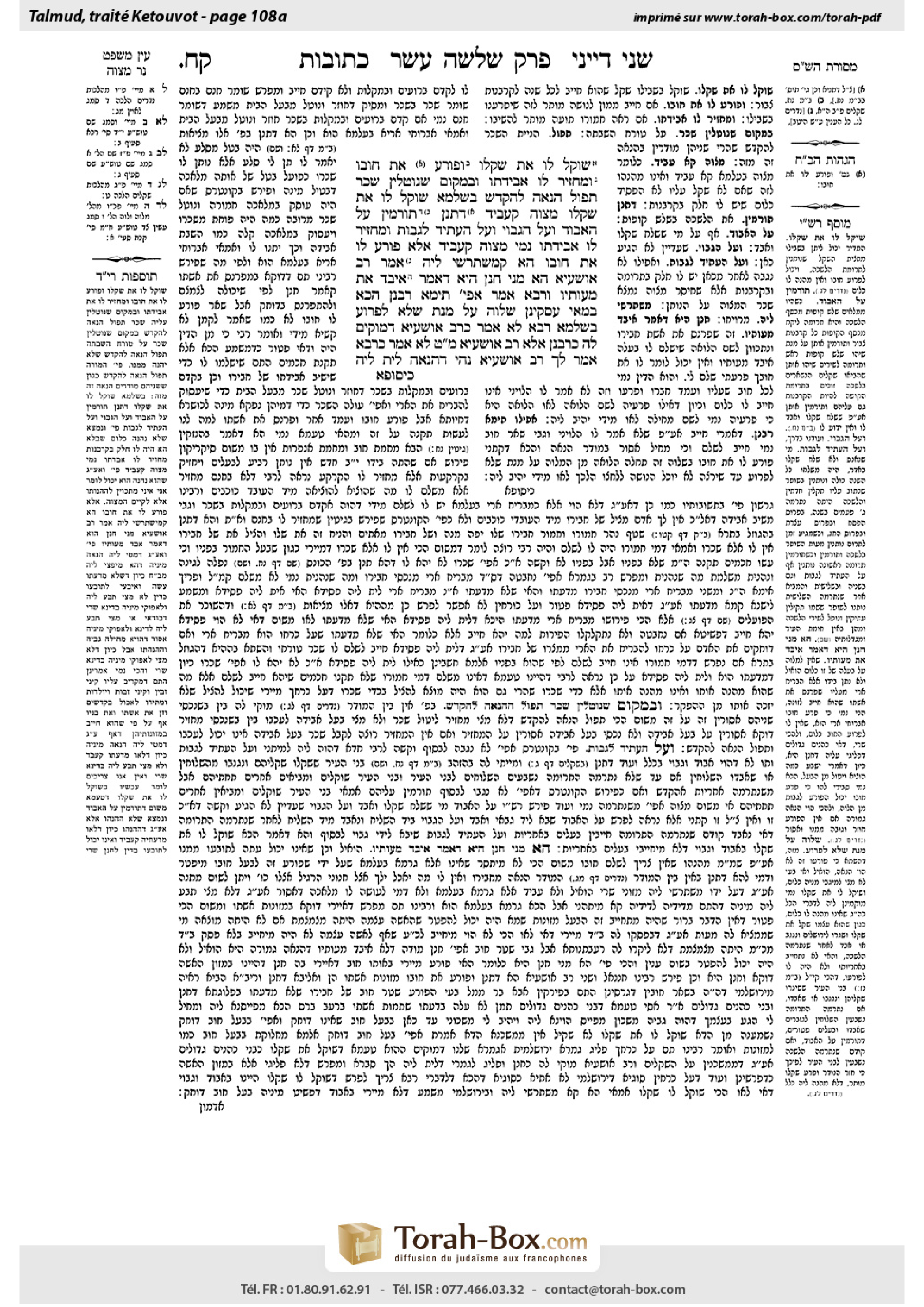
Ketubot 108a: Talmud study for Daf Yomi
Daf Yomi is the daily study of one Talmud folio. Explore 37 tractates with scans, Hebrew text, Sefaria English and AI-generated French translations where annotated.
Passage selection and English or AI-generated French translation are available where the scan has annotations. Daf Study is independent of Torah-Box and Sefaria.
Browse Ketubot · כתובות · All tractatesKetubot 108a text and translations
This page of Ketubot includes the Aramaic text, an English translation and an AI-generated French translation, alongside the scan above.
כתובות ק״ח א · Aramaic and Hebrew text
שׁוֹקֵל לוֹ אֶת שִׁקְלוֹ, וּפוֹרֵעַ אֶת חוֹבוֹ, וּמַחֲזִיר לוֹ אֲבֵידָתוֹ. וּבְמָקוֹם שֶׁנּוֹטְלִין שָׂכָר — תִּפּוֹל הֲנָאָה לַהֶקְדֵּשׁ.
בִּשְׁלָמָא שׁוֹקֵל לוֹ אֶת שִׁקְלוֹ — מִצְוָה קָעָבֵיד. דִּתְנַן: תּוֹרְמִין עַל הָאָבוּד וְעַל הַגָּבוּי וְעַל הֶעָתִיד לִגָּבוֹת.
וּמַחֲזִיר לוֹ אֲבֵידָתוֹ נָמֵי מִצְוָה קָעָבֵיד. אֶלָּא פּוֹרֵעַ לוֹ אֶת חוֹבוֹ, הָא קָמִשְׁתָּרְשִׁי לֵיהּ!
אָמַר רַב אוֹשַׁעְיָא: הָא מַנִּי? חָנָן הִיא, דְּאָמַר: אִיבֵּד אֶת מְעוֹתָיו.
וְרָבָא אָמַר: אֲפִילּוּ תֵּימָא רַבָּנַן, הָכָא בְּמַאי עָסְקִינַן, שֶׁלָּוָה עַל מְנָת שֶׁלֹּא לִפְרוֹעַ.
בִּשְׁלָמָא רָבָא לָא אָמַר כְּרַב אוֹשַׁעְיָא: דְּמוֹקֵים לַהּ כְּרַבָּנַן. אֶלָּא רַב אוֹשַׁעְיָא, מַאי טַעְמָא לָא אָמַר כְּרָבָא? אָמַר לָךְ רַב אוֹשַׁעְיָא: נְהִי דַּהֲנָאָה לֵית לֵיהּ,
Ketubot 108a · English translation
the other may contribute his shekel for him, i.e., it is permitted for the second individual to donate the half-shekel from his own money to the Temple on behalf of the first one, who is prohibited by the vow from deriving benefit; and he may repay his debt for him, i.e., if the one prohibited by the vow owes money to a third party, the one from whom he may not derive benefit may pay off that debt on his behalf. And he may return to him his lost object, and in a place where one takes a wage for returning a lost article, the benefit paid for the return of the item goes to the Temple treasury of consecrated property.
The Gemara discusses this mishna: Granted, he may contribute his shekel for him, as he thereby performs a mitzva. The one prohibited by the vow from deriving benefit does not derive any direct benefit from this action, as even if he did not pay the half-shekel, all Jews have a share in the communal offerings brought in the Temple, as we learned in a baraita: One performs the collection of money from the chamber with the intention that the ceremony apply to money that is lost, and money that has already been gathered but has not yet been brought to the Temple, and money that will be gathered in the future. This shows that even if one did not give a half-shekel, the communal offerings are nevertheless sacrificed in his name.
And concerning the halakha that he may return to him his lost object, he also performs a mitzva by means of this action. However, with regard to the statement that he may repay his debt for him, this is problematic because it provides a gain for the one prohibited by the vow from deriving benefit; if he did not repay the person’s debt, that person would have to pay it from his own pocket. Consequently, it should be considered as though the one prohibited from deriving benefit received money.
Rav Oshaya said: In accordance with whose opinion is this mishna? It is in accordance with the opinion of Ḥanan, who said in the mishna: He has lost his money. In other words, this is referring to a case in which he repays a debt that the other does not really have to repay at all, and therefore he is doing a favor to the creditor, not to the one who is prohibited from deriving benefit.
And Rava said: You can even say that this is in accordance with the opinion of the Rabbis, and here we are dealing with a situation where the borrower borrowed money on the condition that he need not pay it back until he chooses to do so. In that case, if the one from whom this borrower may not derive benefit repaid the debt for him, he performed a favor only to the lender, not to the borrower.
The Gemara analyzes these opinions: Granted, Rava did not say his statement in accordance with the explanation of Rav Oshaya, as he establishes the mishna in Nedarim not only in accordance with the view of Ḥanan, but also in accordance with the opinion of the Rabbis. However, what is the reason that Rav Oshaya did not say that the mishna is referring to a loan that did not have to be repaid, in accordance with the explanation of Rava? The Gemara answers that Rav Oshaya could have said to you: Although in this type of loan there is no benefit to the borrower, as he need not repay it within a certain period of time,
Ketubot 108a · Traduction française (IA)
L’autre peut verser son demi-sicle à sa place, c’est-à-dire qu’il est permis à la seconde personne de donner au Temple, avec ses propres fonds et au nom de la première, le demi-sicle, puisque le vœu interdit à celle-ci d’en tirer profit ; et il peut acquitter sa dette à sa place, c’est-à-dire que si la personne frappée par l’interdiction du vœu doit de l’argent à un tiers, celui dont elle ne peut tirer profit peut régler cette dette pour elle. Il peut aussi lui restituer l’objet qu’elle a perdu ; et, dans un endroit où l’on perçoit un salaire pour restituer un objet perdu, le bénéfice découlant de cette restitution revient au trésor du Temple, au fonds des biens consacrés.
La Guemara examine cette Michna : certes, il peut verser son demi-sicle à sa place, puisqu’il accomplit ainsi une mitsva. La personne à qui le vœu interdit de tirer profit ne tire aucun avantage direct de cet acte : même si elle ne versait pas le demi-sicle, tous les Juifs ont une part dans les offrandes communautaires apportées au Temple. En effet, nous avons appris dans une baraïta : On procède au prélèvement des fonds de la chambre avec l’intention que cette opération porte sur l’argent qui a été perdu, sur l’argent déjà collecté mais pas encore apporté au Temple, ainsi que sur l’argent qui sera collecté à l’avenir. Cela montre que même si quelqu’un n’a pas donné de demi-sicle, les offrandes communautaires sont néanmoins offertes en son nom.
Quant à la halakha selon laquelle il peut lui restituer l’objet qu’elle a perdu, il accomplit également une mitsva par cet acte. Toutefois, l’affirmation selon laquelle il peut acquitter sa dette à sa place pose problème, car elle procure un avantage à la personne à qui le vœu interdit de tirer profit : si l’autre ne réglait pas sa dette, cette personne devrait la payer de sa propre poche. Il faudrait donc considérer que la personne à qui le vœu interdit de tirer profit a reçu de l’argent.
Rav Ochaïa dit : Selon l’avis de qui cette Michna a-t-elle été enseignée ? Selon l’avis de Ḥanan, qui a dit dans la Michna : « Il a perdu son argent. » Autrement dit, il s’agit d’un cas où il acquitte une dette que l’autre n’est pas réellement tenu de rembourser ; il rend donc service au créancier, et non à la personne à qui le vœu interdit de tirer profit.
Et Rava dit : Tu peux même dire que cette opinion est conforme à celle des Sages ; ici, il s’agit d’un cas où l’emprunteur a emprunté de l’argent à la condition de ne pas être tenu de le rembourser avant de décider de le faire. Dans ce cas, si celui dont l’emprunteur ne peut tirer profit acquitte sa dette à sa place, il ne rend service qu’au prêteur, et non à l’emprunteur.
La Guemara analyse ces opinions : certes, Rava n’a pas formulé son propos selon l’explication de Rav Ochaïa, puisqu’il établit que la Michna de Nedarim est conforme non seulement à l’avis de Ḥanan, mais aussi à celui des Sages. Mais pourquoi Rav Ochaïa n’a-t-il pas dit que la Michna parle d’un prêt qui n’avait pas à être remboursé, conformément à l’explication de Rava ? La Guemara répond que Rav Ochaïa aurait pu te dire : bien que, dans ce type de prêt, l’emprunteur ne tire aucun avantage, puisqu’il n’est pas tenu de le rembourser dans un délai déterminé,
Traduction française générée par IA à partir de l’édition anglaise de Sefaria. Vérifie toujours un passage avec le texte source.
Text from Sefaria: William Davidson Edition - Vocalized Aramaic (CC BY NC); William Davidson Edition - English (CC BY NC).