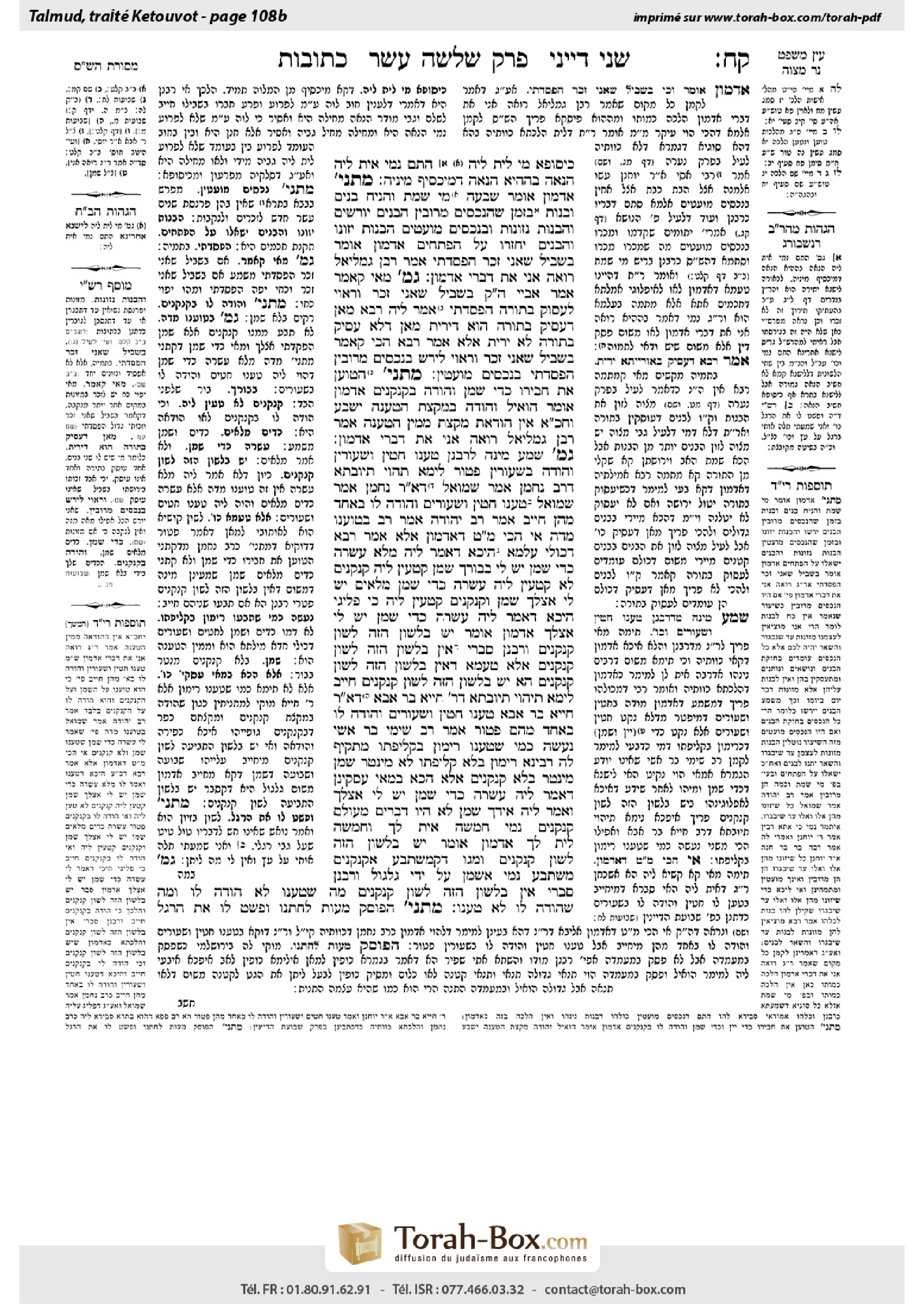
Ketubot 108b: Talmud study for Daf Yomi
Daf Yomi is the daily study of one Talmud folio. Explore 37 tractates with scans, Hebrew text, Sefaria English and AI-generated French translations where annotated.
Passage selection and English or AI-generated French translation are available where the scan has annotations. Daf Study is independent of Torah-Box and Sefaria.
Browse Ketubot · כתובות · All tractatesKetubot 108b text and translations
This page of Ketubot includes the Aramaic text, an English translation and an AI-generated French translation, alongside the scan above.
כתובות ק״ח ב · Aramaic and Hebrew text
כִּיסּוּפָא מִי לֵית לֵיהּ? הָתָם נָמֵי אִית לֵיהּ הֲנָאָה בְּהָהִיא הֲנָאָה דְּמִיכְּסִיף מִינֵּיהּ.
מַתְנִי׳ אַדְמוֹן אוֹמֵר, שִׁבְעָה: מִי שֶׁמֵּת וְהִנִּיחַ בָּנִים וּבָנוֹת, בִּזְמַן שֶׁהַנְּכָסִים מְרוּבִּין — הַבָּנִים יוֹרְשִׁים, וְהַבָּנוֹת נִזּוֹנוֹת. וּבִנְכָסִים מוּעָטִים — הַבָּנוֹת יִזּוֹנוּ, וְהַבָּנִים — יְחַזְּרוּ עַל הַפְּתָחִים. אַדְמוֹן אוֹמֵר: בִּשְׁבִיל שֶׁאֲנִי זָכָר הִפְסַדְתִּי?! אָמַר רַבָּן גַּמְלִיאֵל: רוֹאֶה אֲנִי אֶת דִּבְרֵי אַדְמוֹן.
גְּמָ׳ מַאי קָאָמַר? אָמַר אַבָּיֵי, הָכִי קָאָמַר: בִּשְׁבִיל שֶׁאֲנִי זָכָר וְרָאוּי לַעֲסוֹק בַּתּוֹרָה — הִפְסַדְתִּי?
אֲמַר לֵיהּ רָבָא: מַאן דְּעָסֵיק בַּתּוֹרָה הוּא דְּיָרֵית, מַאן דְּלָא עָסֵיק בַּתּוֹרָה לָא יָרֵית?! אֶלָּא אָמַר רָבָא, הָכִי קָאָמַר: בִּשְׁבִיל שֶׁאֲנִי זָכָר וְרָאוּי לִירַשׁ בִּנְכָסִים מְרוּבִּין — הִפְסַדְתִּי בִּנְכָסִים מוּעָטִין?!
מַתְנִי׳ הַטּוֹעֵן אֶת חֲבֵירוֹ כַּדֵּי שֶׁמֶן וְהוֹדָה בַּקַּנְקַנִּים, אַדְמוֹן אוֹמֵר: הוֹאִיל וְהוֹדָה בְּמִקְצָת הַטְּעָנָה — יִשָּׁבַע. וַחֲכָמִים אוֹמְרִים: אֵין הוֹדָאַת מִקְצָת מִמִּין הַטַּעֲנָה. אָמַר רַבָּן גַּמְלִיאֵל: רוֹאֶה אֲנִי אֶת דִּבְרֵי אַדְמוֹן.
גְּמָ׳ שְׁמַע מִינַּהּ לְרַבָּנַן: טְעָנוֹ חִטִּין וּשְׂעוֹרִין וְהוֹדָה בִּשְׂעוֹרִין — פָּטוּר.
לֵימָא תִּהְוֵי תְּיוּבְתָּא דְּרַב נַחְמָן אָמַר שְׁמוּאֵל, דְּאָמַר רַב נַחְמָן אָמַר שְׁמוּאֵל: טְעָנוֹ חִטִּין וּשְׂעוֹרִים וְהוֹדָה לוֹ בְּאֶחָד מֵהֶן — חַיָּיב!
אָמַר רַב יְהוּדָה אָמַר רַב: בְּטוֹעֲנוֹ מִדָּה. אִי הָכִי, מַאי טַעְמָא דְּאַדְמוֹן?
אֶלָּא אָמַר רָבָא: דְּכוּלֵּי עָלְמָא הֵיכָא דַּאֲמַר לֵיהּ ״מְלֹא עֲשָׂרָה כַּדֵּי שֶׁמֶן יֵשׁ לִי בְּבוֹרֶךָ״, שֶׁמֶן קָטָעֵין לֵיהּ, קַנְקַנִּים לָא קָטָעֵין לֵיהּ. ״עֲשָׂרָה כַּדֵּי שֶׁמֶן מְלֵאִים יֵשׁ לִי אֶצְלְךָ״ — שֶׁמֶן וְקַנְקַנִּים קָטָעֵין לֵיהּ.
כִּי פְּלִיגִי הֵיכָא דַּאֲמַר לֵיהּ ״עֲשָׂרָה כַּדֵּי שֶׁמֶן יֵשׁ לִי אֶצְלְךָ״. אַדְמוֹן אוֹמֵר: יֵשׁ בַּלָּשׁוֹן הַזֶּה לְשׁוֹן קַנְקַנִּים, וְרַבָּנַן סָבְרִי: אֵין בַּלָּשׁוֹן הַזֶּה לְשׁוֹן קַנְקַנִּים.
אֶלָּא טַעְמָא דְּאֵין בַּלָּשׁוֹן הַזֶּה לְשׁוֹן קַנְקַנִּים, הָא יֵשׁ בַּלָּשׁוֹן הַזֶּה לְשׁוֹן קַנְקַנִּים — חַיָּיב. לֵימָא תֶּיהְוֵי תְּיוּבְתָּא דְּרַבִּי חִיָּיא בַּר אַבָּא. דְּאָמַר רַבִּי חִיָּיא בַּר אַבָּא: טְעָנוֹ חִטִּין וּשְׂעוֹרִים וְהוֹדָה לוֹ בְּאֶחָד מֵהֶם — פָּטוּר!
אָמַר רַב שִׁימִי בַּר אָשֵׁי: נַעֲשָׂה כְּמִי שֶׁטְּעָנוֹ רִימּוֹן בִּקְלִיפָּתוֹ. מַתְקֵיף לַהּ רָבִינָא: רִימּוֹן בְּלֹא קְלִיפָּתוֹ לָא מִינְּטַר, שֶׁמֶן מִינְּטַר בְּלֹא קַנְקַנִּים!
אֶלָּא, הָכָא בְּמַאי עָסְקִינַן, דַּאֲמַר לֵיהּ: עֲשָׂרָה כַּדֵּי שֶׁמֶן יֵשׁ לִי אֶצְלְךָ, וַאֲמַר לֵיהּ אִידַּךְ: שֶׁמֶן — לֹא הָיוּ דְבָרִים מֵעוֹלָם, קַנְקַנִּים נָמֵי — חַמְשָׁה אִית לָךְ, וְחַמְשָׁה לֵית לָךְ.
אַדְמוֹן אוֹמֵר: יֵשׁ בַּלָּשׁוֹן הַזֶּה לְשׁוֹן קַנְקַנִּים, וּמִגּוֹ דְּקָמִשְׁתְּבַע אַקַּנְקַנִּים מִשְׁתְּבַע נָמֵי אַשֶּׁמֶן עַל יְדֵי גִּלְגּוּל. וְרַבָּנַן סָבְרִי: אֵין בַּלָּשׁוֹן הַזֶּה לְשׁוֹן קַנְקַנִּים. מַה שֶּׁטְּעָנוֹ לֹא הוֹדָה לוֹ, וּמַה שֶּׁהוֹדָה לוֹ — לֹא טָעֲנוּ.
מַתְנִי׳ הַפּוֹסֵק מָעוֹת לַחֲתָנוֹ, וּפָשַׁט לוֹ אֶת הָרֶגֶל —
Ketubot 108b · English translation
doesn’t he have shame due to his failure to repay the debt? There too, in the case of one prohibited by a vow, he has benefit; namely, the benefit that he is ashamed before him until the loan is repaid.
MISHNA: Admon states a dissenting opinion to that of the Rabbis in seven cases. The mishna elaborates: With regard to one who died and left behind both sons and daughters, when the estate is large the sons inherit the property and the daughters are provided with sustenance from it. And with regard to a small estate, which is insufficient to provide for both the sons and the daughters, the daughters are provided with sustenance and the sons have neither inheritance nor sustenance, and therefore, if they have no other means with which to support themselves, they must go round begging at the doors. Admon says: Because I am a male, will I lose out? Rabban Gamliel said: I see as correct the statement of Admon.
GEMARA: With regard to Admon’s statement: Because I am a male will I lose out, the Gemara asks: What is he saying? What is the significance of the fact that one is male? Abaye said that this is what he is saying: Because I am a male and, unlike women, I am fit to engage in Torah study, should I lose out?
Rava said to him: Is that to say that it is one who is engaged in Torah study who inherits, whereas one who is not engaged in Torah study does not inherit? What does the study of Torah have to do with the matter at hand? Rather, Rava said that this is what Admon is saying: Because I am a male, who has a greater right to the property by Torah law, and therefore it is fitting for me to inherit when the estate is large, will I now lose out entirely in a case of a small estate?
MISHNA: The mishna cites another case involving a dispute between Admon and the Rabbis. With regard to one who claims that another owes him jugs of oil, and the other admits to the claim of pitchers but not the oil, Admon says: Since he made a partial admission to the claim, he takes an oath swearing that he owes only what he has admitted to and no more. And the Rabbis say: The partial admission in this case is not of the same type as the claim, as the claim specified oil and the admission referred to pitchers. Rabban Gamliel said: I see as correct the statement of Admon.
GEMARA: One can conclude from here that according to the opinion of the Rabbis, if one claimed that another owed him wheat and barley, and the other party partially admitted that the claim was true only with regard to the barley, he is exempt, just as he is exempt in this case when the claim was for jugs of oil and the admission referred only to jugs.
The Gemara suggests: Let us say that it is a conclusive refutation of the opinion that Rav Naḥman said that Shmuel said. As Rav Naḥman said that Shmuel said: If one claimed against another that he owed him wheat and barley, and the other admitted to owing one of the types, he is obligated to take an oath, as he partially admitted to the claim.
Rav Yehuda said that Rav said: The mishna is not referring to a case where one claimed that another owed him oil and pitchers. Rather, he claimed that another owed him a certain measure of oil, i.e., an amount of oil that would fill a certain number of jugs, while he did not claim the jugs at all. Consequently, the admission was not of the same type as the claim at all. The Gemara asks: If so, what is the rationale for the ruling of Admon that he must take an oath? Clearly, the admission and the claim do not refer to the same objects.
Rather, Rava said: Everyone agrees that in a case where he said to him: I have ten jugfuls of oil in your pit, he is claiming oil from him and he is not claiming pitchers from him at all. In this case, it is clear that admitting to owing pitchers is not a partial admission whatsoever that would lead to an obligation to take an oath. Similarly, if he said to him: I have ten full jugs of oil with you, he is claiming from him both oil and pitchers, and therefore if the other party concedes to owing pitchers, this is a partial admission to the claim and everyone agrees that he must take an oath.
When they disagree in the mishna is in a case where he said to him simply: I have ten jugs of oil with you. Admon says: This expression includes a reference to the pitchers, while the Rabbis hold that this expression does not include a reference to the pitchers.
The Gemara infers: Rather, the reason for the ruling of the Rabbis is specifically that the expression does not include a reference to pitchers, which indicates that if the expression includes a reference to pitchers, one is obligated to take an oath. If so, let us say that this is a conclusive refutation of the opinion of Rabbi Ḥiyya bar Abba. As Rabbi Ḥiyya bar Abba said: If one claimed against another that he owed him wheat and barley, and the other admitted to one of the types, he is exempt from an oath.
Rav Shimi bar Ashi said: The case of the mishna is not similar to that of wheat and barley, as those two types are not connected to one another. Rather, the case of jugs of oil is more like that of one who claimed that the other owed him a pomegranate in its peel, as the jugs are as necessary for the oil as the peel of a pomegranate protecting its fruit. Ravina strongly objects to this: The comparison between these cases does not bear close scrutiny. A pomegranate without its peel cannot be preserved, and therefore it is obvious that when one claims a pomegranate, he must be referring to the peel as well. By contrast, oil can be preserved without the pitchers, as it can be placed in another receptacle.
Rather, here we are dealing with a case where one said to another: I have ten jugs of oil with you, and the other said to him: With regard to the oil, these matters never occurred; I never borrowed oil from you. Concerning the pitchers as well, you do have five of them with me and these I admit I took from you, but you do not have the other five you claim.
Admon says: This expression includes a reference to pitchers, and since he takes an oath about the pitchers, as he partially admitted to owing them, he takes an oath about the oil as well, by means of an extension of the first oath. And the Rabbis hold that this expression does not include a reference to the pitchers, and therefore that which the first person claimed from him the second person did not admit to at all, and that which the second person admitted to, the first person had not claimed from him. The second individual denied owing any oil, and as for his partial admission with regard to the pitchers, there was no claim about pitchers at all. Consequently, no oath is required whatsoever.
MISHNA: The mishna states another case involving a ruling of Admon. With regard to one who promises and apportions money for his son-in-law as a dowry, and he went bankrupt, and he now claims that he does not have the money to fulfill his financial obligations,
Ketubot 108b · Traduction française (IA)
N’a-t-il pas honte de ne pas rembourser la dette ? De même, dans le cas de celui qui est soumis à une interdiction due à un vœu, il en tire un avantage : il a honte devant lui jusqu’au remboursement du prêt.
MICHNA : Admon exprime une opinion divergente de celle des Sages dans sept cas. La Michna détaille : lorsqu’un homme meurt en laissant des fils et des filles, si la succession est importante, les fils héritent des biens et les filles en reçoivent de quoi subvenir à leurs besoins. Si la succession est modeste et ne suffit pas à subvenir aux besoins des fils et des filles, les filles reçoivent de quoi subvenir à leurs besoins, tandis que les fils n’ont ni héritage ni subsistance ; par conséquent, s’ils n’ont pas d’autres moyens de subvenir à leurs besoins, ils doivent aller mendier de porte en porte. Admon dit : Parce que je suis un homme, vais-je être lésé ? Rabban Gamliel dit : Je considère que la position d’Admon est juste.
GUEMARA : À propos de la déclaration d’Admon : « Parce que je suis un homme, vais-je être lésé ? », la Guemara demande : Que veut-il dire ? Quelle importance y a-t-il à ce qu’on soit un homme ? Abayé dit que voici ce qu’il veut dire : Puisque je suis un homme et que, contrairement aux femmes, je suis apte à étudier la Torah, devrais-je être lésé ?
Rava lui dit : Est-ce à dire que seul celui qui étudie la Torah hérite, tandis que celui qui ne l’étudie pas n’hérite pas ? Quel rapport l’étude de la Torah a-t-elle avec la question ? Rava dit plutôt que voici ce qu’Admon veut dire : Puisque je suis un homme, auquel la Torah accorde un droit supérieur sur les biens, et qu’il est donc juste que j’hérite lorsque la succession est importante, vais-je maintenant être entièrement lésé lorsque la succession est modeste ?
MICHNA : La Michna cite un autre cas de désaccord entre Admon et les Sages. Si quelqu’un prétend qu’un autre lui doit des cruches d’huile, et que l’autre reconnaît devoir les cruches, mais pas l’huile, Admon dit : Puisqu’il a reconnu une partie de la réclamation, il prête serment qu’il ne doit que ce qu’il a reconnu et rien de plus. Les Sages disent : Dans ce cas, la reconnaissance partielle ne porte pas sur le même type de bien que la réclamation, car celle-ci portait sur l’huile, tandis que la reconnaissance portait sur les cruches. Rabban Gamliel dit : Je considère que la position d’Admon est juste.
On peut en déduire que, selon l’opinion des Sages, si quelqu’un prétend qu’un autre lui doit du blé et de l’orge, et que ce dernier reconnaît partiellement la réclamation, mais seulement pour l’orge, il est exempt, tout comme il est exempt dans le cas présent, où la réclamation portait sur des cruches d’huile et où la reconnaissance ne concernait que les cruches.
La Guemara suggère : Disons que cela réfute définitivement l’opinion que Rav Naḥman a rapportée au nom de Shmuel. En effet, Rav Naḥman a dit au nom de Shmuel : Si quelqu’un prétend qu’un autre lui doit du blé et de l’orge, et que l’autre reconnaît devoir l’une de ces deux espèces, il est tenu de prêter serment, puisqu’il a reconnu une partie de la réclamation.
Rav Yehouda dit au nom de Rav : La Michna ne traite pas d’un cas où quelqu’un prétend qu’un autre lui doit de l’huile et des cruches. Il a plutôt prétendu que l’autre lui devait une certaine mesure d’huile, c’est-à-dire une quantité d’huile pouvant remplir un certain nombre de cruches, sans réclamer les cruches elles-mêmes. Par conséquent, la reconnaissance ne portait absolument pas sur le même type de bien que la réclamation. La Guemara demande : Dans ce cas, quel est le fondement de la décision d’Admon selon laquelle il doit prêter serment ? Il est clair que la reconnaissance et la réclamation ne portent pas sur les mêmes objets.
Rava dit plutôt : Tout le monde convient que, si quelqu’un lui dit : « J’ai dix cruches d’huile dans ta citerne », il lui réclame de l’huile et ne lui réclame pas du tout les cruches. Dans ce cas, il est clair que reconnaître devoir des cruches ne constitue absolument pas une reconnaissance partielle qui entraînerait l’obligation de prêter serment. De même, s’il lui dit : « J’ai chez toi dix cruches pleines d’huile », il lui réclame à la fois l’huile et les cruches ; par conséquent, si l’autre reconnaît devoir les cruches, il s’agit d’une reconnaissance partielle de la réclamation, et tout le monde convient qu’il doit prêter serment.
Le désaccord dans la Michna porte sur le cas où il lui dit simplement : « J’ai chez toi dix cruches d’huile. » Admon dit que cette expression fait référence aux cruches, tandis que les Sages estiment qu’elle n’y fait pas référence.
La Guemara en déduit que la raison de la décision des Sages est précisément que l’expression ne fait pas référence aux cruches, ce qui indique que si elle y fait référence, on est tenu de prêter serment. Si tel est le cas, disons que cela réfute définitivement l’opinion de Rabbi Ḥiyya bar Abba. En effet, Rabbi Ḥiyya bar Abba a dit : Si quelqu’un prétend qu’un autre lui doit du blé et de l’orge, et que l’autre reconnaît devoir l’une de ces espèces, il est exempt de prêter serment.
Rav Shimi bar Ashi dit : Le cas de la Michna ne ressemble pas à celui du blé et de l’orge, car ces deux espèces ne sont pas liées l’une à l’autre. Le cas des cruches d’huile ressemble plutôt à celui de quelqu’un qui prétend qu’un autre lui doit une grenade avec son écorce, car les cruches sont aussi nécessaires à l’huile que l’écorce à la grenade pour protéger son fruit. Ravina objecte vivement : La comparaison entre ces cas ne résiste pas à un examen attentif. Une grenade sans son écorce ne peut être conservée ; il est donc évident que, lorsqu’on réclame une grenade, on entend également réclamer son écorce. En revanche, l’huile peut être conservée sans les cruches, puisqu’on peut la mettre dans un autre récipient.
Il s’agit plutôt ici d’un cas où quelqu’un dit à un autre : « J’ai chez toi dix cruches d’huile », et où l’autre lui répond : « Pour ce qui est de l’huile, il n’en a jamais été question ; je ne t’ai jamais emprunté d’huile. Quant aux cruches, tu en as bien cinq chez moi, et je reconnais les avoir prises chez toi, mais tu n’as pas chez moi les cinq autres que tu réclames. »
Admon dit que cette expression fait référence aux cruches ; puisqu’il prête serment au sujet des cruches, dont il a reconnu devoir une partie, il prête également serment au sujet de l’huile, par extension du premier serment. Les Sages estiment que cette expression ne fait pas référence aux cruches ; par conséquent, le second n’a rien reconnu de ce que le premier lui réclamait, et le premier ne lui avait rien réclamé de ce que le second reconnaît devoir. Le second a nié devoir de l’huile et, quant à sa reconnaissance partielle concernant les cruches, aucune réclamation ne portait sur celles-ci. Il n’a donc absolument pas à prêter serment.
MICHNA : La Michna présente un autre cas concernant une décision d’Admon. Lorsqu’un homme promet à son gendre une somme d’argent à titre de dot et la fixe, puis fait faillite, il prétend maintenant ne pas avoir les fonds nécessaires pour honorer ses obligations financières,
Traduction française générée par IA à partir de l’édition anglaise de Sefaria. Vérifie toujours un passage avec le texte source.
Text from Sefaria: William Davidson Edition - Vocalized Aramaic (CC BY NC); William Davidson Edition - English (CC BY NC).