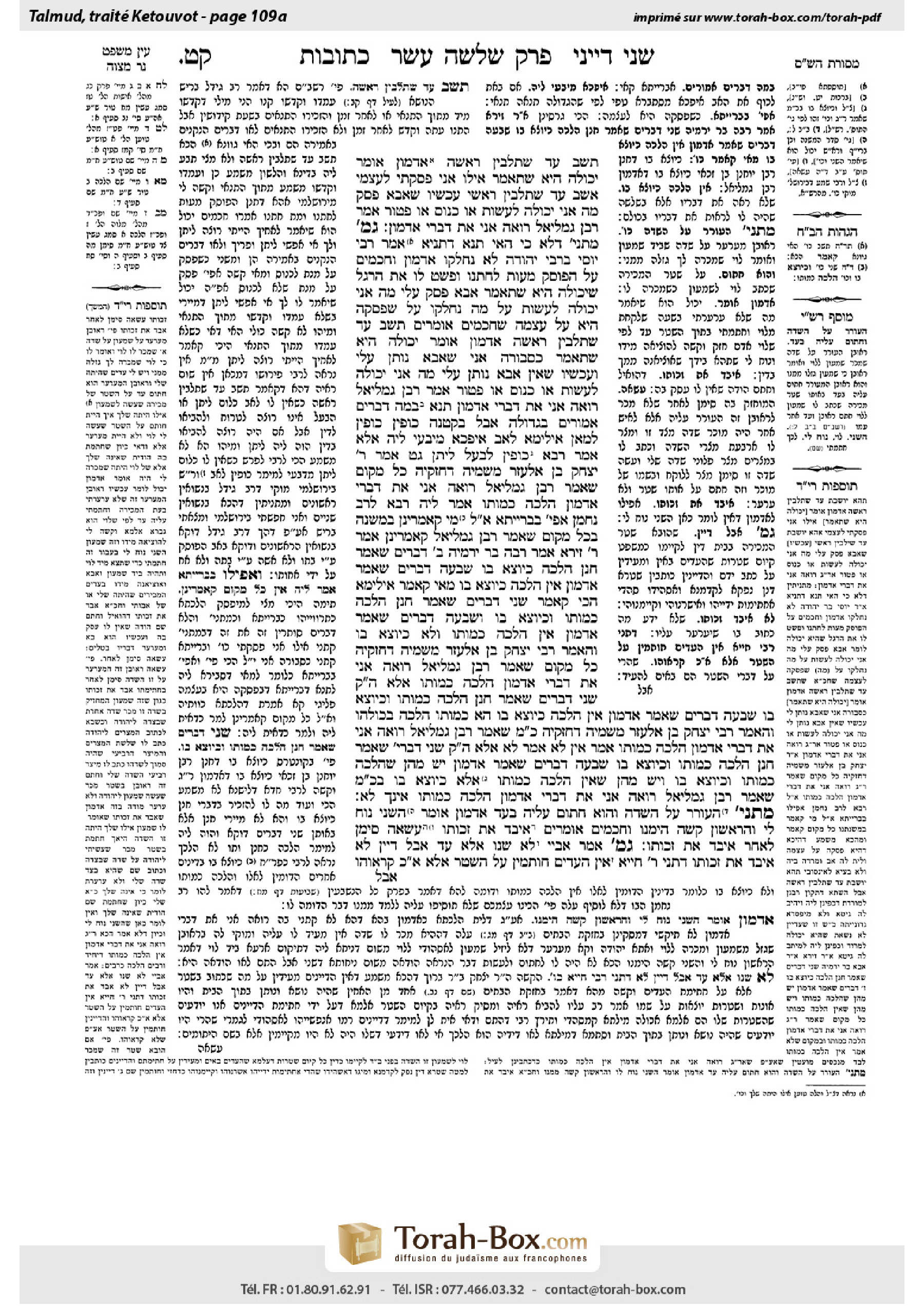
Ketubot 109a: Talmud study for Daf Yomi
Daf Yomi is the daily study of one Talmud folio. Explore 37 tractates with scans, Hebrew text, Sefaria English and AI-generated French translations where annotated.
Passage selection and English or AI-generated French translation are available where the scan has annotations. Daf Study is independent of Torah-Box and Sefaria.
Browse Ketubot · כתובות · All tractatesKetubot 109a text and translations
This page of Ketubot includes the Aramaic text, an English translation and an AI-generated French translation, alongside the scan above.
כתובות ק״ט א · Aramaic and Hebrew text
תֵּשֵׁב עַד שֶׁיַּלְבִּין רֹאשָׁהּ. אַדְמוֹן אוֹמֵר: יְכוֹלָה הִיא שֶׁתֹּאמַר: אִילּוּ אֲנִי פָּסַקְתִּי לְעַצְמִי — אֵשֵׁב עַד שֶׁיַּלְבִּין רֹאשִׁי, עַכְשָׁיו שֶׁאַבָּא פָּסַק — מָה אֲנִי יְכוֹלָה לַעֲשׂוֹת? אוֹ כְּנוֹס, אוֹ פְּטוֹר. אָמַר רַבָּן גַּמְלִיאֵל: רוֹאֶה אֲנִי אֶת דִּבְרֵי אַדְמוֹן.
גְּמָ׳ מַתְנִיתִין דְּלָא כִּי הַאי תַּנָּא, דְּתַנְיָא: אָמַר רַבִּי יוֹסֵי בְּרַבִּי יְהוּדָה: לֹא נֶחְלְקוּ אַדְמוֹן וַחֲכָמִים עַל הַפּוֹסֵק מָעוֹת לַחֲתָנוֹ וּפָשַׁט לוֹ אֶת הָרֶגֶל, שֶׁיְּכוֹלָה הִיא שֶׁתֹּאמַר: ״אַבָּא פָּסַק עָלַי, מָה אֲנִי יְכוֹלָה לַעֲשׂוֹת״.
עַל מָה נֶחְלְקוּ — עַל שֶׁפָּסְקָה הִיא עַל עַצְמָהּ. שֶׁחֲכָמִים אוֹמְרִים: תֵּשֵׁב עַד שֶׁתַּלְבִּין רֹאשָׁהּ. אַדְמוֹן אוֹמֵר, יְכוֹלָה הִיא שֶׁתֹּאמַר: כִּסְבוּרָה אֲנִי שֶׁאַבָּא נוֹתֵן עָלַי, וְעַכְשָׁיו שֶׁאֵין אַבָּא נוֹתֵן עָלַי — מָה אֲנִי יְכוֹלָה לַעֲשׂוֹת? אוֹ כְּנוֹס אוֹ פְּטוֹר. אָמַר רַבָּן גַּמְלִיאֵל: רוֹאֶה אֲנִי אֶת דִּבְרֵי אַדְמוֹן.
תָּנָא: בַּמֶּה דְּבָרִים אֲמוּרִים בִּגְדוֹלָה, אֲבָל בִּקְטַנָּה — כּוֹפִין. כּוֹפִין לְמַאן? אִילֵימָא לְאָב — אִיפְּכָא מִיבְּעֵי לֵיהּ! אֶלָּא אָמַר רָבָא: כּוֹפִין לַבַּעַל לִיתֵּן גֵּט.
אָמַר רַבִּי יִצְחָק בֶּן אֶלְעָזָר מִשְּׁמֵיהּ דְּחִזְקִיָּה: כׇּל מָקוֹם שֶׁאָמַר רַבָּן גַּמְלִיאֵל ״רוֹאֶה אֲנִי אֶת דִּבְרֵי אַדְמוֹן״ — הֲלָכָה כְּמוֹתוֹ. אֲמַר לֵיהּ רָבָא לְרַב נַחְמָן: אֲפִילּוּ בְּבָרַיְיתָא? אֲמַר לֵיהּ: מִי קָאָמְרִינַן בַּמִּשְׁנָה?! בְּכׇל מָקוֹם שֶׁאָמַר רַבָּן גַּמְלִיאֵל קָאָמְרִינַן.
אָמַר רַבִּי זֵירָא אָמַר רַבָּה בַּר יִרְמְיָה: שְׁנֵי דְּבָרִים שֶׁאָמַר חָנָן — הֲלָכָה כַּיּוֹצֵא בּוֹ, שִׁבְעָה דְּבָרִים שֶׁאָמַר אַדְמוֹן — אֵין הֲלָכָה כַּיּוֹצֵא בּוֹ. מַאי קָאָמַר?
אִילֵּימָא הָכִי קָאָמַר: שְׁנֵי דְּבָרִים שֶׁאָמַר חָנָן — הֲלָכָה כְּמוֹתוֹ וְכַיּוֹצֵא בּוֹ, וְשִׁבְעָה דְּבָרִים שֶׁאָמַר אַדְמוֹן — אֵין הֲלָכָה כְּמוֹתוֹ וְלֹא כַּיּוֹצֵא בּוֹ. וְהָאָמַר רַבִּי יִצְחָק בֶּן אֶלְעָזָר מִשְּׁמֵיהּ דְּחִזְקִיָּה: כׇּל מָקוֹם שֶׁאָמַר רַבָּן גַּמְלִיאֵל ״רוֹאֶה אֲנִי אֶת דִּבְרֵי אַדְמוֹן״ — הֲלָכָה כְּמוֹתוֹ!
אֶלָּא הָכִי קָאָמַר: שְׁנֵי דְּבָרִים שֶׁאָמַר חָנָן — הֲלָכָה כְּמוֹתוֹ וְכַיּוֹצֵא בּוֹ, שִׁבְעָה דְּבָרִים שֶׁאָמַר אַדְמוֹן — אֵין הֲלָכָה כַּיּוֹצֵא בּוֹ. הָא כְּמוֹתוֹ — הֲלָכָה בְּכוּלְּהוּ.
וְהָאָמַר רַבִּי יִצְחָק בֶּן אֶלְעָזָר מִשְּׁמֵיהּ דְּחִזְקִיָּה: כׇּל מָקוֹם שֶׁאָמַר רַבָּן גַּמְלִיאֵל ״רוֹאֶה אֲנִי אֶת דִּבְרֵי אַדְמוֹן״ — הֲלָכָה כְּמוֹתוֹ, אָמַר — אִין, לֹא אָמַר — לָא!
אֶלָּא הָכִי קָאָמַר: שְׁנֵי דְּבָרִים שֶׁאָמַר חָנָן — הֲלָכָה כְּמוֹתוֹ וְכַיּוֹצֵא בּוֹ, שִׁבְעָה דְּבָרִים שֶׁאָמַר אַדְמוֹן — יֵשׁ מֵהֶן שֶׁהֲלָכָה כְּמוֹתוֹ וְכַיּוֹצֵא בּוֹ, וְיֵשׁ מֵהֶן שֶׁאֵין הֲלָכָה כְּמוֹתוֹ אֶלָּא כַּיּוֹצֵא בּוֹ.
בְּכׇל מָקוֹם שֶׁאָמַר רַבָּן גַּמְלִיאֵל רוֹאֶה אֲנִי אֶת דִּבְרֵי אַדְמוֹן — הֲלָכָה כְּמוֹתוֹ, אִינָךְ — לָא.
מַתְנִי׳ הָעוֹרֵר עַל הַשָּׂדֶה, וְהוּא חָתוּם עָלֶיהָ בְּעֵד — אַדְמוֹן אוֹמֵר: הַשֵּׁנִי נוֹחַ לִי, וְהָרִאשׁוֹן קָשֶׁה הֵימֶנּוּ.
וַחֲכָמִים אוֹמְרִים: אִיבֵּד אֶת זְכוּתוֹ. עֲשָׂאָהּ סִימָן לְאַחֵר — אִיבֵּד אֶת זְכוּתוֹ.
גְּמָ׳ אָמַר אַבָּיֵי: לֹא שָׁנוּ אֶלָּא עֵד, אֲבָל דַּיָּין — לֹא אִיבֵּד אֶת זְכוּתוֹ. דְּתָנֵי רַבִּי חִיָּיא: אֵין הָעֵדִים חוֹתְמִין עַל הַשְּׁטָר אֶלָּא אִם כֵּן קְרָאוּהוּ.
Ketubot 109a · English translation
the betrothed woman can be left to sit unwed in her father’s house until her head turns white. If the groom does not wish to marry without a dowry he cannot be forced to do so, as the father failed to fulfill his promise. Admon says that she can say: Had I apportioned the money myself and broken my promise, I would agree to sit until my head turns white. However, now that my father was the one who apportioned the dowry, what can I do? Either marry me or release me by a bill of divorce. Rabban Gamliel said: I see as correct the statement of Admon.
GEMARA: The mishna is not in accordance with the opinion of this tanna, as it is taught in the Tosefta (13:1) that Rabbi Yosei, son of Rabbi Yehuda, said: Admon and the Rabbis did not disagree with regard to one who promises and apportions money for his son-in-law as a dowry and subsequently went bankrupt, that the betrothed woman can say: My father apportioned money for me; what can I do?
With regard to what did they disagree? It is with regard to a case where she apportioned money for herself, as the Rabbis say: Let her sit until her head turns white, as she did not fulfill her promise. However, Admon says that she can say: I thought that my father would give the money for me, and now that my father is not giving the money for me, what can I do? Either marry me or release me. And it is with regard to this case that Rabban Gamliel said: I see as correct the statement of Admon, as the betrothed woman has no money of her own, and she was clearly relying on her father to provide the dowry.
§ It is taught: In what case is this statement said? It is said in the case of an adult woman. However, with regard to a minor girl, the court compels payment. The Gemara asks: Whom do they compel? If we say that they coerce the father to pay, the tanna should have stated the opposite. It is more reasonable to suggest that the father is compelled to pay when an adult woman promises the money, as the promises of an adult are legally valid, whereas a minor is not legally competent and therefore her promises are of no consequence. Rather, Rava said: In the case of a minor, the court compels the groom either to give her a bill of divorce or to marry her.
§ Rabbi Yitzḥak ben Elazar said in the name of Ḥizkiyya: Anywhere it is recorded that Rabban Gamliel said: I see as correct the statement of Admon, the halakha is in accordance with his opinion. Rava said to Rav Naḥman: Does this halakhic principle apply even when the debate between Admon and the Rabbis is recorded in a baraita? Rav Naḥman said to him: Did we say: Anywhere it is recorded in the Mishna? We said: Anywhere it is recorded that Rabban Gamliel said, which means even in a baraita.
Rabbi Zeira said that Rabba bar Yirmeya said: With regard to the two statements that Ḥanan said, the halakha is in accordance with he who ruled similarly to him, i.e., Rabban Yoḥanan ben Zakkai (see 107b); however, with regard to the seven statements that Admon said, the halakha is not in accordance with he who ruled similarly to him, i.e., Rabban Gamliel. The Gemara asks: What is he saying? What does this ruling mean?
If we say that this is what he is saying: With regard to the two statements that Ḥanan said, the halakha is in accordance with his opinion and in accordance with he who ruled similarly to him, and with regard to the seven statements that Admon said, the halakha is not in accordance with his opinion and also not in accordance with he who ruled similarly to him, but didn’t Rabbi Yitzḥak ben Elazar say in the name of Ḥizkiyya: Anywhere it is recorded that Rabban Gamliel said: I see as correct the statement of Admon, the halakha is in accordance with his opinion.
Rather, this is what Rabbi Zeira is saying: With regard to the two statements that Ḥanan said, the halakha is in accordance with his opinion and is also in accordance with he who ruled similarly to him, i.e., Rabban Yoḥanan ben Zakkai. With regard to the seven statements that Admon said, the halakha is not only in accordance with the ruling of Rabban Gamliel, who ruled similarly to Admon in three of these cases. Rather, the halakha is in accordance with Admon’s ruling in all seven cases.
The Gemara questions this interpretation: Didn’t Rabbi Yitzḥak ben Elazar say in the name of Ḥizkiyya: Anywhere it is recorded that Rabban Gamliel said: I see as correct the statement of Admon, the halakha is in accordance with his opinion? It may be inferred from here that in those cases concerning which Rabban Gamliel said his statement, yes, the halakha is in accordance with Admon’s ruling, but in those cases where Rabban Gamliel did not say his statement, no, the halakha is not in accordance with the opinion of Admon.
Rather, this is what Rabbi Zeira is saying: With regard to the two statements that Ḥanan said, the halakha is in accordance with his opinion and is also in accordance with he who ruled similarly to him. With regard to the seven statements that Admon said, there are among these rulings those in which the halakha is in accordance with his opinion and in accordance with he who ruled similarly to him, and there are among these rulings those in which the halakha is not in accordance with his opinion but in accordance with he who ruled similarly to him.
The Gemara explains the above statement. In other words, anywhere it is recorded that Rabban Gamliel said: I see as correct the statement of Admon, the halakha is in accordance with his opinion, whereas in those other cases, where Rabban Gamliel remained silent, indicating that he did not agree with him, the halakha is not in accordance with Admon.
MISHNA: With regard to one who contests ownership of a field, claiming that a field under the control of someone else actually belongs to him, and the claimant himself is signed as a witness on the bill of sale to that other person, Admon says: His signature does not disprove his claim of ownership of the property, as it is possible that the claimant said to himself: The second person is easier for me, as I can reason with him, but the first owner, who sold the field to the current holder, is more difficult to deal with than him. The claimant might have been afraid to protest against the first one, who is perhaps violent, and therefore he was even willing to sign as a witness to transfer the field to the control of someone more amenable to his ensuing protest.
And the Rabbis say: He has lost his right to contest ownership, as he signed a bill of sale that states that the field belongs to the present holder. If he established that field as a marker for another field, everyone agrees that he has lost his right. In other words, if the claimant wrote a document concerning another field and in that document he listed the first field as a boundary marker and described it as belonging to someone else, even Admon concedes that he has lost his right, as he had no reason to say it belonged to someone else other than his belief this was in fact the case.
GEMARA: Abaye said: They taught this dispute only with regard to a witness who signed on a bill of sale. However, a judge who was contesting the ownership of a field and at the same time sat on a court that certified the bill of sale for that very tract of land has not lost his right. This is as Rabbi Ḥiyya taught: Witnesses do not sign a document unless they have read it, which means that a witness cannot reasonably claim that he is certifying only part of document; it is assumed that he read and is aware of everything it contains.
Ketubot 109a · Traduction française (IA)
La jeune femme fiancée peut rester sans être mariée dans la maison de son père jusqu’à ce que ses cheveux blanchissent. Si le fiancé ne veut pas l’épouser sans dot, on ne peut pas l’y contraindre, puisque son père n’a pas tenu sa promesse. Admon dit qu’elle peut répondre : « Si j’avais moi-même fixé la somme et manqué à ma promesse, j’accepterais de rester ainsi jusqu’à ce que mes cheveux blanchissent. Mais maintenant que c’est mon père qui a fixé la dot, que puis-je faire ? Ou bien épouse-moi, ou bien libère-moi au moyen d’un acte de divorce. » Rabban Gamliel dit : « Je considère que la position d’Admon est juste. »
GUEMARA : La Michna ne suit pas l’opinion de ce tanna, car il est enseigné dans la Tosefta (13:1) que Rabbi Yosei, fils de Rabbi Yehuda, a dit : Admon et les Sages n’étaient pas en désaccord au sujet de celui qui promet une somme à son gendre et la fixe comme dot, puis fait faillite : la jeune femme fiancée peut dire : « Mon père m’avait fixé une somme ; que puis-je faire ? »
Sur quoi étaient-ils en désaccord ? Sur le cas où elle avait fixé elle-même la somme : les Sages disent qu’elle doit rester ainsi jusqu’à ce que ses cheveux blanchissent, puisqu’elle n’a pas tenu sa promesse. Mais Admon dit qu’elle peut répondre : « Je pensais que mon père me donnerait cet argent. Maintenant que mon père ne me le donne pas, que puis-je faire ? Ou bien épouse-moi, ou bien libère-moi. » C’est à propos de ce cas que Rabban Gamliel a dit : « Je considère que la position d’Admon est juste », car la jeune femme fiancée n’a pas d’argent à elle et s’en remettait manifestement à son père pour lui fournir la dot.
§ Il est enseigné : Dans quel cas cette déclaration a-t-elle été faite ? Dans le cas d’une femme majeure. Mais s’il s’agit d’une jeune fille mineure, le tribunal contraint au paiement. La Guemara demande : Qui contraint-on ? Si l’on dit que le père est contraint de payer, le tanna aurait dû enseigner le contraire. Il est plus logique de dire que le père est contraint de payer lorsqu’une femme majeure promet la somme, car les promesses d’une majeure ont une valeur juridique, tandis qu’une mineure n’a pas la capacité juridique et que ses promesses sont donc sans effet. Rava a plutôt dit : Dans le cas d’une mineure, le tribunal contraint le fiancé soit à lui donner un acte de divorce, soit à l’épouser.
§ Rabbi Yitzḥak ben Elazar a dit au nom de Ḥizkiyya : Chaque fois qu’il est rapporté que Rabban Gamliel a dit : « Je considère que la position d’Admon est juste », la halakha suit l’opinion d’Admon. Rava a dit à Rav Naḥman : Ce principe halakhique s’applique-t-il même lorsque le débat entre Admon et les Sages est rapporté dans une baraïta ? Rav Naḥman lui répondit : Avons-nous dit : « Chaque fois que cela est rapporté dans la Michna » ? Nous avons dit : « Chaque fois qu’il est rapporté que Rabban Gamliel a dit », ce qui signifie que cela vaut même dans une baraïta.
Rabbi Zeira a dit que Rabba bar Yirmeya a dit : Concernant les deux déclarations de Ḥanan, la halakha suit son opinion, ainsi que celle de celui qui a tranché de la même manière que lui, à savoir Rabban Yoḥanan ben Zakkai (voir 107b) ; mais concernant les sept déclarations d’Admon, la halakha ne suit pas son opinion, ni celle de celui qui a tranché de la même manière que lui, à savoir Rabban Gamliel. La Guemara demande : Que veut-il dire ? Que signifie cette décision ?
Si l’on comprend qu’il dit ceci : concernant les deux déclarations de Ḥanan, la halakha suit son opinion et celle de celui qui a tranché de la même manière que lui ; et concernant les sept déclarations d’Admon, la halakha ne suit ni son opinion ni celle de celui qui a tranché de la même manière que lui, mais Rabbi Yitzḥak ben Elazar n’a-t-il pas dit au nom de Ḥizkiyya : « Chaque fois qu’il est rapporté que Rabban Gamliel a dit : “Je considère que la position d’Admon est juste”, la halakha suit l’opinion d’Admon » ?
Il faut plutôt comprendre que Rabbi Zeira dit ceci : concernant les deux déclarations de Ḥanan, la halakha suit son opinion ainsi que celle de celui qui a tranché de la même manière que lui, à savoir Rabban Yoḥanan ben Zakkai. Concernant les sept déclarations d’Admon, la halakha ne suit pas seulement la décision de Rabban Gamliel, qui a tranché de la même manière qu’Admon dans trois de ces cas ; elle suit la décision d’Admon dans les sept cas.
La Guemara conteste cette interprétation : Rabbi Yitzḥak ben Elazar n’a-t-il pas dit au nom de Ḥizkiyya : « Chaque fois qu’il est rapporté que Rabban Gamliel a dit : “Je considère que la position d’Admon est juste”, la halakha suit l’opinion d’Admon » ? On peut en déduire que dans les cas où Rabban Gamliel a prononcé cette déclaration, oui, la halakha suit la décision d’Admon ; mais dans les cas où Rabban Gamliel ne l’a pas prononcée, non, la halakha ne suit pas l’opinion d’Admon.
Il faut plutôt comprendre que Rabbi Zeira dit ceci : concernant les deux déclarations de Ḥanan, la halakha suit son opinion ainsi que celle de celui qui a tranché de la même manière que lui. Concernant les sept déclarations d’Admon, certaines décisions suivent son opinion ainsi que celle de celui qui a tranché de la même manière que lui, tandis que d’autres ne suivent pas son opinion, mais suivent celle de celui qui a tranché de la même manière que lui.
La Guemara explique la déclaration précédente. Autrement dit, chaque fois qu’il est rapporté que Rabban Gamliel a dit : « Je considère que la position d’Admon est juste », la halakha suit l’opinion d’Admon ; en revanche, dans les autres cas, où Rabban Gamliel est resté silencieux, indiquant qu’il n’était pas d’accord avec lui, la halakha ne suit pas Admon.
MICHNA : Au sujet de celui qui conteste la propriété d’un champ, affirmant qu’un champ détenu par quelqu’un d’autre lui appartient en réalité, alors que le demandeur lui-même a signé comme témoin l’acte de vente de ce champ à cette autre personne, Admon dit : Sa signature ne réfute pas sa revendication de propriété, car il est possible que le demandeur se soit dit : « Il m’est plus facile d’avoir affaire à la deuxième personne, car je peux raisonner avec elle ; le premier propriétaire, qui a vendu le champ au détenteur actuel, est plus difficile à convaincre qu’elle. » Le demandeur a peut-être eu peur de protester contre le premier, qui est peut-être violent ; il était donc même prêt à signer comme témoin pour que le champ passe sous le contrôle d’une personne plus accommodante, contre laquelle il pourrait ensuite protester.
Les Sages disent : Il a perdu son droit de contester la propriété, puisqu’il a signé un acte de vente qui stipule que le champ appartient au détenteur actuel. S’il a désigné ce champ comme limite d’un autre champ, tous conviennent qu’il a perdu son droit. Autrement dit, si le demandeur a rédigé un document concernant un autre champ et y a mentionné le premier champ comme limite, en le décrivant comme appartenant à quelqu’un d’autre, même Admon concède qu’il a perdu son droit, car il n’avait aucune raison d’affirmer qu’il appartenait à quelqu’un d’autre, si ce n’est qu’il croyait que c’était effectivement le cas.
GUEMARA : Abaye a dit : Ce différend ne porte que sur le cas d’un témoin qui a signé un acte de vente. En revanche, un juge qui contestait la propriété d’un champ et siégeait en même temps au tribunal qui authentifiait l’acte de vente de cette même parcelle n’a pas perdu son droit. En effet, Rabbi Ḥiyya a enseigné : Les témoins ne signent un document qu’après l’avoir lu. Cela signifie qu’un témoin ne peut raisonnablement prétendre qu’il n’authentifiait qu’une partie du document ; on présume qu’il l’a lu et qu’il connaît tout ce qu’il contient.
Traduction française générée par IA à partir de l’édition anglaise de Sefaria. Vérifie toujours un passage avec le texte source.
Text from Sefaria: William Davidson Edition - Vocalized Aramaic (CC BY NC); William Davidson Edition - English (CC BY NC).