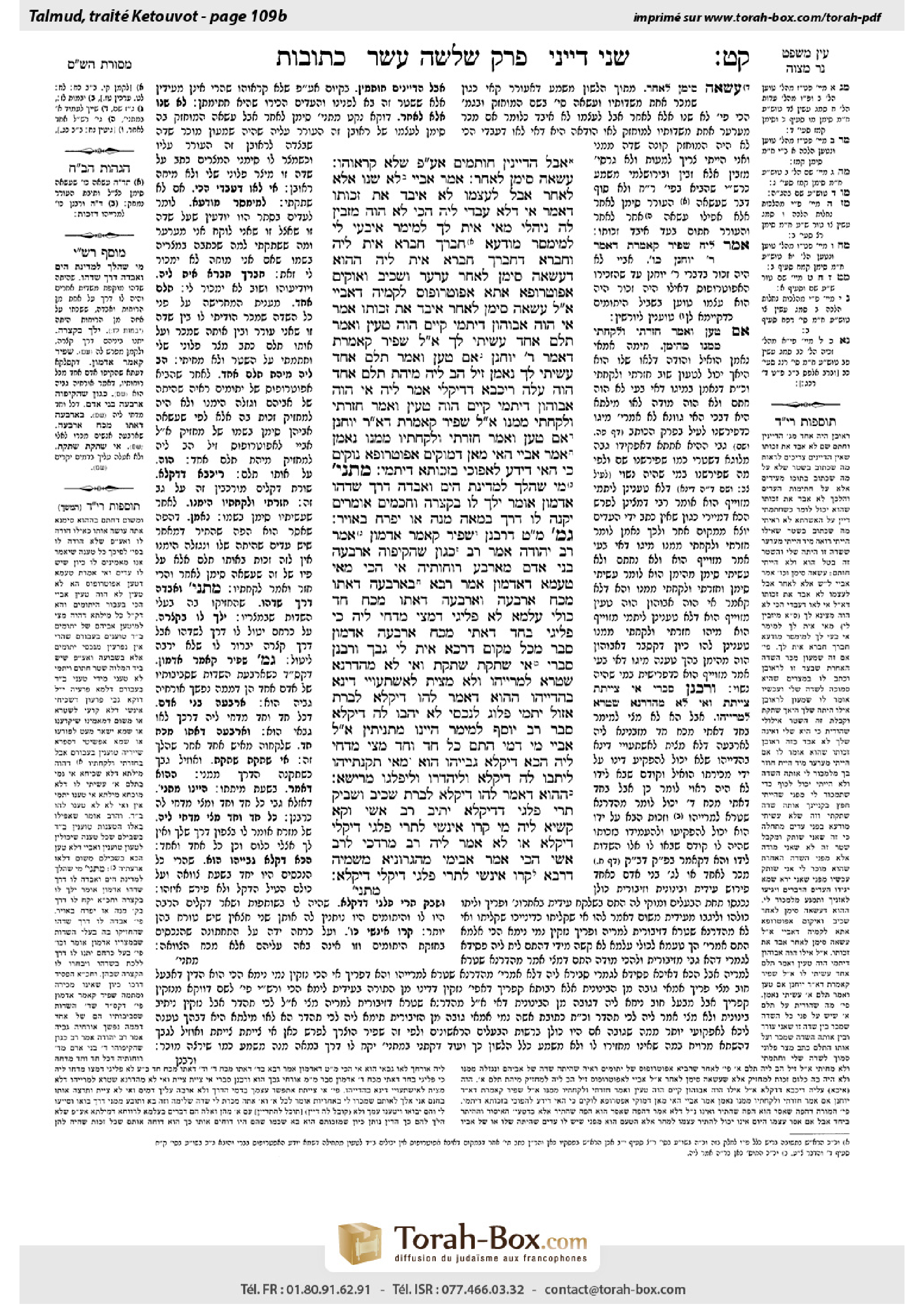
Ketubot 109b: Talmud study for Daf Yomi
Daf Yomi is the daily study of one Talmud folio. Explore 37 tractates with scans, Hebrew text, Sefaria English and AI-generated French translations where annotated.
Passage selection and English or AI-generated French translation are available where the scan has annotations. Daf Study is independent of Torah-Box and Sefaria.
Browse Ketubot · כתובות · All tractatesKetubot 109b text and translations
This page of Ketubot includes the Aramaic text, an English translation and an AI-generated French translation, alongside the scan above.
כתובות ק״ט ב · Aramaic and Hebrew text
אֲבָל הַדַּיָּינִין חוֹתְמִים אַף עַל פִּי שֶׁלֹּא קְרָאוּהוּ.
עֲשָׂאָהּ סִימָן לְאַחֵר. אָמַר אַבָּיֵי: לֹא שָׁנוּ אֶלָּא לְאַחֵר, אֲבָל לְעַצְמוֹ — לֹא אִיבֵּד אֶת זְכוּתוֹ.
דְּאָמַר: אִי דְּלָא עֲבַדִי לֵיהּ הָכִי לָא הֲוָה מְזַבֵּין לַהּ נִיהֲלִי, מַאי אִית לָךְ לְמֵימַר? אִיבְּעִי לִי לְמִימְסַר מוֹדָעָא — חַבְרָךְ חַבְרָא אִית לֵיהּ, וְחַבְרָא דְחַבְרָךְ חַבְרָא אִית לֵיהּ.
הָהוּא דַּעֲשָׂאָהּ סִימָן לְאַחֵר, עַרְעַר, וּשְׁכֵיב, וְאוֹקֵים אַפּוֹטְרוֹפָּא. אֲתָא אַפּוֹטְרוֹפּוֹס לְקַמֵּיהּ דְּאַבָּיֵי. אֲמַר לֵיהּ: עֲשָׂאָהּ סִימָן לְאַחֵר אִיבֵּד אֶת זְכוּתוֹ.
אֲמַר: אִי הֲוָה אֲבוּהוֹן דְּיַתְמֵי קַיָּים, הֲוָה טָעֵין וְאָמַר: ״תֶּלֶם אֶחָד עָשִׂיתִי לָךְ״. אֲמַר לֵיהּ: שַׁפִּיר קָאָמְרַתְּ. דְּאָמַר רַבִּי יוֹחָנָן, אִם טָעַן וְאָמַר ״תֶּלֶם אֶחָד עָשִׂיתִי לָךְ״ — נֶאֱמָן. זִיל הַב לֵיהּ מִיהַת תֶּלֶם אֶחָד.
הֲוָה עֲלַהּ רִיכְבָּא דְּדִיקְלֵי, אֲמַר לֵיהּ: אִי הֲוָה אֲבוּהוֹן דְּיַתְמֵי קַיָּים, הֲוָה טָעֵין וְאָמַר, חָזַרְתִּי וְלָקַחְתִּי מִמֶּנּוּ. אֲמַר לֵיהּ: שַׁפִּיר קָאָמְרַתְּ. דְּאָמַר רַבִּי יוֹחָנָן: אִם טָעַן וְאָמַר ״חָזַרְתִּי וּלְקַחְתִּיו מִמֶּנּוּ״ — נֶאֱמָן. אָמַר אַבָּיֵי: הַאי מַאן דְּמוֹקֵים אַפּוֹטְרוֹפָּא — נוֹקֵים כִּי הַאי דְּיָדַע לְאַפּוֹכֵי בִּזְכוּתָא דְיַתְמֵי.
מַתְנִי׳ מִי שֶׁהָלַךְ לִמְדִינַת הַיָּם וְאָבְדָה דֶּרֶךְ שָׂדֵהוּ. אַדְמוֹן אוֹמֵר: יֵלֵךְ לוֹ בִּקְצָרָה. וַחֲכָמִים אוֹמְרִים: יִקְנֶה לוֹ דֶּרֶךְ בְּמֵאָה מָנֶה, אוֹ יִפְרַח בָּאֲוִיר.
גְּמָ׳ מַאי טַעְמָא דְרַבָּנַן, שַׁפִּיר קָאָמַר אַדְמוֹן! אָמַר רַב יְהוּדָה אָמַר רַב: כְּגוֹן שֶׁהִקִּיפוּהָ אַרְבָּעָה בְּנֵי אָדָם מֵאַרְבַּע רוּחוֹתֶיהָ — אִי הָכִי, מַאי טַעְמָא דְאַדְמוֹן?
אָמַר רָבָא: בְּאַרְבְּעָה דְּאָתוּ מִכֹּחַ אַרְבְּעָה, וְאַרְבְּעָה דְּאָתוּ מִכֹּחַ חַד — כּוּלֵּי עָלְמָא לָא פְּלִיגִי דְּמָצֵי מְדַחֵי לֵיהּ. כִּי פְּלִיגִי בְּחַד דְּאָתֵי מִכֹּחַ אַרְבְּעָה.
אַדְמוֹן סָבַר: מִכׇּל מָקוֹם דַּרְכָּא אִית לִי גַּבָּךְ. וְרַבָּנַן סָבְרִי: אִי שָׁתְקַתְּ — שָׁתְקַתְּ, וְאִי לָא — מַהְדַּרְנָא שְׁטָרָא לְמָרַיְיהוּ וְלָא מָצֵית לְאִשְׁתַּעוֹיֵי דִּינָא בַּהֲדַיְיהוּ.
הָהוּא דַּאֲמַר לְהוּ: דִּיקְלָא לִבְרַת. אֲזוּל יַתְמֵי פְּלוּג לְנִכְסֵי, לָא יְהַבוּ לַהּ דִּיקְלָא. סְבַר רַב יוֹסֵף לְמֵימַר: הַיְינוּ מַתְנִיתִין.
אֲמַר לֵיהּ אַבָּיֵי: מִי דָּמֵי? הָתָם כֹּל חַד וְחַד מָצֵי מְדַחֵי לֵיהּ, הָכָא דִּיקְלָא גַּבַּיְיהוּ הוּא. מַאי תַּקַּנְתַּיְיהוּ? לִיתְּבוּ לַהּ דִּיקְלָא וְלֶיהְדְּרוּ וְלִיפַּלְגוּ מֵרֵישָׁא.
הָהוּא דַּאֲמַר לְהוּ: דִּיקְלָא לִבְרַת. שְׁכֵיב וּשְׁבַיק תְּרֵי פַּלְגֵי דְּדִיקְלָא.
יָתֵיב רַב אָשֵׁי וְקָא קַשְׁיָא לֵיהּ: מִי קָרוּ אִינָשֵׁי לִתְרֵי פַּלְגֵי דִּיקְלֵי דִּיקְלָא, אוֹ לָא? אֲמַר לֵיהּ רַב מָרְדֳּכַי לְרַב אָשֵׁי: הָכִי אָמַר אֲבִימִי מֵהַגְרוֹנְיָא מִשְּׁמֵיהּ דְּרָבָא: קָרוּ אִינָשֵׁי לִתְרֵי פַּלְגֵי דִּיקְלֵי דִּיקְלָא.
Ketubot 109b · English translation
However, judges do sign a document even though they have not read it, as they are merely certifying the signatures without relating to the content of the document at all.
§ The mishna taught that if someone established a field as a marker for another field, everyone agrees that he has lost his right to contest its ownership. Abaye said: They taught this only in a case where he stated this in a document unrelated to the field in question, which was written for another person. However, if he established it as a marker for himself, when he was buying a different field owned by the person who is in possession of the contested field, he has not lost his right.
The reason is that the claimant can say: Had I not done this act of writing that the field belongs to him, he would not have sold me this other field. What have you to say against this argument? Will you say that I should have put out a notice and declared in the presence of witnesses that I am forced to write this way in the contract? I was concerned about doing this, as your friend has a friend and your friend’s friend has a friend. In other words, it is hard to keep an announcement of this kind secret, and ultimately my notice would have become public knowledge and would have reached the owner of the field himself, and he would have refused to sell me the other tract of land.
§ The Gemara relates: There was a certain individual who established a field as a marker for another field, with ownership of the first field ascribed to someone else. Later he contested the ownership of the first field, claiming it as his own, and he subsequently died. And prior to his death he had appointed a steward to manage the properties of his orphans. The steward came before Abaye. Abaye said to him: The deceased established the field as a marker for another, and therefore he has lost his right to contest ownership of the land.
The steward said to Abaye: If the father of these orphans were alive he would have claimed and said: I established one furrow for you. In other words, the marker I established by means of this field was not meant as a reference to the entire field but only to a furrow at the edge of the field. Abaye said to him: You have spoken well, as Rabbi Yoḥanan said: If he claimed and said: I established one furrow for you, he is deemed credible. Go and give him one furrow in any event, as you freely admit that at least one furrow belongs to the one currently in control of the property.
On that particular furrow there was a row of palm trees, which the steward did not want to lose. He said to Abaye: If the father of these orphans were alive he would have claimed and said: I did in fact sell the field to him, but I went back and bought it from him sometime later. Abaye said to him: You have spoken well, as Rabbi Yoḥanan said: If he claimed and said: I went back and bought it from him, he is deemed credible. After the steward won his suit in court, Abaye said: One who wants to appoint a steward should appoint someone like this person, who knows how to look out for the rights of the orphans and how to argue on their behalf.
MISHNA: With regard to one who went overseas and in the meantime the path leading to his field was lost, e.g., the path he used to reach his land was taken over by the owner of the field through which it passed, so that its exact position is now unknown, Admon says: Let him go to his field by the shortest possible route. And the Rabbis say: Let him buy himself a path from an owner of a neighboring field at whatever price he can, even if it is one hundred dinars [maneh], or let him fly through the air.
GEMARA: The Gemara asks: What is the reason for the opinion of the Rabbis that he is not automatically entitled to a path leading to his field? After all, Admon speaks well, as it was established that he owned a path beforehand. Rav Yehuda said that Rav said: The mishna is dealing with a case where the field was surrounded on four sides by the property of four different people. Each of the four properties adjoining his field belonged to a different person, each of whom denied that his path cut through his land. Since he is unable to prove his claim with regard to each one of them, he has no choice but to buy himself a new path. The Gemara asks: If so, what is the reason for the opinion of Admon?
Rava said: In a case where there are four owners of fields who come by virtue of four previous owners, and in a case where there are four owners who come by virtue of one previous owner of all four properties, everyone agrees that they may put off the claims of the owner of the field in the middle, as each can say: Your path did not cut through my property. When they disagree is in a case where there is one current owner of four fields who comes by virtue of four previous owners.
Rava elaborates: Admon holds that the claimant can say to the landowner: In any case, I have a path through your property. Although he cannot prove where the path ran, it was certainly within the perimeter of the landowner’s property that borders his own tract of land, and for this reason he selects the shortest route. And the Rabbis hold that the landowner can say to the man: If you will stay silent, then stay silent and we will compromise; and if not, I will return the document of each field to its previous owner and you will not be able to negotiate with them, as you do not know through which field your path passed.
§ The Gemara relates: There was a certain man who said to his heirs, in his will: I am leaving a palm tree for my daughter. The orphans went and divided up the property and they did not give the daughter a palm tree at all. Rav Yosef thought to say that this is exactly like the case of the mishna, as each heir can say to her: The tree designated for you is not in my portion but in that of a different heir.
Abaye said to him: Are the cases comparable? There, each and every one of the fields’ owners can put him off, as in fact the path might not have passed through his property, whereas here, the palm tree is in their possession, i.e., they all share the obligation to give her a tree, and each is illegally holding on to a share of it. Abaye adds: What is their remedy? Let them give her a palm tree and go back and divide the inherited property once again from the outset. Since the palm tree will be taken from one of the shares, they must redistribute the estate afresh.
The Gemara relates a similar story: There was a certain man who said to his heirs, in his will: I am leaving a palm tree for my daughter. He died and left behind two halves of palm trees, as there had been two trees he had shared with different business partners. The heirs wished to give the girl these two halves, despite the fact that tending to them would involve considerably more trouble than taking care of a single tree.
Rav Ashi sat and posed a difficulty to the proposal of the heirs. Do people refer to two halves of a palm tree as a whole palm tree or not? If the statement of the dying father can reasonably be interpreted as referring to these two halves she is at a disadvantage, as the burden of proof rests upon the claimant. Alternatively, if this is an unreasonable explanation of his wishes, they must give her a whole tree. Which alternative is correct? Rav Mordekhai said to Rav Ashi: Avimi of Hagronya said as follows in the name of Rava: People do in fact refer to two halves of a palm tree as a whole palm tree. Consequently, the heirs may fulfill their father’s dying wish by giving the girl the two halves they inherited.
Ketubot 109b · Traduction française (IA)
Cependant, les juges signent effectivement un document sans l’avoir lu, car ils ne font qu’authentifier les signatures, sans se prononcer aucunement sur le contenu du document.
§ La Michna enseigne que si quelqu’un a désigné un champ comme repère pour un autre champ, tous conviennent qu’il a perdu son droit d’en contester la propriété. Abayé dit : Cela n’a été enseigné que dans le cas où il l’a indiqué dans un document sans rapport avec le champ en question, rédigé pour une autre personne. En revanche, s’il l’a désigné comme repère pour lui-même, lors de l’achat d’un autre champ appartenant à celui qui détient le champ dont la propriété est contestée, il n’a pas perdu son droit.
La raison en est que le demandeur peut dire : « Si je n’avais pas accompli cet acte consistant à écrire que le champ lui appartient, il ne m’aurait pas vendu cet autre champ. » Que pouvez-vous objecter à cet argument ? Allez-vous dire que j’aurais dû publier un avis et déclarer devant témoins que je suis contraint de rédiger le contrat de cette manière ? J’ai craint de le faire, car l’ami de ton ami a un ami, et l’ami de cet ami a lui aussi un ami. Autrement dit, il est difficile de garder secrète une annonce de ce genre ; mon avis aurait fini par être connu de tous et serait parvenu au propriétaire du champ lui-même, qui aurait refusé de me vendre l’autre parcelle.
§ La Guemara rapporte : Un homme avait désigné un champ comme repère pour un autre champ, la propriété du premier étant attribuée à quelqu’un d’autre. Plus tard, il contesta la propriété du premier champ, le revendiquant comme sien, puis il mourut. Avant sa mort, il avait nommé un intendant pour gérer les biens de ses orphelins. L’intendant se présenta devant Abayé. Abayé lui dit : Le défunt a désigné le champ comme repère pour un autre ; il a donc perdu son droit d’en contester la propriété.
L’intendant dit à Abayé : « Si le père de ces orphelins était encore en vie, il aurait revendiqué et dit : “Je t’ai désigné un sillon.” » Autrement dit, le repère que j’ai établi au moyen de ce champ ne désignait pas le champ entier, mais seulement un sillon au bord du champ. Abayé lui dit : « Tu as bien parlé, car Rabbi Yoḥanan a dit : “S’il a revendiqué et dit : ‘Je t’ai désigné un sillon’, on le croit.” Va donc lui donner un sillon dans tous les cas, puisque tu reconnais toi-même qu’au moins un sillon appartient à celui qui détient actuellement le bien. »
Sur ce sillon précis se trouvait une rangée de palmiers, que l’intendant ne voulait pas perdre. Il dit à Abayé : « Si le père de ces orphelins était encore en vie, il aurait revendiqué et dit : “En réalité, je le lui ai vendu, mais je le lui ai racheté quelque temps après.” » Abayé lui dit : « Tu as bien parlé, car Rabbi Yoḥanan a dit : “S’il a revendiqué et dit : ‘Je le lui ai racheté’, on le croit.” » Après que l’intendant eut remporté son procès, Abayé dit : « Celui qui veut nommer un intendant devrait choisir quelqu’un comme cet homme, qui sait défendre les droits des orphelins et plaider en leur faveur. »
MICHNA : À propos de celui qui est parti outre-mer et qui, entre-temps, a perdu le chemin menant à son champ — par exemple, le propriétaire du champ qu’il traversait s’est approprié le chemin qu’il empruntait pour accéder à sa terre, si bien que son emplacement exact est désormais inconnu —, Admon dit : « Qu’il rejoigne son champ par le trajet le plus court possible. » Et les Sages disent : « Qu’il achète un chemin à un propriétaire d’un champ voisin, quel qu’en soit le prix, même s’il s’élève à cent dinars [maneh], ou qu’il vole dans les airs. »
GUEMARA : La Guemara demande : Pour quelle raison les Sages pensent-ils qu’il n’a pas automatiquement droit à un chemin menant à son champ ? Après tout, Admon parle à juste titre, puisqu’il est établi qu’il possédait auparavant un chemin. Rav Yehouda dit au nom de Rav : La Michna traite du cas où le champ était entouré sur ses quatre côtés par les propriétés de quatre personnes différentes. Chacune des quatre propriétés qui jouxtaient son champ appartenait à une personne différente, et chacune niait que son chemin traversât sa terre. Puisqu’il ne peut prouver sa prétention à l’égard de chacune d’elles, il n’a d’autre choix que d’acheter un nouveau chemin. La Guemara demande : Si tel est le cas, quelle est la raison de l’avis d’Admon ?
Rava dit : Dans le cas où quatre propriétaires de champs tiennent leurs droits de quatre propriétaires précédents, ainsi que dans celui où quatre propriétaires tiennent leurs droits d’un seul propriétaire précédent des quatre parcelles, tous conviennent qu’ils peuvent écarter les prétentions du propriétaire du champ situé au milieu, car chacun peut dire : « Ton chemin ne traversait pas ma propriété. » Le désaccord porte sur le cas où un seul propriétaire actuel détient quatre champs dont il tient les droits de quatre propriétaires précédents.
Rava précise : Admon estime que le demandeur peut dire au propriétaire des terres : « Quoi qu’il en soit, j’ai un chemin qui traverse ta propriété. » Bien qu’il ne puisse prouver où passait le chemin, celui-ci se trouvait certainement dans les limites de la propriété du propriétaire qui jouxte sa propre parcelle ; c’est pourquoi il choisit le trajet le plus court. Les Sages, quant à eux, estiment que le propriétaire peut lui dire : « Si tu veux te taire, tais-toi et nous trouverons un compromis ; sinon, je rendrai à chaque propriétaire précédent le titre de propriété de son champ, et tu ne pourras pas négocier avec eux, puisque tu ne sais pas par quel champ passait ton chemin. »
§ La Guemara rapporte : Un homme dit à ses héritiers dans son testament : « Je laisse un palmier à ma fille. » Les orphelins allèrent répartir les biens, mais ne donnèrent aucun palmier à la fille. Rav Yossef pensa dire que le cas était exactement semblable à celui de la Michna, car chaque héritier peut lui dire : « L’arbre qui t’a été attribué ne se trouve pas dans ma part, mais dans celle d’un autre héritier. »
Abayé lui dit : « Ces cas sont-ils comparables ? Là-bas, chacun des propriétaires des champs peut l’écarter, car il se peut en réalité que le chemin n’ait pas traversé sa propriété ; ici, en revanche, le palmier est en leur possession, c’est-à-dire qu’ils sont tous tenus de lui donner un arbre et que chacun en retient illégalement une part. » Abayé ajoute : « Que doivent-ils faire ? Qu’ils lui donnent un palmier, puis qu’ils reprennent depuis le début la répartition des biens hérités. Puisque le palmier sera prélevé sur l’une des parts, ils doivent procéder à une nouvelle répartition de la succession. »
La Guemara rapporte une histoire semblable : Un homme dit à ses héritiers dans son testament : « Je laisse un palmier à ma fille. » Il mourut et laissa deux moitiés de palmiers, car il détenait deux arbres en copropriété avec différents associés. Les héritiers voulurent donner à la fille ces deux moitiés, bien que leur entretien lui occasionne beaucoup plus de peine que celui d’un seul arbre.
Rav Achi était assis et souleva une difficulté concernant la proposition des héritiers : parle-t-on de deux moitiés de palmier comme d’un palmier entier ou non ? Si la déclaration du père mourant peut raisonnablement être interprétée comme faisant référence à ces deux moitiés, la fille est désavantagée, car la charge de la preuve incombe au demandeur. À l’inverse, si cette interprétation de ses volontés n’est pas raisonnable, ils doivent lui donner un arbre entier. Quelle est la bonne interprétation ? Rav Mordekhaï dit à Rav Achi : « Avimi de Hagronya a enseigné ceci au nom de Rava : On parle bel et bien de deux moitiés de palmier comme d’un palmier entier. » Par conséquent, les héritiers peuvent accomplir le dernier souhait de leur père en donnant à la fille les deux moitiés dont ils ont hérité.
Traduction française générée par IA à partir de l’édition anglaise de Sefaria. Vérifie toujours un passage avec le texte source.
Text from Sefaria: William Davidson Edition - Vocalized Aramaic (CC BY NC); William Davidson Edition - English (CC BY NC).