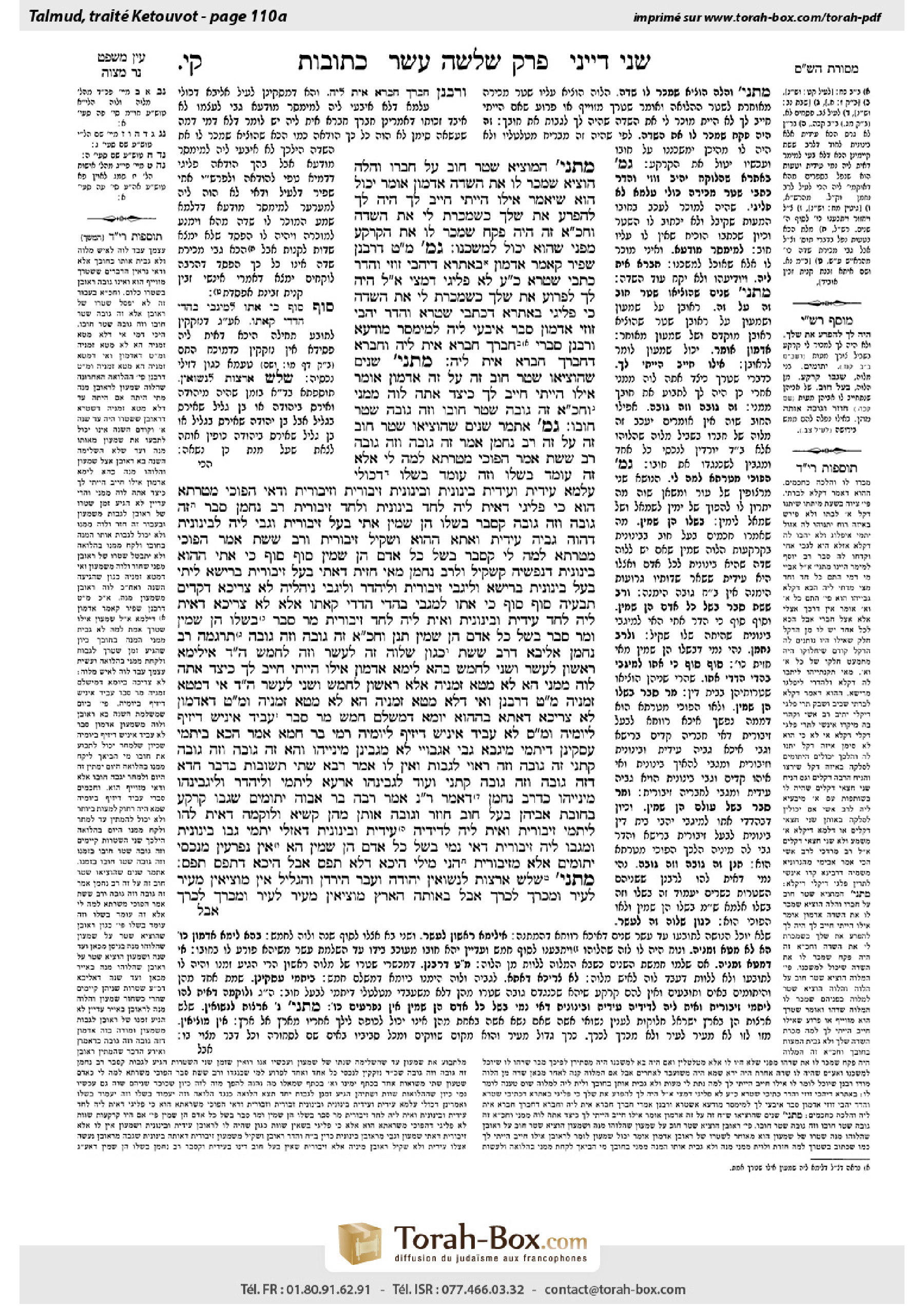
Ketubot 110a: Talmud study for Daf Yomi
Daf Yomi is the daily study of one Talmud folio. Explore 37 tractates with scans, Hebrew text, Sefaria English and AI-generated French translations where annotated.
Passage selection and English or AI-generated French translation are available where the scan has annotations. Daf Study is independent of Torah-Box and Sefaria.
Browse Ketubot · כתובות · All tractatesKetubot 110a text and translations
This page of Ketubot includes the Aramaic text, an English translation and an AI-generated French translation, alongside the scan above.
כתובות ק״י א · Aramaic and Hebrew text
מַתְנִי׳ הַמּוֹצִיא שְׁטַר חוֹב עַל חֲבֵרוֹ, וְהַלָּה הוֹצִיא שֶׁמָּכַר לוֹ אֶת הַשָּׂדֶה. אַדְמוֹן אוֹמֵר: יָכוֹל הוּא שֶׁיֹּאמַר: אִילּוּ הָיִיתִי חַיָּיב לְךָ — הָיָה לְךָ לְהִפָּרַע אֶת שֶׁלְּךָ כְּשֶׁמָּכַרְתָּ לִי אֶת הַשָּׂדֶה. וַחֲכָמִים אוֹמְרִים: זֶה הָיָה פִּקֵּחַ, שֶׁמָּכַר לוֹ אֶת הַקַּרְקַע מִפְּנֵי שֶׁהוּא יָכוֹל לְמַשְׁכְּנוֹ.
גְּמָ׳ מַאי טַעְמָא דְּרַבָּנַן? שַׁפִּיר קָאָמַר אַדְמוֹן! בְּאַתְרָא דְּיָהֲבִי זוּזֵי וַהֲדַר כָּתְבִי שְׁטָרָא — כּוּלֵּי עָלְמָא לָא פְּלִיגִי דְּמָצֵי אָמַר לֵיהּ: הָיָה לְךָ לִפְרוֹעַ אֶת שֶׁלְּךָ כְּשֶׁמָּכַרְתָּ לִי אֶת הַשָּׂדֶה.
כִּי פְּלִיגִי, בְּאַתְרָא דְּכָתְבִי שְׁטָרָא וַהֲדַר יָהֲבִי זוּזֵי. אַדְמוֹן סָבַר: אִיבְּעִי לֵיהּ לְמִימְסַר מוֹדָעָא. וְרַבָּנַן סָבְרִי: חַבְרָךְ חַבְרָא אִית לֵיהּ וְחַבְרָא דְּחַבְרָךְ חַבְרָא אִית לֵיהּ.
מַתְנִי׳ שְׁנַיִם שֶׁהוֹצִיאוּ שְׁטַר חוֹב זֶה עַל זֶה, אַדְמוֹן אוֹמֵר: אִילּוּ הָיִיתִי חַיָּיב לְךָ — כֵּיצַד אַתָּה לֹוֶה מִמֶּנִּי?! וַחֲכָמִים אוֹמְרִים: זֶה גּוֹבֶה שְׁטַר חוֹבוֹ, וְזֶה גּוֹבֶה שְׁטַר חוֹבוֹ.
גְּמָ׳ אִתְּמַר: שְׁנַיִם שֶׁהוֹצִיאוּ שְׁטַר חוֹב זֶה עַל זֶה. רַב נַחְמָן אָמַר: זֶה גּוֹבֶה וְזֶה גּוֹבֶה. רַב שֵׁשֶׁת אָמַר: הַפּוֹכֵי מַטְרָתָא לָמָּה לִי. אֶלָּא זֶה עוֹמֵד בְּשֶׁלּוֹ וְזֶה עוֹמֵד בְּשֶׁלּוֹ.
דְּכוּלֵּי עָלְמָא עִידִּית וְעִידִּית, בֵּינוֹנִית וּבֵינוֹנִית, זִיבּוּרִית וְזִיבּוּרִית — וַדַּאי הַפּוֹכֵי מַטְרָתָא הוּא.
כִּי פְּלִיגִי, דְּאִית לֵיהּ לְחַד בֵּינוֹנִית וּלְחַד זִיבּוּרִית — רַב נַחְמָן סָבַר: זֶה גּוֹבֶה וְזֶה גּוֹבֶה. קָסָבַר: בְּשֶׁלּוֹ הֵן שָׁמִין.
אָתֵי בַּעַל זִיבּוּרִית וְגָבֵי לֵיהּ לְבֵינוֹנִית, דַּהֲוָה גַּבֵּיהּ עִידִּית, וַאֲתָא הָהוּא וְשָׁקֵיל זִיבּוּרִית.
וְרַב שֵׁשֶׁת אָמַר: הַפּוֹכֵי מַטְרָתָא לָמָּה לִי, קָסָבַר: בְּשֶׁל כׇּל אָדָם הֵן שָׁמִין, סוֹף סוֹף כִּי אָתֵי הָהוּא — בֵּינוֹנִית דְּנַפְשֵׁיהּ קָשָׁקֵיל.
וּלְרַב נַחְמָן: מַאי חָזֵית דְּאָתֵי בַּעַל זִיבּוּרִית בְּרֵישָׁא, לֵיתֵי בַּעַל בֵּינוֹנִית בְּרֵישָׁא וְלִיגְבֵּי זִיבּוּרִית, וְלֶיהְדַּר וְלִיגְבֵּי נִיהֲלֵיהּ!
לָא צְרִיכָא, דִּקְדֵים תַּבְעֵיהּ. סוֹף סוֹף כִּי אֲתוֹ לְמִגְבֵּי, בַּהֲדֵי הֲדָדֵי קָאָתוּ!
אֶלָּא, לָא צְרִיכָא דְּאִית לֵיהּ לְחַד עִידִּית וּבֵינוֹנִית, וְאִית לֵיהּ לְחַד זִיבּוּרִית — מָר סָבַר: בְּשֶׁלּוֹ הֵן שָׁמִין, וּמָר סָבַר: בְּשֶׁל כׇּל אָדָם הֵן שָׁמִין.
תְּנַן, וַחֲכָמִים אוֹמְרִים: זֶה גּוֹבֶה וְזֶה גּוֹבֶה! תַּרְגְּמַהּ רַב נַחְמָן אַלִּיבָּא דְּרַב שֵׁשֶׁת: כְּגוֹן שֶׁלָּוָה זֶה לְעֶשֶׂר וְזֶה לְחָמֵשׁ.
הֵיכִי דָמֵי? אִילֵּימָא רִאשׁוֹן לְעֶשֶׂר וְשֵׁנִי לְחָמֵשׁ, בְּהָא לֵימָא אַדְמוֹן: אִילּוּ הָיִיתִי חַיָּיב לְךָ כֵּיצַד אַתָּה לֹוֶה מִמֶּנִּי? הָא לָא מְטָא זִמְנֵיהּ. אֶלָּא רִאשׁוֹן לְחָמֵשׁ, וְשֵׁנִי לְעֶשֶׂר.
הֵיכִי דָמֵי? אִי דִּמְטָא זִמְנֵיהּ — מַאי טַעְמָא דְּרַבָּנַן. וְאִי דְּלָא מְטָא זִמְנֵיהּ — הָא לָא מְטָא זִמְנֵיהּ, וּמַאי טַעְמָא דְּאַדְמוֹן?
לָא צְרִיכָא דַּאֲתָא בְּהָהוּא יוֹמָא דְּמִשְׁלַם חָמֵשׁ. מָר סָבַר: עֲבִיד אִינִישׁ דְּיָזֵיף לְיוֹמֵיהּ, וּמָר סָבַר: לָא עֲבִיד אִינִישׁ דְּיָזֵיף לְיוֹמֵיהּ.
רָמֵי בַּר חָמָא אָמַר: הָכָא בְּיַתְמֵי עָסְקִינַן, דְּיַתְמֵי מִיגְבָּא גָּבֻי, אַגְבּוֹיֵי לָא מַגְבִּינַן מִינַּיְיהוּ. וְהָא ״זֶה גּוֹבֶה וְזֶה גּוֹבֶה״ קָתָנֵי! זֶה גּוֹבֶה, וְזֶה רָאוּי לִגְבּוֹת וְאֵין לוֹ.
אָמַר רָבָא: שְׁתֵּי תְּשׁוּבוֹת בַּדָּבָר, חֲדָא: דְּזֶה גּוֹבֶה וְזֶה גּוֹבֶה קָתָנֵי. וְעוֹד, לַגְבִּינְהוּ אַרְעָא לְיַתְמֵי וְלֶיהְדַּר וְלִיגְבִּינְהוּ מִינַּיְיהוּ, כִּדְרַב נַחְמָן. דְּאָמַר רַב נַחְמָן אָמַר רַבָּה בַּר אֲבוּהּ: יְתוֹמִים שֶׁגָּבוּ קַרְקַע בְּחוֹבַת אֲבִיהֶן — בַּעַל חוֹב חוֹזֵר וְגוֹבֶה אוֹתָהּ מֵהֶן. קַשְׁיָא.
וְלוֹקְמַהּ דְּאִית לְהוּ לְיַתְמֵי זִיבּוּרִית, וְאִית לֵיהּ לְדִידֵיהּ עִידִּית וּבֵינוֹנִית, דְּאָזְלִי יַתְמֵי גָּבוּ בֵּינוֹנִית, וּמַגְבּוּ לֵיהּ זִיבּוּרִית. דְּאִי נָמֵי בְּשֶׁל כׇּל אָדָם הֵן שָׁמִין, הָא אֵין נִפְרָעִין מִנִּכְסֵי יְתוֹמִים אֶלָּא מִזִּיבּוּרִית!
הָנֵי מִילֵּי הֵיכָא דְּלָא תְּפַס, אֲבָל הֵיכָא דִּתְפַס — תְּפַס.
מַתְנִי׳ שָׁלֹשׁ אֲרָצוֹת לְנִשּׂוּאִין: יְהוּדָה וְעֵבֶר הַיַּרְדֵּן וְהַגָּלִיל — אֵין מוֹצִיאִין מֵעִיר לָעִיר וּמִכְּרַךְ לִכְרַךְ. אֲבָל בְּאוֹתָהּ הָאָרֶץ — מוֹצִיאִין מֵעִיר לְעִיר וּמִכְּרַךְ לִכְרַךְ.
Ketubot 110a · English translation
MISHNA: With regard to one who produces a promissory note against another, and this borrower produced a bill of sale dated after the promissory note that states that the lender sold him a field of his, Admon says that the borrower can say: Were I really indebted to you, you should have collected your loan when you sold me the field, and you would not have needed to sell it. And the Rabbis say: This is no proof, as it is possible that this lender was perspicacious, as he sold the borrower the land for a good reason, because now he can take the field as collateral from him in lieu of the outstanding loan.
GEMARA: The Gemara asks: What is the rationale for the opinion of the Rabbis? After all, Admon is saying well. The Gemara explains: In a place where people first give money and only afterward they write the bill of sale, everyone agrees that the borrower can say to the lender: You should have collected your debt when you sold me the field, i.e., when you received money from me you should have said that it is not for the field but is repayment of the debt I owed you.
When they disagree is with regard to a place where people first write out the bill of sale and only afterward they give money. Admon holds that the lender should have put out a preemptive declaration, i.e., he should have earlier told witnesses that he is selling the field only so it can be used as collateral, and this transaction should not be taken as an indication that the buyer is not indebted to him. And the Rabbis hold that the lender may argue: Your friend has a friend and your friend’s friend has a friend, i.e., word of my intention to use the field as collateral would have come back to the borrower and he would not have agreed to the transaction, and that is why I did not issue any declaration.
MISHNA: With regard to two people who each produced a promissory note of a monetary debt against the other, Admon says: The one holding the note with the later date can say to the first: If I owed you money, how is it that you are borrowing from me? You should have sued to collect your debt. This is proof that your document is a forgery. And the Rabbis say: This one collects his promissory note, and that one collects his promissory note.
GEMARA: It was stated that amora’im disputed the case of two people who each produced a promissory note against the other for the same value. Rav Naḥman said: This one collects his debt and that one collects his debt. Rav Sheshet said: Why do I need to shift donkey packs [matrata] from one side to the other? Rather, as each will retain the same sum, let this one stand with his money and let that one stand with his money.
The Gemara analyses this dispute: Everyone agrees that if the field of one of the parties, which served as guarantee for the promissory note, was superior-quality land and the other person also had superior-quality land, or one had intermediate-quality land and the other had intermediate-quality land, or one had inferior-quality land and the other had inferior-quality land, this is certainly considered like shifting donkey packs, i.e., it is an exercise in futility, as there is no reason to exchange their money.
When they disagree is in a case where one has intermediate-quality land and the other one has inferior-quality land. Rav Naḥman holds that this one collects his debt and that one collects his debt, as he holds that one assesses the quality of land on the basis of his own fields, i.e., if the borrower has different types of land, then his best land is classified as superior-quality land, the next best is considered intermediate-quality land, and his worst fields are called inferior-quality land.
Consequently, the owner of inferior-quality land, Reuven, will come and collect his debt from the intermediate-quality land of his debtor, Shimon, in accordance with the halakha that a creditor collects payment from intermediate-quality land. Since Shimon does not have any land that is inferior, Reuven necessarily takes his debt from that land. However, at this stage the land Reuven took from Shimon is considered for him superior-quality land, as all of his other fields are of lower quality than the field he took. And therefore, that other creditor, Shimon, comes to collect his debt from Reuven, and takes from inferior-quality land, as the intermediate-quality land that Reuven took from Shimon is now, relative to Reuven’s other field, classified as superior-quality land. Consequently, each debtor will take different fields from the other, despite the fact that they owe the same sum.
And Rav Sheshet, who said: Why do I need to shift donkey packs, holds that the quality of the land is not assessed differently for each individual borrower. Rather, one assesses the quality of land on the basis of the lands of all people, i.e., there is a standard measure of land quality which applies to everyone. If so, then ultimately, when that second debtor, Shimon, comes to collect from Reuven he will take back his own intermediate-quality land, i.e., the field that Reuven took from him only a short while earlier. Consequently, no purpose is served by going through this process.
The Gemara asks: And according to the opinion of Rav Naḥman, what did you see that led you to establish that the owner of inferior-quality land will come and collect his debt first, as described above? Let the owner of intermediate-quality land come first and collect inferior-quality land from the other party, as that is all he possesses. In this scenario, the intermediate-quality land in the possession of the one who collected his debt will be classified as high quality, while his inferior-quality field will be considered of intermediate quality. And therefore let the other return and collect the same portion of land that he took from him. Once again, this is an apparently unnecessary exchange.
The Gemara answers: No, it is necessary only in a case where the owner of the low-quality land happened to precede the other and claim from him first. The Gemara raises a difficulty: Ultimately, when they come to collect their respective debts, they come together, which means that they will pass the same portion of land back and forth.
Rather, the Gemara provides an alternative explanation: No, this dispute is necessary in a case where one has superior-quality land and intermediate-quality land, and the other one has only inferior-quality land. One Sage, Rav Naḥman, holds that one assesses the quality of land on the basis of his own fields. Consequently, the owner of the low-quality land stands to gain, as he collects intermediate-quality land from the other and pays low-quality land in return, regardless of the order of the claims. And one Sage, Rav Sheshet, holds that the court appraises the quality of land on the basis of the lands of all people, which means that they will be trading the same plot of land back and forth.
We learned in the mishna: And the Rabbis say: This one collects his promissory note and that one collects his promissory note. This ruling apparently contradicts the opinion of Rav Sheshet. Rav Naḥman himself interpreted the mishna in accordance with the opinion of Rav Sheshet: This is referring to a situation, for example, where this one borrowed for a period of ten years and that one borrowed for five years. In this case it makes sense to say that each collects as stated in the promissory note in his possession.
The Gemara asks: What are the circumstances of this case? If we say that the first one borrowed for ten years and the second for five, is this the case in which Admon would say: If I owed you money, how is it that you are borrowing from me? After all, the due date has not yet arrived for the second person to pay his debt. Perhaps the other creditor needs money to sustain himself for the next five years. Rather, the first one borrowed for five years and the second for ten years.
The Gemara continues to inquire: What are the circumstances? If this is referring to a case where the due date of the first promissory note had already arrived when the second loan was issued, what is the rationale for the ruling of the Rabbis? The second person should not have borrowed money from the first, as he should have instead collected payment on the debt owed to him. And if the due date had not yet arrived, the second person clearly cannot demand his money, as the due date had not yet arrived, and perhaps he simply was in need of available money. And if so, what is the rationale for the opinion of Admon?
The Gemara answers: No, it is necessary in a case where he came on exactly that day when the five years of the first loan were completed. The dispute is as follows: One Sage, the Rabbis, holds that a person will take out a loan even for one day, and one Sage, Admon, holds that a person will not take out a loan for one day, and therefore he would have waited one day to receive payment of the debt owed to him.
Rami bar Ḥama stated a different answer: Here we are dealing with orphans, i.e., one of the debtors died without leaving any landed properties, as orphans collect debts owed to their father but others do not collect from them the debts their father owed. Consequently, the statement of the Rabbis that each collects based on the document in his possession has practical ramifications. The Gemara asks: But the mishna teaches that this one collects his promissory note and that one collects his promissory note, whereas according to this interpretation only the orphans collect the debts they are owed. The Gemara answers: The mishna means that this one collects, and that one has the potential to collect but he does not have any land from which he may legally collect his debt.
Rava said: There are two responses to this explanation. One is that the mishna teaches that this one collects his promissory note and that one collects his promissory note, which indicates that each actually collects what is owed to him, not that one is entitled to collect it but may not do so in practice. And furthermore, let him give land to the orphans and return and collect it from them, in accordance with the opinion of Rav Naḥman. As Rav Naḥman said that Rabba bar Avuh said: With regard to orphans who collected land in payment of their father’s debt, a creditor may come back and collect it from them. The Gemara comments: This does pose a difficulty for the explanation of Rami bar Ḥama.
§ The Gemara asks: And let us establish the mishna as referring to a case where the orphans have inferior-quality land, and he himself, the other creditor, has both superior-quality land and intermediate-quality land. In this scenario the orphans go and collect intermediate-quality land from him, while they give him inferior-quality land in payment of the debt owed to him by their father. The reason is that even if the halakha is that one assesses the quality of land on the basis of the lands of all people, and therefore the other creditor should be able to collect intermediate-quality land from the orphans, there is a principle that one collects a debt from the property of orphans only from inferior-quality land.
The Gemara answers: This applies only to a case where the lender has not as yet seized any land from the orphans in payment of his debt. However, where he has seized intermediate-quality land, he has seized that land. Since he is already in possession of a field, it is not taken from him. In these circumstances there is no significance to each party collecting from the other.
MISHNA: Eretz Yisrael is divided into three separate lands with regard to marriage: Judea, Transjordan, and the Galilee. If a man marries a woman in one of these lands he may not remove her from one town to another town in another of these lands or from one city to another city, i.e., he cannot compel her to move to another land. However, in the same land one may remove her from one town to another town or from one city to another city.
Ketubot 110a · Traduction française (IA)
MICHNA : Lorsqu’un homme produit contre un autre une reconnaissance de dette, et que le débiteur produit un acte de vente daté après cette reconnaissance, attestant que le prêteur lui a vendu un champ lui appartenant, Admon dit que le débiteur peut lui répondre : « Si je t’étais réellement redevable, tu aurais dû recouvrer ta créance lorsque tu m’as vendu le champ, et tu n’aurais pas eu besoin de me le vendre. » Les Sages disent : Cela ne constitue pas une preuve, car il est possible que le prêteur ait été prévoyant et ait vendu le champ au débiteur pour une bonne raison : il peut désormais prendre le champ en garantie de la dette encore impayée.
GUEMARA : La Guemara demande : Quel est le raisonnement des Sages ? Après tout, Admon a raison. La Guemara explique : Dans un endroit où les gens donnent d’abord l’argent et ne rédigent l’acte de vente qu’ensuite, tous conviennent que le débiteur peut dire au prêteur : « Tu aurais dû recouvrer ta créance lorsque tu m’as vendu le champ », c’est-à-dire qu’en recevant mon argent, tu aurais dû dire qu’il ne s’agissait pas du prix du champ, mais du remboursement de la dette que j’avais envers toi.
Le désaccord porte sur un endroit où les gens rédigent d’abord l’acte de vente et ne donnent l’argent qu’ensuite. Admon estime que le prêteur aurait dû faire une déclaration préventive, c’est-à-dire dire à l’avance à des témoins qu’il ne vendait le champ que pour qu’il serve de garantie, et que cette transaction ne devait pas être considérée comme une indication que l’acheteur ne lui était pas redevable. Les Sages estiment que le prêteur peut faire valoir : « Ton ami a un ami, et l’ami de ton ami a un ami » ; autrement dit, mon intention d’utiliser le champ comme garantie serait parvenue jusqu’au débiteur, qui n’aurait alors pas accepté la transaction. C’est pourquoi je n’ai fait aucune déclaration.
MICHNA : Lorsque deux personnes produisent chacune contre l’autre une reconnaissance de dette, Admon dit : Celui qui détient le titre portant la date la plus tardive peut dire à l’autre : « Si je te devais de l’argent, pourquoi m’empruntais-tu ? Tu aurais dû intenter une action pour recouvrer ta créance. » Cela prouve que ton document est un faux. Les Sages disent : Celui-ci recouvre sa créance conformément à la reconnaissance de dette qu’il détient, et celui-là recouvre la sienne conformément à la sienne.
GUEMARA : Il a été rapporté que des amoraïm sont en désaccord au sujet de deux personnes qui produisent chacune contre l’autre une reconnaissance de dette portant sur le même montant. Rav Naḥman dit : Celui-ci recouvre sa créance, et celui-là recouvre la sienne. Rav Sheshet dit : « Pourquoi faudrait-il déplacer des charges d’ânes [matrata] d’un côté à l’autre ? » Puisqu’ils conserveront chacun le même montant, que chacun garde son argent.
La Guemara analyse ce désaccord : Tous conviennent que si le champ de l’un des deux, qui servait de garantie à la reconnaissance de dette, était de première qualité et que l’autre possédait lui aussi un terrain de première qualité, ou si l’un avait un terrain de qualité moyenne et l’autre un terrain de qualité moyenne, ou si l’un avait un terrain de qualité inférieure et l’autre un terrain de qualité inférieure, cela revient assurément à déplacer des charges d’ânes, c’est-à-dire à une opération vaine, puisqu’il n’y a aucune raison d’échanger leurs biens.
Le désaccord porte sur le cas où l’un possède un terrain de qualité moyenne et l’autre un terrain de qualité inférieure. Rav Naḥman estime que chacun recouvre sa créance, car, selon lui, la qualité des terrains s’évalue en fonction des champs propres à chacun : si l’emprunteur possède différents types de terrains, son meilleur terrain est classé comme terrain de première qualité, le suivant comme terrain de qualité moyenne et ses moins bons champs comme terrains de qualité inférieure.
Par conséquent, le propriétaire du terrain de qualité inférieure, Reouven, vient recouvrer sa créance sur le terrain de qualité moyenne de son débiteur, Shimon, conformément à la halakha selon laquelle un créancier recouvre sa créance sur un terrain de qualité moyenne. Comme Shimon ne possède aucun terrain de qualité inférieure, Reouven prélève nécessairement sa créance sur ce terrain. Mais, à ce stade, le terrain que Reouven a pris à Shimon est pour lui un terrain de première qualité, puisque tous ses autres champs sont de moindre qualité que celui qu’il a pris. Dès lors, l’autre créancier, Shimon, vient recouvrer sa créance sur Reouven et prélève un terrain de qualité inférieure, car le terrain de qualité moyenne que Reouven a pris à Shimon est désormais classé, par rapport aux autres champs de Reouven, comme un terrain de première qualité. Ainsi, chaque débiteur prendra à l’autre des terrains différents, bien qu’ils soient redevables de la même somme.
Rav Sheshet, qui a dit : « Pourquoi faudrait-il déplacer des charges d’ânes ? », estime que la qualité des terrains ne s’évalue pas différemment pour chaque emprunteur. Elle s’évalue plutôt en fonction des terrains de tous, c’est-à-dire qu’il existe une mesure standard de la qualité des terrains, applicable à chacun. Dans ce cas, lorsque le second débiteur, Shimon, viendra finalement recouvrer sa créance sur Reouven, il reprendra son propre terrain de qualité moyenne, c’est-à-dire le champ que Reouven lui avait pris peu auparavant. Cette procédure ne sert donc à rien.
La Guemara demande : Et selon l’opinion de Rav Naḥman, pourquoi as-tu établi que le propriétaire du terrain de qualité inférieure viendrait recouvrer sa créance en premier, comme décrit plus haut ? Que le propriétaire du terrain de qualité moyenne vienne d’abord prélever un terrain de qualité inférieure chez l’autre partie, puisque c’est tout ce qu’elle possède. Dans ce scénario, le terrain de qualité moyenne détenu par celui qui a recouvré sa créance sera classé comme terrain de première qualité, tandis que son terrain de qualité inférieure sera considéré comme étant de qualité moyenne. L’autre pourra donc revenir et prélever la même parcelle qu’il lui avait prise. Là encore, cet échange semble inutile.
La Guemara répond : Non, cela n’est nécessaire que dans le cas où le propriétaire du terrain de qualité inférieure a devancé l’autre et lui a réclamé sa dette en premier. La Guemara soulève une difficulté : En définitive, lorsqu’ils viennent recouvrer leurs créances respectives, ils viennent ensemble, ce qui signifie qu’ils se rendront la même parcelle de terrain l’un à l’autre.
La Guemara propose plutôt une autre explication : Non, le désaccord est nécessaire dans le cas où l’un possède des terrains de première qualité et de qualité moyenne, tandis que l’autre ne possède que des terrains de qualité inférieure. Un Sage, Rav Naḥman, estime que la qualité des terrains s’évalue en fonction des champs propres à chacun. Par conséquent, le propriétaire du terrain de qualité inférieure a tout à gagner : il prélève un terrain de qualité moyenne chez l’autre et lui donne en retour un terrain de qualité inférieure, quel que soit l’ordre des réclamations. L’autre Sage, Rav Sheshet, estime que le tribunal évalue la qualité des terrains en fonction des terrains de tous ; ils échangeront donc la même parcelle dans les deux sens.
Nous avons appris dans la Michna : « Les Sages disent : Celui-ci recouvre sa créance conformément à la reconnaissance de dette qu’il détient, et celui-là recouvre la sienne conformément à la sienne. » Cette décision semble contredire l’opinion de Rav Sheshet. Rav Naḥman lui-même a interprété la Michna conformément à l’opinion de Rav Sheshet : elle concerne, par exemple, un cas où l’un a emprunté pour une durée de dix ans et l’autre pour une durée de cinq ans. Dans ce cas, il est logique de dire que chacun recouvre sa créance comme l’indique le document qu’il détient.
La Guemara demande : Dans quelles circonstances ? Si l’on dit que le premier a emprunté pour dix ans et le second pour cinq ans, est-ce dans ce cas qu’Admon aurait dit : « Si je te devais de l’argent, pourquoi m’empruntais-tu ? » Après tout, l’échéance de la dette du second n’est pas encore arrivée. Peut-être l’autre créancier a-t-il besoin d’argent pour subvenir à ses besoins pendant les cinq années à venir. Il faut donc plutôt dire que le premier a emprunté pour cinq ans et le second pour dix ans.
La Guemara poursuit son examen : Dans quelles circonstances ? S’il s’agit d’un cas où l’échéance de la première reconnaissance de dette était déjà arrivée lorsque le second emprunt a été contracté, quel est le raisonnement des Sages ? Le second n’aurait pas dû emprunter de l’argent au premier : il aurait dû recouvrer la créance qui lui était due. Et si l’échéance n’était pas encore arrivée, le second ne peut manifestement pas réclamer son argent, puisque l’échéance n’est pas encore arrivée ; peut-être avait-il simplement besoin d’argent disponible. Dans ce cas, quel est le raisonnement d’Admon ?
La Guemara répond : Non, cela est nécessaire dans le cas où il est venu précisément le jour où les cinq années du premier emprunt se sont achevées. Le désaccord est le suivant : Un Sage, les Sages, estime qu’une personne contracterait un emprunt même pour une seule journée ; l’autre Sage, Admon, estime qu’une personne ne contracterait pas un emprunt pour une seule journée et qu’elle aurait donc attendu un jour pour percevoir le remboursement de la créance qui lui était due.
Rami bar Ḥama a donné une autre réponse : Il s’agit ici d’orphelins, c’est-à-dire qu’un des débiteurs est mort sans laisser de biens fonciers, car les orphelins recouvrent les créances dues à leur père, tandis que les autres ne recouvrent pas auprès d’eux les dettes que leur père devait. Par conséquent, l’affirmation des Sages selon laquelle chacun recouvre sa créance sur la base du document qu’il détient a des conséquences pratiques. La Guemara demande : Mais la Michna enseigne que celui-ci recouvre sa créance conformément à la reconnaissance de dette qu’il détient et que celui-là recouvre la sienne conformément à la sienne, alors que, selon cette interprétation, seuls les orphelins recouvrent les créances qui leur sont dues. La Guemara répond : La Michna signifie que celui-ci recouvre sa créance, tandis que celui-là est en droit de la recouvrer, mais ne possède aucun terrain sur lequel il puisse légalement le faire.
Rava dit : Il y a deux réponses à cette explication. D’abord, la Michna enseigne que celui-ci recouvre sa créance conformément à la reconnaissance de dette qu’il détient et que celui-là recouvre la sienne conformément à la sienne ; cela indique que chacun recouvre effectivement ce qui lui est dû, et non que l’un a le droit de la recouvrer sans pouvoir le faire en pratique. En outre, qu’il donne un terrain aux orphelins, puis revienne le leur reprendre, conformément à l’opinion de Rav Naḥman. En effet, Rav Naḥman a dit que Rabba bar Avuh a dit : « À propos d’orphelins qui ont reçu un terrain en paiement de la dette de leur père, un créancier peut revenir le leur reprendre. » La Guemara commente : Cela pose effectivement une difficulté à l’explication de Rami bar Ḥama.
§ La Guemara demande : Établissons donc que la Michna se rapporte à un cas où les orphelins possèdent un terrain de qualité inférieure et où l’autre créancier possède lui-même des terrains de première qualité et de qualité moyenne. Dans ce scénario, les orphelins vont prélever chez lui un terrain de qualité moyenne, tandis qu’ils lui donnent un terrain de qualité inférieure en paiement de la dette que leur père lui devait. La raison en est que, même si la halakha veut que la qualité des terrains s’évalue en fonction des terrains de tous et que l’autre créancier devrait donc pouvoir prélever un terrain de qualité moyenne chez les orphelins, un principe veut qu’une dette ne soit recouvrée sur les biens des orphelins qu’au moyen de terrains de qualité inférieure.
La Guemara répond : Cela ne s’applique que dans un cas où le créancier n’a pas encore saisi de terrain appartenant aux orphelins en paiement de sa créance. En revanche, s’il a saisi un terrain de qualité moyenne, il l’a saisi : puisqu’il est déjà en possession d’un champ, on ne le lui retire pas. Dans ces circonstances, le fait que chacun recouvre une créance sur l’autre n’a aucune importance.
MICHNA : Eretz Israël est divisée en trois régions distinctes en matière de mariage : la Judée, la Transjordanie et la Galilée. Si un homme épouse une femme dans l’une de ces régions, il ne peut pas la faire déménager d’une ville à une autre dans une autre région, ni d’une cité à une autre ; autrement dit, il ne peut pas la contraindre à déménager dans une autre région. Toutefois, à l’intérieur d’une même région, on peut la faire déménager d’une ville à une autre ou d’une cité à une autre.
Traduction française générée par IA à partir de l’édition anglaise de Sefaria. Vérifie toujours un passage avec le texte source.
Text from Sefaria: William Davidson Edition - Vocalized Aramaic (CC BY NC); William Davidson Edition - English (CC BY NC).