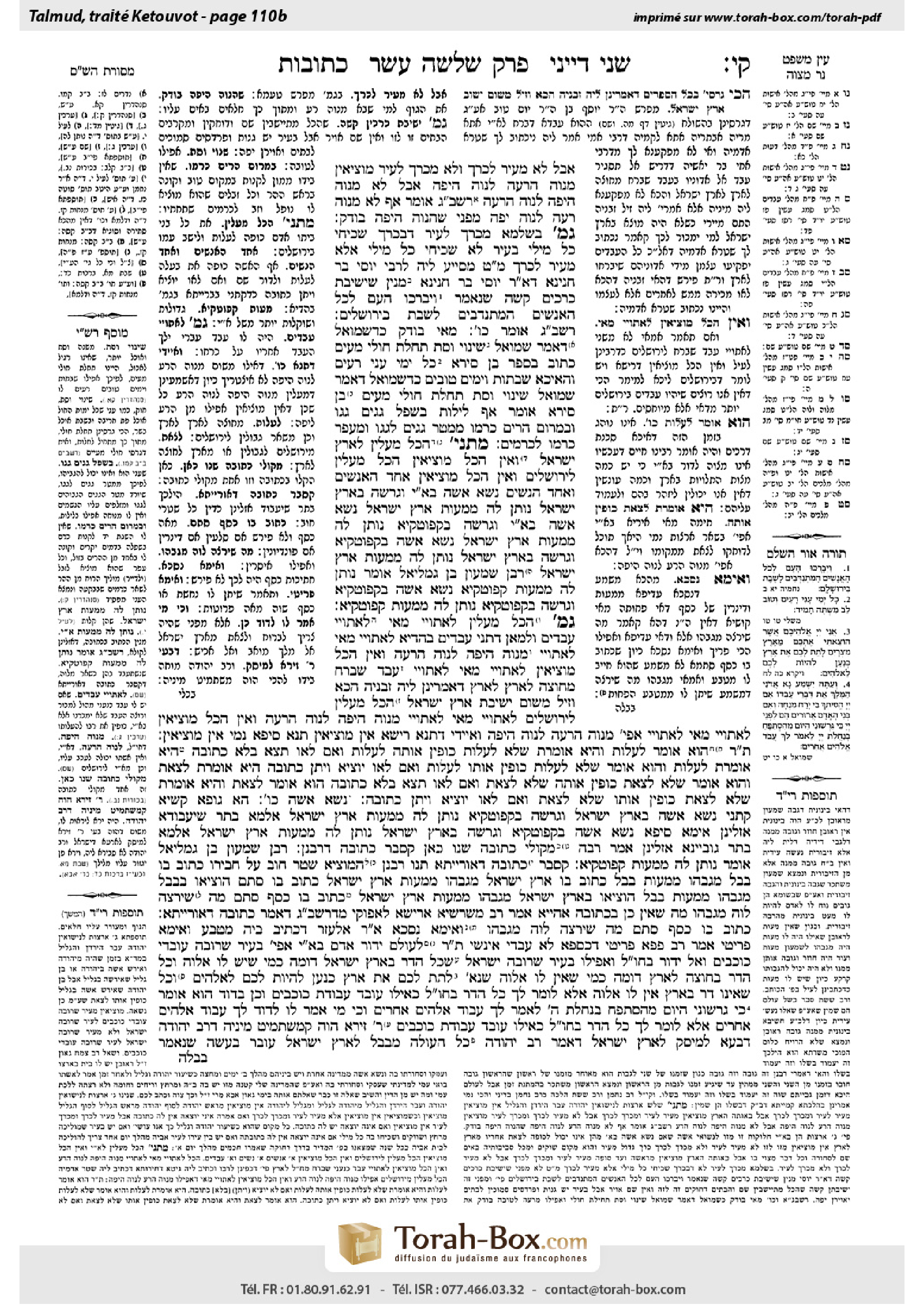
Ketubot 110b: Talmud study for Daf Yomi
Daf Yomi is the daily study of one Talmud folio. Explore 37 tractates with scans, Hebrew text, Sefaria English and AI-generated French translations where annotated.
Passage selection and English or AI-generated French translation are available where the scan has annotations. Daf Study is independent of Torah-Box and Sefaria.
Browse Ketubot · כתובות · All tractatesKetubot 110b text and translations
This page of Ketubot includes the Aramaic text, an English translation and an AI-generated French translation, alongside the scan above.
כתובות ק״י ב · Aramaic and Hebrew text
אֲבָל לֹא מֵעִיר לִכְרַךְ, וְלֹא מִכְּרַךְ לְעִיר.
מוֹצִיאִין מִנָּוֶה הָרַע(ה) לְנָוֶה הַיָּפֶה, אֲבָל לֹא מִנָּוֶה הַיָּפֶה לְנָוֶה הָרַע(ה). רַבָּן שִׁמְעוֹן בֶּן גַּמְלִיאֵל אוֹמֵר: אַף לֹא מִנָּוֶה רַע(ה) לְנָוֶה יָפֶה, מִפְּנֵי שֶׁהַנָּוֶה הַיָּפֶה בּוֹדֵק.
גְּמָ׳ בִּשְׁלָמָא מִכְּרַךְ לָעִיר — דְּבִכְרַךְ שְׁכִיחִי כֹּל מִילֵּי, בְּעִיר לָא שְׁכִיחִי כֹּל מִילֵּי. אֶלָּא מֵעִיר לִכְרַךְ מַאי טַעְמָא?
מְסַיַּיע לֵיהּ לְרַבִּי יוֹסֵי בַּר חֲנִינָא. דְּאָמַר רַבִּי יוֹסֵי בַּר חֲנִינָא: מִנַּיִן שֶׁיְּשִׁיבַת כְּרַכִּים קָשָׁה, שֶׁנֶּאֱמַר: ״וַיְבָרְכוּ הָעָם לְכֹל הָאֲנָשִׁים הַמִּתְנַדְּבִים לָשֶׁבֶת בִּירוּשָׁלִָים״.
רַבָּן שִׁמְעוֹן בֶּן גַּמְלִיאֵל אוֹמֵר כּוּ׳. מַאי ״בּוֹדֵק״? כְּדִשְׁמוּאֵל. דְּאָמַר שְׁמוּאֵל: שִׁינּוּי וֶסֶת תְּחִלַּת חוֹלִי מֵעַיִם. כָּתוּב בְּסֵפֶר בֶּן סִירָא: ״כׇּל יְמֵי עָנִי רָעִים״. וְהָאִיכָּא שַׁבָּתוֹת וְיָמִים טוֹבִים? כְּדִשְׁמוּאֵל. דְּאָמַר שְׁמוּאֵל: שִׁינּוּי וֶסֶת תְּחִלַּת חוֹלִי מֵעַיִם.
בֶּן סִירָא אוֹמֵר: ״אַף לֵילוֹת, בִּשְׁפַל גַּגִּים גַּגּוֹ, וּבִמְרוֹם הָרִים כַּרְמוֹ, מִמְּטַר גַּגִּים לְגַגּוֹ, וּמֵעֲפַר כַּרְמוֹ לִכְרָמִים״.
מַתְנִי׳ הַכֹּל מַעֲלִין לְאֶרֶץ יִשְׂרָאֵל, וְאֵין הַכֹּל מוֹצִיאִין. הַכֹּל מַעֲלִין לִירוּשָׁלַיִם, וְאֵין הַכֹּל מוֹצִיאִין. אֶחָד הָאֲנָשִׁים וְאֶחָד הַנָּשִׁים.
נָשָׂא אִשָּׁה בְּאֶרֶץ יִשְׂרָאֵל וְגֵרְשָׁהּ בְּאֶרֶץ יִשְׂרָאֵל — נוֹתֵן לָהּ מִמְּעוֹת אֶרֶץ יִשְׂרָאֵל. נָשָׂא אִשָּׁה בְּאֶרֶץ יִשְׂרָאֵל וְגֵרְשָׁהּ בְּקַפּוֹטְקְיָא — נוֹתֵן לָהּ מִמְּעוֹת אֶרֶץ יִשְׂרָאֵל. נָשָׂא אִשָּׁה בְּקַפּוֹטְקְיָא וְגֵרְשָׁהּ בְּאֶרֶץ יִשְׂרָאֵל — נוֹתֵן לָהּ מִמְּעוֹת אֶרֶץ יִשְׂרָאֵל. רַבָּן שִׁמְעוֹן בֶּן גַּמְלִיאֵל אוֹמֵר: נוֹתֵן לָהּ מִמְּעוֹת קַפּוֹטְקְיָא. נָשָׂא אִשָּׁה בְּקַפּוֹטְקְיָא וְגֵרְשָׁהּ בְּקַפּוֹטְקְיָא — נוֹתֵן לָהּ מִמְּעוֹת קַפּוֹטְקְיָא.
גְּמָ׳ ״הַכֹּל מַעֲלִין״ לְאֵתוֹיֵי מַאי? לְאֵתוֹיֵי עֲבָדִים.
וּלְמַאן דְּתָנֵי עֲבָדִים בְּהֶדְיָא, לְאֵתוֹיֵי מַאי? לְאֵתוֹיֵי מִנָּוֶה הַיָּפֶה לְנָוֶה הָרַע(ה).
״וְאֵין הַכֹּל מוֹצִיאִין״ לְאֵתוֹיֵי מַאי? לְאֵתוֹיֵי עֶבֶד שֶׁבָּרַח מֵחוּצָה לָאָרֶץ לָאָרֶץ, דְּאָמְרִינַן לֵיהּ: זַבְּנֵיהּ הָכָא וְזִיל, מִשּׁוּם יְשִׁיבַת אֶרֶץ יִשְׂרָאֵל.
״הַכֹּל מַעֲלִין לִירוּשָׁלַיִם״ לְאֵתוֹיֵי מַאי? לְאֵתוֹיֵי מִנָּוֶה הַיָּפֶה לְנָוֶה הָרַע(ה).
״וְאֵין הַכֹּל מוֹצִיאִין״ לְאֵתוֹיֵי מַאי? לְאֵתוֹיֵי אֲפִילּוּ מִנָּוֶה הָרַע(ה) לְנָוֶה הַיָּפֶה. וְאַיְּידֵי דִּתְנָא רֵישָׁא ״אֵין מוֹצִיאִין״, תְּנָא סֵיפָא נָמֵי ״אֵין מוֹצִיאִין״.
תָּנוּ רַבָּנַן: הוּא אוֹמֵר לַעֲלוֹת, וְהִיא אוֹמֶרֶת שֶׁלֹּא לַעֲלוֹת — כּוֹפִין אוֹתָהּ לַעֲלוֹת, וְאִם לָאו — תֵּצֵא בְּלֹא כְּתוּבָּה. הִיא אוֹמֶרֶת לַעֲלוֹת, וְהוּא אוֹמֵר שֶׁלֹּא לַעֲלוֹת — כּוֹפִין אוֹתוֹ לַעֲלוֹת, וְאִם לָאו — יוֹצִיא וְיִתֵּן כְּתוּבָּה.
הִיא אוֹמֶרֶת לָצֵאת, וְהוּא אוֹמֵר שֶׁלֹּא לָצֵאת — כּוֹפִין אוֹתָהּ שֶׁלֹּא לָצֵאת, וְאִם לָאו — תֵּצֵא בְּלֹא כְּתוּבָּה. הוּא אוֹמֵר לָצֵאת, וְהִיא אוֹמֶרֶת שֶׁלֹּא לָצֵאת — כּוֹפִין אוֹתוֹ שֶׁלֹּא לָצֵאת, וְאִם לָאו — יוֹצִיא וְיִתֵּן כְּתוּבָּה.
נָשָׂא אִשָּׁה כּוּ׳. הָא גּוּפַהּ קַשְׁיָא:
קָתָנֵי: נָשָׂא אִשָּׁה בְּאֶרֶץ יִשְׂרָאֵל וְגֵרְשָׁהּ בְּקַפּוֹטְקְיָא, נוֹתֵן לָהּ מִמְּעוֹת אֶרֶץ יִשְׂרָאֵל — אַלְמָא בָּתַר שִׁיעְבּוּדָא אָזְלִינַן. אֵימָא סֵיפָא: נָשָׂא אִשָּׁה בְּקַפּוֹטְקְיָא וְגֵרְשָׁהּ בְּאֶרֶץ יִשְׂרָאֵל, נוֹתֵן לָהּ מִמְּעוֹת אֶרֶץ יִשְׂרָאֵל — אַלְמָא בָּתַר גּוּבְיָינָא אָזְלִינַן!
אָמַר רַבָּה: מִקּוּלֵּי כְתוּבָּה שָׁנוּ כָּאן. קָסָבַר כְּתוּבָּה דְּרַבָּנַן.
רַבָּן שִׁמְעוֹן בֶּן גַּמְלִיאֵל אוֹמֵר: נוֹתֵן לָהּ מִמְּעוֹת קַפּוֹטְקְיָא. קָסָבַר כְּתוּבָּה דְּאוֹרָיְיתָא.
תָּנוּ רַבָּנַן: הַמּוֹצִיא שְׁטַר חוֹב עַל חֲבֵירוֹ, כָּתוּב בּוֹ בָּבֶל — מַגְבֵּהוּ מִמְּעוֹת בָּבֶל, כָּתוּב בּוֹ אֶרֶץ יִשְׂרָאֵל — מַגְבֵּהוּ מִמְּעוֹת אֶרֶץ יִשְׂרָאֵל. כָּתוּב בּוֹ סְתָם, הוֹצִיאוֹ בְּבָבֶל — מַגְבֵּהוּ מִמְּעוֹת בָּבֶל, הוֹצִיאוֹ בְּאֶרֶץ יִשְׂרָאֵל — מַגְבֵּהוּ מִמְּעוֹת אֶרֶץ יִשְׂרָאֵל. כָּתוּב בּוֹ כֶּסֶף סְתָם — מַה שֶּׁיִּרְצֶה לֹוֶה מַגְבֵּהוּ. מַה שֶּׁאֵין כֵּן בִּכְתוּבָּה.
אַהֵיָיא? אָמַר רַב מְשַׁרְשְׁיָא: אַרֵישָׁא, לְאַפּוֹקֵי מִדְּרַבָּן שִׁמְעוֹן בֶּן גַּמְלִיאֵל, דְּאָמַר כְּתוּבָּה דְּאוֹרָיְיתָא.
כָּתוּב בּוֹ כֶּסֶף סְתָם — מַה שֶּׁיִּרְצֶה לֹוֶה מַגְבֵּהוּ. וְאֵימָא נְסָכָא? אָמַר רַבִּי אֶלְעָזָר: דִּכְתִיב בֵּיהּ מַטְבֵּעַ. וְאֵימָא פְּרִיטֵי? אָמַר רַב פָּפָּא: פְּרִיטֵי דְכַסְפָּא לָא עָבְדִי אִינָשֵׁי.
תָּנוּ רַבָּנַן: לְעוֹלָם יָדוּר אָדָם בְּאֶרֶץ יִשְׂרָאֵל אֲפִילּוּ בְּעִיר שֶׁרוּבָּהּ גּוֹיִם, וְאַל יָדוּר בְּחוּצָה לָאָרֶץ וַאֲפִילּוּ בְּעִיר שֶׁרוּבָּהּ יִשְׂרָאֵל, שֶׁכׇּל הַדָּר בְּאֶרֶץ יִשְׂרָאֵל דּוֹמֶה כְּמִי שֶׁיֵּשׁ לוֹ אֱלוֹהַּ, וְכׇל הַדָּר בְּחוּצָה לָאָרֶץ דּוֹמֶה כְּמִי שֶׁאֵין לוֹ אֱלוֹהַּ. שֶׁנֶּאֱמַר: ״לָתֵת לָכֶם אֶת אֶרֶץ כְּנַעַן לִהְיוֹת לָכֶם לֵאלֹהִים״.
וְכֹל שֶׁאֵינוֹ דָּר בָּאָרֶץ אֵין לוֹ אֱלוֹהַּ? אֶלָּא לוֹמַר לָךְ: כׇּל הַדָּר בְּחוּצָה לָאָרֶץ כְּאִילּוּ עוֹבֵד עֲבוֹדָה זָרָה. וְכֵן בְּדָוִד הוּא אוֹמֵר: ״כִּי גֵרְשׁוּנִי הַיּוֹם מֵהִסְתַּפֵּחַ בְּנַחֲלַת ה׳ לֵאמֹר לֵךְ עֲבוֹד אֱלֹהִים אֲחֵרִים״, וְכִי מִי אָמַר לוֹ לְדָוִד לֵךְ עֲבוֹד אֱלֹהִים אֲחֵרִים? אֶלָּא לוֹמַר לָךְ: כׇּל הַדָּר בְּחוּצָה לָאָרֶץ — כְּאִילּוּ עוֹבֵד עֲבוֹדָה זָרָה.
רַבִּי זֵירָא הֲוָה קָמִשְׁתְּמִיט מִינֵּיהּ דְּרַב יְהוּדָה דִּבְעָא לְמִיסַּק לְאֶרֶץ יִשְׂרָאֵל, דְּאָמַר רַב יְהוּדָה: כׇּל הָעוֹלֶה מִבָּבֶל לְאֶרֶץ יִשְׂרָאֵל עוֹבֵר בַּעֲשֵׂה, שֶׁנֶּאֱמַר:
Ketubot 110b · English translation
However, even within the same land one may not force his wife to move from a town to a city, nor from a city to a town.
The mishna adds: One may remove his wife from a noxious residence to a pleasant residence, even if it is in another land. However, one may not compel his wife to move from a pleasant residence to a noxious residence. Rabban Shimon ben Gamliel says: One may also not remove her from a noxious residence to a pleasant residence, because a pleasant residence tests the individual, i.e., one accustomed to certain environments can suffer even in more comfortable living quarters.
GEMARA: With regard to the statement in the mishna that one may not force one’s spouse to move from a city to a town or from a town to a city, the Gemara asks: Granted, one may not remove her from a city to a town, as all items are readily available in a city, whereas in a town all items are not as available, and therefore the wife can argue that living in a town is inconvenient for her. However, what is the reason that the husband cannot compel her to move from a town to the city?
The Gemara answers: This supports the opinion of Rabbi Yosei bar Ḥanina, as Rabbi Yosei bar Ḥanina said: From where is it derived that dwelling in cities is difficult? As it is stated: “And the people blessed all the men who willingly offered themselves to dwell in Jerusalem” (Nehemiah 11:2). This shows that living in a city is difficult, due to the noise and the general hubbub of an urban area.
§ The mishna taught: Rabban Shimon ben Gamliel says that a pleasant residence tests the individual. The Gemara asks: What is the meaning of the term tests in this context? The Gemara explains: This is in accordance with the opinion of Shmuel, as Shmuel said: A change in one’s eating habits [veset] or in one’s place of residence is the start of intestinal disease. Similarly, it is written in Sefer Ben Sira: All the days of the poor are terrible. And yet there are Shabbatot and Festivals, when even the poor eat well. Once again, the Gemara answers: This is in accordance with the opinion of Shmuel, as Shmuel said: A change in one’s eating habits or in one’s place of residence is the start of intestinal disease, and as a result the poor suffer even from a change for the better.
Since the Gemara quoted from Sefer Ben Sira, it cites the rest of the passage concerning the terrible days of the poor. Ben Sira says: Even the nights of the poor are bad. His roof is at the low point of the roofs, i.e., his residence is at the lowest point in the city, and his vineyard is at the mountain peaks, at the highest point of the slope, which means that the rain of roofs washes down to his roof, and the soil of his vineyard to other vineyards, i.e., the rain washes away the soil in his vineyard and carries it away to the vineyards below.
MISHNA: All may force their family to ascend to Eretz Yisrael, i.e., one may compel his family and household to immigrate to Eretz Yisrael, but all may not remove others from Eretz Yisrael, as one may not coerce one’s family to leave. Likewise, all may force their family to ascend to Jerusalem, and all may not, i.e., no one may, remove them from Jerusalem. Both men and women may force the other spouse to immigrate to Eretz Yisrael or to move to Jerusalem.
The mishna lists other halakhic distinctions between various geographic locations: If one married a woman in Eretz Yisrael and divorced her in Eretz Yisrael, and the currency of the sum in the marriage contract was not specified, he gives her the sum of her marriage contract in the currency of Eretz Yisrael. If one married a woman in Eretz Yisrael and divorced her in Cappadocia, where the currency holds greater value, he gives her the currency of Eretz Yisrael. If one married a woman in Cappadocia and divorced her in Eretz Yisrael, he likewise gives her the currency of Eretz Yisrael. Rabban Shimon ben Gamliel says: He gives her the currency of Cappadocia. Everyone agrees that if one married a woman in Cappadocia and divorced her in Cappadocia, he gives her the currency of Cappadocia.
GEMARA: The mishna stated: All can force the members of their family to ascend. The Gemara asks: This inclusive phrase serves to include what case? The Gemara answers: It comes to include slaves, i.e., Hebrew slaves as well may be coerced to immigrate to Eretz Yisrael with their master’s family against their will.
The Gemara asks: And according to the one whose text of the mishna expressly teaches the case of slaves, this phrase comes to include what case? As stated later in the Gemara, there are some editions of the mishna that state that this halakha applies equally to men, women, and slaves. The Gemara answers: It comes to include one who moves from a pleasant residence to a noxious residence, i.e., one may coerce his family to ascend to Eretz Yisrael even from a good residence abroad to an inferior one in Eretz Yisrael.
§ The mishna further taught: But all may not remove others. Once again the Gemara asks: This phrase comes to include what case? The Gemara answers: It comes to include a Canaanite slave who ran away from his master and came from outside Eretz Yisrael to Eretz Yisrael, as we say to the master: Sell your slave here, in Eretz Yisrael, and then you may go and return abroad, but you may not take the slave abroad with you, due to the mitzva of settling Eretz Yisrael.
§ The mishna taught: All may force others to ascend to Jerusalem. The Gemara asks once again: This phrase comes to include what case? The Gemara answers: It comes to include a move from a pleasant residence elsewhere in Eretz Yisrael to a noxious residence in Jerusalem.
§ The mishna taught: And all may not remove them from Jerusalem. The Gemara asks: This phrase comes to include what case? The Gemara answers: It comes to include even a move from a noxious residence to a pleasant residence. The Gemara adds: And since the tanna of the mishna taught: But one may not remove, in the first clause, he also taught: But one may not remove, in the latter clause, despite the fact that this halakha could have been inferred from the first clause.
§ The Sages taught: If the husband says that he wishes to ascend, i.e., to immigrate to Eretz Yisrael, and his wife says that she does not wish to ascend, one forces her to ascend. And if she will not do so, as she resists all attempts to force her to make the move, she is divorced without receiving her marriage contract, i.e., she forfeits her rights to the benefits outlined in the marriage contract. If she says that she wishes to ascend to Eretz Yisrael and he says that he does not wish to ascend, one forces him to ascend. And if he does not wish to immigrate, he must divorce her and give her the marriage contract.
If she says that she wishes to leave Eretz Yisrael, and he says that he does not wish to leave, one forces her not to leave. And if she does not wish to stay in Eretz Yisrael and resists all attempts to force her to stay, she is divorced without receiving her marriage contract. If he says that he wishes to leave Eretz Yisrael and she says that she does not wish to leave, one forces him not to leave. And if he does not wish to stay in Eretz Yisrael, he must divorce her and give her the marriage contract.
§ The mishna taught that if one married a woman in Eretz Yisrael and divorced her in Cappadocia, he must pay her the marriage contract in the currency of Eretz Yisrael. The same is true if he married her in Cappadocia and divorced her in Eretz Yisrael. The Gemara asks: This matter itself is difficult, i.e., there is an internal contradiction in the rulings provided by the mishna.
The Gemara elaborates: The mishna first teaches that if one married a woman in Eretz Yisrael and divorced her in Cappadocia, he gives her the currency of Eretz Yisrael. Apparently, one follows the customs of the place of the lien, i.e., he pays with the currency of the location of the wedding, where the obligation came into force. Now, say the latter clause of the mishna: If one married a woman in Cappadocia and divorced her in Eretz Yisrael, he likewise gives her currency of Eretz Yisrael. Apparently, one follows the place of the collection of the money.
Rabba said: The Sages taught here one of the leniencies that apply to a marriage contract. The leniency is that the husband pays with the less valuable currency of Eretz Yisrael in both cases, whether the wedding or the divorce occurred there. This is because the tanna of this mishna holds that a marriage contract applies by rabbinic law.
§ The mishna taught that Rabban Shimon ben Gamliel says that if one married a woman in Cappadocia and divorced her in Eretz Yisrael, he pays her the marriage contract in the currency of Cappadocia. The Gemara explains that Rabban Shimon ben Gamliel holds that a marriage contract applies by Torah law, which means that its debt must be paid according to its highest possible value. Consequently, one follows the place in which the obligation was formed, which is the halakha for all deeds and contracts, and there is no room for leniency in this matter.
§ The Sages taught: With regard to one who produces a promissory note against another, if Babylonia is written in it, he pays it with the currency of Babylonia; if Eretz Yisrael is written in it, he pays it with currency of Eretz Yisrael. In a case where it is written without specification as to where the document was written, if he produced it in Babylonia he pays it with the currency of Babylonia and if he produced it in Eretz Yisrael he pays it with currency of Eretz Yisrael. If the note mentions money without specification of what type of coins are to be used, the borrower may pay it with any type of coin he likes, even the smallest denomination available. However, this is not the case with regard to a marriage contract.
The Gemara asks: With regard to this last statement, that this is not the case with regard to a marriage contract: To which part of the baraita is this referring? Rav Mesharshiyya said: It is referring back to the first clause, that if the promissory note mentions Babylonia one pays with Babylonian currency. This indicates that one invariably pays based on the place where the document was written. The tanna adds that this principle does not apply to a marriage contract, as one pays based on the place where a marriage contract was written only if this would lead to a leniency, as explained above (Rid). This ruling comes to exclude the opinion of Rabban Shimon ben Gamliel, who said that that a marriage contract applies by Torah law and must always be paid in the currency of the place in which the obligation was first formed.
§ The Gemara continues to analyze the baraita, which teaches: If the note mentions money [kesef ] without specification, the borrower may pay it with any type of coin he likes. The Gemara asks: But can’t one say that perhaps the document was not speaking of coins but of silver [kesef ] strips? Rabbi Elazar said: The baraita is referring to a case in which it is written in the document: Coins, although it does not specify which ones. The Gemara further asks: And can’t one say that one may pay off the debt with perutot, a small denomination? Rav Pappa said: People do not ordinarily mint perutot of silver, as they reserve silver for larger denominations.
§ In relation to the basic point raised by the mishna concerning living in Eretz Yisrael, the Sages taught: A person should always reside in Eretz Yisrael, even in a city that is mostly populated by gentiles, and he should not reside outside of Eretz Yisrael, even in a city that is mostly populated by Jews. The reason is that anyone who resides in Eretz Yisrael is considered as one who has a God, and anyone who resides outside of Eretz Yisrael is considered as one who does not have a God. As it is stated: “To give to you the land of Canaan, to be your God” (Leviticus 25:38).
The Gemara expresses surprise: And can it really be said that anyone who resides outside of Eretz Yisrael has no God? Rather, this comes to tell you that anyone who resides outside of Eretz Yisrael is considered as though he is engaged in idol worship. And so it says with regard to David: “For they have driven me out this day that I should not cleave to the inheritance of the Lord, saying: Go, serve other gods” (I Samuel 26:19). But who said to David: Go, serve other gods? Rather, this comes to tell you that anyone who resides outside of Eretz Yisrael is considered as though he is engaged in idol worship.
§ The Gemara relates: Rabbi Zeira was avoiding being seen by his teacher, Rav Yehuda, as Rabbi Zeira sought to ascend to Eretz Yisrael and his teacher disapproved. As Rav Yehuda said: Anyone who ascends from Babylonia to Eretz Yisrael transgresses a positive mitzva, as it is stated:
Ketubot 110b · Traduction française (IA)
Toutefois, même à l’intérieur d’un même pays, on ne peut pas contraindre sa femme à déménager d’une ville à un village, ni d’un village à une ville.
La Michna ajoute : On peut faire déménager sa femme d’un logement malsain à un logement agréable, même si celui-ci se trouve dans un autre pays. En revanche, on ne peut pas la contraindre à déménager d’un logement agréable à un logement malsain. Rabban Shimon ben Gamliel dit : On ne peut pas non plus la faire déménager d’un logement malsain à un logement agréable, car un logement agréable met l’individu à l’épreuve, c’est-à-dire qu’une personne habituée à certains environnements peut souffrir même dans des conditions de vie plus confortables.
GUEMARA : À propos de la déclaration de la Michna selon laquelle on ne peut pas contraindre son conjoint à déménager d’une ville à un village, ou d’un village à une ville, la Guemara demande : Il est compréhensible qu’on ne puisse pas la faire déménager d’une ville à un village, car tout est facilement accessible en ville, tandis que dans un village, tout l’est moins ; la femme peut donc soutenir que la vie au village lui est peu pratique. Mais pourquoi le mari ne peut-il pas la contraindre à déménager d’un village à une ville ?
La Guemara répond : Cela appuie l’opinion de Rabbi Yosei bar Ḥanina, car Rabbi Yosei bar Ḥanina a dit : D’où déduit-on qu’il est difficile de vivre dans les villes ? Du verset : « Et le peuple bénit tous les hommes qui se portèrent volontairement pour habiter à Jérusalem » (Néhémie 11:2). Cela montre qu’il est difficile de vivre dans une ville, en raison du bruit et de l’agitation générale d’un milieu urbain.
§ La Michna a enseigné que Rabban Shimon ben Gamliel dit qu’un logement agréable met l’individu à l’épreuve. La Guemara demande : Que signifie ici l’expression « met à l’épreuve » ? La Guemara explique : Cela est conforme à l’opinion de Shmuel, car Shmuel a dit : Un changement des habitudes alimentaires [veset] ou du lieu de résidence marque le début d’une maladie intestinale. De même, il est écrit dans le Sefer Ben Sira : « Tous les jours du pauvre sont pénibles. » Pourtant, il y a les Chabbatot et les fêtes, où même les pauvres mangent bien. La Guemara répond de nouveau : Cela est conforme à l’opinion de Shmuel, car Shmuel a dit : Un changement des habitudes alimentaires ou du lieu de résidence marque le début d’une maladie intestinale ; par conséquent, les pauvres souffrent même d’un changement qui améliore leur situation.
Comme la Guemara a cité le Sefer Ben Sira, elle rapporte la suite du passage concernant les jours pénibles des pauvres. Ben Sira dit : « Même les nuits des pauvres sont pénibles. Son toit se trouve au point le plus bas parmi les toits, c’est-à-dire que son logement est situé dans la partie la plus basse de la ville, et sa vigne se trouve au sommet des montagnes, au point le plus élevé de la pente. » Autrement dit, l’eau de pluie provenant des toits s’écoule sur son toit, et la terre de sa vigne vers les autres vignes : la pluie emporte la terre de sa vigne et la charrie jusqu’aux vignes situées en contrebas.
MICHNA : Tous peuvent contraindre les membres de leur famille à monter en Terre d’Israël, c’est-à-dire qu’on peut obliger sa famille et son foyer à immigrer en Terre d’Israël ; en revanche, personne ne peut contraindre les autres à quitter la Terre d’Israël. De même, tous peuvent contraindre leur famille à monter à Jérusalem, et personne ne peut l’en faire sortir. Les hommes comme les femmes peuvent contraindre leur conjoint à immigrer en Terre d’Israël ou à déménager à Jérusalem.
La Michna énumère d’autres distinctions halakhiques entre différentes régions géographiques : si un homme a épousé une femme en Terre d’Israël et a divorcé d’elle en Terre d’Israël, et que la monnaie dans laquelle la somme de la ketouba devait être payée n’a pas été précisée, il lui verse la somme de sa ketouba dans la monnaie de Terre d’Israël. S’il a épousé une femme en Terre d’Israël et a divorcé d’elle en Cappadoce, où la monnaie a une valeur supérieure, il lui verse la somme dans la monnaie de Terre d’Israël. S’il a épousé une femme en Cappadoce et a divorcé d’elle en Terre d’Israël, il lui verse également la somme dans la monnaie de Terre d’Israël. Rabban Shimon ben Gamliel dit : Il lui verse la somme dans la monnaie de Cappadoce. Tous conviennent que si un homme a épousé une femme en Cappadoce et a divorcé d’elle en Cappadoce, il lui verse la somme dans la monnaie de Cappadoce.
GUEMARA : La Michna a enseigné : Tous peuvent contraindre les membres de leur famille à monter. La Guemara demande : Quels cas cette expression générale vient-elle inclure ? La Guemara répond : Elle vient inclure les esclaves, c’est-à-dire que les esclaves hébreux peuvent eux aussi être contraints, contre leur gré, à immigrer en Terre d’Israël avec la famille de leur maître.
La Guemara demande : Et selon celui dont la version de la Michna mentionne explicitement le cas des esclaves, quel cas cette expression vient-elle inclure ? Comme la Guemara le dira plus loin, certaines versions de la Michna précisent que cette halakha s’applique pareillement aux hommes, aux femmes et aux esclaves. La Guemara répond : Elle vient inclure celui qui déménage d’un logement agréable à un logement malsain, c’est-à-dire qu’on peut contraindre sa famille à monter en Terre d’Israël, même si cela signifie quitter un logement confortable à l’étranger pour un logement inférieur en Terre d’Israël.
§ La Michna a aussi enseigné : Mais personne ne peut faire sortir les autres. La Guemara demande de nouveau : Quels cas cette expression vient-elle inclure ? La Guemara répond : Elle vient inclure un esclave cananéen qui s’est enfui de chez son maître et est venu de l’extérieur de la Terre d’Israël en Terre d’Israël. On dit alors au maître : « Vends ton esclave ici, en Terre d’Israël, puis tu pourras partir et retourner à l’étranger ; mais tu ne peux pas emmener l’esclave à l’étranger avec toi », en raison de la mitsva de s’établir en Terre d’Israël.
§ La Michna a enseigné : Tous peuvent contraindre les autres à monter à Jérusalem. La Guemara demande de nouveau : Quels cas cette expression vient-elle inclure ? La Guemara répond : Elle vient inclure le déménagement d’un logement agréable situé ailleurs en Terre d’Israël vers un logement malsain à Jérusalem.
§ La Michna a enseigné : Et personne ne peut les faire sortir de Jérusalem. La Guemara demande : Quels cas cette expression vient-elle inclure ? La Guemara répond : Elle vient inclure même le déménagement d’un logement malsain vers un logement agréable. La Guemara ajoute : Puisque le tanna de la Michna a enseigné « Mais on ne peut pas faire sortir » dans la première partie, il a également enseigné « Mais on ne peut pas faire sortir » dans la dernière partie, bien que cette halakha aurait pu être déduite de la première partie.
§ Les Sages ont enseigné : Si le mari dit qu’il souhaite monter, c’est-à-dire immigrer en Terre d’Israël, et que sa femme dit qu’elle ne souhaite pas monter, on la contraint à monter. Si elle refuse, résistant à toutes les tentatives de la contraindre à déménager, elle est divorcée sans recevoir sa ketouba, c’est-à-dire qu’elle perd ses droits aux avantages prévus par la ketouba. Si elle dit qu’elle souhaite monter en Terre d’Israël et que lui dit qu’il ne souhaite pas monter, on le contraint à monter. S’il ne veut pas immigrer, il doit divorcer d’elle et lui verser la ketouba.
Si elle dit qu’elle souhaite quitter la Terre d’Israël et que lui dit qu’il ne souhaite pas partir, on la contraint à ne pas partir. Si elle ne veut pas rester en Terre d’Israël et résiste à toutes les tentatives visant à l’y maintenir, elle est divorcée sans recevoir sa ketouba. Si lui dit qu’il souhaite quitter la Terre d’Israël et qu’elle dit qu’elle ne souhaite pas partir, on le contraint à ne pas partir. S’il ne veut pas rester en Terre d’Israël, il doit divorcer d’elle et lui verser la ketouba.
§ La Michna a enseigné que si un homme a épousé une femme en Terre d’Israël et a divorcé d’elle en Cappadoce, il doit lui verser la ketouba dans la monnaie de Terre d’Israël. Il en va de même s’il l’a épousée en Cappadoce et a divorcé d’elle en Terre d’Israël. La Guemara demande : Cette règle elle-même pose problème, car les décisions de la Michna se contredisent.
La Guemara développe : La Michna enseigne d’abord que si un homme a épousé une femme en Terre d’Israël et a divorcé d’elle en Cappadoce, il lui verse la somme dans la monnaie de Terre d’Israël. Apparemment, on suit les usages du lieu où le droit de créance a pris naissance, c’est-à-dire qu’il paie dans la monnaie du lieu du mariage, où l’obligation est entrée en vigueur. Or, la dernière partie de la Michna dit : Si un homme a épousé une femme en Cappadoce et a divorcé d’elle en Terre d’Israël, il lui verse également la somme dans la monnaie de Terre d’Israël. Apparemment, on suit le lieu où la somme est réclamée.
Rabba a dit : Les Sages ont enseigné ici l’une des indulgences qui s’appliquent à une ketouba. Cette indulgence consiste à faire payer au mari la monnaie de moindre valeur de Terre d’Israël dans les deux cas, que le mariage ou le divorce ait eu lieu là-bas. En effet, le tanna de cette Michna considère que la ketouba relève du droit rabbinique.
§ La Michna a enseigné que Rabban Shimon ben Gamliel dit que si un homme a épousé une femme en Cappadoce et a divorcé d’elle en Terre d’Israël, il lui verse la ketouba dans la monnaie de Cappadoce. La Guemara explique que Rabban Shimon ben Gamliel considère que la ketouba relève de la Torah écrite, ce qui signifie que cette dette doit être payée selon sa valeur la plus élevée possible. Par conséquent, on suit le lieu où l’obligation a été contractée, comme c’est la halakha pour tous les actes et contrats ; il n’y a donc pas lieu d’appliquer une indulgence dans ce cas.
§ Les Sages ont enseigné : Concernant celui qui présente un billet à ordre contre une autre personne, si la Babylonie y est mentionnée, la dette est payée dans la monnaie de Babylonie ; si la Terre d’Israël y est mentionnée, elle est payée dans la monnaie de Terre d’Israël. Si le lieu où le document a été rédigé n’est pas précisé, lorsqu’il le présente en Babylonie, la dette est payée dans la monnaie de Babylonie, et lorsqu’il le présente en Terre d’Israël, elle est payée dans la monnaie de Terre d’Israël. Si le billet mentionne une somme d’argent sans préciser le type de pièces à utiliser, l’emprunteur peut payer avec le type de pièce de son choix, même la plus petite dénomination disponible. Toutefois, il n’en va pas ainsi pour une ketouba.
La Guemara demande : À propos de cette dernière déclaration, selon laquelle il n’en va pas ainsi pour une ketouba, à quelle partie de la baraïta se rapporte-t-elle ? Rav Mesharshiyya a dit : Elle renvoie à la première partie, selon laquelle, si le billet à ordre mentionne la Babylonie, la dette est payée dans la monnaie de Babylonie. Cela indique que le paiement se fait toujours selon le lieu où le document a été rédigé. Le tanna ajoute que ce principe ne s’applique pas à une ketouba : on se fonde sur le lieu où celle-ci a été rédigée uniquement si cela constitue une indulgence, comme expliqué plus haut (Rid). Cette décision vient exclure l’opinion de Rabban Shimon ben Gamliel, qui a dit que la ketouba relève de la Torah écrite et doit toujours être payée dans la monnaie du lieu où l’obligation a été initialement contractée.
§ La Guemara poursuit l’analyse de la baraïta, qui enseigne : Si le billet mentionne une somme d’argent [kesef] sans autre précision, l’emprunteur peut payer avec le type de pièce de son choix. La Guemara demande : Ne peut-on pas dire que le document ne parlait peut-être pas de pièces, mais de lamelles d’argent [kesef] ? Rabbi Elazar a dit : La baraïta parle d’un cas où le document indique « pièces », sans préciser lesquelles. La Guemara demande encore : Ne peut-on pas dire que la dette peut être remboursée en peroutot, de petites pièces ? Rav Pappa a dit : Les gens ne frappent pas couramment des peroutot en argent, car ils réservent l’argent aux pièces de plus grande valeur.
§ À propos du principe fondamental soulevé par la Michna concernant la résidence en Terre d’Israël, les Sages ont enseigné : Une personne devrait toujours résider en Terre d’Israël, même dans une ville dont la majorité des habitants sont des non-Juifs, et ne devrait pas résider à l’extérieur de la Terre d’Israël, même dans une ville dont la majorité des habitants sont des Juifs. En effet, quiconque réside en Terre d’Israël est considéré comme ayant un Dieu, tandis que quiconque réside à l’extérieur de la Terre d’Israël est considéré comme n’ayant pas de Dieu. Comme il est dit : « Pour vous donner le pays de Canaan, afin que je sois votre Dieu » (Lévitique 25:38).
La Guemara exprime son étonnement : Peut-on vraiment dire que quiconque réside à l’extérieur de la Terre d’Israël n’a pas de Dieu ? En réalité, cela vient t’enseigner que quiconque réside à l’extérieur de la Terre d’Israël est considéré comme s’il pratiquait l’idolâtrie. Et il est dit à propos de David : « Car ils m’ont chassé aujourd’hui pour que je ne puisse plus prendre part à l’héritage du Seigneur, en disant : Va, sers d’autres dieux » (I Samuel 26:19). Mais qui a dit à David : « Va, sers d’autres dieux » ? En réalité, cela vient t’enseigner que quiconque réside à l’extérieur de la Terre d’Israël est considéré comme s’il pratiquait l’idolâtrie.
§ La Guemara rapporte : Rabbi Zeira évitait que son maître, Rav Yehuda, le voie, car Rabbi Zeira cherchait à monter en Terre d’Israël et son maître désapprouvait ce projet. En effet, Rav Yehuda a dit : Quiconque monte de Babylonie en Terre d’Israël transgresse une mitsva positive, comme il est dit :
Traduction française générée par IA à partir de l’édition anglaise de Sefaria. Vérifie toujours un passage avec le texte source.
Text from Sefaria: William Davidson Edition - Vocalized Aramaic (CC BY NC); William Davidson Edition - English (CC BY NC).