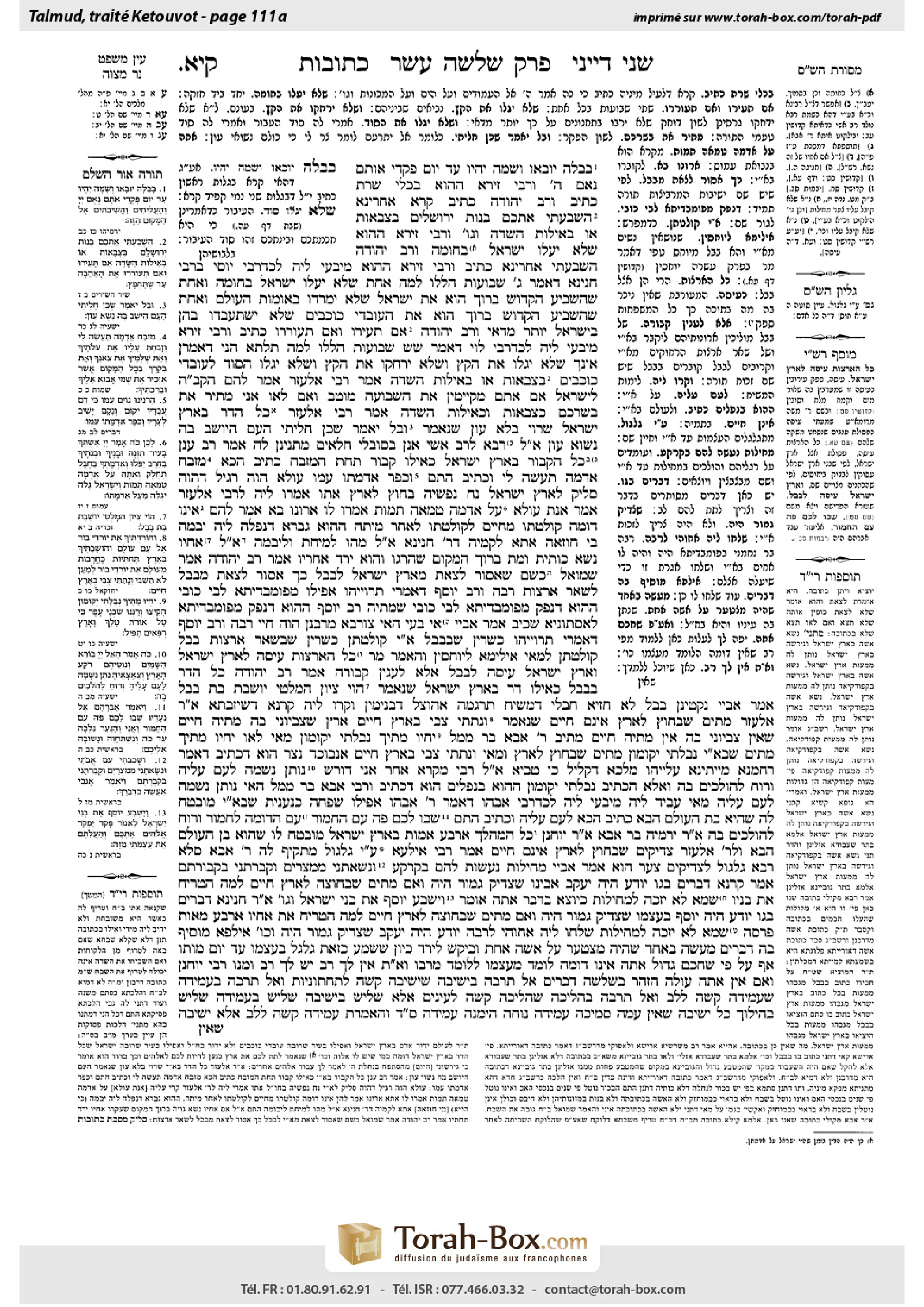
Ketubot 111a: Talmud study for Daf Yomi
Daf Yomi is the daily study of one Talmud folio. Explore 37 tractates with scans, Hebrew text, Sefaria English and AI-generated French translations where annotated.
Passage selection and English or AI-generated French translation are available where the scan has annotations. Daf Study is independent of Torah-Box and Sefaria.
Browse Ketubot · כתובות · All tractatesKetubot 111a text and translations
This page of Ketubot includes the Aramaic text, an English translation and an AI-generated French translation, alongside the scan above.
כתובות קי״א א · Aramaic and Hebrew text
״בָּבֶלָה יוּבָאוּ וְשָׁמָּה יִהְיוּ עַד יוֹם פׇּקְדִי אוֹתָם נְאֻם ה׳״. וְרַבִּי זֵירָא — הָהוּא בִּכְלֵי שָׁרֵת כְּתִיב.
וְרַב יְהוּדָה? כְּתִיב קְרָא אַחֲרִינָא: ״הִשְׁבַּעְתִּי אֶתְכֶם בְּנוֹת יְרוּשָׁלִַים בִּצְבָאוֹת אוֹ בְּאַיְלוֹת הַשָּׂדֶה וְגוֹ׳״.
וְרַבִּי זֵירָא — הָהוּא שֶׁלֹּא יַעֲלוּ יִשְׂרָאֵל בְּחוֹמָה. וְרַב יְהוּדָה? ״הִשְׁבַּעְתִּי״ אַחֲרִינָא כְּתִיב.
וְרַבִּי זֵירָא — הָהוּא מִיבְּעֵי לֵיהּ לְכִדְרַבִּי יוֹסֵי בְּרַבִּי חֲנִינָא, דְּאָמַר: שָׁלֹשׁ שְׁבוּעוֹת הַלָּלוּ לָמָּה? אַחַת שֶׁלֹּא יַעֲלוּ יִשְׂרָאֵל בְּחוֹמָה, וְאַחַת שֶׁהִשְׁבִּיעַ הַקָּדוֹשׁ בָּרוּךְ הוּא אֶת יִשְׂרָאֵל שֶׁלֹּא יִמְרְדוּ בְּאוּמּוֹת הָעוֹלָם, וְאַחַת שֶׁהִשְׁבִּיעַ הַקָּדוֹשׁ בָּרוּךְ הוּא אֶת הַגּוֹיִם שֶׁלֹּא יִשְׁתַּעְבְּדוּ בָּהֶן בְּיִשְׂרָאֵל יוֹתֵר מִדַּאי.
וְרַב יְהוּדָה — ״אִם תָּעִירוּ וְאִם תְּעוֹרְרוּ״ כְּתִיב.
וְרַבִּי זֵירָא — מִיבְּעֵי לֵיהּ לְכִדְרַבִּי לֵוִי, דְּאָמַר: שֵׁשׁ שְׁבוּעוֹת הַלָּלוּ לָמָּה? תְּלָתָא — הָנֵי דַּאֲמַרַן, אִינָךְ: שֶׁלֹּא יְגַלּוּ אֶת הַקֵּץ, וְשֶׁלֹּא יְרַחֲקוּ אֶת הַקֵּץ, וְשֶׁלֹּא יְגַלּוּ הַסּוֹד לַגּוֹיִם.
״בִּצְבָאוֹת אוֹ בְּאַיְלוֹת הַשָּׂדֶה״, אָמַר רַבִּי אֶלְעָזָר: אָמַר לָהֶם הַקָּדוֹשׁ בָּרוּךְ הוּא לְיִשְׂרָאֵל, אִם אַתֶּם מְקַיְּימִין אֶת הַשְּׁבוּעָה — מוּטָב, וְאִם לָאו — אֲנִי מַתִּיר אֶת בְּשַׂרְכֶם כִּצְבָאוֹת וּכְאַיְלוֹת הַשָּׂדֶה.
אָמַר רַבִּי אֶלְעָזָר: כׇּל הַדָּר בְּאֶרֶץ יִשְׂרָאֵל שָׁרוּי בְּלֹא עָוֹן, שֶׁנֶּאֱמַר: ״וּבַל יֹאמַר שָׁכֵן חָלִיתִי הָעָם הַיּוֹשֵׁב בָּהּ נְשׂוּא עָוֹן״. אֲמַר לֵיהּ רָבָא לְרַב אָשֵׁי: אֲנַן בְּסוֹבְלֵי חֳלָאִים מַתְנֵינַן לַהּ.
אָמַר רַב עָנָן: כׇּל הַקָּבוּר בְּאֶרֶץ יִשְׂרָאֵל כְּאִילּוּ קָבוּר תַּחַת הַמִּזְבֵּחַ. כְּתִיב הָכָא: ״מִזְבַּח אֲדָמָה תַּעֲשֶׂה לִּי״, וּכְתִיב הָתָם: ״וְכִפֵּר אַדְמָתוֹ עַמּוֹ״.
עוּלָּא הֲוָה רְגִיל דַּהֲוָה סָלֵיק לְאֶרֶץ יִשְׂרָאֵל, נָח נַפְשֵׁיהּ בְּחוּץ לָאָרֶץ. אֲתוֹ אֲמַרוּ לֵיהּ לְרַבִּי אֶלְעָזָר. אָמַר: אַנְתְּ עוּלָּא, ״עַל אֲדָמָה טְמֵאָה תָּמוּת״. אָמְרוּ לוֹ: אֲרוֹנוֹ בָּא. אָמַר לָהֶם: אֵינוֹ דּוֹמֶה קוֹלַטְתּוֹ מֵחַיִּים לְקוֹלַטְתּוֹ לְאַחַר מִיתָה.
הָהוּא גַּבְרָא דִּנְפַלָה לֵיהּ יְבָמָה בֵּי חוֹזָאָה, אֲתָא לְקַמֵּיהּ דְּרַבִּי חֲנִינָא, אֲמַר לֵיהּ: מַהוּ לְמֵיחַת וּלְיַבֹּמַהּ?
אֲמַר לֵיהּ: אָחִיו נָשָׂא כּוּתִית וָמֵת — בָּרוּךְ הַמָּקוֹם שֶׁהֲרָגוֹ. וְהוּא יֵרֵד אַחֲרָיו?!
אָמַר רַב יְהוּדָה אָמַר שְׁמוּאֵל: כְּשֵׁם שֶׁאָסוּר לָצֵאת מֵאֶרֶץ יִשְׂרָאֵל לְבָבֶל כָּךְ אָסוּר לָצֵאת מִבָּבֶל לִשְׁאָר אֲרָצוֹת. רַבָּה וְרַב יוֹסֵף דְּאָמְרִי תַּרְוַיְיהוּ: אֲפִילּוּ מִפּוּמְבְּדִיתָא לְבֵי כוּבֵּי. הָהוּא דִּנְפַק מִפּוּמְבְּדִיתָא לְבֵי כוּבֵּי, שַׁמְתֵּיהּ רַב יוֹסֵף. הָהוּא דִּנְפַק מִפּוּמְבְּדִיתָא לְאַסְתּוֹנְיָא, שְׁכֵיב. אֲמַר אַבָּיֵי: אִי בָּעֵי הַאי צוּרְבָּא מֵרַבָּנַן, הֲוָה חָיֵי.
רַבָּה וְרַב יוֹסֵף דְּאָמְרִי תַּרְוַיְיהוּ: כְּשֵׁרִין שֶׁבְּבָבֶל אֶרֶץ יִשְׂרָאֵל קוֹלַטְתָּן, כְּשֵׁרִין שֶׁבִּשְׁאָר אֲרָצוֹת בָּבֶל קוֹלַטְתָּן. לְמַאי? אִילֵימָא לְיוּחֲסִין, וְהָאָמַר מָר: כׇּל הָאֲרָצוֹת עִיסָּה לְאֶרֶץ יִשְׂרָאֵל, וְאֶרֶץ יִשְׂרָאֵל עִיסָּה לְבָבֶל! אֶלָּא לְעִנְיַן קְבוּרָה.
אָמַר רַב יְהוּדָה: כׇּל הַדָּר בְּבָבֶל כְּאִילּוּ דָּר בְּאֶרֶץ יִשְׂרָאֵל, שֶׁנֶּאֱמַר: ״הוֹי צִיּוֹן הִמָּלְטִי יוֹשֶׁבֶת בַּת בָּבֶל״. אָמַר אַבָּיֵי, נָקְטִינַן: בָּבֶל לָא חָזְיָא חַבְלֵי דְמָשִׁיחַ. תַּרְגְּמַהּ אַהוּצָל דְּבִנְיָמִין, וְקָרוּ לֵיהּ קַרְנָא דְשֵׁיזָבְתָּא.
אָמַר רַבִּי אֶלְעָזָר: מֵתִים שֶׁבְּחוּץ לָאָרֶץ אֵינָם חַיִּים, שֶׁנֶּאֱמַר: ״וְנָתַתִּי צְבִי בְּאֶרֶץ חַיִּים״ — אֶרֶץ שֶׁצִּבְיוֹנִי בָּהּ מֵתֶיהָ חַיִּים, שֶׁאֵין צִבְיוֹנִי בָּהּ — אֵין מֵתֶיהָ חַיִּים.
מֵתִיב רַבִּי אַבָּא בַּר מֶמֶל: ״יִחְיוּ מֵתֶיךָ נְבֵלָתִי יְקוּמוּן״, מַאי לָאו: ״יִחְיוּ מֵתֶיךָ״ — מֵתִים שֶׁבְּאֶרֶץ יִשְׂרָאֵל. ״נְבֵלָתִי יְקוּמוּן״ — מֵתִים שֶׁבְּחוּץ לָאָרֶץ. וּמַאי ״וְנָתַתִּי צְבִי בְּאֶרֶץ חַיִּים״ — אַנְּבוּכַד נֶצַּר הוּא דִּכְתִיב, דְּאָמַר רַחֲמָנָא: מַיְיתֵינָא עֲלַיְיהוּ מַלְכָּא דְּקַלִּיל כִּי טַבְיָא.
אֲמַר לֵיהּ: רַבִּי, מִקְרָא אַחֵר אֲנִי דּוֹרֵשׁ: ״נוֹתֵן נְשָׁמָה לָעָם עָלֶיהָ וְרוּחַ לַהוֹלְכִים בָּהּ״. וְאֶלָּא הָכְתִיב ״נְבֵלָתִי יְקוּמוּן״! הָהוּא בִּנְפָלִים הוּא דִּכְתִיב.
וְרַבִּי אַבָּא בַּר מֶמֶל, הַאי ״נוֹתֵן נְשָׁמָה לָעָם עָלֶיהָ״ מַאי עָבֵיד לֵיהּ? מִיבְּעֵי לֵיהּ לְכִדְרַבִּי אֲבָהוּ. דְּאָמַר רַבִּי אֲבָהוּ: אֲפִילּוּ שִׁפְחָה כְּנַעֲנִית שֶׁבְּאֶרֶץ יִשְׂרָאֵל מוּבְטָח לָהּ שֶׁהִיא בַּת הָעוֹלָם הַבָּא. כְּתִיב הָכָא: ״לָעָם עָלֶיהָ״, וּכְתִיב הָתָם: ״שְׁבוּ לָכֶם פֹּה עִם הַחֲמוֹר״ — עַם הַדּוֹמֶה לַחֲמוֹר.
״וְרוּחַ לַהוֹלְכִים בָּהּ״, אָמַר רַבִּי יִרְמְיָה בַּר אַבָּא אָמַר רַבִּי יוֹחָנָן: כׇּל הַמְהַלֵּךְ אַרְבַּע אַמּוֹת בְּאֶרֶץ יִשְׂרָאֵל מוּבְטָח לוֹ שֶׁהוּא בֶּן הָעוֹלָם הַבָּא.
וּלְרַבִּי אֶלְעָזָר, צַדִּיקִים שֶׁבְּחוּץ לָאָרֶץ אֵינָם חַיִּים?! אָמַר רַבִּי אִילְעָא: עַל יְדֵי גִּלְגּוּל. מַתְקֵיף לַהּ רַבִּי אַבָּא סַלָּא רַבָּא: גִּלְגּוּל לְצַדִּיקִים צַעַר הוּא! אָמַר אַבָּיֵי: מְחִילּוֹת נַעֲשׂוֹת לָהֶם בַּקַּרְקַע.
״וּנְשָׂאתַנִי מִמִּצְרַיִם וּקְבַרְתַּנִי בִּקְבוּרָתָם״, אָמַר קַרְנָא, דְּבָרִים בְּגוֹ: יוֹדֵעַ הָיָה יַעֲקֹב אָבִינוּ שֶׁצַּדִּיק גָּמוּר הָיָה, וְאִם מֵתִים שֶׁבְּחוּצָה לָאָרֶץ חַיִּים, לָמָה הִטְרִיחַ אֶת בָּנָיו? שֶׁמָּא לֹא יִזְכֶּה לִמְחִילּוֹת.
כַּיּוֹצֵא בַּדָּבָר אַתָּה אוֹמֵר: ״וַיַּשְׁבַּע יוֹסֵף אֶת בְּנֵי יִשְׂרָאֵל וְגוֹ׳״, אָמַר רַבִּי חֲנִינָא, דְּבָרִים בְּגוֹ: יוֹדֵעַ הָיָה יוֹסֵף בְּעַצְמוֹ שֶׁצַּדִּיק גָּמוּר הָיָה, וְאִם מֵתִים שֶׁבַּחוּצָה לָאָרֶץ חַיִּים, לָמָה הִטְרִיחַ אֶת אֶחָיו אַרְבַּע מֵאוֹת פַּרְסָה? שֶׁמָּא לֹא יִזְכֶּה לִמְחִילּוֹת.
שְׁלַחוּ לֵיהּ אֲחוֹהִי לְרַבָּה: יוֹדֵעַ הָיָה יַעֲקֹב שֶׁצַּדִּיק גָּמוּר הָיָה וְכוּ׳. אִילְפָא מוֹסִיף בָּהּ דְּבָרִים: מַעֲשֶׂה בְּאֶחָד שֶׁהָיָה מִצְטַעֵר עַל אִשָּׁה אַחַת, וּבִיקֵּשׁ לֵירֵד, כֵּיוָן שֶׁשָּׁמַע כָּזֹאת, גִּלְגֵּל בְּעַצְמוֹ עַד יוֹם מוֹתוֹ.
אַף עַל פִּי שֶׁחָכָם גָּדוֹל אַתָּה, אֵינוֹ דּוֹמֶה לוֹמֵד מֵעַצְמוֹ לַלּוֹמֵד מֵרַבּוֹ. וְאִם תֹּאמַר אֵין לְךָ רַב — יֵשׁ לְךָ רַב, וּמַנּוּ — רַבִּי יוֹחָנָן.
וְאִם אֵין אַתָּה עוֹלֶה — הִזָּהֵר בִּשְׁלֹשָׁה דְּבָרִים: אַל תַּרְבֶּה בִּישִׁיבָה — שֶׁיְּשִׁיבָה קָשָׁה לְתַחְתּוֹנִיּוֹת, וְאַל תַּרְבֶּה בַּעֲמִידָה — שֶׁעֲמִידָה קָשָׁה לַלֵּב, וְאַל תַּרְבֶּה בַּהֲלִיכָה — שֶׁהֲלִיכָה קָשָׁה לָעֵינַיִם. אֶלָּא שְׁלִישׁ בִּישִׁיבָה, שְׁלִישׁ בַּעֲמִידָה, שְׁלִישׁ בְּהִילּוּךְ.
כׇּל יְשִׁיבָה שֶׁאֵין עִמָּהּ סְמִיכָה — עֲמִידָה נוֹחָה הֵימֶנָּה. עֲמִידָה סָלְקָא דַּעְתָּךְ? וְהָאָמְרַתְּ עֲמִידָה קָשָׁה לַלֵּב! אֶלָּא: יְשִׁיבָה
Ketubot 111a · English translation
“They shall be taken to Babylonia and there they shall remain until the day that I recall them, said the Lord” (Jeremiah 27:22). Based on that verse, Rav Yehuda held that since the Babylonian exile was imposed by divine decree, permission to leave Babylonia for Eretz Yisrael could be granted only by God. The Gemara asks: And how does Rabbi Zeira interpret that verse? The Gemara answers that Rabbi Zeira maintains that that verse is written about the Temple service vessels, and it does not refer to the Jewish people, as the previous verse states: “Thus says the Lord of Hosts, the God of Israel, concerning the vessels that remain in the house of the Lord” (Jeremiah 27:21). Consequently, Rabbi Zeira sought to ascend to Eretz Yisrael.
The Gemara asks: And how does Rav Yehuda respond to this argument? The verse is clearly referring to the Temple vessels, not to the people. The Gemara answers that another verse is written: “I adjure you, O daughters of Jerusalem, by the gazelles and by the hinds of the field, that you not awaken or stir up love, until it please” (Song of Songs 2:7). Rabbi Yehuda derived from here that no act of redemption should be performed until a time arrives when it pleases God to bring about the redemption.
And Rabbi Zeira maintains that the oath mentioned in that verse means that the Jews should not ascend to Eretz Yisrael as a wall, i.e., en masse, whereas individuals may immigrate as they wish. The Gemara asks: And what does Rav Yehuda reply to this? The Gemara answers that this command is derived from another verse in which “I adjure you” (Song of Songs 3:5) is written.
The Gemara asks: And how does Rabbi Zeira explain the repetition of this oath in these verses? The Gemara explains: That verse is necessary for that which was taught by Rabbi Yosei, son of Rabbi Ḥanina, who said: Why are these three oaths (Song of Songs 2:7, 3:5, 8:4) needed? One, so that the Jews should not ascend to Eretz Yisrael as a wall, but little by little. And another one, that the Holy One, Blessed be He, adjured the Jews that they should not rebel against the rule of the nations of the world. And the last one is that the Holy One, Blessed be He, adjured the nations of the world that they should not subjugate the Jews excessively.
And how does Rav Yehuda respond? It is written: “That you not awaken or stir up love” (Song of Songs 2:7), which serves to amplify and include a prohibition against Jews immigrating to Eretz Yisrael.
The Gemara asks: And how does Rabbi Zeira explain the extra emphasis of this phrase? The Gemara explains: He needs this phrase for that which was taught by Rabbi Levi, who said: These six oaths, i.e., the aforementioned three verses containing oaths, each of which contains the phrase “That you not awaken or stir up,” why are they necessary? Three are those that we said and explained above. The other three oaths are as follows: That those who know should not reveal the end of days; and that they should not distance the end of days by saying that it is still distant; and that they should not reveal the secret of the Jews to the nations.
§ The Gemara discusses a phrase in the verse cited above. “I adjure you, O daughters of Jerusalem, by the gazelles and by the hinds of the field” (Song of Songs 2:7). Rabbi Elazar said: The Holy One, Blessed be He, said to the Jewish people: If you fulfill the oath, it is good, and if not, I will abandon your flesh and all will devour you like the gazelles and like the hinds of the field.
Rabbi Elazar said: Anyone who resides in Eretz Yisrael dwells without transgression, as it is stated: “And the inhabitant shall not say: I am sick; the people that dwell there shall be forgiven their iniquity” (Isaiah 33:24). Rava said to Rav Ashi: We learned this promise with regard to those who suffer from sickness. The phrase “I am sick” indicates that they are the ones who are forgiven their sins.
Rav Anan said: Anyone who is buried in Eretz Yisrael is considered as though he is buried beneath the altar. It is stated here: “An altar of earth [adama] you shall make for Me” (Exodus 20:21), and it is stated there: “For He does avenge the blood of His servants, and renders vengeance to His adversaries, and atones for the land of [admato] His people” (Deuteronomy 32:43). This teaches that one who is buried in the earth of Eretz Yisrael is considered as though he is buried beneath the altar in the Temple.
§ The Gemara relates: Ulla was accustomed to ascend to Eretz Yisrael from time to time. However, he died outside of Eretz Yisrael. They came and said to Rabbi Elazar that Ulla had passed away. He said: Woe for you Ulla, as through you a verse was fulfilled: “You shall die in an unclean land” (Amos 7:17). They said to him: But his coffin is coming for burial in Eretz Yisrael. He said to them: Even so, one who was absorbed by the soil of Eretz Yisrael while he was yet alive is not similar to one who was absorbed only after death.
The Gemara relates with regard to a certain man from Eretz Yisrael that a yevama, i.e., a woman whose childless husband died and left a surviving brother, happened before him, the surviving brother, for levirate marriage. This yevama was living in the district of Bei Ḥoza’a, far away in southeast Babylonia. The man came before Rabbi Ḥanina and said to him: What is the halakha as to whether I may descend to Babylonia to enter into levirate marriage with this woman?
Rabbi Ḥanina said to him: His brother married a Samaritan woman [kutit] and died. Rabbi Ḥanina described the man’s late brother in these terms because he had left Eretz Yisrael to marry, and for the same reason he called his wife a Samaritan. Blessed be the Omnipresent who killed him. And yet the brother wishes to follow in his footsteps and descend after him? Better that he stay in Eretz Yisrael.
§ Rav Yehuda said that Shmuel said: Just as it is prohibited to leave Eretz Yisrael and go to Babylonia, so too, is it prohibited to leave Babylonia for any of the other lands. Rabba and Rav Yosef both say: Even to go from Pumbedita to Bei Kuvei, which is located beyond the border of Babylonia proper, is not permitted. The Gemara relates: A certain man left Pumbedita to live in Bei Kuvei, and Rav Yosef excommunicated him. A certain man left Pumbedita to live in Astonia, which also lay beyond the borders of Babylonia proper, and he died. Abaye said: Had this Torah scholar wanted, he would still be alive, as he could have stayed in Babylonia.
Rabba and Rav Yosef both say: With regard to the worthy of Babylonia, Eretz Yisrael absorbs them; with regard to the worthy of other lands, Babylonia absorbs them. The Gemara asks: With regard to what matter did they issue this statement? If we say that they were referring to matters of lineage, didn’t the Master say: Lineage of residents of all lands are muddled compared to that of Eretz Yisrael, and lineage of residents of Eretz Yisrael is muddled compared to that of Babylonia. This means that the lineage of Babylonians was purer than that of the residents of Eretz Yisrael. Rather, they taught this with regard to matters of burial, i.e., the worthy of Babylonia are buried in Eretz Yisrael.
Rav Yehuda said: With regard to anyone who resides in Babylon, it is as though he is residing in Eretz Yisrael, as it is stated: “Ho Zion, escape, you who dwells with the daughter of Babylon” (Zechariah 2:11). This verse equates the two countries. Abaye said: We have a tradition that Babylonia will not see the pangs of the Messiah, i.e., it will be spared the suffering that will be prevalent at the time of his arrival. Abaye interpreted this statement in reference to the city of Hutzal deVinyamin in Babylonia, and as a result people call it Karna deShizavta, Horn of Salvation, as its residents will not endure the travails of the time of the Messiah.
§ Rabbi Elazar said: The dead of the lands outside of Eretz Yisrael will not come alive and be resurrected in the future, as it is stated: “And I will set glory [tzvi] in the land of the living” (Ezekiel 26:20). This teaches that with regard to a land which contains My desire [tzivyoni], its dead will come alive; however, with regard to a land which does not contain My desire, i.e., outside of Eretz Yisrael, its dead will not come alive.
Rabbi Abba bar Memel raised an objection from a different verse: “Your dead shall live; my dead bodies shall arise” (Isaiah 26:19). What, is it not the case that the phrase “Your dead shall live” is referring to the dead of Eretz Yisrael, whereas the subsequent phrase “My dead bodies shall arise” is referring to the dead of the lands outside of Eretz Yisrael? And if so, what is the meaning of the verse “And I will set glory [tzvi] in the land of the living”? This verse is written with regard to Nebuchadnezzar, as the Merciful One states: I will bring upon you a king who is as swift as a deer [tzvi].
Rabbi Elazar said to Rabbi Abba bar Memel: My teacher, I teach it from a different verse, as it is stated: “He gives breath to the people upon it, and spirit to they who walk there” (Isaiah 42:5). This indicates that the future resurrection is specifically for those who dwell in Eretz Yisrael. Rabbi Abba retorted: But isn’t it written: “My dead bodies shall arise”? How do you interpret this verse? Rabbi Elazar replied: That verse is not referring to those living outside Eretz Yisrael; rather, it is written with regard to stillborns, as they too will merit resurrection.
The Gemara asks: And what does Rabbi Abba bar Memel do with this verse “He gives breath to the people upon it”? The Gemara answers: He requires that verse for that which was taught by Rabbi Abbahu. As Rabbi Abbahu said: Even a Canaanite maidservant in Eretz Yisrael is assured a place in the World-to-Come. It is written here: “To the people [la’am] upon it,” and it is written there: “Abide you here with [im] the donkey” (Genesis 22:5). This verse in Genesis is traditionally interpreted to mean: A people [am] that is similar to a donkey, from which it may be inferred that even the members of this people merit a share in the world to come.
With regard to the aforementioned verse “And spirit to they who walk there” (Isaiah 42:5), Rabbi Yirmeya bar Abba said that Rabbi Yoḥanan said: Anyone who walks four cubits in Eretz Yisrael is assured of a place in the World-to-Come.
The Gemara asks: And according to the opinion of Rabbi Elazar, will the righteous outside of Eretz Yisrael not come alive at the time of the resurrection of the dead? Rabbi Ile’a said: They will be resurrected by means of rolling, i.e., they will roll until they reach Eretz Yisrael, where they will be brought back to life. Rabbi Abba Salla Rava strongly objects to this: Rolling is an ordeal that entails suffering for the righteous. Abaye said: Tunnels are prepared for them in the ground, through which they pass to Eretz Yisrael.
§ The verse states that Jacob commanded Joseph: “You shall carry me out of Egypt and bury me in their burying-place” (Genesis 47:30). Karna said: There are inner matters here, i.e., a secret meaning: Our Patriarch Jacob knew that he was completely righteous, and if the dead of the lands outside of Eretz Yisrael come alive, why did he trouble his sons to bring him to Eretz Yisrael? The reason is that he was concerned lest he not merit the tunnels.
On a similar note, you say: “And Joseph took an oath of the children of Israel, saying: God will surely remember you, and you shall carry up my bones from here” (Genesis 50:25). Rabbi Ḥanina said: There are inner matters here. Joseph knew concerning himself that he was completely righteous, and if the dead of the lands outside of Eretz Yisrael come alive, why did he trouble his brothers to carry his coffin four hundreds parasangs to Eretz Yisrael? The reason is that he was concerned lest he not merit the tunnels.
§ Rabba’s brothers sent him a letter to Babylonia from Eretz Yisrael, in which they mentioned this idea that Jacob knew that he was completely righteous, as detailed above. They continued by writing that Ilfa adds matters to this statement: An incident occurred involving one who was suffering through his love for a certain woman he desired to marry, and he sought to descend from Eretz Yisrael. When he heard this idea concerning the tremendous significance of living in Eretz Yisrael, he suffered without leaving the country until the day he died.
Rabba’s brothers further wrote in their letter: And although you are a great Sage, one who studies by himself is not similar to one who studies from his teacher, and therefore you should come to Eretz Yisrael. And if you say that you do not have a teacher in Eretz Yisrael, in fact you do have a teacher. And who is he? He is Rabbi Yoḥanan.
And if you do not ascend to Eretz Yisrael, be careful in three matters: Do not sit excessively, as sitting is harmful with regard to hemorrhoids; do not stand excessively, as standing is harmful with regard to heart trouble; and do not walk excessively, as walking is harmful with regard to eye problems. Rather, divide your time: One-third for sitting, one-third for standing, and one-third for walking.
Rabba’s brothers offered him more advice in their letter: With regard to any sitting that is without support, i.e., an object on which to lean, standing is more comfortable than that position. The Gemara asks: Can it enter your mind that standing is better than sitting? Didn’t you say that standing is harmful with regard to heart trouble? Rather, with regard to sitting
Ketubot 111a · Traduction française (IA)
« On les emportera à Babylone et ils y resteront jusqu’au jour où Je les réclamerai, dit le Seigneur » (Jérémie 27:22). Sur la base de ce verset, Rav Yehouda soutenait que, puisque l’exil à Babylone avait été imposé par décret divin, seul Dieu pouvait autoriser à quitter Babylone pour la terre d’Israël. La Guemara demande : Comment Rabbi Zeira interprète-t-il ce verset ? La Guemara répond que, selon Rabbi Zeira, ce verset concerne les ustensiles du service du Temple et non le peuple juif, comme l’indique le verset précédent : « Ainsi parle le Seigneur des armées, le Dieu d’Israël, au sujet des ustensiles qui restent dans la maison du Seigneur » (Jérémie 27:21). Rabbi Zeira cherchait donc à monter en terre d’Israël.
La Guemara demande : Comment Rav Yehouda répond-il à cet argument ? Le verset se rapporte clairement aux ustensiles du Temple, et non au peuple. La Guemara répond qu’un autre verset est écrit : « Je vous adjure, filles de Jérusalem, par les gazelles et les biches des champs : ne réveillez ni ne suscitez l’amour avant qu’il ne le veuille » (Cantique des Cantiques 2:7). Rabbi Yehouda en déduisait qu’aucune action en vue de la rédemption ne devait être entreprise avant que ne vienne le moment où Dieu voudrait l’accomplir.
Rabbi Zeira soutient que le serment mentionné dans ce verset signifie que les Juifs ne doivent pas monter en terre d’Israël en masse, comme un rempart, tandis que les individus peuvent y immigrer à leur gré. La Guemara demande : Que répond Rav Yehouda à cela ? La Guemara répond que cette interdiction est déduite d’un autre verset où figurent les mots « Je vous adjure » (Cantique des Cantiques 3:5).
La Guemara demande : Comment Rabbi Zeira explique-t-il la répétition de ce serment dans ces versets ? La Guemara explique : Ce verset est nécessaire pour l’enseignement de Rabbi Yossei, fils de Rabbi Ḥanina, qui a dit : Pourquoi ces trois serments (Cantique des Cantiques 2:7, 3:5, 8:4) sont-ils nécessaires ? L’un interdit aux Juifs de monter en terre d’Israël en masse, comme un rempart, mais progressivement. Un autre indique que le Saint, béni soit-Il, a adjuré les Juifs de ne pas se rebeller contre la domination des nations du monde. Le dernier indique que le Saint, béni soit-Il, a adjuré les nations du monde de ne pas asservir les Juifs de façon excessive.
Et comment Rav Yehouda répond-il ? Il est écrit : « Ne réveillez ni ne suscitez l’amour » (Cantique des Cantiques 2:7), formule qui renforce l’interdiction et inclut celle faite aux Juifs d’immigrer en terre d’Israël.
La Guemara demande : Comment Rabbi Zeira explique-t-il l’insistance supplémentaire contenue dans cette expression ? La Guemara explique : Cette expression lui est nécessaire pour l’enseignement de Rabbi Levi, qui a dit : Pourquoi ces six serments — c’est-à-dire les trois versets susmentionnés contenant des serments, chacun avec l’expression « Ne réveillez ni ne suscitez » — sont-ils nécessaires ? Trois sont ceux que nous avons mentionnés et expliqués plus haut. Les trois autres serments sont les suivants : ceux qui connaissent la fin des temps ne doivent pas la révéler ; ils ne doivent pas en éloigner l’échéance en disant qu’elle est encore lointaine ; et ils ne doivent pas révéler le secret des Juifs aux nations.
§ La Guemara examine une expression du verset cité plus haut : « Je vous adjure, filles de Jérusalem, par les gazelles et les biches des champs » (Cantique des Cantiques 2:7). Rabbi Elazar a dit : Le Saint, béni soit-Il, a dit au peuple juif : Si vous respectez le serment, tout ira bien ; sinon, Je vous abandonnerai, et tous vous dévoreront comme les gazelles et les biches des champs.
Rabbi Elazar a dit : Quiconque réside en terre d’Israël demeure sans transgression, comme il est dit : « L’habitant ne dira pas : “Je suis malade” ; le peuple qui y demeure sera absous de son iniquité » (Isaïe 33:24). Rava dit à Rav Ashi : Nous avons appris que cette promesse concerne ceux qui souffrent de maladie. L’expression « Je suis malade » indique que ce sont eux dont les péchés sont pardonnés.
Rav Anan a dit : Quiconque est enterré en terre d’Israël est considéré comme s’il était enterré sous l’autel. Il est dit ici : « Tu me feras un autel de terre [adama] » (Exode 20:21), et il est dit là : « Car Il vengera le sang de Ses serviteurs, Il exercera la vengeance contre Ses adversaires et Il fera l’expiation pour la terre de [admato] Son peuple » (Deutéronome 32:43). Cela enseigne que celui qui est enterré dans le sol de la terre d’Israël est considéré comme s’il était enterré sous l’autel du Temple.
§ La Guemara rapporte : Oulla avait l’habitude de monter de temps à autre en terre d’Israël. Pourtant, il mourut hors de la terre d’Israël. On vint annoncer à Rabbi Elazar qu’Oulla était mort. Il dit : Malheur à toi, Oulla, car à travers toi s’est accompli le verset : « Tu mourras dans une terre impure » (Amos 7:17). On lui dit : Mais son cercueil est en route pour être enterré en terre d’Israël. Il leur répondit : Malgré tout, celui qui a été absorbé par le sol de la terre d’Israël alors qu’il était encore vivant n’est pas comparable à celui qui ne l’a été qu’après sa mort.
La Guemara rapporte qu’un certain homme de la terre d’Israël avait une yevama, c’est-à-dire une femme dont le mari était mort sans enfant en laissant un frère survivant, qui lui incombait en vue d’un mariage léviratique. Cette yevama vivait dans la région de Bei Ḥoza’a, loin au sud-est de la Babylonie. L’homme se présenta devant Rabbi Ḥanina et lui demanda : Quelle est la halakha quant à savoir si je peux descendre en Babylonie pour contracter un mariage léviratique avec cette femme ?
Rabbi Ḥanina lui dit : Son frère a épousé une Samaritaine [kutit] et il est mort. Rabbi Ḥanina décrivit ainsi le frère défunt de cet homme parce qu’il avait quitté la terre d’Israël pour se marier et, pour la même raison, qualifia son épouse de Samaritaine. Béni soit le Tout-Lieu qui l’a fait mourir ! Et son frère souhaite pourtant suivre ses traces et descendre après lui ? Mieux vaut qu’il reste en terre d’Israël.
§ Rav Yehouda a dit au nom de Shmuel : De même qu’il est interdit de quitter la terre d’Israël pour aller en Babylonie, il est également interdit de quitter la Babylonie pour se rendre dans tout autre pays. Rabba et Rav Yosef disent tous deux : Il est même interdit d’aller de Pumbedita à Bei Kuvei, qui se trouve au-delà des frontières de la Babylonie proprement dite. La Guemara rapporte : Un homme quitta Pumbedita pour s’établir à Bei Kuvei, et Rav Yosef le mit au ban. Un autre homme quitta Pumbedita pour s’établir à Astonia, qui se trouvait également au-delà des frontières de la Babylonie proprement dite, et il mourut. Abaye dit : Si ce sage l’avait voulu, il serait encore en vie, car il aurait pu rester en Babylonie.
Rabba et Rav Yosef disent tous deux : Les personnes dignes de Babylonie sont attirées par la terre d’Israël, tandis que les personnes dignes des autres pays sont attirées par la Babylonie. La Guemara demande : À quel sujet ont-ils fait cette déclaration ? Si l’on dit qu’ils parlaient de la généalogie, le Maître n’a-t-il pas dit : La généalogie des habitants de tous les pays est confuse par rapport à celle des habitants de la terre d’Israël, et celle des habitants de la terre d’Israël est confuse par rapport à celle des habitants de Babylonie ? Cela signifie que la généalogie des Babyloniens était plus pure que celle des habitants de la terre d’Israël. Ils enseignaient donc plutôt cela au sujet de l’inhumation : les personnes dignes de Babylonie sont enterrées en terre d’Israël.
Rav Yehouda a dit : Quiconque réside en Babylonie est comme s’il résidait en terre d’Israël, comme il est dit : « Ho ! Sion, échappe-toi, toi qui habites avec la fille de Babylone » (Zacharie 2:11). Ce verset met les deux pays sur un pied d’égalité. Abaye a dit : Nous avons reçu une tradition selon laquelle la Babylonie ne connaîtra pas les douleurs du Messie, c’est-à-dire qu’elle sera épargnée des souffrances qui prévaudront à son arrivée. Abaye interprétait cette déclaration comme se rapportant à la ville de Hutzal deVinyamin, en Babylonie. C’est pourquoi on l’appelle Karna deShizavta, « la corne du salut », car ses habitants n’endureront pas les tourments de l’époque messianique.
§ Rabbi Elazar a dit : Les morts des pays situés hors de la terre d’Israël ne reviendront pas à la vie lors de la résurrection future, comme il est dit : « Je placerai la splendeur [tzvi] dans le pays des vivants » (Ézéchiel 26:20). Cela enseigne que les morts d’un pays qui contient Mon désir [tzivyoni] reviendront à la vie, tandis que ceux d’un pays qui ne contient pas Mon désir, c’est-à-dire situé hors de la terre d’Israël, ne reviendront pas à la vie.
Rabbi Abba bar Memel souleva une objection à partir d’un autre verset : « Tes morts vivront, mes cadavres se relèveront » (Isaïe 26:19). N’est-il pas vrai que l’expression « Tes morts vivront » se rapporte aux morts de la terre d’Israël, tandis que l’expression qui suit, « mes cadavres se relèveront », se rapporte aux morts des pays situés hors de la terre d’Israël ? Si tel est le cas, que signifie le verset « Je placerai la splendeur [tzvi] dans le pays des vivants » ? Ce verset concerne Nabuchodonosor, car le Miséricordieux dit : Je ferai venir contre toi un roi aussi rapide qu’un cerf [tzvi].
Rabbi Elazar dit à Rabbi Abba bar Memel : Mon maître, je l’enseigne à partir d’un autre verset, comme il est dit : « Il donne le souffle au peuple qui s’y trouve et l’esprit à ceux qui y marchent » (Isaïe 42:5). Cela indique que la résurrection future concerne spécifiquement ceux qui résident en terre d’Israël. Rabbi Abba répliqua : Mais n’est-il pas écrit : « Mes cadavres se relèveront » ? Comment interprètes-tu ce verset ? Rabbi Elazar répondit : Ce verset ne se rapporte pas à ceux qui vivent hors de la terre d’Israël ; il concerne plutôt les enfants mort-nés, car eux aussi mériteront la résurrection.
La Guemara demande : Que fait Rabbi Abba bar Memel de ce verset : « Il donne le souffle au peuple qui s’y trouve » ? La Guemara répond : Il a besoin de ce verset pour l’enseignement de Rabbi Abbahou. Rabbi Abbahou a dit : Même une servante cananéenne en terre d’Israël est assurée d’avoir une part dans le Monde futur. Il est écrit ici : « au peuple [la’am] qui s’y trouve », et il est écrit là : « Restez ici avec [im] l’âne » (Genèse 22:5). Selon l’interprétation traditionnelle, ce verset de la Genèse signifie : « un peuple [am] semblable à un âne » ; on peut en déduire que même les membres de ce peuple méritent une part dans le Monde futur.
Au sujet de l’expression susmentionnée « et l’esprit à ceux qui y marchent » (Isaïe 42:5), Rabbi Yirmeya bar Abba a dit au nom de Rabbi Yoḥanan : Quiconque marche quatre coudées en terre d’Israël est assuré d’avoir une part dans le Monde futur.
La Guemara demande : Selon l’opinion de Rabbi Elazar, les justes qui se trouvent hors de la terre d’Israël ne reviendront-ils pas à la vie au moment de la résurrection des morts ? Rabbi Ile’a a dit : Ils seront ressuscités par le moyen du roulement : ils rouleront jusqu’à atteindre la terre d’Israël, où ils reviendront à la vie. Rabbi Abba Salla Rava s’y oppose vivement : rouler est une épreuve qui fait souffrir les justes. Abaye a dit : Des tunnels sont préparés pour eux sous terre, par lesquels ils passeront jusqu’en terre d’Israël.
§ Le verset rapporte que Jacob ordonna à Joseph : « Tu me transporteras hors d’Égypte et tu m’enterreras dans leur sépulcre » (Genèse 47:30). Karna a dit : Il y a là des choses cachées, c’est-à-dire un sens secret. Notre patriarche Jacob savait qu’il était entièrement juste ; si les morts des pays situés hors de la terre d’Israël reviennent à la vie, pourquoi aurait-il imposé à ses fils de le transporter en terre d’Israël ? C’est qu’il craignait de ne pas mériter les tunnels.
Dans le même ordre d’idées, on lit : « Joseph fit jurer les enfants d’Israël en disant : Dieu se souviendra sûrement de vous, et vous emporterez mes os d’ici » (Genèse 50:25). Rabbi Ḥanina a dit : Il y a là des choses cachées. Joseph savait qu’il était entièrement juste ; si les morts des pays situés hors de la terre d’Israël reviennent à la vie, pourquoi aurait-il imposé à ses frères de transporter son cercueil sur quatre cents parasanges jusqu’en terre d’Israël ? C’est qu’il craignait de ne pas mériter les tunnels.
§ Les frères de Rabba lui envoyèrent une lettre depuis la terre d’Israël, en Babylonie, où ils évoquaient l’idée mentionnée plus haut selon laquelle Jacob savait qu’il était entièrement juste. Ils poursuivaient en écrivant qu’Ilfa ajoutait un élément à cette déclaration : un homme souffrait par amour pour une femme qu’il désirait épouser et envisageait de quitter la terre d’Israël. Lorsqu’il entendit ce qui avait été dit sur l’immense importance de résider en terre d’Israël, il endura sa souffrance sans quitter le pays jusqu’au jour de sa mort.
Les frères de Rabba ajoutèrent dans leur lettre : Bien que tu sois un grand sage, celui qui étudie seul n’est pas comparable à celui qui étudie auprès de son maître ; tu devrais donc venir en terre d’Israël. Et si tu dis que tu n’as pas de maître en terre d’Israël, en réalité, tu en as un. Qui est-ce ? Rabbi Yoḥanan.
Et si tu ne montes pas en terre d’Israël, prends garde à trois choses : ne reste pas assis trop longtemps, car la position assise est néfaste en cas d’hémorroïdes ; ne reste pas debout trop longtemps, car la station debout est néfaste en cas de troubles cardiaques ; et ne marche pas trop longtemps, car la marche est néfaste en cas de problèmes oculaires. Répartis plutôt ton temps : un tiers assis, un tiers debout et un tiers à marcher.
Les frères de Rabba lui donnèrent encore un conseil dans leur lettre : lorsqu’on est assis sans appui, c’est-à-dire sans objet sur lequel s’appuyer, il est plus confortable d’être debout que dans cette position. La Guemara demande : Peut-on imaginer que la station debout soit préférable à la position assise ? N’as-tu pas dit que la station debout est néfaste en cas de troubles cardiaques ? Il faut plutôt dire qu’en matière de position assise
Traduction française générée par IA à partir de l’édition anglaise de Sefaria. Vérifie toujours un passage avec le texte source.
Text from Sefaria: William Davidson Edition - Vocalized Aramaic (CC BY NC); William Davidson Edition - English (CC BY NC).