Ketubot 111b: Talmud study for Daf Yomi
Daf Yomi is the daily study of one Talmud folio. Explore 37 tractates with scans, Hebrew text, Sefaria English and AI-generated French translations where annotated.
Passage selection and English or AI-generated French translation are available where the scan has annotations. Daf Study is independent of Torah-Box and Sefaria.
Browse Ketubot · כתובות · All tractatesKetubot 111b text and translations
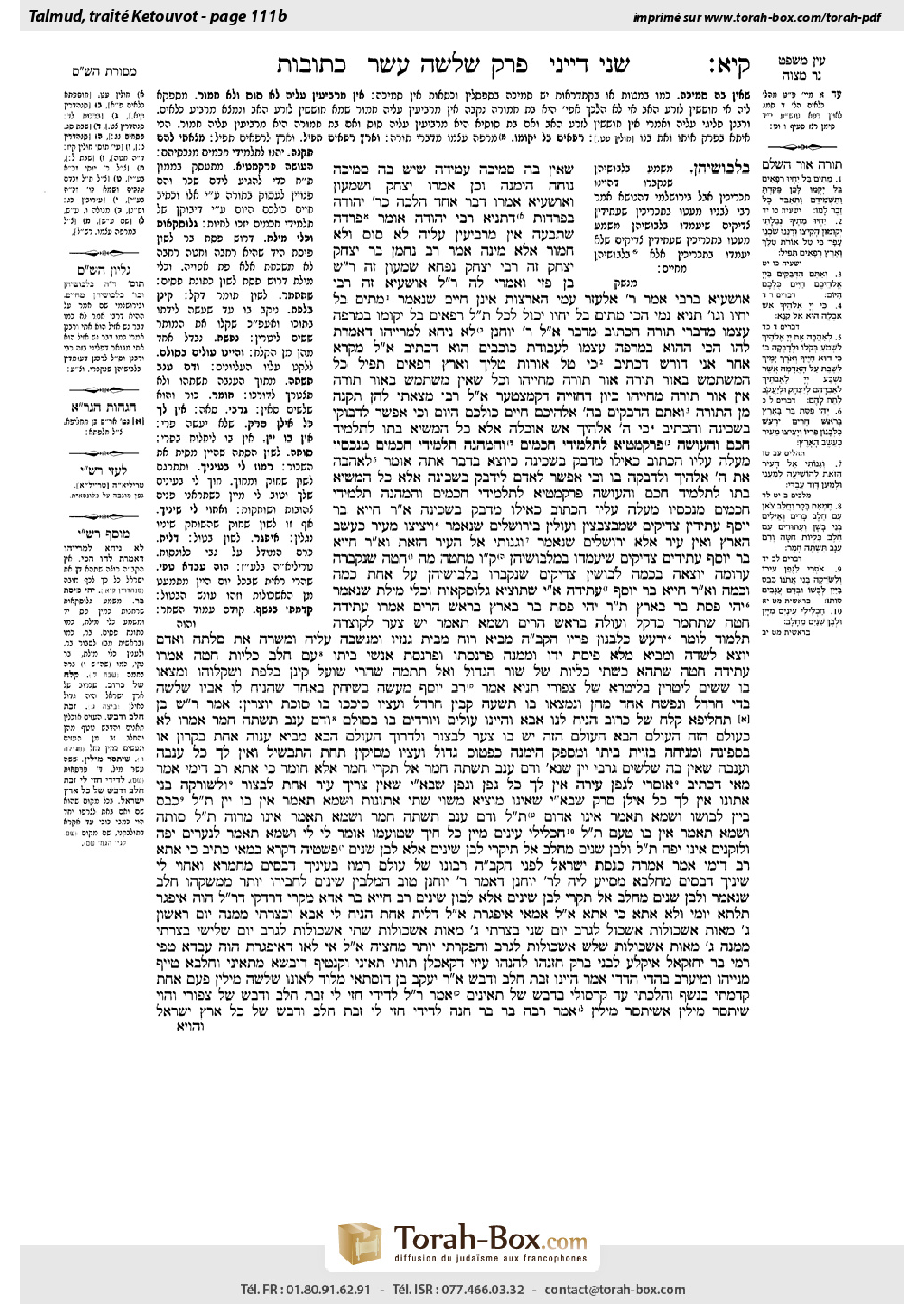
This page of Ketubot includes the Aramaic text, an English translation and an AI-generated French translation, alongside the scan above.
כתובות קי״א ב · Aramaic and Hebrew text
שֶׁאֵין בָּהּ סְמִיכָה — עֲמִידָה שֶׁיֵּשׁ בָּהּ סְמִיכָה נוֹחָה הֵימֶנָּה.
וְכֵן אָמְרוּ: יִצְחָק וְשִׁמְעוֹן וְאוֹשַׁעְיָא אָמְרוּ דָּבָר אֶחָד: הֲלָכָה כְּרַבִּי יְהוּדָה בִּפְרָדוֹת. דְּתַנְיָא רַבִּי יְהוּדָה אוֹמֵר: פִּרְדָּה שֶׁתָּבְעָה — אֵין מַרְבִּיעִין עָלֶיהָ לֹא סוּס וְלֹא חֲמוֹר, אֶלָּא מִינָהּ.
אָמַר רַב נַחְמָן בַּר יִצְחָק: יִצְחָק — זֶה רַבִּי יִצְחָק נַפָּחָא, שִׁמְעוֹן — זֶה רַבִּי שִׁמְעוֹן בֶּן פַּזִּי, וְאָמְרִי לַהּ: רֵישׁ לָקִישׁ, אוֹשַׁעְיָא — זֶה רַבִּי אוֹשַׁעְיָא בְּרַבִּי.
אָמַר רַבִּי אֶלְעָזָר: עַמֵּי הָאֲרָצוֹת אֵינָן חַיִּים, שֶׁנֶּאֱמַר: ״מֵתִים בַּל יִחְיוּ וְגוֹ׳״, תַּנְיָא נָמֵי הָכִי: ״מֵתִים בַּל יִחְיוּ״, יָכוֹל לַכֹּל — תַּלְמוּד לוֹמַר: ״רְפָאִים בַּל יָקוּמוּ״, בִּמְרַפֶּה עַצְמוֹ מִדִּבְרֵי תוֹרָה הַכָּתוּב מְדַבֵּר.
אֲמַר לֵיהּ רַבִּי יוֹחָנָן: לָא נִיחָא לְמָרַיְיהוּ דְּאָמְרַתְּ לְהוּ הָכִי, הָהוּא בִּמְרַפֶּה עַצְמוֹ לַעֲבוֹדָה זָרָה הוּא דִּכְתִיב. אֲמַר לֵיהּ: מִקְרָא אַחֵר אֲנִי דּוֹרֵשׁ, דִּכְתִיב: ״כִּי טַל אוֹרוֹת טַלֶּיךָ וָאָרֶץ רְפָאִים תַּפִּיל״, כׇּל הַמִּשְׁתַּמֵּשׁ בְּאוֹר תּוֹרָה — אוֹר תּוֹרָה מְחַיֵּיהוּ, וְכֹל שֶׁאֵין מִשְׁתַּמֵּשׁ בְּאוֹר תּוֹרָה — אֵין אוֹר תּוֹרָה מְחַיֵּיהוּ.
כֵּיוָן דְּחַזְיֵיהּ דְּקָמִצְטַעַר, אֲמַר לֵיהּ: רַבִּי, מָצָאתִי לָהֶן תַּקָּנָה מִן הַתּוֹרָה: ״וְאַתֶּם הַדְּבֵקִים בַּה׳ אֱלֹהֵיכֶם חַיִּים כּוּלְּכֶם הַיּוֹם״, וְכִי אֶפְשָׁר לִדַּבּוֹקֵי בַּשְּׁכִינָה? וְהָכְתִיב: ״כִּי ה׳ אֱלֹהֶיךָ אֵשׁ אוֹכְלָה״?
אֶלָּא: כׇּל הַמַּשִּׂיא בִּתּוֹ לְתַלְמִיד חָכָם, וְהָעוֹשֶׂה פְּרַקְמַטְיָא לְתַלְמִידֵי חֲכָמִים, וְהַמְהַנֶּה תַּלְמִידֵי חֲכָמִים מִנְּכָסָיו — מַעֲלֶה עָלָיו הַכָּתוּב כְּאִילּוּ מִדַּבֵּק בַּשְּׁכִינָה.
כַּיּוֹצֵא בַּדָּבָר אַתָּה אוֹמֵר: ״לְאַהֲבָה אֶת ה׳ אֱלֹהֶיךָ וּלְדׇבְקָה בוֹ״, וְכִי אֶפְשָׁר לָאָדָם לִידַּבֵּק בַּשְּׁכִינָה? אֶלָּא: כׇּל הַמַּשִּׂיא בִּתּוֹ לְתַלְמִיד חָכָם, וְהָעוֹשֶׂה פְּרַקְמַטְיָא לְתַלְמִידֵי חֲכָמִים, וְהַמְהַנֶּה תַּלְמִידֵי חֲכָמִים מִנְּכָסָיו — מַעֲלֶה עָלָיו הַכָּתוּב כְּאִילּוּ מִדַּבֵּק בַּשְּׁכִינָה.
אָמַר רַבִּי חִיָּיא בַּר יוֹסֵף: עֲתִידִין צַדִּיקִים שֶׁמְּבַצְבְּצִין וְעוֹלִין בִּירוּשָׁלַיִם, שֶׁנֶּאֱמַר: ״וְיָצִיצוּ מֵעִיר כְּעֵשֶׂב הָאָרֶץ״, וְאֵין ״עִיר״ אֶלָּא יְרוּשָׁלַיִם, שֶׁנֶּאֱמַר: ״וְגַנּוֹתִי אֶל הָעִיר הַזֹּאת״.
וְאָמַר רַבִּי חִיָּיא בַּר יוֹסֵף: עֲתִידִים צַדִּיקִים שֶׁיַּעַמְדוּ בְּמַלְבּוּשֵׁיהֶן, קַל וָחוֹמֶר מֵחִטָּה: מָה חִטָּה שֶׁנִּקְבְּרָה עֲרוּמָּה — יוֹצְאָה בְּכַמָּה לְבוּשִׁין, צַדִּיקִים שֶׁנִּקְבְּרוּ בִּלְבוּשֵׁיהֶן — עַל אַחַת כַּמָּה וְכַמָּה.
וְאָמַר רַבִּי חִיָּיא בַּר יוֹסֵף: עֲתִידָה אֶרֶץ יִשְׂרָאֵל שֶׁתּוֹצִיא גְּלוּסְקָאוֹת וּכְלֵי מֵילָת, שֶׁנֶּאֱמַר: ״יְהִי פִסַּת בַּר בָּאָרֶץ״.
תָּנוּ רַבָּנַן: ״יְהִי פִסַּת בַּר בָּאָרֶץ בְּרֹאשׁ הָרִים״, אָמְרוּ: עֲתִידָה חִטָּה שֶׁתִּתַּמֵּר כְּדֶקֶל, וְעוֹלָה בְּרֹאשׁ הָרִים. וְשֶׁמָּא תֹּאמַר: יֵשׁ צַעַר לְקוֹצְרָהּ! תַּלְמוּד לוֹמַר: ״יִרְעַשׁ כַּלְּבָנוֹן פִּרְיוֹ״ — הַקָּדוֹשׁ בָּרוּךְ הוּא מֵבִיא רוּחַ מִבֵּית גְּנָזָיו וּמְנַשְּׁבָהּ עָלֶיהָ וּמַשִּׁרָה אֶת סׇלְתָּהּ, וְאָדָם יוֹצֵא לַשָּׂדֶה וּמֵבִיא מְלֹא פִּיסַּת יָדוֹ, וּמִמֶּנָּה פַּרְנָסָתוֹ וּפַרְנָסַת אַנְשֵׁי בֵיתוֹ.
״עִם חֵלֶב כִּלְיוֹת חִטָּה״, אָמְרוּ: עֲתִידָה חִטָּה שֶׁתְּהֵא כִּשְׁתֵּי כְלָיוֹת שֶׁל שׁוֹר הַגָּדוֹל. וְאַל תִּתְמַהּ, שֶׁהֲרֵי שׁוּעָל קִינֵּן בְּלֶפֶת, וּשְׁקָלוּהוּ, וּמָצְאוּ בּוֹ שִׁשִּׁים לִיטְרִין, בְּלִיטְרָא שֶׁל צִפּוֹרִי.
תַּנְיָא, אָמַר רַב יוֹסֵי: מַעֲשֶׂה בְּשִׁיחִין בְּאֶחָד שֶׁהִנִּיחַ לוֹ אָבִיו שְׁלֹשָׁה בַּדֵּי חַרְדָּל וְנִפְשַׁח אֶחָד מֵהֶן וְנִמְצְאוּ בּוֹ תִּשְׁעָה קַבִּין חַרְדָּל. וְעֵצָיו, סִיכְּכוּ בּוֹ סוּכַּת יוֹצְרִין. אָמַר רַבִּי שִׁמְעוֹן בֶּן תַּחְלִיפָא: קֶלַח שֶׁל כְּרוּב הִנִּיחַ לָנוּ אַבָּא, וְהָיִינוּ עוֹלִים וְיוֹרְדִים בּוֹ בְּסוּלָּם.
״וְדַם עֵנָב תִּשְׁתֶּה חָמֶר״, אָמְרוּ: לֹא כָּעוֹלָם הַזֶּה הָעוֹלָם הַבָּא. הָעוֹלָם הַזֶּה יֵשׁ בּוֹ צַעַר לִבְצוֹר וְלִדְרוֹךְ, הָעוֹלָם הַבָּא מֵבִיא עֲנָוָה אַחַת בַּקָּרוֹן אוֹ בִּסְפִינָה, וּמַנִּיחָהּ בְּזָוִית בֵּיתוֹ, וּמְסַפֵּק הֵימֶנָּה כְּפִטוֹס גָּדוֹל. וְעֵצָיו, מַסִּיקִין תַּחַת הַתַּבְשִׁיל. וְאֵין לְךָ כׇּל עֲנָבָה וַעֲנָבָה שֶׁאֵין בָּהּ שְׁלֹשִׁים גַּרְבֵי יַיִן, שֶׁנֶּאֱמַר: ״וְדַם עֵנָב תִּשְׁתֶּה חָמֶר״, אַל תִּקְרֵי ״חָמֶר״ אֶלָּא ״חוֹמֶר״.
כִּי אֲתָא רַב דִּימִי, אָמַר: מַאי דִּכְתִיב ״אוֹסְרִי לַגֶּפֶן עִירֹה״ — אֵין לְךָ כׇּל גֶּפֶן וָגֶפֶן שֶׁבְּאֶרֶץ יִשְׂרָאֵל שֶׁאֵין צָרִיךְ עַיִר אַחַת לִבְצוֹר. ״וְלַשּׂוֹרֵקָה בְּנִי אֲתוֹנוֹ״ — אֵין לָךְ כׇּל אִילַן סְרָק שֶׁבְּאֶרֶץ יִשְׂרָאֵל שֶׁאֵינוֹ מוֹצִיא מַשּׂוֹי שְׁתֵּי אֲתוֹנוֹת. וְשֶׁמָּא תֹּאמַר אֵין בּוֹ יַיִן, תַּלְמוּד לוֹמַר: ״כִּבֵּס בְּיַיִן לְבוּשׁוֹ״. וְשֶׁמָּא תֹּאמַר אֵינוֹ אָדוֹם, תַּלְמוּד לוֹמַר: ״וְדַם עֵנָב תִּשְׁתֶּה חָמֶר״.
וְשֶׁמָּא תֹּאמַר אֵינוֹ מַרְוֶה — תַּלְמוּד לוֹמַר: ״סוּתֹה״. וְשֶׁמָּא תֹּאמַר אֵין בּוֹ טַעַם — תַּלְמוּד לוֹמַר: ״חַכְלִילִי עֵינַיִם מִיָּיִן״. כׇּל חֵיךְ שֶׁטּוֹעֲמוֹ, אוֹמֵר: ״לִי לִי״. וְשֶׁמָּא תֹּאמַר לִנְעָרִים יָפֶה וְלִזְקֵנִים אֵינוֹ יָפֶה — תַּלְמוּד לוֹמַר: ״וּלְבֶן שִׁנַּיִם מֵחָלָב״, אַל תִּיקְרֵי ״לְבֶן שִׁינַּיִם״ אֶלָּא ״לְבֶן שָׁנִים״.
פְּשָׁטֵיהּ דִּקְרָא בְּמַאי כְּתִיב? כִּי אֲתָא רַב דִּימִי, אָמַר: אָמְרָה כְּנֶסֶת יִשְׂרָאֵל לִפְנֵי הַקָּדוֹשׁ בָּרוּךְ הוּא: רִבּוֹנוֹ שֶׁל עוֹלָם, רְמוֹז [לִי] בְּעֵינָיךְ דִּבְסִים מֵחַמְרָא, וְאַחְוִי לִי שִׁינָּיךְ דִּבְסִים מֵחֲלָבָא.
מְסַיַּיע לֵיהּ לְרַבִּי יוֹחָנָן, דְּאָמַר רַבִּי יוֹחָנָן: טוֹב הַמַּלְבִּין שִׁינַּיִם לַחֲבֵירוֹ יוֹתֵר מִמַּשְׁקֵהוּ חָלָב, שֶׁנֶּאֱמַר: ״וּלְבֶן שִׁנַּיִם מֵחָלָב״, אַל תִּקְרֵי ״לְבֶן שִׁינַּיִם״ אֶלָּא ״לִבּוּן שִׁינַּיִם״.
רַב חִיָּיא בַּר אַדָּא מַקְרֵי דַרְדְּקֵי דְּרֵישׁ לָקִישׁ הֲוָה. אִיפַּגַּר תְּלָתָא יוֹמֵי וְלָא אֲתָא. כִּי אֲתָא, אֲמַר לֵיהּ: אַמַּאי אִיפַּגַּרְתְּ?
אֲמַר לֵיהּ: דָּלִית אַחַת הִנִּיחַ לִי אַבָּא וּבָצַרְתִּי מִמֶּנָּה יוֹם רִאשׁוֹן שְׁלֹשׁ מֵאוֹת אֶשְׁכּוֹלוֹת אֶשְׁכּוֹל לְגָרָב, יוֹם שֵׁנִי בָּצַרְתִּי שְׁלֹשׁ מֵאוֹת אֶשְׁכּוֹלוֹת שְׁתֵּי אֶשְׁכּוֹלוֹת לְגָרָב, יוֹם שְׁלִישִׁי בָּצַרְתִּי מִמֶּנָּה שְׁלֹשׁ מֵאוֹת אֶשְׁכּוֹלוֹת שָׁלֹשׁ אֶשְׁכּוֹלוֹת לְגָרָב, וְהִפְקַרְתִּי יוֹתֵר מֵחֶצְיָהּ. אֲמַר לֵיהּ: אִי לָאו דְּאִיפַּגַּרְתְּ הֲוָה עָבְדָא טְפֵי.
רָמֵי בַּר יְחֶזְקֵאל אִיקְּלַע לִבְנֵי בְרַק, חֲזַנְהוּ לְהָנְהוּ עִיזֵּי דְּקָאָכְלָן תּוּתֵי תְּאֵינֵי וְקָנָטֵיף דּוּבְשָׁא מִתְּאֵינֵי וַחֲלָבָא טָיֵיף מִנַּיְיהוּ וּמִיעָרַב בַּהֲדֵי הֲדָדֵי. אֲמַר: הַיְינוּ: ״זָבַת חָלָב וּדְבָשׁ״.
אָמַר רַבִּי יַעֲקֹב בֶּן דּוֹסְתַּאי: מִלּוֹד לְאוֹנוֹ שְׁלֹשָׁה מִילִין, פַּעַם אַחַת קִדַּמְתִּי בַּנֶּשֶׁף וְהָלַכְתִּי עַד קַרְסוּלַּיי בִּדְבַשׁ שֶׁל תְּאֵינִים. אָמַר רֵישׁ לָקִישׁ: לְדִידִי חֲזֵי לִי ״זָבַת חָלָב וּדְבָשׁ״ שֶׁל צִפּוֹרִי, וְהָוֵי שִׁיתְּסַר מִילִין אַשִּׁיתְּסַר מִילִין. אָמַר רַבָּה בַּר בַּר חָנָה: לְדִידִי חֲזֵי לִי ״זָבַת חָלָב וּדְבָשׁ״ שֶׁל כׇּל אֶרֶץ יִשְׂרָאֵל,
Ketubot 111b · English translation
without support, standing with a support, i.e. an object against which one can lean, is better than it.
And so too, the brothers said to Rabba: Yitzḥak, Shimon, and Oshaya all said the same statement: The halakha is in accordance with the opinion of Rabbi Yehuda with regard to female mules. As it is taught in a baraita that Rabbi Yehuda says: With regard to a female mule in heat, one may not mate a horse or a donkey with her, due to the prohibition against crossbreeding of livestock. Rather, one mates her with one of her kind, another mule.
Rav Naḥman bar Yitzḥak said, in explanation of this last statement of Rabba’s brothers: Yitzḥak is to be identified with Rabbi Yitzḥak Nappaḥa; Shimon is Rabbi Shimon ben Pazi. And some say that he is Reish Lakish, i.e., Rabbi Shimon ben Lakish. Oshaya is Rabbi Oshaya the Distinguished.
§ Rabbi Elazar said: The common, uneducated people will not come alive in the future, as it is stated: “The dead live not” (Isaiah 26:14). In other words, those who were already considered dead in their lifetimes will not come back to life afterward either. This idea is also taught in a baraita: “The dead live not”; one might have thought that this is referring to everyone, i.e., none of the dead will live again. Therefore, the verse states: “The shades [refa’im] rise not” (Isaiah 26:14). This teaches that the verse is speaking of one who weakens [merapeh] himself from matters of Torah.
Rabbi Yoḥanan said to Rabbi Elazar: Their master, i.e. God, is not pleased that you say this of ordinary Jews. Rather, that verse is written about one who weakens himself and succumbs to idol worship. Those who commit this great sin do not merit to be resurrected in the future. Rabbi Elazar said to him: I teach it from a different verse, as it is written: “For Your dew is as the dew of light, and the earth shall bring to life the shades” (Isaiah 26:19). Rabbi Elazar explains: Anyone who uses the light of Torah, which is called the dew of light, the light of Torah will revive him; and anyone who does not use the light of Torah, the light of Torah will not revive him.
Since Rabbi Elazar saw that Rabbi Yoḥanan was grieved over the distress of common, uneducated people, he said to him: My teacher, I have found for them a remedy from the Torah so that they will merit life in the World-to-Come, as it states: “But You who cleave to the Lord your God, are alive every one of you this day” (Deuteronomy 4:4). But is it possible to cleave to the Divine Presence? Isn’t it written: For the Lord your God is a devouring fire” (Deuteronomy 4:24)?
Rather, this verse teaches that anyone who marries his daughter to a Torah scholar, and one who conducts business [perakmatya] on behalf of Torah scholars, by investing their money, and one who utilizes his wealth to benefit Torah scholars with his property in some other way, the verse ascribes him credit as though he is cleaving to the Divine Presence.
On a similar note, you say: The verse states: “To love the Lord your God, to hearken to His voice, and to cleave to Him” (Deuteronomy 30:20). But is it possible for a person to cleave to the Divine Presence? Rather, anyone who marries his daughter to a Torah scholar, and one who conducts business on behalf of Torah scholars, and one who utilizes his wealth to benefit Torah scholars with his property, the verse ascribes him credit as though he is cleaving to the Divine Presence.
§ Rabbi Ḥiyya bar Yosef said: In the future, at the time of the resurrection of the dead, the righteous will burst forth and arise in Jerusalem, as it is stated: “And may they blossom out of the city like the grass of the earth” (Psalms 72:16), and the term “city” means nothing other than Jerusalem, as it is stated: “For I will defend this city” (II Kings 19:34).
And Rabbi Ḥiyya bar Yosef said: In the future the righteous will stand up from their graves in their clothes. This is derived by an a fortiori inference from the example of wheat: Just as wheat, which is buried naked, i.e., the seed alone is planted, and yet it emerges from the ground with several layers of garb, including straw and chaff, in the case of the righteous, who are buried fully clothed, all the more so do they come out of the ground properly dressed.
And Rabbi Ḥiyya bar Yosef further said: In the future Eretz Yisrael will produce cakes [geluskaot] and fine wool clothing [meilat] that will grow from the ground, as it is stated: “Let abundant [pissat] grain [bar] be in the land” (Psalms 72:16). The term pissat is interpreted in a similar manner to ketonet passim, Joseph’s valuable clothing of many colors, while bar can mean bread.
§ The Sages taught the following with regard to the verse “Let abundant [pissat] grain be in the land upon the top of the mountains” (Psalms 72:16). They said: In the future, wheat will rise up, and grow tall like a palm tree, and ascend to the top of the mountains. And lest you say that if wheat will grow this tall its reaper will suffer discomfort, the same verse states: “May his fruit rustle like Lebanon.” The Holy One, Blessed be He, will bring a wind from His treasury and blow across, and this will thereby induce the flour to fall from the stalks of wheat, and a person will go out to the field and bring back a palmful [pissat] of flour, from which he will provide his livelihood and the livelihood of the members of his household.
It is stated: “With the kidney-fat of wheat” (Deuteronomy 32:14). The Sages said: In the future, each and every kernel of wheat will be as big as the two kidneys of the large ox. And do not be surprised that this is possible, as there was an incident involving a fox that nested inside a turnip, and they weighed this turnip, and they discovered that even discounting the space dug out by the fox, it still weighed sixty litra, as measured by the litra of Tzippori.
Similarly, it is taught in a baraita that Rav Yosef said: There was an incident which occurred in the village of Shiḥin, in Eretz Yisrael, involving one whose father had left him three branches of mustard, one of which broke. And they discovered on this one branch alone nine kav of mustard. And with the wood of its large branches they roofed a booth for artisans. Similarly, Rabbi Shimon ben Taḥlifa said: Father left us a cabbage stalk and we would go up and down on it with a ladder, due to its great height.
§ It is stated: “And from the blood of the grape you drank foaming wine” (Deuteronomy 32:14). The Sages said: The World-to-Come is not like this world. In this world there is suffering involved in picking grapes and in pressing them. By contrast, in the World-to-Come one will bring one grape in a wagon or on a boat and set it down in a corner of his house and supply from it enough to fill about the amount of a large jug [pitus], and with its wood one will kindle a fire under a cooked dish. And every grape you have will produce no less than thirty full jugs of wine, each with the capacity of a se’a. As it is stated: “And from the blood of the grape you drank foaming wine [ḥamer].” Do not read this term as ḥamer; rather, read it as ḥomer, which is a measure equaling thirty se’a.
§ When Rav Dimi came from Eretz Yisrael to Babylonia, he said: What is the meaning of that which is written: “Binding his foal to the vine” (Genesis 49:11), which is interpreted as a prophecy for the future? It means that every grapevine you have in Eretz Yisrael requires a foal to carry the load of its harvest. The verse continues: “And his donkey’s colt to the choice vine [soreka].” The Gemara explains: Every barren [serak] tree you have in Eretz Yisrael will produce sufficient fruit in the future to load upon two donkeys. And lest you say that these trees do not contain wine, the same verse states: “He washes his garments in wine.” And lest you say that the wine is not red, the verse states: “And from the blood of the grape you drank foaming wine” (Deuteronomy 32:14).
And lest you say that this wine does not inebriate those who drink it, the verse states: “And his vesture [suto] in the blood of grapes” (Genesis 49:11). This verse indicates that these wines will induce [mesit] a state of drunkenness. And lest you say that this wine has no flavor, the verse states: “His eyes shall be red [ḥakhlili] with wine” (Genesis 49:12). This unusual term is read homiletically as follows: Each palate [ḥeikh] that tastes it says: This is for me, for me [li li]. And lest you say that the wine is good for the young but it is not good for the old, the verse states: “And his teeth white [leven shinayim] with milk” (Genesis 49:12). Do not read this expression as leven shinayim; rather, read it as leven shanim, one of years, i.e., an elderly person.
The Gemara asks: To what does the plain meaning of the aforementioned verse refer? When Rav Dimi came from Eretz Yisrael to Babylonia, he said: The congregation of Israel said before the Holy One, Blessed be He: Master of the Universe: Hint with Your eyes a love that is sweeter than wine, and show me Your teeth through a smile that is sweeter than milk.
The Gemara comments: This interpretation supports the opinion of Rabbi Yoḥanan. As Rabbi Yoḥanan said: One who whitens his teeth to his friend by smiling at him is better than one who gives him milk to drink, as it is stated: “And his teeth white [leven shinayim] with milk” (Genesis 49:12). Do not read this expression as leven shinayim; rather, read it as libbun shinayim, the whitening of teeth. Likewise, the phrase: With milk, can be read as: Than milk.
§ The Gemara relates further stories concerning the great bounty of Eretz Yisrael. Rav Ḥiyya bar Adda was a school teacher of Reish Lakish. On one occasion, Rav Ḥiyya bar Adda was delayed for three days and did not come to teach the children. When he finally came, Reish Lakish said to him: Why were you delayed?
Rav Ḥiyya bar Adda said to him: Father left me one branch of a grape vine, and I harvested from it on the first day three hundred grape clusters, and each cluster yielded a quantity of wine enough to fill a jug. On the second day I harvested another three hundred grape clusters, and every two clusters yielded enough wine to fill a jug. On the third day I once again harvested three hundred grape clusters, and every three clusters yielded enough to fill a jug, and I declared ownerless more than half of it. Reish Lakish said to him: Had you not delayed and thereby disrupted the Torah study of children, each grape cluster would have produced more wine. Due to your cancellation of Torah study, each cluster yielded progressively less.
§ Rami bar Yeḥezkel happened to come to Benei Berak. He saw those goats that were grazing beneath a fig tree, and there was honey oozing from the figs and milk dripping from the goats, and the two liquids were mixing together. He said: This is the meaning of the verse “A land flowing with milk and honey” (Exodus 3:8).
Rabbi Ya’akov ben Dostai said: There are three mil from Lud to Ono. Once I rose early in the morning and I walked in ankle-deep honey oozing from fig trees. Reish Lakish said: I myself saw a region called: The place flowing with milk and honey by Tzippori, and it was an area that covered sixteen by sixteen mil, 256 square mil. Rabba bar bar Ḥana said: I myself saw the region flowing with milk and honey of all Eretz Yisrael,
Ketubot 111b · Traduction française (IA)
Sans soutien, il vaut mieux se tenir avec un appui, c’est-à-dire un objet sur lequel on peut s’appuyer.
De même, les frères dirent à Rabba : Yitzḥak, Shimon et Oshaya ont tous énoncé la même chose : la halakha suit l’opinion de Rabbi Yehuda au sujet des mules femelles. En effet, il est enseigné dans une baraïta que Rabbi Yehuda dit : lorsqu’une mule est en chaleur, on ne peut l’accoupler ni avec un cheval ni avec un âne, en raison de l’interdiction de croiser des espèces animales. On l’accouple plutôt avec un animal de son espèce, c’est-à-dire une autre mule.
Rav Naḥman bar Yitzḥak expliqua cette dernière déclaration des frères de Rabba : Yitzḥak désigne Rabbi Yitzḥak Nappaḥa ; Shimon désigne Rabbi Shimon ben Pazi. Certains disent qu’il s’agit de Reish Lakish, c’est-à-dire Rabbi Shimon ben Lakish. Oshaya désigne Rabbi Oshaya le Distingué.
§ Rabbi Elazar dit : les gens du commun, sans instruction, ne revivront pas à l’avenir, ainsi qu’il est dit : « Les morts ne revivent pas » (Isaïe 26:14). Autrement dit, ceux qui étaient déjà considérés comme morts de leur vivant ne reviendront pas non plus à la vie par la suite. Cette idée est également enseignée dans une baraïta : « Les morts ne revivent pas » ; on aurait pu penser que cela concerne tout le monde, c’est-à-dire qu’aucun mort ne revivra. C’est pourquoi le verset précise : « Les ombres [refa’im] ne se relèvent pas » (Isaïe 26:14). Cela enseigne que le verset parle de celui qui se relâche [merapeh] dans les matières de Torah.
Rabbi Yoḥanan dit à Rabbi Elazar : leur Maître, c’est-à-dire Dieu, n’apprécie pas que tu dises cela des Juifs ordinaires. Ce verset parle plutôt de celui qui se relâche et succombe au culte des idoles. Ceux qui commettent cette faute grave ne méritent pas de ressusciter à l’avenir. Rabbi Elazar lui dit : je l’apprends d’un autre verset, comme il est écrit : « Car ta rosée est une rosée de lumière, et la terre fera revivre les ombres » (Isaïe 26:19). Rabbi Elazar explique : quiconque se sert de la lumière de la Torah, appelée « rosée de lumière », sera ravivé par la lumière de la Torah ; et quiconque ne se sert pas de la lumière de la Torah ne sera pas ravivé par elle.
Voyant que Rabbi Yoḥanan était affligé par la détresse des gens du commun, sans instruction, Rabbi Elazar lui dit : mon maître, j’ai trouvé dans la Torah un remède pour eux, afin qu’ils méritent la vie dans le Monde à venir, comme il est dit : « Mais vous, qui êtes attachés au Seigneur votre Dieu, vous êtes tous vivants aujourd’hui » (Deutéronome 4:4). Mais est-il possible de s’attacher à la Présence divine ? N’est-il pas écrit : « Car le Seigneur ton Dieu est un feu dévorant » (Deutéronome 4:24) ?
Ce verset enseigne plutôt que quiconque marie sa fille à un érudit de Torah, fait des affaires [perakmatya] pour le compte d’érudits de Torah en investissant leur argent, ou utilise sa fortune et ses biens d’une autre manière pour leur venir en aide, le verset lui en attribue le mérite comme s’il s’attachait à la Présence divine.
Dans le même ordre d’idées, le verset dit : « Aimer le Seigneur ton Dieu, écouter sa voix et t’attacher à lui » (Deutéronome 30:20). Mais est-il possible à une personne de s’attacher à la Présence divine ? Quiconque marie sa fille à un érudit de Torah, fait des affaires pour le compte d’érudits de Torah, ou utilise sa fortune et ses biens pour leur venir en aide, le verset lui en attribue le mérite comme s’il s’attachait à la Présence divine.
§ Rabbi Ḥiyya bar Yosef dit : à l’avenir, au moment de la résurrection des morts, les justes jailliront et se lèveront à Jérusalem, comme il est dit : « Qu’ils fleurissent hors de la ville comme l’herbe de la terre » (Psaumes 72:16). Or, le terme « ville » ne désigne rien d’autre que Jérusalem, comme il est dit : « Je défendrai cette ville » (II Rois 19:34).
Rabbi Ḥiyya bar Yosef dit également : à l’avenir, les justes se lèveront de leurs tombes vêtus. On le déduit a fortiori de l’exemple du blé : de même que le blé, enterré nu, c’est-à-dire que seule la graine est plantée, ressort de terre revêtu de plusieurs enveloppes, notamment la paille et la balle, à plus forte raison les justes, qui sont enterrés entièrement vêtus, sortiront-ils de terre convenablement habillés.
Rabbi Ḥiyya bar Yosef dit encore : à l’avenir, la terre d’Israël produira des gâteaux [geluskaot] et des vêtements de fine laine [meilat] qui pousseront du sol, comme il est dit : « Qu’il y ait abondance [pissat] de blé [bar] dans le pays » (Psaumes 72:16). Le terme pissat est interprété de façon analogue à ketonet passim, le vêtement précieux et multicolore de Joseph, tandis que bar peut signifier « pain ».
Les Sages ont enseigné ce qui suit au sujet du verset : « Qu’il y ait abondance [pissat] de blé dans le pays, au sommet des montagnes » (Psaumes 72:16). Ils dirent : à l’avenir, le blé s’élèvera, poussera haut comme un palmier et atteindra le sommet des montagnes. Et de peur que tu ne dises que, si le blé poussait aussi haut, sa récolte serait pénible, le même verset dit : « Que son fruit bruisse comme le Liban. » Le Saint, béni soit-Il, fera venir un vent de son trésor et le fera souffler ; ainsi, la farine tombera des tiges de blé. Une personne ira alors dans les champs et en rapportera une poignée [pissat] de farine, de quoi assurer sa subsistance et celle des membres de sa maisonnée.
Il est dit : « De la graisse des reins du blé » (Deutéronome 32:14). Les Sages dirent : à l’avenir, chaque grain de blé sera aussi gros que les deux reins d’un grand bœuf. Et ne sois pas surpris que cela soit possible : un renard avait fait son terrier à l’intérieur d’un navet. On pesa ce navet et l’on constata que, même en déduisant l’espace creusé par le renard, il pesait encore soixante litra, selon la litra de Tzippori.
De même, une baraïta enseigne que Rav Yosef dit : un incident s’est produit dans le village de Shiḥin, en terre d’Israël. Le père d’un homme lui avait laissé trois plants de moutarde, dont l’un se brisa. On découvrit que cette seule branche portait neuf kav de graines de moutarde. Avec le bois de ses grosses branches, on couvrit une cabane destinée aux artisans. De même, Rabbi Shimon ben Taḥlifa dit : notre père nous a laissé une tige de chou, et nous montions et descendions dessus à l’aide d’une échelle, tant elle était haute.
§ Il est dit : « Et du sang du raisin, tu as bu du vin mousseux » (Deutéronome 32:14). Les Sages dirent : le Monde à venir ne ressemble pas à ce monde. Dans ce monde, il faut peiner pour cueillir et presser les raisins. En revanche, dans le Monde à venir, on apportera un raisin dans une charrette ou sur un bateau, on le déposera dans un coin de sa maison et l’on en tirera de quoi remplir environ un grand récipient [pitus] ; avec son bois, on allumera un feu sous un plat en train de cuire. Chaque raisin que tu posséderas produira au moins trente cruches pleines de vin, chacune d’une capacité d’un séa. Comme il est dit : « Et du sang du raisin, tu as bu du vin mousseux [ḥamer]. » Ne lis pas ḥamer, mais ḥomer, une mesure équivalant à trente séa.
§ Lorsque Rav Dimi vint de la terre d’Israël en Babylonie, il dit : que signifie ce qui est écrit : « Attachant son ânon à la vigne » (Genèse 49:11), verset interprété comme une prophétie pour l’avenir ? Cela signifie que chaque vigne que tu possèdes en terre d’Israël nécessitera un ânon pour porter le chargement de sa récolte. Le verset poursuit : « Et le petit de son ânesse à la vigne de choix [soreka]. » La Guemara explique : chaque arbre stérile [serak] que tu possèdes en terre d’Israël produira à l’avenir assez de fruits pour charger deux ânes. Et de peur que tu ne dises que ces arbres ne contiennent pas de vin, le même verset dit : « Il lave ses vêtements dans le vin. » Et de peur que tu ne dises que ce vin ne sera pas rouge, le verset dit : « Et du sang du raisin, tu as bu du vin mousseux » (Deutéronome 32:14).
Et de peur que tu ne dises que ce vin n’enivrera pas ceux qui le boiront, le verset dit : « Et son vêtement [suto] dans le sang des raisins » (Genèse 49:11). Ce verset indique que ces vins provoqueront [mesit] l’ivresse. Et de peur que tu ne dises que ce vin n’aura pas de goût, le verset dit : « Ses yeux seront rouges [ḥakhlili] de vin » (Genèse 49:12). Ce terme inhabituel est interprété de manière homilétique ainsi : tout palais [ḥeikh] qui le goûtera dira : « C’est pour moi, pour moi [li li]. » Et de peur que tu ne dises que le vin sera bon pour les jeunes mais pas pour les vieux, le verset dit : « Et ses dents blanches [leven shinayim] de lait » (Genèse 49:12). Ne lis pas cette expression leven shinayim, mais leven shanim, c’est-à-dire « des années blanches », un homme âgé.
La Guemara demande : à quoi se rapporte le sens littéral du verset mentionné plus haut ? Lorsque Rav Dimi vint de la terre d’Israël en Babylonie, il dit : l’assemblée d’Israël dit devant le Saint, béni soit-Il : « Maître de l’univers, fais-moi signe des yeux en me témoignant un amour plus doux que le vin, et montre-moi tes dents dans un sourire plus doux que le lait. »
La Guemara fait remarquer que cette interprétation appuie l’opinion de Rabbi Yoḥanan. En effet, Rabbi Yoḥanan dit : sourire à son prochain en lui découvrant les dents vaut mieux que de lui donner du lait à boire, comme il est dit : « Et ses dents blanches [leven shinayim] de lait » (Genèse 49:12). Ne lis pas cette expression leven shinayim, mais libbun shinayim, « le blanchissement des dents ». De même, l’expression « de lait » peut se lire « plutôt que du lait ».
§ La Guemara rapporte encore des récits concernant l’abondance exceptionnelle de la terre d’Israël. Rav Ḥiyya bar Adda était l’instituteur des enfants de Reish Lakish. Un jour, Rav Ḥiyya bar Adda fut retenu pendant trois jours et ne vint pas enseigner aux enfants. Lorsqu’il finit par venir, Reish Lakish lui dit : pourquoi as-tu été retenu ?
Rav Ḥiyya bar Adda lui dit : mon père m’a laissé un seul sarment de vigne, dont j’ai récolté trois cents grappes de raisin le premier jour ; chaque grappe donnait assez de vin pour remplir une cruche. Le deuxième jour, j’ai récolté trois cents autres grappes, et deux grappes donnaient ensemble assez de vin pour remplir une cruche. Le troisième jour, j’ai de nouveau récolté trois cents grappes, et trois grappes donnaient ensemble assez de vin pour remplir une cruche ; j’en ai déclaré plus de la moitié sans propriétaire. Reish Lakish lui dit : si tu n’avais pas été retenu et ainsi interrompu l’étude de Torah des enfants, chaque grappe aurait produit davantage de vin. À cause de l’annulation de l’étude de Torah, chaque grappe en a donné de moins en moins.
§ Rami bar Yeḥezkel arriva par hasard à Benei Berak. Il vit des chèvres qui paissaient sous un figuier ; du miel coulait des figues et du lait dégouttait des chèvres, les deux liquides se mélangeant. Il dit : voilà le sens du verset « Un pays ruisselant de lait et de miel » (Exode 3:8).
Rabbi Ya’akov ben Dostai dit : il y a trois mil entre Lud et Ono. Un jour, je me suis levé tôt le matin et j’ai marché dans du miel qui m’arrivait aux chevilles, coulant des figuiers. Reish Lakish dit : j’ai moi-même vu une région appelée « l’endroit ruisselant de lait et de miel », près de Tzippori ; elle couvrait seize mil sur seize, soit 256 milles carrés. Rabba bar bar Ḥana dit : j’ai moi-même vu la région de toute la terre d’Israël ruisselant de lait et de miel,
Traduction française générée par IA à partir de l’édition anglaise de Sefaria. Vérifie toujours un passage avec le texte source.
Text from Sefaria: William Davidson Edition - Vocalized Aramaic (CC BY NC); William Davidson Edition - English (CC BY NC).